Driving is a cognitively demanding task, and declines in cognitive functioning associated with aging – particularly age-related disorders – may pose significant risks to older adults’ ability to operate a motor vehicle safely (Mathias & Lucas, Reference Mathias and Lucas2009). Previous cross-sectional studies have found evidence of an association between cognitive functioning and driving ability, although the associations varied depending on the measures used to assess cognitive functioning, with specific performance-based tasks more likely to be related to driving practices (Ball et al., Reference Ball, Roenker, Wadley, Edwards, Roth and McGwin2006; Bédard, Weaver, Darzins, & Porter, Reference Bédard, Weaver, Darzins and Porter2008; Classen et al., Reference Classen, Horgas, Awadzi, Messinger-Rapport, Shechtman and Joo2008; Rapoport et al., Reference Rapoport, Naglie, Weegar, Myers, Cameron and Crizzle2013) than global cognitive assessments (Crizzle, Myers, & Almeida, Reference Crizzle, Myers and Almeida2013; Rapoport et al., Reference Rapoport, Naglie, Weegar, Myers, Cameron and Crizzle2013). However, cognitive impairment in later life does not necessarily influence older adults’ decisions to restrict or quit driving (Molnar & Eby, Reference Molnar and Eby2008; Kowalski et al., Reference Kowalski, Love, Tuokko, MacDonald, Hultsch and Strauss2012), and longitudinal research is needed to discern whether changes in cognitive functioning influence self-regulatory driving practices, as well as perceptions and attitudes related to driving.
Our previous cross-sectional research found statistically significant, but only modest, associations between Trails A and B task completion times and driver perceptions (day and night driving comfort and perceived driving abilities) and driving restrictions (situational avoidance) in a large sample of older drivers (Rapoport et al., Reference Rapoport, Naglie, Weegar, Myers, Cameron and Crizzle2013). The current study extends that work by examining whether changes in cognitive performance are associated with intra-individual changes in driving attitudes and behaviour over a 2-year period among a cohort assessed at baseline and annually thereafter. We hypothesized that changes over time in cognitive performance are associated with changes in driver perceptions, attitudes, and self-regulatory behaviors among older adults.
Methods
Participants
Participants (n = 928) were drawn from a Canadian nation-wide driving study (Candrive II; see Marshall et al., Reference Marshall, Man-Son-Hing, Bédard, Charlton, Gagnon and Gélinas2013, for details) and were recruited from seven cities across four provinces (Ontario, Quebec, Manitoba, and British Columbia). Eligible participants were active drivers with a valid license, aged 70 or older at inception, without medical contraindications that could impair their driving abilities according to the Canadian Medical Association (2012).
Demographic information was collected at baseline. Participants ranged in age from 70 to 94 (M = 76.21, SD = 4.85), and 62 per cent (n = 577) were males. Most participants (45%) had completed some post-secondary education after high school; 19 per cent had obtained a diploma or a trade/technical certificate beyond high school; 26 per cent completed high school; and 10 per cent did not continue beyond grade school.
Attrition was minimal across the three waves of data collection. Selective attrition was assessed by testing for differences in demographic characteristics at baseline (T1) for participants who remained in the study compared to those who did not at one year, (T2: n = 46, 5%; 65% males) and two years later, (T3: n = 108, 12%; 65% males). Although there were no attrition-related differences in gender or education, by T3, participants who dropped out were, on average, almost 2 years older at baseline (M = 77.79, SD = 5.41) than participants who remained in the study (M = 76.01, SD = 4.74), t(926) = –3.39, p = 0.001).
Procedure
Each participating research institution received ethical approval by their respective human research ethics board, and all participants provided written informed consent. Participants underwent annual comprehensive evaluations of their health status, completed a battery of functional tests (sensory, physical, and cognitive) as well as measures of driver perceptions, self-regulatory behaviors, and intentions to continue driving (Marshall et al., Reference Marshall, Man-Son-Hing, Bédard, Charlton, Gagnon and Gélinas2013).
Measures
Cognitive Performance
The Montreal Cognitive Assessment (MoCA) (Nasreddine et al., Reference Nasreddine, Phillips, Bédirian, Charbonneau, Whitehead and Collin2005) was used as a screening tool for mild cognitive impairment (MCI) and early Alzheimer’s disease. Scores can range from 0 to 30, with lower scores indicating more cognitive impairment, and for this article, the scores were corrected for education.
The Mini-Mental State Examination (MMSE) (Folstein, Folstein, & McHugh, Reference Folstein, Folstein and McHugh1975) was used to assess participants’ overall cognitive function. Possible scores range from 0 to 30, where 0 indicates severe cognitive impairment and 30 indicates no impairment.
The Trail Making Test (Reitan, Reference Reitan1958) was used to test psychomotor speed, mental flexibility, and executive function (Moses, Reference Moses2004). The test consists of two parts (A and B). Part A requires the participant to connect a series of 25 numbers in numerical order, whereas part B requires participants to draw lines between 13 numbers and 12 letters in sequential alternating order. Performance was measured as the number of seconds required to complete the task as well as the number of errors. Lower values indicate better performance.
The Months Task (Katzman et al., Reference Katzman, Brown, Fuld, Peck, Schechter and Schimmel1983) was used to test attention and mental control. Participants were asked to reverse-order months of the year. Performance was measured as the number of seconds required to complete the task as well as the number of errors, with lower values indicating better performance.
The Digit-Span Task, a subtest from the Wechsler Memory Scale-Revised (WMS-R) (Weschsler, Reference Weschsler1987) was used to assess attention, short-term memory, and working memory. In the “forward” portion of the test, the number of digit sequences correctly repeated was summed. Similarly, in the “backward” portion, the number of digit sequences correctly repeated in a backward fashion was summed. Higher scores indicate better performance on the task, and participants have a maximum of two chances to succeed at each level. For example, a digit-span forward or backward of 2 is characterized as a score of either 1 or 2, and a digit-span of 8 is characterized by a score of either 13 or 14. The maximum score is 16 for the “forward” portion (i.e., a forward digit span of 9), and the maximum score is 14 for the “backward” portion (i.e., a backward digit span of 8).
The Motor-Free Visual Perception Test (MVPT) (Mercier, Hebert, Colarusso, & Hammill, Reference Mercier, Hebert, Colarusso and Hammill1997) was used to measure aspects of visual-perceptual abilities (e.g., visual analysis, visual discrimination, and figure-ground discrimination) that have been shown to impact on-road driving performance in older drivers referred for driving assessment (Mazer, Korner-Bitensky, & Sofer, Reference Mazer, Korner-Bitensky and Sofer1998; Oswanski et al., Reference Oswanski, Sharma, Raj, Vassar, Woods and Sargent2007). Performance was measured as the number of correct responses on the task such that higher values represented better performance.
Driver Perceptions, Attitudes, and Self-regulatory Driving Behaviours
Driver Perceptions. Perceived driving comfort was assessed using the Daytime Driving Comfort Scale (DCS-D) and the Nighttime Driving Comfort Scale (DCS-N) (Myers, Paradis, & Blanchard, Reference Myers, Paradis and Blanchard2008). Respondents were asked to consider confidence in their own skills as well as the situation itself and to assume normal traffic conditions unless otherwise stated, with higher scores indicating higher levels of comfort (Myers et al., Reference Myers, Paradis and Blanchard2008). Perceived driving abilities were assessed using the Perceived Driving Abilities (PDA) Scale which asks drivers to rate their abilities (such as seeing road signs or pavement lines, avoiding curbs or medians, reversing, making quick driving decisions) (Blanchard & Myers, Reference Blanchard and Myers2010).
Driving Attitudes. The Decisional Balance Plus (DBP) Scale (Tuokko, McGee, & Rhodes, Reference Tuokko, McGee and Rhodes2006; Lindstrom-Forneri, Tuokko, & Rhodes, Reference Lindstrom-Forneri, Tuokko and Rhodes2007; Jouk et al., Reference Jouk2016 [elsewhere in this issue]) was used to assess psychosocial attitudes towards driving, including positive aspects of driving relevant for the individual (Pro-self; e.g., “Driving a vehicle is pleasurable”), positive aspects of driving relevant for others (Pro-other; e.g., “Others count on me being able to drive”), negative aspects of driving relevant for the individual (Con-self; e.g., “The financial cost of maintaining a vehicle is an increasing concern of mine”), and negative aspects of driving relevant to others (Con-other; e.g., “My driving bothers other people”).
Self-regulatory Driving Behaviours
The Situational Driving Frequency (SDF) and Situational Driving Avoidance (SDA) scales were used to assess self-reported driving restrictions (MacDonald, Myers, & Blanchard, Reference MacDonald, Myers and Blanchard2008; Blanchard & Myers, Reference Blanchard and Myers2010). The SDF assesses how often people drive in challenging situations (such as at night, in new or unfamiliar areas) whereas the SDA asks people to check particular situations (such as bad weather or heavy traffic) they try to avoid if possible, with higher scores indicating greater frequency and avoidance of driving in challenging situations, respectively (MacDonald et al., Reference MacDonald, Myers and Blanchard2008).
Data Analytic Strategy
We used multi-level models to examine within-person (cognitive performance) and between-person (age, gender, and education) factors that are hypothesized to be associated with changes in driving behaviors, perceptions, and attitudes across 2 years of assessment. Two levels were specified in the multi-level models to account for the nested structure of the data (i.e., measurement occasions are nested within individuals). Unlike traditional ordinary least-square techniques such as repeated measures analysis of variance, which assume uniform change across time for all individuals in a sample, multi-level analyses model each individual’s unique pattern of change across time providing both average (i.e., fixed effects) and individual deviations from this average trajectory (i.e., random effects). Multi-level analyses also permit the use of participants with incomplete data across time through the use of maximum likelihood estimation.
First, we applied a time-based model to the data to estimate individual rates of cognitive performance as a function of time across the 2-year period. Age, gender (0 = male, 1 = female), and education (0 = grade school, 1 = high school, 2 = trades, 3 = diploma, 4 = degree, 5 = post-graduate) were added as candidate predictors of the intercept and slope parameters to examine between-person differences in initial levels of cognitive performance and in rates of change over time. Next, to identify intra-individual co-variates of cognitive performance, we extended the time-based models by including driver perceptions, and self-regulatory driving behaviours as time-varying co-variates. This analysis determines whether a participant’s contemporaneous perceptions (driving comfort and abilities), attitudes (Pro-self, Pro-other, Con-self, Con-other), and self-regulatory behaviours (situational driving frequency and avoidance) were linked to higher (or lower) cognitive scores independent of linear changes in cognition across time. In other words, specifying driver perceptions, attitudes, and behaviours as time-varying co-variates permits examination of whether these variables “travel together” with cognitive performance over time. All analyses were adjusted for age and gender. Education was adjusted for in all analyses except for that pertaining to the MoCA, because the MoCA itself contains an education adjustment.
We used separate models to assess the relationships between cognitive performance and driving behaviours, perceptions, and attitudes over time. Mplus v7 (Muthén & Muthén, 1998–Reference Muthén and Muthén2012) was used for all multi-level analyses using full information maximum likelihood (FIML) estimation procedures. FIML estimation enables the analyses to use all available data to produce model estimates. Assumptions of normality were assessed using IBM SPSS Statistics v17.0. A number of univariate outliers were identified on all the cognitive variables. Scores that were greater than 2 standard deviations away from the mean (approximately 2–5% of the sample) were omitted from the analyses (Fidell & Tabachnick, Reference Fidell and Tabachnick2006). In this exploratory analysis, we tested many hypotheses, and the critical p-value was not adjusted (Rothman, Reference Rothman1990; Savitz & Olshan, Reference Savitz and Olshan1995).
Results
Descriptive Data
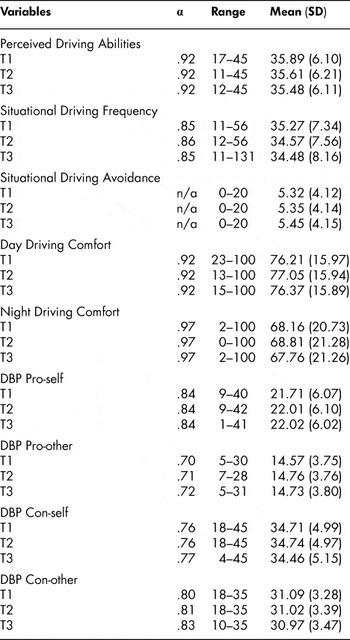
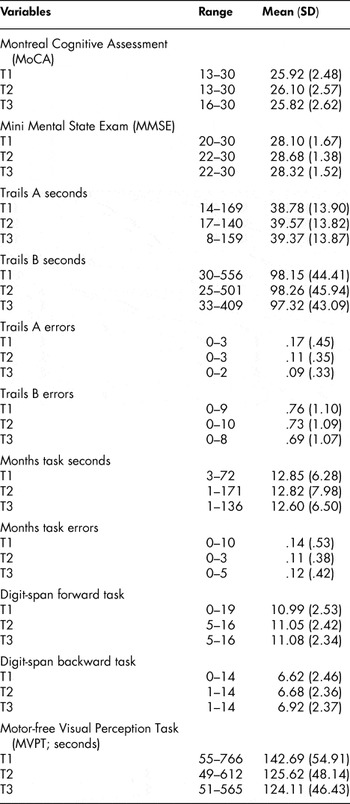
Psychometric data and mean levels of driving behaviours, perceptions, and attitudes are presented in Table 1. Mean levels of cognitive performance are provided in Table 2.
Psychometric properties and mean levels of driving behaviours, perceptions, and attitudes

α = Cronbach’s alpha; DBP = Decisional Balance Plus Scale; n/a = not applicable as scores are counts; ns for T1 = 928, T2 = 882, and T3 = 774.
Mean levels of cognitive performance

ns for T1 = 928, T2 = 882, and T3 = 774
Time-Based Models: Cognitive Performance over Time
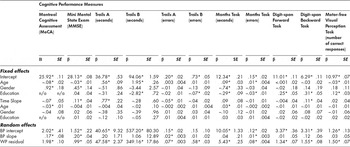
Table 3 summarizes results from the initial time-based models that examine the trajectories of cognitive performance over the 2 years of assessments. Most of the cognitive measures remained relatively stable over time. MMSE (β = 0.11) and digit-span backward task (β = 0.11) scores increased over time, reflecting small improvements over the course of the study. However, the increases were modest, representing average increases of 0.39 per cent (i.e., β coefficient divided by baseline score, 0.11/28.13) in MMSE scores and 1.75 per cent (0.11/6.29) in digit-span backward scores for each additional year from baseline. In the Trails A task, the significant positive slope coefficient (β = 0.77) for seconds indicate that, on average, participants took longer to complete the task over time, although the significant negative slope coefficient for the number errors (β = –0.05) indicate that participants committed fewer errors over time. As with the MMSE and digit-span backward task, the increase was modest, representing an average increase of 2.09 per cent (0.77/36.78) in seconds to complete the task and a decrease of 0.25 per cent (0.05/.20) in number of errors over time with Trails A. Age, gender, and education were related to baseline levels and changes in some of the cognitive measures, and were thus controlled for in all subsequent co-variation analyses.
Time-based models: Cognitive trajectories adjusting for age, gender, and education

BP = between-person; WP = within-person; n/a = not applicable as education has been previously adjusted for. Unstandardized coefficients are presented. *p < 0.05.
Time-Varying Co-variation Models: Do Changes in Cognition Correspond with Changes in Driving Behaviours, Perceptions, and Attitudes over Time?
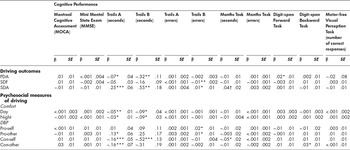
To determine whether within-person increases or decreases in cognitive performance are associated with corresponding increases or decreases in various driving outcomes, we tested models that included driving behaviours (SDF and SDA scores), perceptions (DCS and PDA scores), and attitudes (Pro-self, Pro-other, Con-self, and Con-other) as concurrent within-person predictors. The resulting coefficients (reported in Table 4) indicate whether longitudinal trajectories of the various driving scales co-vary with the longitudinal trajectories for the cognitive measures.
Time-varying co-variation models: Cognitive performance as a function of time, driving behaviors, perceptions, and attitudes

DBP = decisional balance plus scale; PDA = perceived driving ability; SDA = situational driving avoidance; SDF = situational driving frequency;. Unstandardized coefficients are presented. Age, gender, and education are controlled for in all co-variation analyses. †p = .06; *p < .05; **p < .01; ***p < .001.
Perceived Driving Ability (PDA)
Increased PDA scores (or better perceptions of one’s driving abilities) over time were associated with faster times to complete Trails A and B (βs = –0.07 and –0.32 respectively). Specifically, for every 1-second decrease in the time it took to complete the Trails A and B tasks, there was a corresponding increase of 0.19 per cent (calculated by β score for the relationship divided by the intercept for the cognitive measure, 0.07/36.78) and 0.34 per cent in PDA scores. Similarly, improvement in performance on the digit-span forward task (β = 0.02) over the course of the study was associated with a 0.18 per cent increase over time in PDA scores.
Situational Driving Frequency (SDF)
Lower SDF scores over time were associated with Trails B errors (β = –0.01), indicating that more errors on the Trails B task over time were associated with a reduction in frequency of driving in challenging situations over time. However, the magnitude was small, representing a 0.04 per cent decrease in the SDF score per every unit increase in Trails B errors scores, over and above the effect of time.
Situational Driving Avoidance (SDA)
Slower performance on the Trails A and B tasks over time was associated with increasing SDA scores (0.68% and 0.58% respectively), indicating that poorer performance on both tasks over time was related to greater reported avoidance of driving in challenging situations. Participants who committed more errors on the Trails B task with time also reported greater driving avoidance over the course of the study (1.37% increase).
Driving Comfort (DCS-Day and DCS-Night)
Participants who performed faster on the Trails A and B tasks over time reported higher levels of driving comfort during the day and at night (day βs = –0.05 and –0.09; night βs = –0.03 and –0.09 for Trails A and B respectively) compared to individuals who performed poorer on the tasks over time. Specifically, for every 1-second decrease in the time it took to complete the Trails A and B tasks, there was a corresponding increase of 0.14 per cent and 0.10 per cent in daytime driving comfort scores. Similarly, there was a corresponding increase of 0.08 per cent and 0.10 per cent in nighttime driving comfort scores per every 1-second decrease in the time it took to complete the Trails A and B tasks.
Decisional Balance
Positive views towards driving for oneself (DBP Pro-self) declined by 2.74 per cent over time for each unit increase of errors on the Trails B. A decrease in others’ views of one’s driving over time (DBP Pro-other) was associated with a 0.35 per cent decrease in Trails A speed, and a 1.37 per cent increase of errors on Trails B over time. In contrast, fewer negative perceptions of driving for oneself over time (Con-self) was associated with faster performance on both the Trails A and B and Months tasks (0.44%, 0.55%, and 0.41% respectively), and fewer negative perceptions of driving in relation to others over time was associated with a 0.44 per cent faster performance on Trails A, and a better performance on digit-span backward (0.48%).
Discussion
In this well-educated sample of older drivers, cognitive functioning was strong and relatively stable over the two years of the study. There were modest improvements over time in MMSE and digit-span backward scores. Time to complete the Trails A task worsened over time although there were fewer errors. These cognitive changes were statistically significant with our large sample size, but the magnitude was extremely small, on the order of less than one point of digit span and MMSE, less than one error on Trails A and MMSE, and less than one second on the time to complete Trails A.
Correspondingly, although we found some associations between cognitive changes and changes in self-reported driving frequency and avoidance, as well as perceptions of driving comfort and abilities, the magnitude of these associations was small. For example, the associations of the largest magnitude in the present study were that faster time to complete Trails B was associated with increases in perceived driving abilities, as well as a reduction in both self-reported driving avoidance and negative perceptions and attitudes towards their own driving skills (both scores on the PDA and DBP Con-self). Specifically, each second decrease over time in Trails B time was associated with a 0.34 per cent increase in perceived driving ability, a 0.58 per cent decrease in situational driving avoidance, and a 0.55 per cent decrease in negative attitudes of their own driving over time. This corresponds with less than 0.20 of a point in each of those three scales, indicating that in our sample with relatively stable cognitive functioning over time, the impact of the observed changes in Trails B was minimal.
More dramatic increases or decreases in Trails B performance over time, however, could have significant effects on these driving variables. An increase of 1.5 standard deviations from baseline on the time to complete Trails B is about 67 seconds longer than baseline, and would correspond with an approximate 8 points decrease on the PDA, 2 points on SDA, and 13 points on the DBP Con-self scales, yielding a potentially clinically meaningful association between worsening executive functioning and perceived worsening in abilities and more driving avoidance. The other cognitive measures do not share the potential clinically significant effect on driving behaviours or perceptions. For example, an increase over baseline of 21 seconds (1.5 SD) in time to complete the Trails A test would be associated with a change of less than one point (0.75) on the SDA scale.
Several international guidelines recommend using the Trails B as a test of divided attention, set shifting, and psychomotor speed to assess older or medically at-risk drivers (Canadian Medical Association, 2012; Carr, Schwartzberg, Manning, & Sempek, Reference Carr, Schwartzberg, Manning and Sempek2010; Charlton et al., Reference Charlton, Koppel, Odell, Devlin, Langford and O'Hare2010). Increased time to complete Trails B has been associated with motor vehicle crashes and poor driving performance (Roy & Molnar, Reference Roy and Molnar2013). In the present study, over a two-year period, average Trails B performance remained well within the published age-related norms (Tombaugh, Reference Tombaugh2004), and well within the recommended cut-offs for driving safety (Roy & Molnar, Reference Roy and Molnar2013), although we did observe a broad range of scores. Worse performance over time on this cognitive test is associated with lower perceived driving abilities, lower perceptions of abilities compared to oneself, greater avoidance of dangerous driving situations, and to a much lesser magnitude, reduced driving comfort during the day and at night. The magnitude of the association between change in time to complete Trails B and change in perceived driving abilities and driving avoidance was much larger in this longitudinal analysis than in our cross-sectional analysis of baseline data (Rapoport et al., Reference Rapoport, Naglie, Weegar, Myers, Cameron and Crizzle2013).
The coefficient for the relationship between Trails B time and SDA scores was 0.55 in the longitudinal analysis (compared to 0.01 in the cross-sectional analysis) and 0.32 with PDA scores longitudinally (as compared to 0.02 cross-sectionally). Hence, cognitive slowing and increased executive dysfunction appear to be associated, at least modestly, with declines in perceived driving abilities and greater avoidance of driving in challenging situations over time. Although it would be reassuring to show evidence that older adults with worsening cognition may be restricting their driving, driving avoidance is determined by many factors, including preferences and changes in lifestyle (Molnar et al., Reference Molnar, Eby, Charlton, Langford, Koppel and Marshall2013), and restrictions may not always be appropriate or enhance safety (Ross et al., Reference Ross, Clay, Edwards, Ball, Wadley and Vance2009; Langford et al., Reference Langford, Charlton, Koppel, Myers, Tuokko and Marshall2013).
The strengths of the present study include the large sample size, longitudinal analysis, small attrition rate, and careful control of potential confounds such as age, education, and gender. One of the main limitations is that our driving measures were based on self-report. Previous naturalistic driving studies with smaller samples have shown that older drivers may not avoid or otherwise restrict their driving practices as much as they self-report (Blanchard & Myers, Reference Blanchard and Myers2010; Crizzle et al., Reference Crizzle, Myers and Almeida2013). A recent publication from our group indicates that in a subset of the Candrive cohort, only moderate agreement was found between self-reported distance and objectively measured actual driving distance as, with a weighted kappa of 0.57 (95% CI 0.47–0.67) (Porter et al., Reference Porter, Smith, Cull, Myers, Bédard and Gélinas2015).
A second limitation is that the large number of tests raises the potential for Type I errors. While p-value correction is not needed in exploratory analyses, the small associations found in the present exploratory analysis should be considered preliminary (Rothman, Reference Rothman1990; Savitz & Olshan, Reference Savitz and Olshan1995). Third, the sample was highly cognitively intact, with a mean MMSE score of 28.1 at baseline, and with minimal changes over time: Two years of follow-up is likely insufficient to examine in detail the impact of clinically significant cognitive changes in such a population. The relatively subtle changes in the present study may influence driving cessation decisions when followed over a longer time period. Finally, the Candrive cohort is made up of cognitively intact volunteers with no medical contraindications to driving at enrollment. Although the sample is similar in self-perceived health to the more representative sample of older Canadians collected in the Canadian Community Health Survey – Healthy Aging (CCHS-HA) (Statistics Canada, 2008; Gagnon et al., Reference Gagnon, Marshall, Kadulina, Man-Son-Hing, Korner-Bitensky and Gélinas2012), the true representativeness of the sample remains to be determined, and these data should not be seen as reflective of a population of older adults with neurodegenerative disorders or other medical problems that pose driving risk.
Further analyses of the Candrive cohort data are needed to determine whether the trajectory of worsening Trails B performance is associated with further reductions in perceived driving abilities, and whether relationships between other cognitive and psychosocial variables emerge. Most importantly, we need to examine whether decrements in cognitive functioning are associated with objectively measured changes in driving practices and crash risk.