Introduction
The revolutionary invention of cochlear implantation has fundamentally transformed the prognosis for children with severe-to-profound sensorineural hearing loss, offering them the potential to develop auditory skills and spoken language. The success of this neural prosthesis, however, is not solely dependent on the surgical procedure or the implant’s internal technology. A critical determinant of long-term outcomes is consistent, full-time use of the external audio processor, which captures, processes, and transmits sound information to the implanted internal device.Reference Alhabib, Abdelsamad, Badghaish, Alzhrani, Hagr and Almuhawas1–Reference Wiseman, Warner-Czyz, Kwon, Fiorentino and Sweeney4
Early activation in cochlear implantation refers to the initial programming of the audio processor during the first post-operative days (1–14 days), rather than after the conventional waiting period of several weeks.Reference Hagr, Garadat, Al-Momani, Alsabellha and Almuhawas5–Reference Aldhafeeri, Saleh, Almuhawas and Hagr7 This approach has gained clinical interest because modern minimally invasive surgical techniques and post-operative care can support earlier device use without compromising wound healing in appropriately selected patients.Reference Alshalan, Abdelsamad, Yousef, Alahmadi, Almuhawas and Hagr8Across published clinical series, early activation has generally been reported to be feasible, with complication profiles comparable with those of conventional timelines and practical benefits such as earlier access to hearing and earlier reassurance for patients and families.Reference Alshalan, Abdelsamad, Yousef, Alahmadi, Almuhawas and Hagr8, Reference Parker, Muzaffar, AuD and Brassington9 Their use may support faster engagement in rehabilitation, which may be particularly meaningful in children, given the developmental importance of timely auditory input.Reference Parker, Muzaffar, AuD and Brassington9, Reference Bruschke, Baumann and Stöver10
Despite the substantial number of publications on early activation, most studies used behind-the-ear (BTE) processors, leaving little evidence on its feasibility with off-the-ear (OTE) processors. In contrast, Batuk et al. (2019) concluded that OTE processors may require greater caution, modified activation strategies, or closer monitoring during early activation.Reference Batuk, Yarali, Cinar, Kocabay, Bajin and Sennaroglu11 Furthermore, post-operative soft-tissue swelling can be a concern that interferes with magnet stability in early-fitted patients.Reference Alhabib, Abdelsamad, Badghaish, Alzhrani, Hagr and Almuhawas1, Reference Hagr, Garadat, Al-Momani, Alsabellha and Almuhawas5, Reference Alahmadi, Abdelsamad, Yousef, Alhabib, Alshalan and Hamed12
In the cochlear implant (CI) population, ensuring consistent device use presents unique challenges. In certain situations, conventional BTE processors could be bulky for very young children. The presence of cables and ear hooks, and the need for a separate headpiece connected via a magnet, can impede consistent use, often resulting in tangling or damage from tugging, a common behaviour in infants and toddlers. Furthermore, the visibility of a BTE device may concern some patients and parents, potentially affecting their acceptance and, by extension, their persistence in wearing the processor.
These practical challenges have motivated the development of an alternative processor architecture. The single-unit OTE sound processor integrates the microphone, processor, battery, and transmitting coil into a single disc-shaped unit that sits directly on the head over the implant magnet. The OTE design eliminates the need for an ear hook and cable and provides a cosmetically appealing, discrete profile, potentially addressing many of the practical challenges associated with conventional processors. For parents, a single-unit device could simplify daily management by making it easier to put on and remove.
Now, many manufacturers offer this OTE processor to their users. However, data on its feasibility, safety and performance with early activation remain limited.Reference Dazert, Thomas, Büchner, Müller, Hempel and Löwenheim13–Reference Wimmer, Caversaccio and Kompis15 Therefore, this study aimed to comprehensively evaluate the feasibility of using the OTE sound processor in early-activated patients.
Materials and Methods
This is a retrospective chart review with prospective, cross-sectional administration of patient-reported outcome measures. The study was conducted to evaluate safety, magnet power adjustment, hearing outcomes and satisfaction among patients fitted with a single-unit audio processor and activated on the first post-operative day.
Study design and participants
The study was conducted in a tertiary university hospital. All patients who met the inclusion criteria, and were implanted consecutively during the study period, were included. Clinical and audiological data were collected retrospectively from electronic medical records. Inclusion criteria were the complete insertion of the electrode array and activation on the day after the surgical procedure with the single-unit processor (RONDO; MED-EL, Innsbruck, Austria). Patients were excluded if they had any additional disabilities, behavioural abnormalities, auditory neuropathy spectrum disorder, single-sided deafness or revision surgical procedure. Ethical approval was obtained from the institutional review board; all parents or their legal guardians provided informed consent.
Surgical details
All patients underwent cochlear implantation in the same institute, using a standardised surgical technique. The surgical procedures were performed using minimally invasive techniques, in which minimal interventions are used to achieve maximal outcomes.Reference Aljazeeri, Abdelsamad, Hajr, Alzahrani, Khurayzi and Aldhafeeri16, Reference Hagr, Alzhrani, Almuhawas, Abdelsamad, Yousef and Alahmadi17 The procedure involved a small (approximately 3 cm in size) post-auricular incision placed approximately 1 cm superior to the mastoid tip. This limited access facilitated the creation of a tight subperiosteal pocket for the internal receiver–stimulator. By minimising tissue dissection and redundancy in the wound layers, the technique aims to reduce dead space, thereby lowering the risk of post-operative complications such as hematoma, seroma and soft-tissue oedema. To further mitigate the risk of fluid collection, surgeons used interrupted sutures for skin closure. This method allows the controlled drainage of post-operative bleeding or serous fluid. Consistent with the minimalist philosophy, no post-operative dressings or compression bandages were applied.
Assessment measures
A multi-method assessment approach was used to comprehensively evaluate the feasibility and outcomes of the OTE processor use.
Audiological performance
Aided thresholds were measured at frequencies of 250, 500, 1000, 2000, 4000 and 8000 Hz.
Parent-report questionnaires
Firstly, the 12-item Speech, Spatial and Qualities of Hearing Scale (SSQ12): A validated, shortened version of the full 49-item SSQ, developed by Noble et al. (2013) for use in clinical research and rehabilitation settings. It assesses subjective hearing abilities across three domains: speech perception (items 1–5), spatial hearing (items 6–8) and qualities of hearing such as sound clarity, segregation and listening effort (items 9–12). Each item was scored on a visual analogue scale from 0 to 10, in which 0 represents the lowest possible ability and 10 represents the highest possible ability. Subscale and total scores were calculated as the average of the respective item scores. Parents completed the test as a proxy for paediatric patients; adult patients completed it independently.Reference Alkhodair, Mesallam, Hagr and Yousef18
Secondly, the Audio Processor Satisfaction Questionnaire (APSQ-15): a standardised, validated questionnaire designed for this study to gauge user satisfaction with the processor across three domains: comfort (items 3, 6, 9, 12, 15), social life (items 1, 4, 7, 10, 13) and usability (items 2, 5, 8, 11, 14). Each item was scored on a visual analogue scale from 0 (‘does not agree at all’) to 10 (‘fully agrees’), with higher scores indicating greater satisfaction. Subscale and total scores were calculated as the average of the respective item scores. The test covered domains such as comfort, safety (retention), ease of daily use (donning/doffing, charging), cosmetic appeal and overall preference compared with a traditional BTE processor.Reference Alasmi, Saleh, Anderson, Abdelsamad and Hagr19
Procedure
During a single study visit, the child’s aided sound-field thresholds were measured in a sound-treated booth. Subsequently, a trained clinician administered the SSQ12 and APSQ-15 in an interview format to ensure completeness and clarity of all questions. Parents served as proxies for paediatric patients, while adult patients completed the questionnaires independently. Questionnaire responses reflected the participant’s current experience at the time of this cross-sectional follow-up visit, rather than a retrospective account of the immediate activation period.
Data analysis
Data collection and management were performed using Microsoft Excel software (version 16.1; Microsoft, Seattle, WA). All statistical analyses were conducted using IBM SPSS Statistics (Version 28.0; IBM Corp., Armonk, NY).
Descriptive statistics (means, standard deviations, ranges) were calculated for all quantitative measures (sound-field thresholds, questionnaire scores).
Questionnaire data from the SSQ-12 and APSQ-15 were analysed both as total scores and by conceptual subscales. For the SSQ-12, items were grouped into three domains as per the standard scoring: speech understanding (items 1–5), spatial hearing (items 6–8), and qualities (items 9–12). For the APSQ-15, items were grouped into comfort (items 3, 6, 9, 12, 15), social life (items 1, 4, 7, 10, 13) and usability (items 2, 5, 8, 11, 14).
Results
In total, 25 cochlear implantations were performed in 22 patients. The cohort consisted of 11 female and 11 male patients. Most patients (n = 19, 86.4 per cent) received a unilateral implant, while three patients (13.6 per cent) received bilateral implants. The implanted ears were 11 on the right side (44 per cent) and 14 on the left side (56 per cent).
The patient population included both paediatric and adult recipients. The paediatric age range was 1 year 1 month to 8 years 7 months, with a mean age of 3 years and 11 months (SD ± 2 years 7 months). The adult age range was 18 years 11 months to 44 years 9 months, with a mean age of 31 years and 6 months (SD ± 8 years). The mean follow-up duration for the cohort was 2 years and 8 months (SD ± 2 years 1 month).
In all patients, no seroma or hematoma was noted on the day following implantation and post-operative soft-tissue swelling was minimal. The patient tolerated the surgical procedure well, experiencing no significant pain, dizziness or vertigo that would have interfered with activation. All patients were fitted with single-unit audio processors on the day after the surgical procedure. The most common models were RONDO3 (n = 16, 64 per cent) and RONDO2 (n = 9, 36 per cent). Among the electrode arrays, the Flex 26 (n = 11, 44 per cent) was most prevalent, followed by the FORM24 and FLEX28 (both n = 7, 28%).
The Power 3 magnet cell was the most frequently used (n = 19, 76 per cent), followed by the Power 1 (n = 4, 16 per cent), Power 2 (n = 1, 4 per cent), and Power 4 (n = 1, 4 per cent). The average daily usage time of the CI system was 15.16 hours (SD ± 3.41 hours).
The daily rate of unlock events was available for the Rondo 3 processors (n = 16). These unlock events, recorded automatically by the processor’s datalogging system, occur when the magnetic coupling between the external processor and the internal implant is temporarily interrupted. They may result from accidental dislodgment during physical activity or deliberate removal by the patient. The data showed a minimum of one disconnect per day in nine patients (56.2 per cent), and a maximum of four disconnects per day in two patients (12.5 per cent), with one outlier of seven disconnects per day in one patient (6.3 per cent).
Post-operative audiological testing demonstrated good functional outcomes. The mean Word Recognition Score (WRS) was 70.33 per cent (SD ± 17.25 per cent). Speech Recognition Threshold (SRT) and post-operative sound-field thresholds, measured using Pure Tone Audiometry, are summarised in Table 1 and Figure 1, showing consistent auditory detection across the frequency spectrum.
Summarising the results of the audiometric evaluations post-operatively

Figure 1 Long description
Post-operative audiometric outcomes are reported, including pure tone thresholds at six frequencies, plus speech recognition threshold and word recognition score. Mean pure tone thresholds are 33.4 dB at 250 Hz, 36.6 dB at 500 Hz, 35.6 dB at 1 kHz, 36 dB at 2 kHz, 35 dB at 4 kHz, and 30.6 dB at 8 kHz. Thresholds are fairly consistent from 250 Hz through 4 kHz, with the lowest mean threshold at 8 kHz, indicating slightly better sensitivity at that highest tested frequency. The speech recognition threshold averages 36.04 dB, aligning closely with the mid-30 dB pure tone results. Word recognition averages 70.33 percent, with notable variability across individuals as reflected by the standard deviation. All values are presented as means with standard deviations, so they summarize group performance and do not show individual patient results or changes from pre-operative testing.
Pure tone audiometry levels.

Table 1 Long description
Line graph titled, Aided Audiogram. Horizontal axis tick labels: 250 Hz, 500 Hz, 1 kHz, 2 kHz, 4 kHz, 8 kHz. Vertical axis label: Threshold (dB). Vertical axis tick labels: 0, 10, 20, 30, 40, 50, 60, 70, 80, 90. Legend labels: Pt1, Pt2, Pt3, Pt4, Pt5, Pt6, Pt7, Pt8, Pt9, Pt10, Pt11, Pt12, Pt13, Pt14, Pt15, Pt16, Pt17, Pt18, Pt19, Pt20, Pt21, Pt22, Pt23, Pt24, Mean. Plotted elements: multiple lines with point markers at each of the six frequency positions and one Mean line with point markers at each of the six frequency positions. Numeric coordinate pairs for the plotted points are not legible from the image.
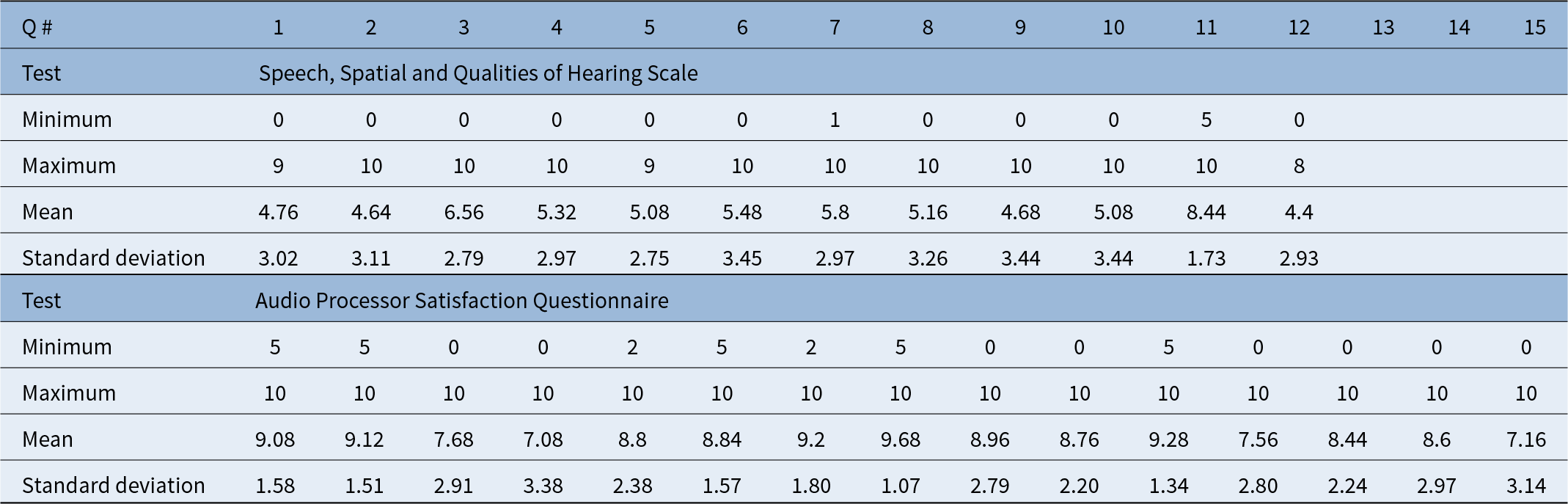
Analysis of the SSQ-12 test revealed mean subscale scores (mean ± SD) of 5.27 ± 2.96 for speech, 5.48 ± 3.20 for spatial and 5.65 ± 3.34 for sound qualities. The highest-rated individual item pertained to sound clarity (Q#11: ‘Do everyday sounds… seem clear to you?’), with a mean score of 8.44 (±1.73). Conversely, the lowest score was for listening effort (Q#12, Do you have to concentrate very much when listening to someone or something?), with a mean score of 4.4 ± 2.90.
Analysis of the ASPQ-15 revealed mean subscale scores of 8.04 ± 2.75 for comfort, 8.51 ± 2.40 for social, and 9.09 ± 1.98 for usability. The mean score was more than seven across all questions. Q#8 received the highest rating, with 23 out of the 25 responses (92 per cent) assigning it the maximum score of 10/10.
The details of the SSQ-12 and ASPQ-15 results are presented in Table 2 and Figure 2.
Illustrating the summary of the SSQ-12 and APSQ-15 questionnaires

Table 2 Long description
Two questionnaires are summarized by item number: SSQ-12 (Speech, Spatial and Qualities of Hearing Scale; items 1 to 12) and APSQ-15 (Audio Processor Satisfaction Questionnaire; items 1 to 15), each reporting minimum, maximum, mean, and standard deviation. SSQ-12 item means range from 4.4 to 8.44, with the highest mean at item 11 (8.44) and the lowest at item 12 (4.4); most other SSQ-12 means cluster around 4.6 to 6.6. SSQ-12 minimums are often 0, except item 7 has a minimum of 1 and item 11 has a minimum of 5; maximums are mostly 9 or 10, with item 12 topping out at 8. SSQ-12 variability is moderate to high, with standard deviations mostly near 2.75 to 3.45, and the smallest spread at item 11 (1.73). APSQ-15 item means are higher overall, ranging from 7.08 to 9.68, with the highest mean at item 8 (9.68) and the lowest at item 4 (7.08). APSQ-15 minimums vary widely by item, from 0 up to 5, while maximums are 10 for all items. APSQ-15 standard deviations range from 1.07 to 3.38, indicating some items are tightly clustered while others show broader differences among respondents. Blank cells indicate SSQ-12 does not include items 13 to 15, so those columns apply only to APSQ-15.
Results of the SSQ-12 and APSQ-15 questionnaires in detail and in subscales in box plot charts.

Figure 2 Long description
A) Two box plot charts. Left chart: Vertical axis label, Score. Horizontal axis label, Detailed. Category labels, Q1, Q2, Q3, Q4, Q5, Q6, Q7, Q8, Q9, Q10, Q11, Q12. Each category has a box and whiskers with multiple dot markers. Right chart: Vertical axis label, Score. Horizontal axis label, Subscales. Category labels, Speech, Spatial, Qualities. Each category has a box and whiskers. Text below the charts reads, Speech, Spatial and Qualities of Hearing Scale 12, SSQ 12. B) Two box plot charts. Left chart: Vertical axis label, Score. Horizontal axis label, Detailed. Category labels, Q1, Q2, Q3, Q4, Q5, Q6, Q7, Q8, Q9, Q10, Q11, Q12, Q13, Q14, Q15. Each category has a box and whiskers with multiple dot markers. Right chart: Vertical axis label, Score. Horizontal axis label, Subscales. Category labels, Social Life, Usability, Comfort. Each category has a box and whiskers. Several dot markers appear below the boxes. Text below the charts reads, Audio Processor Satisfaction Questionnaire 15, APSQ 15.
Discussion
This study demonstrated that early activation with the single-unit OTE sound processor is feasible in a cohort of adults and young children with CIs. The central finding was that a standardised, minimalist surgical technique, combined with careful management, permitted secure magnet retention and immediate post-operative device use without complications.
The results directly address the primary concern regarding early OTE fitting post-operative swelling compromising magnet stability. The absence of post-operative seroma, hematoma or significant oedema in the studied cohort underscored the importance of the surgical approach used. The creation of a tight subperiosteal pocket, minimisation of tissue dissection and dead space, and the use of interrupted skin sutures, collectively, are believed to prevent fluid accumulation.Reference Prager, Neidich, Perkins, Meinzen-Derr and Greinwald20–Reference Stratigouleas, Perry, King and Syms22 All patients in the current study successfully adapted to the device using standard magnet strengths (powers 2 and 3), indicating that sufficient retention force can be reliably achieved, even in the immediate post-operative period.
The datalogging data on daily unlock events provide an objective measure of real-world device retention in this study. The observed unlock rates, with the majority of Rondo 3 users (56.3 per cent) experiencing only one disconnect per day, suggested clinically acceptable magnet stability during routine daily activities. It is important to note that unlock events are not necessarily indicative of inadequate magnetic retention; they may equally reflect deliberate removal of the processor by the user. A limitation of the current study was the absence of comparative BTE processor unlock data.
Bruschke et al. have reported successful early activation without major complications in 65 out of their 67 patients.Reference Bruschke, Baumann and Stöver10 A similar report was documented by Wolf et al., who reported a success rate of early activation in 39 out of 40 patients.Reference Wolf–Magele, Schnabl, Edlinger, Pok, Schoerg and Sprinzl23 The current study further supports these findings and extends their limits by earlier activation on the next day compared with the reported 14 days in both studies and by reporting paediatric patients compared with adult patients.
The findings of the current work address the conventional caution regarding early OTE fitting. While previous literature has highlighted the risk of swelling interfering with magnet retention, this study provides a practical counterpoint: that this surgical technique is a modifiable and decisive factor. By proactively managing the surgical site to minimise oedema, the barrier to early use of OTE can be effectively removed.
Audiologically, aided sound-field thresholds across the frequency spectrum confirm that the OTE processor provides the required audibility for auditory development. The high scores on the SSQ-12 questionnaire, particularly in the domain of sound clarity, reflect the auditory performance in real-world environments. The APSQ-15 results indicated parental satisfaction, with the highest ratings in the domains of ease of use, comfort, safety and cosmetic appeal. This high acceptance is a critical non-audiological outcome, as parent-perceived benefits and ease of management are key drivers of consistent device use in young children.
Beyond its clinical and practical benefits, the strategy of early activation with a single-unit processor represents a direct and impactful application of ‘Green Cochlea’ principles, aligning cochlear implantation with broader healthcare sustainability goals.Reference Hagr, Alzhrani, Almuhawas, Abdelsamad, Yousef and Alahmadi17 This approach contributes to several United Nations Sustainable Development Goals (SDGs) through three key mechanisms. Firstly, it significantly reduces the environmental footprint associated with patient travel. By enabling activation on the first post-operative day, this model minimises the number of dedicated clinic visits for programming, cutting down on cumulative travel time and associated carbon emissions for families. Secondly, it promotes responsible consumption and production. The single-unit (OTE) processor design inherently eliminates vulnerable cables, ear hooks and separate headpieces, reducing the volume of electronic components prone to damage and replacement. This streamlined design not only enhances durability for paediatric users, but also lessens material waste over the device’s lifespan. Thirdly, early activation may contribute to sustainable energy use. Evidence suggests that early electrical stimulation can lead to a sustained reduction in electrode impedance.Reference Alhabib, Abdelsamad, Yousef, Alzhrani and Hagr24, Reference Wilk, Hessler, Mugridge, Jolly, Fehr and Lenarz25 Lower impedance decreases the power required for effective stimulation, which can prolong battery life in rechargeable systems or extend the use of disposable batteries, thereby reducing resource consumption and waste. Collectively, by integrating patient-centred care with a conscious design and accelerated timeline, early activation with an OTE processor offers a holistic, sustainable care model that benefits both the individual recipient and the environment.
Summary
What is already known on the subject
• Existing literature has cautioned that off-the-ear processors may require modified activation strategies due to post-operative swelling and magnet instability.
What this paper adds to our understanding
• All 25 implants in this study underwent successful next-day early activation with off-the-ear processors using standard magnet strengths, with no seroma, hematoma or significant oedema.
• A minimalist surgical technique with a tight subperiosteal pocket and interrupted skin closure is a modifiable factor that enables secure early magnet retention.
• Aided thresholds confirmed good audibility; questionnaire results demonstrated a high auditory performance and sound clarity.
• Users reported strong satisfaction, with the highest ratings for comfort, ease of use and cosmetic appeal compared with behind-the-ear processors.
• Early activation with single-unit processors aligns with sustainability principles by reducing clinic visits, disposable components and possible long-term power consumption.
Conclusion
This feasibility study confirms that early post-operative fitting with the single-unit audio processor is a feasible and effective strategy for paediatric and adult CI recipients. The key to success lies in a synergistic approach: a meticulously executed minimalist surgical technique that prevents significant post-operative swelling, thereby enabling immediate and stable magnet retention. The single-unit audio processor provides reliable auditory access and its practical design – which eliminates vulnerable cables and ear hooks prone to toddler-related damage – contributes to exceptionally high parental satisfaction and sustained, consistent device use. Future studies with larger samples and extended follow-up duration are expected to generalise these findings.
Funding
The authors received no funding for this manuscript.
Competing interest
Athair Alradhi and Yassin Abdelsamad work with MED-EL solely in scientific roles. The authors have no conflicts of interest to declare.
Authors’ contributions
I.Aj. had substantial contribution to the concept and design, data analysis and drafting the article. S.A. had substantial contribution to the concept, data analysis and drafting the article. A.A. had substantial contribution to the concept, data analysis and drafting the article. Y.A. had substantial contribution to the concept, data analysis and critically revising the article. A.H. had substantial contribution to the concept and design, supervised and led the project, and critically revising the article. All authors discussed the results and implications and commented on the manuscript at all stages and critically revising the final article.
Acknowledgements
The authors have no acknowledgements to declare.
Statements and Declarations
• Athair Alradhi and Yassin Abdelsamad work with MED-EL solely in scientific roles.
• The authors have no competing interest to declare.
• The authors have no relevant financial or non-financial interests to disclose.
• The authors did not receive support from any organisation for the submitted work.
• The data from this article are available upon request from the corresponding author.
• The authors assert that all procedures contributing to this work comply with the ethical standards of the relevant national and institutional guidelines on human experimentation and with the Helsinki Declaration of 1975, as revised in 2008.