This article concerns the history of antiphonal psalmody since the eighth century. Nevertheless, readers may wish to be cognisant of certain assumptions about the genre's earlier history that challenge the prevailing view. Chief among them are that the term ‘antiphon’ in the fourth, fifth and sixth centuries ordinarily referred to psalms sung in dual-choir alternation without refrain; that the antiphon understood as a short verse added to psalms performed antiphonally is a later development unattested before the seventh century;Footnote 1 and that the antiphon in this later sense never functioned as a true refrain, but as a thematic affix whose basic intent could be satisfied with a minimum of repetition. I do not expect responsible scholars to accept any of these assumptions without vigorous demonstration, which I have presented and hope to continue presenting in other forums.Footnote 2 They are stated here in order to help readers understand the present article as part of a coherent story. The article itself depends on no assumptions and no evidence except what arise within the stated period of investigation.
The modern historiography of antiphonal psalmody in the West at least since the seventeenth century has held that antiphons are a kind of refrain and that they were originally intended to be repeated after every verse of their respective psalms. Guided by that assumption, scholars have treated any number of repetitions that failed to match the number of verses of the psalm and doxology as a sign of laxity, a concession to the pressures of time, or a betrayal of historical authenticity. Thus, Tommasi wrote in 1686:
Furthermore, when the antiphon of old was said with a psalm or canticle, clearly no one will deny that it was repeated after every verse … [But later] in the churches of Germany they began to neglect the repetition of antiphons, nay even to omit them entirely for the sake of brevity. For truly, this omission demonstrates that the musical rendition of antiphons according to the ancient custom demanded a great deal of time, which the current custom of singing them only once or twice does not.Footnote 3
This view was transmitted essentially unchanged by Martin Gerbert in 1774Footnote 4 and again by Peter Wagner in 1895.Footnote 5 Elaborating upon it, Wagner attributed what appeared to him as reductions in the number of repetitions to various practical accommodations, while acknowledging occasional revivals of what he regarded as the more authentic practice:
A procedure of this kind naturally extended the length of the psalms, and still more, of the whole canonical hour. At first the repetition was dropped only in the daytime hours, since one could not, of course, spend the whole day chanting psalms.… From there the practice of not singing the antiphon after every verse spread to the hours of Matins and Lauds. Yet traces of the original antiphonal psalmody continued to follow the Office into the Middle Ages and on into more recent times. Amalar, in describing the composition of the night Office on ordinary days, mentions the six antiphons that were repeated in alternation by the two choirs after every verse. And later the repetition after every verse was sometimes reintroduced when one wanted to extend the length the Office, as the Cluniacs did with the antiphons of Matins on the feast of St Martin. Much later, it was a favourite practice on feast days to repeat the antiphons for the canticles of Lauds and Vespers before the Gloria Patri, and before and after the Sicut erat – singing them four times altogether. The term they used for that practice was triumphare or triumphaliter canere, which alludes nicely to the threefold repetition (ter fari) as well as to its festive character. Bishop Durandus of Mende (thirteenth century) even speaks of this practice as a deeply rooted custom. It was a remnant of the ancient antiphonal psalmody.Footnote 6 (Emphasis added.)
All the sources on which these opinions rest bear examination. The earliest and most frequently cited are two passages in the works of Amalar of Metz, one in chapter 7 of the fourth book of his Liber officialis, written between 831 and 834, the other in chapter 3 of his Liber de ordine antiphonarii, written between 844 and his death c.850.Footnote 7 The earlier passage begins as follows:
Antiphon means reciprocal utterance. The antiphon is begun by one member of one choir, and the psalm is sung by two choirs according to the antiphon's harmony, for it is through the antiphon that the two choirs are joined together into one.Footnote 8
Amalar begins by paraphrasing Isidore's well-known definition: ‘Antiphona ex Graeco interpretatur vox reciproca.’ Thereafter his exposition is original. He articulates the understanding, taken for granted since the eighth century, but perhaps not in Isidore's time, that the antiphon is something adjunct to the psalm and not the psalm itself.Footnote 9 He says that it is begun by a soloist but is silent – at least for the moment – on whether it is sung to completion, and if so, how, and by whom. In the thirteenth century, Guillaume Durand interpreted the passage to mean that only a brief incipit of the antiphon was sung before the psalm, as was customary in the late Middle Ages and early modern era.Footnote 10 It is unlikely, however, that that was Amalar's intent. The psalm itself is sung by the whole body of singers divided into two choirs. One of the functions of the antiphon is to impose its harmony, or tonality, upon the psalm and thus to combine the opposing choirs into a harmonious unity. There is no suggestion, however, that that function required frequent interpolation. The passage as a whole appears to belie the definition of the antiphon given at the beginning, for it is not the antiphon but the psalm that seems to exhibit the reciprocity that the definition calls for. This question will be resolved later. For the present, Amalar is more concerned with the presentation of a moral allegory.
For as much as the spirit is superior to the body, so much is the chant of the spirit superior to the chant of the body. We must therefore ask ourselves what the antiphon of the spirit might be. It seems to me that it is the virtue of charity, which joins together the labors of two brothers into one. The psalms stand for works, the antiphon for the charity by which each offers his work to his brother. For example, one lectures and teaches doctrine in school while the other sows seed in the field. At harvest time the teacher offers to the sower instruction, and the sower offers to the teacher bread.Footnote 11
Here Amalar compares the alternate singing of the verses of the psalm to reciprocal good works, and the harmony imposed by the antiphon to the charity that motivates them. The analogy implies that the psalm-verses follow upon one another without interruption. Finally, Amalar addresses the pending question about the performance of the antiphon:
The antiphon is alternated by two choirs because there cannot be charity between less than two. The singers, who alternately from either side proclaim the antiphon, signify this reciprocal charity. The wings of the living creatures extended toward each other, which Ezekiel saw in prefigurement of the coming of Christ and the New Testament, represent the two choirs, and the conjoining of their wings is the antiphon, which stands for charity.Footnote 12
This paragraph resolves the question mentioned above by asserting that singers from both sides proclaimFootnote 13 the antiphon, because there cannot be charity between less than two. The moral allegory is imperfect, for the antiphon, which signifies the soul and the virtue of charity, and the psalm, which signifies the body and physical works, do not differ in the literal manner of their performance. Both are performed in complementary halves. Yet that seems to be Amalar's unmistakable meaning.Footnote 14 The antiphon's distinction consists rather in its function as the element that determines the over-arching tonality of the psalmody. The entire passage bears witness to the practice by which the antiphon-as-refrain, when it was adopted as such, assimilated the performing style of the psalm, dividing itself in half and distributing the parts to the opposing choirs or their surrogates, following the pattern established in the fourth century by simple dual-choir psalmody.Footnote 15 Completing his multilayered exegesis, Amalar introduces a typological allegory from chapter 1 of the Book of Ezekiel, whose image of wings reaching out to touch each other confirms the description of the antiphon as something both dual and unifying.
Though hardly explicit, Amalar's exposition in the Liber officialis permits certain tentative conclusions. It appears that the antiphon was divided and that the complementary halves were sung in turn by the opposing choirs or by a soloist from each.Footnote 16 The psalm was sung chorally and in alternation, with verses most likely following upon one another without interruption. That is the implication of the allegory of reciprocal good works, and it is implicit in Amalar's prose (‘Antiphona inchoatur ab uno unius cori, et ad eius symphoniam psalmus cantatur per duos coros’), which presents the antiphon and the psalm as successive rather than alternating elements of the form.Footnote 17
In his later work, the Liber de ordine antiphonarii, Amalar appears, at least on first reading, to address the question of interpolation more directly. In the course of an allegorical commentary upon the Office of Matins for ferial days, he makes a passing reference to the Office's six antiphons, suggesting that they are repeated after every verse of their respective psalms. The critical words are these:
Et ex senis antiphonis quas vicissim chori per singulos versus repetunt, ammonemur ut nostra intentio tendat ad perfectionem bonorum operum.Footnote 18
At least since Tommasi in the 1680s, scholars have been reading the phrase per singulos versus to mean between, or throughout, all the verses of the psalm.Footnote 19 Yet this reading raises a disturbing question. Interpreted in that way, the words seem to call for a kind of inverted solemnity, in which the most ample regime of repetition is applied to one of the least solemn Offices – Matins on ferial days. Now it could be argued that the method is intended to apply to the whole Office, but Amalar's description, when read in context, does not sustain that interpretation. His failure to make any mention of it in the chapters on Matins for Sundays and feasts or at the hours of Lauds and Vespers makes it hard to escape the conclusion that the antiphons for ferial Matins are being singled out as exceptional. Yet any distinction that Amalar may have had in mind can hardly have been one of elevated solemnity.
In fact, this difficulty may be a false one, for the reading on which it is based may be erroneous. I propose instead to read the phrase per singulos versus not in the distributive sense, as a reference to the places in the psalm where the antiphon was inserted, but as a reference to the antiphon itself, here called a verse, and to the manner in which that verse was performed; namely, through the repetition of its whole text rather than in reciprocal halves.Footnote 20 The phrase would then mean that the two choirs took turns singing the whole antiphon at each of its insertion points – presumably at the beginning and end of the psalm – instead of dividing it in half, as they usually did. Accordingly, I propose the following translation:
And from the six antiphons that the choirs, in turn, repeat as whole verses, let us be admonished to turn our attention to the perfection of good works.
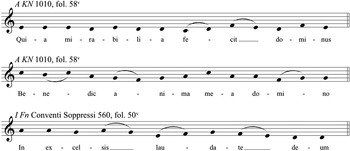
To be sure, the main point of these remarks is the allegory between the number six, the first perfect number,Footnote 21 and the perfection of good works; the reference to performing style is merely parenthetical. Nevertheless, it has caused Amalar to draw attention to the peculiar condition of the ferial antiphons, which are so short that they do not easily admit a medial caesura. Any attempt to divide them in half is generally awkward on grounds of verbal or musical syntax or both. Unlike most antiphons, which the choirs divided in half, performing them per dimidios versus, these particular ones were repeated in their entirety, per singulos versus, because they are too short to divide. (The brevity of typical ferial antiphons is illustrated in Ex. 1.) Amalar's remark on the antiphons of ferial Matins is a red herring. It does not support the theory of frequent interpolation, and its removal undermines one of the theory's oldest and most persistent arguments.
Examples of ferial antiphons.

Another ninth-century source cited by Tommasi is the preface to an anonymous liturgical treatise addressed to Batterich, Bishop of Regensburg, who took office in 814, complaining about the laxity of the clergy in the performance of the Office. It is worth noting, however, that the particular abuse cited was the omission of antiphons entirely, not the failure to observe some expected number of repetitions. ‘For there are some who, having entered the church, assist negligently at the divine praises, [saying them] hastily without antiphons and with all speed.’ And the anonymous author's protestation that doctors of the Church had established the repetition of antiphons and responsories as an honourable and musically pleasing exercise, besides offering no help on the question of frequency, gives an impression of special pleading.Footnote 22
Rounding out Tommasi's pre-millennial testimony is the biography of Odo, the second abbot of Cluny (d. 942), written by one of his disciples.Footnote 23 According to the biography, the monks of Odo's abbey approached him with a complaint. It had been their custom on the feast of St Martin (11 November) to repeat the antiphons of the night Office after every verse of the respective psalms. It was well known, they argued, that those antiphons were short and that without such repetition the Office would not last until daybreak on the long November night. Now, however, the need for so many repetitions was turning the Office of St Martin into drudgery (labor improbus). The monks appealed to Odo to compose a new set of antiphons whose greater length (prolixitas) would relieve the monotony (fastidium) of the current set of very brief antiphons. The implication is that more prolix antiphons would require fewer repetitions to achieve the desired length. Undoubtedly the monks were also hoping for a formulary whose poetry and music would engage their imagination.
It is worth noting at this point that an exception is being implied, for it is unlikely that such immoderate terms would have been used to describe the usual daily experience of the Office. Adding to the impression of exceptionality is the special mention of the feast of St Martin of Tours, one of the highest-ranking feasts in the French Sanctorale. It is doubtful that the monks would have had similar concerns on days of more ordinary solemnity.
Odo at first demurred, praising the current short antiphons and arguing that the prolixity that his monks desired disgusted him. Eventually, however, he relented and composed a new set of twelve antiphons, each one having three melodic settings (differentiae), whose words and melodies were in such perfect harmony with each other that their sweetness left nothing to be desired. The story suggests that antiphons were not inserted after every verse on ordinary days, that the practice of doing so was in response to unique conditions, and that the remedy, a set of more prolix antiphons, would permit a more ordinary and less tiresome regime of repetitions. Surely a dose of scepticism is called for when such an extraordinary case as this is cited as an example of the general rule.
No less meager than the early testimony is that of the twelfth and thirteenth centuries. The Old Roman antiphonary transmitted in San Pietro B79 (late twelfth or early thirteenth century)Footnote 24 indicates with the rubric hodie antiphonamus the practice of repeating the antiphons to the Benedictus after every pair of verses and prescribes the practice for the Sundays of Advent, the Wednesday and Friday before Christmas, the eve, the day, and the octave of Christmas, and the feast of the Epiphany. The ‘O’ antiphons, sung daily from 6 to 13 December excluding Sundays, were to be sung in the same way, except that the repetitions were to begin only from the eighth verse. On Christmas, Epiphany, and the feast of Saints Peter and Paul, the rubrics specify that all of the antiphons at Matins were to be repeated after the last biblical verse of each psalm, after the Gloria patri, and after the Sicut erat, as well as in the middle of the psalm at the place from which the antiphon was extracted, when that was the case.Footnote 25
In the late thirteenth century, Guillaume Durand, Bishop of Mende, in his Rationale Divinorum Officiorum, writes that the antiphons to the Benedictus and Magnificat on high feasts were repeated three times, mentioning the possibility of additional repetitions if they were necessary to fill the time until the odour of the incense reached all the people in the church. Though Durand does not describe their position explicitly, Gerbert's inference that they were inserted after the last biblical verse, after the Gloria patri, and after the Sicut erat is reasonable.Footnote 26 In neither Durand's account nor in San Pietro B79 is there any indication that the repetitions are remnants of ancient practice. Indeed, the suggestion is that they are deliberate measures instituted to signify the solemnity of the feast, like another measure of obviously recent origin, the addition of neumata to each antiphon's final note.Footnote 27 And, of course, with the exception of three days at St Peter's, they are limited to the ceremonious chanting of the gospel canticle at Lauds alone or at Lauds and Vespers.
One class of evidence that has been overlooked in discussions of Office psalmody is that transmitted in the Ordines Romani of the eighth and ninth centuries. Although these sources are concerned mainly with papal and episcopal Masses, it is nevertheless a mistake to neglect them, for they describe a kind of singing for the entrance procession and the distribution of holy communion that is antiphonal and that was most likely modelled on the Office psalmody of the Roman basilical monasteries.Footnote 28 The earliest, Ordo Romanus I, while surviving in a Frankish redaction made around 780, transmits Roman practice from the first half of the century and therefore predates the testimony of Amalar by about a hundred years.Footnote 29 The description of the introit, quoted here, is particularly instructive.
Then rising in order, [the members of the schola] go before the altar. There they form two rows in order of rank, with the parafonistae [standing] to the right and left on the outside, and the boys [standing] in order of rank on each side in front. And presently the prior of the schola begins the antiphon to the introit, and when the deacons shall have heard their voices, they immediately enter the vestry and go to the pontiff. Then the pontiff rises and gives his right hand to the archdeacon and his left to the second, or to whoever shall be next in rank, and after they have kissed his hands, they take him by the hand and walk with him in procession.… Then the candle-bearers, as they approach [the altar], but before they reach the schola, divide themselves to the right and left, and the pontiff passes between [them] into the head of the schola, and bows his head to the altar. [Then] rising and making the [sign of the] cross upon himself, he gives the kiss of peace to one bishop from the hebdomadaries and to the archpriest and to all the deacons. And glancing over to the prior of the schola, he indicates to him with a nod that it should say the Gloria [patri]. And the prior of the schola bows to the pontiff and imposes it. But the fourth of the schola goes before the pontiff so that he may place the prayer-cushion before the altar; and stepping forward, the pontiff prays upon it until the repetition of the verse. Meanwhile the deacons rise when the Sicut erat is being said, so that they may kiss the sides of the altar.… And when the antiphon is finished, the schola imposes the Kyrieleison.Footnote 30
The text states that the prior of the schola ‘begins’ (incipit) the antiphon, but the following clause, referring to ‘their’ (quorum) voices, implies that it is sung to completion by a plurality of singers. Those singing the antiphon probably comprised no more than the adult members of the schola. The boys could not have been expected to learn the unique proper antiphons for each passing day, except perhaps on feasts of the highest solemnity. The psalm verses, of course, would have been sung by the entire schola in antiphonal alternation.Footnote 31 When the pontiff gives the signal, the prior of the schola interrupts the psalm at whatever verse it happens to be and imposes the doxology. No mention is made of an intervening repetition of the antiphon. The pontiff does not rise from the prayer-cushion until the repetition of the ‘verse’. This verse must be the antiphon, for there is nothing else in the psalmody to which such repetition could possibly refer. From this description, it is fair to conclude that the antiphon was sung in two iterations: once at the beginning and once at the end of the entire set. This reading and the procedure that it indicates are confirmed by the description of the communion chant found several paragraphs later.
Now presently, as the pontiff begins to distribute communion in the senatorium, the schola immediately begins the antiphon to the communion and they sing until, when all the people have been communicated, the pontiff indicates with a nod that they should say the Gloria patri; and after the verse has been repeated, they are silent.Footnote 32
Evidence for antiphonal singing at Mass before the Ordines Romani is scarce. Perhaps the earliest is the brief reference to singing antiphonally at Mass (literally, before the sacrifice) in the second edition of the Liber Pontificalis, created during the pontificate of Pope Vigilius (537–55). While scholars regard the notice, particularly its allusion to Pope Celestine (422–32), with caution, they do take seriously its testimony to practices that were current at the time when the notice was written, in the mid-sixth century:Footnote 33
[Pope Celestine I] issued many decrees, and he decreed that the 150 psalms of David be sung before the sacrifice, antiphonally out of all, which had not been done before, but only the epistle of blessed Paul was recited and the holy gospel.Footnote 34
Peter Jeffery has interpreted ex omnibus as referring to the psalms and infers that ‘once this is accepted, it is difficult to understand antiphonatim as describing any sort of performance practice’.Footnote 35 The reason, presumably, is that he considers antiphonatim (‘antiphonally’ or ‘in the manner of antiphons’) to be dependent upon ex omnibus, understanding the whole phrase to mean ‘in excerpts extracted from all the psalms’. He then cites Amalar's Liber officialis in evidence:
Celestine added this ceremony, recorded as follows in the [book of] pontifical deeds: ‘He decreed that the 150 psalms of David be sung before the sacrifice, antiphonally out of all…’ which we understand in this way: that out of all the psalms he excerpted antiphons that would be sung in the ceremony of the Mass.Footnote 36
But Amalar's interpretation may be anachronistic. As I read the historical record, antiphons in the mid-sixth century were psalms sung antiphonally. Without positive evidence of a change, I consider it safer to assume that the adverb antiphonatim referred simply to dual-choir alternation. In fact, the passage may be read as positive evidence of that meaning, for the phrase ex omnibus implies whole psalms or sections of psalms selected from all 150. This comports with Jeffery's conjecture that the reviser of the Liber Pontificalis merely wished to clarify a certain ambiguity by stating explicitly that what Celestine ordered was not literally all 150 psalms at every Mass, but excerpts selected from the 150 on an ad hoc basis. However, it is a strain to read the passage as referring to the short verses affixed to psalms that have come to be known as antiphons since the seventh century.Footnote 37 The reviser of the Liber Pontificalis employed the word antiphonatim because the selections have multiple verses, and he wanted to allude to their manner of performance.
Though it is not my purpose to take a position on whether the psalm sung before the sacrifice in the mid-sixth century was an introit or a gradual, my interpretation of the word antiphonatim will surely have a bearing on the question. For it is generally agreed that the psalm sung between the epistle and the gospel was either solo or responsorial, and that antiphonal singing, at least in the Ordines Romani of the eighth century, was reserved for the entrance procession and the distribution of holy communion. If the singing to which the Liber Pontificalis refers is really a whole psalm or section of a psalm performed in dual-choir alternation, how likely is it that it would have occurred in the position of the gradual, a chant traditionally sung, or led, by a soloist?Footnote 38
An argument for frequent interpolation that is hard to dismiss concerns the use of special cadences called differentiae at the end of the psalm-tones. The practice, not attested before the ninth century, permitted the monotonous formulas for chanting the psalms to be concluded with various small melodic flourishes deliberately designed to make a felicitous transition to the beginning of the antiphon. That, of course, presupposes that the antiphon, which introduces the psalm-tone, would also follow it at least once. This practice raises the question whether such a fastidious musical refinement would have been created to be used only once in each psalm, at the end, and to be wasted, in a manner of speaking, at the end of all the internal verses, which were followed only by another iteration of the psalm-tone. This problem, acknowledged by Wagner at the beginning of the twentieth century, has been subjected to rigorous examination by Joseph Dyer.Footnote 39 In his view, the decline in the number and variety of differentiae is an index of a corresponding decline in the number of interpolations of the antiphon, especially in the twelfth through the fourteenth centuries. Presumably, monastic choirs in the ninth and tenth centuries, when differentiae were numerous, were motivated to master them by the frequency of their distribution, but could not justify the effort in later centuries when the purpose they served had declined to a single occurrence in each psalm.
In considering this question, we need to be mindful that the surviving repertories of psalmodic differentiae are the products of elite foundations that had the resources to record them in tonaries and that also cultivated the performance of opulent sequentiae and neumata. It would not have been out of character at such foundations to sustain a musical practice whose invention may have been motivated by functional logic, but whose subsequent cultivation had little purpose beyond sheer embellishment of the singing.
Given our present state of knowledge, I doubt that a completely satisfying solution to this problem is possible. And whatever the difficulty, the fact remains that the problem would have arisen whenever antiphons failed to be repeated after every verse. Unless all psalmody without exception were performed in that way, ‘unused’ differentiae would have been inevitable. If they were tolerated at all, the implication is that they did not give offence and were considered acceptable even when they did not introduce internal repetitions of the antiphon.
The foregoing review of frequent interpolation in antiphonal psalmody has focused on the history of the practice itself, that is, when it may have originated and how long it may have lasted. Still to be considered is the question of belief, that is, how long have historians believed that frequent interpolation was the authentic primitive practice, regardless of its state at the time of their writing. So far we have considered that record as far back as Tommasi. To determine whether the belief originated with him, we must consider the work of liturgical historians in the preceding centuries. That work is best represented by the Rationale of Guillaume Durand, written between 1291 and 1295,Footnote 40 and the three liturgical treatises of Radulph de Rivo, written between 1395 and 1400.Footnote 41
Durand's Rationale may be fairly considered the most influential liturgical treatise of the late Middle Ages. One of its modern editors, Timothy Thibodeau, considers it a ‘best seller’, circulating in numerous Latin and vernacular copies and abridgements in its own time and still familiar in the sixteenth century.Footnote 42 In book 5, chapter, 2, section 4, on antiphons, Durand takes for granted that antiphons are sung only at the beginning and end of the psalm, and that the first statement is truncated, being sung in full (etiam ante psalmum perfecte dicitur) only on high-ranking feasts.Footnote 43 This exception would make no sense if the norm were to insert the antiphon between all the verses. In the one place where Durand had the opportunity to claim that the authentic performing style was to interpolate antiphons after every verse, in his discussion of the six antiphons of ferial Matins, he pointedly omits doing so.Footnote 44 The opportunity could not have been more obvious. He has paraphrased Amalar here and there throughout the entire discussion and shows that he knows Amalar's text intimately. Yet when he comes to the six antiphons of ferial Matins, he mentions only their allegorical affinity with the works of mercy and the first perfect number, while ignoring Amalar's pregnant phrase Per singulos versus repetunt. Evidently, he considered the phrase unimportant. As mentioned above, Durand does acknowledge the threefold repetition of the antiphon at the end of the gospel canticles, later referred to as ‘triumphing’, but his admiration for the practice did not entail a belief in its antiquity.
The other link in the historiographic chain is Radulph de Rivo, known in his native Flemish as Radulph van der Beeke, and sometimes as Ralph, or Raoul, of Tongres, after the city of Tongres (Flemish Tongeren) in the diocese of Liège, where he was dean of the chapter of the collegiate church from 1383 until his death in 1403. Radulph was a respected scholar and churchman.Footnote 45 He studied in Bologna, Rome, Paris and Orléans, and was a member of the faculty of the University of Cologne, even serving as its rector from March to June 1397. (The normal term of office was three months.) He was well schooled in canon and civil law, and an acknowledged expert on the history of the Roman liturgy, to whose study he applied himself with special intensity during a six-month research visit from October 1396 to March 1397. Upon returning to Cologne, he composed the most influential of his three liturgical treatises, the De canonum observantia liber, in response to a general appeal from a community of canons in Windesheim in the diocese of Utrecht. The canons, an offshoot of the reformist movement known as the Brethren of the Common Life, had circulated an appeal asking for advice on the composition of their Office, and Radulph responded with hammer and tongs. His response was not merely learned and exhaustive; it was also conservative. Radulph was a fierce critic of the abbreviations of the Office promoted by the Franciscans and their protectors in the papal curia and an energetic advocate for the restoration of older Roman liturgical customs.Footnote 46
The canons accepted Radulph's advice, and the reforms soon spread beyond Windesheim and its three daughter-houses. By the mid-fifteenth century, several communities of canons regular and Benedictine monks in northern Germany, the Rhineland and Franconia had adopted the reforms. The lasting influence of the De canonum observantia liber is further attested by its republication in the collection De Catholicae Ecclesiae Divinis Officiis ac Ministeriis edited by Melchior Hittorp in Cologne in 1568, and in a second edition published in Paris in 1610.Footnote 47
But what sort of reforms did Radulph advocate? First, he believed that the source from which later practices should derive their authority was the liturgy of the Archbasilica of the Holy Saviour, commonly known as the Lateran, as it had been performed during the pontificate of Gregory VII (1073–85).Footnote 48 To be sure, Radulph's research was wide-ranging. His liturgical investigations had probed the works of Augustine, Cassian, Benedict, Cassiodorus, Isidore, Walafrid Strabo, Amalar of Metz, Sigebert of Gembloux and Bernold of Constance, along with the rules of the newer religious orders and the usages of the dioceses of Milan, Cologne, Paris, Orléans, Liège and Utrecht.Footnote 49 But what he took from these sources was not the form and content of particular liturgies, but the principle of adhering to apostolic tradition. For practical guidance in matters of liturgical detail, Radulph considered the service books in use at the Lateran during the pontificate of Gregory VII to be necessary and sufficient.
In his copious and detailed recommendations for a reformed Office, he stressed three points: observance of the obligation to say all 150 psalms every week, avoiding as much as possible ‘feasts of nine lessons’, on which the respective day's portion of the hebdomadal cycle was suspended; the reform of the calendar to reduce the number of saints’ days or their rank, permitting them to be superseded by ordinary ferial celebrations; and an emphasis on antiphon- and responsory-formularies derived from biblical sources, patristic sermons, and legends of only the most deeply rooted tradition.Footnote 50 In a word, Radulph's reformist energies were directed towards what was sung, not how.
It is instructive to consider what Radulph has to say about antiphons in particular. He is concerned mainly with the question of which antiphons are to be sung, and which not, and their literary sources. On performing style, he has little to say except to object to the practice of singing several psalms under a single antiphon at the major canonical hours (Matins, Lauds and Vespers). An antiphon ought to follow every psalm, he says, just as a responsory follows every reading: ‘Nam institutae fuerunt ad psallendum psalmos sicut responsoria lectionibus correspondent.’Footnote 51 This comment would make no sense if Radulph believed that antiphons were intended originally to be inserted after every verse. On the question of frequency, Radulph's main concern is that antiphons should be said not only at the end of the psalms, but also at the beginning, and that this stricture should be observed even in private recitation: ‘Et debent antiphonae imponi ante inchoationem psalmorum. Et hoc observetur etiam, si quis privatim dicat horas.’Footnote 52 That too would seem to make no sense if he believed that the proper usage of antiphons was to insert them after every verse. In Radulph's entire three treatises on the subject of liturgical reform, one searches in vain for any reference to frequent interpolation. For someone as determined as he to restore traditional practices, it would be unlikely to remain silent on that particular practice if he had possessed any evidence of it.
As far as my research has been able to uncover, neither Radulph nor Durand before him bear any witness to the practice of frequent interpolation or to any tradition of a belief in its antiquity. In consideration of that evidence, or rather, of the lack of any, I conclude that the historical doctrine of frequent interpolation of antiphons, maintained in our own day by a body of liturgical scholarship that includes the imposing histories of Robert TaftFootnote 53 and Suitbert BäumerFootnote 54 and the influential work in applied liturgy of Joseph Gelineau,Footnote 55 is no older than Giuseppe Maria Tommasi in the late seventeenth century. The singing of antiphons once at the beginning and once at the end of each psalm is not the remnant of some pristine earlier practice, but the normal way in which antiphons were intended to be performed from the beginning.