INTRODUCTION
In recent decades, systematic surveys of marine littoral caves have received particular attention from the scientific community (Iliffe et al., Reference Illffe, Wilkens, Parzefall and Williams1984; Hart et al., Reference Hart, Manning and Iliffe1985; Vacelet & Boury-Esnault, Reference Vacelet and Boury-Esnault1995; Bianchi et al., Reference Bianchi, Cattaneo-Vietti, Cinelli, Morri and Pansini1996; Harmelin, Reference Harmelin1997; Boxshall & Jaume, Reference Boxshall and Jaume2000; Bussotti et al., Reference Bussotti, Denitto, Guidetti and Belmonte2002; Chevaldonné & Lejeusne, Reference Chevaldonné and Lejeusne2003; Manconi et al., Reference Manconi, Serusi and Pisera2006; Bakran-Petricioli et al., Reference Bakran-Petricioli, Vacelet, Zibrowius, Petricioli, Chevaldonné and Rada2007; Manconi & Serusi, Reference Manconi and Serusi2008; Pisera & Vacelet, Reference Pisera and Vacelet2010; Dark Habitats Action Plan, 2015). Despite these caves being in constant contact with the sea, the particular environmental characteristics of these habitats (absence of light, oligotrophy and often reduced water-movement action) have resulted in special conditions and specific ecological niches. These unique environments accommodate in some cases a narrow range of stenobiotic organisms that have adapted to life in dark or abyssal conditions to flourish, making such marine caves enclave mesocosms of the deep aphotic zone in shallow coastal areas (Harmelin et al., Reference Harmelin, Vacelet and Vasseur1985). This particular aspect has been highlighted in several studies on the environmental conditions and the bathyal and abyssal organisms that are found in some caves. Indeed, these caves serve as convenient natural laboratories, which provide unique opportunities for researchers to access organisms and processes that are otherwise very difficult to study (Vacelet et al., Reference Vacelet, Boury-Esnault and Harmelin1994; Harmelin & Vacelet, Reference Harmelin and Vacelet1997; Calado et al., Reference Calado, Chevaldonné and dos Santos2004; Bakran-Petricioli et al., Reference Bakran-Petricioli, Vacelet, Zibrowius, Petricioli, Chevaldonné and Rada2007). Due to their relatively small size and ease of accessibility, to environmental stability, and to the presence of communities of endemic and specialized species (Harmelin et al., Reference Harmelin, Vacelet and Vasseur1985), marine caves are excellent model habitats which can help to address important ecological and evolutionary questions such as the influence of life cycle and habitat fragmentation on gene flow (Lejeusne & Chevaldonné, Reference Lejeusne and Chevaldonné2005, Reference Lejeusne and Chevaldonné2006). Submerged marine caves are also of considerable interest in the determination of the role of hydro-environmental factors on the transfer of nutrients and oxygen (Gili et al., Reference Gili, Riera and Zabala1986; Zabala et al., Reference Zabala, Riera, Gili, Barange, Lobo and Penuelas1989; Fichez, Reference Fichez1990, Reference Fichez1991a, Reference Fichezb), on the isolation of populations, and on the stability of these communities (Buss & Jackson, Reference Buss and Jackson1981; Harmelin et al., Reference Harmelin, Vacelet and Vasseur1985; Harmelin, Reference Harmelin, Morel, Rondi-Costanzo and Ugolini2000). In addition, all the information gathered concerning such habitats can be interpreted in the context of global climate change and can help increase awareness of pertinent related issues (Chevaldonné & Lejeusne, Reference Chevaldonné and Lejeusne2003).
Marine ecologists have been further attracted to marine caves because of the occurrence of strong environmental gradients on spatial scales of only a few metres (Riedl, Reference Riedl1966; Ott & Svoboda, Reference Ott and Svoboda1976; Cinelli et al., Reference Cinelli, Fresi, Mazzella, Pansini, Pronzato, Svoboda, Keegan, Ceidigh and Boaden1977). Changes in the intensity of light and in the hydrodynamic regime are easily perceived as one progresses into a cave (Benedetti-Cecchi et al., Reference Benedetti-Cecchi, Airoldi, Abbiati and Cinelli1996; Corriero et al., Reference Corriero, Liaci, Ruggiero and Pansini2000).
In the last decade, special attention has been given to the marine caves and grottos in the north-western Mediterranean. However, information on the biodiversity of the marine caves of the Black Sea is extremely fragmentary.
The first data on the invertebrates of marine caves of the Black Sea date from the beginning of the 20th century, when a number of faunal surveys in easily accessible marine karst caves identified rare, negatively phototaxic species in spotlighted areas (Swartschewsky, Reference Swartschewsky1905; Kudelin, Reference Kudelin1910). Among these species were representatives of both vagile (e.g. mysids, shrimp) and sessile (sponges, molluscs, ascidians, bryozoans, polychaetes etc.) invertebrates. Until recently, however, no research on the invertebrate fauna in marine caves had been conducted.
The first publication devoted exclusively to the marine caves of the Black Sea coast was published only in 1974 (Popov & Shutov, Reference Popov and Shutov1974). In 1988, a study of the caves at Snake Island was carried out (Pronin, Reference Pronin1989), and in 1997 the caves of the southern coast of the Crimea (in the Noviy Svet region) were investigated (Shumeyko, Reference Shumeyko1998).
Research focusing on the marine caves of the Black Sea has since accelerated, thanks to the Ukraine Caves Cadaster programme (Pronin, Reference Pronin2011). In particular, a full morphological description of some of the coastal caves from the northern part of the Tarkhankut Peninsula was published (Pronin, Reference Pronin2011). The longest cave in Crimea is the semi-submerged Kapchik-2 Cave (250 m). There are four other semi-submerged caves with lengths of over 100 m. However, the vast majority (155 caves) are small caves of only 5–10 m in length (Kovtun & Pronin, Reference Kovtun and Pronin2011a). During recent years, research in these caves has revealed the presence of several rare hydrobionts which had previously been unknown in the Black Sea (Kovtun, Reference Kovtun2008, Reference Kovtun2010; Kovtun & Makarov, Reference Kovtun and Makarov2008, Reference Kovtun and Makarov2011; Petrjachev & Kovtun, Reference Petrjachev and Kovtun2011; Vorobieva et al., Reference Vorobieva, Kovtun, Kulakova, Garlitskaya, Bomdarenko and Ribalko2012).
The Black Sea is the largest meromictic (with unmixed water layers) sea in the world. The upper layer of water extends to a depth of 150 m. This topmost layer is cool, oxygen-rich and of low density and salinity. It is separated by the chemocline (the boundary level between the aerobic and anaerobic zones) from the warmer, saltier and denser layer below, which is saturated with hydrogen sulphide (Zaitsev & Mamaev, Reference Zaitsev and Mamaev1997). The surface layers of the Black Sea, with the exception of areas adjacent to the estuaries and some parts of the coast, have a salinity of 15–18‰. Surface water temperature along the coasts in summer reaches 27–28°C. During the winter, the surface waters of the Black Sea are cooled. In the most north-western and north-eastern parts of the sea, winter temperatures can drop to 1.4°C and ice may form (Zaitsev & Mamaev, Reference Zaitsev and Mamaev1997).
Invertebrates of the Black Sea represent only 20–25% of taxa in comparison with the Mediterranean Sea, and some taxa, such as cephalopods, brachiopods, siphonophores, and others, may not be represented at all (Zaitsev & Mamaev, Reference Zaitsev and Mamaev1997). This could be due to the low salinity and the low winter temperatures in parts of the Black Sea.
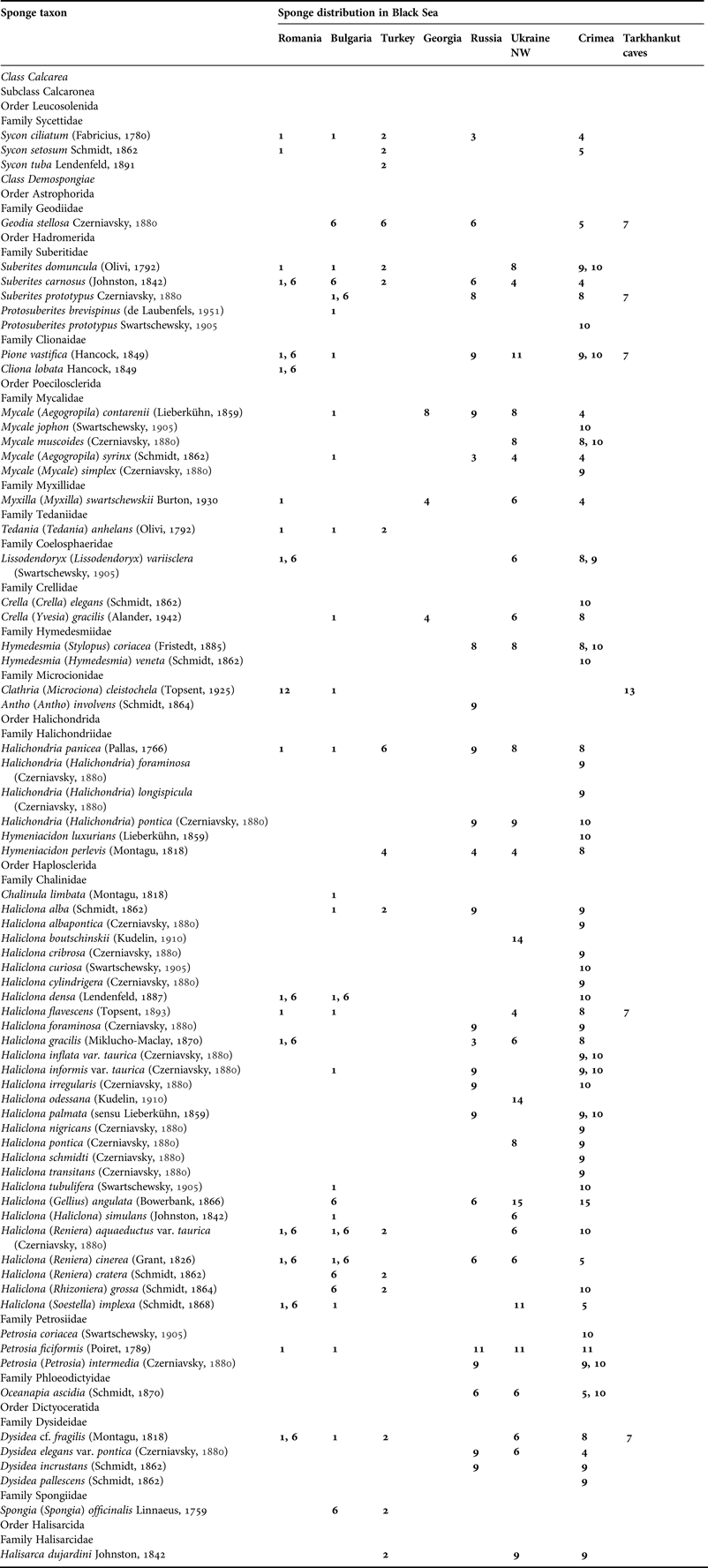
A good example of this pattern is the phylum Porifera. The first studies on Black Sea sponges were published by Czerniavsky (Reference Czerniavsky1880), Swartschewsky (Reference Swartschewsky1905) and Kudelin (Reference Kudelin1910). Kaminskaya (Reference Kaminskaya1961, Reference Kaminskaya1966, Reference Kaminskaya and Vodjanitskij1968), later undertook the taxonomic revision of sponges and their biogeographic affinities. Three checklists of Black Sea sponges have also been published (Bačescu et al., Reference Bačescu, Muller and Gomoiu1971; Gomoiu & Skolka, Reference Gomoiu and Skolka1998; Topaloğlu & Evcen, Reference Topaloğlu and Evcen2014). According to all these studies, 68 species of sponges inhabit the Black Sea (see Appendix 1). This represents only 10.5% of the total number of sponges described in the Mediterranean Sea (Pansini & Longo, Reference Pansini and Longo2003).
These data are now undoubtedly out of date, revealing the need for a major revision going beyond morphology into molecular-genetic methods.
The main objectives of this study are (1) a detailed geomorphological description of several semi-submerged and submerged shallow water marine caves from the Tarkhankut Peninsula (Crimea), and (2) their biological characteristics. In addition, we set a goal (3) to study species composition and distribution of sponges in these caves.
MATERIALS AND METHODS
This paper is based on the geomorphological descriptions and faunal material collected during the extensive Sea Caves of Ukraine research expedition in 2009–2011.
Work was carried out in three semi-submerged caves (Scuba Divers, Love and PK-356) and in two shallow-water submerged caves (Tarzanka and PK-324). All are located on the western tip of the Tarkhankut Peninsula (Figure 1).
Map showing investigated caves in the northern Black Sea (Peninsula of Crimea).

Caves descriptions were conducted using classic geological and hydrobiological methods such as three-dimensional mapping, as well as methods originally developed by the authors of this study. All work was carried out using scuba equipment. All surveys of the caves were digitally recorded using a Sony 3CCD camcorder. Morphometric data obtained are listed in the Ukraine Caves Cadaster (http://www.institute.speleoukraine.net/).
The coordinates of the cave entrances were determined using a Garmin 12XL GPS navigator unit. Depths were measured with a Mares M2 diving depth gauge to an accuracy of 0.1 m. Underwater tunnels, domes and crevices were measured using a standardized flexible reinforced-plastic ruler. Underwater topographic mapping was conducted according to the following technique: length and azimuth were measured between survey pegs placed near the marine cave entrances. Then an azimuthal survey of the cave was done using an underwater compass and the survey pegs. The basis for topographic mapping was thus obtained. Cross-sections of each cave were drawn using survey pegs. Photographs were taken with a Nikon P6000 digital camera. Faunal sampling has been made by visual observation and photography taken with a Nikon P6000 digital camera analysis.
RESULTS
All caves described are located in the territory of the West Tarkhankutskii karst area on the south coast of the Tarkhankut Peninsula (Figure 1). The primary host rock is medium-Sarmatian dense, thick layered or massive limestone ranging in colour from light grey to white.
Scuba Divers Cave
CAVE DESCRIPTION
The cave known as Scuba Divers Cave is a semi-submerged cavity which is oriented in a S–N direction with entrance coordinates of 45°19′59.3″ N and 32°34′17.6″ E (Table 1, Figure 2). The main part of the cave is of karst origin, with initial karst cavities that have undergone sea abrasion. The cave is located at sea level. Its lower part is flooded with water to a depth of 4 m. Water depth at the entrance is as high as 3.5 m, decreasing to 1 m towards the end of the cave. The ceiling is 3 m above the water level. The cave is wedge-shaped in the longitudinal section, and predominantly trapezoidal with a flat ceiling in the transversal sections. Maximum width of the cave (10 m) is observed in the large chamber and maximum height (8.5 m) is located at the entrance.
Scuba Divers Cave in the northern Black Sea (Peninsula of Crimea).
The main characteristics of investigated underwater caves from Tarkhankut Peninsula (Crimea).
This cave consists of three aligned chambers of various sizes connected by low and narrow passages of varying lengths (Figure 2). Between chambers 2 and 3, the ceiling of the cave is at sea level, forming a half-siphon. On the cave floor in the far (north) chamber there are several blocks of limestone, some of which break the surface of the water. Against the far wall there is a small pile of limestone rubble protruding above the surface. The floor of the western branch of the cave is sandy and rises towards the cave end, where the height of the tunnel does not exceed 1 m. The floor of the main part of the cave is also sandy, and is littered with rocks and boulders.
The cave, when eastern and southern winds blow, is inaccessible due to strong wave action. In the inner reaches of the cave wave action is lesser, allowing for abundant incrustation of marine organisms in the wall niches and the small branches of the cave. The terminal, shallow part of the cave fills up periodically with a great amount of debris brought in by storms, including dead macrophytes, jellyfish and various other detritus. This organic matter provides food for crabs, shrimps and some fishes. Illumination in most parts of the cave is very limited, except for near the small entrance. The most distant room from the entrance is always dark.
CAVE BIOTA
The surface of the lateral walls of the cave entrance is covered with macrophyte algae, predominantly the brown algae Cystoseira barbata (Stackhouse) C. Agardh, 1820, and C. crinita Duby, 1830. The upper zone of the cave entrance features encrusting red algae Corallina mediterranea (Areschoug, 1852) and Lithothamnion sp. In the middle zone at a depth of 1.0–2.0 m Phyllophora crispa (Hudson) P.S. Dixon, 1964 is commonly observed. Beyond section A-A1, it is a drastic reduction of incoming light to the cave, there is an almost complete absence of macrophytes. They give way to dense colonies of Obelia sp., in particular in the upper zone where this hydroid can form a continuous cover to a depth of 1.0–1.5 m. The hollows and rock cavities of the upper zone support mussels (Mytilus galloprovincialis (Lamarck, 1819)), the small (up to 2 cm) clam Mytilaster lineatus (Gmelin, 1791) and the gastropod Rapana venosa (Valenciennes, 1846). The boring bivalve Petricola lithophaga (Retzius, 1788) is widespread along the rock walls. The cave entrance and middle part are inhabited by the common rock shrimp Palaemon elegans (Rathke, 1837) and by several species of crabs including Eriphia verrucosa (Forskål, 1775), Pilumnus hirtellus (Linnaeus, 1761) and Pachygrapsus marmoratus (Fabricius, 1787). The rare shrimp Palaemon serratus (Pennant, 1777) is found only in the dark zones of the cave. The very rare Black Sea red shrimp Lysmata seticaudata (Risso, 1816) also inhabits these zones. Throughout the lower section of the cave the common shrimp Hemimysis lamornae pontica (Couch, 1856) and Siriella jaltensis (Czerniavsky, 1868) can be found. They form numerous clusters in the wall cavities with populations reaching several hundred specimens m−3. Hemimysis serrata (Bačescu, 1938), a rare species which is endemic to the Azov-Black Sea Basin and which is included in the Black Sea red data book (Akimov, Reference Akimov2009) is also present. This species had formerly been observed near the Romanian coast only.
The sea-anemone Sagartia elegans (Dalyell, 1848) was also established as a Black Sea species following its discovery in this cave. In many areas the walls of the cave are covered with tubes of the polychaete Ficopomatus sp., and in the niches of the wall there are tubes of the rarer Serpula vermicularis (Linnaeus, 1767). There are more than 15 species of fish in the cave, most of which are trogloxenes which enter the cave to spend the night only. Permanent inhabitants of this cave are Gobius cobitis (Pallas, 1814), G. bucchichi (Steindachner, 1870), Parablennius sanguinolentus (Pallas, 1814), Atherina boyeri Risso, 1810 and the rare wrasse Ctenolabrus rupestris (Linnaeus, 1758), which is found in Crimea almost exclusively in caves.
SPONGES
From the cave entrance as far as section A-A1 (up to 10–15 m deep), the dominant sponge species is Dysidea cf. fragilis (Montagu, 1818). These sponges are generally bright blue in colour and present an uneven, convex surface, especially on the illuminated side. In most cases they are hemispherical in shape, with sizes varying from 1 to 2 cm. They may also take the form of a flat crust with a thickness of 1 cm and a diameter of 10 cm (Figure 3A). In the dim zones of the cave between sections A-A1 and B-B1, D. cf. fragilis occurs sporadically and can have a flattened habitus and be mauve or pale yellow in colour (Figure 3B). All the walls of the cave have been perforated by the boring sponges Pione vastifica (Hancock, 1849) (Figure 3C). This species also perforates shells of Mytilus galloprovincialis and Rapana venosa.
Sponges from the Tarkhankut caves. (A) Dysidea cf. fragilis light blue morph; (B) Dysidea cf. fragilis mauve morph; (C) Pione vastifica; (D) Haliclona flavescens; (E) Haliclona sp.; (F) Geodia stellosa; (G) Suberites prototypus; (H) Clathria (Microciona) cleistochela specimen encrusting on a mussel.
Beyond section A-A1 the encrusting sponge Haliclona flavescens (Topsent, Reference Topsent1893) occurs deeper than 1.0–1.5 m. It is almost colourless and covers the flat surfaces of the side walls (Figure 3D). In the niches and the deep crevices of the cave walls lives Haliclona sp. with its outstretched oscular tubes and outgrowths (Figure 3E). Its size and quantity increases from section B-B1 to section D-D1. The biggest individuals of Haliclona sp. were found in niches of the horizontal rock surface at a distance of more than 50 m from the entrance. Vertical rock surfaces are covered with encrusting forms of Haliclona sp. with short outgrowths. Also present are the mainly globular forms of Geodia stellosa (Czerniavsky, Reference Czerniavsky1880) (Figure 3F), and also the encrusting Suberites prototypus (Czerniavsky, Reference Czerniavsky1880) (Figure 3G). Haliclona flavescens inhabits the big boulders which make up the substrate of the floor of this cave in areas with a projective cover area of about 20–40%. Here, rare specimens of Clathria (Microciona) cleistochela (Topsent, 1925) encrusting mussel shells, occur as a thin red crust measuring up to 1–2 cm (Figure 3H). The innermost shallow part of the cave with a depth of up to 1 m lack of the sponges.
Love Cave (PK-333)
CAVE DESCRIPTION
Love Cave is semi-submerged and is oriented in an E–W direction with cave entrance coordinates of: 45°20′27.7″N and 32°31′29.7″E (Table 1, Figure 4).
Love Cave (PK-333) in the northern Black Sea (Peninsula of Crimea).
The cave has a rather simple form. The main part is of karst origin, subsequently transformed through abrasive processes. The entrance is located on the abrasive shore. The cave can be divided into two parts: the extensive area of the entrance region (to section F-F1) which has a plane-parabolic shape and the main part of the cave (up to section F-F1). This second part consists of a straight wide passage, receding from the entrance area at a mitred acute angle. The main part of the cave consists of a single short, wide branch which terminates in a dead-end (section K-K1). In its terminal part are two small niches, 1.5–4.0 m in length and 0.7 m in height. In the left (west) niche there is a freshwater spring. A few metres from the niche, the sea water is much colder than in other parts of the cave. Fresh water issuing from the rock accumulates in a 20–30 cm layer on the surface of the salt water.
The entire cave is located on one level. The cave floor is nearly flat, rising gently from the entrance to the closed end. The depth of water at the cave entrance can be up to 4 m, but then decreases rapidly to a depth of 1.2–1.8 m. The height of the ceilings also varies slightly between 2.0–3.0 m above water level. The maximum width of the cave (37 m) is located at a distance of 15 m from the entrance. The maximum height (14 m) is located at the entrance to the cave under the rocky peak.
The floor of the cave is covered with well-rounded limestone boulders with gravel in between them. There are also large, well-rounded slabs of limestone. The cave floor in the innermost reaches is covered with small pebbles. Along the right wall of the central section the cave floor is sandy between boulders and along submerged tunnels. The cave is fairly exposed during storms and impossible to access in windy weather.
CAVE BIOTA
Above the water line the rocky walls of the cave are lightly covered with green and blue-green algae. The species composition of the cave is similar to adjacent coastal water areas. On the rocks and boulders the sea-anemone Actinia equina (Linnaeus, 1758) can be found in different colour variations. In the upper zone to a depth of 2 m live numerous mussels (Mytilus galloprovincialis) covered with epibiotic organisms such as the colonial ascidian Botryllus schlosseri (Pallas, 1766) and bryozoans, small polychaetes and sponges. The uppermost portion of the side walls is covered with Obelia sp. hydroids.
The stone shrimp Palaemon elegans, the pennywort crab Xantho poressa (Olivi, 1792) and the stone crab Eriphia verrucosa are commonly found under stones. Pisidia longimana (Risso, 1815) lives in the recesses of rocks, among mussels and under stones. Love Cave is inhabited by Gobius cobitis and Lepadogaster lepadogaster (Bonnaterre, 1788). A recent Black Sea invasive species, the golden goby Gobius xanthocephalus (Heymer & Zander, 1992) inhabits the entrance of this cave. Gobius bucchichi Steindachner, 1870 lives among the rocks. In the daytime Crenilabrus tinca (Linnaeus, 1758), Atherina boyeri and Spicara smaris (Linnaeus, 1758) can be observed in the cave, as can the predatory fishes Scorpaena porcus (Linnaeus, 1758) and Gaidropsarus mediterraneus (Linnaeus, 1758).
SPONGES
Sponge distribution in the entrance zone of the cave is similar to what is found on the rocks outside the cave entrance. However, the permanent inflow of fresh water in the terminal section influences sponge distribution in the upper (1–2 m depth) zone. The cave's funnel-shaped entrance is completely open to the sea, so the real cave per se begins with section F-F1, where the distribution of sponges is typical of dark areas. At the entrance the blue sponge Dysidea cf. fragilis is sharply reduced in number and then disappears. The eastern wall of the cave, rich with different niches and cavities, is more abundantly populated by sponges. Geodia stellosa occurs on almost all vertical and inclined surfaces, and may take the form of tall spherical specimens up to 5 cm high (Figure 3F). Haliclona sp. with long outgrowths is abundant in the niches and recesses. The encrusting red sponge Clathria (Microciona) cleistochela is found on side walls with weak positive slope and on horizontal surfaces of large boulders. In the middle chamber of the cave Suberites prototypus is quite numerous. Most of the side walls are covered with the sponge Haliclona flavescens, in the form of thin crusts, sometimes with small outgrowths. Most of the rocks in the niches have been perforated by the boring sponge Pione vastifica.
Cave PK-356
CAVE DESCRIPTION
Cave PK-356 is a semi-submerged abrasive cavity. The cave is oriented in a N – S direction, with entrance coordinates of: 45°27′9.13″N and 32°33′3.16″E (Table 1, Figure 5).
PK-356 Cave in the northern Black Sea (Peninsula of Crimea).
This cave is wedge-shaped, and is parabolic, trapezoidal in section. The floor rises gently from the entrance to the inner regions. The maximum height of the cave (8 m) occurs at the entrance, in a small rocky peak. Otherwise, the height of the cave is 6 m, of which 3 m are flooded by the sea. The height of the cave decreases with distance from the entrance. The maximum width of the cave (8 m) is also located at the entrance. The ceiling of the cave is rough and slightly flattened.
On the cave floor near the entrance are large, slightly rounded boulders interspersed with smaller rocks and pebbles. In the back of the cave, well-rounded boulders and pebbles dominate, with small areas covered by sand. The water depth at the entrance is 3 m and at the end of the cave 0.8 m. During storms the access to the cave is difficult. The cave has flat and smooth contours and is open to direct wave influence during northern storms.
CAVE BIOTA
This affects the distribution and abundance of hydrobionts. The entrance zone of the cave is covered with algae and invertebrate species characteristic of the surrounding open sea rock area. The walls have numerous small cracks and grooves, which are inhabited by Mytilus galloprovincialis and small Mytilaster lineatus. The main epibionts of the side parts of the cave walls are bryozoans, the ascidian Botryllus schlosseri and the tube-dwelling polychaete Spirorbis sp.
SPONGES
Cave PK-356 does not exhibit a rich variety of sponges. The most frequently occurring is Pione vastifica, which perforates the surface of rocks and the shells of molluscs. Dysidea cf. fragilis inhabits the entrance area of the cave, as well as the surrounding rocks. Haliclona flavescens settles deeper in the rocks and cracks, starting at approximately 6 m from the entrance and continuing to be found till the end of the cave. On vertical walls in the middle part of the cave some specimens of Suberites prototypus can be observed.
Tarzanka Cave
CAVE DESCRIPTION
Tarzanka Cave is a submerged karst cavity. The cave is oriented in a S–N direction, with cave entrance coordinates of: 45°20′5″N and 32°33′21″E (Table 1, Figure 6). Some passages are too narrow to permit the complete investigation of the cave.
Tarzanka Cave in the northern Black Sea (Peninsula of Crimea).
The cave was formed above sea level and underwent abrasion after subsequent sinking below sea level. The cave has a complex shape and structure (Figure 6). Most of the cave is completely flooded by the sea. It has air-filled domes (cavities) that are above water level. The dome in the west entrance chamber (section E-E1) has a rounded shape with a diameter of 5.5 m and an air gap height of −0.3–0.7 m. The second air-filled dome is located north of the eastern entrance to the cave (section L-L1). Cavity height above sea level is 1.5–3.0 m. This dome includes a dry area. The third air-filled dome is visible above section G-G1. The maximum width of the cave (10 m) is in the western part of the first chamber where the cave reaches its maximum height of 6 m.
The cave floor at the entrance is flat, rising by terraces towards the cave end. The depth of the western entrance to the cave is 7 m. The ceiling of the dome is at a depth of 2 m. The floor rises sharply towards the north. The floor of the eastern cave entrance (section B-B1) is also located at a depth of 7 m and rises in the direction of B-B1. The underwater parts of the walls are eroded. Numerous round niches of 1–1.5 m length can be observed.
Light penetrates only into the entrance of the cave and the inner areas are in darkness. Hydrodynamic conditions of the cave are such that in spite of strong storms the internal, circular part of the cave is only minimally eroded.
CAVE BIOTA
The fauna of Tarzanka Cave has been well-studied (Kovtun & Pronin, Reference Kovtun and Pronin2011a, Reference Kovtun and Proninb). Currently, 18 species of hydrobionts from this cave have been entered into the Black Sea red data book (Akimov, Reference Akimov2009), three species figure in the Berne Convention on the Conservation of European Wildlife and Natural Habitats (1979), and 11 can be found in the Black Sea red data book (Dumont Reference Dumont1999). The most remarkable discovery in this cave is the very rare Black Sea shrimp, Lysmata seticaudata. In Tarzanka Cave some species rare for the Black Sea have been found: the sea-anemone Sagartia elegans, the goby Gammogobius steinitzi Bath, 1971 and the mysid Hemimysis serrata. This cave shelters the populations of rare bright red sea-anemone Actinia equina. The shelly floor is covered in many places with bryozoans and the colonial ascidian Botryllus schlosseri. As is the case in other dark caves, Tarzanka hosts several species of fish which enter only at night: amongst those are Sciaena umbra (Linnaeus, 1758), Symphodus tinca (Linnaeus, 1758), Mullus barbatus ponticus (Essipov, 1927), and others. In the entrance part can be found numerous specimens of the gobies Gobius bucchichi and Gobius xanthocephalus.
SPONGES
As in other caves, in the light entrance area of Tarzanka Cave the dominant sponge species is Dysidea cf. fragilis in its blue colour morph. In the locality of section D-D1 its colour has changed from blue to yellow, and it is not found beyond this point. The most interesting area of this cave is a zone from section E-E1 to section J-J1 where the lateral branches of the narrow circular tunnel are almost entirely covered with the sponges Haliclona flavescens and Haliclona sp. Surface outgrowth of Haliclona sp. are as long as 10–15 cm in some specimens in the most protected part of the cave, and 1–2 cm in other areas. On the smooth walls of the narrow parts of the cave where there is strong horizontal movement of the water during storms, the dominant species is Geodia stellosa. Here lives the encrusting sponge Clathria (Microciona) cleistochela. Most of the walls of the cave have a loose surface layer that can be eroded by rock borers and the boring sponge Pione vastifica.
Cave PK-324
CAVE DESCRIPTION
Cave PK-324 is a submerged abrasive-karst cavity. The cave is oriented in a NW–SE direction, with cave entrance coordinates of 45°30′28.6″N and 32°39′13.4″E (Table 1, Figure 7).
PK-324 Cave in the northern Black Sea (Peninsula of Crimea).
The cave has two underwater tunnels stretching inwards from a single entrance. Both tunnels lead into a low oval extension with a height of 1.0–1.5 m and a length of 7 m. In the central part of the cave (section B-B1) the ceiling rises to a height of 2.7 m and consists of a large, flat horizontal ledge (section C-C1) measuring 1.5 × 2 m. The cave ceiling is predominately flat, as is the cave floor. The underwater portion of the cave walls is uneven, and has been leached in different limestone strata.
The walls have many large, flattish pocket-like cavities (average width of 1 m and height of 20 cm). The cave floor is covered with rounded boulders, limestone rubble and sand. In some areas the floor is rock. In an extension of the cave, near the middle, there is a circular air pocket of about 2.5 m in diameter. The cave entrance is located at a depth of less than one metre and the floor is at a depth of 1.5–1.8 m. The shallow depth of the cave, leads it to be strongly impacted by storm waves.
CAVE BIOTA
Some areas of the surface of Cave PK-324 – notably in the upper part of the walls and ceiling – are covered with a reddish-brown coating of diatoms and cyanobacteria. The same cover is observed on the walls above the water line and in the air-filled dome. The cave shelters the pennywort crab Xantho poressa and the stone crab Eriphia verrucosa. In the pitted surface of the walls colonies of small bivalves such as Mytilaster lineatus and bryozoans have settled. In the summer period the rocks are overgrown with hydroids. The small fish Parablennius sanguinolentus can be found throughout the cave, hiding in the holes in the rocks. The fish species Symphodus tinca, Mullus barbatus ponticus, Atherina boyeri and Gobius cobitis also inhabit the cave.
SPONGES
Only four sponge species were found in PK-324 cave. The cave entrance is inhabited by small, blue, cushion-shaped Dysidea cf. fragilis. Small individuals of this species are found in the western walls of the central part of the cave. Here there are encrusting specimens of Geodia stellosa. In the southern end of the cave there are small patches of Haliclona flavescens. The most common sponge in Cave PK-324 is Pione vastifica, which perforated limestone walls over the entire length of the cave.
DISCUSSION
The marine caves of Tarkhankut which we investigate were formed during the Holocene period when the sea level was 6–8 m lower than it is today. They differ in this respect from many marine caves of the Mediterranean Sea which were formed during the Würm glacial age (Lowe & Walker, Reference Lowe and Walker1997). The Tarkhankut karst caves were uncovered by abrasion processes following coastline destruction. As is the case in the majority of Mediterranean marine caves, the floors of Crimean caves are covered with debris alluvia and sand which drifted by the wave action as well as Middle Sarmatian limestone which has fallen from the cave ceiling. The caves described in this paper can be classified according to three main features: (1) location (on the northern or the southern coast of the Tarkhankut Peninsula), (2) in relation to sea level and (3) relative size (Table 1).
Caves PK-324 and PK-356 are located on the northern coast of the peninsula. Accordingly, their entrances open to the north (onto Karkinitsky Bay). These caves are influenced by waves from the north and west. Winds from these directions generally blow in the autumn-winter period. Love, Tarzanka and Scuba Divers Caves are located on the southern coast of the peninsula, with southward-opening entrances. These caves are affected by the waves associated with the winds from the west, south and east that blow during the warmer months.
Caves PK-324 and Tarzanka are submerged. Unlike the other caves, they are subject to less wave action, as their entrances are located below sea level, which protects them to some extent from hydrodynamics from water-movement. However, Tarzanka Cave is much better protected, as the main striking force of the waves spreads over the cave entrance on the flat surface of the rocks and on to the shore. The circular structure of its tunnels with multiple niches and branches make a habitat which is suitable for animals. The entrance to PK-324 is situated on a cliff and the striking power of waves is obviously stronger. A further difference which distinguishes these two caves from the others is the lesser degree of illumination: indeed, light penetrates into these two caves through the water only. Any slight decrease in illumination on the surface leads to a dramatic reduction of light in the cave.
A third group of relatively large caves can be set apart from the others by their lengths (>100 m): this group includes Love, Scuba Divers and Tarzanka Caves (Table 1). The large size and, accordingly, the large volumes and areas of porous surfaces and cavities in these caves create better conditions for the existence of more diverse species communities.
Marine caves offer a unique variety of rare habitats which may shelter highly specialized invertebrates, many of which are of significant interest such as sponges, various crustaceans (copepods, mysids, shrimps), bryozoans, cnidarians and fishes. These caves appear to be characterized by a similar distribution of their inhabitants, regardless of the geographic location of the sea they are associated with (Gerovasileiou & Voultsiadou, Reference Gerovasileiou and Voultsiadou2012). One of the significant features of this habitat is the drastic decrease in species diversity, biomass and the colonized surfaces in cave communities which is noticeable as distance from the cave entrance increases (Harmelin et al., Reference Harmelin, Vacelet and Vasseur1985). It is known that light and water-movement reduction are the main factors controlling species composition and community structure in marine caves (Ott & Svoboda, Reference Ott and Svoboda1976; Gili et al., Reference Gili, Riera and Zabala1986; Balduzzi et al., Reference Balduzzi, Bianchi, Boero, Cattaneo Vietti, Pansini and Sarà1989; Bianchi et al., Reference Bianchi, Cattaneo-Vietti, Cinelli, Morri and Pansini1996). Another important factor is the locality of the cave (Pérès & Picard, Reference Pérès and Picard1949; Riedl, Reference Riedl1966).
The diversity of fauna in the caves we investigate herein decreases in the following order: Scuba Divers – Tarzanka – Love – PK-324 – PK-356. This shows that the longer and more well-protected from wave action a cave is, the richer it is in species composition of crustaceans, sponges, polychaetes and fishes. The cave floor is covered with stones, boulders of different shape and sizes, creating favourable conditions for the nocturnal shelter of diurnal fishes (Mullus barbatus ponticus, Atherina boyeri, Labridae, Gobiidae and others). The constant availability of food and sufficient depth also create a favourable habitat for prey fishes (Scorpaena porcus, Gaidropsarus mediterraneus, Gobiidae) and for numerous large sea anemones (Actinia equina) that eat the young fishes, crustaceans, etc. The cave walls are covered with a variety of encrusting organisms, including sponges. Almost the entire surface of the side walls to a depth of 1.5–2.0 m is covered with colonies of hydroids and bryozoans. All small cavities of all investigated caves are filled with the bivalves Mytilaster lineatus and juvenile mussels, especially in the illuminated and twilight parts of the cave.
A similar, albeit slightly different distribution of fauna is observed in Tarzanka Cave. The essential difference is the presence of a circular, branched tunnel with a permanently dark area in which dwell animals with negative phototaxis and species not able to withstand wave action. Some species new to the Black Sea have recently been discovered here (Kovtun, Reference Kovtun2010, Reference Kovtun2012; Kovtun & Pronin, Reference Kovtun and Pronin2011a, Reference Kovtun and Proninb; Kovtun & Petriashev, Reference Kovtun and Petriashev2012; Grebelniy & Kovtun, Reference Grebelniy and Kovtun2013). Tarzanka Cave shelters almost all the species of fish that live in the open waters of this area (personal observations).
Love Cave is distinguished by the influence of a freshwater spring which, depending on wind strength, can create a layer of fresh water in the cave that may reach from a few centimetres to a metre deep. Hydroids in this cave are not common in the upper layers where they begin to be found only from a depth of 0.5–1.0 m. They do not extend deep into the cave. Sponges are observed mainly on the rocks and in the lower niches of the walls. As has been seen in other caves, Love Cave provides a favourable nocturnal environment for diurnal fishes and for permanently residing predators. Seasonal dynamics of species composition in this cave are probably under-evaluated, because winter storms do serious damage to the epifauna whose numbers are reduced to a minimum with the exception of the fixed molluscs and polychaetes. The smooth, well-rolled and polished boulders and stones on the cave floor indicate very strong wave action in this cave during the winter.
Adaptation by cave-dwelling organisms from different taxonomic groups depends mainly on their trophic requirements (Harmelin et al., Reference Harmelin, Vacelet and Vasseur1985; Zabala et al., Reference Zabala, Riera, Gili, Barange, Lobo and Penuelas1989; Fichez, Reference Fichez1990, Reference Fichez1991a, Reference Fichezb) and on factors of light and hydrodynamics (Cinelli et al., Reference Cinelli, Fresi, Mazzella, Pansini, Pronzato, Svoboda, Keegan, Ceidigh and Boaden1977; Balduzzi et al., Reference Balduzzi, Bianchi, Boero, Cattaneo Vietti, Pansini and Sarà1989). Active filter feeders such as sponges are well adapted to this environment, due to their high ability to absorb the small organic particles (Simpson, Reference Simpson1984; Ramoino et al., Reference Ramoino, Ledda, Ferrando, Gallus, Bianchini, Diaspro, Fato, Tagliafierro and Manconi2011) which are brought in great quantity into caves. As a result, sponges are highly competitive organisms in marine caves (Harmelin et al., Reference Harmelin, Vacelet and Vasseur1985) and almost always dominate in sciaphilic communities (Vacelet, Reference Vacelet1979, Reference Vacelet1996).
Our study showed the dominance of sponges in the caves of the Tarkhankut Peninsula. However, the community structure, abundance and biomass of these sponges vary from cave to cave and require special quantitative investigation. The most pertinent criteria, in our view, are cave depth and degree of protection from offshore storm action.
Spatial analysis of the horizontal distribution gradient of sponge fauna from Crimean marine caves reveals similarities to shallow-water Mediterranean caves (Corriero et al., Reference Corriero, Liaci, Ruggiero and Pansini2000; Marti et al., Reference Marti, Uriz, Ballesteros and Turon2004). Indeed, the majority of species found in the middle zones of caves show a mosaic-like distribution. This distribution pattern can be explained by the preferences of certain species for certain hydrological conditions (Pansini & Pronzato, Reference Pansini and Pronzato1982). The increase in the biomass of sponges at 10 m from cave entrances may be explained by the drastic diminution of photophilic animals and algae, which frees up space and reduces competitive conditions. The presence of branches and niches in caves changes the hydrodynamic conditions on the micro-scale and contributes to the development of sponges. This occurs, for example, in the ring tunnel of Tarzanka Cave. Scuba Divers Cave is well protected from the strong turbulence of water throughout the year, and the development of sponges appears to be determined by the presence of suitable substrates, depth and light. The terminal zone of this cave is almost uninhabited by sponges as a result of fluctuations in water level. Thus, the overall picture of the distribution of sponges is different in long, marine caves, but the general pattern of increasing and decreasing sponge coverage with depth persists.
Species composition of sponges of the caves of Crimea is quite different from that observed in Mediterranean caves (Pouliquen, Reference Pouliquen1972; Balduzzi et al., Reference Balduzzi, Bianchi, Boero, Cattaneo Vietti, Pansini and Sarà1989; Harmelin & Vacelet, Reference Harmelin and Vacelet1997; Arko-Pijevac et al., Reference Arko-Pijevac, Benac, Kovacic and Kirincic2001; Gerovasileiou & Voultsiadou, Reference Gerovasileiou and Voultsiadou2012). This is probably due to the geographic isolation of the Black Sea and the differences in the hydro-chemical parameters of the milieu (water salinity in Tarkhankut is 18–21‰).
In our investigations of five shallow-water marine caves we inventoried only seven sponge species, all from the class Demospongiae (Table 2), which represent only 2.2% of the Porifera of Mediterranean marine caves (Gerovasileiou & Voultsiadou, Reference Gerovasileiou and Voultsiadou2012; Manconi et al., Reference Manconi, Cadeddu, Ledda and Pronzato2013). It is interesting that some of the Crimean marine cave sponge species we describe had previously been observed in adjacent open seawater (Appendix 1). All these species are tolerant to different hydrological conditions, mostly temperature and salinity. Some of them have wide geographic distribution.
Sponges from underwater caves from Tarkhankut (Crimea) and their distribution in relation to the entrance to the cave.
Dysidea cf. fragilis is widely distributed in the central and north Atlantic Ocean from the American to the European coast (Van Soest et al., Reference Van Soest, Boury-Esnault, Hooper, Rützler and de Voogd2015). It is common in the Mediterranean Sea in both open waters and in the semi-dark zones of some caves (Pansini & Longo, Reference Pansini and Longo2003; Gerovasileiou & Voultsiadou, Reference Gerovasileiou and Voultsiadou2012). It is also widely distributed in the Black Sea at depths of 0.3–40 m (de Laubenfels, Reference de Laubenfels1951; Kaminskaya, Reference Kaminskaya1961, Reference Kaminskaya and Vodjanitskij1968; Bačescu et al., Reference Bačescu, Muller and Gomoiu1971; Gomoiu & Skolka, Reference Gomoiu and Skolka1998; Topaloğlu & Evcen, Reference Topaloğlu and Evcen2014).
Pione vastifica is a widely distributed species in the Atlantic Ocean from West Africa to the Arctic (Van Soest et al., Reference Van Soest, Boury-Esnault, Hooper, Rützler and de Voogd2015). It is common in the Mediterranean Sea in both open waters and in the semi-dark and dark zones of many different Mediterranean caves (Pansini & Longo, Reference Pansini and Longo2003; Gerovasileiou & Voultsiadou, Reference Gerovasileiou and Voultsiadou2012). In the Black Sea this species is widely distributed in coastal zones of Crimea, Caucasia and in the western regions at depths from 1 to 42 m (Kaminskaya, Reference Kaminskaya and Vodjanitskij1968; Bačescu et al., Reference Bačescu, Muller and Gomoiu1971; Gomoiu & Skolka, Reference Gomoiu and Skolka1998).
Haliclona flavescens has been recorded in this work for the first time in a marine cave habitat. This species is distributed in the Western Mediterranean, in Catalonia and the Balearic Islands (Topsent, Reference Topsent1893; Pansini & Longo, Reference Pansini and Longo2003), and on the Tunisian coast (Ben Mustapha et al., Reference Ben Mustapha, Chaouh and Dhahbi2007). In the Black Sea its range extends from depths of 2 m (in caves) to 35 m (in open water) in the north-western region, near the coasts of Crimea, Bulgaria and Romania (de Laubenfels, Reference de Laubenfels1951; Kaminskaya, Reference Kaminskaya1961, Reference Kaminskaya and Vodjanitskij1968; Bačescu et al., Reference Bačescu, Muller and Gomoiu1971; Gomoiu & Skolka, Reference Gomoiu and Skolka1998).
Clathria (Microciona) cleistochela is a predominantly Mediterranean species (Pansini & Longo, Reference Pansini and Longo2003; Voultsiadou, Reference Voultsiadou2005), although it has also been observed in the Azores and Canary Islands (Cruz, Reference Cruz2002). In the Black Sea it has been inventoried in the Bulgarian coastal zone at depths of 0–5 m (de Laubenfels, Reference de Laubenfels1951; Kaminskaya, Reference Kaminskaya and Vodjanitskij1968; Bačescu et al., Reference Bačescu, Muller and Gomoiu1971; Gomoiu & Skolka, Reference Gomoiu and Skolka1998). This species had never been observed in caves prior to our study (Ereskovsky & Kovtun, Reference Ereskovsky and Kovtun2013).
Geodia stellosa is endemic to the Black Sea and inhabits the coastal zone of Crimea in semi-dark and dark caves at depths of 0.3–5.0 m (Kaminskaya, Reference Kaminskaya and Vodjanitskij1968).
Suberites prototypus is also endemic to the Black Sea. In this work it has been recorded for the first time in a marine cave habitat. This species is widely distributed in the coastal zones of Crimea, Caucasia and in the western region at depths of 3–90 m (Swartschewsky, Reference Swartschewsky1905; Kaminskaya, Reference Kaminskaya1961, Reference Kaminskaya and Vodjanitskij1968; Bačescu et al., Reference Bačescu, Muller and Gomoiu1971; Gomoiu & Skolka, Reference Gomoiu and Skolka1998).
FINANCIAL SUPPORT
This work has been supported by grants from the Russian Foundation for Basic Research (no. 15-04-07554) and is a contribution to the Labex OT-Med (no. ANR-11-LABX-0061) funded by the French Government ‘Investissements d'Avenir’ programme of the French National Research Agency (ANR) through the A*MIDEX project (no. ANR-11-IDEX-0001-02).
Appendix 1
Taxonomic composition and distribution of Black Sea sponge fauna.