Introduction
Cardiovascular disease (CVD) is a major public health burden and is a leading cause of morbidity and mortality in both developed and developing countries Reference McAloon, Boylan and Hamborg1 . In addition to suboptimal lifestyle and environmental factors in adult life, early life experiences are believed to contribute to CVD Reference Blackmore and Ozanne2 . Preterm birth (PTB) affects 5%–8% of pregnancies worldwide with an estimated 15 million babies born before the completion of 37 weeks’ of gestation each year Reference Purisch and Gyamfi-Bannerman3 . In addition to being the leading cause of mortality among neonates, infants, and children under 5 years of age, there is an increasing evidence to show that those born preterm are at increased risk of developing CVD in adulthood Reference Kajantie and Hovi4 . With one in 10 babies born preterm and >99% surviving due to improved newborn care, long-term health outcome of those born preterm is a growing health concern Reference Saigal and Doyle5 .
A number of studies have identified PTB as a risk factor for higher blood pressure (BP), higher body mass index (BMI), and type 2 diabetes mellitus (T2DM). A systematic review and meta-analysis reports that PTB associates with an increased risk of T2DM Reference Li, Zhang, Tian, Liu, Yin and Xi6 . However, other studies have shown no association between PTB and systolic BP (SBP) or insulin sensitivity. A recent systematic review that evaluated risk factors for CVD among adults (≥ 18 years of age) born preterm reports that PTB is associated with higher SBP, diastolic BP (DBP), 24 h DBP, fat mass, glucose, insulin, and total cholesterol levels Reference Markopoulou, Papanikolaou, Analytis, Zoumakis and Siahanidou7 . However, whether this elevated risk factor profile is evident from childhood is not known. Therefore, our primary aim was to conduct a systematic review and meta-analysis on the association between PTB and key risk factors for CVD including BP, BMI, fasting glucose, insulin, and lipids using data from studies from birth until adulthood. Our secondary aim was to assess the risk factor profile based on gender, age, gestational age at birth, and PTB associated with small for gestational age (SGA) or average for gestational age (AGA) subgroups.
Methods
Data sources and search strategy
This systematic review and meta-analysis was conducted in accordance with the Preferred Reporting Items for Systematic reviews and Meta-Analysis (PRISMA), Reference Moher, Liberati, Tetzlaff and Altman8 and the review protocol is registered with PROSPERO (CRD42018095005). The electronic databases, PubMed, CINAHL, the Cochrane Library, and EMBASE were searched with an end of search date of July 14, 2020. A full list of the search terms is included in the Supplementary Material. Earlier reviews of relevant topics and bibliographies of included papers were also checked for relevant publications.
Study section and data extraction
Studies were selected if they compared CVD risk factors in offspring born preterm compared to offspring born at term. “Preterm” was defined as delivery <37 weeks’ gestation and “term” was defined as delivery ≥37 weeks’ gestation Reference Quinn, Munoz and Gonik9 . In addition, studies on very low birthweight infants where gestational age at birth was reported to be prior to 37 weeks’ gestation were also included. We included studies that reported on outcome measures including SBP, DBP, BMI, lipid levels (total cholesterol, low density lipoprotein [LDL], high density lipoprotein [HDL], nonHDL, and triglycerides), blood glucose, and fasting insulin. Studies that did not have the above definitions of “preterm” and “term”, those that did not define the groups, and those that compared preterm born with another risk group were excluded. When the same cohort was reported in multiple publications at similar ages, the study reporting on the largest sample size was included in the meta-analyses. When the same cohort was reported in multiple publications at different ages, the study reporting at the oldest age was included in the meta-analyses. However, studies reporting outcomes at different age points in separate publications were included in subgroup analyses based on the age of the offspring. All selected studies were published in peer-reviewed journals, undertaken in humans, and published in English. Two reviewers independently screened the titles and abstracts of studies. Data extraction was also conducted by two reviewers independently. Disagreements were resolved by discussion within the team.
Study quality assessment
The methodological quality was assessed by two independent reviewers using the Newcastle–Ottawa Quality Assessment Scale (NOS) which assesses three broad perspectives: the selection of the study groups; the comparability of the groups; and the ascertainment of either the exposure or outcome of interest for case-control or cohort studies, respectively Reference Wells, O’Connell, Peterson, Welch and Losos10 . The total maximum score for these three subsets is seven stars. Disagreements were resolved by discussions within the team.
Data synthesis
For studies that separately analyzed more than one full-term group defined as SGA and AGA, we used the AGA full-term group for comparison. For studies that separately analyzed more than one preterm term group defined as SGA and AGA, we extracted results for both groups. We also performed subgroup analyses based on gender, age, gestational age at birth (<32 weeks’ and <28 weeks’), preterm SGA, and preterm AGA groups. Since some articles reported more than one multivariable model, and different studies adjusted for different sets of covariates, we extracted crude mean values for each outcome from each article. The meta-analyses were performed using RevMan software (Review Manager Version 5.1.1). For each outcome measure, standardized mean difference (SMD) or mean difference (MD) and the 95% confidence interval (CI) were calculated using a random effects model. SMD was used when the outcome was measured in different units across trials and MD when units were consistent. Reference Takeshima, Sozu, Tajika, Ogawa, Hayasaka and Furukawa11 When mean and SD were not reported, the results were extracted as presented (i.e., mean ± SEM, mean and CI, or range) and are detailed in Supplementary Table 1. Substantial heterogeneity was considered when I 2 statistic exceeded 50%, and the Chi² p-value was less than 0.1. Reference Higgins, Thompson, Deeks and Altman12 Funnel plots were examined for the evidence of publication bias if more than 10 studies reported data on the same outcome (Supplementary Figs. 8–11). Reference Sterne, Egger and Smith13
Subgroup and sensitivity analyses
The robustness of results was evaluated by subgroup and sensitivity analyses. Prespecified subgroup analyses were performed to determine the risk factors based on gender, age group, gestational age at birth, and PTB associated with SGA vs AGA. Sensitivity analyses were performed based on evidence for publication bias.
Results
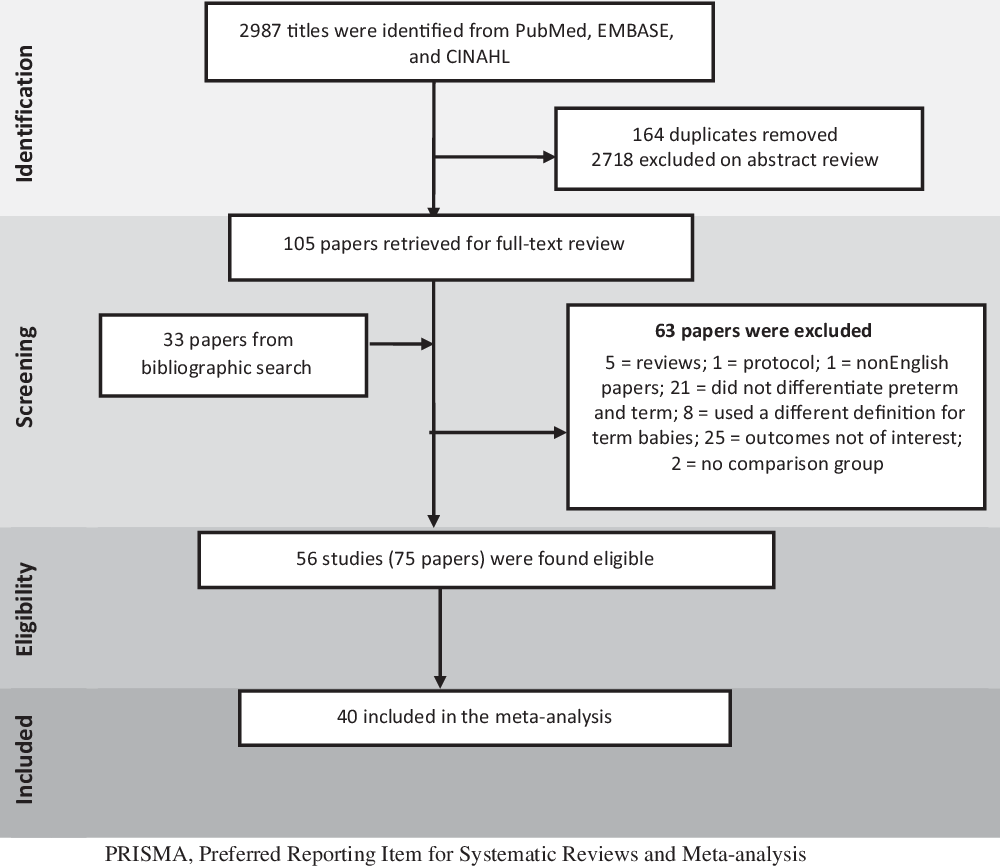
A total of 2987 articles were identified by the search, of which 105 were eligible for a full-text review (Fig. 1) and a further 33 from bibliographic search. Of these, 56 studies (published as 75 papers) were included in the review, and 40 were included in the meta-analyses (Table 1). Of the selected studies, 25 were population-based cohort studies and the others were case-control studies. The reasons for excluding 63 papers are shown in Fig. 1. Of the studies included in the meta-analyses, 11.5% were of high quality (scored 7–8), 86.9% were of moderate quality (scored 4–6), and 1.6% were of low quality (scored 1–3) as assessed by the NOS (Supplementary Table 2).
Study selection process.

Risk factor profile between those born preterm compared to term
Systolic blood pressure
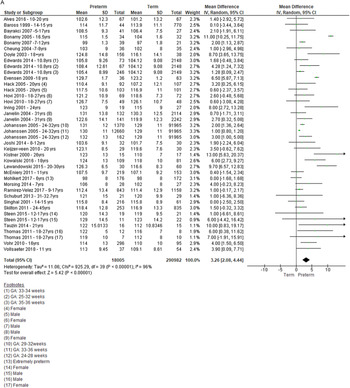
SBP data were available from 35 studies. Of these, 31 were included in the meta-analysis providing data on 308,987 individuals, of whom 18,005 were born preterm (Fig. 2A). The meta-analysis demonstrated that those born preterm have 3.26 mmHg (95% CI: 2.08 to 4.44) higher mean SBP compared to those born at term (Fig. 2A) Reference Alves, Araujo Junior, Henriques and Carvalho14–Reference Vollsaeter, Halvorsen and Markestad44 . Four studies could not be included in the meta-analysis Reference Chan, Morris, Leslie, Kelly and Gallery45–Reference Lee, Dichtl, Mormanova, Pozza and Genzel-Boroviczeny48 . Of these, two demonstrated an increase in SBP among preterm compared to term-born individuals Reference Hovi, Vohr and Ment47,Reference Lee, Dichtl, Mormanova, Pozza and Genzel-Boroviczeny48 and one demonstrated a reduction in SBP of 0.53 mmHg (95% CI: 0.32, 0.75) for every 1-week increase in gestational age after adjusting for confounders Reference Cooper, Atherton and Power46 (Supplementary Table 1).
MD in SBP between those born preterm and term.

Diastolic blood pressure
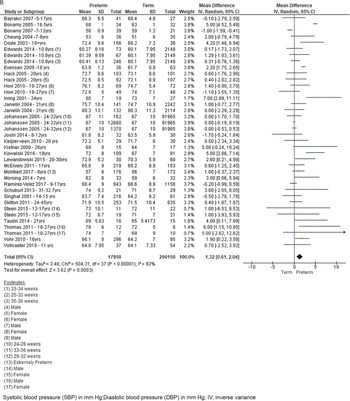
DBP data were available from 32 studies. Of these, 29 were included in the meta-analysis providing data on 308,048 individuals, of whom 17,898 were born preterm (Fig. 2B). The meta-analysis demonstrated that those born preterm have 1.32 mmHg (95% CI: 0.61 to 2.04) higher mean DBP compared to those born at term (Fig. 2B) Reference Bayrakci, Schaefer, Duzova, Yigit and Bakkaloglu16–Reference Vollsaeter, Halvorsen and Markestad44 . The three studies that could not be included in the meta-analysis showed an increase in DBP among preterm compared to the term group (Supplementary Table 1) Reference Chan, Morris, Leslie, Kelly and Gallery45–Reference Hovi, Vohr and Ment47 .
MD in DBP between those born preterm and term.

Body mass index
BMI data were available from 34 studies. Of these, 30 were included in the meta-analysis providing data on 311,030 individuals, of whom 18,077 were born preterm (Supplementary Fig. 1). The meta-analysis demonstrated that there was no difference in BMI between those born preterm and at term (MD, 0.13 kg/m2, 95% CI: −0.40 to 0.14 Supplementary Fig. 1) Reference Bayrakci, Schaefer, Duzova, Yigit and Bakkaloglu16–Reference Cheung, Wong, Lam and Tsoi19,Reference Edwards, Watkins and Kotecha21,Reference Evensen, Steinshamn and Tjonna22,Reference Hovi, Andersson and Raikkonen24,Reference Johansson, Iliadou, Bergvall, Tuvemo, Norman and Cnattingius27,Reference Keijzer-Veen, Dulger, Dekker, Nauta and van der Heijden29–Reference Lewandowski, Davis and Yu32,Reference Mohlkert, Hallberg and Broberg34,Reference Ramirez-Velez, Correa-Bautista, Villa-Gonzalez, Martinez-Torres, Hackney and Garcia-Hermoso36–Reference Vollsaeter, Halvorsen and Markestad44,Reference Bassareo, Fanos and Puddu49–Reference Shimizu, Fujii and Iwasaki56 . Four studies could not be included in the meta-analysis Reference Alves, Araujo Junior, Henriques and Carvalho14,Reference Morsing, Liuba, Fellman, Marsal and Brodszki35,Reference Darendeliler, Bas and Bundak57,Reference Hui, Lam, Leung and Schooling58 . Of these, one showed that obesity was more prevalent among those born preterm (Supplementary Table 1) Reference Alves, Araujo Junior, Henriques and Carvalho14 .
Total cholesterol
Total cholesterol data were available from 10 studies. Of these, eight were included in the meta-analysis providing data on 2705 individuals, of whom 1265 were born preterm (Supplementary Fig. 2). The meta-analysis demonstrated that there was no difference in total cholesterol between offspring born preterm and at term (SMD, 0.12 [95% CI: −0.05 to 0.30]), (Supplementary Fig. 2) Reference Irving, Belton, Elton and Walker25,Reference Joshi, Wilson, Kotecha, Pickerd, Fraser and Kotecha28,Reference Lewandowski, Davis and Yu32,Reference Ramirez-Velez, Correa-Bautista, Villa-Gonzalez, Martinez-Torres, Hackney and Garcia-Hermoso36,Reference Singhal, Kattenhorn, Cole, Deanfield and Lucas38,Reference Thomas, Parkinson and Hyde42,Reference Mathai, Derraik and Cutfield53,Reference Hovi, Turanlahti and Strang-Karlsson59 . Two studies could not be included in the meta-analysis Reference Alves, Araujo Junior, Henriques and Carvalho14,Reference Cooper, Atherton and Power46 . Of these, one reported that there was no difference in total cholesterol between preterm and term groups Reference Alves, Araujo Junior, Henriques and Carvalho14 while the other reported a reduction in total cholesterol of 0.02 mmol/l for every 1-week increase in gestational age after adjusting for confounders (Supplementary Table 1) Reference Cooper, Atherton and Power46 .
LDL cholesterol
LDL cholesterol data were available from eight studies. Of these, six were included in the meta-analysis providing data on 3437 individuals, of whom 1274 were born preterm (Supplementary Fig. 3). The meta-analysis demonstrated that there was no difference in LDL cholesterol between offspring born preterm and at term (SMD, 0.02 [95% CI: −0.10 to 0.14]), (Supplementary Fig. 3) Reference Lewandowski, Davis and Yu32,Reference Ramirez-Velez, Correa-Bautista, Villa-Gonzalez, Martinez-Torres, Hackney and Garcia-Hermoso36,Reference Skilton, Viikari and Juonala39,Reference Thomas, Parkinson and Hyde42,Reference Mathai, Derraik and Cutfield53,Reference Hovi, Turanlahti and Strang-Karlsson59 . The two studies that were not included in the meta-analysis also reported that there was no difference in LDL between the groups (Supplementary Table 1) Reference Alves, Araujo Junior, Henriques and Carvalho14,Reference Cooper, Atherton and Power46 .
HDL cholesterol
HDL cholesterol data were available from 11 studies. Of these, nine were included in the meta-analysis providing data on 3813 individuals, of whom 1538 were born preterm (Supplementary Fig. 4). The meta-analysis demonstrated that there was no difference in HDL cholesterol between offspring born preterm and at term (SMD, 0.00 [95% CI: −0.12 to 0.11]), (Supplementary Fig. 4) Reference Irving, Belton, Elton and Walker25,Reference Joshi, Wilson, Kotecha, Pickerd, Fraser and Kotecha28,Reference Lewandowski, Davis and Yu32,Reference Ramirez-Velez, Correa-Bautista, Villa-Gonzalez, Martinez-Torres, Hackney and Garcia-Hermoso36,Reference Singhal, Kattenhorn, Cole, Deanfield and Lucas38,Reference Skilton, Viikari and Juonala39,Reference Thomas, Parkinson and Hyde42,Reference Mathai, Derraik and Cutfield53,Reference Hovi, Turanlahti and Strang-Karlsson59 . The two studies that were not included in the meta-analysis also reported that there was no difference in HDL between the groups (Supplementary Table 1) Reference Alves, Araujo Junior, Henriques and Carvalho14,Reference Cooper, Atherton and Power46 .
Triglycerides
Triglyceride data were available from nine studies. Of these, seven were included in the meta-analysis providing data on 3475 individuals, of whom 1285 were born preterm (Supplementary Fig. 5). The meta-analysis demonstrated that there was no difference in triglycerides between offspring born preterm and at term (SMD, 0.03 [95% CI: −0.06 to 0.12]), (Supplementary Fig. 5) Reference Irving, Belton, Elton and Walker25,Reference Joshi, Wilson, Kotecha, Pickerd, Fraser and Kotecha28,Reference Lewandowski, Davis and Yu32,Reference Ramirez-Velez, Correa-Bautista, Villa-Gonzalez, Martinez-Torres, Hackney and Garcia-Hermoso36,Reference Skilton, Viikari and Juonala39,Reference Thomas, Parkinson and Hyde42,Reference Hovi, Turanlahti and Strang-Karlsson59 . The two studies that were not included in the meta-analysis also reported that there was no difference in triglycerides between the groups (Supplementary Table 1) Reference Alves, Araujo Junior, Henriques and Carvalho14,Reference Cooper, Atherton and Power46 .
Fasting blood glucose
Fasting blood glucose data were available from 11 studies. Of these, 10 were included in the meta-analysis providing data on 3967 individuals, of whom 1616 were born preterm (Supplementary Fig. 6). The meta-analysis demonstrated that there was no difference in fasting blood glucose between offspring born preterm and at term (SMD, −0.32 [95% CI: −0.70 to 0.07]), (Supplementary Fig. 6) Reference Irving, Belton, Elton and Walker25,Reference Joshi, Wilson, Kotecha, Pickerd, Fraser and Kotecha28,Reference Lewandowski, Davis and Yu32,Reference Ramirez-Velez, Correa-Bautista, Villa-Gonzalez, Martinez-Torres, Hackney and Garcia-Hermoso36,Reference Singhal, Kattenhorn, Cole, Deanfield and Lucas38,Reference Skilton, Viikari and Juonala39,Reference Thomas, Parkinson and Hyde42,Reference Mathai, Derraik and Cutfield53,Reference Darendeliler, Bas and Bundak57,Reference Kajantie, Strang-Karlsson and Hovi60 . The study that was not included in the meta-analysis also reported that there was no difference in fasting glucose between the groups. (Supplementary Table 1) Reference Alves, Araujo Junior, Henriques and Carvalho14 .
Fasting insulin
Fasting blood glucose data were available from eight studies. Of these, seven were included in the meta-analysis providing data on 602 individuals, of whom 307 were born preterm (Supplementary Fig. 7). The meta-analysis demonstrated that there was no difference in fasting insulin between offspring born preterm and at term (SMD, 0.06 [95% CI: −0.34 to 0.45]), (Supplementary Fig. 7) Reference Irving, Belton, Elton and Walker25,Reference Lewandowski, Davis and Yu32,Reference Thomas, Parkinson and Hyde42,Reference Mathai, Derraik and Cutfield53,Reference Darendeliler, Bas and Bundak57,Reference Kajantie, Strang-Karlsson and Hovi60,Reference Hofman, Regan and Jackson61 . The study that was not included in the meta-analysis also reported that there was no difference in fasting insulin between the groups (Supplementary Table 1) Reference Hofman, Regan and Jackson61 .
Risk factor profile based on subgroup analyses
Age
The age groups were classified according to the World Health Organization (WHO) criteria as age <10 years, child; 10–19 years, adolescent; 20–24 years, young adult; and >24 years, adult. Since some studies included a mix of children and adolescents, we classified the groups as, children, children and adolescents, adolescents and adults. SBP was higher among those born preterm compared to term in the subgroups “children and adolescents”, adolescents, young adults, and adults (Table 2). No significant difference was seen in SBP between preterm and term groups among children. No trends were seen for any difference in the other risk factors between term and preterm groups based on age (Table 2).
Characteristics of the included studies

AGA, average for gestational age; BG, blood glucose; BMI, body mass index; DBP, diastolic blood pressure; HDL, high density lipoprotein; LBW, low birth weight; LDL, low density lipoprotein; N/A, not available; SBP, systolic blood pressure; SGA, small for gestational age; TC, total cholesterol; TG, triglycerides; VLBW, very low birth weight.
* Included in the meta-analyses.
Risk factors profile of preterm born compared to term based on gender and age

Results are presented in MD or SMD with 95% CIs.
Following outcomes are presented as MD with 95% CI and the rest are in SMD.
Systolic blood pressure, diastolic blood pressure, and body mass index.
Heterogeneity is presented as Chi2 p value and I 2 percentage.
Gender
A total of 635 prematurely born (307 males; 328 females) and 4745 at term born (2293 males; 2452 females) were included in the analyses on SBP and DBP. A total of 576 prematurely born (275 males; 301 females) and 588 at term born (272 males; 316 females) were included in the analysis on BMI. SBP was higher among females born preterm compared to females born at term but not among males born preterm compared to males born at term (Table 2). BMI was lower among males born preterm compared to males born at term but not among females born preterm compared to females born at term (Table 2). Subgroup analyses based on gender could not be performed for the other risk factors as there were no available studies reporting on these outcomes.
PTB based on gestational age at birth
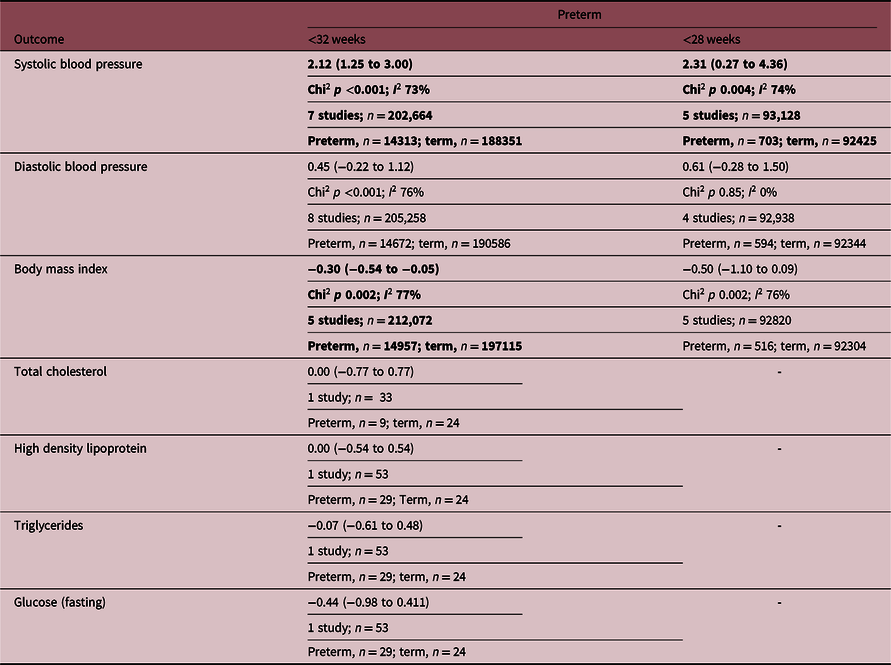
Subgroup meta-analyses were performed based on gestational age at birth (<32 weeks’ gestation compared to term and <28 weeks’ gestation compared to term) (Table 3). SBP was higher among both study groups compared to the term born group (Table 3). BMI was lower among those born prior to 32 weeks compared to term (Table 3). Subgroup analyses based on gestational age at birth could not be performed for the other risk factors as there were no available studies reporting on these outcomes.
Risk factor profile of preterm born compared to term based on gestational age at birth

Results are presented in MD or SMD with 95% CIs.
Following outcomes are presented as MD with 95% CI and the rest are in SMD.
Systolic blood pressure, diastolic blood pressure, and body mass index.
Heterogeneity is presented as Chi2 p value and I 2 percentage.
Preterm SGA and AGA
Subgroup meta-analyses were performed on preterm SGA compared to term AGA, preterm AGA compared to term AGA, and preterm SGA compared to preterm AGA (Table 4). Mean DBP was higher among preterm AGA compared to term AGA. SMD of LDL was higher among preterm SGA compared to term AGA and preterm SGA compared to preterm AGA (Table 4). No significant differences were seen between the SGA and AGA preterm groups (Table 4).
Risk factor profile of preterm born based on size at birth outcomes

AGA, average for gestational age; SGA, small for gestational age.
Results are presented in MD or SMD with 95% CIs.
Following outcomes are presented as MD with 95% CI and the rest are in SMD.
Systolic blood pressure, diastolic blood pressure, and body mass index.
Heterogeneity is presented as Chi2 p value and I 2 percentage.
Sensitivity analysis based on the evidence of publication bias
The funnel plots on studies reporting on SBP and DBP suggested possible publication bias. Hence, the meta-analyses on the above outcomes were repeated after excluding the studies with high standard deviations. The significant results remained in these secondary analyses (Supplementary Figs. 12–15).
Discussion
This systematic review and meta-analyses demonstrates that those born preterm have higher mean SBP and DBP compared to those born at term. Other conventional CVD risk factors are not significantly different between the two groups. The main findings of the subgroup analyses demonstrate that higher SBP is evident from early adolescence onwards among those born preterm compared to term, higher SBP is only seen among females born preterm, and that the difference in SBP between preterm and term groups is seen both among those born prior to 32 weeks’ gestation and prior to 28 weeks’ gestation.
The observed SBP difference of 3.5 mmHg and DBP difference of 1.4 mmHg between the preterm and term groups is modest. However, even small differences in BP are important at the population level prevention of CVD since even a 2 mmHg reduction in SBP is associated with 10% lower mortality from stroke and 7% lower mortality from ischemic heart disease in middle age Reference Lewington, Clarke, Qizilbash, Peto and Collins62 . Both SBP and DBP track from childhood to adulthood with average reported tracking correlation being greater for SBP than for DBP Reference Chen and Wang63 . Therefore, the higher SBP in the preterm group which is evident from early adolescence is an important finding as elevated BP in childhood predicts adult hypertension Reference Chen and Wang63 . Our systematic review was not designed to assess the association between PTB and hypertension in later life. However, a previous systematic review and meta-analysis that comprised 973,458 participants including 76,886 hypertensive cases showed that PTB was associated with increased risk of essential hypertension (defined as BP ≥ 140/90 mmHg, odds ratio 1.31, 95% CI 1.20 to 1.43) Reference Li and Xi64 .
A previous systematic review and meta-analysis comprising 1342 individuals born preterm or with a very low birthweight and 1738 full term participants also showed that those born preterm had 2.5 mmHg higher SBP compared to those born preterm Reference de Jong, Monuteaux, van Elburg, Gillman and Belfort65 . The above review did not assess DBP or other CVD risk factors. Our meta-analyses on a larger sample demonstrate a stronger association of PTB with higher SBP and a significant association with higher DBP. Markopoulou and colleagues conducted a systematic review and meta-analysis of studies that reported on metabolic and cardiovascular outcomes in adults (≥18 years of age) born preterm (<37 weeks of gestation) compared with adults born at term (37–42 weeks of gestation) Reference Markopoulou, Papanikolaou, Analytis, Zoumakis and Siahanidou7 . The major outcomes assessed in this study were BMI, waist circumference, waist-to-hip ratio, fat mass, SBP, DBP, 24-h SBP, 24-h DBP, endothelium-dependent brachial artery flow-mediated dilation, carotid intima-media thickness, pulse wave velocity, fasting glucose, insulin, and lipid profiles. The above study included a total of 18,295 preterm and 294, 063 term born adults. Prematurity was associated with significantly higher fat mass (p = 0.03), SBP (p < 0.0001), DBP (p < 0.0001), 24-h SBP (p < 0.001), 24-h DBP (p < 0.001), fasting glucose (p = 0.01), insulin (p = 0.002), and total cholesterol levels (p = 0.05) in comparison with adults born at term Reference Markopoulou, Papanikolaou, Analytis, Zoumakis and Siahanidou7 . In our study of children, adolescents, and adults, we found higher SBP and DBP among those born preterm compared to those born at term. Higher SBP was seen in children, adolescents, and young adults born preterm compared to those born at term. We did not find significant differences in fasting blood glucose, insulin, or lipids between preterm and term groups. Our findings extend the findings of Markopoulou and colleagues by demonstrating that higher SBP among those born preterm is seen as early as during childhood and adolescence.
The finding of higher BP among those born preterm compared to term in the absence of differences in any of the other metabolic parameters assessed in this review suggests that an increased BP may be a main mechanism that links PTB with CVD. Both prenatal and postnatal factors may underlie the link between PTB and higher BP. The increased BP may be influenced through the process of fetal programming, which involves long-lasting adaptive changes in response to an adverse intrauterine environment during a period of critical development. While most of the initial evidence on fetal programming in response to adverse intrauterine environment focused on intrauterine undernutrition, subsequent epidemiological studies have shown that numerous intrauterine exposures including major pregnancy complications (preeclampsia and gestational diabetes mellitus [GDM]), maternal obesity, and smoking during pregnancy and exposure to environmental chemicals can each trigger propensity for a myriad of cardiovascular and metabolic disorders in the offspring Reference Murphy, Cohn and Loria66 . The adverse intrauterine environment, for example, in the case of maternal preeclampsia, GDM, or intrauterine growth restriction may result in PTB. We recently conducted two systematic reviews and meta-analyses on the association between maternal preeclampsia and GDM and offspring risk for CVD and found that both pregnancy complications were associated with elevated SBP in the offspring Reference Andraweera and Lassi67,Reference Pathirana, Lassi, Roberts and Andraweera68 . These adverse pregnancy outcomes are quite often coexistent and hard to decipher in the context of a systematic review as many studies on PTB do not report on the prevalence of other pregnancy complications in the study cohorts. Therefore, the coexistence of these pregnancy complications may confound the association between PTB and elevated BP. However, being born preterm is one of the most robust clinical surrogates for low nephron number Reference Luyckx, Bertram and Brenner69 . Human nephrogenesis continues up to about 36 weeks’ gestation, and prematurity is associated with a congenital reduction in nephron number. Reduced nephron number is shown to be associated with raised BP (reviewed in reference Reference Luyckx, Bertram and Brenner69). The preterm infant is also ex-utero during the last weeks of fetal development (PTB to 40 weeks’ gestation). Many preterm neonates spend the first few weeks of extra-uterine life in the neonatal intensive care unit and may experience extra-uterine growth restriction which can influence BP through programming mechanisms Reference Clark, Thomas and Peabody70 . Preterm infants are also likely to receive nutrient enriched preterm infant formula that can contribute to rapid early weight gain which may lead to higher BP Reference Singhal, Cole and Lucas71 .
Although fetal programming can be considered as the main mechanistic pathway linking PTB with increased BP in later life, genetic, environmental, and lifestyle factors are also likely to play an important role. Understanding the relative contribution of each potential pathway to higher BP is very difficult, due to the possible interactions between these pathways. However, the finding of higher SBP and DBP among those born preterm and especially the higher SBP being evident from early adolescence is of clinical importance.
The finding of higher mean SBP among females born preterm compared to term, but not among males born preterm compared to term, was surprising, especially since most studies included in the meta-analyses were conducted on females in premenopausal age groups. However, a recent very large population-based study from Sweden of 2,141,709 individuals reported that at ages 30–43 years, adjusted hazard ratio for ischemic heart disease (IHD) was 1.53 (95% CI, 1.20 to 1.94) among those born preterm compared to term and that adjusted HR for IHD among women born preterm compared to men born preterm was 1.93 (95% CI, 1.28 to 2.90) Reference Crump, Howell, Stroustrup, McLaughlin, Sundquist and Sundquist72 . These findings suggest that females born preterm may be at a higher risk of premature CVD and that the finding of higher SBP among females in our study may be an evidence of an increased risk factor profile among women.
We acknowledge the following limitations in this systematic review. We limited our search to articles published in English and may have missed important data from studies published in other languages. Since most studies included in the meta-analyses did not report on the coexistence of other major pregnancy complications including exposure to preeclampsia, gestational diabetes, or intrauterine growth restriction, we could not limit the analyses to a group of spontaneous PTB. Therefore, the results may have been confounded by possible associations between these pregnancy complications and risk for CVD. The heterogeneity among studies was also quite high and the subgroup analyses did not change the I 2 of most analyses. However, most of the included studies (~ 87%) were of moderate quality as assessed by the NOS, and the results of the sensitivity analysis confirmed the previous findings.
Since elevated BP during childhood has been shown to predict the development of hypertension Reference Chen and Wang63 , the findings of this study suggest that those born preterm may benefit from routine BP monitoring and targeted interventions when required.
Acknowledgements
None.
Financial support
NHMRC Australia Peter Doherty Early Career Fellowship (GNT1090778) awarded to PHA and NHMRC Australia Public Health Early Career Fellowship (GNT1141382) awarded to ZSL.
Conflicts of Interest
The authors declare no conflicts of interest.
Ethical standards
None.
Supplementary Material
To view supplementary material for this article, please visit https://doi.org/10.1017/S2040174420000914