I. INTRODUCTION
Magnesium alloy is often utilized as a structural material in aerospace, electronics, and automotive industries, favored for its ready castability, high specific strength, low density, and excellent electromagnetic shielding performance. Reference Olguín-González, Hernández-Silva, García-Berna and Sauce-Range1,Reference Krishna, Poshal, Jyothirmayi and Sundararajan2 The corrosion resistance of magnesium alloy is rather poor, however, which significantly limits further development or application of the material. Reference Atrens, Song, Liu, Shi, Cao and Dargusch3,Reference Atrens, Song, Cao, Shi and Bowen4 In recent years, the effects of rare earth microalloying on microstructural and mechanical properties of magnesium alloy have been investigated at length, specifically in an effort to improve corrosion resistance.
Studies have shown that the microstructures of magnesium alloys improve considerably after the addition of Rare Earth (RE) elements, facilitated by an RE-rich strengthening phase. Examples include, Al2Yb, Reference Jo, Park, Kim, Kimura, Park and Park5 Mg2Yb, Reference Ohhashi, Suzuki, Kato and Tsai6 Al2Sm, Reference Li, Li, Zhang and Chen7 Al2Y, Reference Huang and Yan8 Al11Nd3, Reference Zhang, Liu, Zhou, Feng and Wang9 , and Al3Er. Reference Sankaranarayanan, Carsten, Baoshu, Wai, Chwee, Norbert and Manoj10,Reference Cui, Bai, Hou, Liu and Wang11 The effects of rare earth element addition on the corrosion resistance of magnesium alloys have also been reported previously. Reference Jia, Zhang, Zhang, Zhang and Guo12–Reference Zhang, Hao, Liu and Zhang14 Liu et al., Reference Liu, Cao, Chang, Zhang and Zhang15 for example, found that new γ phases containing larger amounts of RE and Al were formed in AM60 magnesium alloys after supplementation with La and Ce. The corrosion resistance of the AM60-RE magnesium alloy was improved due to RE-rich compounds that formed in the corrosion product film surface and successfully inhibited further corrosion. A stable, intermetallic Al11RE3 phase formed in an Mg–8Al alloy in a study by Jain and Koo, Reference Jain and Koo16 who focused on corrosion properties of extruded magnesium alloys containing rare earth. They found the corrosion rate of the alloy decreases with increasing RE content.
Microstructures and tensile properties of as-cast Mg–Al series alloys have been shown to significantly improve by adding Sm. Reference Wu, Yan, Wang, Zhang, Miao, Zhang and Chen17–Reference Wang, Dai, Liu, Zhang and Wu20 Relatively few studies regarding the effects of Sm addition on microstructures and properties of wrought magnesium alloys have been conducted, however. Though AZ61 alloy is one of the most advantageous wrought magnesium materials, its use is yet limited to some extent due to its inherently poor corrosion resistance. This study investigates the effects of Sm on the microstructures and corrosion resistance of hot-extruded AZ61 magnesium alloys, in an effort to build a more comprehensive understanding and promote the use of the material in future.
II. EXPERIMENT
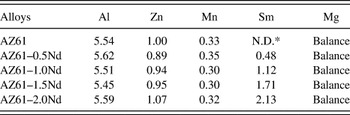
The chemical composition of AZ61–xSm (x = 0, 0.5, 1.0, 1.5, and 2.0 wt%) magnesium alloy as used in this study is shown in Table I. Five alloy samples with uniform, basic composition of AZ61 magnesium alloy were melted at 750 °C in a steel crucible inside a resistant furnace for 20 min in an SF6 and CO2 atmosphere. Four of the melts were treated with 0.5, 1.0, 1.5, and 2 wt% Sm (in the form of Mg–15 wt% Sm master alloy) respectively, and the fifth alloy (without Sm) served as the control, and prepared throughout the entire experiment under the same conditions. The melts were poured into metallic molds with dimensions of 150 mm in length and 40 mm in diameter, at 700 °C. The AZ61 alloys were then homogenized at 400 °C for 10 h, then hot-extruded after holding for 1 h at 400 °C. The extrusion ratio and the extrusion rate of the extruded bars were 6.25 and 2.5 m/min, respectively. Extruded bars with uniform diameter of 16 mm were processed as standard tensile bars for tensile testing.
Chemical composition of the AZ61 magnesium alloy (wt%).

N.D.*: Not detectable.
Microstructural evolution studies were conducted to examine all morphological changes in the compounds after Sm addition. An etchant of 4% nitric acid in alcohol solution was used to reveal the microstructures of the polished specimens. Microstructure of each specimen was observed by optical microscopy (Nican M200; Nican, Tokyo, Japan). Precipitated phases in the AZ61–xSm magnesium alloys were characterized by scanning electron microscopy (SEM) (FEI Quanta 200F, FEI Company, Hillsboro, Oregon, and JSM-6701F, JEOL Ltd., Tokyo, Japan) plus energy dispersive spectroscopy (EDS), and transmission electron microscopy (TEM; JEM-2100, JEOL Ltd., Tokyo, Japan). TEM foils were prepared by twin-jet polishing in an electrolyte of 5 vol% perchloric acid in alcohol.
Heavier specimens, which showed smaller corroded surfaces, lost a small amount of weight to corrosion, preventing fully accurate measurement of corrosion resistance. To remedy this, Φ16 × 10 mm cylindrical specimens of hot-extruded AZ61–xSm magnesium alloys were used instead of corrosion testing. Before tests, the top surface of hot-extruded AZ61–xSm magnesium alloys for corroded surface morphology analysis was ground successively to 1000 grit SiC abrasive paper and degreased in ethanol. Then, the specimens were immersed in 3.5 wt% NaCl solution for 6 and 12 h after their corroded top surface morphologies were recorded. Specimens were cleaned by dipping in 20 vol% CrO3 + 1 vol% AgNO3 solution for 10 min, then washing with acetone, drying in air. The ratio of the surface area of the corrosion samples and the volume of the electrolyte for immersion test is 30 mL/cm2. The corrosion rate of each specimen was measured according to its weight loss, under the same set of corrosion parameters. Corrosion rate was calculated using Eq. (1), as follows:
 $$V = {{{W_1} - {W_2}} \over {A \times t}}\quad ,$$
where A is
 $$A = {{\pi {D^2}} \over 2} + H\pi D\quad .$$
V (mg/cm2·day) is the corrosion rate, W 1 (mg) is the quality of the specimen before corrosion, W 2 (mg) is the quality of the specimen after corrosion, A (cm2) is the total area of the specimen which contacted the etchant solution, t (day) is the corrosion time, D (cm) is the diameter of the specimen, H (cm) is the height of the specimen, and π is the circularity ratio.
III. RESULTS
A. Phase
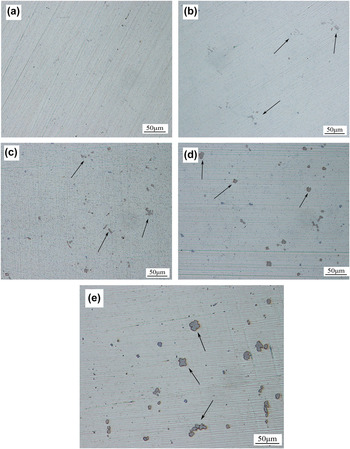
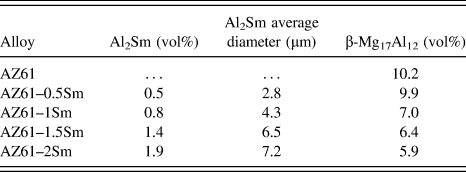
Optical microstructures of uncorroded hot-extruded AZ61–xSm magnesium alloys are presented in Fig. 1. As shown in Fig. 1, many fine particles (marked by the arrows) were found in AZ61 magnesium alloys with Sm addition, but not emerged in the matrix alloy [Fig. 1(a)]. Thus, it can be inferred that these fine particles are probably a kind of Sm-rich intermetallic compound. With the increasing Sm content in test alloys, the number of Sm-rich particles increases significantly and some particles tend to grow up and agglomerate, as shown in Figs. 1(d) and 1(e). The volume fraction and average diameter of Sm-rich particles were measured with an Image-Pro Plus 6.0 image analyzer (Media Cybernetics), and the results are represented in Table II. When Sm content is increased to 2.0 wt% in test alloys, the volume fraction of Sm-rich particles increases from 0 to 1.9 vol%, which is similar to the trend of the average diameter. The maximum average diameter was obtained from 2.0 wt% Sm-modified alloy, which is approximately 7.2 μm.
Optical microstructures of uncorroded hot-extruded AZ61–xSm magnesium alloy: (a) AZ61, (b) AZ61–0.5Sm, (c) AZ61–1Sm, (d) AZ61–1.5Sm, (e) AZ61–2Sm.

The volume fraction and average diameter of Al2Sm and β-Mg17Al12.

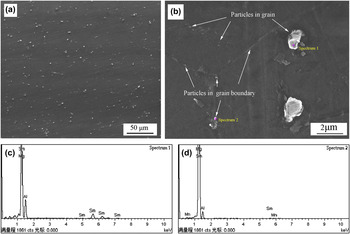
SEM micrographs and EDS results of the hot-extruded AZ61 magnesium alloy sample modified with 1.0 wt% Sm are illustrated in Fig. 2. As shown in Fig. 2(a), the Mg17Al12 phase was difficult to identify in the alloy because it had dissolved into α-Mg during homogenization treatment—this benefited better observation of the fine, white particles in the alloy. White particles with size ∼2 μm were uniformly dispersed in the grain boundary and grain of the alloy, as shown in Fig. 2(b). According to EDS analysis results [Figs. 2(c) and 2(d)], the primary components of the white particles in the α-Mg grain were Mg, Al, and Sm, and the particles in the grain boundary were mostly Mg, Al, Sm, and Mn. The formation enthalpies for Al–Sm, Mg–Sm, Mn–Sm, and Zn–Sm were −38, −6, −1, and 8 kJ/mol of atoms, respectively, Reference Hou and Napolitano21–Reference Son, Lee, Kim, Yoshimi and Maruyama24 indicating that the Al–Sm phase formed more readily in the AZ61 magnesium alloy than other phases.
SEM micrographs and EDS results of hot-extruded AZ61 magnesium alloy modified with 1.0 wt% Sm: (a) low magnification (b) high magnification (c) EDS at point 1 (d) EDS at point 2.

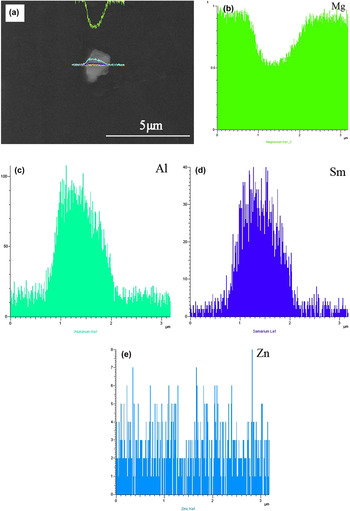
Similar results were observed in the element line scanning images of the Sm-rich phase, as shown in Fig. 3. Al and Sm were the primary components of the Sm-rich phase's center region, whereas Mg dominated the surrounding areas in the phase, as shown in Figs. 3(b)–3(d). A negligible amount of Zn remained as a solution element, but not enough to show Zn peak value within the line scan, as shown in Fig. 2(e). Overall, the line scanning results confirm that the Al–Sm intermetallic compound was first to form within the AZ61–xSm magnesium alloy.
Line scanning image of Sm-rich phases: (a) SEM micrographs and line scanning images (b) Mg (c) Al (d) Sm (e) Zn.

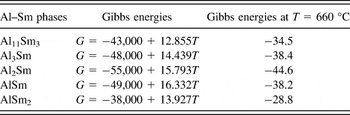
The stoichiometric ratio of an Al–Sm intermetallic compound is dependent on the thermodynamic functions of the Al–Sm system Reference Saccone, Cacciamani, Maccio, Borzone and Ferro25 (Table III). When the Al atoms precipitated during the solidification process (liquid phase temperature of pure Al is 660 °C), they reacted with the Sm atoms in the alloy (Al + Sm → Al x Sm). The Gibbs energy of the Al2Sm intermetallic compound was −44.6 kJ/mol and lower than that of other Al–Sm intermetallic compounds, as shown in Table III. To this effect, the Al–Sm intermetallic compound in the hot-extruded AZ61 magnesium alloys speculate to be in the Al2Sm phase.
The thermodynamic functions of the Al–Sm systems (kJ/mol of atoms).

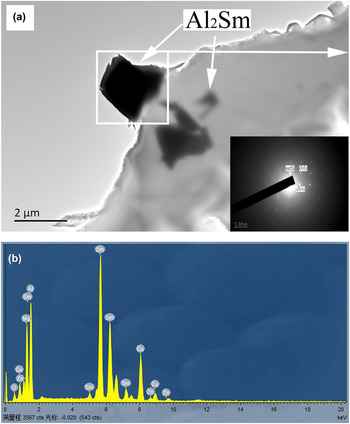
In a related study, Son et al. Reference Son, Lee and Kim26 found that Sm-rich intermetallic compounds in Mg–Al–Ca–xSm alloys were Al2Sm phases, according to the atomic ratio of Al:Sm (2.36:1) shown in EDS tests. In another study, TEM images of Mg–5Al–0.3Mn alloys with the addition of Sm showed a polygonal Al2Sm phase, confirmed by diffraction pattern. Reference Wang, Wang, Wu and Wang27 TEM and diffraction pattern were also used in this study to investigate the Sm-rich phase, detailed in Fig. 4. As shown in Fig. 4(a), Sm-rich particles with size of ∼2 μm in the α-Mg grain showed well interface bonding with the Mg matrix. EDS results shown in Fig. 4(b), clearly indicate that Al and Sm were the predominant elements. Corresponding selected area diffraction patterns for Al2Sm phase (face centered cubic structure, a = 0.7942 nm), are provided in the lower right-hand corner of Fig. 4(a).
Hot-extruded AZ61 magnesium alloy modified with 1.0 wt% Sm: (a) TEM image (b) EDS at black particle, in which the Cu peak is due to the use of Cu applied in transmission electron microscope.

B. Microstructure
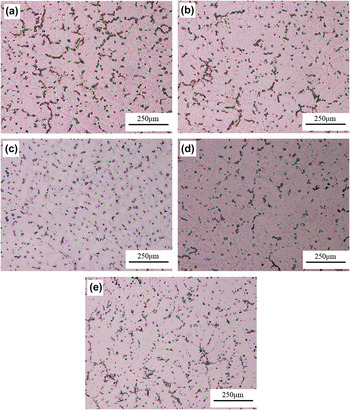
Optical images of as-cast AZ61–xSm magnesium alloys are showed in Fig. 5. The major components of the matrix alloy are discontinuous mesh β-Mg17Al12 phase and α-Mg matrix. As shown in Fig. 5, it can be clearly seen that β-Mg17Al12 content obviously decreased with increased Sm content because a large number of Al atoms firstly reacted with Sm atoms. The volume fraction value of the β-Mg17Al12 phase in the matrix alloy is 10.2 vol%, which is much more than that of the β-Mg17Al12 phase in Sm-modified alloys, as shown in Table II.
Optical microstructures of as-cast AZ61–xSm magnesium alloy: (a) AZ61, (b) AZ61–0.5Sm, (c) AZ61–1Sm, (d) AZ61–1.5Sm, (e) AZ61–2Sm.

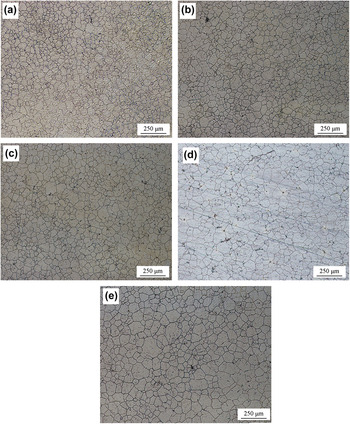
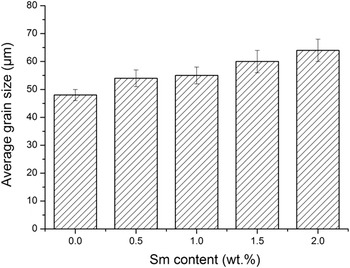
Optical microstructures of the hot-extruded AZ61–xSm magnesium alloys are presented in Fig. 6. As shown in the graph, the microstructure of hot-extruded AZ61 magnesium alloys presented fine, equiaxed grains that were formed by dynamic recrystallization in the alloy during the hot-extrusion process. Similar results were reported by Wu et al., Reference Wu, Yang, Liao and Zhu28 on the dynamic behavior of extruded AZ61 Mg alloys during hot compression. Under the same hot-extrusion conditions, the grain of the AZ61–xSm magnesium alloys displayed a gradually increasing trend along with increasing Sm content, detailed in Figs. 6 and 7. Figure 7 depicts the average grain size of hot-extruded AZ61 magnesium alloys modified with varying Sm content, measured by linear intercept method. The average grain size of the unmodified alloy was 48 μm. The average grain size of the alloys supplemented with 0.5, 1.0, 1.5, and 2.0 wt% Sm were 54, 55, 60, and 64 μm, respectively.
Optical microstructures of hot-extruded AZ61–xSm magnesium alloys: (a) AZ61, (b) AZ61–0.5Sm, (c) AZ61–1Sm, (d) AZ61–1.5Sm, (e) AZ61–2Sm.

Average grain size of hot-extruded AZ61magnesium alloys modified with varying Sm content.

C. Corrosion resistance
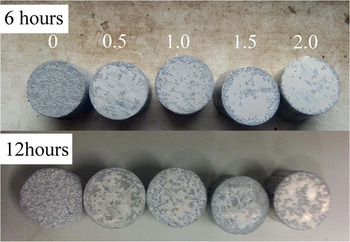
Figure 8 summarizes the corroded top surface morphologies of the hot-extruded AZ61–xSm magnesium alloy samples after immersion in 3.5 wt% NaCl solution for 6 h and 12 h. As shown in Fig. 8, the corroded surface of the unmodified alloy after immersion in 3.5 wt% NaCl solution for 6 h lost its metallic luster, and corrosion pits occupied the entire corroded surface. The corroded surface of hot-extruded AZ61 magnesium alloy samples was improved significantly after supplementation with rare earth Sm. The corrosion area of the modified alloys decreased as Sm content increased. When Sm content reached 2.0 wt%, the corrosion area accounted for less than 10% of the total specimen surface. After 12 h of immersion, the surface of the unmodified specimen showed the deepest overall corrosion depth, but all the samples differed in corrosion depth level (Fig. 8).
Corroded top surface morphologies of hot-extruded AZ61–xSm magnesium alloys after immersion in 3.5 wt% NaCl solution for 6 and 12 h.

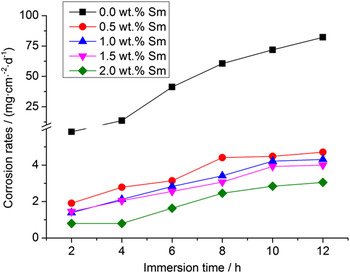
To further detail the effects of Sm on the corrosion resistance of hot-extruded AZ61 magnesium alloys, the weight loss method was used to test corrosion rate. Relationship curves for corrosion rate, immersion time, and Sm content are displayed in Fig. 9. Immersion time had significant impact on the corrosion rate of the alloy samples. As immersion time increased, the corrosion rate gradually increased. Between immersion time of 2 and 12 h, the corrosion rate of the unmodified alloy (5.8 mg/cm2·day) increased to 82 mg/cm2·day, well above that of the modified alloys. The corrosion rate of the alloy modified with 2.0 wt% Sm showed minimum values across all parameters. When immersion time reached 12 h, its corrosion rate was only 3.1 mg/cm2·day. The corrosion rates of alloys modified with 0.5, 1.0, and 1.5 wt% were 4.7, 4.3, and 4.9 mg/cm2·day, respectively. In a previous study, Zhang et al. Reference Zhang, Meng, Shao, Cui and Wang29 investigated the effects of rare earth element neodymium on the corrosion behavior of extruded AZ91 magnesium alloy, and discovered that neodymium modification promoted corrosion resistance in the alloy. Zhu et al. Reference Zhu, Liu, Qu, Wang, Li and Guan30 found that higher RE content (Ce and La, specifically, at total content ≤1 wt%) in extruded AZ61 alloys improved corrosion rate. Similar results were obtained for the corrosion rates of specimens after addition of a variety of RE elements, with 3.5 wt% NaCl solution immersion, after 3, 6, and 12 days of testing.
Relationship curves for corrosion rates, immersion time, and Sm content.

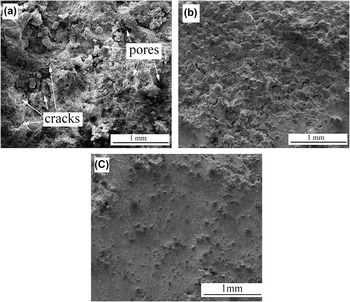
Figure 10 shows SEM micrographs of the corroded surfaces of experimental alloys after immersion in 3.5 wt% NaCl solution for 12 h. The surface of the unmodified alloy was fully corroded by this time. Specific corrosion products on the corroded surface of the AZ61 alloy were mostly loose-structure Mg(OH)2 (reaction equation: Mg + H2O → Mg(OH)2 + H2), which produced many pores and cracks as shown in Fig. 10(a). Relatively few areas on the surface of the alloy modified with 2.0 wt% Sm were corroded, by comparison. Micrographs of the corroded and noncorroded areas of the sample are provided in Figs. 10(b) and 10(c). As shown in Fig. 10(b), the degree of corrosion of the alloy modified with 2.0 wt% Sm was much lower than that of the unmodified alloy. Noncorroded areas formed a densely layered structure, as shown in Fig. 10(c), thus protecting the alloy's surface from corrosion.
SEM micrographs of corroded surfaces of experimental alloys after immersion in 3.5 wt% NaCl solution for 12 h: (a) AZ61 (b) corroded areas of AZ61–2.0Sm (c) noncorroded areas of AZ61–2.0Sm.

IV. DISCUSSION
A. Microstructure
The overall effects of Sm addition on the microstructure of the hot-extruded AZ61 magnesium alloys are explained best from the following two perspectives: (i) The Al2Sm phase functioned as a heterogenous nucleation core in the α-Mg phase, dependent on planar disregistry between Al2Sm and α-Mg phase of 12.3% [i.e., less than 15% when the orientation relationship is
 ${\left( {111} \right)_{{\rm{A}}{{\rm{l}}_2}{\rm{sm}}}}//{\left( {10\bar 10} \right)_{\alpha {\rm{ - Mg}}}}$
(Ref. Reference Li, Li, Jing, Chen, Zhang and Zhang31)] refining the grains of the as-cast magnesium alloy significantly. During the dynamic recrystallization caused by the hot-extrusion process, however, small grain size inhibited grain nucleation and shrank the grain boundary area, coarsening the dynamic recrystallized grains.
Reference Blaz, Sakai and Jonas32
(ii) The area where Al2Sm particles contacted α-Mg caused significant dislocation during the hot-extrusion process. As far as the dynamics at work in this process, when the energy provided by outside sources remained the same, more dislocations formed in the alloys and dislocation sliding and climbing occurred more readily. Thus, subgrain and dislocation cells formed more readily in the alloys, promoting the nucleation and growth of dynamic recrystallization. However, relatively slow hot-extrusion speed increases the holding time of the AZ61–xSm magnesium alloys in the extruding tube, allowing dynamic recrystallized grains to grow more rapidly at the grain boundary.
B. Corrosion resistance
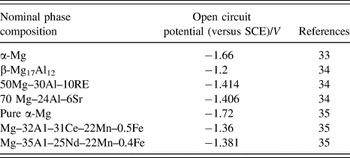
Galvanic anodic α-Mg and galvanic cathodic β-Mg17Al12 form a microgalvanic couple in this system. As reported, the corrosion potential of α-Mg and β-Mg17Al12 was established previously as −1.631 and −1.2 V, respectively, for Mg–Al series alloys. Reference Cao, Shi, Song, Liu and Atrens33,Reference Niu, Chen, Xu and Wei34 And the intermetallic compounds were specially prepared to simulate the RE-contained phase in magnesium alloys according to the EDS results, and their open circuit potentials are listed in Table IV. It can be clearly seen that the corrosion potential of RE-contained phase is more negative than that of β-Mg17Al12 phase and positive than that of α-Mg phase. Similar results were reported by Liu, Reference Liu, Cao, Chen, Chang, Zhang and Cao36 they found that with La and Ce addition in AM60 alloy, the potential difference between α-Mg and β-Mg17Al12 phase is 30 mV and between α-Mg, rich-La and rich-Ce phases are 8 and 11 mV, respectively. Thus, they claimed that the rich-RE phase presents more noble potential and leads to the decrease of microgalvanic corrosion caused by its coupling with anodic Mg based phase. Thus, the corrosion potential of the Al2Sm phase in the hot-extruded AZ61 magnesium alloys is likely to exist between the β-Mg17Al12 and α-Mg, so reducing the corrosion potential between them reduced overall corrosion potential. Basically, once the driving force of the corrosion is decreased due to Sm addition, the corrosion resistance of the alloy is improved. In addition, the Al2Sm phase consumed a great deal of Al in alloys, which in turn reduced the β-Mg17Al12 content from 10.2 to 5.9 vol%. The corresponding effective area of galvanic cathodic β-Mg17Al12 in the modified alloys decreased, thus improving the corrosion rates of the modified alloys.
Open circuit potentials of specifically prepared intermetallic phases at 25 °C.

SCE = Saturated Calomel Electrode.
V. CONCLUSION
-
(1) The addition of rare earth Sm in hot-extruded AZ61 magnesium alloys formed a granular Al2Sm phase. The particles dispersed uniformly in the alloy and showed well interface bonding with the Mg matrix.
-
(2) The grain of the hot-extruded AZ61–xSm magnesium alloys displayed a gradually increasing trend with increased Sm content, because Al2Sm particles promoted dynamic recrystallization grain growth during the hot-extrusion process.
-
(3) Corroded surface morphology and corrosion rate of the alloys both significantly improved after Sm addition. The corrosion rate of the alloy modified with 2.0 wt% Sm after immersion in 3.5 wt% NaCl solution for 12 h presented the optimal value out of all samples at 3.1 mg/cm2·day. Enhanced corrosion resistance can be attributed to fewer dislocations and improved grain boundaries in the modified alloys, caused by decreased corrosion potential between β-Mg17Al12 and α-Mg and decreased effective area of galvanic cathodic β-Mg17Al12 facilitated by Al2Sm.
ACKNOWLEDGMENTS
The authors would like to acknowledge the financial support by the National Natural Science Foundation of China (51405216, 51165032), the Natural Science Foundation of Jiangxi Province (20151BAB216018), Ministry of Education Tied up with the Special Research Fund for the Doctoral Program for Higher School (20133601110001), Training Program Foundation for Young Scientist of Jiangxi (20153BCB23023).