Introduction
Volcanic ash includes pyroclastic material with a particle size of <2 mm, which is formed during volcanic eruptions. The violent nature of eruptions causes the magma and solid rocks to separate into these tiny particles and other larger materials (>2 mm) such as volcanic scum and pumice (Lemougna et al., Reference Lemougna, Wang, Tang, Nzeukou, Billong, Melo and Min2018).
After decades of quiescence, the Puyehue-Cordón Caulle volcanic complex (PCCVC; Chile) erupted in 2011. As usual in Andean eruptions (Folch et al., Reference Folch, Jorba and Viramonte2008), the dominant regional winds drove the ash clouds over the Andes and caused abundant ash fallout in the south of Argentina, also affecting the proximal Chilean areas. This event was significant and the transport and deposition of ash as well as its detrimental effects on the spread area were studied intensively (Collini et al., Reference Collini, Osores, Folch, Viramonte, Villarosa and Salmuni2013; Klüser et al., Reference Klüser, Erbertseder and Meyer-Arnek2013; Elissondo et al., Reference Elissondo, Baumann, Bonadonna, Pistolesi, Cioni, Bertagnini, Biass, Herrero and Gonzalez2016).
Volcanic ashes are harmful materials for the environment and human health (Covey et al., Reference Covey, Dominelli, Horwell, Rachmawati, Martin del Pozzo, Armienta, Nugroho and Ogawa2021), impacting negatively on socio-economic development (Wilson et al., Reference Wilson, Cole, Stewart, Cronin and Johnston2011). Due to the wind, the process of mobilization and atmospheric re-suspension is one of the most important factors in determining the seriousness of risks (Wilson et al., Reference Wilson, Cole, Stewart, Cronin and Johnston2011).
The chemical composition and structural properties of volcanic residues make them suitable for technological applications. The literature reports engineering applications such as: filler for roadway and pavement material (Gautam et al., Reference Gautam, Kalla, Jethoo, Agrawal and Singh2018); cement replacement (Siddique, Reference Siddique2011; Al-Fadala et al., Reference Al-Fadala, Chakkamalayath, Al-Bahar, Al-Aibani and Ahmed2017); geopolymers (Lemougna et al., Reference Lemougna, MacKenzie and Melo2011; Tchakoute Kouamo et al., Reference Tchakoute Kouamo, Elimbi, Mbey, Ngally Sabouang and Njopwouo2012; Tchakoute et al., Reference Tchakoute, Elimbi, Yanne and Djangang2013); adsorbent for pollutants (Botto et al., Reference Botto, Canafoglia, Gazzoli and González2013); catalysis (Muñoz et al., Reference Muñoz, Pasquale, Sathicq, Romanelli, Cabello and Gazzoli2019), among others.
The presence of inorganic compounds, such as amorphous silicates or aluminosilicates (Botto et al., Reference Botto, Canafoglia, Gazzoli and González2013); and some crystalline phases (particularly plagioclase) (Canafoglia et al., Reference Canafoglia, Vasallo, Barone and Botto2012), allows their use as raw material in the synthesis of zeolites. The zeolitization process without an appropriate activation of the starting solid produces a final product within which quartz remains (Sanhueza Nuñez & Bennun Torres, Reference Sanhueza Núñez and Bennun Torres2015). As a consequence, an activation that includes calcination in the presence of various alkali sources is suitable. An alkaline fusion method with NaOH as pretreatment was used (Lee et al., Reference Lee, Park, Kam and Lee2018; Belviso et al., Reference Belviso, Abdolrahimi, Peddis, Gagliano, Sgroi, Lettino, Roccaro, Vagliasindi, Falciglia, Di Bella, Giustra and Cavalcante2021), but the published results involve some drawbacks such as hard-cake products, low zeolite conversions, or the co-crystallization of different zeolite structures.
A great variety of raw materials used for the synthesis of zeolites can be found in the literature. They include low-cost natural materials such as clay minerals (Gougazeh et al., Reference Gougazeh, Kooli and Buhl2019; Chen et al., Reference Chen, Qian, Yang, Xu, Zhu and Zhong2020) and waste generated by the energy industry or agriculture (Mohamed et al., Reference Mohamed, Mkhalid and Barakat2015; He et al., Reference He, Yao, Xia, Huang, Gan and Zhang2020).
Concerning waste reutilization, previous studies (Gonzalez et al., Reference Gonzalez, Pereyra, Bosch, Fetter, Lara and Basaldella2016; Monzón et al., Reference Monzón, Pereyra, Conconi and Basaldella2017) focused on the conversion of aluminosiliceous residues (exhausted catalysts and fly ash) into zeolite A, a material used widely in technological processes such as adsorption and cation exchange. The procedure for obtaining A-type zeolite from these wastes involves a suitable alkali activation with Na2CO3 followed by hydrothermal synthesis. Results have shown that pretreatment conditions which favor the generation of crystalline nepheline and low-carnegieite, two polymorphic forms of NaAlSiO4, are beneficial for obtaining large amounts of zeolite A after synthesis, attaining a conversion of close to 80%.
Some siliceous compounds such as quartz, present commonly in the ash, do not react under the usual synthesis conditions used in the industry for producing low-silica zeolites. The aim of the present study was to achieve efficient transformation of a residual volcanic ash into a product containing A-type(LTA) and X-type(FAU) zeolites, free of other crystalline impurities, avoiding the need for using extended reaction times or more exigent synthesis conditions for a complete hydrothermal transformation.
EXPERIMENTAL
Materials
Volcanic ash (VA) from the Puyehue-Cordón Caulle (volcanic complex located in Chile) was used as a raw material. This pyroclastic material belonged to the June 2011 eruption. The ash sample was collected at Bariloche, Río Negro, Argentina (91 km from the volcanic complex, 41°09′S 71°18′W).
The natural material was suspended in distilled water under stirring for 72 h at room temperature and dried for 24 h at 60°C. The VA was then sieved (#40 mesh), and the >0.425 mm particle-size fraction was separated from the bulk (VA40). The chemical compositions of samples VA and VA40 were obtained by energy dispersive X-ray microanalysis (EDX).
Activation Pretreatments and Hydrothermal Synthesis
Before the hydrothermal step, samples VA and VA40 were activated by either alkaline fusion or by milling amorphization in order to enhance their reactivity toward zeolite crystallization. Both procedures had been tested in previous work (Gonzalez et al., Reference Gonzalez, Pereyra, Bosch, Fetter, Lara and Basaldella2016; Monzón et al., Reference Monzón, Pereyra, Conconi and Basaldella2017). For alkaline activation, a mixture containing equal amounts of VA and analytical-grade Na2CO3 (J.T. Baker, Phillipsburg, New Jersey, USA) was sonicated for 300 s in order to obtain an homogeneous sample (Monzón et al., Reference Monzón, Pereyra, Conconi and Basaldella2017). Then, the mixture was calcined under static conditions at 800°C (5°C·min–1) for the selected time. The same procedure was applied to sample VA40. The activated samples were named VAC and VA40C. To activate the samples by milling (VAM and VA40M), VA and VA40 were submitted to milling for 60 min, in a Herzog HSM 100 (HERZOG Maschinenfabrik GmbH, Osnabrück, Germany) oscillating mill.
Subsequently, each sample was placed in contact with the synthesis solution in a 250 mL polypropylene reactor. The synthesis solution consisted of appropriate amounts of NaOH (CARLO ERBA Reagents, Paris, France) and deionized water; NaAlO2 commercial solution (36.5% Al2O3, 29.6% Na2O, 33.9% H2O) (ALUM, Buenos Aires, Argentina) was added as an extra aluminum source at the beginning of the synthesis in order to obtain the selected starting molar ratios for producing NaA or NaX zeolite as the main product. Each sample was mixed with a magnetic stirrer for 30 min and aged at room temperature for the indicated time (Table 1). The mixture was then placed in a conventional air oven at 100°C.
Identification of products, starting solids, pretreatment procedures, synthesis mixture type, and aging times used

The course of the reaction was followed by taking aliquots after 0, 3, 6, and 24 h. The solid products obtained were washed and dried in a conventional air oven at 110°C.
Different hydrothermal products were obtained by varying the activation-step conditions and aging times (Table 1).
Physicochemical Characterization
The structural characterization of crystalline materials (starting volcanic ash, the products obtained after pretreatment, and those resulting from hydrothermal synthesis) was carried out by XRD. The diffraction patterns were obtained using a PANalytical X´Pert PRO 3373/00 instrument (PANalytical B.V., Almelo, The Netherlands) (40 kV, 40 mA, CuKα with Ni filter, step size 0.02°2θ). The types of zeolite and other crystalline phases obtained were determined by comparing diffraction profiles with published data (PDF, Powder Diffraction File). The Rietveld method (Rietveld, Reference Rietveld1969) and the FULLPROF program (Rodríguez-Carvajal, Reference Rodríguez-Carvajal2001) were used for the quantitative determination of the crystalline components of VA using a PANalytical X´Pert 3020 instrument (PANalytical B.V., Almelo, The Netherlands) (35 kV, 40 mA, CuKα radiation, and Ni filter). A Bruker IFS 66 (Bruker Optik GmbH, Ettlingen, Germany) FTIR spectrophotometer was used to record infrared spectra in the 400–4000 cm–1 range. The samples were prepared by dilution in KBr (100 mg KBr/1 mg zeolite sample). Then, the mixtures were subjected to high pressure in a sample holder in order to form pellets. The morphology and semiquantitative chemical compositions of the solid samples were determined by scanning electron microscopy (SEM) using a Philips 505 microscope (Philips, Eindhoven, The Netherlands) equipped with an EDX Prime 10 spectrometer.
N2adsorption-desorption isotherms were obtained using a Micromeritics ASAP 2020 automated gas adsorption system (Micromeritics Instrument Corporation, Norcross, Georgia, USA) at the temperature of liquid nitrogen (–196°C) in a relative pressure (p/p 0 ) range of 0.01–0.99. Before adsorption, samples were out-gassed by heating at 350°C in vacuum, with a pressure of <3×10⁻² mm Hg for 12 h. The specific surface area was estimated by the Brunauer Emmett Teller (BET) method (Brunauer et al., Reference Brunauer, Emmett and Teller1938), the micropore and the external surface area were determined using the t-plot method (Gregg & Sing, Reference Gregg and Sing1982), and the pore-size distribution was evaluated by the Horvath-Kawazoe method (Horvath & Kawazoe, Reference Horvath and Kawazoe1983).
Zeolite Conversions
The zeolite content of the samples obtained was calculated by XRD. The relative crystallinity was estimated by the intensity of the characteristic diffraction peaks. These intensities were compared with those present in the pattern of a pure zeolite sample synthesized in the laboratory, which was set to be 100%. The crystallinity was obtained by comparing the intensities of the peaks assigned to the three main reflections, based on ASTM D5357-19 and D3906-19 test methods for zeolites A and X, respectively.
RESULTS AND DISCUSSION
Chemical Analysis
The chemical composition and the SiO2/Al2O3 wt.% ratio were obtained by EDX for VA and V40 (Table 2). The chemical compositions for both samples were very similar, but the amount of Fe2O3 (present as magnetite structure in the ash) was greater for VA40. The SiO2/Al2O3 wt.% ratio was slightly higher for natural volcanic ash (VA).
Chemical composition of VA and VA40

According to the SiO2/Al2O3 ratio obtained for each sample, the amounts of Al2O3, Na2O, and H2O in the synthesis mixture were adjusted in order to obtain the zeolite desired (A or X type). The starting molar ratios (including the theoretical values provided by the volcanic ash) used for synthesizing zeolite X were SiO2/Al2O3 = 6, Na2O/H2O = 0.03, and Na2O/Al2O3 = 9.8. For zeolite A, the molar ratios were SiO2/Al2O3 = 1.4, Na2O/H2O = 0.03, and Na2O/Al2O3 = 3.4. The two starting mixtures were named types X and A, respectively (Table 1).
Mineralogical Analysis of the Fly Ash
According to the XRD analysis for VA and VA40 (Fig. 1), the mineralogical composition of volcanic ash depended on the particle-size distribution of the sample studied. The natural volcanic ash, sample VA, contained crystalline and amorphous fractions, identified by applying the Rietveld method (Fig. 1). The data collected indicated the presence of quartz (PDF# 85-0457, SiO2), andesine (PDF# 83-1938, Na0.622 Ca0.368Al1.29Si2.71O8), and a wide amorphous halo in the angular region 17 to 35°2θ, centered at ~24°2θ. Andesine is a solid isomorphic solution composed of 70–50% albite (NaAlSi3 O8) and 30–50% anorthite (Ca Al2 Si2 O8) (Jiménez-Alvarez & Téllez-Jurado, Reference Jiménez-Alvarez and Téllez-Jurado2010). The potassium detected by EDX could be located in the crystalline network of albite, replacing some Na ions. Small peaks of calcite (PDF# 72-1650, CaCO3) and magnetite (PDF# 86-1351, Fe2.936O4) were also detected in the ash pattern.
XRD pattern of natural volcanic ash (VA) and of a volcanic ash particle-size fraction >0.425 mm (VA40). Quartz (Q), andesine (An), magnetite (M), and calcite (C)

Regarding the VA40 fraction, the X-ray diffraction (XRD) pattern presented purely disordered characteristics. The VA40 pattern showed the wide amorphous halo in the same angular region as observed for the VA diffraction pattern (Fig. 1).
Phase Transformation after Pretreatments
The structural transformations throughout the synthesis process was followed by XRD (Fig. 2). After the alkaline fusion activation step of VA, the XRD revealed a change in the structural composition (VAc). The crystalline phases originally present in the volcanic ash disappeared (mainly quartz and andesine), and new crystalline compounds associated with NaAlSiO4 grew. The new phases were identified by the (International Center for Diffraction Data Powder Diffraction File) PDF# 19-1176, ascribed to nepheline, and PDF# 11-0221, assigned to low-carnegieite. Sodium carbonate was also found. The activation process generated significant levels of both polymorphs, accompanied by a decrease and a clear shift in the amorphous phase from 20–30°2θ to 25–35°2θ (Fig. 2, curve b). The generation of the same NaAlSiO4 polymorphic structures had already been noted in a previous study (Gonzalez et al., Reference Gonzalez, Pereyra, Bosch, Fetter, Lara and Basaldella2016; Monzón et al., Reference Monzón, Pereyra, Conconi and Basaldella2017) where residual catalyst and fly ash were zeolitized.
Evolution of the XRD patterns during zeolite synthesis from VA. a VA, b VAC (12 h at 800°C), c VACafter aging at room temperature (48 h), d product after zeolite X crystallization, and e product after zeolite A crystallization. Quartz (Q), andesine (An), magnetite (M), calcite (C), low-carnegieite (L), nepheline (N), sodium carbonate (S), zeolite X (X), and zeolite A (A)

The sodium carbonate pretreatment thus led to the dissolution of sodium and calcium plagioclase (albite and anorthite, respectively), quartz, as well as the minor phases present in the volcanic ash (magnetite and calcite). The transformation involved two mechanisms that appear simultaneously: (1) the displacement of Ca2+ ions (provided by anorthite and partially substituted albite) and K+ ions (from the partially substituted albite) by Na+ ions of the fluid phase (Na2CO3); and (2) the release of Al and Si from the breakdown of andesine and quartz, which combine with Na+ from the fluid to generate NaAlSiO4 polymorphs. The following equation describes the reaction that controls the process in the case of the calcium endmember of plagioclase (anorthite): CaAl2Si2O8 + 2Na+ = 2NaAlSiO4 + Ca2+ (Rao and Murthy, Reference Rao and Murthy1974). A similar mechanism could be proposed for albite, and the albite partially substituted by K+ ions. These results showed the transformation of tectosilicate structures (continuous framework of tetrahedra, each sharing all four oxygen atoms: (SiO2) n as quartz, K-feldspar, andesine, Si:O ratio 1:2) into NaAlSiO4 polymorphs by a fluid-mediated reaction that involved the dissolution of the original crystalline compounds, accompanied by the precipitation of the new polymorphic phases. In this transformation, the fluid phase promotes the reacting mineral conversion into a mixture of amorphous and crystalline phases (Hamilton et al., Reference Hamilton, Brantley, Pantano, Criscenti and Kubicki2001; Upadhyay, Reference Upadhyay2012; Crundwell, Reference Crundwell2014).
Subsequently, some additional restructuring occurred during the aging period, noted by comparison of the respective XRD patterns. At the end of the aging period, a crystalline equilibrium seemed to be attained between the two main polymorphs, the nepheline was dissolved partially and the diffraction patterns showed the peaks of low-carnegieite and small intensities of the remaining nepheline (Fig. 2, curve c).
Similar behavior was noted for the XRD evolution recorded for sample VA40 (Fig. 3). Nevertheless, the peak intensities of NaAlSiO4 polymorphs obtained after alkaline fusion (Fig. 3, curve b) were noticeably smaller than those present in the pattern of VAC treated for 12 h. Thus, the reactivity toward the polymorph crystallization depended on the mineralogical composition of the starting ash sample.
Evolution of the XRD patterns during zeolite synthesis from the VA40 fraction. a VA40, b VA40C (12 h at 800°C), c VA40C after aging at room temperature (48 h), and d product after zeolite A crystallization. Low-carnegieite (L), nepheline (N), and zeolite A (A)

After aging, VAC and VA40C showed the presence of nepheline and low-carnegieite. In both samples, the nepheline was dissolved preferentially (Fig. 2, curve c and Fig. 3, curve c). The greatest peak intensities corresponding to the polymorphs were found in the VA40C pattern (Fig. 3, curve c). The milled samples (VAMC and VA40MC) showed an increased degree of amorphousness after pretreatment, and the polymorphic peak intensities were smallest.
With respect to NaAlSiO4-polymorph generation, the alkaline pretreatment applied to the non-crystalline ash fraction VA40 involved a similar route to that described for VA: the dissolution of amorphous aluminosilicates took place during alkaline fusion, followed by the polymerization of active groups to form three-dimensional networks made of various units of connected SiO4 and AlO4 tetrahedra, and the incorporation of Na+ as compensation ions (Tait et al., Reference Tait, Sokolova, Hawthorne and Khomyakov2003; Kumar et al., Reference Kumar, Dhoble, Peshwe and Bhatt2014).
Hydrothermal Synthesis
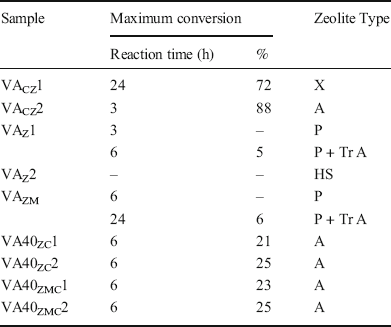
According to the reaction conditions, different zeolite structures and conversion levels were obtained (Table 3).
Type of zeolite obtained and maximum conversion percentage attained in the various synthesis products

VA zeolitization – Zeolite X
The zeolitization of VA using the synthesis mixture composition X was evaluated after 24 h of reaction. For this sample the greatest degree of conversion to zeolite X was obtained (72% of zeolite X, Table 3, VACZ1). The XRD pattern (Fig. 2, curve c) corroborates the transformation VA → VACZ1.
On the other hand, according to the XRD results, the synthesis composition was adjusted to obtain zeolite X from VA samples aged for 48 h and 96 h without alkaline activation mainly produced zeolite P (synthetic zeolite analogue of the gismondine-like framework). Small peaks corresponding to andesine were still observed after 3 h of synthesis time in both samples. After 6 h of reaction, andesine crystals disappeared completely, and a product containing 10% of zeolite A and 60% of zeolite P was obtained in both reactions (Table 3, samples VAZ1 and VAZM).
Zeolite A
As expected, the synthesis mixture prepared using VAC and aged for 48 h produced zeolite A (Table 3, sample VACZ2). In this experiment, the diffraction pattern obtained after 3 h of reaction showed clear, high-intensity peaks of zeolite A (Fig. 2, curve e). Thus, 88% conversion to zeolite was obtained after 3 h of reaction.
Synthesis using the composition adjusted to obtain zeolite A from the natural, non-pretreated VA sample, aged for 48 h (Table 3, sample VAZ2) showed hydroxysodalite after 3 h of reaction. Small peaks related to andesine were also detected in the diffraction pattern (not shown). At longer reaction times, andesine disappeared, and the intensities of the hydroxysodalite (HS) zeolite peaks increased.
V40 Zeolitization
The batch used to synthesize NaA using the amorphous fraction VA40 was also adjusted considering that the SiO2, Al2O3, and Na2O amounts provided by the ash reacted fully in the hydrothermal conversion.
As mentioned previously, the XRD patterns for samples VA40CZ1, VA40CZ2, VA40MCZ1, and VA40MCZ2 corroborated that after alkaline pretreatment for 12 h (VA40CZ1), or 24 h (VA40CZ2), the peak intensities of NaAlSiO4 polymorphs at the end of the aging time were smaller than those obtained starting from VA. Similar results were found when additional milling for 1 h was included (VA40MCZ1 and VA40MCZ2). The conversions in zeolite A were also very low, ~20–25% (Table 3). This fact confirms that the presence of polymorphic species at the beginning of the hydrothermal crystallization is beneficial for zeolite growth. Besides, 1 h of milling treatment did not alter meaningfully the conversion level attained. These results are in agreement with previous work (Yamada et al., Reference Yamada, Sukenaga, Ohara, Anand, Ando, Shibata, Okubo and Wakihara2018), where the generation of zeolitic arrangements depended on the crystalline ordering of the precursor phase.
The mechanism of topotactic transformation of polymorphic species into zeolitic structures could be explained on the basis of the three-dimensional reorganization and reconnection of building units occurring when the reacting solid phase is energetically disturbed. As reported (Baerlocher et al., Reference Baerlocher, McCusker and Olson2007), similar composite building units (CBUs) and secondary building units (SBUs) are common for the wide variety of aluminosiliceous materials. The planar SBUs are also capable of reorganizing themselves to form a three-dimensional structure after specific activation procedures. The planar arrangements of rings, such as the single six-membered ring (S6R) present in NaAlSiO4 polymorphs, can be folded into an α-cage by thermal treatment (Boscoboinik et al., Reference Boscoboinik, Yang, Shaikhutdinov and Freund2013). In the current study, in addition to heat treatment, the chemical composition was adjusted in terms of the Si/Al ratio to lead the reaction toward the intended zeolitic structure. The feasibility of this rearrangement was reinforced by the fact that it could be reversed under selected working conditions. According to the literature (Lutz et al., Reference Lutz, Engelhardt, Fichtner-Schmittler, Peuker, Löffler and Siegel1985; Dimitrijevic et al., Reference Dimitrijevic, Dondur, Vulic, Markovic and Macura2004), temperatures >700°C led to the destruction of the initial zeolite framework, by D4R rings breaking and the unfolding of the supercage into a planar structure of S6R tetrahedral building units. Polymorphic NaAlSiO4 frameworks were reconstituted by forming and connecting the S6R member rings, the Si4+ and Al3+ cations being ordered to obey Loewenstein’s rule. On the other hand, following the inverse transformation, the lack of the LTA and FAU zeolitic ordering toward low-carnegieite and pure sodium nepheline growth, induced by heating, has also been reported (Dimitrijevic et al., Reference Dimitrijevic, Dondur, Vulic, Markovic and Macura2004).
Comparing the XRD peaks present in the patterns obtained from the solid phases VAC and VA40C after 48 h of aging, the generation of the two polymorphs (nepheline and low-carnegieite) was observed, the crystallization being more pronounced starting from VAC. This fact, along with the displacement of the amorphous halo detected after the pretreatment, confirms that zeolite crystallization depends not only on the chemical composition of the raw material but also on the presence of the polymorphs. Despite the similar chemical composition of VA and VA40 and equal pretreatment conditions applied to both samples, differences in zeolite content were detected when comparing the zeolitized VACZ and VA40CZ products.
In addition, with respect to the amorphous component, non-crystalline materials can be considered less susceptible to transformation into zeolite than crystalline precursors (Yamada et al., Reference Yamada, Sukenaga, Ohara, Anand, Ando, Shibata, Okubo and Wakihara2018). This can be attributed to the presence of Al–O–Al bonding, which is forbidden in the framework of zeolites, mainly when the Si/Al ratio is 1.0 (zeolites A and X) (Loewenstein, Reference Loewenstein1954). The existing differences between the amorphous/crystalline samples in VAZ and VA40Z could also be correlated with the different zeolite crystallization level, estimated when comparing VAZ and VA40Z.
FTIR Analyses
The volcanic ash, pure zeolites (A and X), and the zeolites obtained from the volcanic ash (VACZ1 and VACZ2) were studied by Fourier-transform infrared (FTIR) analysis in the frequency range 400 to 4000 cm–1(Fig. 4).
FTIR spectra of samples I VA, II pure zeolite X, III VACZ1, IV pure zeolite A, and V VACZ2 in the a4000–1200 cm–1 range and b1200–400 cm–1 range

For all samples, the recorded IR spectra showed signals corresponding to adsorbed water, indicated by the dominant O–H stretching signal at ~3450 cm–1. In addition, the peak at ~1650 cm–1, characteristic of the bending mode in the water molecule (δH–O–H bond), was observed clearly (Fig. 4a). These bands were more attenuated in the volcanic ash spectrum (Fig. 4a.I), indicating an increased presence of water molecules in the more open zeolitic structures.
Regarding the volcanic ash, the characteristic signals of its aluminosiliceous composition were detected (Hamilton et al., Reference Hamilton, Brantley, Pantano, Criscenti and Kubicki2001) (Fig. 4b.I). The signals corresponding to the symmetric and asymmetric stretching vibrations (νas and νs) of T–O (T = Si, Al) were observed in the tetrahedral environment at 1050–1100 and 790 cm–1, respectively, and the network stretching modes at ~460 cm–1.
After synthesis, the structural zone spectra (exhibited at wavenumber values of <1200 cm–1) of the zeolitized volcanic ash (VACZ1, Fig. 4b.III, and VACZ2, Fig. 4b.V) were coincident with the spectra of their pristine zeolites (Fig. 4b.II and Fig. 4b.IV).
Thus, the IR spectra of both zeolite X and VACZ1 (Fig. 4b.II and Fig. 4b.III) showed the strongest absorption bands at 974, 670, and 460 cm−1 related to the internal tetrahedral vibrations found in all zeolites. The peaks at 974 and 670 cm−1 are attributed to the Si–O–Al asymmetric and symmetric stretching vibrations, respectively, while the band at 460 cm–1 corresponded to the TO4 bending vibration. Moreover, the bands at 1082, 755, and 560 cm–1 were sensitive to the presence of external linkages between tetrahedra and the mode of arrangement of the zeolite secondary units, the peaks at 1082 and 755 being attributed to stretching modes and the signal at 560 being assigned to the presence of the double rings (Breck, Reference Breck1974).
In relation to the IR spectra of zeolite A (Fig. 4b.IV and Fig. 4b.V), the structure analysis is quite similar to that described previously for zeolite X. Significant peaks were observed at ~1000, ~665, and ~463 cm–1 corresponding to the internal tetrahedral vibrations. The absorption bands related to external linkages were situated at 1096 and 557 cm–1. The peak at 1096 cm−1 is related to asymmetric stretching modes. In this case, the absorption band at 557 cm–1 showed the presence of the four-membered double rings (D4R).
When comparing the FTIR signal positions of the structural zone of the volcanic ash with those of the zeolitized products, the peaks shifted to lower wavenumbers for zeolites A and X. The stretching modes are known to be sensitive to the Si:Al molar ratio present in the zeolite network. This fact could be attributed to the perturbation of the Si–O–Si stretching vibration by Al or strongly coupled Al–O in the AlO4 tetrahedra and Si–O vibrations (Roy, Reference Roy1990). The FTIR results corroborated the incorporation of Al in the network, which promoted the formation of the new aluminosilicate zeolitic structures at the expense of quartz, andesine, and the non-crystalline fraction belonging to volcanic ash.
Textural Properties
The activation and subsequent synthesis procedure allowed conversion of the macro-mesoporous structure of volcanic ash (50–500 Å according to IUPAC convention, Sing et al., Reference Sing, Everett, Haul, Moscou, Pierotti, Rouquérol and Siemieniewska1985) with a very small surface area of 1.5 m2·g–1(Muñoz et al., Reference Muñoz, Pasquale, Sathicq, Romanelli, Cabello and Gazzoli2019) into a microporous framework with enhanced surface-area values.
The N2adsorption-desorption isotherm and the differential pore-size distribution were analyzed for sample VACZ1 (Fig. 5). In relation to the sodium form of LTA zeolite sample (VACZ2), the data for nitrogen physisorption at 77 K were not acquired because the small pore size of NaA does not allow N2 to enter at a measurable rate at 77 K, giving unrepresentative results (Du & Wu, Reference Du and Wu2007).
a N2adsorption/desorption isotherm and bHorvath-Kawazoe differential pore-size distribution of VACZ1

For the VACZ1 sample, according to IUPAC classification, a type I isotherm typical of microporous materials was observed (Fig. 5a). The BET specific surface area was 415 m2·g–1, where 361 m2·g–1 and 54 m2·g–1 corresponded to t-plot micropore area and t-plot external surface area, respectively. These values were on the order of those expected for a zeolite X. The total pore volume was 0.25 cm3·g–1, while the pore-size distribution showed a single peak centered at 2.36 nm (Fig. 5b), similar to the diameter of the supercage surrounded by ten sodalite units, which can be found in FAU structures. These results, together with those obtained from the XRD and FTIR techniques, confirmed the presence of zeolite X in the VACZ1 sample. Zeolite X (VACZ1) showed the absence of mesopores and an adsorption isotherm characteristic of a microporous material.
Morphological Analyses
Samples VA and VA40 obtained before and after pretreatments were analyzed by SEM. Samples VA and VA40 consisted of irregularly shaped particles with cavities of different sizes (Figs 6a and c, respectively). The crystalline morphologies appeared after alkaline treatment of VAC(Fig. 6b) and VA40C(Fig. 6d), both samples calcined for 12 h at 800°C with 50 wt.% Na2CO3.
Morphology of the volcanic ash samples before and after pretreatment: a natural VA, b VAC, c VA40, and d VA40C

The products obtained after synthesis were also studied by SEM (Fig. 7). Sample VAZC1, obtained after 24 h of reaction, clearly exhibited zeolite X crystals with a particle size of ~2–3 μm (Fig. 7a,b). After 3 h of reaction (VAZC2), zeolite A crystals of ~0.5–1 μm were observed (Fig. 7c,d). For sample VAMZ, SEM images showed intergrowth of rounded and cubic crystal shapes of zeolites P and A (Fig. 7e). Rounded hydroxysodalite crystals of ~5–7 μm were formed in sample VAZ2 (Fig. 7f).
Morphology of the synthesized products: a Zeolite X crystals in VAZC1 sample, b enlargement showing the surface covered by the crystals formed, c zeolite A crystals in VAZC2, d enlargement showing the surface covered by zeolite A, e zeolite P crystals found in VAMZ, and f hydroxysodalite crystals in VAMZ

Conclusions
Zeolites A and X were obtained successfully using volcanic ash as a raw material. The crystallinity of the ash, the application of adequate activation pretreatment, and the adjustment of reaction variables (batch composition and crystallization time) were required in order to obtain the best zeolitic structures.
Even under appropriate activation conditions, the mineralogical composition of the volcanic ash seemed to control the generation of polymorphs. The alkaline activation applied to crystalline samples led to the dissolution of quartz and plagioclase with the concomitant displacement of compensating ions, followed by the reorganization of Al and Si species into new NaAlSiO4 polymorphs. The X-ray analysis corroborated the generation of low levels of nepheline and low-carnegieite from non-crystalline samples, including samples with an additional activation promoted by milling. The greater the contents of nepheline and low-carnegieite in the intermediate samples obtained after aging, the better the resulting conversions to zeolite A or X. On the other hand, samples without treatment generated zeolite P or hydroxysodalite, with remaining plagioclase. These conclusions are in accord with previous observations resulting from the conversion of aluminosiliceous wastes. The textural property results confirmed that ash activation and the subsequent synthesis procedure allowed conversion of a small-surface-area volcanic ash (BET area = 1.5 m2 g–1) into a microporous solid with an enhanced surface area of 415 m2 g–1 (VACZ1). The results obtained show that, in hydrothermal conversion, the generation of an intermediate crystalline phase consisting of unstable polymorphic species undoubtedly promotes further zeolite growth, regardless of the starting aluminosiliceous source employed.
ACKNOWLEDGMENTS
The authors acknowledge the financial support received from CONICET, CICPBA, UNLP, UTN, and FONCyT (PICT 2017-3454). The authors thank Lic. M. Theiller for performing the SEM-EDX experiments, and Lic. M.S. Conconi and Lic. L.G. Kürten for the XRD analyses.
Funding
Funding sources are as stated in the Acknowledgments.
Declarations
Conflict of Interest
The authors declare that they have no conflict of interest.