INTRODUCTION
Epibiosis is a non-symbiotic, facultative association between an organism growing attached to a living substrate—the epibiont—and a substrate organism—the basibiont (Wahl, Reference Wahl1989). Through direct and indirect interactions, this association has major effects on the species involved and on community dynamics (Wahl & Mark, Reference Wahl and Mark1999) and entails both benefits and disadvantages for both participants. For basibionts, benefits are related to enhancement of energy flow, protection and optical or chemical camouflage. However, epibionts may cause an increase of mass, reduce elasticity, and increase surface friction among others (Wahl, Reference Wahl1989). By substantially changing the surface properties of the basibiont, this association has the potential to change host mortality (Wahl et al., Reference Wahl, Hay and Enderlein1997).
The mole crab Emerita analoga Stimpson, 1857 (Decapoda: Hippidae) is one of the most abundant decapods of the Peruvian intertidal sandy beach community. Its geographical distribution in the Pacific Ocean extends from Alaska (58°N) to the Beagle Channel (55°S). However, it is not found in tropical zones with temperatures above 20°C; it inhabits the middle and lower intertidal, particularly of exposed beaches (Lépez et al., Reference Lépez, Furet and Aracena2001), where it is often the dominant species in abundance and biomass (Dugan et al., Reference Dugan, Hubbard and Page1995, Reference Dugan, Hubbard and Lastra2000). Emerita analoga is a suspension-feeding tidal migrant and can be considered a substrate generalist, able to burrow rapidly across a range of sediment grain sizes (Alexander et al., Reference Alexander, Stanton and Dodd1993; Dugan et al., Reference Dugan, Hubbard and Lastra2000). In sandy beaches they play an important role as secondary producers. Being a prey for many crustaceans, fish, birds, and even humans, they occupy a central position in the trophic web of the coastal ecosystem (Alvitres et al., Reference Alvitres, Gutierrez, Veneros, Chanamé and Fupuy1998, Reference Alvitres, Fupuy, Chanamé, Chambergo and Cortez2002).
An association between the mussel Semimytilus algosus and E. analoga has already been reported for southern Peru (18°12S 70°35W; Villegas et al., Reference Villegas, Stotz and Laudien2006). However, in the area of the central Peruvian Ancón Bay (11°46S 77°11W) E. analoga is commonly fouled with epibiotic green macroalgae. A similar association was reported for E. talpoida from the north-western Atlantic (Williams, Reference Williams1947), however to date, algae have rarely been described as epibionts on crustaceans (but see Barea-Arco et al., Reference Barea-Arco, Pérez-Martínez and Morales-Baquero2001 for epibiosis on crustacean zooplankton in freshwater systems, and McGaw, Reference McGaw2006 for epiphytes on Cancer crabs).
Algae are one of the components of the ‘soft’ macrofouling communities (Callow & Callow, Reference Callow and Callow2002) and the development of these fouling communities is affected directly and indirectly by organic pollution, usually related to discharge of sewage into coastal waters (Mayer-Pinto & Junqueira, Reference Mayer-Pinto and Junqueira2003). Macroalgal blooms in relatively nutrient-rich waters consist of extraordinary growth and dominance of a relatively small group of taxa, predominately green algal species. These blooms have a broad range of ecological effects, which are usually indirect and extensive (Valiela et al., Reference Valiela, McClelland, Hauxwell, Behr, Hersh and Foreman1997). Thus, it can be hypothesized that this type of epibiosis between green macroalgae and mole crabs may have higher incidence in nutrient-rich areas.
A physically unstable environment, such as exposed sandy beaches, with unconsolidated sediments subject to constant movement by waves is a harsh habitat for intertidal organisms (Dugan et al., Reference Dugan, Hubbard and Lastra2000). Furthermore, in nutrient-limited conditions, toleration of fouling would release energy reserves normally invested in growth or reproduction (Wahl, Reference Wahl1989; Bazzaz et al., Reference Bazzaz, Chiariello, Coley and Pitelka1987; Paul & van Alstyne, Reference Paul and van Alstyne1988; van Alstyne, Reference van Alstyne1988). Therefore we hypothesized that the presence of fouling algae could influence life history characteristics of mole crabs, by increasing mass, buoyancy, surface friction or by hindering motion and ultimately, modifying their burrowing abilities as well as life history traits.
Thus, we describe: (1) the epibiosis and its prevalence on the mole crab E. analoga; and (2) how the algal development can affect its burrowing abilities and life history parameters, such as size–frequency distribution, sex ratios, body condition and fecundity in the area of Ancón Bay.
MATERIALS AND METHODS
Study area and physical measurements
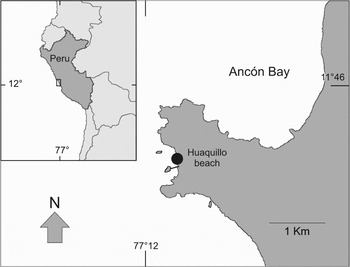
Sampling and experiments were performed between December 2005 and November 2006 in a central Peruvian beach, Huaquillo, a semi-exposed beach of 200 m length, located south of Ancón Bay (Figure 1), and subject to a semidiurnal tidal cycle with average amplitude of 0.54 m (Dirección de Hidrografía y Navegación, 2006).
Map of the study area, Ancón Bay, on the Peruvian central coast, indicating Huaquillo beach.

The area of Ancón Bay is part of the Peruvian coastal upwelling ecosystem, one of the most productive marine systems (Tarazona et al., Reference Tarazona, Gutiérrez, Paredes and Indacochea2003). This area is characterized by the hypoxic conditions normally prevailing close to the seafloor (Tarazona et al., Reference Tarazona, Salzwedel and Arntz1988, Reference Tarazona, Gutiérrez, Paredes and Indacochea2003), and is under significant organic loads of anthropogenic origin.
To characterize the morphodynamic state of the beach, mean grain size, beach slope, wave height and period were measured. The mean grain size was calculated based on five replicates of sediment samples, collected from the uppermost layer (10 mm) of the saturation zone (for details see Contreras et al., Reference Contreras, Jaramillo and Quijon2000, Reference Contreras, Jaramillo, Duarte and McLachlan2003; Jaramillo et al., Reference Jaramillo, Dugan and Contreras2000). From estimated mean wave height, wave period and sand fall velocity, Dean's parameter (Ω) was calculated (Celentano & Defeo, Reference Celentano and Defeo2006).
Epibiosis description
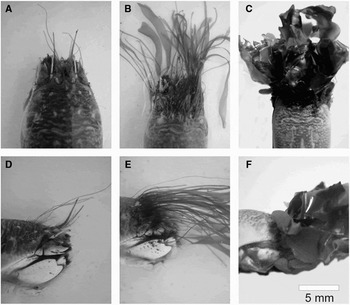
The description of the epibiosis on Emerita analoga was carried out by stereomicroscopic observations of E. analoga individuals and identification of epibibionts. To obtain a rapid assessment of the degree of epibiosis, a three level qualitative scale was designed based on the fouling of the rostrum: level 0 (L0), no epibiotic algae observed; level 1 (L1), algae covering 0 to 50% of the rostrum surface; and level 2 (L2), algae covering 50 to 100% of the rostrum surface (Figure 2).
Dorsal and right side carapace view of Emerita analoga fouled by Entermorpha spp. L1 (A, D) and L2 (B, E), and Ulva spp. (C, F).

Epibiosis prevalence and life history traits of Emerita analoga
To analyse life history traits of E. analoga during the year and the prevalence of epibiosis, seasonal samplings were performed in December, February, June and September 2006. Samplings were performed in 10 parallel transects, perpendicular to the shoreline and separated by 6 m. On each transect three sampling units (SUs) were obtained using a core of 0.02 m2 and 0.2 m in depth. The first SU was obtained in the saturation zone, the second in the resurgence zone, and the third in the retention zone (Salvat, Reference Salvat1964). The collected material was sieved through a 1 mm mesh screen and the retained organisms were stored for analysis. In the laboratory, the carapace length (CL; cephalothorax distance from the tip of the rostrum to the distal scoop) was measured (±0.5 mm). Individuals were classified by sex and ontogenetic development in four categories: (1) female (presence of pleopods); (2) ovigerous female (presence of eggs under the abdomen); (3) male (hemipenis and absence of pleopods); and (4) recruits (absence of sexual characters, CL ≤4 mm; see Brazeiro, Reference Brazeiro2005). We also determined total body mass, dry mass (DM; dried at 80°C to constant mass), and when applicable, we determined egg mass (EM) with a precision of ±0.1 mg. In all cases, presence of epibiosis was registered. Differences in size between sexes and time were analysed through a factorial two-way ANOVA, with a subsequent Tukey's HDS test (Zar, Reference Zar1999). The sex ratio was tested against a 1:1 ratio with the Chi-square test.
To analyse fecundity (i.e. number of eggs in a single clutch of an individual crab; Dugan et al., Reference Dugan, Wenner and Hubbard1991), a subsample of each egg mass was obtained, weighed (± 0.1 mg), the number of eggs estimated and extrapolated to the whole egg mass using the gravimetric method (Lee & Hsu, Reference Lee and Hsu2003). Determination of fecundity was made on females with newly extruded eggs. Eggs were classified into four developmental stages (Dugan et al., Reference Dugan, Wenner and Hubbard1991), according to the amount of cleavage and the proportion of the egg free of orange yolk. Differences in frequency distribution of egg stages among months were investigated through pair-wise Chi-squares tests (Zar, Reference Zar1999).
Epibiotic prevalence was estimated as the percentage of the population sampled with fouling algae. The maximum epibiotic prevalence was considered as total prevalence (L1+L2).
Additionally we analysed if fouling could reduce body condition and fecundity. We collected fouled (N = 155) and non-fouled (N = 195) E. analoga females from the shallow subtidal in October 2006. Differences in body condition (DM/CL) among E. analoga with different epibiotic level and reproductive state were analysed through two-way factorial ANOVA with a subsequent Tukey's HDS test (Zar, Reference Zar1999). DM of ovigerous females were obtained after the removal of egg mass. We also analysed differences among epibiosis level and egg stage through two-way ANOVA for ovigerous females. Developmental stages 2, 3, and 4 were used for ANOVA as no L2 females with eggs in stage 1 were found. Body condition data were log-transformed to meet the assumptions of normality and homoscedasticity.
To investigate the effect of epibiosis on fecundity, relationships between CL and number of eggs were examined by epibiosis level. As no relationship between CL and number of eggs was found for females L1 and L2 (see Results), epibiosis effects on fecundity were analysed through a one-way ANOVA. To restrict the analysis to overlapping size-ranges, only females with a CL between 20.88 mm and 23.46 mm were included in the analysis.
Effect of epibiosis on Emerita analoga burrowing ability
To assess direct effects of epibiosis on burrowing ability of E. analoga, field experiments were performed in March 2006, where burrowing time and depth were measured. Mole crabs of different size with (N = 147) and without (N = 133) epiphitic macrophytes were collected by hand in the shallow subtidal and kept in a cooler box with fresh seawater. In a round plastic receptacle of 200 mm diameter filled with 100 mm sand and 20 mm water column from the shallow subtidal, the burrowing times of individual mole crabs (N = 280) were timed with a chronometer from the initiation of burrowing to the disappearance of the mole crab under the sediment surface (see Jaramillo et al., Reference Jaramillo, Dugan and Contreras2000; Lastra et al., Reference Lastra, Jaramillo, López, Contreras, Duarte and Rodríguez2004). Test mole crabs were later classified by sex, CL, and degree of epibiosis as mentioned above.
A full interaction ANCOVA model with a subsequent Tukey's HDS test was used to analyse the relationship between CL (covariate) and burrowing time (dependent variable) related to epibiosis level (independent variable), when assumptions of normality, homoscedasticity and parallelism were proved (Zar, Reference Zar1999); when necessary we used log-transformed data. The overlapping CL size-range considered for ANCOVA was between 16 mm and 20 mm.
To evaluate the relationship between burrowing time and algal biomass, another set of field experiments was performed in November 2006. Mole crabs (N = 200) were collected and experiments were carried out as described above; additionally fouling algae were removed from mole crabs by scraping, stored and ADM was determined after drying at 80°C to constant mass (±0.1 mg). Relationships between ADM and burrowing time for each size-range of 1 mm were performed only for non-ovigerous and ovigerous females from 19 to 25 mm CL. The epibiosis incidence was noted as follows: no epibiosis (no epibiotic algae observed), low incidence (algal biomass from 1 mg to 10 mg), and high incidence (algal biomass >10 mg). Relationships between CL and burrowing time for each epibiosis level were assessed only for ovigerous females (N = 136); given the non-significant linear relationship between both variables (see Results), a one-way ANOVA with a subsequent Tukey's HDS test was carried out to compare burrowing times under different epibiosis levels (Sokal & Rohlf, Reference Sokal and Rohlf1998).
To evaluate if the fouling effect on burrowing time can be reverted by removing the algae, a field experiment was performed in November 2006 with ovigerous females, the only category with sufficient number of fouled individuals to perform statistical tests. Mole crabs (N = 204) were collected and the epibiosis level was again determined. For L1 (N = 12) and L2 (N = 18) fouling algae were removed by scraping, and experiments were carried out as described above. Given the non-significant linear relationship between burrowing time and CL, a two-way ANOVA with a subsequent Tukey's HDS test was carried out to compare burrowing time by epibiosis level and algae removed/non-removed (Sokal & Rohlf, Reference Sokal and Rohlf1998). Assumptions of normality and homoscedasticity were proved before (Zar, Reference Zar1999), when necessary log-transformed data were used.
For burrowing depth experiments, a 0.35 mm wide nylon string was glued with cyanoacrylate adhesive to the carapace of test mole crabs (N = 189), before releasing them in a plastic tub to burrow as mentioned above. When burrowing stopped, maximum burrowing depths were estimated by measuring the length of the string from the sediment surface to the tip of the rostrum. After the experiment, individuals were categorized as mentioned above. Again, relationships between CL and burrowing depth for each epibiosis level were calculated only for females. Given the non-significant linear relationship between both variables (see Results), we carried out a one-way ANOVA to compare burrowing depth by epibiosis level (Sokal & Rohlf, Reference Sokal and Rohlf1998).
RESULTS
Physical measurements
With a Dean's parameter of 1.97, Huaquillo was characterized as a reflective beach, with a mean grain size of 0.25 mm, and a slope of 2.75%.
Epibiosis description
The epibiotic algae fouling Emerita analoga were identified as Enteromorpha spp. (probably Enteromorpha intestinalis, or Ulva intestinalis according to the revision of Hayden et al., Reference Hayden, Blomster, Maggs, Silva, Stanhope and Waalland2003), and settled mainly on the anterior dorsal portion of the carapace, the rostrum, but were also found on primary and secondary antennae and maxillipeds (see Figure 2). When completely immersed, in natural conditions, these parts of the mole crabs remain above the sediment surface. Occasionally the epibiotic green alga Ulva lactuca, the red algae Chondracanthus chamissoi, and Polisiphonia spp. were observed under the Enteromorpha spp. canopy, as well as the barnacle Balanus laevis, tubes of the polychaete Phragmatopoma moerchi and an unidentified anemone.
Epibiosis prevalence and life history traits of Emerita analoga
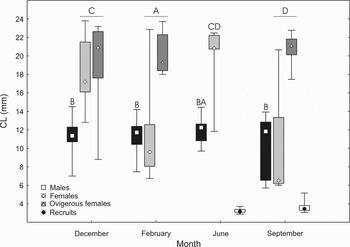
The population structure varied throughout the year. No ovigerous females were found during winter, and recruits were only recorded in June and September (Figure 3). Emerita analoga abundance and biomass reached the maximum in February (1230 ind m−2, 220 g m−2, Table 1). No differences in male sizes were registered during the year, the smallest females, found in February, were of the same size as males found in June, and females in December were larger than in September (P < 0.001; Tukey's HSD test, P < 0.05; Figure 3). Males were more abundant than females, except in September, where no difference in sex ratio was found (Table 1). There were no differences in the egg stage frequency distribution among months (P > 0.05).
Size-ranges for males, females, ovigerous females and recruits (median, whisker: 5th to 95th percentile sizes, box: 25th to 75th percentile sizes) during the year at Huaquillo beach. Letters denote significant differences at α = 0.05 (two-way ANOVA with subsequent Tukey's HDS test).

Emerita analoga population characteristics at Huaquillo beach for the studied months. The values in parentheses are standard deviations.

* denotes differences from 1:1 sexual ratio at α = 0.05 (P < 0.05).
The maximum prevalence of epibiosis was 2.1% of the population, and was registered in February. Epibiosis disappeared in June and September. From the total of fouled mole crabs sampled in December and February, all were females, and 65% of them were ovigerous. The minimum size of fouled individuals was 18 mm CL and only individuals sampled in the saturation zone were fouled.
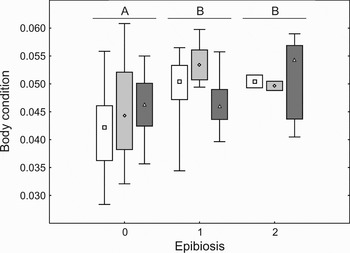
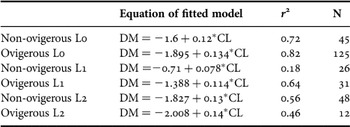
A linear relationship between CL and DM was observed for all female categories (Table 2). Body condition was different among epibiosis levels (F 2,305 = 9.4; P < 0.001; Tukey's HSD test, P < 0.05) and reproductive state (F 1,305 = 5.38; P < 0.05; Tukey's HSD test, P < 0.05). The body condition of females at L1 and L2 resulted higher than those at L0, whereas body condition of ovigerous females resulted higher than of non-ovigerous ones. In ovigerous females, body condition was affected by epibiosis (F 2,128 = 8.21; P < 0.001; Tukey's HSD test, P < 0.05) but not by egg stage (F 2,128 = 0.44; P > 0.05; Figure 4), females of L0 had lower body condition than females of L1 and L2.
Body condition (DM/CL) by epibiosis level and egg stage for ovigerous females at Huaquillo beach in October. Median, whisker: 5th to 95th percentile, box: 25th to 75th percentile. White box indicates females with egg stage 2, light grey females with egg stage 3 and dark grey females with egg stage 4. Letters denote significant differences at α = 0.05 (two-way ANOVA with subsequent Tukey's HDS test).

Summary of regression models of dry mass (dependent variable) versus CL (independent variable). Values of r2 are significant (P < 0.05).

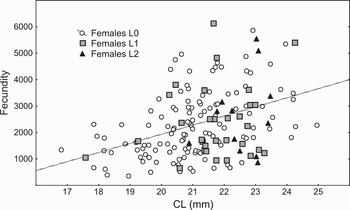
There was a linear relationship between CL and fecundity of females at L0 (P < 0.001), but not for fouled females at L1 and L2 (P > 0.05; Figure 5). No differences in the fecundity of L0-2 females between 20.88 and 23.46 mm CL (F 2,90 = 0.53; P > 0.05) were recorded.
Crab size (CL, independent variable) and fecundity (number of eggs, dependent variable) regression by epibiosis level. Linear regression was significant for females L0 (P < 0.05).

Effect of epibiosis on Emerita analoga burrowing ability
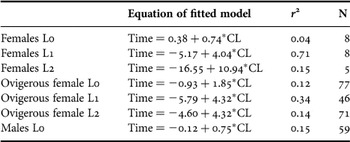
The burrowing time of mole crabs increased with increasing CL, except for males at L1, where no significant relationship was found. No males fouled at L2 were found (Table 3).
Summary of regression models of burrowing time (dependent variable) versus CL (independent variable). Values of r 2 are significant (P < 0.05).

The presence of fouling macroalgae had a negative effect on the burrowing time of non-ovigerous and ovigerous females; whereas the presence of eggs did not affect the burrowing time. Both females and ovigerous females at L2 were slower than females and ovigerous females at L1 and L0 (F 2,101 = 12.44; P < 0.05; Tukey's HSD test, P < 0.001).
No relationship between ADM and burrowing time of each 1 mm CL range were found for non-ovigerous and ovigerous females (P > 0.05). Furthermore no relationship between CL and burrowing time for each epibiosis level for ovigerous females was detected (P > 0.05). The burrowing time was shorter for non-fouled females than for females with low and high incidence (F 2,168 = 8.74; P > 0.001; Tukey's HDS, P < 0.05).
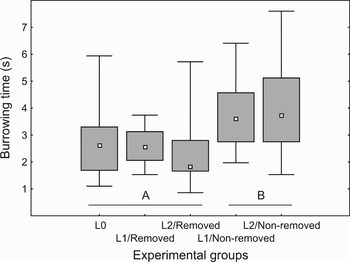
There was an interaction effect of epibiosis level and algal removal on the burrowing time of ovigerous females (F 2,1,198 = 6.70; P < 0.001). Mole crabs with removed algae (L1 and L2) showed similar burrowing time to mole crabs without epibiosis, and were faster than mole crabs with non-removed algae at L1 and L2 (Tukey's HDS, P < 0.05; Figure 6).
Burrowing time by experimental group (L0, L1 with and without removed algae, L2 with and without removed algae. Median, whisker: 5th to 95th percentile, box: 25th to 75th percentile). Letters denote significant differences at α = 0.05 (two-way ANOVA with subsequent Tukey's HDS test).

There was no linear relationship between burrowing depth and CL for ovigerous females (P > 0.05). Burrowing depth for ovigerous females at L0, L1 and L2 was not different (F 2,125 = 2.35; P > 0.05).
DISCUSSION
At Huaquillo beach (Peru), the most abundant epibionts of the mole crab Emerita analoga are algae of the genus Enteromorpha, which attach to the anterior part of the carapace. Despite the low epibiosis prevalence, this association affected in particular the larger females. Population parameters, such as abundance, sex ratio and size–frequency distribution resulted consistent with other studies for the area and were not related to the epibiosis event. Interestingly, individuals with epibiotic algae showed better body condition than those not fouled, whereas fecundity showed no differences. Algal epibiosis influenced E. analoga motility by slowing their burrowing activity, although this effect was reversible by the removal of fouling algae.
The epiobitic organisms most frequently fouling E. analoga are the fast growing green macroalgae belonging to the genus Enteromorpha (Fong et al., Reference Fong, Boyer and Zedler1998, Reference Fong, Fong and Fong2004). These opportunistic macroalgae, characterized by a high rate of nutrient uptake and enhanced reproductive capability, can proliferate in a wide range of abiotic and biotic conditions (Sousa et al., Reference Sousa, Martins, Lillebø, Flindt and Pardal2007). Enteromorpha spp. attach to the exoskeleton of the mole crabs, which constitute a suitable substrate for algae spores to settle in an environment where other hard substrates are absent.
Mole crab abundances at Huaquillo beach are consistent with those reported for the region (Aguilera, Reference Aguilera1992; Alvitres et al., Reference Alvitres, Gutierrez, Veneros, Chanamé and Fupuy1998). Abundances usually broadly range, possibly due to differences in the morphodynamic characteristics of the study areas (see Lépez et al., Reference Lépez, Furet and Aracena2001). Larger proportions of males were observed, coinciding with the sex ratios previously reported for different areas of the Peruvian and Chilean coasts (Aguilera, Reference Aguilera1992; Alvitres et al., Reference Alvitres, Gutierrez, Veneros, Chanamé and Fupuy1998; Lépez et al., Reference Lépez, Furet and Aracena2001). Agreeing with the reproductive behaviour observed in populations of central (Osorio et al., Reference Osorio, Bahamonde and López1967; Brazeiro, Reference Brazeiro2005) and southern Chile (Contreras et al., Reference Contreras, Defeo and Jaramillo1999), the proportion of ovigerous females varied seasonally, although contrary to the observation of previous authors, ovigerous females were absent in our study area during winter. Therefore, the E. analoga population parameters calculated for Huaquillo beach resulted consistent with other studies for the south-eastern Pacific and were not related to the epibiosis event.
The maximum epibiosis prevalence registered was ~2%, and presented a seasonal pattern, with a peak in February. In several systems the highest spore biomass of Enteromorpha spp. occurs in spring and early summer (Sousa et al., Reference Sousa, Martins, Lillebø, Flindt and Pardal2007). Moreover, Enteromorpha spp. growth rates increase at temperatures up to 15°C (Lotze et al., Reference Lotze, Schramm, Schories and Worm1999; Lotze & Worm, Reference Lotze and Worm2002), coinciding with the temperatures registered for the area of Ancón Bay during austral summer (Tello, Reference Tello2006).
Epibiosis affected females, most of them ovigerous. This may be due to the fact that E. analoga presents sexual dimorphism, with females being larger than males (Alvitres et al., Reference Alvitres, Fupuy, Chanamé, Chambergo and Cortez2002). In several decapods, including E. analoga, larger individuals allocate energy into reproduction suspending growth (Siegel, Reference Siegel1984; Dam et al., Reference Dam, Styrishave, Rewitz and Andersen2006; Nilssen & Sundet, Reference Nilssen and Sundet2006), hence females would have longer intermoult periods, from 36 days for 10 mm CL females to 44 days for 13.5 mm CL females reared in tanks (Siegel, Reference Siegel1984), favouring spores settlement and development. After releasing, Enteromorpha spp. spores can persist in the water column for hours or even days. Once they have encountered a suitable surface, they adhere, and germination often occurs within a few hours, giving rise to germlings (Callow et al., Reference Callow, Callow, Pickett-Heaps and Wetherbee1997; Callow & Callow, Reference Callow and Callow2002). Another cause of the high epibiosis prevalence of females may be the different spatial distribution. Adult females tend to distribute in the lower shore levels (Lépez et al., Reference Lépez, Furet and Aracena2001), where they are more exposed to seedling.
Body condition was positively related to epibiosis, females at L1 and L2 reached higher body condition than females at L0. Pre-burrowing time and behaviour (e.g. orientation and movement before contact with the substrate is made) appear to be important for crabs inhabiting the swash zone and it has been suggested that differences in those factors among crab species may be significant in determining their natural distributions (Dugan et al., Reference Dugan, Hubbard and Lastra2000). By enhancing physical dislodgement in the swash zone and modifying swimming behaviour, epibiosis may shift mole crab distribution from the intertidal swash zone to the shallow subtidal. In these conditions individuals could accumulate energy, normally spent in swimming and burrowing in an unstable environment and persist in more time filtering, reaching, hence, a higher body condition.
Despite the lack of differences found in fecundity among epibiosis levels, the significant relationship between mole crab size and number of eggs found for females without epibiosis and reported from several Pacific beaches (Dugan et al., Reference Dugan, Wenner and Hubbard1991; Contreras et al., Reference Contreras, Jaramillo and Quijon2000) differed from that of fouled females. Whereas the fecundity of non-fouled females rose with increasing CL, fouled females did not present a clear trend, suggesting an epibiosis impact on fecundity. Fecundity changes induced by epibiosis have also been demonstrated in freshwater systems for Daphnia, which enhances reproduction due to the green algae Korshikoviella gracilipes (Barea-Arco et al., Reference Barea-Arco, Pérez-Martínez and Morales-Baquero2001).
Macroalgal epibiosis has a negative effect on the burrowing activity of the mole crab E. analoga by increasing burrowing time, whereas burrowing depth was not affected. Furthermore, removal of epibiotic algae decreased burrowing time to non-fouled values. This reversion of burrowing performance indicates a physical and transient effect of fouling on motion. Thus, this alteration of locomotion skills, besides enhancement of visual cue due to epibiosis, may involve a modified availability to predators (Laudien & Wahl, Reference Laudien and Wahl1999). Moreover, in Huaquillo beach, avian predators fed on fouled individuals at higher rates (Hidalgo et al., Reference Hidalgo, Firstater, Lomovasky, Gallegos and Iribarne2006). Hence, this epibiosis may influence the population dynamic, by indirectly enhancing predation pressure on a critical component of the population, the mature females (see Laudien & Wahl, Reference Laudien and Wahl1999; Wahl & Mark, Reference Wahl and Mark1999). Emerita analoga life history traits vary between different morphodynamics of beach types, therefore, our finding on epibiosis effects, studied in a reflective to intermediate beach, should be restricted to these type of environments.
The association described in this study was found in one of the most productive marine systems (Tarazona et al., Reference Tarazona, Gutiérrez, Paredes and Indacochea2003), and doubtlessly, nutrients play an important role in the development of algal blooms (Valiela et al., Reference Valiela, McClelland, Hauxwell, Behr, Hersh and Foreman1997). This non-trophic, but primary production dependent interaction, allows Enteromorpha spp. to extend its occurrence in soft bottom systems, and should be considered an ecological indirect effect of algal development, that may alter the function and structure of affected systems (Valiela et al., Reference Valiela, McClelland, Hauxwell, Behr, Hersh and Foreman1997).
In general the effects of this association on E. analoga, were mainly neutral, in terms of demographic parameters, but important on behavioural traits. Contrary to expectations, sex ratios, abundance, and size–frequency distribution were not related to epibiosis. Even more, body condition was positively related to epibiosis. The only negative effect of fouling was on burrowing performance, but this effect resulted reversible by the removal of epibiotic algae.
ACKNOWLEDGEMENTS
We thank Juan Tarazona who provided his laboratory facilities, Elmer Ramos who made our work much easier, Alex Gamarra for field assistance and the Marina de Guerra del Perú, especially to Martin Magnani, who allowed us to access the closed study sites. This study was conducted and financed in the framework of the EU-project CENSOR (Climate variability and El Niño Southern Oscillation: Implications for natural resources and management, contract 511071) and is CENSOR publication No. 098.