Many colossal land-based empires, including China, Tsarist Russia, and the Ottoman Empire, contained large geographic zones inhabited and guarded by nomadic populations. In the nineteenth century, as the territorial security of these old empires was endangered by the expansive European state system, large-scale sedentarization projects were undertaken to restrict the mobility of nomads occupying frontier spaces. These projects often involved instituting private landownership and were intended to bind nomads under state control in order to make them more governable state citizens. In this article, I will apply a comparative approach to a similar historic process, that of the Inner Mongolia land reform instituted by the Qing court during the last decade of its rule. Rather than analyzing land reform as a state-enacted transformation of the nomads, I will explore changing governing relationships in Inner Mongolia as they unfolded throughout the land reform process. My central focus will be coalitions and conflicts among four key players: the Mongol banners, the neighboring Han Chinese provinces, the Court of Dependencies, and the frontier military governors. By examining the changing political relationships among these players, my study pinpoints the key agendas of the land reforms, how the Mongols were differently positioned vis-à-vis state agencies throughout the reform process, and the extent to which state centralization became possible after the reform. None of these questions can be adequately answered if we cast the whole process solely in the light of a state intention to reduce nomadic mobility. My conclusion will draw out some broader implications this study has for comparative research on frontier politics and modern state expansion.
SEDENTARIZING NOMADS AND THE MODERNIST THEORY OF STATE EXPANSION
Conceived as formidable foes of sedentary populations, nomads are pejoratively portrayed in history as ruthless desolaters of civilizations, yet many great empires relied heavily on them for auxiliary military assistance. Under the Qing Empire, nomads, particularly the Mongols, were not a peripheral people to be conquered and pacified by the state. On the contrary, alliances with Mongol nobles provided the Manchu rulers with the most capable military forces in their expeditions to the northern and northwestern borderlands during the seventeenth and eighteenth centuries. We also know that in the late fifteenth century the Muscovite princes shed the “Tartar yoke” and became prominent conquerors, but nevertheless, even when the Golden Horde decayed, they continued paying tribute to nomads, a practice that had been instituted during the Mongol conquest. When the Muscovites finally gained the upper hand in relations with the nomads of the former Horde, they strategically changed the form of tribute into attractive rewards and gifts. They utilized such soft strategies—endowing noble titles, granting rewards and protection, and demanding oaths of allegiance and the surrender of hostages—to create alliances with nomads and thus expand Muscovite influence into Central Asia.Footnote 1
The Ottoman expansion provides another example. Beginning in the eleventh century, the Ottomans grew out of a westward nomadic migration, mainly by Turks and Mongols. The nomads provided mobile units that were stationed in the frontier zones as shock troops for the empire and they were integrated into extensive trading networks that nourished the empire's economy. Through the practice of sürgün, the Ottomans strategically moved the nomadic communities across long distances to designated lands, but did not change their grazing habits (Kasaba Reference Kasaba2009: 18). They were recruited to guard the poorly populated mountain passes and their mobility partially solved the problem of imperial overreach (ibid.: 71).
Nonetheless, in the nineteenth century nomadic mobility gradually became a liability for all three empires. Encounters with European states, which mostly involved defeats in wars, are often given as the major reason behind the move to create and demarcate fixed borders in these old empires. More citadels and fortifications were built along the frontier zones, which necessitated an increased presence of imperial officials and administrative representatives, and diminished nomadic domination in many places.Footnote 2 During this time, mobile nomads were accused of plundering and raiding, which caused a tremendous loss of products and population in neighboring peasant villages.Footnote 3 Nomadic mobility was also suspected of enhancing transregional religious contacts, for example between the Kazaks and pan-Islamic religious networks, which hindered the clarification of the sovereign states' territorial boundaries.Footnote 4 The most urgent tasks for these empires became to forestall these unpredictable transnational ties and improve the governability of nomads. Sedentarization became necessary.
Scholarly attention to the sedentarization of nomads has not been restricted to these empires, and has included Iran, East Africa of the British Empire, and other imperial fringe areas. But the mainstream studies have analyzed the phenomenon exclusively from a state-centered perspective, and have identified land reform as a process coercively implemented by states pursuing modernization and increased territorial security. In this view, while invading and appropriating pastoral lands that nomads had originally owned as communal property, the state simultaneously propagated the institution of private land ownership (Salzman and Galaty Reference Salzman and Galaty1990: 15). By forcing nomads to take up sedentary lives, the state was also trying to make them more governable. The consequence was the extension of state power into nebulous frontier spaces that previously had only tenuous connections to the state.
A good example of such state-centered reasoning is Robert Geraci's Reference Geraci2001 study of the transformation of Kazan. Kazan was an important city in imperial Russia, a window opening toward the vast east. Russia long followed an incorporative assimilation policy regarding Christian education in Kazan, one that relied on extensive collaboration with various fluid groups including nomadic Tartars and amateurs. This incorporative religious education was abandoned in the late nineteenth century when the state laid a new emphasis upon modern professionalization. Consequently, centrally dispatched clergies and professional ethnographers came to dominate missionary schools in Kazan (Geraci Reference Geraci2001). Nomadic elements there were completely erased.
The Ottoman Empire began to settle nomads as early as 1689, focusing mostly on their registration and relocation into designated places, in a manner quite similar to how the Manchu handled the Mongols after politically subjugating them. The early settlement of nomads did not impose a sedentary life upon them, but starting from the mid-nineteenth century, systematic attempts at sedentarization were made that included breaking up tribes, confiscating their animals, and scattering their members. This was facilitated by large military campaigns to pacify the borderlands in the 1830s, 1840s, and 1850s. Meanwhile, imperial officials initiated empire-wide censuses to monitor, count, and identify the nomads and draft them into the professional state armies (Kasaba Reference Kasaba2009: 85, 99). The trend culminated in an 1858 land code ruling intended to entirely erase all traces of nomadic tribes from eastern Anatolia and Arab provinces (ibid.: 104–5).
These studies have tended to conceptualize sedentarization as a coercive state action to tame disobedient nomads, make them into useful modern citizens, and reduce social and political disorder in border areas. Such a conceptualization is grounded in paradigmatic thinking that idealizes the modern nineteenth-century state as constant and stable, and nomadic zones as marginal spaces where state regulation faded to oblivion. This view posits a stark contrast between marginal societies (often combining elements of traditional tribal, clan, and communal societies) that permitted mobility, mixing, and a confusion of people, and the modern state that insisted upon fixing and directly regulating the people.Footnote 5 Such a dichotomy dominates not only studies of nomad sedentarization but also more general studies on the expansion of the modern state.
A good example is James Scott's work on the legibility of the modern state (Reference Scott1998). In his discussion of the invention of standard measurements that in unprecedented ways facilitated state penetration into local societies, Scott maintains the dichotomy between traditional and modern state rule. By traditional states he means not only the mosaic of precolonial Southeast Asian polities, but also the European states before the French Revolution. Scott argues at many points that early modern European states maintained volatile and unpredictable rule in terms of both fiscal extraction and military coercion (ibid.: 38–39). The French Revolution brought about the birth of an entirely new form of state, which overwhelmingly invaded regions previously beyond its reach. More importantly, through a process of diffusion, colonial administrators transplanted the modular form of the European modern state into colonies, which imposed dramatic and often harmful changes on indigenous societies. Scott is not, of course, alone in stating that the modern state aggressively invaded areas once beyond its control,Footnote 6 and studies of the European nation-state-making process offer similar arguments.Footnote 7
In many respects, premodern European states resembled traditional states in other places, characterized by aloof central governments overseeing the self-governance of loosely assembled societies. As Krishan Kumar succinctly points out, the often-idealized European nation-states were not unified internally, and this made them indistinguishable from old empires (Reference Kumar2010: 124–28).Footnote 8 This point bridges the geographical and conceptual gaps that separate the history of these states from those of other, traditional states. It shows that the expansion of the modern state follows a common pattern, one faced by both European and non-European political rulers.
At the base of all of these studies is a theoretical assumption that has yet to be properly analyzed. Scott and others configure a general process of state expansion that reifies the categorical attributes of both the traditional and modern states. The traditional state is conceived as limited, with a high toleration of autonomous societal rule at its edges. The modern state that replaces it seeks to impose stricter territorial boundaries and tighter control over the population.Footnote 9 This model attributes to the modern state a subjective, ideational will led by a passion for expansion and uniformity. While highlighting the modern state's intention, it leaves out its actual composition and operation. This leads us back to Timothy Mitchell's classic critique of the state-centered approach, which he says mystifies the actual operation of the state by identifying state effects with subjective decision-making.Footnote 10 My stance here is slightly different from Mitchell's in ways that I will discuss in my conclusion. For now, I will simply state that I fully agree with Mitchell that when studying modern state expansion we must beware of totalizing and idealizing the state role.
In what follows, instead of portraying land reform in Inner Mongolia (1900–1911) as a replica of the general process of state invasion into a peripheral, non-state space occupied by nomads, I will focus on how the frontier governance system was restructured in interaction with the reform process. I draw inspiration from Owen Lattimore, who defined “frontier” not as a sharply demarcated edge where state power recedes and non-state, societal forces begin to dominate, but rather as a lively in-between place where imperial agents intermingle with various groups of local elites who both serve the central state and cater to indigenous interests (Reference Lattimore1940: 474; Reference Lattimore1962: 469–92). I will pay particular attention to the four key players referred to above as they both competed and collaborated. Their close interactions bound them into a political system whose relational patterns were radically changed while land reform was being implemented. In the end, this transformation did to a large extent centralize state control over the Mongolian lands, but that was not the result of any singular, voluntary state action.
LAND OWNERSHIP AND THE DEFINITIONS OF FRONTIER
Mongols were the Qing imperial rulers' most powerful allies. In the long military march from Manchuria's forests to the northern Chinese plains, the Manchus successively won the support of the eastern, southern, and northern Mongols, and this placed the conqueror in a strategic geographic position to subjugate the whole of China. During the march, the Mongolian imperial title was transferred to the Manchu ruler.Footnote 11 Once the battles were settled, the Mongols were granted many privileges; they were endowed with noble titles, presented with stipends and gifts, and exempted from tax obligations. Frequent intermarriages between the Mongolian and Manchu elites further consolidated the Mongol-Manchu bond.Footnote 12 These feudal privileges and alliances largely separated the Mongols from most Han Chinese, who had been traumatized by the Manchu conquest. As a result, Mongols regarded themselves as honored “banner auxiliaries to the Qing emperor” and not as mere “subjects” (Atwood Reference Atwood2002: 39).
Nomadic life was an important source of Mongolian military superiority. However, the Manchu court never seriously considered sedentarizing the Mongols, even after completing its imperial conquest during the eighteenth century. Like the Ottomans, who devised a “relocation” policy to integrate the nomads in the seventeenth century, the Manchu rulers used a banner-league structure to reorganize Mongols in a way that did not damage the basic structure of nomadic life.Footnote 13 Being a major component of Qing Mongolian political organization, the banner-league institution gave Mongol nobles great latitude in handling intra-Mongol affairs. But this freedom simultaneously placed them under the inspection of the Court of Dependencies and of Manchu garrisons stationed in the area. Moreover, this particular institution largely accommodated the intricate Mongol system of land ownership and testifies to Lattimore's point that a frontier is not an arbitrarily enforced borderline, but a vast interfacial space existing in its own right.
The Mongol banner combined military, civil, and juridical functions. It typically contained three to eight thousand members in the high steppe, and fifteen to twenty-five thousand near the Chinese heartland (ibid.: 24). Each was divided into several sum (literally “arrows”), each of which included a sufficient number of subject households to provide about 150 capable adult males for military service. A banner was “the hereditary domain of the ruling lord who managed his subjects and territory with the assistance of a series of officials and held judicial authority over his subjects” (Boldbaatar and Sneath Reference Boldbaatar, Sneath and Sneath2006: 299). It was a simple government run by nobles. In order to restrain the free mobility of Mongols, lest they coalesce into a supra-tribal confederation, the Manchu emperor fixed the domains of the banners.
My study focuses on Inner Mongolia, an area more proximate to the Manchu court than was Outer Mongolia.Footnote 14 Under the Qing, Inner Mongolia included the territory occupied by four eastern leagues (Jerim, Josotu, JuuUda, and Shili-yin Gool) and two western leagues (Ulaanchab and YekheJuu).Footnote 15 The region was much smaller than the contemporary Inner Mongolian Autonomous Region under the People's Republic of China because it did not include the northeastern section that was guarded by the Hulun Buir garrison banners, or the western section abutting Gansu and Ningxia provinces where the Oriot Mongols herded.Footnote 16 At that time, Inner Mongolia consisted of forty-nine banners. The banner ruler, or jasag, was normally selected from among the Borjigin (the golden lineage of Genghis Khan) descendants in elections attended by nobles. Beneath the jasag were six ranks of nobles. Above the banner organization, Manchu rulers consolidated the league at a regular meeting, thus creating a forum in which banner leaders could make decisions on important inter-banner affairs.Footnote 17
The forty-nine banners of Inner Mongolia were vertically linked to the imperial court via the central organ Lifanyuan (the Court of Dependencies).Footnote 18 The goals of the court differed from those of regular state administration, which prioritized tasks of taxation, legal adjudication, and social security. The court was mainly concerned with things such as the promotion, demotion, and succession of ruling nobles, the arrangement of stipends, the rotation of imperial audiences, and the compilation of genealogies (Atwood Reference Atwood2002: 33–34). Banners were also required to report irresolvable disputes to the court and wait for it to dispense justice. Capricious court interventions into the banners were disallowed.
The banner-league institution mitigated tribal allegiance by relocating the Mongols into designated banner land without creating a dominant, mutually exclusive land ownership. It thereby restricted the mobility of the Mongols to an extent that did not damage the basis of their nomadic life. Thus nomadic elements were preserved in the complex Mongolian system of land ownership. Unlike sedentary people who have a lifelong attachment to the land they plough, mobile nomads always move and choose the best land for herding. They therefore do not conceive of land in terms of either fixed property or exclusively defined ownership (Bo-er-zhi-jin Reference Bo-er-zhi-jin2007: 62). Their wealth is based on possession of livestock, not of land. This detachment from land was found among the Mongols.
From the Qing court's perspective, Mongols formally dedicated their land rights to the emperor when they swore an oath of loyalty to the throne. Strictly speaking, Mongols only had usufruct rights to their banner land—they could use it for moving their herds or staying with them in a given locality.Footnote 19 The banner jasag—the ruling noble—was granted the right to supervise land use but was not authorized to sell land or adjudicate land transactions.
In practice, the banner land was a combination of common, official, and semi-private land. Common land designated the vast pastoral land used by herdsmen as communitarian property. Official land (guandi) was assigned by the emperor to the jasag government and was factually managed by the jasag. It also included land assigned to other banner officials or given for the maintenance of official post stations. The common and official lands constituted the major part of each banner land. Patches of semi-private land were owned by noble families and warriors. These lands were usually called private land (sidi), which also included the land belonging to the jasag and non-ruling noble families as well as the subsistence land of banner soldiers. The land boundaries were imprecisely demarcated by natural markers such as hills or rivers and were often trespassed upon. When famines, droughts, pests, or other disasters deprived some herdsmen of their livelihood, they were generously accommodated on the pastoral land of others.Footnote 20 Sometimes commoners rented small portions of banner land to Han Chinese peasants without the jasag's permission.Footnote 21
Both the banner-league institution and the mosaic land ownership system differentiated Inner Mongolia from the Chinese heartland, where a prefecture-county system was established and private land ownership prevailed. The Mongolian territory, with strong nomadic features, was therefore called a “frontier” (bianjiang), distinguishing it from the Chinese core. Yet the word “frontier” often carries contradictory implications, and I will review several definitions before presenting my own.
According to C. R. Whittaker, a historian of the ancient Roman Empire, the connotations of “frontier” narrow if it is transferred from the original context of ancient empires to modern states. He summarized three nationally distinct concepts of frontier, which differed from his own interpretation based upon the Roman case (Reference Whittaker1994: 1–7). The first concept underpins the mentality of British Victorians, represented by the famous novelist Rudyard Kipling and the colonial official Lord Curzon, who conceived a frontier as a sharp line separating the civilized from the barbarian world. Guarding the frontier implied “the single strategy of forming a barrier line to keep the barbarians out” (ibid.: 3). The French concept, in contrast, stresses a natural, linear frontier, incarnated in the myth of river frontiers, and used also as an administrative symbol. The American understanding of frontier is evinced by Frederick Jackson Turner's paper, “The Significance of the Frontier in American History,” delivered in 1893. Turner depicted the western frontier as an empty, wild land waiting to be explored and occupied by adventurous, energetic frontiersmen. As long as the expansion into the frontier continued, “the growth of American manhood and its national history” would never decline (ibid.: 5).
While criticizing these different strands of modern “frontier” theories, Whittaker displays the strong influence of Lattimore, particularly in his book's third chapter. Unlike the British Victorians, Whittaker rejects the conception of frontier as a line rather than a zone where two worlds melded—the civilized and the barbarian. Neither does he agree with the idea that frontier is arbitrarily defined by the location of rivers and mountains, without involving the vital space in which human activities spread. Finally, he proposes that frontier indicates the limits of the reach of empire, which is not determined by military and political powers alone but also by long-term social and economic interactions, as well as ecological constraints.
Whittaker's attention to the intermixing of the civilized and barbarian elements, to vigorous human activities, and to long-term social and economic interactions and ecological constraints all show Lattimore's influence. When Lattimore explained why China through its history could expand almost infinitely south but not north, he cited the distinct ecological conditions of the northern Chinese frontier, which rendered agrarian production a costly enterprise whereas a pastoral economy easily thrived (Reference Lattimore1940: 243–44). But he did not conceive of frontier as a sharp edge separating the civilized from the barbarians, sedentary from agrarian, or state from societal forces. He saw it as an extensive space existing in its own right, linked to the imperial center via varied connections. In such a space, state power loses its purely coercive edge and becomes entangled with local people, institutions, and events, and this generates multifarious power coalitions among state and non-state agents.
Here I will follow Lattimore in my use of a relational model to study how power coalitions among state and non-state agents both sustained and transformed the frontier governance system throughout the process of land reform. A relational model of the frontier also helps to answer two important questions: what was the structural change that repositioned Mongols vis-à-vis multiple state agencies, and to what extent did this restructuring make state centralization possible?
Four key players and their interactions constituted the frontier governance system I examine here, and they engaged in extensive dealings that allowed the integration of state and non-state forces in an elaborate system that existed in its own right. Aside from the banner-league institution and the Court of Dependencies at the center, this system included the frontier military governors who led the Manchu garrisons, and the neighboring Han Chinese provinces that controlled the influx of Han migrants.
In Inner Mongolia, the three most prominent military governors were the Suiyuan jiangjun (general), the Chakhar dutong (commander in-chief), and the Jehol dutong.Footnote 22 Their major functions were to pacify Mongols, supervise northern security, and provide military support whenever there was a war. Unlike the governors of the Chinese heartland, frontier military governors did not administer civilian affairs and were even less likely to intervene in Mongolian banner affairs.Footnote 23 They also commanded the Manchu troops stationed at the frontier garrisons established to guard frontier security.
The neighboring Chinese provinces, such as Zhili, Shanxi, and Shaanxi, abutted the territory of Inner Mongolia and ruled Han migrants settling in the Mongol land. Early generations of Chinese agrarian settlers were made up of bankrupt peasants, peddlers, victims of war, and disbanded solders, and Mongol nobles recruited them to toil on their land. As their numbers grew, Chinese-style administration was established. A couple of ting (sub-prefectures) were eventually founded, and functioned as extensions of adjacent provinces to govern the Han who lived and worked in the Mongol territory.Footnote 24
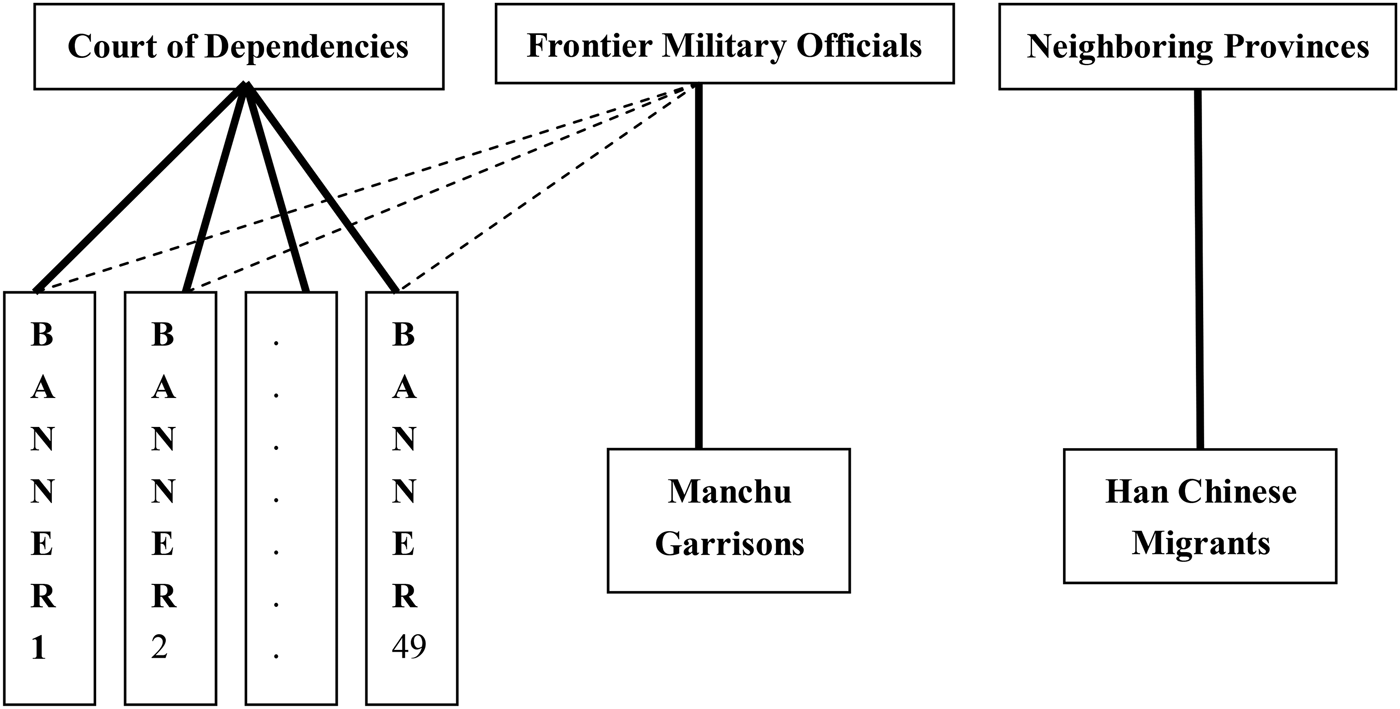
To summarize, the frontier governance system incorporated the four actors already mentioned (see figure 1). The structure was segmented since in addition to the banners, the multiple state agents—the Court of Dependencies, the frontier military governors, and the neighboring Chinese provincial authorities—were linked to Mongolian politics via discrete and functionally irreplaceable ties. Mapping out this governance system helps us to grasp the structural, relational changes brought about by land reform. It reveals that the sedentarization of nomads was not enacted by an abstract will of the state but was instead a consequence of relations and interactions generated within this multiparty system.
Frontier Governance System before Land Reform.

HOW LAND REFORM RESTRUCTURED THE FRONTIER GOVERNANCE SYSTEM
The Background of the Land Reform
Historically, nomads rarely led a pristine, untainted pastoral existence. Their nomadic life was intermittently threatened by sudden changes of climate, military expansion of sedentary regimes, or the presence of surplus agrarian populations, among other factors. Many studies have analyzed the early phases of sedentarization, which often displayed a sporadic and inconsistent quality. For example, C. A. Bayly emphasizes the symbiotic relationship between the nomadic economy and that of agrarian settlers before the nineteenth century. The old Indian nomadic tribes, such as the Gujars, Bhattis, RangarRajputs, and Mewatis, often moved their herds and extracted protection rent as they went. They also bred the horses required by many indigenous regimes. Occasional sedentarization occurred, usually under pressure from the peasant population or military insecurity. But early sedentarization was never systematic, thorough, or irreversible. Only under British rule, through the assessment of waste land and the creation of more rigid property right regimes, do we find that “the stranger, older India of forest and nomad where the agricultural frontier was as often in retreat as on the advance, began to disappear” (Bayly Reference Bayly1988: 144). Likewise, early Chinese settlers could not perpetually secure their agrarian settlement within Inner Asian frontiers because the pastoral land there was unsuitable for Chinese-style intensive agriculture (Rossabi Reference Rossabi1975: 19).
In Inner Mongolia, before land reform began, the nomadic livelihood of the Mongols was more or less eclipsed due to the gradual encroachment of private land cultivation. Small-scale cultivation was first attempted on the fringe of the banner land with the plowing of small patches of crops. Mongolian nobles led the early rush for land profits, their interests driven primarily by their indulgence in luxuries.Footnote 25 On the other hand, landless peasants and peddlers in adjacent provinces such as Shanxi, Shaanxi, and Zhili were compelled by famine, epidemics, and other natural disasters to try their luck in frontier regions where the population was still sparse.Footnote 26 Those who lost their livelihoods to the Manchu conquest swarmed into the frontier, along with disbanded soldiers who had been summoned to suppress rebellions. These various groups of wretched Han made up the early agrarian settlers of Inner Mongolia, whose livelihoods wholly depended upon land they privately rented from individual Mongol nobles (Lu Minghui 1990: 9).
This early phase of sedentarization allowed agrarian production to slowly and incrementally penetrate the Mongolian frontier with only the slightest state impetus. It thereby did little to undermine the frontier governance system. The land reform initiated in the last decade of the Qing not only drastically accelerated the erosion of Mongolian nomadic life but also resulted in a centralization of state control over the Mongol lands through an effective reconstruction of the frontier governance system.
A systematic land reform named fangken was instituted in Inner Mongolia at the turn of the twentieth century. It was part of the New Policy reform (xinzheng) deployed by the Qing court after the Sino-Japanese War (1895). Prior to this, Mongol land was officially categorized as pastoral land reserved for nomadic Mongols. Although private cultivation led by Han migrants had been ongoing, the official ban on land cultivation was not lifted until the land reform period (Wang Reference Wang2002). For the first time, the Qing government pressured most banners to officially open their grazing land to cultivation. The banners were required to report the exact quantities and conditions of the lands they agreed to open, to “superintendents,” officials dispatched by the emperor to conduct field operations to investigate and survey land. Land cultivation superintendents, who were often simultaneously the frontier military governors, organized land cultivation bureaus in specific spots to conduct land surveys and pool resourceful Chinese land merchants and peasants who were willing to purchase these lands. To obtain a license to cultivate, they had to pay Wild Land Money (yahuang yin) or Land Price Money (dijia yin). Once their land became eligible for taxation, a few years later, they were obliged to pay a regular land tax just as Chinese peasants in the heartland did. To compensate the Mongol banners for land losses, they were usually permitted to share in the income from the sales of land licenses and from land taxes that were later collected.
There have been few recent studies of the impact of land reform in Inner Mongolia in either English or Chinese. Most of them have suffered from a dearth of sources that directly address the political orchestration of the land reform, and so have generalized it as a symbolic transition of the Qing state from a traditional empire aiming at pacification to a modern state driven to advance itself militarily and fiscally.Footnote 27 They fail to answer the basic questions of who actually undertook the reform, and whether we can understand this in terms of a unified state seeking to expand.
Those who actually carried out the reform were Manchu frontier military governors, who often came from imperial elite families. Some may have had vague ideas about state expansion, but overall they were old fashioned bureaucrats concerned mostly with practical matters. Most importantly, they were embedded in a complex web that connected them to other agents in the frontier governance system. The following discussion is drawn mainly from administrative reports written by two prominent governors who were actively engaged in land reform during this period. These sources reveal governors undertaking shrewd, tactical maneuvers in order to overcome obstacles to reform. They show how the reform was accomplished through successfully readjusting governing relationships without sparking violent ethnic confrontations. I have conducted an exhaustive search and have found no previous studies of this aspect of the reform. I will highlight the governors as protagonists, but I fully concede that as more sources become available related to other agents, such as the Court of Dependencies and Mongol banners, I may well have to modify my argument to make it more textured and nuanced.
Xiliang (1853–1917) and Yigu (?–1926) were the most important frontier military governors who actively participated in Inner Mongolian land reform. Xiliang was a Mongol official renowned for his achievements as Jehol dutong in 1902 and as the governor-general of three northeastern provinces from 1909 to 1912. Although born a Mongol, Xiliang pursued a career path typical of Han Chinese mandarins. He received his jinshi degree in 1864 and was rotated through various minor civil positions before his ability impressed Empress Dowager Cixi during the Boxer incident. He was afterwards appointed Jehol dutong.Footnote 28 We have less biographical information about Yigu and know only that he was a Manchu and attended the Hanlinyuan (Imperial Academy) after earning the jinshi degree. Both men were conventional imperial bureaucrats raised with excellent classic Chinese educations. Xiliang left some fifty-three memorials from his tenure as Jehol dutong, and 379 written as the governor-general of the northeastern provinces, all of which were compiled and published by his descendants in 1959. Yigu left two major collections of memorials, Kenwu Zouyi and Suiyuan Zouyi, which give detailed information on his activities when he was Land Cultivation Superintendent and Suiyuan jiangjun. Neither of these collections, or Xiliang's Xiliang Yigao, have ever been systematically studied. They are my major data sources for analyzing the complex restructuring of the frontier governance system.
The frontier military governors led Manchu garrisons under the direct command of the emperor. They were requested to assist in dealing with military exigencies, but were forbidden to intervene in ordinary banner affairs.Footnote 29 They therefore were marginal agents in early Qing designs for Inner Mongolian governance. Their positions nevertheless gave them considerable leverage in managing land reform since their relationship with the banners was flexible. Their writings show that both Xiliang and Yigu made tactical maneuvers to propel the reform. Their mediating abilities were manifest when they resolved conflicts between the banners (divided into reform proponents and opponents), the neighboring Chinese provincial authorities, the Court of Dependencies, and amongst themselves. Let me address each in turn.
Frontier Military Governors versus Mongol Banners
During the land reform Mongols were divided between those who strove for protection of their pastoral rights and those who did not want to be impoverished by a herdsmen's life.Footnote 30 In the eastern part of Inner Mongolia, private land cultivation was widespread before the land reform. The Mongol nobles, Manchu garrisons, lower class Mongols, and Han peasants all contributed to the establishment of agrarian settlements. Yigu described the situation in a memorial he sent in 1903: “Half of the land in Chakhar has been privately cultivated. To an outsider, to officially supervise these privately cultivated lands seems easy. But once you are in it, you would realize that to clarify the cultivated land is several times more difficult than to just open the wild land.”Footnote 31 That private land cultivation was apparently flourishing before the reform implies that land leasing and transactions between Mongol landlords and Han tenants had been ongoing for some time. Xiliang's memorial confirms this: “In the three banners of the Korchin left wing and the Gorlos front banner, private land cultivation has been continuous since the Jiaqing (1760–1820) and Xianfeng (1851–1861) periods. All land rents and taxes were collected solely by the bureaus established by the banners. Transfers of land and housing were never reported to the state.”Footnote 32
Yet the prevalence of land cultivation could not conceal a rift that had the potential to strain the Mongol-Han relationship. Much of that rift originated in the jurisdictional division between state rule (symbolically located in the provincial government) and the Mongol banners. Han peasants were judicially governed by sub-prefectures, which were officially subordinate to the neighboring Chinese provinces, while Mongols were governed by banner governments. This posed the difficult question of who should be authorized to manage the land tax gathered from the newly cultivated lands in Inner Mongolia. In the same memorial, Xiliang continued: “According to the rule, the banners allowing private land cultivation should conduct surveys every five years. However, since the banners neither kept the land transaction records, nor did they cooperate with the state government, they provoked much discontent each time land rights were transferred.”Footnote 33
Xiliang was obviously chiding the banner governments for trying to monopolize administration of the land tax. By state government, he meant the elaborate province-prefecture-county system governing the Chinese heartland. In the eyes of imperial bureaucrats, state government was clearly separated from the banner government. Banners were only responsible for governing Mongol herding protocols. They had no right to collect the land tax, especially in places where large groups of Han cultivators concentrated. Those people were under the judicial administration of neighboring Chinese provinces. Xiliang thus correctly believed that the three Korchin banners and the Gorlos banner were trespassing on state jurisdiction by administering the land rent and tax themselves.
This jurisdictional division was further elaborated in another memorial describing the rampant administrative chaos in places where land cultivation had increased and new sub-prefectures had been built in response to the accumulation of Han migrants: “In places where Chinese local governments were established, Mongols became a big problem for governance. Because Mongols were traditionally ruled by banner governments, they refused to cooperate with state administration on such matters as investigations of households or the opium ban.”Footnote 34 Here “local government” specifically refers to the newly instituted sub-prefectures in the Mongol territory. According to Justin Tighe, a few ting (sub-prefectures) existed as civil administrative units to govern the Han migrants in Inner Mongolia before the land reform. During the reform, the number of sub-prefectures rapidly increased. In 1907, the Dongsheng ting was created in the YekheJuu League, which brought the total number of sub-prefectures in the Guisui Circuit alone up to twelve, and “decisively pushed Chinese-style territorial administration out beyond the confines of the directly-ruled banners of Court Mongolia into the territory of the Inner Jasagh banners of Ulaanchab and Yeke-juu leagues” (Tighe Reference Tighe2005: 65). These Chinese administrative units were controlled by neighboring Chinese provinces such as Shanxi and Shaanxi. However, because their territorial boundaries often mingled with those of local banners, jurisdictional conflicts between provincial and banner governments became inevitable.
These memorials show that Mongols as a whole were not hostile to the Han Chinese, who were hungry for their land. Neither was the state primarily interested in fixing the Mongols under its control. Mongol banners were part of the frontier governance system and they actively participated in land reform. Although Mongols and Han were not entirely antagonistic toward each other, the jurisdictional conflicts between banners and neighboring Chinese provincial governments were intense. Facing these conflicts, Xiliang reiterated that only the state could administer taxes, and he exhorted the banners to pass this task over to it, which in effect allowed for a penetration of the provincial sub-prefecture system. This proclivity for empowering provincial sub-prefectures is also evident in Yigu's memorials.Footnote 35
To briefly summarize, then, one of the central issues brought forth by land reform was the conflict between Mongol banners and Han Chinese provinces, over not whether Mongol land should be opened or not, but over who was eligible to collect the land tax. In mediating this jurisdictional conflict, the frontier military governors tended to side with the provincial authorities, since they insisted that tax administration was a responsibility of the state and not the banners. Even so, the governors never fully committed themselves to the provincial authorities. While interacting with Chinese provincial governments, these same governors worked hard to ward off their interventions.
Frontier Military Governors versus Han Chinese Provincial Authorities
The conflict between the governors and the neighboring Han Chinese provincial authorities was another crucial issue of land reform, but it was not a byproduct of the jurisdictional controversy between state and non-state governance. Both the governors and the provincial authorities deemed themselves state bureaucrats endowed with legitimate power to manage the land tax. Neither were they split in their attitude toward land cultivation, since both championed land reform. Yet the sources reveal their divergence on other matters.
While the governors affirmed the right of the state government to collect a land tax in Inner Mongolia, they carefully stated that the sub-prefectures in the Mongol territory should be partitioned from the neighboring Chinese provinces due to the inconvenience brought by the latter being so far away. For instance, in a memorial sent in 1907, Yigu admitted that the governor was not supposed to advise the actual management of the ting. However, land reform generated enormous disputes and conflicts embroiling both the Han (legally governed by the ting) and the Mongols (politically affiliated with the banners). Even more worrisome, residents widely exploited these administrative divisions and greatly hampered the reconciliation of conflicts. Yigu therefore suggested that a unified civil administration that could effectively govern both Mongols and Han was necessary.Footnote 36 In doing so, he boldly tried to reduce provincial control over the sub-prefectures located in the Mongol territory and managed to greatly enlarge his own administrative scope.
A more explicit call for amalgamation of local sub-prefectures with the governance of the military governors was conveyed in a later memorial. On 8 June of the Guangxu 33rd year (1907), in response to a proposal by the well-known Han Chinese official Cen Chunxuan (1861–1933) that provinces be established in Inner Mongolia, the imperial court promptly decreed that Cen's memorial be circulated among prominent frontier officials. In response, Yigu wrote a long memorial on 13 September in which he approved of the idea that a province should be set up in Suiyuan. He suggested that the shallow civil administration there could no longer manage the complicated tasks associated with occupation by foreign Christian churches, land reform, and escalating banditry. On the topic of making Suiyuan a province, Yigu emphasized that no extension of control from the adjacent Shanxi province should be allowed: “The Shanxi officials in the frontier [a phrase he used to refer to sub-prefecture officials] are irredeemably corrupt, both because they have inherited bad habits and lack strict supervision. The provincial authorities relaxed surveillance of the frontier sub-prefectures located so far from the provincial power seats. In the absence of proper supervision, their frontier officials have become unanimously selfish and unruly” (1974b: 335–36). Yigu therefore urged that the new province of Suiyuan, if it was to be established, should cut its ties to Shanxi. He suggested, moreover, that the revenue these sub-prefectures collected and annually remitted to Shanxi was sufficient to establish a modest provincial government in Suiyuan.Footnote 37
These sources reveal another, new type of conflict different from that between the governors and the banners. This was provoked by a redistribution of administrative power between the rising elites—the governors—and the entrenched provincial authorities. While the governors worked to diminish the control that neighboring Chinese provinces exerted over sub-prefectures in the Mongol territory, they stressed the importance of physical proximity. In other words, they distinguished themselves, as closer to the frontier sub-prefectures, from provincial authorities who were physically remote. They also emphasized that they were more responsive to the Mongols' needs.
In contrast to Chinese provincial authorities, who extended their reach by following the expansion of Han migrants, the governors were more circumspect and avoided violating Mongolian interests. They made more concessions to the Mongols than did provincial authorities, who were often implicated in intense struggles with banners. For example, governors devised methods of adapting to the diversity of communal land, official land, and semi-private land.
A large proportion of the official and semi-private land was actually what I classify as “privileged land.” This included land belonging to sub-prefecture governments; rice land of the Suiyuan government; the land of post-relay stations; land of Manchu princesses who married Mongol nobles; subsistence lands of Mongol nobles and ordinary Mongol commoners; official grazing land; the land of households without descendants; and the land for temples. I call these various lands “privileged” to emphasize that they were treated differently from ordinary land. They were encouraged to be opened, but this was not required, and when they were opened, greater compensation was paid to their owners (or to the Mongol banner government).Footnote 38
The frontier military governors also worked out a highly sophisticated benefit-distribution plan. At least half of the income accrued from selling land licenses was to be distributed to banners and to the Lamaseries. After they paid the license fee, Han Chinese peasants were granted a five-year exemption from taxation, after which their land would be taxable (shengke). In practice, most peasants received a further three-year exemption.Footnote 39 Banners were usually granted the right to share in the land tax.
Thus, while the governors encouraged the Mongols to open their land for cultivation, they did not abrogate the customary laws regulating Mongolian land ownership. Neither did they force the Mongols to accept a uniform set of practices quintessentially called “private landownership.” By carefully safeguarding the land privileges Mongols enjoyed in their own territory, the governors distinguished themselves from the neighboring Han Chinese provincial authorities, who knew and cared little about the customary laws binding the Mongols to their land.
To maintain the delicate balance between Mongol banners and Han Chinese provinces, the governors had to be skillful mediators. By emphasizing the jurisdictional division between banners and the state, they facilitated the expansion of provincial sub-prefecture powers to include the administration of the Mongolian land tax. At the same time, by highlighting their own physical proximity to frontier sub-prefectures and their willingness to grant more benefits to Mongols, these same governors attained the twin goals of imposing their authority over the frontier sub-prefectures while curtailing that of the neighboring Han provinces. These measures allowed the governors to successfully mediate the relationship between banners and the Chinese provinces without fully committing themselves to either side. In this way they greatly boosted their own capacity to rule.
Frontier Military Governors versus the Court of Dependencies
My discussion thus far has focused mostly on the triangular relationship of the frontier military governors, the Mongol banners, and the neighboring Han Chinese provinces. Let me turn now to the Court of Dependencies, the central organ that sent off imperial decrees and transmitted Mongol petitions to the court. At the beginning of the land reform, the relationship between the governors and the court was fairly good, since the governors heavily relied on the court to persuade reluctant, conservative Mongols to open their lands. The court was habitually recognized as the highest official organ for making decisions regarding Mongolian affairs. It was viewed as an institutional incarnation of the vassal-lord relationship binding Mongol nobles to the emperor. Thus it is little wonder that during the incipient stage of the reform governors zealously sought the court's support.
In Guangxu 27th year (1901) when the order to open Mongol land reached the Ulaanchab League, it was bluntly refuted, since land cultivation was still uncommon in that league at that time. Facing recalcitrance against the reform, Yigu recognized that only the Court of Dependencies, which held a righteous symbolic sway among the Mongol nobles, could help him out of this difficult situation. He sent memorials to the Guangxu Emperor, who then decreed the Court of Dependencies should persuade the Ulaanchab and YekheJuu Leagues to comply with the order (Li Keren 1990: 133).
In the early phase of the land reform, then, the governors very much needed the cooperation of the Court of Dependencies. As the reform proceeded, however, a new kind of conflict damaged their relationship. We find that the same military governors started to file grievances over court misdemeanors. In the attached memorial sent on 3 May of Guangxu 29th year (1903), Yigu complained that the court played an equivocal role in land reform. The nobles in Khanggin banner refused to open their land on the pretense that they had appealed for an exemption in the court. In response, Yigu said, “Land reclamation should have been deployed promptly. Several Shanxi governors were urged to do so. Yet the Court of Dependencies was too conservative to allow any change in the interaction with Mongols. Regretfully, the banners lost the opportunity of being wealthy [from opening the land].”Footnote 40
Despite the court's incipient support for the governors, the governors clearly came to see it as a rigidly managed imperial institution whose ways of handling Mongolian affairs could no longer adapt to contemporary needs. This “backward” institution sheltered the conservative Mongol nobles who refrained from joining the land reform process. The dissonance grew more acute as the reform progressed and both sides began to worry about the distribution of land income.
In a more acrimonious critique of the Court of Dependencies submitted on 6 October, Guangxu 31st year (1905), Yigu bitterly reprimanded the court's unjust claim to a share of the land income collected in Inner Mongolia. He argued that land reform was not proceeding as smoothly as expected and that land income was actually meager. At that stage in the process, he saw no real hope of squeezing out more land income to satiate the greed of the court. He pointed out also that the court had other, more lucrative means for making money such as selling official positions and noble titles to the Mongols.
If the land reclamation in the western leagues had proceeded well, I would have been able to make a small contribution to the Court of Dependencies. However the land income from fangken is too modest to be comparable to regular taxes, which genuinely produced little more to be distributed to the Court of Dependencies. I have been thinking there is perhaps a way to improve the financial status of the Court of Dependencies—to turn private profits for public use. We know that the Court of Dependencies monopolized the supervision of all major Mongol affairs and its administrative staff exploited huge profits from selling minor clerk positions to Mongols. This money was shamelessly pocketed by these bureaucrats. If this income could be used for public purposes, the Court of Dependencies would have secured sufficient funds for itself.Footnote 41
Here, Yigu was trying to fortify the functional divide between the court and the frontier military governors. He thought the court should be restricted to coping with ritual affairs among the Mongol nobles, while the governors wielded the legitimate power to administer land cultivation. It was unreasonable for the court to intrude in land affairs, let alone share in land income.
Although the conflicts between the governors and the court were not as complex as the triangular relationships between the governors, Mongol banners, and Han provinces, they show the ambivalent roles that traditional imperial institutions played in the land reform. While the governors sought the court's help in ameliorating tensions with resistant Mongol nobles, they also needed to overcome the institutional inertia embodied by the court that might be constraining the shift toward land cultivation. As in their management of relations between the banners and the Han Chinese provinces, the governors here displayed impressive mediation skills.
Frontier Military Governors versus Conservative Mongols versus Foreign Churches
This triangular relationship embodied the last type of conflict I will discuss. As noted earlier, Mongols were internally divided into land reform proponents and opponents. Many banners in western Inner Mongolia were opponents and clung tenaciously to their conventional pastoral privileges. To overcome their reluctance, the frontier military governors did not rely just on persuasion by the Court of Dependencies, but also took advantage of the presence of foreign churches to make the land reform more appealing to many conservative Mongols.
Catholic churches first boomed in western Inner Mongolia during the nineteenth century. They did not merely preach to people, but also introduced commercial enterprises and, most importantly, occupied a large quantity of land (A-le-tan-ce-ce-ge 1988: 16). Because most Mongols were devout disciples of Tibetan Buddhism, they detested conversion to Christianity and saw it as a blasphemy. Consequently, the Christians found most of their followers among Han Chinese who needed a powerful patron or protectors to help them cope with the frontier's haphazard environment. Meanwhile, the churches were granted “extraterritorial” rights, implying that the lands they occupied were outside the jurisdictions of both local banner governments and the Qing state. As a result, many Han who were called “displaced people” (liumin) secured the lands they cultivated under the aegis of the foreign churches. Once they became “church people” (jiaomin), the ecclesiastical districts they inhabited soon became in effect concessional areas—that is, though church people were within Mongol banner territories, they were under neither Qing nor Mongol legal jurisdiction (Jagchid Reference Jagchid, Kaplan and Whisenhunt1994). Backed by missionaries, “church people” ruthlessly seized banner lands. In the attached memorial sent on 27 December of Guangxu 29th year (1903), Yigu provided an overview of the difficulties the missionaries had caused in frontier land affairs:
The region most seriously stricken by the disaster of missionary cases is the seven sub-prefectures along the border of Shanxi province. No reconciliation has been reached there and the root of the problem is land. According to Cen Chunxuan's memorial, about one hundred thousand guest people (Han Chinese) live in Sa-la-qi ting alone and half of them are church people. According to my investigation, the situation in Fengning is almost the same. The four right wing banners of Chakhar had plenty of fertile lands and people strove to open them for cultivation…. There also were concentrations of Christian merchants and church property. Many of them simply grabbed lands without the consent of the Mongol banners. Some of them were previous tenants on those lands…. If you are not a Christian, you cannot secure your land. But if you are, you can even appropriate more land and oppress others. As a result, many people turned to the church….Footnote 42
The collusion between the churches and the Han migrants incited the enmity of the Mongols, who finally revolted in the Boxer uprising. The Mongol rioters tore down churches and many priests died at Mongol hands. Western Inner Mongolia, especially the Alashan banner and the Ulaanchab and YekheeJuu leagues, were particular hotbeds for the violence. As the rebels were suppressed and order was restored, these insurgent banners were devastated by large compensations they had to pay to the churches for damages. For example, Dalad banner was forced to pay local churches as much as 370,000 silver taels after peace negotiations. Even when the banner promised to mortgage all their livestock, houses, and land rents, it still owed 140,000 taels (Zhang 1984: 17). In many places what compelled banners to join the land reform was fiscal pressure—they needed land income to pay the indemnities.
For example, during the rebellion the Mongols in three YekheJuu banners killed a Catholic priest and ten church people, besides burning down many houses. During negotiations initiated by Suiyuan jiangjun, and Shaanxi provincial officials and the church, the banners and the church reached an agreement: the church would return the lands it had occupied after the rebellion, but each banner responsible for this incident would pay 28,000 taels remuneration.Footnote 43 Short of cash, they agreed to open their lands.
These banners found that working through the frontier military governors better suited their interests than did interacting with the churches directly. In a memorial sent on 23 January of Guangxu 29th year (1903), Yigu detailed why the Dalad banner desperately needed his support in handling its relations with the churches.
Dalad banner still owes about 170,000 silver taels indemnity debts to the church and it has no cash to pay except by selling its land. But the church refuses to take land and insists on having money…. Shanxi governor Cen Chunxuan has discussed this issue with me and I have determined a way to get this money. The West Land Reclamation Company could draw about 120,000 taels from its official and private funds to buy land from the Dalad banner. Shanxi province has agreed to loan 50,000 taels to the Mongols to meet this emergency.Footnote 44
These cases tell us that the conservative Mongols in western Inner Mongolia wanted to stop the trend toward sedentarization. Yet their conflicts with local land cultivators were confounded by the involvement of foreign churches, and finally the Mongols resorted to violence to try to frighten the churches, but the compensation liabilities that resulted shattered the banner economy. Once again the governors were adept mediators, now negotiating with churches on behalf of the banners, and eventually breaking down Mongolian reluctance to cooperate with the land reform.
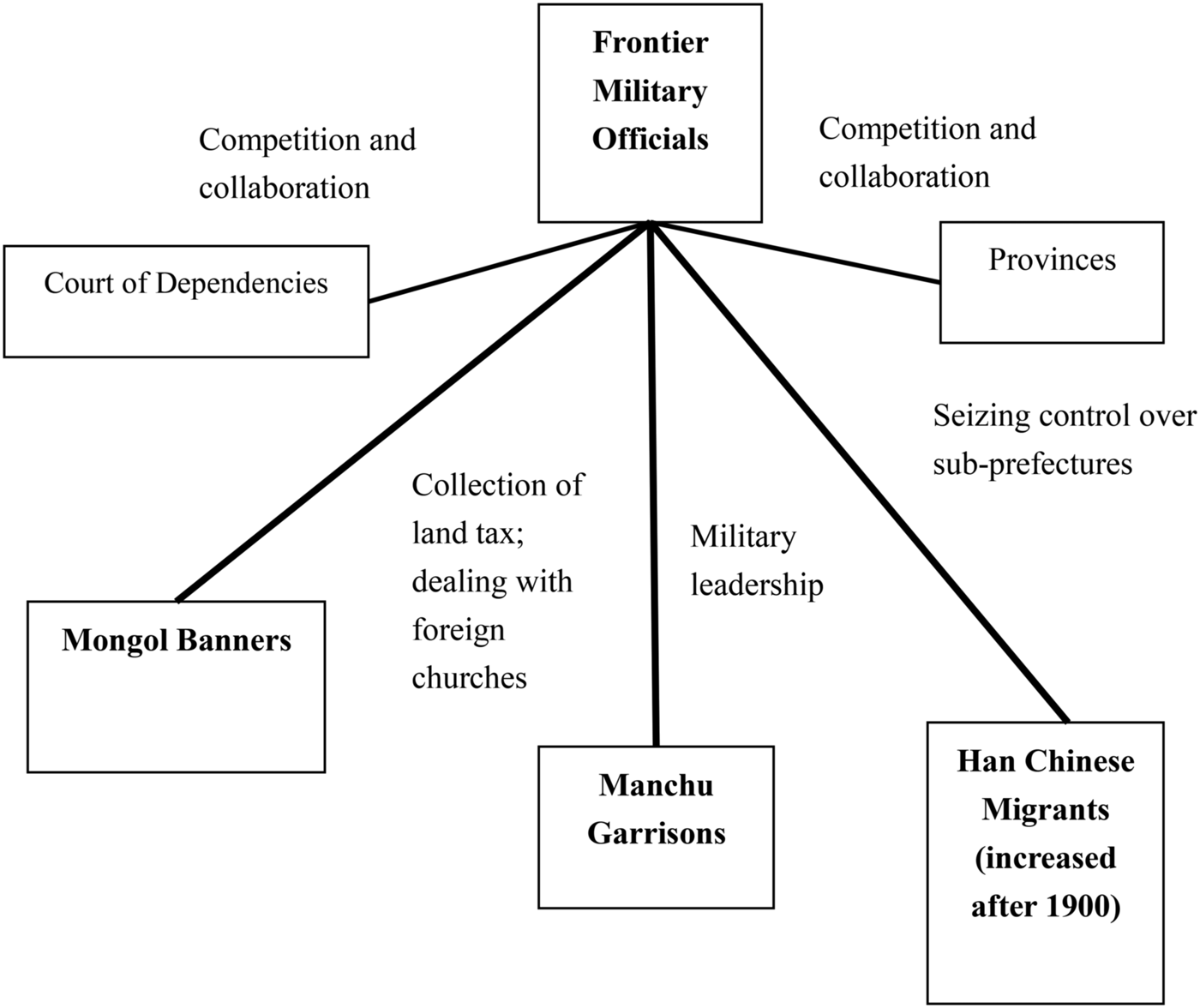
These four kinds of conflict, characterizing the relationships among the four key players, tell us that the key issues in the land reform cannot be understood simply as a conflict between an intrusive, sedentarizing state and the nomadic Mongols (see figure 2). Both how the reform was deployed and the process of nomad sedentarization became entangled with more specific disputes, such as those over who was entitled to collect the land tax, how to redistribute administrative power, how to utilize the symbolic power of old imperial institutions to overcome obstacles to reform, and how to mediate the relationship between Mongols and foreign churches.
Frontier Governance System after Land Reform.
By comparing figure 2 with figure 1, we see a structural change that took shape during this period. Frontier military governors were no longer a marginal group restricted to the military sphere. Once they were endowed with authority to carry out the land reform, in practice they moved to the center of frontier politics. They weakened connections between Mongol banners and the Court of Dependencies and relieved tensions between banners and the neighboring Chinese provinces. They mediated the relationships between these various players and centralized the conduits tying Mongols to the imperial center. After the land reform, Mongols became structurally subordinate to the governors and this restructuring made state centralization possible.
CONCLUSION
The restructuring of the frontier governance system greatly determined the path taken by Inner Mongolia when, around 1911, a Chinese nationalist revolution, driven by strong anti-Manchu sentiments, quickly destroyed the Qing dynasty. Because they were faithful military allies of the Manchu court, Mongols were expected to gravitate toward secession after the empire's collapse.Footnote 45 I cannot delve here into how Mongols were affected by the ethnic (and perhaps racist) propaganda of the 1911 revolution, though this paper offers a new way to approach this question. My findings show that frontier military governors carried out comprehensive mediations that not only strengthened central control over Mongol land but also produced a cohesive, frontier clique made up of the banner nobles, Han migrant elites affiliated with local sub-prefectures, and the military governors. This clique mitigated the impact of the revolution's ethic of ethnic exclusion.
There are primary sources that support this argument. For example, the Kharachin prince and the Jehol native residents association (founded by Han elites) sent petitions to the central government which confirm that, after the revolution, the Mongol nobles, Han elites, and governors shared a common interest in perpetuating the frontier governance system rather than splitting along ethnic lines.Footnote 46 These issues push us to redefine the turning points in modern Chinese imperial history. They are not marked by events of concentrated symbolic meanings, such as the 1911 revolution, but rather by events that generated genuine endogenous restructuring, like the land reform and later the rise of warlordism (1917–1928).
I have not dealt with the issue of nationalism, a topic frequently engaged by studies of nomad sedentarization, but this does not mean I consider it unimportant. Previous studies have pointed out that sedentarization policies may have had goals beyond simply appropriating land resources, such as to homogenize national culture by transforming diverse, unruly, and mobile people into governable national citizens. The sedentarization process was also bound to alienate nomads and spark antagonistic ethnic movements. This argument echoes explanations of imperial demise found in the sociological literature,Footnote 47 which emphasize that empires have the advantage of “containing nationalism” because they allow peripheral peoples to exercise a considerable degree of self-governance. State centralization and cultural homogenization, two outcomes of modern nation-state building, curtail the political autonomy of local peoples and may leave them classified as cultural inferiors. They may therefore become catalysts for centrifugal movements, often with ethnic names, that can wreck empires.
Cultural homogenization and state centralization are less conspicuous in the China-Inner Mongolia case. While the land reform did effectively centralize state control over Mongol land, it was driven more by practical concerns over jurisdictional confusions and land disputes than by any ideological presumption of Chinese cultural superiority. Moreover, the reform relieved rather than aggravated tensions between Mongols and Han migrants. It bought about a significant hybridization of Mongolian and Han interests. My study therefore reaches a tentative conclusion that nationalist rebellion or mobilization is not an inevitable outcome of nomad sedentarization, or at least it did not occur in this case.
By constructing a relational model of frontier governance, my study suggests new directions for future studies of modern state expansion. Timothy Mitchell nicely critiques the model of an autonomous state by arguing that constructing the state as the formation and expression of authoritative intentions is problematic (Reference Mitchell and Steinmetz1999: 82). He stresses that the state's intentions matter less than its actual operation when its extension merges almost seamlessly with social sectors on the ground. My findings support this point. Even so, in contrast to Mitchell's more provocative perspective, I have not examined the emergence of internal boundaries that set the state apart from society. Mitchell assumes a pristine premodern situation in which state institutions were surrounded by indistinct and multiple social organizations. What set the state apart from other commercial and social organizations, for Mitchell, were its modern techniques for bringing about revolutionary transformations in the army and the bureaucracy (ibid.: 85). He illustrates this with the case of policing frontiers. He says that a range of modern techniques and practices, including barbed-wire fencing, passports, immigration laws, inspections, and currency control, define modern governmental functions in the frontier, and simultaneously enclose a territorially and culturally homogeneous national entity (ibid.: 90). But this falls back on the same erroneous assumption that he critiques earlier in his paper. He considers that the modern state could triumphantly enforce disciplinary regulation of the frontier, which rarely involved conceding or even adjusting to power dynamics within the frontier.
I have adopted a quite different stance here by not focusing on the deployment of such modern techniques, which were not the central strategy of the Qing Empire's land reforms. I have given more attention to the constitution of the frontier governance system that wove together the interests and stakes of the central state agents and local actors. In general, I endorse the observations of Lattimore and Whittaker, who distinguish the frontier from the core that is directly administrated by the state bureaucracy, without relegating the frontier to a totally stateless ambiguity. As Whittaker argues, both governed and ungoverned land was “incorporated within the orbit of power and collective ownership of the city-state [of Rome]” (Reference Whittaker1994: 20). I contend that both the Inner Mongolian frontier and the Chinese heartland were under the control of the Qing imperial state for centuries. The sedentarization reforms undertaken in the early twentieth century did not mark the state's presence in the frontier for the first time, but rather substantiated its presence by reshuffling governing relationships. While categorizing the state as an external actor and the frontier as a passively inert object waiting to be shaped might provide a heuristic tool for understanding how drastic modern state expansion is, it effectively mystifies the state process. As Andrew Abbott argues, the state, whether traditional or modern, is not a statically positioned external actor judging and imposing actions upon non-state space (Reference Abbott2005: 245–74). I argue that the manner of state expansion is better analyzed using a relational model that captures the interactions of and transmissions between state and local agents.Footnote 48
Some of my findings here specifically relate to the Inner Mongolia case. As I have noted, the governance system that crystallized in Outer Mongolia involved disparate and less intricate relationships. Likewise, the governance systems in other imperial frontiers such as Tibet, Xinjiang, or the southwest display still more variation. Future research should compare these systems. As Lucien Febvre hinted decades ago, a fruitful approach would be to generate typological comparisons by studying what sorts of frontier-governing relationships define particular types of states (Reference Febvre and Burke1973: 208–19). We can extend our approach beyond the confines of the contiguous land-based empires to study regional political relationships on the maritime frontiers.Footnote 49