I THE ‘ARA OF DOMITIUS AHENOBARBUS’: A LONG AND PROTRACTED HISTORY
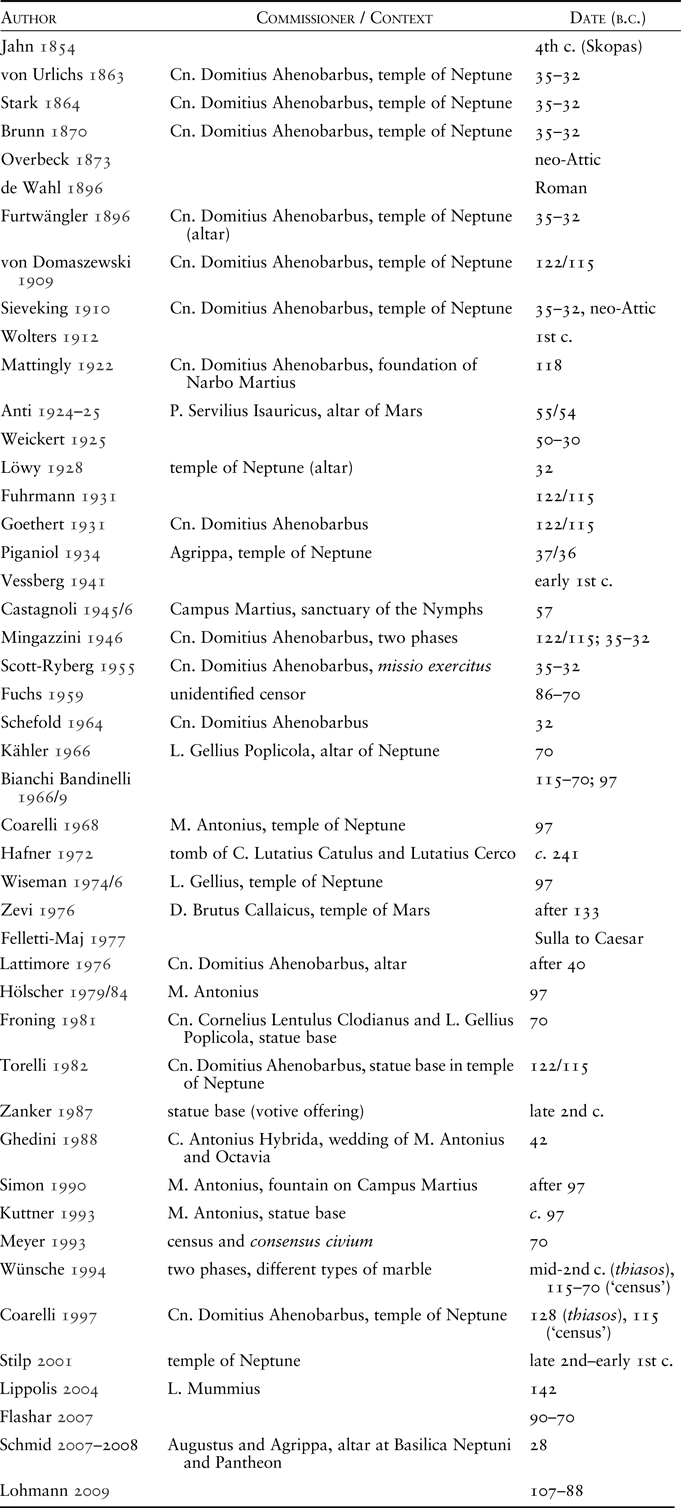
Although it will always easily qualify as both one of the best known and most disputed monuments of republican Rome, the ‘Ara of Domitius Ahenobarbus’ has seen little scholarly attention over the course of the past decade.Footnote 1 The reasons for this impasse are difficult to gauge. Possibly, the last 130 or so years of scholarship and well-entrenched intellectual fault lines have led to the resigned conviction that a final conclusion on the issue of the Ara’s original meaning will most probably never be reached. In principle, this seems to be a fair assessment. In practice, it has led to an uneasy compromise among archaeologists and art historians who generally attribute the monument to the years around 100 b.c., even though the overall range of proposed dates stretches from the middle of the second century b.c. to the Augustan period (Table 1).Footnote 2
Interpretations of the ‘Ara of Domitius Ahenobarbus’, a survey from 1854 to the present day (based on Schmid Reference Schmid2007–2008).

Thus, in terms of its historical contextualisation, the Ara has become one of Classical Archaeology's most persistent paradoxes: simultaneously both mid-second- and late first-century b.c., before and after the Marian reforms, ascribed to various commissioners, both anonymous and named — and therefore almost invalid as a source of historical information beyond the purely anecdotal. It is precisely because of this bleak outlook that a fresh assessment of the Ara is long overdue. This paper will offer a new interpretation of the monument which is based on a close reading of its imagery. However, before we can turn to the visual evidence, it is necessary to provide a brief introduction to the labyrinthine structures of scholarly discourse in which the Ara has been caught since its first appearance in the seventeenth century.
In its entirety, the monument was virtually unknown before 1896, when Adolf Furtwängler spotted some striking formal similarities between a sculpted frieze in the Louvre (Fig. 2) and several slabs of another frieze in the Glyptothek in Munich (Fig. 1).Footnote 3 Although identical in their basic dimensions and architectural framing, both friezes had previously been ascribed to separate monuments on the grounds of topic and sculptural style. The fact that the reliefs had ended up in two different collections is due to the circumstances of their discovery and their subsequent fate, a topic which has been extensively explored by Filippo Coarelli, Ann Kuttner, Florian Stilp and Stephan Schmid.Footnote 4 Furtwängler was able to demonstrate that as late as 1811 all of the friezes were kept in the private collection of Cardinal Fesch in Rome. After this date, they were sold to separate museums: the so-called ‘census-relief’ ended up in the Louvre, whereas the frieze with the marine thiasos went to Munich.
‘Ara of Domitius Ahenobarbus’, central scene of the marine thiasos with Neptune and Salacia (Munich, Glyptothek). (Photo: akg-images / De Agostini / W. Buss)

‘Ara of Domitius Ahenobarbus’, so-called census relief (Paris, Musée du Louvre, MA975). (Photo: RMN-Grand Palais (Musée du Louvre), Hervé Lewandowski)

However the collection of Cardinal Fesch was not the first place where the Ara’s reliefs were kept. Based on travellers’ reports and engravings, it is clear that the slabs had been located in Rome as early as the seventeenth century, when they were on display in the inner courtyard of the Palazzo Santacroce ai Catinari. This lavish urban residence next to the Piazza Cairoli was originally built between 1598 and 1602, following a design by the architect Carlo Maderno who also created the facade of St Peter's for Pope Paul V. A second building phase was under way in the decade between 1630 and 1640.Footnote 5 The substantial construction works for the Palazzo can therefore be securely dated between the end of the sixteenth century and 1640. In a seminal paper, Filippo Coarelli postulated that the reliefs of the Ara were most probably discovered during these building activities.Footnote 6 If this assumption were correct, not only the findspot but also the original ancient location of the reliefs would in all likelihood have been on the site of the Palazzo Santacroce or in its immediate vicinity. Indeed, there is archaeological evidence for a republican temple underneath the neighbouring church of S. Salvatore in Campo.Footnote 7 This temple and its sacred precinct were already considered by Furtwängler as the most likely ancient setting for the Ara.Footnote 8 As will be discussed in more detail below, this assumption had far-reaching implications for the dating and interpretation of the monument.
In a meticulous piece of revisionist scholarship, however, Stephan Schmid has recently been able to demonstrate that the Santacroce family's collection of antiquities was actually much older than their baroque palazzo. The collection dates back to the second half of the fifteenth century and, from the beginning, consisted of objects not only from Rome but also from other parts of central and southern Italy.Footnote 9 The question of the provenance and the original urban context of the Ara’s reliefs must therefore remain open, at least as long as no further evidence for a discovery during the early seventeenth-century construction works is produced.
Another chronologically important aspect of the reliefs proves at least as elusive as their findspot: their sculptural style. Since Furtwängler there have been various fierce arguments about supposed stylistic similarities or discrepancies between the friezes in Paris and Munich. The suggested dates on the grounds of style differ hugely (Table 1), as a look at the two extreme positions helps to illustrate. While Enzo Lippolis was confident in asserting that the ‘census-relief’ was most probably sculpted in the middle of the second century b.c., Stephan Schmid, with much the same confidence, claimed that the relief's style was perfectly in line with the key features of early Augustan sculpture.Footnote 10
This matter has been further complicated by the not yet fully published observations of Raimund Wünsche regarding the use of different marbles for the ‘census-relief’ and the marine thiasos, as well as the latter's alleged re-cutting which implies different dates for the creation of the two reliefs.Footnote 11 In a more detailed stylistic assessment, Heinz Kähler was able to demonstrate some similarities between the figures of the marine thiasos and Pergamene sculpture of the late third and early second centuries b.c. However, he also noted a series of formal inconsistencies between the Paris relief and the frieze in Munich which, in his opinion, should be read as a reflection of the often pan-Mediterranean provenance of late republican artists who had several stylistic options at their disposal.Footnote 12 Against this backdrop, the findings of Wünsche's analysis could also be taken as evidence for a two-phased monument, with the marine thiasos being an earlier creation by Pergamene sculptors, and the Paris relief a later addition by a cosmopolitan workshop based in Rome.Footnote 13 This leads to an obvious dilemma: although the similarities with Pergamene sculpture of the late Attalid period provide a rough date for the Munich frieze, it is also evident that this very frieze was re-used in order to create a new monument in conjunction with the Louvre relief for which we do not have any precise stylistic comparanda. Thus, both the potential re-use of an older monument alongside a more recent creation and the wide range of artistic styles attested for late republican Rome make it very clear that conventional stylistic analysis will not help us to arrive at a more precise date for the Ara, or, in the words of Tonio Hölscher, ‘due to the still quite vague […] stylistic development of Roman art in the second and first centuries b.c., the date and interpretation of the monument probably can only be derived from its historical message’.Footnote 14
The clues to this message are hidden in the images. The aim of the following is to identify as many of these clues as possible and to provide a coherent reading which takes into account both the macro-level of the overall composition and the micro-level of specific figures, gestures and objects. The final interpretation will rely on the comprehensive explanation of all the narrative components of the reliefs. It seems, therefore, legitimate to start with a very simple question: What do the friezes in Munich and Paris actually show?
II RECONSIDERING THE FRIEZES IN MUNICH AND PARIS: THE VISUAL EVIDENCE
Three sides of the original four-sided monument were taken up by the continuous frieze with a marine thiasos which is now kept in the Munich Glyptothek. The main part of the frieze consists of seven slabs, supplemented by two shorter slabs. The fact that the main frieze is framed by two Tuscan pilasters demonstrates its completeness and can serve as an indication of the original length of the monument. According to the research of Raimund Wünsche, the two shorter slabs show traces of re-working which served the purpose of transforming them into the opposing narrow sides of the rectangular monument.Footnote 15 The symmetrical composition of the long frieze unfolds around the figure of a frontally depicted triton whose legs end in fish tails. This triton is one of a pair of mythological sea creatures who pull a two-wheeled cart with two seated figures whose identification allows for an unambiguous interpretation of the scenery: a bearded, bare-chested man and a veiled woman. Amongst other clues, such as the torch-bearing sea goddess riding on a hippocamp in the left part of the frieze, the veil is a clear sign that we are dealing with a wedding scene. With regard to the supernatural marine environment, the protagonists of this wedding can only be identified as Poseidon and Amphitrite or, in Roman terminology, Neptune and Salacia. The tritons, nereids and erotes on the two narrow sides of the monument belonged to the wedding procession.Footnote 16
The reading of the mythological frieze in Munich is thus to all intents straightforward and, indeed, has never been disputed. However, the main challenge lies in the obviously secondary combination of the marine thiasos with the so-called ‘census-relief’ in the Louvre. This frieze formed the second long side of the monument and was therefore originally placed opposite the wedding scene of Neptune and Salacia. In accordance with the latter, the frieze in the Louvre is also framed by Tuscan pilasters which have been neatly modelled after the pieces in Munich. Despite these similarities, the frieze in Paris consists of only three slabs, as opposed to the seven slabs of the Munich thiasos.Footnote 17
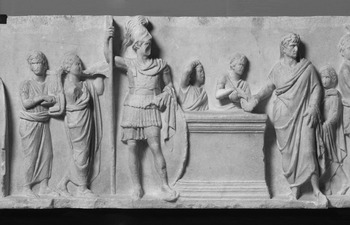
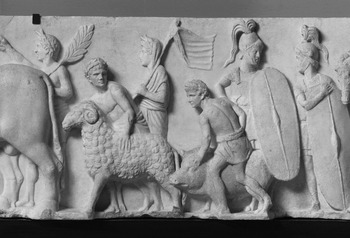
In the centre of the Paris frieze, a libation is performed at an altar, preceding the immolatio of several victims (Fig. 4). The main sacrificer is a man wearing a toga who, whilst turning his head to his left, extends his right hand with the shallow libation bowl (patera) over the altar. Appropriately, he is shown capite velato. A sacrificial servant pours liquid from a small jug (gutus) onto the patera. The scene is complemented by two more servants and two musicians. To the left of the altar stands another male figure who is looking in the same direction as the togatus and is of roughly the same size. He is wearing military attire, including a cuirass with pteryges, a helmet, a spear, a sword and a mantle. This figure follows a well-known Hellenistic prototype and has therefore convincingly been interpreted as the god Mars who personally and with benign approval attends a sacrifice at his own altar.Footnote 18
‘Ara of Domitius Ahenobarbus’, detail of so-called census relief (Paris, Musée du Louvre, MA975). (Photo: Universität zu Köln, Arbeitsstelle für digitale Archäologie (FA-Kae5481-21), http://arachne.unikoeln.de/item/relief/2440901)

‘Ara of Domitius Ahenobarbus’, detail of so-called census relief (Paris, Musée du Louvre, MA975). (Photo: Universität zu Köln, Arbeitsstelle für digitale Archäologie (FA-Kae5481-24), http://arachne.unikoeln.de/item/relief/2440901)

This interpretation of the cuirassed figure is further supported by the scenery unfolding immediately to the right of the altar. Here, three victims are led to the centre of the relief, in an order which reflects their descending physical size from left to right: a bull, a ram and a male pig. This combination of three exclusively male victims, called the suovetaurilia, is well attested in literary sources on Roman religion. The primary function of the suovetaurilia was the ritual purification and expiation of a specific area or a group of people, the so-called lustratio. Traditionally, the suovetaurilia was addressed to Mars, which strengthens the proposed reading of the central scene at the altar.Footnote 19
The sacrifice on the relief in the Louvre can therefore be identified as a lustratio in honour of Mars. But what about the rest of the frieze? This question leads back into the maze of interpretations whose origins date back to the late nineteenth century. Only thirteen years after Furtwängler's felicitous reunification of the Munich and Paris friezes, the great scholar of Roman religious and military history, Alfred von Domaszewski, put forward a first reading of the Paris relief, which, in its basic outlines, has been almost unanimously accepted until the present day. Von Domaszewski not only identified the sacrificial act as a lustratio, but he also interpreted the whole scene as a depiction of the Roman census which, in combination with the sacrifice of the suovetaurilia, was conducted by the pair of incumbent censors every five years in the Campus Martius in Rome.Footnote 20
Based on the assumption that such a census would have been obsolete for the levy of the Roman army after the so-called military reforms of Marius, von Domaszewski dated the Paris frieze to the period before 107 b.c. Furthermore, he tried to reconcile this date with an identification of the monument's commissioner which had already been suggested by Furtwängler in Reference Furtwängler and Furtwängler1896. Following an idea of Ludwig von Urlichs, Furtwängler tentatively connected the Munich thiasos with a statue group of the sculptor Skopas.Footnote 21 This statue group, as mentioned by Pliny the Elder, belonged to the temple of Neptune in Rome which was attributed to a certain Gnaeus Domitius Ahenobarbus.Footnote 22 With regard to its alleged findspot next to the Palazzo Santacroce, Furtwängler concluded that the architectural remains underneath the church of S. Salvatore in Campo were part of this temple of Neptune. Even though many scholars, most notably Filippo Coarelli, have accepted and defended this idea ever since, the connection between the findspot of the reliefs and the Palazzo Santacroce is by no means clear. Furthermore, both Fausto Zevi and Pier Luigi Tucci have provided critical re-assessments of the religious topography in this area of the Campus Martius which render Furtwängler's reading of the temple under S. Salvatore in Campo highly unlikely. Based upon the building materials and the architectural style of the extant remains, Zevi was able to propose a convincing identification of the building with the temple of Mars in circo, commissioned by Decimus Iunius Brutus Callaicus after his consulship in 138 b.c. Moreover, Tucci successfully pinpointed the actual location of the temple of Neptune in the vicinity of the former Piazza Giudea, close to the modern Piazza Costaguti and consequently about 250 metres to the east of the temple of Mars.Footnote 23
Unfortunately, Pliny did not provide any additional information which would allow for an unambiguous identification of Gnaeus Domitius Ahenobarbus within the extensive lineage of his family. In Furtwängler's opinion, the person in question was the consul of 32 b.c. and great-grandfather of the future emperor Nero. Due to his seemingly secure date before 107 b.c., von Domaszewski had to adapt Furtwängler's arguments to make them fit his interpretation: in his view, the statue group and the temple mentioned by Pliny were commissioned by another member of the Domitii Ahenobarbi, namely Gnaeus Domitius Ahenobarbus, consul in 122 b.c. and censor in 115. Accordingly, the ‘census-relief’ in Paris was created in order to commemorate the censorship as the prime achievement in Domitius’ distinguished career.Footnote 24
Within the scope of this paper, it is not possible to follow all the elaborate details and variations which, over the course of the past hundred years, have been added to Furtwängler's and von Domaszewski's initial propositions. In his fundamental article, Stephan Schmid has summarised the diverse interpretative positions in a succinct table which neatly illustrates the complexity of this highly specialised scholarly discourse.Footnote 25 From this it becomes clear that, apart from the chronological assessment, the main source of disagreement has always been the detailed interpretation of the various figures on the Paris frieze. However, there is one element which is commonly shared by even the most divergent interpretations: the clear majority of scholars have accepted von Domaszewski's opinion and read the scenery of the Paris frieze as a depiction of the censorial lustratio. But is this reading actually supported by the visual evidence?
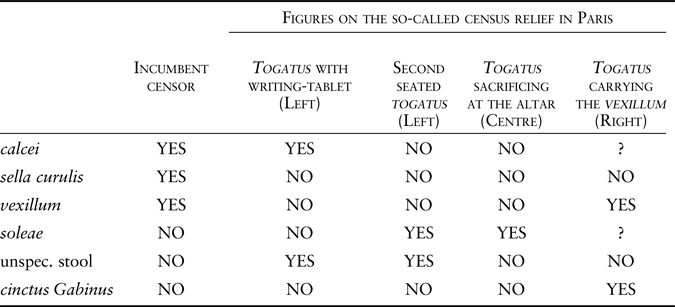
This question can only be answered by looking again at the defining features, figures and attributes of the so-called ‘census-relief’ (Table 2). For such a reassessment it is crucial to pay close attention to key indicators of socio-political rank, prestige and seniority: dress, shoes and specific paraphernalia must indeed be taken seriously as they were all indicative of an individual's achievement in Roman social and political life. Vice versa, the lack of such elements can also be taken as evidence for what an individual had not yet achieved in their political career. Both the presence and the absence of certain items will, therefore, be used in order to arrive at a new interpretation of the Paris relief. This is of particular relevance as the monument to which the ‘census-relief’ belonged was certainly designed for public display and would have been subjected to close scrutiny by an audience well-versed in the paraphernalia of Roman power which indeed were part and parcel of their everyday lives. In such a context, any images depicting flawed details of dress or attributes would have either failed to convey the commissioners’ intended message or, even worse, could have been understood as an overt breach of socio-political norms and conventions.
‘Ara of Domitius Ahenobarbus’, attributes of the main protagonists vs. attributes of Roman censors.

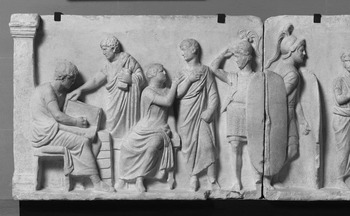
I shall start with the group of four male figures in the left part of the frieze (Fig. 3). The largest of these figures is the man on the very left, clad in a toga, sitting on a stool and gazing upon a tablet. From the hand posture, von Domaszewski concluded that this man was shown in the very moment of writing. Consequently, he interpreted him as a scriba, an official writer and record-keeper.Footnote 26 This identification as lectio facilior has been widely accepted by scholars ever since. Only Mario Torelli and Claude Nicolet have disagreed and identified this man as a iurator, an official who took the citizen's oath during the census procedures. According to this latter reading, the gesture of the togatus to the right of the alleged iurator indicates the very moment when the correctness of the individually reported census qualification was asserted by oath.Footnote 27 A third but widely overlooked interpretation was offered by R. M. Ogilvie, who, albeit without further discussion, suggested that the ‘record-keeper’ should actually be interpreted as the censor himself, shown in the act of adding names and property qualifications to the lists of Roman citizens.Footnote 28 The reason for Ogilvie's isolation lay in the fact that the apparently humble posture of the seated figure was not what scholars generally expected for the depiction of one of the highest magistrates of the Roman Republic.
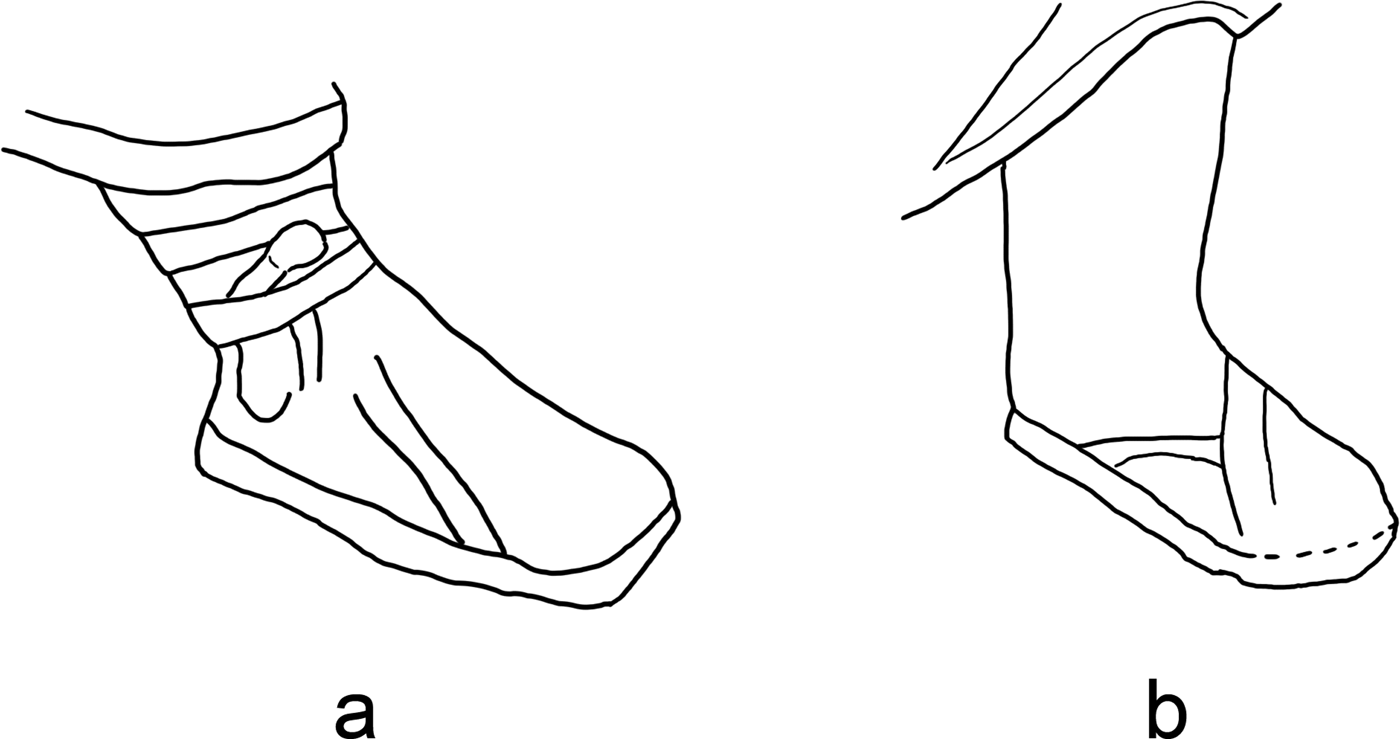
However, a lucid observation of Florian Stilp has recently shown that von Domaszewski's classic reading is actually untenable in the light of the footwear of the so-called scriba: he is not wearing common shoes but calcei senatorii or calcei patricii (Fig. 6a). The former were high, laced boots which, in the rigid social hierarchy of Roman dress, were restricted to senators; the latter (calcei patricii) were reserved for an even more exclusive group, namely those senators who had already served in the capacity of a curule magistrate (that is, curule aedile, praetor, consul or censor). Consequently, the man writing on the far left of the Paris frieze must be identified as a person of high socio-political standing and can by no means be a humble scriba.Footnote 29
‘Ara of Domitius Ahenobarbus’, detail of so-called census relief (Paris, Musée du Louvre, MA975). (Photo: Universität zu Köln, Arbeitsstelle für digitale Archäologie (FA-Kae5481-27), http://arachne.unikoeln.de/item/relief/2440901)

Shoes on the ‘Ara of Domitius Ahenobarbus’: (a) seated man with writing-tablet (calceus); (b) man sacrificing at the altar (solea). (Drawing: D. Maschek)

The shoes also help to clarify the role of the second seated man on the frieze. Von Domaszewski, Kähler and Stilp identified this person as the iurator who receives the oath of the togatus to his left (the viewer's right).Footnote 30 According to Ferdinando Castagnoli, the seated man is the curator of the voting tribe to which the citizen standing in front of him belonged, even though this interpretation is not supported by the literary sources about the Roman census.Footnote 31 In the view of Mario Torelli, this second seated man is in fact the censor who formally carried out the discriptio, assigning the man in front of him to the appropriate military class by putting a hand onto his shoulder.Footnote 32 This last interpretation cannot be correct for two reasons: first, documents such as the Lex Iulia Municipalis include the explicit prescription that, during a census, all the relevant information had to be received and recorded by the presiding censor in person.Footnote 33 If we had to search for a censor on the Paris frieze, it could therefore only be the figure holding the writing-tablet. Second, Stilp's observations regarding the shoes are again significant: Torelli's alleged censor is not even wearing the calceus senatorius, which stands in stark contrast with the presumed iurator on the very left. Even without an unambiguous attribution of their respective official functions, the social hierarchy between the two seated men must have been the direct opposite: the man on the left is undoubtedly of higher social (and presumably also political) rank than his neighbour on the right.
Apart from the writing of records and the suovetaurilia, the Paris frieze also features five soldiers. They frame the main sacrificial scene, with two infantrymen to the left and two more footsoldiers and a horseman to the right of the altar (Figs 1 and 3). Since Furtwängler and von Domaszewski, the number of soldiers has been seen as a deliberate hint at the organisation of the Roman army, consisting of several classes of footsoldiers (pedites) and horsemen (equites).Footnote 34 Torelli suggested that the Paris frieze refers to the class division of the army of Servius Tullius. Consequently, he presumed that the intention of the alleged census scene was to present an idealised version of the Roman citizen body, dating back to the regal period.Footnote 35 However, Livy's account makes it absolutely clear that Servius’ division resulted in five classes of infantry and one class of cavalry. This conflicts with the total number of five soldiers on the Paris frieze.Footnote 36 More convincingly, scholars such as Tonio Hölscher, Filippo Coarelli and, despite some reservations, Florian Stilp have claimed that this number neatly matches the account of Polybius for the division of the Roman army during his lifetime, consisting of four classes of pedites and one class of equites. The soldiers on the frieze can therefore be read as a symbolic representation of the military class division of the Roman citizen body as it existed in the mid-second century b.c.Footnote 37
There is yet another figure which must be briefly revisited because, for good reasons, it has always played an important part in previous interpretations of the scene: the standard-bearer who walks behind the sacrificial animals in the right half of the frieze (Fig. 5). His prominence is highlighted by the conspicuous draping of his toga which makes him stand out amongst the rest of the togati. The toga's left tail does not cover the man's shoulder in the usual way, instead it has been slung around his waist. Moreover, another part of the garment is used to cover the back of the standard-bearer's head. This draping of the toga is commonly known as the cinctus Gabinus which, according to Varro and Servius, was only worn on very particular ritual and cultic occasions.Footnote 38 In addition to this special feature of his dress, the man's prominent position is further underlined by the flapping vexillum he is carrying over his left shoulder.
Based on this brief reconsideration, it is possible to identify four main elements within the narrative structure of the Paris frieze:
1. On the left (Fig. 3), a scene in which two togati are involved in the recording of information which is reported personally by another two Roman citizens. According to his footwear, the highest-ranking of these togati can only be the seated man on the far left.
2. A central scene (Fig. 4) showing the sacrifice of suovetaurilia dedicated to Mars and presided over by another togatus. The purpose of this sacrifice was ritual purification, a lustratio.
3. On the right and walking behind the victims, a man who is carrying a vexillum whilst wearing a toga in a distinct style known as the cinctus Gabinus (Fig. 5).
4. Both on the right and on the left, a total of five armed soldiers which can be further divided into four infantrymen and one cavalryman. Their number equals the military division of the Roman citizen body in the mid-second century b.c., although their equipment and body armour are remarkably similar in style and shape.
III OVERCOMING CONFLICTING INTERPRETATIONS OF DATE AND CONTENT: THE ABSENCE OF A CENSOR ON THE ‘CENSUS-RELIEF’
Despite this clear arrangement of key narrative elements, the interpretation of the Paris frieze has been controversial since the very first attempts by Furtwängler and von Domaszewski. The main discrepancies revolve around two closely related questions: What does the scenery of the so-called ‘census-relief’ reveal about its date of creation? And was the narrative of the Paris frieze designed to recall specific historical events or a rather abstract concept of Roman social and political values?
As for the first question regarding the frieze's date, the intricate web of accumulated scholarly opinion can only be fully grasped by consulting the exhaustive summaries by Florian Stilp and Stephan Schmid.Footnote 39 In the following, therefore, I want to concentrate on the most common trends in order to identify what we might call the academic mainstream. Undoubtedly, this mainstream rests upon von Domaszewski's venerated idea that the Paris frieze shows the census of Roman citizens. Such censuses were conspicuous events which were only convened every five years. The fact that they were organised by the two highest-ranking ordinary magistrates of the Roman Republic increases the probability of pinpointing the specific census on the Paris frieze. Another seemingly secure point of chronological orientation was found in the military reforms initiated by Marius in 107 b.c. In the opinion of many scholars and following the initial suggestion of von Domaszewski, the recruitment of proletarians would have rendered the role of the census in the levy obsolete; 107 b.c. was therefore seen by many as a terminus ante quem for the commissioning of the monument.Footnote 40
However, this is by no means a secure proposition. Based upon a thorough reassessment of the textual sources, Elizabeth Rawson was able to demonstrate that the Marian reforms should not be understood as a clear-cut constitutional watershed. Proletarians had been recruited before 107 b.c., and some of the military functions of the census were obviously still important after this date.Footnote 41 Such well-founded qualifications notwithstanding, not only the lustratio but also the soldiers on the Paris frieze have often been used as pawns in the dating game: for example, the depiction of both infantry and cavalry has been read as a proof of a pre-Marian date; according to another view, the soldiers with their strikingly homogeneous armour and equipment refer to the post-Marian army whilst, in terms of their overall numbers, still harking back to the ‘ideal’ class division of the second century b.c.Footnote 42
Apart from the so-called Marian reforms, another chronological point of orientation was identified in the combination of the Munich thiasos and the ‘census-relief’ in Paris. The most common interpretation rests upon the assumption that the frieze in Munich was meant to commemorate a naval victory. Consequently, scholars have searched for a censor of the late second or early first century b.c. who was also the victorious commander in a naval engagement.Footnote 43 However, Paul Zanker, Peter Wiseman, Erich Gruen, Florian Stilp and Stephan Schmid have pointed out that the thematic choice of a marine wedding was not particularly suited for the commemoration of sea battles. Instead, they suggested reading the thiasos as pointing towards a genealogical connection of the monument's commissioner with Neptune or, more generally, as an allegory for some sort of ‘renewal’ under the auspices of the sea-god.Footnote 44 As already stated in the opening paragraph, it must be emphasised that, based on more or less convincing arguments, the so-called ‘census-relief’ can be — and indeed has been — dated to almost any point in time between the middle of the second century b.c. and the early Augustan period. Moreover, the combination of an alleged census with the wedding of Neptune and Salacia has not yet been explained in a fully convincing way.
I want to turn therefore to the second question regarding the narrative structure and content of the Paris frieze. This offers the opportunity to reconsider the wider context of all the key elements we have identified in the previous section. Apart from Mars, there are obviously three figures who, due to their dress, attributes and position, carry particular symbolic weight: the seated man holding the writing-tablet on the very left (Fig. 3); the togatus sacrificing at the altar (Fig. 4); and the standard-bearer with the vexillum (Fig. 5). If the Paris frieze were really meant to show the official Roman census, we are facing a simple, but arithmetically insoluble problem: within their respective contexts, the image features three protagonists — but in Rome there were only two censors.
Since the early days of Furtwängler and von Domaszewski, scholars have tried to overcome this essential dilemma in a variety of ways: either they postulated that all three figures must be identified as the same historical person, i.e. the commissioner of the monument, in three different and chronologically distinct episodes of his censorship;Footnote 45 or they argued that in the alleged census-scene on the left there is no censor at all, whilst the two actual censors and commissioners of the monument are the men sacrificing at the altar and carrying the vexillum; and finally, it has also been suggested that one of the seated men on the left and the togatus at the altar must be the censors, whereas the standard-bearer is no more than an anonymous participant in the sacrificial procession.Footnote 46
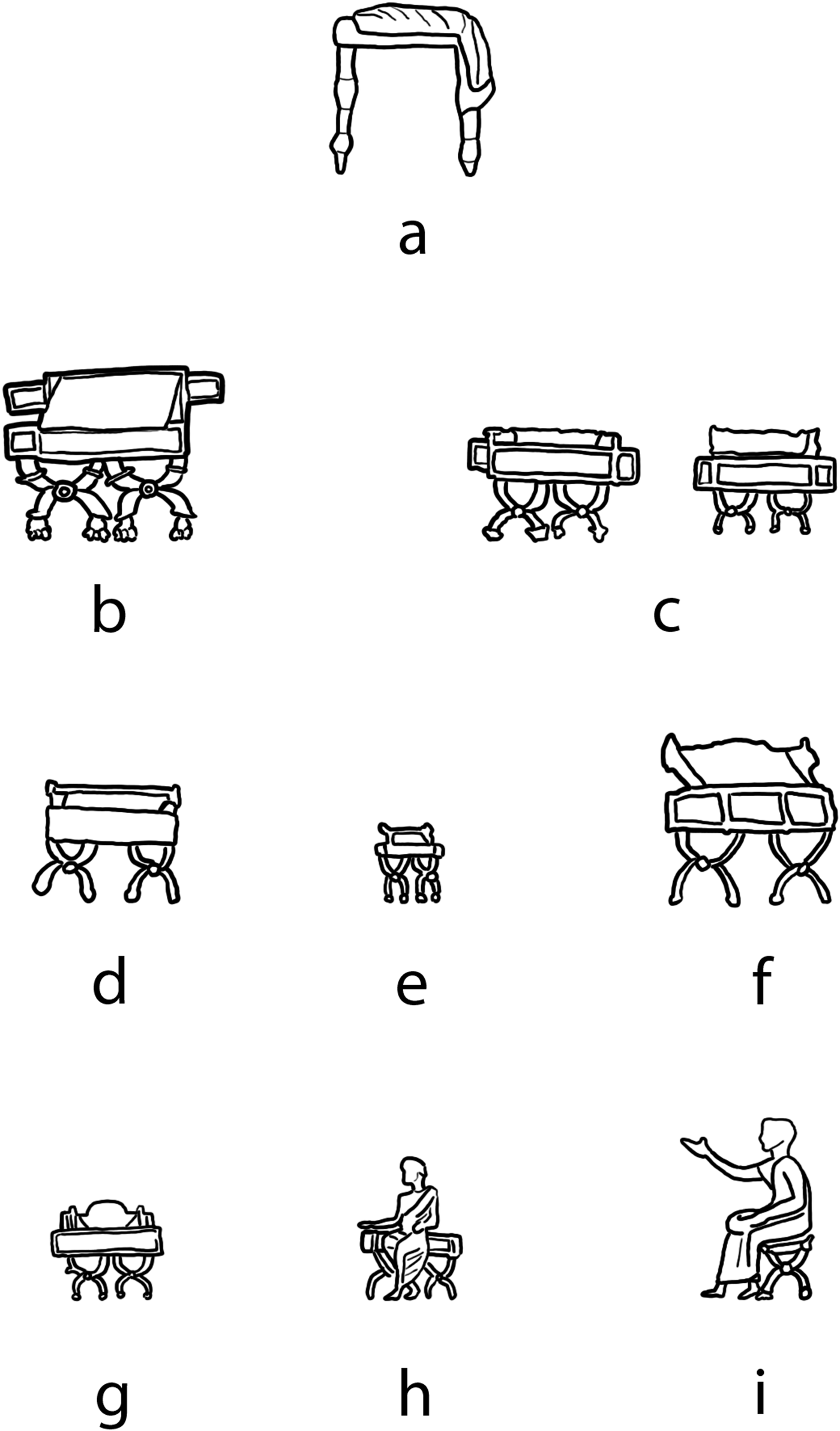
These conflicting interpretations can only be resolved by yet another close look at the three protagonists (Table 2), starting with the seated man on the left of the frieze. It has already become obvious that, due to his distinctive footwear, he must be at least a senator and maybe even a former curule magistrate. Moreover, there is one additional item which, apart from a passing reference by Thomas Schäfer,Footnote 47 has never been considered despite its significance for the identification of this high-ranking figure: the stool upon which the man is sitting, shown in side view with intricately turned legs and topped by a soft cushion. If, with respect to his shoes, the man's socio-political rank must have been more than that of a simple scriba, it is equally impossible to interpret him as a censor on the grounds of this particular stool, for whilst in office the censors were entitled to the sella curulis.Footnote 48 This supreme symbol of curule power features prominently on republican denarii. From the very beginning of these depictions, the curule seat has a distinctive, indeed unique, shape with curved and widely crossed legs (Fig. 7).Footnote 49 It is obvious that the stool on the Paris frieze has nothing in common with the iconic shape of the sella curulis. Thus, within the group of four togati the seated man with the writing-tablet must still be interpreted as the highest-ranking and most important person — but by no means can he be an incumbent censor.
Sellae curules in late republican/early imperial imagery: (a) ‘Ara of Domitius Ahenobarbus’, stool of the man with the writing-tablet; (b) denarius of P. Furius Crassipes, 84/83 b.c. (Crawford Reference Crawford1974: no. 356/1); (c) denarius of Q. Pompeius Rufus, 54 b.c. (Crawford Reference Crawford1974: no. 434/2); (d) denarius of L. Furius Brocchus, 63 b.c. (Crawford Reference Crawford1974: no. 414/1); (e) denarius of Q. Cassius Longinus, 55 b.c. (Crawford Reference Crawford1974: no. 428/2); (f) denarius of L. Livineius Regulus, 42 b.c. (Crawford Reference Crawford1974: no. 494/31); (g) denarius of Octavian, 42 b.c. (Crawford Reference Crawford1974: no. 497/2); (h) denarius of Octavian, 29–27 b.c. (RIC 270); (i) denarius of Augustus, 15–13 b.c. (RIC 165a). (Drawing: D. Maschek)

Now for the togatus sacrificing at the altar. Can we be sure that this central figure is a censor, or at least the same person as the seated man with the writing-tablet? Again, both questions must be answered in the negative. Unlike the seated man, the togatus at the altar is not wearing the calcei, but simple sandals (soleae; see Fig. 6b). While the man with the tablet clearly sports the characteristic straps as part of his footwear as they are deeply cut into the marble, the sacrificer's lower legs are perfectly smooth with the original surface neatly preserved. It is highly implausible that one and the same high-ranking Roman official should have worn calcei during the taking of the census records but not at the sacrifice by which this act was officially concluded. Furthermore, the absence of calcei in the sacrificial scene allows us to draw an even more decisive conclusion: the togatus at the altar cannot be interpreted as a censor either because in this capacity he would previously have served as praetor and consul.Footnote 50 This would have given him the right to wear the calcei patricii instead of simple soleae. Thus, the number of potential censors on the so-called ‘census-relief’ has been considerably depleted.
Let us finally turn to the standard-bearer. According to Varro, one of the censors did indeed carry a vexillum when, following the lustratio, he led the citizens back into the city from the Campus Martius.Footnote 51 Moreover, with regard to the Paris frieze it is hard to find any clear attributes pointing to the standard-bearer's status or rank. He is walking right behind the victims of the sacrificial procession, and neither his feet nor his potentially relevant shoes have been rendered by the artist in any detail. Despite this lacuna, another aspect of the standard-bearer's dress provides crucial information: the man is wearing the toga in the specific draping of the cinctus Gabinus which, in the literary sources, is never mentioned with respect to the censors or the rituals connected with the census.Footnote 52 The antiquarians’ conspicuous silence on this point is revealing and speaks strongly against an interpretation of the standard-bearer as a censor. Furthermore, due to his particular dress, it is also rather unlikely that this was just another representation of either the seated man on the left or the togatus at the altar.
Ultimately, two decisive conclusions can be drawn from this reconsideration of the three most prominent figures on the Paris frieze: first, we are not dealing with one or two individuals in three different scenes, but with three individuals in three distinct contexts (record keeping; sacrifice; carrying the vexillum); second, based upon attributes and dress none of these three individuals is an incumbent censor. If there was anything close to a consensus in previous scholarship, it rested on von Domaszewski's assumption that the Paris frieze showed a Roman census and a censorial lustratio. Quarrels about interpretation and dating notwithstanding, the vast majority of scholars developed their arguments based upon this seemingly secure proposition. However, the only logical consequence of my systematic reassessment of the Paris frieze is to abandon this commonsense interpretation — to put it as succinctly as possibly: there cannot be a census without a censor.
IV NOT CENSUS BUT DEDUCTIO: VISUALISING A COLONIAL FOUNDATION
Consequently, a completely new interpretation of the whole monument is needed. The key for this lies in the central scene of the Paris frieze, the suovetaurilia. Contrary to von Domaszewski's authoritative and widely accepted reading, it is by no means certain that this particular sacrifice needs to be associated with the closing of a censorial lustrum. Ritual lustrations, including the suovetaurilia, were also held on various other occasions, for example by farmers who wanted to purify their fields, or by generals for the purification of their army or fleet before a campaign or a battle.Footnote 53 Finally, a lustratio was also performed as part of the foundation ritual for Roman colonies, the so-called deductio.Footnote 54 It is precisely this last context which provides a comprehensive and cogent framework of reference for the reliefs in Munich and Paris, both with respect to their overarching meaning and to the details of specific scenes. Credit must go to Harold B. Mattingly who, in a paper published in this very journal in 1922, was the first of a tiny minority of scholars who considered a scene of colonial foundation with respect to the Paris frieze. Admittedly, Mattingly's idea to read the Paris frieze as a representation of the founding act of the colony Narbo Martius by Gnaeus Domitius Ahenobarbus did not plausibly integrate the Munich reliefs and therefore failed to convince.Footnote 55 However, his basic idea derived from the astute observation that a suovetaurilia sacrifice to Mars was actually obligatory for the establishment of all Roman colonies, not only those under the explicit protection of Mars. Against this backdrop, it is possible to arrive at a coherent interpretation of the three key elements on the Paris frieze, from left to right:
1. The classification of citizens: the deductio of a colony started with the compilation of a list of colonists. This record not only comprised the colonists’ names, but also information about their social class, family status and property. Even though this procedure was very similar to the census, it led to a different outcome, namely a very simple distinction amongst the colonists between pedites and equites.Footnote 56 With respect to their homogeneous equipment, the five soldiers of the Paris frieze can best be understood as representing these two basic classes of colonists.
2. The lustratio: as already mentioned, a sacrifice of suovetaurilia was regularly performed on the occasion of the deductio of a colony. Originally, this lustratio took place in the Campus Martius, which helps to explain the presence of Mars next to the altar.Footnote 57 Arthur Eckstein convincingly argued for the colonial lustratio being one of the most essential acts before the colonists left Rome for their new home.Footnote 58 Moreover, in terms of its ritual symbolism and performative aspects the lustratio of colonists was closely related to the censorial lustratio. This becomes particularly evident in the following passage from Cicero's De divinatione (1.45.102):
Itemque in lustranda colonia ab eo qui eam deduceret, et cum imperator exercitum, censor populum lustraret, bonis nominibus qui hostias ducerent eligebantur.
So too, when the sacred ceremony of purification was held by one starting on an expedition to found a colony, or when the commander-in-chief was reviewing his army, or the censor was taking his census, it was the rule to choose men with names of good omen to lead the victims.
According to Eckstein, this and other key similarities between the colonial and the censorial lustratio strongly support the idea that the former was not carried out on the site of the colonial foundation but on the Campus Martius in Rome. Given that the lustrum of the citizen body at the Roman census took place between the compilation of the census records and the march back to Rome, the march to a new colony in all likelihood was also preceded by a lustratio of the colonists before their departure from Rome. This is further underlined by the fact that in military contexts the lustratio of the army always happened before a major undertaking such as a campaign or a battle.Footnote 59
3. Vexillum and cinctus Gabinus: traditionally, the colonists were led to the site of the new colony by one of the founding magistrates who carried a vexillum. In the term deductio, this active process of deducere became synonymous with the act of foundation itself.Footnote 60 This is also in line with the toga draped in the cinctus Gabinus, the peculiar dress of the standard-bearer on the Paris frieze. According to Varro, one of the founders would wear his toga in exactly this way whilst ploughing the first furrow around the area of a new colony.Footnote 61 Consequently, a togatus wearing the cinctus Gabinus and handling a plough figures prominently not only on various coins but also on a famous relief from Aquileia, all dating to the early imperial period.Footnote 62 At the same time, the vexillum became a powerful symbol for the foundation of colonies, especially in the late republican period.Footnote 63 Despite its much earlier date, the combination of vexillum and cinctus Gabinus on the Paris frieze can therefore be best understood as an unambiguous allusion to the process of deductio.
Most importantly, the context of a deductio allows for an integrated reading of all the monument's previously contentious elements as one meaningful ensemble. From their dress and attributes, it has already become clear that the three main protagonists of the Paris frieze, that is the seated togatus on the left, the man sacrificing at the altar and the standard-bearer, must be identified as three distinct individuals of different political standing. This does not make much sense when it comes to the Roman census which was conducted by a pair of experienced and equally distinguished magistrates. However, it perfectly matches the situation of a deductio, which was not conducted by one or two, but in fact by three officials, the tresviri coloniae deducendae.Footnote 64 This reading allows us to settle scores of scholarly disputes: the Paris frieze does not show one or two individuals in three different functions, but three magistrates fulfilling their respective tasks, that is compiling the list of colonists, conducting the lustratio, and preparing to lead the settlers’ march sub vexillo into the new colony.Footnote 65
As Ed Bispham and Guy Bradley have recently pointed out, the colonial foundation ritual over the course of the centuries was much less set in stone than traditionally assumed in scholarship.Footnote 66 Especially for the earlier stages of Roman colonisation in Italy and well into the middle Republic there is clear evidence for historical retrofitting which started in the late republican period. By contrast, the record of colonial foundations in the second century b.c. is in no doubt, and neither are the accounts of the details regarding the mid- to late republican census by Polybius, Varro and Livy. If then we accept the new interpretation of the four key elements on the Paris relief (record taking; suovetaurilia; vexillum; cinctus Gabinus) as indicators of a colonial deductio rather than a censorial lustratio, we can continue to search for a more specific historical context in order to arrive at a potential date for the monument.
The establishment of citizen colonies in Italy came to an end in the late second century b.c. The final attempts to revive this practice were Gaius Gracchus’ foundations in Tarentum and Scolacium, together with his ill-fated colony at Carthage.Footnote 67 The very last deductio before Sulla's veteran settlements was Narbo Martius (Narbonne) in Southern France, founded in 118 b.c.Footnote 68 Therefore, the Ara was either commissioned to commemorate an event which happened before 117 b.c., or from the period of Sulla onwards. However, the property assessment of colonists, their classification as pedites and equites, and the general reference to the five classes of the Roman citizen body as reported by Polybius all strongly indicate a second-century b.c. date for the monument as, from the time of Sulla, the whole administrative background, let alone the political context, for deductiones was radically transformed by the pressing issue of veteran settlement.Footnote 69 At this point, the combination of the Paris frieze with the marine thiasos in Munich provides the crucial piece of information. In the second century b.c., Roman colonies were occasionally associated with tutelary deities, but, as evidenced by the literary sources, there was only one republican colony bearing the name of the sea god: Neptunia, the settlement established by Gaius Gracchus at Tarentum in 123 b.c.Footnote 70 One can scarcely imagine a more evocative image to symbolise the foundation of this new colony than the wedding of Neptune and Salacia.
V CONCLUDING REMARKS: IN SEARCH OF THE MONUMENT'S HISTORICAL CONTEXT
The reassessment of the reliefs in Munich and Paris has led to a fundamentally new interpretation of the ‘Ara of Domitius Ahenobarbus’, although it must be clearly stated that we have to distinguish three basic levels of probability. Firstly, there is the high certainty that the conventional interpretation of the so-called census relief in Paris is not correct. A detailed iconographic analysis with particular focus on shoes, clothing and attributes has shown that none of the three key protagonists on the Paris frieze can be rightly identified as a censor. Moreover, the sacrifice of suovetaurilia and the gathering of citizen data were also performed in other contexts and thus were by no means exclusive to the Roman census. Therefore, it is more than unlikely that the ‘Ara of Domitius Ahenobarbus’ commemorated such a census or was indeed a censorial location.
Secondly, it is highly probable that the frieze in Paris does actually show another important political event, namely the deductio of a Roman colony. Colonial foundations included the performance of suovetaurilia in honour of Mars, the compilation of a list of colonists, their basic division into two classes of pedites and equites, and the subsequent march to the site of the new colony which was led by one of the founders carrying a vexillum. Another indication in favour of this interpretation is the presence of three protagonists on the Paris relief, acting in the three different roles, who can be read as representing a panel of three men such as the tresviri coloniae deducendae. The depictions on the Paris relief therefore not only coincide with all the key elements provided by our literary sources on Roman colonial foundations, but there is indeed no other occasion in Roman political life that would fit the observations made.
Thirdly, by taking into consideration the reliefs in Munich which depict the wedding of Neptune and Salacia, and given the fact that we know of only one republican colony firmly associated with the sea-god, there is a possibility of arriving at an even more precise date and historical context for the monument. The ‘Ara’ could have been commissioned in order to celebrate the foundation of the colony Neptunia by Gaius Gracchus and two other tresviri coloniae deducendae in 123 b.c.Footnote 71 In this possible context, the wedding of Neptune and Salacia would not only have evoked the blessing of the colony's tutelary deity, but it would also have expressed a clear desire for the new community's well-being under divine auspices. It is therefore possible that the friezes formed part of a votive monument for Neptune in a religious setting.Footnote 72 Although its findspot must ultimately remain uncertain, the scene of the Paris relief makes a Roman context for this votive monument much more probable than a location in the colony itself. As we have seen, it shows three key moments of a deductio which would all have happened on the Campus Martius in Rome: the recruitment of the colonists, the lustratio, and the impending march to the colonial site sub vexillo. It is therefore likely that the monument was indeed commissioned and built in Rome right after the occasion of the actual deductio. This probably included the re-use of the marine thiasos from an older monument which was then combined with the bespoke creation of the Paris relief which was intended to celebrate the formal acts of the colonial foundation. Of course, the erection of such a monument is virtually unimaginable in the period following the violent death of Gracchus, and therefore, after more than a hundred years of uncertainty, this new reading would offer us the exciting opportunity to arrive at a very precise date for the Ara which ranges from 123 to 121 b.c.
It was also in 123 b.c. that Gaius Gracchus passed a law which provided for the free issue of clothes and equipment to soldiers. This law was part of the same bundle of social reforms as the foundation of Gracchus’ three colonies, amongst them Neptunia. The incentive behind all these measures was to relieve small peasant farmers from their pressing financial burdens and, ultimately, to reinvigorate the traditional, property-based structure of the Roman citizen army.Footnote 73 It may therefore not be a coincidence that the Paris frieze shows the basic distinction of pedites and equites which can be read as a stand-in for the whole community of male Roman citizens, albeit with distinctively homogeneous equipment. All this would have added up to an extremely condensed image of heightened symbolism, in which the chosen colonists, provided with state-funded armour and weapons by the Gracchan law, are about to start more prosperous lives in a newly-founded settlement under the divine protection of Neptune.
With respect to the different attributes of status (especially the presence or absence of calcei) for the main protagonists on the Paris frieze, it is significant that colonial tresviri were regularly drawn from all age groups and ranks of Roman senators.Footnote 74 In the period of Gaius Gracchus, the tribunate of the people was not yet a qualification for entry into the Senate,Footnote 75 which helps to explain the simple sandals of the togatus at the altar. Thus this figure could well be identified with Gracchus himself. Accordingly, the man with the writing-tablet and calcei could then be interpreted as Marcus Fulvius Flaccus who, as a senator and former consul, would have been entitled to this exclusive type of footwear. In this context it is also most interesting that in both cases the figures’ faces had gone missing at some unknown point in time and were only restored in the eighteenth or early nineteenth century. Stilp and Kähler are very precise about all these restorations, but despite their accuracy they did not consider the potential historical significance of this idiosyncratic pattern of destruction.Footnote 76
Whatever force chopped off the faces of the two protagonists would certainly also have seriously damaged other prominent figures of the frieze, such as the Mars or the soldiers on the right. If we thus wish to view this damage as more targeted than casual vandalism, then — at the risk of over-interpretation — it might even be suggested that this was a deliberate destruction of just these two heads in the aftermath of Gracchus’ and Flaccus’ downfall. As the base for a votive offering in a sanctuary, the monument itself would probably have survived due to its sacrosanctitas, although bearing the clear signs of an eradicated, undesirable memory. In the fierce political climate of the late second century b.c. this would not have been exceptional: Flaccus’ destroyed house on the Palatine stood as an empty ruin for some twenty years, a bleak reminder of what Hariett Flower has aptly called ‘the invention of punitive memory sanctions’ in 121 b.c.Footnote 77 Even more examples of the conspicuous survival of mutilated reliefs, statues and inscriptions after a damnatio memoriae in the public sphere could be cited from the imperial period.Footnote 78 Moreover, unlike the ill-fated foundation at Carthage, the Gracchan colony Neptunia did not fail immediately and actually survived for at least one generation until the old town of Tarentum was enfranchised after the Social War.Footnote 79 Thus, there would have been no obvious reason for a radical removal of the monument from its presumably sacred context in the aftermath of Gaius Gracchus’ death in 121 b.c. and it could well have survived into the imperial period.
If one is willing to accept this new reading of the friezes in Paris and Munich and the possibility of their Gracchan date, the conventional understanding of the narrative intentions behind the ‘Ara of Domitius Ahenobarbus’ has also to be reconsidered.Footnote 80 Traditionally, the key message of the Paris relief in conjunction with the marine thiasos was held to be the commemoration of an important late republican statesman and the main exploits of his political and military career. In this respect, the Ara is seen as representative of a general art historical trend in the late Republic which is still, by and large, conceptualised as having been driven by family representation and the growing competition of high-ranking individuals.Footnote 81
However, in the context of Gracchan colonial policy, the monument's symbolism would not primarily have commemorated the noteworthy deeds of one distinguished member of the Roman nobility, but in a time of crisis and vicious political struggle it would rather have expressed the hopes and ambitions of its commissioners for a better future for the Roman commonwealth. Against this backdrop, the new interpretation of the monument as pointing towards a colonial foundation under divine auspices does indeed have important implications for our understanding of late republican art in general: we should probably put much more emphasis on the role of such artworks as statements of collective and widely shared values within the framework of the res publica. The aim of this and other monuments would have been to address not only the senatorial elite but also a wider, non-elite audience of Roman citizens who were about to profit from the Gracchan projects of land reform and colonisation. At the same time, the monument transcended the realm of the purely socio-political by invoking the divine support of Neptune, both in terms of its decoration and its probable function as a religious dedication on the Campus Martius.
With the benefit of hindsight, we can now state that the commissioners’ hopes and ambitions were much less durable than their visual representations in stone. The colonial project of Gaius Gracchus did not succeed, and neither did his agrarian commission manage to achieve anything close to social justice when it came to the re-distribution of arable land. The hoped-for recovery of the Roman small farmers was never achieved. Ultimately, Gaius Gracchus and Fulvius Flaccus were killed by a reactionary group within the Roman nobility, hundreds of their followers were persecuted and slaughtered. Within years of its creation, the Ara would therefore have turned into a failed monument. However, its intricate display of socio-political and religious symbolism makes it a unique milestone of Roman political representation. The new reading of its imagery, if accepted, thus not only provides us with an important new chronological anchor point for Roman art, but also with an invaluable visual source for one of the most crucial periods of late republican history.