Academic achievement among minority children has received much attention in an attempt to clarify which variables interact with individual and group characteristics to result in educational disadvantages that contribute to school failure. Although the political and societal factors involved in the education of minority students form a quite complex investigation arena, research has identified several relevant issues. For instance, the variability in academic achievement among different ethnic groups and the consistent pattern of underachievement for certain groups highlight the heterogeneity of the minority student population and the need for diversifying educational practices (Cummins, Reference Cummins1984). Bilingualism and its impact upon children's linguistic and cognitive development has been another target of rigorous research (Baker, Reference Baker2011; Bialystok, Luk, & Kwan, Reference Bialystok, Luk and Kwan2005; Bialystok & Majumder, Reference Bialystok and Majumder1998; Bialystok, Majumder, & Martin, Reference Bialystok, Majumder and Martin2003; Bialystok & Shapero, Reference Bialystok and Shapero2005). However, the notion of bilingual child within the educational context has not been easy to define, since there is a lot of variation in the degree of noted proficiency across the two (or more) languages used, the age and degree of language exposure, and the circumstances of language learning (Rhodes, Ochoa, & Ortiz, Reference Rhodes, Ochoa and Ortiz2005). The primary goal of the present study was to assess patterns of vocabulary growth in children born to immigrant families from Albania and attending Greek immersion classrooms. Receptive vocabulary was selected as a proxy for word-level language ability. Although this measure may not share the direct relevance of expressive vocabulary to everyday communication ability, it has the advantage of not penalizing (at least to the same extent as expressive vocabulary measures) an immigrant student's likely reduced oral exposure to the second language (L2) at home. Through random selection of immigrant and native Greek children from the same classrooms and hierarchical linear modeling of between-subjects sources of individual variability (parental education, gender, and nonverbal cognitive ability), we attempted to account for factors that may determine differential vocabulary growth between the two ethnic/linguistic groups.
In early studies bilingualism appeared to negatively affect many aspects of children's adjustment and to be a major drawback on language development and academic achievement (Cummins, Reference Cummins1984). As early as Reference Macnamara1966 Macnamara pooled the results from 77 published studies to reach the general conclusion that “bilinguals have a weaker grasp of language than monoglots” (p. 31). Several of the studies reviewed in that report focused on vocabulary and most employed cross-sectional designs and concentrated on early language development. Macnamara invoked four key contributing factors to the presumed linguistic lag of bilingual children behind their monolingual peers: cognitive (interference between the two languages and sharing of memory resources), sociocultural (poor cultural assimilation of bilingual children), family–interpersonal (lack of a language model for L2 in the family), and pragmatic (less time available to learn L2 as compared to the first language [L1]). Macnamara also argued that instruction implemented through an ill-developed L2 leads to academic delays. Subsequent research, however, highlighted the inadequacy of the “linguistic lag” hypothesis, suggesting that bilingualism can positively influence both cognitive and linguistic development (Bialystok, Reference Bialystok2001; Cummins, Reference Cummins1976, Reference Cummins1978, Reference Cummins1979, Reference Cummins2000). According to the interdependency hypothesis formulated by Cummins, achieving proficiency in L1 could enhance L2 acquisition if the learner is suitably exposed to L2 and motivated for learning (Cummins, Reference Cummins1979, Reference Cummins2000). Furthermore, a firm knowledge foundation for L1 could facilitate L2 acquisition through the already developed cognitive and linguistic skills under specific circumstances (Leseman, Reference Leseman2000).
Many researchers have argued for the primacy of social factors over linguistic factors in explaining the academic progress of bilingual children (e.g., Tucker, Reference Tucker and Tucker1977). Data show that sociocultural and socioeconomic factors play a key role in determining acquisition of both L1 and L2. It appears that socioeconomically disadvantaged children may acquire L2 skills and knowledge at a slower pace (Hakuta, Butler, & Witt, Reference Hakuta, Butler and Witt2000). Home–school language switch has a beneficial effect on functional bilingualism in middle-class majority-language children, whereas it may lead to inadequate command of both L1 and L2 in minority-language children. Furthermore, SES seems to interact with language education programs: In most cases majority bilingual children follow immersion programs, where L1 appears in the curriculum, while minority bilingual children follow “submersion” programs, where L1 is not taken into account and sociocultural and attitudinal factors usually hinder integration into the class environment (Cummins, Reference Cummins2000; Hamers & Blanc, Reference Hamers and Blanc2000).
Another delicate issue concerns the relation between bilingualism and nonverbal cognitive ability. Bilingual children may or may not perform differently than comparable monolinguals on nonverbal intelligence tests and on more targeted tests of problem solving ability, such as the Wechsler Intelligence Scale for Children (WISC) block design subtest. However, even if they do, it is not clear whether differences in either direction reflect levels of intellectual capacity or are attributable to bilingualism (for instance, see Bialystok & Craik, Reference Bialystok and Craik2010; Bialystok & Majumder, Reference Bialystok and Majumder1998).
VOCABULARY DEVELOPMENT AMONG SCHOOL-AGED BILINGUAL CHILDREN
There is an ongoing discussion over whether bilingualism results in a lower rate of vocabulary development for bilingual students than for monolinguals. The majority of existing studies involve Spanish immigrant children attending US schools, with some researchers reporting lower vocabulary scores for bilingual than monolingual children (Bialystok, Reference Bialystok1988; Leseman, Reference Leseman2000) while others fail to find differences in growth rates (Goodz, Reference Goodz and Genesee1994). Conflicting evidence has been added by more recent studies of lexical acquisition of minority students learning English. For instance, in a study examining the profiles of two groups of fifth graders over a 2-year period, children speaking English as a L2 lagged behind their monolingual peers on word meanings and academic vocabulary (Jean & Geva, Reference Jean and Geva2009), challenging Cummins's (1980) proposal for a 5- to 7-year period required by immigrant children to master academic language.
Vocabulary growth assessment should take into account the developmental level of the students, since the interlanguage fossilization factor plays a significant role in L2 acquisition (Selinker, Reference Selinker1972). The findings, for instance, from English-language learners indicate quite rapid growth at lower elementary grades (where students progress from beginning to middle proficiency levels) in contrast to the slower progress that characterizes upper grades (middle to upper levels of language proficiency; Genesee, Lindholm-Leary, Saunders, & Christian, Reference Genesee, Lindholm-Leary, Saunders and Christian2005). Evidence collected from Spanish-speaking students from four US states and their English-only classmates indicates considerable differences in vocabulary knowledge (breadth and depth) despite substantial L2 growth among bilingual students (August, Carlo, Dressler, & Snow, Reference August, Carlo, Dressier and Snow2005; August et al., Reference August, Carlo, Lively, Lippman, McLaughlin and Snow1999). Similar findings were reported by the Early Childhood Study of Language and Literacy Development of Spanish-Speaking Children, where longitudinal data from young Spanish/English children from low SES backgrounds were analyzed (Paez & Rinaldi, Reference Páez and Rinaldi2006; Uccelli & Paez, Reference Uccelli and Páez2007).
Differences in vocabulary development combined with disadvantaged SES may place bilingual students at risk for literacy difficulties and academic underachievement, in light of the increasing recognition of the importance of vocabulary to academic achievement (August & Shanahan, Reference August and Shanahan2006; August et al., Reference August, Snow, Carlo, Proctor, De San Francisco and Duursma2006; Snow, Burns, & Griffin, Reference Snow, Burns and Griffin1998; Verhoeven & van Leeuwe, Reference Verhoeven and van Leeuwe2008).
VOCABULARY ASSESSMENT WITH THE PEABODY PICTURE VOCABULARY TEST—REVISED (PPVT-R)
One of the most widely used measures of spoken vocabulary knowledge is the PPVT-R. The test was introduced by Dunn and Dunn (Reference Dunn and Dunn1981) as a measure of receptive vocabulary for children and since then has been widely used in research and practice (e.g., Mahon & Crutchley, Reference Mahon and Crutchley2006; Pankratz, Morrison, & Plante, Reference Pankratz, Morrison and Plante2004). The examinee is asked to indicate on a stimulus plate which of four drawings corresponds to a spoken word (noun, verb, or adjective). Due to the special response requirements of the tasks, it is reasonable to expect that perceptual organization and decision-making ability may account for a certain amount of individual variability in performance, although, at least in children, PPVT-R performance loads primarily on verbal comprehension-related factors (Culbert, Hamer, & Klinge, Reference Culbert, Hamer and Klinge1989; D'Amato, Gray, & Dean, Reference D'Amato, Gray and Dean1988). The utility of the test has been appraised for a variety of clinical groups and purposes. Ease of administration and scoring, and that the test does not require a verbal response, render it appealing for assessing language as well as general intellectual ability in children who are mentally retarded, severely language impaired, or display emotional and behavioral problems (Ollendick, Finch, & Ginn, Reference Ollendick, Finch and Ginn1974; Pasnak, Wilson-Quayle, & Whitten, Reference Pasnak, Wilson-Quayle and Whitten1998). In general, standard PPVT-R scores tend to be higher than those on the third edition of the WISC (WISC-III) and Wechsler Preschool and Primary Scale of Intelligence verbal subtests, especially among “special” ability groups (Vance, Kitson, & Singer Reference Vance, West and Kutsick1985; Vance, West, & Kutsick, Reference Vance, Kitson and Singer1989). It has even been reported that the strength of the relation between PPVT-R test scores and achievement tests is somewhat higher than the relation between other verbal tests, characterized by more elaborate response requirements, and the same achievement tests (Ollendick et al., Reference Ollendick, Finch and Ginn1974).
There is growing evidence on the strong predictive validity of the PPVT-R for academic skills. For instance, PPVT-R scores have been used as a measure of lexical (word) knowledge in studies investigating sources of individual variability in reading achievement (for a recent review see Joshi, Reference Joshi2005). Word knowledge may account for discrepancies between decoding and reading comprehension skills (Oakhill, Cain, & Bryant, Reference Oakhill, Cain and Bryant2003). In this context, it is necessary to identify valid indices of both the depth and the breadth of lexical knowledge (Ouellette, Reference Ouellette2006), which, according to one view, should reflect the existence of lexical entries associated with redundant (phonological, orthographic, and semantic) information (Perfetti, Reference Perfetti2007; Perfetti & Hart, Reference Perfetti, Hart and Gorien2001). In addition to the logical expectation that strong vocabulary knowledge would facilitate fluency and reading comprehension (Dixon, LeFevre, & Twilley, Reference Dixon, LeFevre and Twilley1988; Frost, Madsbjerg, Niedersoe, Olofsson, & Sorensen, Reference Frost, Madsbjerg, Niedersoe, Olofsson and Sorensen2005), several recent empirical findings appear to support this thesis (Vellutino, Tunner, Jaccard, & Chen, Reference Vellutino, Tunmer, Jaccard and Chen2007; Yovanoff, Duesbery, Alonzo, & Tindal, Reference Yovanoff, Duesbery, Alonzo and Tindal2005). For instance, in a recent study two measures of lexical/semantic knowledge (the WISC-III vocabulary test and the PPVT-R) were found to account (both jointly and independently) for a significant amount of variance in passage comprehension scores even after controlling for word-level reading skills, automatized naming ability, and nonverbal intelligence (Protopapas, Sideridis, Mouzaki, & Simos, Reference Protopapas, Sideridis, Mouzaki and Simos2007). A vocabulary composite (made up of the PPVT-R and the Wechsler Abbreviated Scale of Intelligence vocabulary test) was found to account for a significant amount of reading comprehension variance (a composite including the Pearson Individual Achievement Test—Revised print sentence comprehension and Gray Oral Reading Test passage comprehension subtests) after controlling for age, listening comprehension, and nonword reading in young adults with a wide range of reading ability (Braze, Tabor, Shankweiler, & Mencl, Reference Braze, Tabor, Shankweiler and Mencl2007).
The present study was designed to assess the growth of receptive vocabulary using the Greek adaptation of PPVT-R in Greek as L2 in school-aged children born in immigrant families of Albanian descent. All children attended monolingual schools starting in Grade 1 and were followed up between Grades 2 and 6. Specific aims of the study were the following: (a) to assess potential differences in vocabulary growth between L1 (Greek children) and L2 (immigrant children) over the 2-year study period, (b) to determine the extent to which growth rate differences can be accounted for by gender and parental education (as a proxy for SES), and (c) to determine the potential effect of nonverbal cognitive ability on vocabulary acquisition in the two groups of children. Individual growth curves were computed using a hierarchical two-level model allowing the estimation of the effects on vocabulary growth rates of ethnic group, parental education, and baseline nonverbal ability.
METHOD
Participants
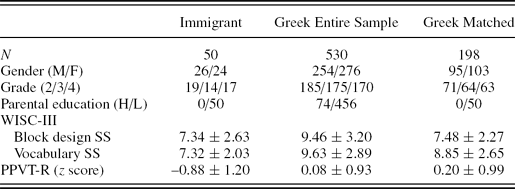
The full sample comprised 580 children from elementary school Grades 2, 3, and 4, recruited from 17 Greek elementary schools in Crete, Attica (including the Athens metropolitan area), and the Ionian islands. School selection followed a stratified randomized approach in an effort to include units representative of urban (7 schools), rural (3 schools), and semiurban areas (7 schools). Children were selected randomly from each class, but only those whose parents gave written permission for participation in the research were included in the study. All participating students were fluent speakers of Greek, had never been retained in the same grade, and did not suffer from any mental or emotional impairment prohibiting enrollment in regular education according to school records. Fluency in Greek was determined qualitatively by teacher report and was assessed solely in order to identify students with poor basic interpersonal communicative skills as an exclusionary criterion. It should be pointed out that an adequate basic interpersonal communicative skills level may mask difficulties in cognitive/academic language proficiency (including vocabulary, which was the focus of the present study; Baker, Reference Baker2011; Cummins, Reference Cummins2000). The sample included 530 monolingual Greek children and 50Footnote 1 bilingual children born to immigrant families of Albanian origin. Table 1 presents the demographic characteristics of the sample. Parental education was coded as a categorical variable with two levels (high/low). Children in the high parental education group had both parents with more than 9 years of formal education whereas children in the low parental education group had both parents with 9 or fewer years of formal education. According to school records, there were no “mixed” couples (with respect to education classification) in the immigrant group. There were 21 “mixed” couples in the larger Greek sample of 530. In those cases, students were categorized according to maternal education. Four bilingual students had attended school (1–4 years) in their home country (one fourth grader had completed kindergarten–third grade in Albania, two third graders had attended first and second grades in Albania, and another third grader had attended second grade in his home country). Based on teacher and student report, the language spoken at the students’ home was only Greek (12%), mainly Greek (29%), only Albanian (12%), mainly Albanian (12%), or both languages about equally (35%). However, these estimates were largely qualitative in nature and not factored into the statistical models.
Sample demographic and psychoeducational characteristics at Wave 1

Note: Greek matched, native Greek students matched on average with the group of immigrant students on parental education and block design score at Time 1; M/F, male/female; WISC-III, Wechsler Intelligence Scale for Children, Third Edition; SS, scaled score; PPVT-R, Peabody Picture Vocabulary Test—Revised. There were 14 mixed couples with respect to parental education in this group, and students were categorized according to maternal education.
Procedure
Children were tested on five consecutive occasions separated by approximately 6 months. At each measurement wave all children were tested individually in two 40-min sessions by a group of undergraduate and graduate students during a period of 3 weeks. Wave 1 was conducted in March of 2005. Examiners underwent rigorous training and were closely monitored by the study coordinators in order to standardize administration procedures.
The Greek version of PPVT-R (Dunn & Dunn, Reference Dunn and Dunn1981) served as the primary measure. Psychometric properties of the Greek version of the test are reported elsewhere (Simos, Sideridis, Protopapas, & Mouzaki, Reference Simos, Sideridis, Protopapas and Mouzaki2011). Briefly, extensive modifications were deemed necessary in the structure of the test in order to accommodate linguistic and cultural differences. Two of the original plates were excluded (items # 65 and 69), leaving a total of 173 plates, and the target word (and corresponding pictorial stimulus) was altered in 44 of the original stimulus plates. Changes in the order of presentation for several items were also deemed necessary based on item difficulty (percentage correct responses in pilot data). Finally, a more lenient stopping rule (8 failures in 10 consecutive trials) was adopted to increase the sensitivity of the measurements. In cases of an incorrect response within the first 6 items (50–55), the examiner administered items reversely (starting from item 49), until a baseline of 6 consecutive correct responses was reached. Administration started with item 50, which is the starting point for children aged 6.5 years in the English version of PPVT-R. Modeling of group differences (Greeks and immigrants) at the item level using the Rasch model (Reference Rasch1980; Smith & Smith, Reference Smith and Smith2004) failed to reveal systematic item bias in favor of either group (Simos et al., Reference Simos, Sideridis, Protopapas and Mouzaki2011).
The assessment battery included word and pseudoword reading accuracy, pseudoword and sight word efficiency (fluency), reading comprehension, rapid automatized naming, and spelling. The WISC-III vocabulary and block design subtests (Greek standardization; Georgas, Paraskevopoulos, Bezevegis, & Giannitsas, Reference Georgas, Paraskevopoulos, Bezevegis and Giannitsas1997) were also administered to the entire sample, using standard procedures. WISC-III standard scores are reported in Table 1 to facilitate comparison with other studies. The block design standard score was also entered as a covariate in some of the analyses reported below in order to assess and control for systematic individual differences in nonverbal cognitive ability at both the intercept and the slope levels. Block design scores show moderate correlations with PPVT-R scores, suggesting that performance on the latter is affected to some extent by nonverbal skills.
Analyses
Individual growth curve analysis was used to investigate change in vocabulary knowledge over time. The dependent variable used in these analyses was the PPVT-R raw score for each participant at each of the five measurement points. Wave (or time) with five levels served as the Level 1 predictor. Two sets of analyses were conducted: unconditional, including only the Level 1 predictor, and conditional. The purpose of the unconditional models was to verify that ample amounts of variance were present around the mean and slope within as well as between students. The general form of the equations describing the unconditional model are the following:
Level 1
 \begin{equation}
{\rm PPVT \hbox{-} R = \upi}_{{\rm 0}i}\, {\rm +\, \upi}_{{\rm 1}i} \times {\rm TIME}_{ij}\, {\rm +\,} e_{ij}\, {\rm +\, \upi}_{{\rm 2}i} \times {\rm TIME}^{\rm 2} _{ij}\, {\rm +}\, e_{ij}.\end{equation}
Level 2
 \begin{equation}
{\rm \upi}_{{\rm 0}i}\, {\rm = \ubeta}_{{\rm 00}} + r_{\rm 0} ,\end{equation}
 \begin{equation}
{\rm \upi}_{{\rm 1}i}\, {\rm = \ubeta}_{{\rm 10}} + r_{\rm 1} ,\end{equation}
 \begin{equation}
\upi _{{\rm 2}i}\, {\rm = \ubeta}_{{\rm 20}} + r_{\rm 2} ,\end{equation}
with the terms π0, π1, and π2 involving the grand mean of PPVT-R, its linear slope, and quadratic slope, respectively. TIMEij and TIME2ij represent the linear and quadratic terms, respectively. At Level 2, π0, π1, and π2 are modeled as dependent variables and the terms β00, π10, and π20 reflect the intercepts of those estimates.
At Level 1 the equations involved in the conditional and unconditional models were identical. Each conditional model included an additional term serving as a between-subjects Level 2 predictor (ethnic/language group, parental education group, gender, or block design score), according to the following set of conceptual equations:
Level 1
 \[
{\rm PPVT \hbox{-} R = \upi}_{{\rm 0}i}\, {\rm +\, \upi}_{{\rm 1}i} \times {\rm TIME}_{ij} + e_{ij}\, {\rm +\, \upi}_{{\rm 2}i} \times {\rm TIME}^{\rm 2} _{ij} + e_{ij} .
\]
Level 2
 \begin{equation}
{\rm \upi}_{{\rm 0}i}\, {\rm = \ubeta}_{{\rm 00}}\, {\rm +\, \ubeta}_{{\rm 01}} {\rm (PREDICTOR)} + r_{\rm 0} ,\end{equation}
 \begin{equation}
{\rm \upi}_{{\rm 1}i}\, {\rm = \ubeta}_{{\rm 10}}\, {\rm +\, \ubeta}_{{\rm 11}} {\rm (PREDICTOR)} + r_{\rm 1} ,\end{equation}
 \begin{equation}
{\rm \upi}_{{\rm 2}i}\, {\rm = \ubeta}_{{\rm 20}}\, {\rm +\, \ubeta}_{{\rm 21}} {\rm (PREDICTOR)} + r_{\rm 2} ,\end{equation}
with the terms π0, π1, and π2 reflecting the grand mean of PPVT-R, its linear slope (growth), and its quadratic effect, respectively. TIMEij and TIME2ij represent the linear and quadratic growth terms, respectively. At Level 2 π0, π1, and π2 are modeled as dependent variables and are predicted by each one of the four Level 2 predictors, entered into the model separately. The π01–π21 terms reflect partial regression coefficients as in multiple regression. The π00, π10, and π20 terms reflect the intercepts of the respective equations. All models involved random effects estimation and modeled each individual's growth trajectory over time.
Level 1 and Level 2 models were fitted to the PPVT-R raw data with restricted maximum likelihood estimation, using Statistical Package for the Social Sciences 16.0 mixed-models analysis. Best fitting models of growth were assessed through a multistage procedure. Unconditional models were tested initially by examining fixed effects for the intercept, (linear) slope, and quadratic parameters. If the fixed slope and/or quadratic effect were significant, corresponding predictors were included in the model to explain the variance in those parameters. Examination of residual plots and comparative fit indices (−2 restricted log likelihood, Akaike information criterion, and Schwartz Bayesian criterion) were used to examine the overall fit of the model (Francis, Schatschneider, & Carlson, Reference Francis, Schatschneider, Carlson and Drotar1999). Ethnic/language group, parental education group, and gender were dummy coded with Greek, high education, and male children as the respective reference categories (= 0), whereas Time 1 was set as the reference value for time. Finally, block design scores measured at Time 1 were centered around the grand mean.
RESULTS
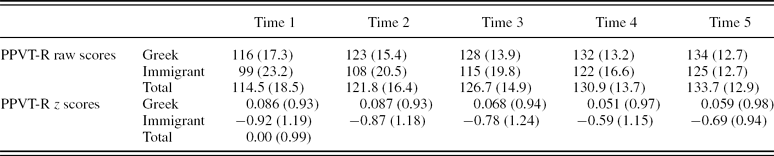
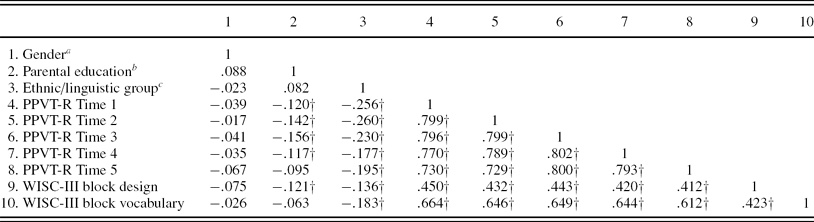
Table 2 presents PPVT-R raw and z scores at each measurement point for each group and for the entire sample. Mean block design standard scores were 9.28 (SD = 3.2) for the entire sample (9.43, SD = 3.2 for native Greek participants and 7.70, SD = 2.89 for immigrants). Table 3 presents correlation coefficients between independent variables which did not exceed r = .2, suggesting that problems with multicollinearity were not likely. Additional tests, regressing each of the independent variables on the combination of the remaining independent variables, corroborated this conclusion, revealing tolerance values > 0.965 in all cases.
PPVT-R raw and age-adjusted z scores by linguistic/ethnic group at five measurement points
Note: PPVT-R, Peabody Picture Vocabulary Test—Revised.
Correlation matrix of predictor and dependent variables
Note: PPVT-R, Peabody Picture Vocabulary Test—Revised; WISC-III, Wechsler Intelligence Scale for Children, Third Edition.
aMale.
bHigh Education group.
cNative Greek.
†p = .001 (statistical significance at the .01 level requires r > .096).
Unconditional analyses
An unconditional growth model was fitted on data from the entire sample under the assumptions of (a) compound symmetry and (b) autoregressive covariance structure. Based on the three criteria of model fit mentioned previously and the estimate of the covariance of residuals across waves was significantly different from 0 (r = .12, z = 2.32, p = .02), the model including autoregressive error variance components provided the best fit to the data and was adopted in further analyses. Each model was then tested with and without assessing intercept and slope random effects as described in Equations 1–3.
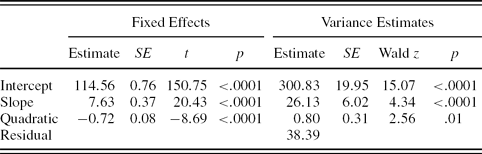
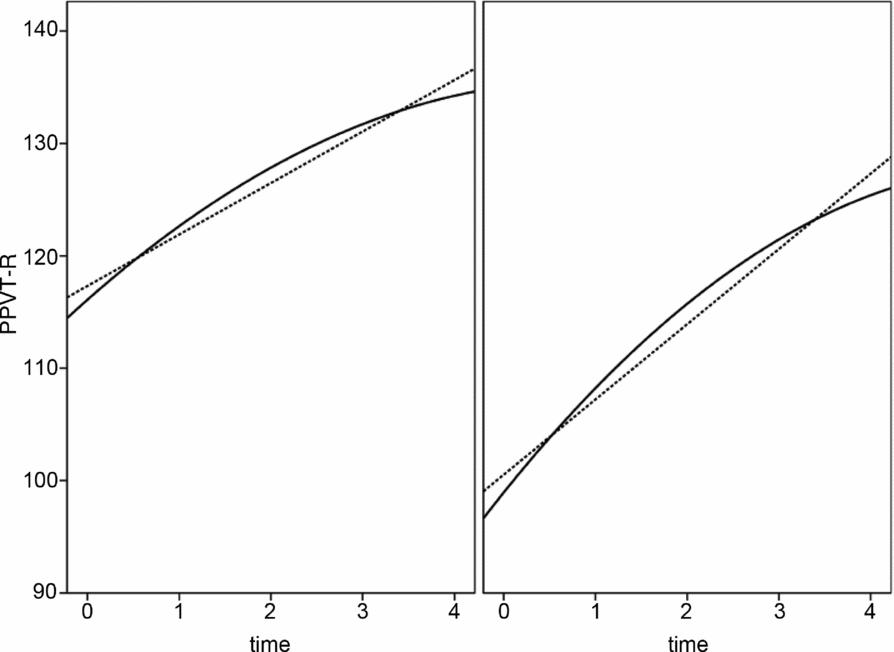
As shown in Table 4, random intercept and slope effects (variability of intercepts and slopes between participants, as well as covariation of slopes and intercepts) were significant, justifying further exploration of the sources of between-participant variability in model parameters by adding additional Level 2 predictors. Moreover, inclusion of a quadratic term (according to Equation 4) further improved model fit (based on the difference in −2 log likelihood fit indices, with 4 degrees of freedom, between models differing only in the presence of the quadratic term Δχ2 = 101, p = .0001). Linear and quadratic slopes for each group are displayed in Figure 1. Table 3 indicates that all three parameters (intercept, linear, and quadratic) were valuable estimates of growth in PPVT-R scores. In addition to the expected finding that PPVT-R scores at Time 1 were significantly different from 0, results demonstrated significant linear growth between Time 1 and Time 5, averaging 7.63 points every 6 months, as well as a small but significant reduction in growth rate over time (quadratic effect), which averaged 0.72 points between adjacent measurement points.
Unconditional model for Peabody Picture Vocabulary Test—Revised for the entire sample
Note: The intercept represents the initial level of performance (at Time 1), the slope represents the semiannual rate of linear growth, and the quadratic parameter indicates the average degree of reduction in growth rate across the five measurement occasions.
Linear (dotted lines) and quadratic (solid lines) average growth curves for Peabody Picture Vocabulary Test—Revised (PPVT-R) raw scores over five measurement points for (left) native Greek and (right) immigrant students.
Conditional analyses: Separate predictor models
In a second set of analyses we examined potential systematic effects of linguistic/ethnic background, gender, parental education, and initial score on the block design WISC-III subtest on growth parameters. Each model is described by Equations 1 (at Level 1) and 5–7 (at Level 2). For instance, Equation 8 describes the full (mixed) model for ethnic group, including only the linear term:
 \begin{eqnarray}
{\rm PPVT \hbox{-} R} &=& \ubeta _{00} + \ubeta _{01} \times {\rm Ethnic Group} + r_{0} + \ubeta_{10} \times {\rm TIME}_{ij} \nonumber \\
& & +\, \ubeta _{11} \times {\rm Ethnic Group} \times {\rm TIME}_{ij} + r_{1} \times {\rm TIME}_{ij} + e_{ij} ,
\end{eqnarray}
whereas Equation 9 describes the mixed model for ethnic group by adding the quadratic term:
\begin{eqnarray}
{\rm PPVT \hbox{-} R} &=& \ubeta_{00} + \ubeta_{01} \times {\rm Ethnic Group} +r_{0} + \ubeta_{10} \times {\rm TIME}_{ij} \nonumber \\
& & +\, \ubeta_{11} \times {\rm Ethnic Group} \times {\rm TIME}_{ij} + r_{1} \times {\rm TIME}_{ij} + \ubeta_{20}\,\times\, {\rm TIME}^{2} _{ij} \nonumber \\
& & +\, \ubeta_{21} \times {\rm Ethnic Group} \times {\rm TIME}^{2} _{ij} + r_{2} \times {\rm TIME}^{2} _{ij} + e_{ij} .
\end{eqnarray}
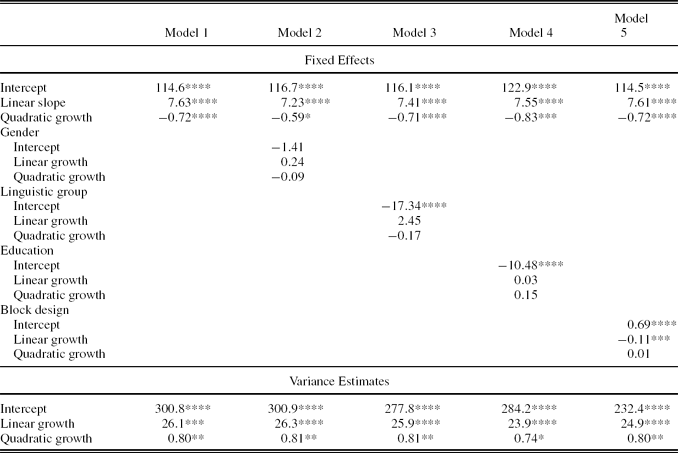
As shown in Table 5, gender did not contribute to the prediction of any of the growth model parameters and was therefore not considered further. In contrast, linguistic/ethnic group entered as a Level 2 predictor improved model fit as indicated by a significant likelihood ratio test with 3 degrees of freedom, Δχ2 = 48, p = .0001 (comparing the model described by Equation 1 [Model 1 in Table 5] with the model described by Equation 9 [Model 3 in Table 5]). The fixed effect of linguistic/ethnic group on intercepts was significant ( $\smash{\hat{\ubeta}}$ = −17.34, SE = 2.61, t = −6.64, p = .0001), although the fixed effects of group on the slope ($\hat{\ubeta}$ = 2.45, SE = 1.35, t = 1.81, p = .07) and quadratic trends ($\hat{\ubeta}$ = −0.17, SE = 0.30, t = −0.57, p = .57) were not. Inspection of the random effects table indicated that ethnic group accounted for as much as 8% of the total shared between-participant variance in intercepts, but only for 1% of the total shared between-participant variance in slopes and <0.1% of the total shared between-participant variance in the quadratic component.
Fixed effects and variance estimates for unconditional (Model 1) and conditional growth models (Models 2–5), considering both linear and quadratic growth in Peabody Picture Vocabulary Test—Revised scores
Note: Significance probabilities of the estimates associated with the corresponding Wald z scores are *p < .05, **p < .01, ***p < .001, and ****p < .0001.
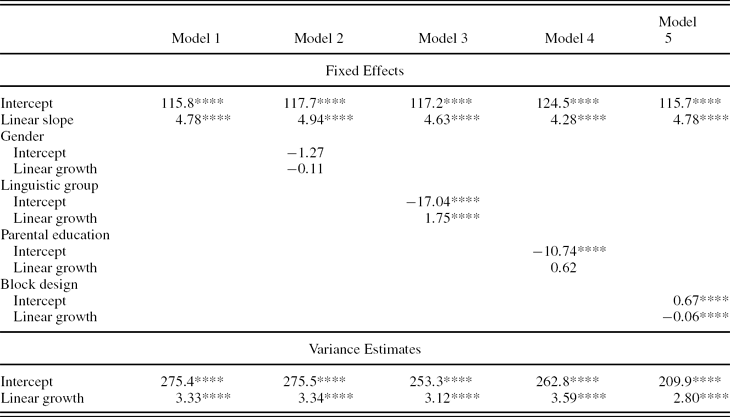
Given, however, that the focus of the present study was on individual differences in growth rates of PPVT-R scores, we considered the possibility that models including a quadratic parameter may have obscured group differences in growth rate, especially in view of the relatively small size of the immigrant group. The conditional model with linguistic/ethnic group as a predictor, which only estimated linear growth (see Equation 8, Model 3, in Table 6), provided a better fit compared to the unconditional linear-only growth model (Equation 1, Model 1, in Table 6), as indicated by a significant likelihood ratio test with 2 degrees of freedom (Δχ2 = 48, p = .0001). This finding suggested that group was a significant predictor not only of the initial PPVT-R score but also of the semiannual rate of growth of PPVT-R scores. Table 6 further reveals that parental education was a significant predictor of initial PPVT-R scores but not of PPVT-R growth rates. Equation (8) describes this model by substituting parental education for ethnic group. Finally, block design initial score was a significant predictor at both the intercept and the (linear) slope levels, whereas gender failed to contribute to the estimation of any of the growth parameters. Examination of the corresponding random effects tables indicated that ethnic group, parental education, and block design variables accounted for 8%, 5%, and 24%, respectively, of the total shared between-participant variance in intercepts. Ethnic group and block design also accounted for 6% and 16% of the total shared between-participant variance in slopes. Therefore, when entered separately as Level 3 predictors, ethnic group and baseline nonverbal cognitive ability emerged as significant predictors of vocabulary growth. With the exception of gender, which was not associated with significant effects at either the intercept or the slope levels, the joined effect of the remaining three independent variables was examined next.
Fixed effects and variance estimates for unconditional (Model 1) and conditional growth models (Models 2–4) that considered only linear growth in Peabody Picture Vocabulary Test—Revised scores
Note: Significance probabilities of the estimates associated with the corresponding Wald z scores are ****p < .0001.
Conditional analyses: Combined predictor models
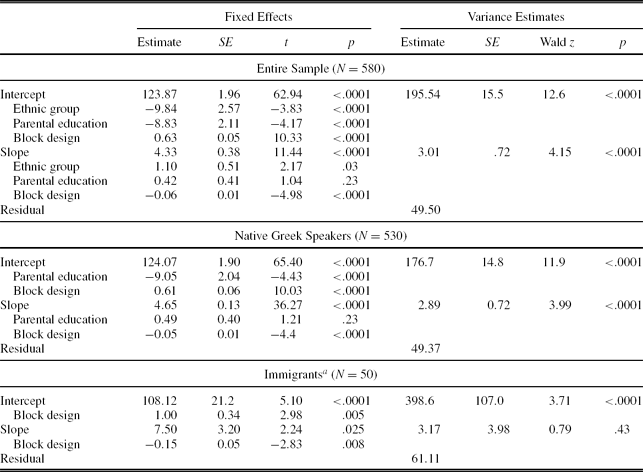
The upper section of Table 7 presents results of the combined conditional model, which included time-invariant variables (linguistic/ethnic group, parental education group, and baseline block design scores) as Level 2 predictors.
Predictors of growth in Peabody Picture Vocabulary Test—Revised scores for the entire sample and for each linguistic/ethnic group separately
aParental education was not entered into the model because all parents had ≤9 years of formal education.
Linguistic/ethnic group remained a significant predictor of initial vocabulary scores. Controlling for initial block design scores and parental education, immigrant students scored on average 9.84 points lower than native Greek speakers at Time 1. Linguistic/ethnic group also remained a significant predictor of vocabulary growth. Thus, PPVT-R scores increased by an average of 4.65 points every 6 months among Greek students, and immigrant students demonstrated faster growth by 1.1 points (again controlling for the significant effect of initial block design scores on growth rates).
Table 7 further reveals that baseline nonverbal cognitive ability was a significant predictor of both initial PPVT-R score and PPVT-R growth rate independent of the effects of Linguistic/ethnic group and parental education. Finally, the effect of parental education on initial vocabulary estimates persisted even after controlling for baseline block design scores (the effect of parental education on PPVT-R growth rate remained nonsignificant as in the conditional single-variable model of Table 6 (Model 4).
Mixed-models analysis results are presented for each ethnic group separately in the lower sections of Table 7. Here it becomes apparent that parental education did not account for a significant amount of variance in vocabulary growth among native Greek students (as in the case of the entire sample). The effect of parental education was not assessed in the immigrant group because all students had parents in the low education group). Moreover, baseline block design scores were significant predictors of vocabulary initial scores and growth rates for both native Greek students and immigrants.
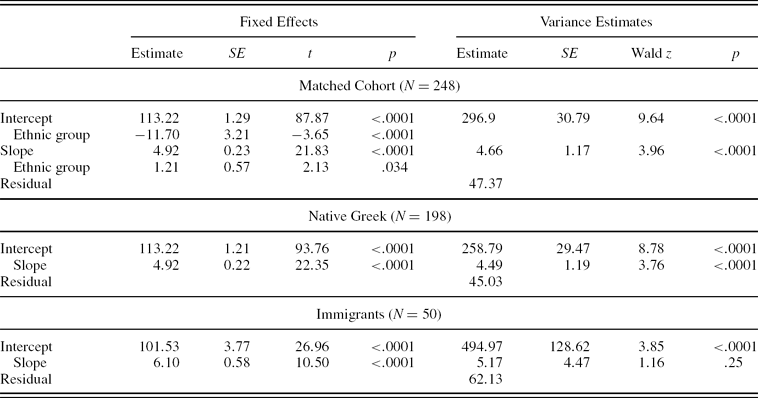
As a complementary test of the potential mediating effect of the predictor variables on growth parameters, a second set of analyses were performed with linguistic/ethnic group as the sole predictor variable. In this case, however, the reference group included native Greek students matched, on average, with the group of immigrant students on parental education and block design score at Time 1. Demographic and psychoeducational data on the matched subgroup of native Greek students are shown in Table 1. The two groups did not differ on gender and grade distribution (p > .6 in both cases) or in block design score (p > .74). Results of the individual growth curve analyses indicated that group remained a significant predictor of PPVT-R scores at both the intercept and the slope levels (see Table 8) even after controlling for the initial differences between groups on parental education and block design.
Predictors of growth in Peabody Picture Vocabulary Test—Revised scores for the entire matched cohort and for the matched groups of Greek and immigrant students separately
DISCUSSION
The present study reports 2-year longitudinal data on the growth of receptive vocabulary in Greek as L2 in children born in immigrant families from Albania attending Greek schools. Five hundred eighty children aged 6 to 9 years took part in this study, including 530 monolingual Greek speakers and 50 Albanian children with Greek as an additional language. Vocabulary size was measured on the Greek-adapted version of PPVT-R, a test that does not require verbal responses and does not show systematic ethnic or gender bias at the item level, as indicated by Rasch model analyses (Simos et al., Reference Simos, Sideridis, Protopapas and Mouzaki2011). Therefore, differences between Greek and immigrant children on this test may not be attributed to cultural differences in the perception and processing of specific stimuli (such as differences associated with differential exposure to the depicted objects/scenes and concepts) or to differential degree of knowledge for everyday versus academically relevant lexical entities, as discussed by Bialystok and Craik (Reference Bialystok and Craik2010). Results indicated that although immigrant children scored significantly lower than native Greek students at baseline, they showed significantly steeper vocabulary acquisition slopes. Two potential correlates of vocabulary growth were examined systematically as moderators of the impact of ethnic group: parental education and nonverbal cognitive ability (gender was not a significant predictor of vocabulary intercepts or slopes and was not examined further). Although the impact of parental education on baseline vocabulary scores or vocabulary growth could not be assessed in the immigrant group due to lack of adequate variance on this parameter, two of our findings point away from this factor as an independent contributor to vocabulary development among Albanian immigrant children. First, parental education was not related to the rate of growth of PPVT-R scores over the 2-year study period in the entire cohort of students (N = 580; although as expected students whose parents had achieved a higher educational level scored significantly higher on PPVT-R at baseline). Second, immigrant students showed significantly faster vocabulary growth rates compared to a group of native Greek students matched on age and parental education.
The second factor that was examined in the present study was nonverbal cognitive ability as measured by scores on the block design WISC-III subtest. This task involves visuospatial processing skills as well as problem solving and construction ability and emerged as a significant predictor of both baseline PPVT-R scores and vocabulary growth rates in the entire sample of students as well as for each linguistic/ethnic group separately. At least at the intercept level (baseline scores), this finding is not surprising given the moderate zero-order correlations typically found between vocabulary and WISC performance scales in student samples (e.g., Craig & Olson, Reference Craig and Olson1991). However, perhaps the most notable present result is that ethnic group differences in both baseline scores and growth rates persisted after controlling for individual differences in block design scores. This conclusion was established both statistically (by entering block design, linguistic/ethnic group, and parental education together as covariates in the same model, see Table 7) and more directly (by comparing immigrant students to a matched subgroup of native Greek students; see Table 8).
Although most immigrant children (N = 47) had attended Greek schools since Grade 1, they had significantly lower average baseline PPVT-R scores than native speakers, a difference which was equivalent to approximately 1 SD. This observed difference is in concordance with findings from Spanish bilingual students learning English, who demonstrated a gap in vocabulary knowledge (both breadth and depth) that did not diminish between the beginning and end of the school year (August et al., Reference August, Carlo, Dressier and Snow2005). The average group difference at baseline was only slightly higher than the estimates reported for a large, ethnically mixed group of immigrant children on the newer version of PPVT (PPVT-III; Bialystok, Luk, Peets, & Yang, Reference Bialystok, Luk, Peets and Yang2010). In that cross-sectional study, group differences did not vary with age (at least between 8 and 10 years), whereas in our sample the group difference in mean PPVT-R scores declined to approximately 0.64 SD points at the end of the study period (2 years). The study period in the present study was lengthier than in the August et al. (Reference August, Carlo, Dressier and Snow2005) study and covered 2 additional years of age than the Bialystok et al. (Reference Bialystok, Luk, Peets and Yang2010) study. Educational and linguistic implications of these results are discussed below.
The type of growth in PPVT-R scores is crucial for predicting future growth and, consequently, longer-term outcomes. Even at the age range studied here, there were indications of a small, but significant, deceleration in growth rates over time, suggesting that the rate at which the gap between the two groups is closing may slowly decline in subsequent grades. Even if we assume a continuing linear growth at the same rates as those observed during the current study period, immigrant children would attain similar average PPVT-R scores in no less than 3 to 5 years (depending on the characteristics of the group of Greek children they are compared to). These findings are in complete agreement with the findings from studies with Spanish/English bilingual students. According to a recent synthesis of research evidence, it seems that oral proficiency develops over time, and it takes 3 to 5 years for English-language learners to achieve advanced levels (Genesee et al., Reference Genesee, Lindholm-Leary, Saunders and Christian2005). These results have implications for assessment strategies for bilingual, immigrant students as well as for predictions regarding their academic achievement. Many experts argue that one should avoid interpreting low scores on language and language-related achievement tests by immigrant children as indicative of deficits in underlying skills (Cobo-Lewis, Pearson, Eilers, & Umbel, Reference Cobo-Lewis, Pearson, Eilers, Umbel, Oller and Eilers2002). While not representative of their “true abilities,” results on tests in L2 may nevertheless predict future academic achievement in the host country educational system. Performance on these tests provides an estimate of the distance between the student's proficiency in a particular aspect of L2 and that expected for his/her monolingual peers. The present data further imply that this distance is covered over time but at a very slow pace, even for children who attended Greek schools since Grade 1. Given the well-documented link between vocabulary and reading comprehension (Oakhill et al., Reference Oakhill, Cain and Bryant2003; Yovanoff et al., Reference Yovanoff, Duesbery, Alonzo and Tindal2005), these findings suggest that this group of young bilingual children is at risk for academic underachievement.
Reduced performance on vocabulary tests by immigrant children should not be interpreted solely as the result of bilingualism but should also take into account the wider social and economic context in which these students develop. There are numerous reports on the crucial role of SES and parental education on vocabulary acquisition and literacy development in monolingual children (Bowey, Reference Bowey1995; Fenson et al., Reference Fenson, Dale, Reznick, Bates, Thal and Pethick1994; Hart & Risley, Reference Hart and Risley1995; Heath, Reference Heath1983; Morisset, Barnard, Greenberg, Booth, & Spieker, Reference Morisset, Barnard, Greenberg, Booth and Spieker1990; White, Reference White1982). The relative degree of immersion in L1 and L2 (in the family and at the school) appears to interact in complex ways with SES to determine language proficiency (Cobo-Lewis et al., Reference Cobo-Lewis, Pearson, Eilers, Umbel, Oller and Eilers2002). Although an effort was made in the present study to control for socioeconomic influences and general cognitive abilities of the children, as potential correlates of initial vocabulary attainment and rate of acquisition, SES and IQ indices may only be used as proxy indices for language capacity in L1. Consequently, little can be said regarding the degree and nature of potential interactions between L1 and L2 at the lexical and semantic levels.
Further, the present study relates to a specific type of bilingualism, resulting from immigration, and may not be generalizable to all forms of bilingualism. In this group of children, bilingualism is typically confounded by other factors (SES and parental education). All immigrant children probably came from low SES families, as indicated by low parental education (fewer than 9 years of formal schooling in Albania). Nevertheless, our finding concerning differential growth rates among native Greek and immigrant students appeared to be largely independent of concurrent group differences in parental education per se, a conclusion supported by two lines of evidence: the lack of a parental education effect on vocabulary growth rates for either group and the native–immigrant difference persisted even after matching the two groups on parental education. It should be noted, however, that parental education, as quantified by years of formal schooling, may not be the best way to match the two groups, because it does not take into account differences between groups in the degree of association between parental education and Greek language ability. The same conclusion can be drawn on the potentially confounding effect of general cognitive ability, which in the present study was measured by a single task (block design subtest).
Unfortunately, detailed information on the relative amount and quality of linguistic experience in Albanian and Greek was not available for all the children in our study, neither were formal measures of L1 vocabulary, mainly because there is no Albanian vocabulary assessment test. Therefore, no conclusions can be drawn about bilingualism per se. In this respect, classifying Greek and Albanian as L1 and L2, respectively, is only tentative in the present study. Some general ethnolinguistic considerations may be useful in this context, however. About 60% of the total population of migrants in Greece come from neighboring Albania (Kasimis & Kasimis, Reference Kasimis and Kasimis2004). Albanian immigration started in the early 1990s, and thus a second generation of Albanian immigrants currently lives in Greece. Moreover, Albanian immigrant students in Greek schools experience social exclusion and are the target of a number of negative stereotypes, which may serve as a powerful motive for cultural and linguistic assimilation (Gogonas, Reference Gogonas2009). Negative ethnic stereotypes very likely generalize toward the immigrants’ L1 in the form of negative attributed value, creating a form of attitudinal “competition” between L1 and L2 (Lambert's [Reference Lambert and Hornby1977] “subtractive” bilingualism). Furthermore, issues of intercultural education and L1 development have little influence in the mainstream educational system (Gkaintartzi & Tsokalidou, Reference Gkaintartzi and Tsokalidou2011). Minority children are mixed together with children having Greek as their native language and attend unsystematic “submersion” classes where L1 does not appear in the school curriculum. This situation may operate as an additional, yet powerful motive to acquire L2 proficiency, at least at the conversational level. Quantitative and qualitative data drawn from second-generation adolescents of Albanian origin on patterns of language use within Albanian households indicate that the Albanian ethnolinguistic group is undergoing rapid language shift (Chatzidaki, Reference Chatzidaki2005; Gogonas, Reference Gogonas2009). This notion is in agreement with qualitative data suggesting that Greek had been adopted, at least partially, in everyday communication by a significant portion of immigrant families participating in the present study. In this respect, the Albanian immigrant population is somewhat atypical in comparison to other ethnolinguistic groups of immigrants living in Greece with more pronounced cultural identity features (Polish, Bulgarian, Pakistani, Chinese, etc.). In addition, language contact (Albanian Greek) is spread at least in some parts of the population on each side of the border given that there is an indigenous Greek minority in Albania, and therefore Greek language is spoken within the Albanian state, and a variety of Albanian (Arvanitika) is spoken by an indigenous population in Greece.
These issues are also relevant to the type of bilingualism immigrant children who took part in the present study were likely to have experienced. The majority of immigrant children were very likely exposed to (some) Greek from early on, although the precise timing of their introduction to the Greek language cannot be precisely determined. However, because there were no ethnically mixed couples among the families of immigrant children, we may assume that they were introduced to Albanian before Greek. For some of these children, systematic exposure to conversational Greek probably took place in daycare or preschool, where Greek would be the main language of teacher–student interaction. Therefore, it appears more likely that the language-acquisition phenomenon approached in the present study is consecutive/sequential bilingualism rather than bilingual L1 acquisition (simultaneous bilingualism; De Houwer, Reference De Houwer, Kroll and De Groot2005; Meisel, Reference Meisel1990).
Motivation for sociocultural (including linguistic) assimilation and early contact with the Greek language and culture by Albanian immigrant children may also account at least in part for the observed accelerated vocabulary growth. Another factor that deserves further study concerns the moderating role of the morphological structure of the Greek language in enhancing metalinguistic awareness in general. Most of the work done in the field of morphology and its potential impact on vocabulary acquisition concerns languages such as English, in which inflectional morphology plays a rather marginal role (e.g., Marchman, Martínez-Sussmann, & Dale, Reference Marchman, Martínez-Sussmann and Dale2004). Greek is a highly synthetic language: The ending of each word is an amalgam morpheme (it contains information about grammatical categories, such as person, number, case, tense, and voice). There is no clear-cut distinction between regular and irregular inflection, but rather, several inflectional patterns varying in regularity. Therefore, it is hard for a nonnative speaker to disentangle the components of the bipartite word structure: stem + inflectional ending. Formal grammar teaching, which in Greek schools is focused mainly on morphology, is likely to promote the development of metalinguistic awareness (for a similar proposal for French, see Duncan, Casalis, & Cole, Reference Duncan, Casalis and Cole2009). This process may further interact with the heightened postulated general metacognitive ability among bilingual children (e.g., Bialystok & Majumder, Reference Bialystok and Majumder1998) to boost vocabulary growth.
To conclude, the findings of this study can be potentially useful to practitioners and can serve as a basis for further investigation, but they must be treated cautiously not only because of the specific characteristics of the sample but also because only a single measure of language proficiency was examined (receptive vocabulary), which naturally fails to capture the entire range of communicative and academic language skills on which immigrant and Greek children may differ.