Between 1960 and 2008, from Latin America to post-Soviet Eurasia, about sixty presidents have managed to extend their stay in office beyond constitutionally mandated periods in one way or another. What explains why some presidents step down from power when required, while others manage to remain in office? The conventional observation is that dictators remain in office and democrats step down. However, democracy alone is too broad a concept to have any useful explanatory potential as a determinant of compliance with constitutions; democracy is itself a function of many factors, and it cannot answer what makes dictators become dictators, and democrats remain democrats. Also, among electoral regimes, whether democratic, semi-democratic or non-democratic, there exists considerable variation in whether or not presidents respect term limits.
In order to explain the stability and breakdown of limited tenure, I provide a theory that focuses on what is at stake for a president facing the prospect of leaving the highest political office. I argue that the income-generating capacity of political office in polities where rent-seeking is prevalent, as well as concerns over future immunity and a malleable institutional environment, entices many presidents to remain in power beyond their mandated period. The larger magnitude of spoils from the political office, together with the probability of retaining these spoils and immunity after exit from office, increases the likelihood that an unconstrained president will try to extend his or her tenure.
During the third wave of democratization, many nations adopted multiparty competitive systems and the subsequent success or failure to consolidate has received much attention in the literature on comparative democratization.Footnote 1 Due to an extensive body of research, we know a good deal about electoral processes and electoral manipulation during the recent period of democratization.Footnote 2 The problem of limited tenure and the confrontation with term limits received no systematic attention in the literature on comparative democratization and this article is the first systematic attempt to explain cross-national compliance with limited tenure.Footnote 3 By focusing on leaders’ incentives to remain in power, it also contributes to the recent surge of interest on the effects of individual political leaders on democracy and economic development.Footnote 4
The article proceeds as follows. First, it describes presidential tenure arrangements across the world, as well as the relationship between limited tenure and democracy. Next, I offer a theory of the value of political office and disentangle the factors that affect this value. At its heart, my argument is very simple: when rulers face high stakes and low constraints, they prolong their rule; when faced with low stakes and high constraints, they step down. To establish this, I fit several statistical models and estimate the impact of the explanatory and control variables on tenure change, using a sample of 196 presidents who entered office with term limits and either completed or extended their terms in the 1960–2005 period. These results, proven to be robust following extensive testing, have significant implications for our understanding of the influence of economic factors on democratization, the constitutional design of presidential democracies and role of political leaders.
Limited Tenure And Democracy
The history of presidential term limits coincides with the history of presidentialism itself; it is no surprise that Thomas Jefferson and Alexander Hamilton were the first to debate presidential tenure restrictions in The Federalist.Footnote 5 When the newly independent Latin American nations adopted presidential forms of government, they had to choose whether to impose restrictions on their executives. In 1819, Simon Bolivar, at that time not yet president, argued ‘behind the veil of ignorance’ that ‘nothing is more perilous than to permit one citizen to retain power for an extended period. The people become accustomed to obeying him, and he forms the habit of commanding them; herein lie the origins of usurpation and tyranny’.Footnote 6 Yet in 1826, by then president, Simon Bolivar advocated life-long presidency, believing that such an institution would enhance political and policy stability. While initially without constitutional provisions (or explicit provisions) against re-elections, all Latin American nations adopted tenure restrictions at some stage between the early and mid-nineteenth century, driven by disastrous experiences with long-serving strongmen and instability. Since then, the majority (but not all) of the newly independent nations across the world that chose presidential forms of government have subjected their chief executives to the legal requirement of stepping down after one or two terms in office. By the end of the twentieth century, term limits seemed to have become the norm of democracy.
By forcing executive turnover, tenure restrictions contribute to the liberalization and democratization of political regimes. In the majority of recent elections in less-developed nations, the ruling elite candidates, whether incumbents or their designated successors, have run against a pro-democratic opposition. The important difference, however, is that designated successors are more likely to lose elections, all things being equal, since the process of presidential succession often triggers elite splits and uncertainty.Footnote 7 A recent paper found that so-called liberalizing electoral outcomes occur in only 18 per cent of elections in electoral autocracies when the incumbent runs, and in 56 per cent in which he or she does not run.Footnote 8 In addition, analysing these data, I found that in 60 per cent of elections without incumbents, the latter did not run because of term limits, while in 38 per cent they did not run because they died or exited ‘irregularly’, which suggests that term limits were the most important obstacle preventing them from standing for re-election.
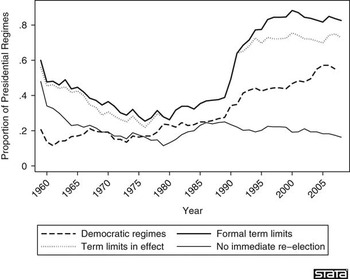
Figure 1 below charts the history of term limits and democracy over the 1960–2008 period. The broken line stands for the proportion of presidential regimes that are democratic (Polity IV score of six and above) in a given year.Footnote 9 The solid black line charts those having formal limits on the number of terms. These two lines run roughly in parallel until the 1990s when many non-democratic and partly democratic regimes adopted limits and the lines diverged.Footnote 10 Note that the dotted line suggests that many presidents chose to extend their stay whether by introducing one more term or by lengthening their existing term (see the section on the dependent variable for more details) without formally abolishing limits – indeed, out of forty-eight rulers who extended their stay from initial single-term or two-term offices, twenty-two dropped restrictions in this period. The figure suggests that the term limits seem to emerge as the norm for the majority of presidential regimes: in 2008, only fifteen presidencies had no formal restrictions. Finally, the thin line documents the decline of single-term regimes.
Presidential tenure restrictions, 1960–2008

Thirty-seven rulers extended their stay after 1991, sixty-one altogether in the 1960–2008 period; thirteen of them extended twice during their tenure and two extended three times, thus increasing the total number of extensions to seventy-eight. Some leaders, such as Deby of Chad, Conte of Guinea or Eyadema of Togo, entered unlimited office, introduced term limits, only to scrap them when the time for departure approached. Twelve presidents, the majority of them from Latin America, entered single-term offices and extended them to two terms; some of them then attempted to stay beyond two terms, but failed. There is variation in the types of extensions as well: from single to two terms, from two to one more term, by several additional years, by scrapping restrictions altogether, or by lengthening the terms but keeping the number of allowed terms intact. Many rulers have failed in their attempts to pursue political immortality, including President Obasanjo of Nigeria in 2006,Footnote 11 Muluzi of Malawi in 2002, and Chávez of Venezuela in 2007.Footnote 12
What explains whether presidents respect the limits on their tenure? Democracy seems to be the obvious explanation for the respect and lack of constitutional provisions on re-election. Indeed, all countries bar France that had not limited their executives until 2008, are non-democratic or only partly democratic, and Figure 1 testifies to the importance of democracy for the stability of term limits. The existing literature on political survival subscribes to the view that term limits are not enforceable in less democratic settings.Footnote 13 While it is true that term limits are more generally honoured in democracies, this is still an incomplete and rather broad explanation for why some rulers are so reluctant to leave while others step down even in less democratic settings. Also, authoritarian Mexico and Lebanon constrained their chief executives with single six-year terms throughout the twentieth century. A number of sitting presidents in less democratic nations have chosen to obey limits and to step down; examples include Leopold Senghor of Senegal in 1980, Jerry Rawlings of Ghana in 2000, Daniel arap Moi of Kenya in 2002, or Vladimir Putin of Russia in 2008.
An Actor-Centred Explanation For The Value Of Political Office And Democracy
In April 2003, Boston University African Presidential Archives and Research Centre held the first-ever roundtable of former African presidents. A total of six ex-presidents attended the gathering.Footnote 14 This roundtable became possible only in 2003 because, to put it bluntly, there had not been enough former African presidents around to man a roundtable in the past. The presidents had either still been in power, had died during their time in office, or had hidden in exile. In contrast, at the time of that 2003 meeting their host country, the United States, had five former presidents alive and active in public life. This one country alone could field almost the same number of former heads of state as the whole continent of Africa.
Why are some rulers more reluctant to leave office than others? The existing record of observance and subversion of term limits by the sitting presidents allows us to address this question and examine why some presidents choose to step down when constitutionally required to do so. A deep but perhaps idiosyncratic examination of what makes individual dictators become dictators, and democrats democrats, would involve inferences drawn from the fields of social and individual psychology and the examination of personalities.Footnote 15 Here, I rely on observable politico-economic data and assume that the primary motivation of a politician is to remain in office.Footnote 16
What goes on in the head of a president who faces the prospect of stepping down? What is at stake? Undoubtedly, politicians value office for its intrinsic benefits. But they also, like all individuals, think about the future and how their actions in the present affect their fate.Footnote 17 They also evaluate their well-being while they are in office, and their likely status once they are out of office. Political office can provide economic enrichment, ‘the fountain of privilege’, that is not available out of office in less developed economies.Footnote 18 The nature of power in poor countries where the highest political office can provide enormous economic advantages is so great that even the most civic-minded leaders are tempted. In the words of the former president of the Czech Republic Václav Havel:
I find myself in the world of privileges, exceptions, perks; in the world of VIPs who gradually lose track of how much butter or a streetcar ticket costs, how to make a cup of coffee, how to drive a car, and how to place a telephone call … I suddenly have a greater understanding of those who are starting to lose their battle with the temptations of power.Footnote 19
How can one operationalize these temptations of power? The existing literature on development and democracy examines how the level of income and expected redistribution affect regime stability and breakdown: democracy is less likely to survive in poor, unequal societies.Footnote 20 Rulers are less likely to relinquish power in poor, less-democratic settings because their utility is concave in income; as income increases, the gap between the likely well-being of electoral losers under democracy and non-democracy becomes larger (and vice versa).Footnote 21 Also, an anti-constitutional coup is twenty times more likely in a poor country: lower income renders stakes higher.Footnote 22 In the words of Douglass North and his co-authors: ‘Higher political stakes imply greater levels of rent seeking. High stakes imply that those in power are far less likely to give up power. The reason is that they have too much to lose from policy changes that would occur if they gave up power’.Footnote 23 Higher inequality could also imply for a ruler both a higher relative loss of assets from potential redistribution, as well as much lower expected income status should he or she lose all assets acquired during tenure.
In countries with relatively lower income and higher inequality, the value of holding office, and therefore the probability of tenure extension, should increase. There exist more direct measures of the rents extracted from the economy through the misuse of public office. Numerous studies have found that development is negatively associated with various indices of corruption.Footnote 24 There are no reliable cross-national indicators that show exactly how much political leaders are able to skim from their countries’ wealth, but anecdotes indicate that the income generated from the highest office could be in magnitudes of billions of dollars or more, especially in poorer nations.Footnote 25 The black market exchange premium, measured as the difference between the official and the market exchange rates, is widely used in the development literature as a reliable proxy for the opportunities for rent seeking and corruption. It is not surprising that Zimbabwe, whose ruler, Mugabe, repeatedly amended the constitution and refused to step down, where the inflation rate for 2007 was 5,200 per cent and the black market premium exceeded 2,000 per cent, provided an unparalleled economic opportunity for power-holders.Footnote 26
Corruption and the higher value of rents extracted from the state could also be due to government activity in the economy and a large public sector.Footnote 27 The public sector could not only increase opportunities for rent seeking, it could also increase the stakes of leaving office, because it would entail relinquishing control over the economy. In Africa, for instance, large public sectors afforded numerous patronage and rent-seeking possibilities.Footnote 28 With a large public sector, public careers become more important for advancement than private ones, and this could additionally affect the incentives of rulers in two ways. First, rulers will not be able to find a career in the private sector with sufficient rewards, and secondly, they could find themselves at the mercy of their successor, who would control high-status jobs. Many anecdotes relate how presidents who amassed enormous control over the economy through the growth of the public sector have then become reluctant to leave office. With the return of Juan Peron to the Argentinian presidency in 1972, for example, public sector employment grew by 11 per cent in the first year and by 20 per cent in the second year.Footnote 29 The growth of the public sector under Hugo Chávez in Venezuela has also been explosive.Footnote 30 In Belarus, where the president extended his tenure in 2004, the state controlled 80 per cent of the economy, with the majority of people being on short-term state contracts.Footnote 31
This manner of asset acquisition also makes ex post office redistribution very likely and immunity problematic. Therefore, we should distinguish between the magnitude of the value of office, and the probability of leading a comparably high-status life after leaving office, and of retaining wealth and immunity.Footnote 32 How can we account for the probability of immunity? It is very plausible that a ruler will receive cues about his or her likely post-tenure fate from the experience of the previous ruler in the same office. If a country has an established tradition of honouring past presidents, the current president’s costs of stepping down should be reduced.Footnote 33 Also, the existence of strong hegemonic parties could ease the costs of stepping down for the outgoing leaders and protect their immunity after exit from office.Footnote 34 Likewise, if a ruler committed human rights abuses during his tenure, future immunity may be far less likely.Footnote 35 Above, I discussed how the level of inequality and the likely manner of asset acquisition by the ruler could affect the probability of retaining wealth. To illustrate, Malawi’s President Muluzi battled to extend his tenure but finally lost in 2003. Post-election events proved that his attempts to remain in office were founded on justified concerns about his likely fate, as the former president became the subject of a corruption probe into a controversial sale of foodstuffs that occurred when Muluzi was in power.Footnote 36 The magnitude of the income-generating potential value of political office, as well as the probability of retaining wealth and immunity, should affect how presidents facing the prospect of stepping down behave. Thus, I put forward the following hypothesis:
HYPOTHESIS 1: Stakes of Losing Office: If the costs of stepping down from office are too high, rulers will extend their tenure.
Presidents motivated by the value of their office must have the capacity to confront other political players and change their constitutions in order to stay in power. We should parse out the specific aspects of democracy that will make it more or less probable that executives will extend their terms. The experiences of presidents bidding for third terms illustrate what obstacles rulers must overcome. In the above-mentioned African cases, Obasanjo’s bid was defeated in the Senate, Muluzi was confronted by his own legislative party, while Chiluba was confronted by grass-roots members of his own party. In the latter two cases, civil society, and especially churches, played a very active role.Footnote 37 Fujimori’s bid to stay for a third term in Peru was thwarted by the unprecedented campaign of demonstrations and civil disobedience. By contrast, in Ukraine, international pressure, in combination with civil society, seems to have played a role. President Kuchma, when asked why he did not run for a third term, replied that unlike Belarus, where his fellow-ruler Lukashenko dropped term limits, Ukraine could not afford international isolation, as 70 per cent of its exports went to the West.Footnote 38
In summary, both elite-level and mass collective action, as well as international pressure, could reduce the capacity of an individual ruler to extend his or her terms. However, if rulers value their office highly enough, they will attempt to reduce constraints after entering into office by undermining checks and balances, by rewriting constitutions, dismissing judges or stealing elections. If constraints are reduced, a subsequent tenure extension could be seen as one of the last pages of the ‘dictator’s script’. In order to tackle potential endogeneity in the estimations to follow, I fix the value of constraints on the executive at the time of entry into office, so that any subsequent changes in constraints that are affected by the value of office will be captured by the dependent variable – tenure extensions. What this article attempts to examine is whether the value of political office affects how rulers behave when term limits approach, for a given level of constraint on the president. Clearly, more ‘democratic’ and constrained presidents will have lower capacity to change their constitutions at will and stay in power. The higher the value of political office (in comparison with other equally constrained and ‘democratic’ peers), however, the more likely it is that rulers will do their utmost to remain in office. This leads us to a further hypothesis:
HYPOTHESIS 2: Constraints: executive constraints decrease the capacity for prolonging rule.
Alternative Explanations
In order to understand what makes some rulers more reluctant to leave office, I have put forward a necessarily very simple decision-making framework conditioned by the costs of stepping down and the constraints imposed on the executive. But other potential explanations for leaders’ behaviour exist – some testable and some not.
A leader’s popularity provides one possible reason as to why some term-bounded rulers step down and others choose to run again. A popular leader might be confident in winning another term, and his or her popularity could help in defeating opponents in order to press for a constitutional amendment. In contrast, an unpopular leader will decide to avoid embarrassment and step down. For example, despite the earlier court ruling that Ukrainian President Kuchma’s second term was actually his first, so that arguably he could run one more time, the president decided to step down and identify a successor in 2004. Due to a series of scandals, his initial popularity came to be virtually nil by the end of his last term, which all but killed the possibility of winning a third term, especially given the international pressure mentioned earlier.Footnote 39 Due to the lack of comparative data on presidential popularity prior to exit or extension, in addition to the obvious influence of executive constraints (and the level of democracy) on reported presidential popularity or vote shares, I will include economic growth as a proxy instead. It is plausible to assume that, all things being equal, leaders whose economies grow are more popular than those where there is economic stagnation.
Leaders’ motivations are more complicated than just the sum of reflections of the perks of office and the fear of retribution once out of office. Some rulers might come into office in order to implement a particular policy, and they will attempt to remain in power longer if this is necessary to achieve their goals. For example, Chávez of Venezuela in all likelihood strove to achieve power in order to improve the lot of the poor. While policy seeking could be an alternative explanation, I do not test it in this article. Short of collecting the policy preferences of each ruler in the sample, it is very difficult to observe empirically that presidents do value policies and step down if they achieve their goals.
Age could also be another factor, but the direction of its potential effects is unclear. For example, after winning three consecutive elections and being able to run for a fourth one in 1999, 83-year-old President Gouled Aptidon of Djibouti stepped down and let his nephew become the new president instead. Older presidents might have less stamina to withstand the stress, and step down. Younger presidents, should they step down, can hardly find a more powerful job to suit their ambitions than the supreme post in a country, so it is quite plausible that they are more likely to remain in office. But President Mugabe, who was only two years younger than Gouled, did not seem to take his own age into account at all. Indeed, after claiming victory in a fraudulent poll in 2005, Mugabe pledged to remain in power until he was 100 years old.Footnote 40 I include age but remain agnostic as to its effects.
Reputation is another alternative explanation as to the rulers’ survival strategies. It is quite likely that some rulers value their international status highly enough to discard the high costs of stepping down. President Putin’s commitment to preserving the prestige of Russia as a superpower, as well as his post-tenure reputational costs, could be an explanation for his decision to step down in 2008. In the words of a prominent Russian political scientist, Putin could have lost both the legitimacy of power and the respect of the world leaders club whose membership he so cherished.Footnote 41
Data, Research Design And Model Specification
The Dependent Variable
As the above anecdotes show, the practice of presidents who attempt to remain in office provides a whole menu of possible strategies for political survival under term limits. I have counted ten discernible actions for rulers who face restrictions. The ruler can:
1. Step down (come what may);
2. Designate a successor and step down (Russia 2000, Kenya 2002);
3. Promulgate a new constitution during one term and start a new term countdown after re-election, in which case the second term becomes the first all over again (Peru 2000, Kyrgyzstan 2000); alternatively, promulgate a new constitution and make amendments to the effect that the time served under the old constitution is discarded (Belarus 1996, Venezuela 2000);
4. Modify the length of term, without changing the number of terms, usually in combination with Strategy 3 (Congo 2002, Uzbekistan 2002);
5. Change the constitution to allow re-election in a single-term regime (Peru 1993, Brazil 1997), or to allow one more term ad hoc (Korea 1969, Namibia 1998);
6. Simply prolong rule by referendum or parliamentary vote ad hoc (Turkmenistan 1994, Kazakhstan 1995);
7. Take a different political office, with or without constitutional changes, to the effect that the political regime or the division of authority within the state changes. For example, it is conceivable to weaken the post of the president so that the latter becomes a mere figurehead, strengthen the prime ministerial position and place oneself as a prime minister, without amending tenure institutions as such, or vice versa; or strengthen the strongest component of the federation at the expense of the centre, or vice versa (Yugoslavia 1997);
8. Suspend elections for the time being (the Philippines 1972, Angola 1992);
9. Change the constitution to eliminate term limits altogether so that an incumbent can run an unlimited number of times (Uganda 2005, Kazakhstan 2007);
10. Abolish elections, presidency for life (Equatorial Guinea 1973, Turkmenistan 1999).
All of these strategies testify to the ingenuity of constitutional designers.Footnote 42 Some of these choices, like ruling by proxy, or a very gradual leadership succession that seemed to have become the norm in China (albeit not a presidential regime) or a more ambiguous version of the eighth strategy could leave open the very question whether the ruler in fact stepped down or not. Continuing with the Russian example, the contradiction between an all-powerful presidency that has been occupied by Dmitri Medvedev since May 2008 and Vladimir Putin’s ambiguous position of a ‘national leader’, in combination with his post of prime minister and his control of a parliamentary super-majority, makes it debatable whether Medvedev ‘succeeded’ Putin in the same sense that Putin succeeded his predecessor Yeltsin. Clearly, even though the Russian president formally stepped down and did not change the constitution, we can classify this case neither as Strategy 7 nor as an unambiguous departure. Anastasio Somoza Debayle (1967–79) of the Dominican Republic ruled by proxy between his terms, but this type of extension can only be classified ex post after the ruler had returned to power again. To avoid possible errors, I exclude all cases that cannot be interpretable as ‘staying in’ or ‘leaving’ office.
I also simplify the choice of available strategies to two: extend tenure or step down, and construct a binary dependent variable. There are two potential challenges to such a specification. First, it is possible that some rulers who extended for one additional term only were driven by different considerations than their more dictatorial peers. If this is the case, the model can be misspecified and two separate models or a model with multiple outcomes would be more suitable. Because of the relatively small number of observations I do not pursue the latter strategy, but I address the former in the section on robustness by distinguishing between short-term (retaining formal limits) and long-term (no limits) extenders, as well as in one of the duration models. Secondly, the binary-outcome variable does not distinguish between cases where presidents stepped down without a fight and when they fought to extend their terms and failed. But how should one define the attempt? Observable cases such as the surprising defeat of Chávez at the 2007 referendum or the protracted battle for a third term by Obasanjo of Nigeria in 2006 can be easily defined as failed attempts. However, more ambiguous cases, such as the discreet backdoor court ruling on President Kuchma’s second term as his first, or the initial manœuvrings by Presidents Moi of Kenya or Chissano of Mozambique prior to their departures that were subsequently abandoned, are more difficult to identify. It is also conceivable that presidents attempt to cajole their subordinates behind closed doors, but fail. Any specification of the attempt is prone to exclude relevant cases; because of the arbitrariness of classifying attempts, it is easier to group the failed and deterred presidents into one group. However, in sections on explanatory variables and robustness, I relax this assumption and examine several attempts as well.
The ruler is coded as having ‘extended’ his or her rule if he or she modified the length of tenure that was proscribed at entry into office in any manner as described in strategies 3–10, and ‘stepped down’ otherwise. I match data on tenure institutions with data on political leaders in order to create the dependent variable, excluding non-presidential leaders.Footnote 43 The sample includes all presidents who entered office with term limits (or introduced them during tenure) in presidential regimes, completed their terms and stepped down, or extended their terms (even if they did not step down). In a few cases where rulers entered unlimited office and subsequently introduced term limits, I count their tenures from the time of this modification.Footnote 44 This excludes those in power who still have a chance to extend their tenure and those who were ousted from office, died or did not complete their terms for whatever reason and hence could not extend their terms, even if they wanted to. If they entered prior to 1960, I extend coverage earlier to include all years in power. There are 196 presidents altogether in the 1960–2005 sample, whether they extended their terms or stepped down. Fifty-one presidents extended their terms and 145 did not.Footnote 45
The Explanatory Variables
In order to operationalize the magnitude of the value of political office, I use several variables: Income in the country (gross domestic product per capita, logged), Inequality (Gini coefficient), Public sector size (public sector employment as a percentage of total labour force) and Black market exchange premium (logged). Details on the construction of these variables can be found in the Appendix. To account for the probability of retaining wealth and immunity, I construct a dummy, Past ruler’s fate, denoting whether the previous ruler’s post tenure fate after exit from office was ‘regular’ or not. In addition, I employ Hegemonic party and Human rights abuses.Footnote 46
In order to capture the capacity of the ruler to extend his or her tenure, I use several measures of possible constraints on the executive. To account for elite-level checks and balances, I use an Executive constraints parameter, polcon,Footnote 47 that classifies all political regimes on the basis of how much political discretion their rulers have. Unlike other possible measures, this one refers to institutional features that are quite distinct from the specific issue of term limits.Footnote 48 I also employ years of uninterrupted democratic rule as a control for the overall level of democracy. Both constraints and democracy years are fixed at entry into office in order to avoid endogeneity. Years will also serve as the measure of the institutionalization of political regime.Footnote 49 In addition, Major constitutional changes will measure constraints and regime institutionalization (in a separate model).
Events are the sum of assassinations, strikes, riots and anti-governmental demonstrations.Footnote 50 I expect this variable to track the opposition’s capacity for collective action, as well as whether the ruler remains in control of the situation. As a proxy for international leverage, I use Foreign aid. There are some notable differences in foreign aid levels between those rulers who stepped down and those who extended their terms. For example, on average, foreign aid amounted to 8.3 per cent before Rawlings of Ghana had stepped down, in contrast to 3.2 per cent in Togo (where Eyadema extended his stay); and it was 1.1 in Ukraine versus a meagre 0.3 per cent in Belarus, prior to the respective outcomes in those countries.
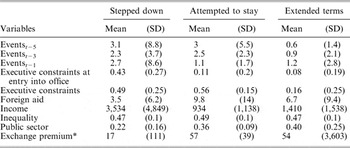
Table 1 details some important differences between those rulers who stepped down, attempted to stay and failed (see previous section, however), and those who succeeded. It appears that the value of political office is similar between those who attempt to remain in office and succeed in doing so: Income, Public sector and Exchange premium are quite similar. I fixed the values of Events at five, three and one years before departure or extension. ‘Extenders’ seem to be more in control of the situation than those who try and fail, when we look at Events at different time lags. Also, while the ‘extenders’ and those who attempt have similar levels of constraints at entry, the latter face significantly stronger checks and balances when they try to stay.
Leaders Step Down, Attempt to Stay and Fail, or Extend Their Rule: Descriptive Statistics

Notes: Mean and standard deviation (in parentheses) are reported. All variables but Events and Executive constraints at entry are the average values for the last three years prior to exit/attempt/extension or the nearest observation, if missing. Variables are described in the Appendix. *Median is reported instead of the mean.
As an additional measure of constraints, and as a proxy for reputation concerns in the international arena, for each ruler’s tenure, I count a number of influential organizations (IOs) and trade agreements that a country is or became a member of. Not all IOs or trade agreements take democracy into consideration, or even if they do, they can hardly exert any influence. For example, even though the Organization for Security and Co-operation in Europe regularly monitors the democratic practices of its members, it cannot exclude or sanction them for non-compliance. Arguably, even if some of these organizations cannot and do not oppose what rulers do, a nation’s membership in a larger number of IOs would signal the possibility that rulers could be concerned with how their reputation and actions are perceived abroad. Finally, I include Economic growth as a comparable and indirect measure of popularity, as well as Ruler’s age.
Model Specification
In order to test the proposed hypotheses, I employ two models: a logit regression model and a duration model; they share a majority of explanatory variables. The first model is a logit regression with 196 observations, with one president being a single observation. I explained the construction of the dependent variable in an earlier section. All independent variables, except those whose values are fixed at entry into office or a past ruler dummy, are the averages for the last three years (or the closest available data during tenure, if missing) before constitutional departure from office or before extension. For leaders who pursued two or more successful extensions, the values are averaged prior to the more significant extension. Details on the construction of variables can be found in the Appendix. The logit regression is estimated with country fixed effects and therefore takes into consideration various omitted country-specific factors such as colonial and legal origins, cultural traits or geography.
In addition to fixed effects, years of democratic rule should also control for the omitted factors that influence the degree of democracy (liberty) in the system. Because Years and Constraints are fixed at entry levels, all institutional changes that might have preceded tenure change will be captured by the dependent variable, and not by these variables, thereby avoiding endogeneity. Also, all explanatory variables are lagged, and the measures of constraints exclude term limits, which additionally address the problem of causality.
I confront the potential problems caused by listwise deletion in the face of missing data by using Amelia II to impute missing values based on patterns in the existing data. This method makes it possible to gain as much leverage as possible while avoiding the bias that could be caused by listwise deletion.Footnote 51 Reported coefficients and standard errors are averaged across five imputed datasets. Estimated results based on the imputed datasets are reported alongside the model estimated with the listwise deletion.
For further tests of the hypotheses, two duration models are fitted. One is a competing risks model, in which each president is assumed to be at risk of experiencing several kinds of events.Footnote 52 The model is specified as a semi-parametric Cox proportional hazards model. Presidents can exit at several ‘destinations’: they can obey the constitution and step down, they can extend the terms, or they can experience irregular exit. The risks must be conditionally independent for the model to hold. Also, it is assumed that all of these kinds of exits – honouring the constitution, extending the term, and irregular removal – are possible for each president. Indeed, a ruler in any polity, in principle, either a less developed or more developed economy, could be ousted, step down or decide to prolong his or her term. Once the president extends his or her term, he or she exits the group of single-term or two-term restricted presidents and begins a new journey in pursuit of political immortality that is not the subject of this study. Unlike the logit regression specification, which only includes leaders who completed or extended their terms, this specification also includes leaders who were thwarted by coups or assassinations prematurely. For each leader, only one failure out of three can be observed, so that the overall likelihood is partitioned in terms of the number of observations failing each of these outcomes; three single-state models for each type of exit are estimated, while failures due to other types of risks are treated as right-censored, for each model.Footnote 53 This model is based on leader-years data, with a significantly larger number of missing observations (that are not averaged per leader in this model) on several variables, especially Public sector and Exchange Premium. Rather than imputing missing values, I omit these variables from the competing risks model specification and instead examine whether the time-invariant versions of explanatory variables produce similar results to logit. Finally, to control for the duration dependency in the data, I include the natural logarithm of the number of terms that the leaders serve. Indeed, if leaders exit after one, or, if re-elected in a two-term presidency, two terms, then this could be an excellent predictor of the constitutional exit destination, and has to be included.
In addition, I fitted the marginal risk set for repeated events. This specification allows rulers to experience both ‘short-term’ and ‘long-term’ extensions from the beginning of their tenure in no particular order, since some rulers extend for short terms and only after that for the long term, while others extend long terms straight away. This Cox model is fitted with the same specifications as above, but the data are stratified by event number (‘long’ or ‘short’), with constant covariates across these two groups but separate baseline hazards.Footnote 54
Results And Discussion
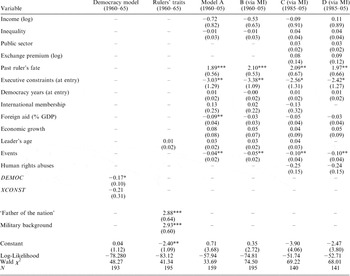
As discussed earlier in this article, the degree of democracy is an obvious but too broad explanation for the observance and subversion of term limits. As an illustration, I first fit a simple ‘democracy’ model. XCONST captures the checks and balances, DEMOC is a broader concept and accounts for civil liberties, electoral participation and control, as well as constraints (these two measures are correlated).Footnote 55 Aside from the possibility of endogeneity in coding democracy levels for those who step down or extend their rule, this explanation is simply too general.Footnote 56 Secondly, I fit an additional model that includes several individual attributes. The results suggest that first post independence leaders and those with military backgrounds are more likely to stay longer. Indeed, eleven out of fifteen ‘national fathers’ in this sample extended their terms. This could be due to the fact that these rulers are perceived as indispensable in settings without the precedent of executive turnover, or that they are more popular. For reasons of space and data availability, however, I forsake a more complete study of various background attributes that affect leaders’ propensity to subvert institutions, and next turn to the empirical estimation of the hypotheses articulated above (Table 2).
Presidents and Tenure Changes: Logit Regression

*Significant at 0.1, **at 0.05 and ***at 0.01 levels; parameter estimates and robust standard errors in parentheses. The dependent variable takes the value of 0 if a ruler steps down and 1 if he extends his terms, including one observation per leader. Only those leaders who extended their terms or served full constitutional terms and stepped down are included. All variables except Past ruler’s fate, Executive constraints and Democracy years at entry into office are measured for the last three years preceding tenure change or constitutional exit from office (or the closest available data during tenure in office, if missing).
Model A includes two broad proxies for the magnitude of political office – Income and Inequality, and one for the probability of retaining assets and immunity – Past ruler’s fate. Foreign aid and International membership provide measures of how much a ruler can be constrained by his or her international obligations or reputation. It also includes the measure of collective action potential, Events. In addition, Constraints and Democracy years provide measures of the initial checks and balances and the institutionalization of political regime that the ruler had to deal with, as well as controls for the overall level of democracy. Also, the model includes Economic growth as a measure of a leader’s popularity and performance in office, and his or her Age. The results from the Model A specification suggest that the fate of the previous ruler seems to provide an important cue for a president reluctant to leave. Also, the model indicates that foreign donors could have an important leverage over decisions of recipient presidents: the less aid a country receives before potential presidential succession, the more likely a ruler is to extend his or her rule.Footnote 57 Likewise, Events decrease the likelihood that rulers will be able to stay on. Most of the variables have the expected sign, except for years of uninterrupted democratic rule and Inequality, which are not statistically significant. Results estimated with the assistance of multiple imputation (Model B) are broadly similar, with Foreign aid becoming borderline significant.
Model C extends the analyses by including three additional and more direct measures of the magnitude of spoils of political office and probability of immunity but excludes rulers who were in power prior to 1985 because of the coverage of the Public sector and abuses variables. Significant predictors from the previous model retain their significance and sign. Public sector has the correct sign, but it is only borderline significant (also see Table 5). Rulers who step down on average command 19 per cent of employed citizens as public sector workers, in contrast to 22 per cent among those who initiate shorter extensions, and 42 per cent who extend indefinitely. Older rulers seem to be more likely to extend. Model C additionally includes the alternative measure of the probability of immunity, Human rights abuses, where the lower value stands for more reported abuses. This proxy for the probability of immunity could capture some of the post-tenure concerns that a ruler could have. While the latter variable has the expected sign, it is not significant. In terms of forecasting and reliability, Model C indicates that 86 per cent of observations are predicted correctly: if Pr > 0.5 and y is 1, and if Pr < 0.5 and y = 0.93 per cent of 0s and 70 per cent of 1s.Footnote 58 Membership in prominent international organizations proves to be insignificant in the models, and its direction is unclear, which could suggest that either rulers care more about the office than their reputation, or that further, better operationalization is required, or, perhaps, that reputation remains in the remit of individual psychology that comparative cross-national research still has to tackle. I exclude Membership, as well as Age from Model D. The variables that were significant in Model C remain so – a further testimony that the model is specified correctly. Based on the likelihood-ratio test, Model D is the preferred model.
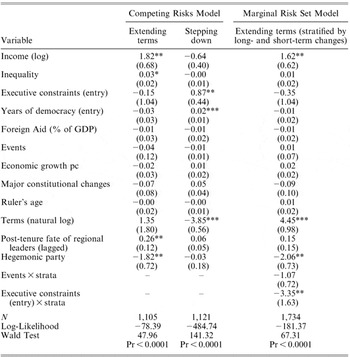
While the main question in this article is whether rulers step down or extend their rule, we can also supplement the analyses by estimating how the value of political office affects the length of time a ruler can be expected to remain according to the tenure arrangement under which he entered office, before he extends it or steps down. Separate models are fitted for the rulers who extend – versus the rest and for the rulers who step down constitutionally – likewise (Table 3).Footnote 59
Competing Risks and Repeated Events Models

*Significant at 0.1, ** at 0.05 and *** at 0.01 levels. Coefficients and robust standard errors are reported. The duration models include presidents who extended terms, stepped down when required and exited prematurely for whatever reason. In the Cox competing risks model, ‘failure’ is to extend terms (1 column) or to step down constitutionally (2 column). Marginal risk set model (3 column) assumes that rulers can extend terms repeatedly so that each president is at risk of extending short terms or long terms (see discussion in text) in no particular order; the data are stratified by event (short-term or long-term change). Terms (log) is the natural log of the number of terms allowed at the entry into office to control for time duration dependency. Based on the initial analysis of the scaled Schoenfeld residuals, none of the variables failed the proportional hazard test.
Because multiple imputation is problematic due to the larger amount of missing data in the leader-year data, I exclude Public sector and Inequality from the estimations. Also, instead of the Past ruler’s fate, which we know to be important, I include the lagged count of rulers who had irregular fates after leaving office in the region (including non-presidential leaders). I also test whether a ruler is more likely to step down or extend his or her stay, given the presence of a Hegemonic party (that often predates a ruler’s tenure).Footnote 60 The model includes the same measures of constraint, fixed at entry. Also, time-variant versions of Human rights abuses and Events are included to see whether they can explain how soon, if a ruler worries about immunity, he will extend his rule, or whether he will be able to do so. Major constitutional changes should capture institutional flexibility. As can be seen, while the majority of the predictors retain the correct sign, only Hegemonic party, the lagged count of rulers who had irregular fates and Income are significant.
The predictions of how long rulers can go on before they constitutionally step down are similar to a hypothetical model that would estimate democratic stability: higher Executive constraints and a larger number of uninterrupted Years of democratic rule at entry into office increase the ‘hazards’ of stepping down when the required time comes.Footnote 61 Hegemonic party cannot predict whether a ruler will step down. While a strong party can guarantee immunity after exit from office, it can also empower the executive for a constitutional change. Many rulers in such regimes do step down (Mexican presidents or Gouled Aptidon of Djibouti, to name a few), yet others prolong their rule (Stroessner of Paraguay or Tubman of Liberia, for example). In both models, the time-variant version of Income tends to produce an unexpected sign.
In addition, the third column presents the repeated events duration model in which all leaders are at risk of attempting short-term and long-extensions. The majority of coefficients report the overall effect of predictors on the probability of tenure change, short or long, but I also include the strata-specific covariates of Constraints, and Events. The latter two variables proved to be significant in a model without interaction terms (results omitted). Results indicate that the presence of a hegemonic party thwarts changes of all kinds. The interaction terms’ coefficients suggest that higher entry Constraints and a higher number of anti-governmental demonstrations, strikes, riots and assassinations reduce the hazard of dropping term limits altogether or attempting a second change, especially whether a ruler already attempted short-term change or not.
The logit regression models, as well as the complementary duration models, provide support for hypotheses that were specified earlier: higher magnitude of spoils of political office, especially manifested in Public sector, and in direct proportion to the economic Inequality in a country, as well as the lower probability of retaining the spoils and immunity after expected exit from office (Past ruler’s fate), for a given level of constraints – especially those arising from collective action of the citizenry (Events) and, to a lesser extent, from international pressure (Foreign aid), increase the chance of tenure extension. In order to grasp the substantive impact of regressors on outcome probability, I compute the first differences and simulate the predicted values using Model C.Footnote 62 Table 4 reports the simulated effects.
Substantive Effects of Selected Predictors on the Dependent Variable

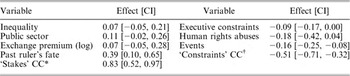
Notes: Parameters are simulated from Model D, Table 2, using the CLARIFY package (see Gary King, Michael Tomz and Jason Wittenberg, ‘Making the Most of Statistical Analyses: Improving Interpretation and Presentation’, American Journal of Political Science, 44 (2000), 347–61). The simulated effects represent the change in the predicted probability of observing extension of tenure (confidence intervals in brackets), given the changes in particular predictors by one standard deviation from the mean (except Past ruler fate dummy, 0 to 1), holding others at their mean. CI = Confidence interval *‘Stakes’ CC is the covariate contribution of Income (inverted), Inequality, Exchange premium, Public sector, Past ruler’s fate and Human rights abuses (inverted). †’Constraints’ CC is the covariate contribution of the Executive constraints, Democracy years, Foreign aid and Events – the independent variables that account for the executive constraints in the model.
Consider the impact of the Public sector size growing from 28 to 44 per cent of the total workforce. This change will increase the probability of extending the terms in one way or another by 11 per cent. To illustrate this, during eight years of Hugo Chávez’s tenure, the public sector has grown by 22 per cent.Footnote 63 Likewise, the increases in other measures of constraints or of the value of political office produce similar substantive results. We can also consider the aggregate contribution of the variables of interest (‘stakes’ of losing office and ‘constraints’). Based on Model D, I generate two covariate contributions as the linear combinations of two groups of predictors (six variables for ‘stakes’ and four for ‘constraints’), multiplied by their corresponding coefficients.Footnote 64 I invert the values of Income and Abuses so that they influence the outcome with the same sign as other predictors do. Holding remaining variables at their means, I estimate the overall effect of ‘stakes’ versus ‘constraints’ (when the value goes from its minimum to its maximum) on the outcome and find that the effects of ‘stakes’ are larger than those of ‘constraints’ in the model: 83 vs. 51 per cent. We can also place the value of office for all presidents of the world on a continuous scale, with democratic presidents valuing their office less than non-democratic presidents. For illustration, placing selected leaders in order of their value of office, from low costs of stepping down to high: Clinton of the USA (1.2) Kuchma of Ukraine (3.6), Muluzi of Malawi (5.2) and al-Bashir of Sudan (6.6), we can observe that the order is rather intuitive and additionally testifies to the model’s predictive capacity.
Robustness Checks
As discussed earlier, the number of possible ways to perpetuate oneself in power can be quite large. However, the specified dependent variable reduced this diversity into one binary outcome. To address the argument that a different model is necessary to deal with the presidents who extended their single terms into additional second terms as opposed to those who, for example, were made presidents for life, or whose failed attempts should be accounted for, in this section I compare the results estimated with alternative specifications of the outcome variable.
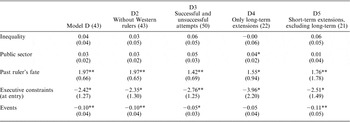
The second column of Table 5 reports the selected results of the model estimated without US and European presidents; results hardly change. Earlier, I discussed the difficulties in identifying what constitutes an attempt to stay in power and what does not. The third column is based on the model that additionally includes seven identifiable failed attempts at ‘tenure extensions’, with the purpose of testing whether the model remains robust enough to explain not only successful but also failed attempts. If a ruler’s desire to remain in power is driven by the income-generating potential of political office and his or her immunity concerns, the ruler will try to remain in power despite the constraints he or she might face. The results of Model D3 could be interpreted as indicating that failed leaders are driven by the similarly high stakes of losing office as their more successful peers, yet they lose their bids, perhaps because of the higher levels of constraints, or the idiosyncrasies of political battles. Events are only borderline significant, which could be due to the fact that rulers who fail face a more serious opposition (which prevent them from achieving their goal in the first place), but when they are reclassified as successful, the effects of this variable disappear.
Results with Different Specifications of the Dependent Variable (Selected Coefficients)

*Significant at 0.1, **at 0.05 and ***at 0.01 levels; parameter estimates and robust standard errors in parentheses.
All models are estimated via multiple imputation (Amelia II). Every model includes the same variables as in Model D (Table 2); only selected coefficients are displayed. D3: dependent variable is specified as in D; in addition, presidents who attempted to extend the terms and failed are coded as 1 (see discussion above). D4: short-term extenders are recoded as 0; only long-term extenders are coded as 1. D5: long-term extenders are excluded from estimation; only short-term extenders are coded as 1.
Next, I compare short-term and long-term extenders. Those presidents who pursued Strategies 9 and 10 are coded as long-term extenders. These strategies are designed to allow unlimited time in office. Likewise, those who pursued Strategies 3 to 8 more than once are also coded as long-term extenders. Indeed, President Rakhmonov of Tajikistan never abolished term limits, but several times he began a new countdown of his terms with every new constitution – clearly, we cannot classify him as a short-term extender. Short-term extenders are those who have pursued Strategies 3 to 8 only once (even if they tried and failed further strategies later on).
If we assume that short-term extenders are driven by determinants different from those that drove their more dictatorial peers, when we re-classify short-term extenders as 0s and retain the long-term extenders as 1s, we should observe similar, if not stronger, results than we do in Model D. Also, short-term extenders should face similar stakes to those rulers who never tried to remain in power. And, likewise, should we drop long-term extenders from the estimation and predict only short-term extensions on the basis of the same original model, we should not observe any significant results, if the latter indeed are not driven by the value of office. As it turns out, nothing can be further from the truth: the coefficients on the major explanatory variables lose their significance or become borderline significant once we reclassify short-term extenders as 0s in Model D4, and results remain robust even after we exclude long-term extenders in Model D5. The major difference is that public sector seems to affect long-term extensions rather than the whole category – a finding that explains the borderline significance of public in the main model D. In the last model (D5), public sector retains the correct sign but loses its significance, which could be due to lower public sector employment in Latin America.
These results suggest that the model is specified correctly and that short-term and long-term extenders have similar utility functions. This finding is also supported by the empirical record of short-term extenders, such as Menem and Fujimori, who sought further extensions but failed in their attempts.Footnote 65
Conclusion
In presidential regimes, regular elections and checks and balances must be strengthened by the institution of term limits, as without tenure restrictions the executives could be re-elected forever. In the words of Simon Bolivar, we elect ‘monarchs’ whom we call ‘presidents’.Footnote 66 Term limits are designed to hinder the transformation of presidents into monarchs. More than 200 years ago, Jefferson emphasized the dangers of long tenures: ‘If some termination to the services of the Chief Magistrate be not fixed by the Constitution, or supplied by practice, his office, nominally four years, will in fact, become for life; and history shows how easily that degenerates into an inheritance’.Footnote 67 In his debate with Hamilton, Jefferson seems to have been proved right: the danger of dictatorial takeover outweighs the possible benefits.
The results in this article make a powerful argument not only for incorporating tenure restrictions into constitutional design, but perhaps more importantly, for paying careful attention to rulers’ incentives. Rulers might be subverting democratic institutions and staying in power because of the rational expectations of what could follow when they step down. Incumbents who do their utmost to designate in advance and ensure the election of their successors are hardly upholding the spirit of democracy. A proper understanding of rulers’ succession strategies and the potential outcomes could lead democracy practitioners to re-examine what is at stake for a typical ruler in a less-developed country, and which institutions and elite pacts could ease ex post contracting in order to ensure transition to and consolidation of democracy. Perhaps constitutional compliance should be rewarded as well. In 2007, the former president of Mozambique, Chissano, was awarded a multi-million dollar Mo Ibrahim Prize for good governance, largely because of his decision to step down earlier when required.Footnote 68
The question as to why some rulers are more reluctant to leave office and what they do to perpetuate themselves in power is very broad and could lead to the coverage of more cases and phenomena beyond succession strategies and outcomes in term-bound presidencies. Alternative and further operationalizations of the value of political office for the power-holders not only in presidential but also in all political regimes could be an interesting and fruitful research programme in the future. Better individual-level data on the affinity with successors, immunity guarantees, and better measurements of the skimmed spoils of office are necessary to disentangle the stakes of losing office. Many rulers could be obeying constitutions out of conviction, and it is difficult to imagine some, like Lech Wałęsa of Poland, for example, extending terms. Perhaps models examining individual traits will enhance our understanding further.
As it stands, however, these results indicate the critical importance of examining the micro-foundations of behaviour in presidential regimes. Institutional design is not enough; to truly understand the practical limits of democratic theory, we must explicitly model the individual-level incentives of leaders to retain power. This study not only deepens our understanding of the workings of presidential regimes, but also offers a cautionary note on the limits of constitutions and regime design. If the stakes are high, an unconstrained president in any variety of regime will be likely to do his or her best to overstay his or her welcome.
Appendix
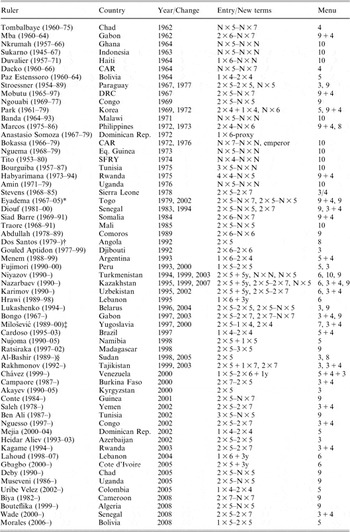
Presidential Tenure Changes, 1960–2008

Notes: N×N stands for the number of terms (1, 2 or unlimited N) × term length. N×N stands for the presidency for life. This article does not discuss changes in interim terms, but there were two such changes: Costa Rica 2003: 1×4–1×4 (after interim allowed); Panama 1994 1×4–1×4 (after two interim terms).
* In 1991, 2×5 was introduced.
†Suspension of elections due to civil war, first term prolonged indefinitely.
‡ Stepped down from Serbian presidency and became president of Yugoslavia in 1997.
§Elected in 2000; according to the 2005 comprehensive peace accords, elections are suspended.
Variables And Data
Income – Gross domestic product (GDP) per capita (constant 2000 US$); Inequality – Gini coefficient (WIID2); Growth – GDP per capita growth (annual per cent); Foreign aid – official developmental assistance and official aid (percentage of GDP) – are all downloaded from World Developmental Indicators, WDI.
Exchange premium is the black market exchange premium (calculated as log(100 × (black market exchange rate – official exchange rate)/official exchange rate)) – from WDI, Arthur Banks, Cross-National Time-Series Data Archive, 1815–2003 (Binghamton, N. Y.: Arthur S. Banks, 2005), CD-ROMs; Philip Cowitt, World Currency Yearbook (various years). Data for NIS/CEE are supplemented from Martha de Melo, Cevdet Denizer, Alan Gelb and Stoyan Tenev, ‘Circumstance and Choice: The Role of Initial Conditions and Policies in Transition Economies’, World Bank Economic Review, 15 (2001), 1–31.
Public is public sector employment (percentage of total employment), from International Labour Organization website (available for 1985–2005), supplemented by the author from the UN Public Administration Country Profiles (available from UNPAN website) and International Labour Organization, World Labour Report (Genève: International Labour Office, various years).
Executive constraints – polconv from Witold Henisz, ‘The Institutional Environment for Infrastructure Investment’, Industrial and Corporate Change, 11 (2002), 355–89 (POLCON 2005 Release).
Democracy years – years of uninterrupted democratic rule, based on PERSIST if democracy (Monty Marshall and Keith Jaggers, Political Regime Characteristics and Transitions, 1800–2004, Dataset Users’ Manual, Polity IV Project (College Park: University of Maryland, 2006)), XCONST and DEMOC are also taken from POLITY IV.
Major constitutional change – Number of Major Constitutional Changes (S21F2). Likewise, Events is constructed as the sum of assassinations (S17F1), strikes (S17F2), riots (S17F6) and anti-governmental demonstrations (S18F1) (see Arthur Banks, Cross-National Time-Series Data Archive, 1815–2003 (Binghamton, N.Y.: Arthur S. Banks, 2005), CD-ROMs.
International membership is coded by the author as the number of organizations that a nation is/became a member of during the ruler’s tenure: Council of Europe (CoE), North Atlantic Treaty Organization (NATO), European Community (EC): for CEE members from the moment of signing of negotiation agreements; World Trade Organization (WTO), Mercosur, Common Market for Eastern and Southern Africa (Comesa), Generalized System of Trading Preferences (GSTP), South African Development Community (SADC), the South Pacific Regional Trade and Economic Cooperation Agreement (Sparteca), Latin American Integration Association (LAIA), North American Free Trade Agreement (NAFTA), and the Protocol relating to Trade Negotiations among Developing Countries (PTN). Likewise, Military and Nation father are coded by the author. Military is 1 if leader is/was a military officer at any stage in his career. Nation father is 1 if first post-independence leader.
Leader’s age is taken from Hein Goemans, Kristian Gleditsch and Giacomo Chiozza, ‘Introducing Archigos: A Data Set of Political Leaders’, Journal of Peace Research, 46 (2009), 269–83; Past ruler’s fate is based on post tenure fate (Archigos): the fate of the leader in the period up to one year after the leader lost power (0 OK, 1 Exile, 2 Imprisonment (including house arrest), 3 Death). I extended the coverage up to three years after leaving office. This variable is coded as 0 if a post-tenure fate of the previous ruler is OK, 1 otherwise. I recoded this variable as 1 if a leader was reported to be under criminal investigation by at least two sources. In addition, a lagged count of leaders with a post-tenure fate of 1–3 in the region (Sub-Saharan Africa, Middle East and North Africa, Latin America, CEE/NIS, West, Asia) is constructed.
Human rights abuses – based on PHYSINT Physical Integrity Rights Index (The Cingranelli-Richards (CIRI) Human Rights Dataset, downloaded from www.humanrightsdata.org), constructed from the Torture, Extra-judicial Killing, Political Imprisonment, and Disappearance indicators, where lower value stands for no respect for rights. Available during 1981–2004.
Hegemonic party – based on the same criteria as in Beatriz Magaloni, Voting for Autocracy: Hegemonic Party Survival and Its Demise in Mexico (Cambridge: Cambridge University Press, 2006), pp. 32–42.