INTRODUCTION
The importance of behaviour in the breeding and husbandry of pigs is becoming more important, especially regarding animal welfare aspects. Social groups in modern pig production are not stable; for example, the mixing of unacquainted pigs after weaning, at the beginning of the growing period or in breeding herds is a common practice (Ismayilova et al. Reference Ismayilova, Oczak, Costa, Thays Sonoda, Viazzi, Fels, Vranken, Hartung, Bahr, Berckmans and Guarino2013). In order to establish a stable hierarchy and to prevent permanent stress within the group, fights take place between the animals. The interaction of pigs using aggressive and submissive behaviour is called agonistic behaviour. Less aggressive animals do not negatively influence other pigs, for example, due to stress or injuries (Tuchscherer & Manteuffel Reference Tuchscherer and Manteuffel2000). Hence, excessive aggression, especially towards low-ranking pigs, can influence welfare, health and weight gain, which are important factors in pig production (Tan et al. Reference Tan, Shackleton and Beames1991; Stookey & Gonyou Reference Stookey and Gonyou1994). Therefore, one possible way to reduce aggression and increase animal welfare is the breeding of calm and less aggressive pigs (Erhard et al. Reference Erhard, Mendl and Ashley1997; D'Eath et al. Reference D'Eath, Roehe, Turner, Ison, Farish, Jack and Lawrence2009). Presently, some breeding organizations include traits regarding behaviour and aggression as subordinated goals in their breeding programmes. In order to use traits concerning agonistic interactions it is important to know their heritability, but only a few estimates have been published on this so far (Løvendahl et al. Reference Løvendahl, Damgaard, Nielsen, Thodberg, Su and Rydhmer2005; Turner et al. Reference Turner, Roehe, Mekkawy, Farnworth, Knap and Lawrence2008, Reference Turner, Roehe, D'eath, Ison, Farish, Jack, Lundeheim, Rydhmer and Lawrence2009; Stukenborg et al. Reference Stukenborg, Traulsen, Stamer, Puppe, Presuhn and Krieter2012). For growing pigs, a wide range of heritability for agonistic behaviour has been estimated (Turner et al. Reference Turner, Roehe, Mekkawy, Farnworth, Knap and Lawrence2008, Reference Turner, Roehe, D'eath, Ison, Farish, Jack, Lundeheim, Rydhmer and Lawrence2009). According to Stukenborg et al. (Reference Stukenborg, Traulsen, Stamer, Puppe, Presuhn and Krieter2012), heritabilities for growing pigs and breeding gilts (242 days of age) are higher than those for weaned pigs, possibly as a result of confusion between playing and fighting in young pigs (Chaloupková et al. Reference Chaloupková, Illmann, Pedersen, Malmkvist and Simecková2008; Silerova et al. Reference Silerova, Spinka, Sarova and Algers2010). Aggression is a more stable temperament trait in older pigs. Even so, fighting in weaned pigs, growing pigs and in breeding gilts is motivated mainly by the attempt to establish a rank order. Agonistic interactions have been recorded by behavioural observations in several studies. In contrast, ontogenetic analysis of the aggressive and submissive behaviour has been less well-documented. Comparisons of agonistic interaction at different stages of life show that stronger relationships exist between growing pigs and breeding gilts than between weaned and growing pigs or between weaned pigs and breeding gilts (Stukenborg et al. Reference Stukenborg, Traulsen, Stamer, Puppe, Presuhn and Krieter2012). However, Stukenborg et al. (Reference Stukenborg, Traulsen, Stamer, Puppe, Presuhn and Krieter2012) worked with focus animals (i.e. only a few pigs in the pen were marked), meaning that not every agonistic interaction was recorded.
The aim of the present study was to examine the systematic effects on different traits related to agonistic interactions in weaned pigs, growing pigs and breeding gilts. Furthermore, heritabilities of six behavioural traits and correlations between these traits in three different age groups were estimated to describe the pig's ontogenetic development of aggression towards conspecifics. The present results will be compared in further investigations with results of behavioural tests for the prediction of pig behaviour at early ages using standardized test situations.
MATERIALS AND METHODS
Animals and housing
Data were recorded from December 2010 to August 2012 on the research farm ‘Hohenschulen’ of the Institute of Animal Breeding and Husbandry of the University of Kiel (Germany). The pigs were purebred and crossbred animals of the breeds German Landrace (DL) and German Edelschwein (DE). The piglets from 139 litters (16 sows per batch) were kept in farrowing pens for 26 days postpartum (suckling period). The building consisted of four rooms each with eight pens. These conventional farrowing pens measured 2·2 × 1·7 m2 and had a tiled and metal base floor with no substrate. The lactating sows received a commercial lactating feed in accordance with the German norm (GfE 2006). Water was accessible through nipple drinkers. A piglet feeder was open to the piglets from the first week after farrowing. Each live born piglet was marked and weighed individually (average weight 1·54 ± 0·188 kg at the first day of age. Within the first 3 days, 0·175 of the total number of piglets were cross-fostered to standardize the litter size (litter size = number of live born piglets). The cross-fostered piglets were the heaviest piglets of the litter. All male piglets were castrated.
At weaning, the pigs (n = 1111) were weighed individually (average weight 8·8 ± 0·68 kg) and then housed in flatdecks. There were four rooms with ten pens each. The dimension of one pen was 2·05 × 1·36 m2 and had a concrete and metal base floor with no substrate. Two nipple drinkers were available in each pen for ad-lib water use. The pigs were fed ad libitum with solid pelleted feed in conformity with the German norm (GfE 2006). The room temperature was approximately 24 °C. The pigs were re-mixed and sorted by the smallest level of familiarity and by nearly equal weight. Eight to ten pigs were housed in one pen and no pig knew another pig from the farrowing pens. The pigs stayed in the flatdecks for 6 weeks (on average 44 days).
After 6 weeks in the flatdeck, the pigs (n = 446) were re-mixed and re-housed in the growing building in groups of 20–25 animals. The pens had a size of 3·25 × 2·40 m2 with a half-slatted and solid floor. Nipple drinkers for ad-lib water use were accessible. The growing pigs were fed by a wet feeder with a commercial diet (GfE 2006). The temperature was 22 °C. The pigs were sorted by the smallest level of familiarity and by nearly equal body size. In the pens, a maximum of two pen mates already knew each other from the time spent in the flatdeck pens.
At approximately 220 days, the breeding gilts (n = 279) were re-mixed and housed in a pen in the breeding area (gilt pen) in groups of 17–28 breeding gilts.
The pen had a dimension of 7·2 × 5·4 m2 and a half-slatted and solid floor. The breeding gilts were fed according to standards of the GfE (2006). Water was accessible through nipple drinkers. All breeding gilts were sorted by the smallest level of familiarity; hence a maximum of five breeding gilts knew each other from the growing pens.
Behavioural observations
The video observations started at approximately 12:00 h immediately after rehousing at each stage and recorded the pigs’ behaviour for 4 days. Stukenborg et al. (Reference Stukenborg, Traulsen, Puppe, Presuhn and Krieter2011) stated that there was a decline in agonistic behaviour during the night and Meese & Ewbank (Reference Meese and Ewbank1973) showed that fighting behaviour decreased significantly after 2 days of observation. Therefore, the video recording was interrupted during the night (from 18:00 to 07:00 h). Due to the high number of animals in the study, the period used for the analysis was limited to 17 h (day of housing: approximately 12:00–18:00 h; 2nd day: 07:00–18:00 h). The HeitelPlayer software (Xtralis Headquarter D-A-CH, HeiTel Digital Video GmbH, Kiel, Germany) was used for video analysis of the agonistic interactions. All pigs in a pen were marked individually on their backs and could be observed in the whole pen. Data from 1111 weaned pigs, 446 growing pigs and 279 breeding gilts were used in the statistical analysis.
The start and end of a fight, the initiator and receiver, and the winner and loser of an agonistic interaction were recorded for all marked pigs in the flatdecks, growing building and gilt pen. If the aggressor/receiver or the winner/loser was not clear, the fights were recorded with unclear starter/finisher. Six traits were obtained: total number of fights (NF), duration of fights (DF), number of initiated fights (IF), number of received fights (RF), number of fights won (FW) and the number of fights lost (FL). A fight was defined as a physical contact longer than 1 s with aggressive behaviour initiated by one pig towards another and ended in the submissive behaviour of an involved pig, i.e. the loser of the fight (Tuchscherer et al. Reference Tuchscherer, Puppe, Tuchscherer and Kanitz1998; Langbein & Puppe Reference Langbein and Puppe2004). ‘Head-to-head knocks’, ‘head-to-body knocks’, ‘parallel/inverse parallel pressings’, ‘bites’ or ‘physical displacements’ were recorded as agonistic behaviour (Puppe Reference Puppe1998; Stukenborg et al. Reference Stukenborg, Traulsen, Stamer, Puppe, Presuhn and Krieter2012; Ismayilova et al. Reference Ismayilova, Oczak, Costa, Thays Sonoda, Viazzi, Fels, Vranken, Hartung, Bahr, Berckmans and Guarino2013). Submissive animals were defined as those which showed typically submissive behaviour, i.e. they stopped fighting, turned away, were displaced from a location or tried to flee (Tuchscherer et al. Reference Tuchscherer, Puppe, Tuchscherer and Kanitz1998; Langbein & Puppe Reference Langbein and Puppe2004; Stukenborg et al. Reference Stukenborg, Traulsen, Stamer, Puppe, Presuhn and Krieter2012). The video observations of the weaned pigs in the flatdecks were carried out by three different observers, who observed different animals of all batches. They had been trained using video test sequences at the beginning of the video analysis. The definition and identification of the agonistic behaviour was tested with an unknown video sequence. The inter-observer agreement was >0·90. The videos of the growing pigs and breeding gilts were analysed by one person only.
Statistical analysis
The statistical analyses were performed using the SAS® statistical software package (SAS 2008) and the variance components were estimated using the software VCE (Kovac & Groeneveld Reference Kovac and Groeneveld2007). All traits of the original data had a non-normal distribution. Therefore, the descriptive statistics used the medians of the data. Further calculations were performed with log-transformed data (Y = loge (1 + observation value)) in order to reduce the skewness. After transformation, the skewness of the weaned pigs ranged from −0·77 to −0·1, for the growing pigs from 0·23 to 1·08 and for the breeding gilts from −0·46 to 0·42 between the traits. The kurtosis of the traits had a range of −0·63 to 0·76 for weaned pigs, of −0·79 to 1·03 for growing pigs and of −0·05 to −0·74 for the breeding gilts. Therefore, after log-transformation, the agonistic behavioural traits were approximately normally distributed, as also confirmed by visual inspection of the residual plots.
Analysis of the relevant systematic effects was performed using the procedure MIXED in SAS (SAS 2008). The Maximum Likelihood Estimation was used to test different models and fixed effects were added stepwise in the models (ignoring all random effects). Evaluation of goodness of fit to the different models was carried out using Akaike information criterion (AIC) and Bayesian information criterion (BIC) (Schwarz Reference Schwarz1978; Hurvich & Tsai Reference Hurvich and Tsai1989). The smaller the AIC and BIC the better was the fit of the model.
The heritabilities of the traits and the genetic and phenotypic correlations between the traits in the different age groups were estimated by an animal model using the software program VCE-6 (Kovac & Groeneveld Reference Kovac and Groeneveld2007). Before using VCE-6, the data were prepared with the program PEST (Groeneveld Reference Groeneveld1990). The pedigree contained two previous generations (parents and grandparents) and sows were mated to one of 60 sires. On average, each sire had 23 offspring and each sow 13 offspring. Sires produced both pure- and crossbred progeny (breeds: Large White 136, German Landrace 12, crossbreeds 1121). The final models for the different traits were the same within one age group (Model I: weaned pigs; Model II: growing pigs; Model III: breeding gilts).
 $$\eqalign{ \hbox{Model I}\, Y_{ijklmno} & = \mu + {B_i} + OB_j + PE{N_k} + C{F_{\rm l}} + b \cr & \quad \times {W_{ijklmno}} + li{t_m} + an{i_n} + {e_{ijklmno}} \cr \hbox{Model II}\, {Y_{ilmno}} & = \mu + {B_i} + C{F_{\rm l}} + b \times {W_{\,jlmno}} \cr & \quad + li{t_m} + an{i_n} + {e_{ilmno}} \cr \hbox{Model III}\, {Y_{imno}} & = \mu + {B_i} + b \times {W_{imno}} \cr & \quad + li{t_m} + an{i_n} + {e_{imno}}} $$
where Y ijklmno = observations of traits NF, DF, IF, RF, FW, FL of weaned pigs; Y ilmno = observation of traits NF, DF, IF, RF, FW, FL of growing pigs and Y imno = observation of traits NF, DF, IF, RF, FW, FL of breeding gilts; μ = overall mean; B i = fixed effect of batch (i = 1–10); OB j = fixed effect of observer (j = 1, 2, 3); PEN k = fixed effect of pen (k = 1–40); CF l = fixed effect of cross-fostering (l = 1, 2); b × W ijklmno = linear regression on weight at rehousing; lit m = random effect of litter (m = 1–139); ani n = random additive genetic effect of the nth animal (n = 1–1273). Fixed effects not reducing the fitting parameters AIC and BIC were removed (e.g. gender, parity of the sow, number of pen mates, pen and breed type).
RESULTS
Behavioural performance
Descriptive statistics of the agonistic behaviour in the three age groups are presented in Table 1. Weaned pigs had the highest and breeding gilts the lowest number of fights (NF). The weaned pigs fought for a total of 387 seconds, the growing pigs for 279 s and breeding gilts for 174 s. Considering all traits, it was shown that the older the pigs were, the fewer agonistic interactions could be observed.
Median, minimum and maximum of behavioural traits (number of fights: NF; duration of fights: DF; initiated fights: IF; received fights: RF; fights won: FW; fights lost: FL) for three different age groups

s.d., standard deviation; d.f., degrees of freedom; s, seconds.
Fixed and random effects
With the exception of DF, the observer significantly influenced all the traits of the weaned pigs (P < 0·01). Testing linear contrasts of the three observers, it could be seen that one observer had significantly different results for the agonistic interactions from the other two (P < 0·05). However, results were unchanged when data from the outlier observer were removed.
Cross-fostering influenced the agonistic interactions of the weaned pigs and the growing pigs. For example, back-transformation of LS Means for the NF trait showed that in weaned pigs: NFcross-fostered: 13·3 ± 0·05, NFnon-cross-fostered: 15·0 ± 0·03; P < 0·05 as well as in growing pigs: NFcross-fostered: 4·3 ± 0·09, NFnon-cross-fostered: 6·0 ± 0·5; P < 0·05. The same effect was observed for the other traits. Pigs which had not been raised by their own dam showed fewer agonistic interactions and were less aggressive than non-cross-fostered animals. The behaviour of the breeding gilts was no longer influenced by cross-fostering.
The weight at rehousing, at weaning or in the growing building influenced the agonistic behaviour of the pigs significantly, with heavier pigs fighting more than lighter pigs. The slopes of the linear regression of weight v. NF were 0·06 ± 0·010 (P < 0·05) for the weaned pigs and 0·03 ± 0·010 (P < 0·05) for the growing pigs. The fighting of breeding gilts was not influenced by the weight of the animals.
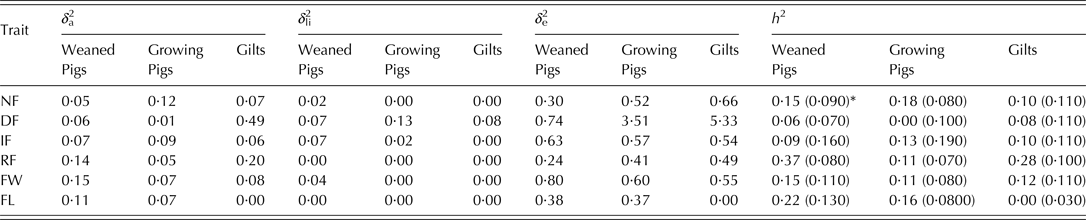
The estimated variances of the random animal effect (additive genetic effect), random litter effect and the residual effect are shown in Table 2. In weaned pigs, the proportion of the total variance explained by litter effects ranged from 0 to 0·08. In growing pigs, this proportion was lower (0–0·04). The behaviour of breeding gilts was not influenced by the litter effect.
Heritabilities and variances of the animal effect (δa2 = additive genetic variance), the litter effect (δli2 = permanent environmental effect) and residual effect (δe2) for the behavioural traits (number of fights: NF; duration of fights: DF; initiated fights: IF; received fights: RF; fights won: FW; fights lost: FL) at different ages (Weaned Pigs: NF, DF, FW, FL n = 1111 and IF, RF n = 778; Growing Pigs: n = 446; Gilts: n = 279)
* Standard errors in brackets.
Heritabilities
For weaned pigs, the heritabilities ranged from 0·06 for DF to 0·37 for RF (Table 2). Heritabilities for NF, FW and FL were similar (0·15–0·22). In growing pigs, the heritabilities did not differ substantially between the recorded behavioural traits (0·11–0·18), apart from DF, which was not heritable. The heritabilities for the breeding gilts ranged between 0·01 (FL) and 0·12 (FW). All heritabilities were estimated with high standard errors in all age groups for most traits.
Correlations between behavioural traits within different age groups
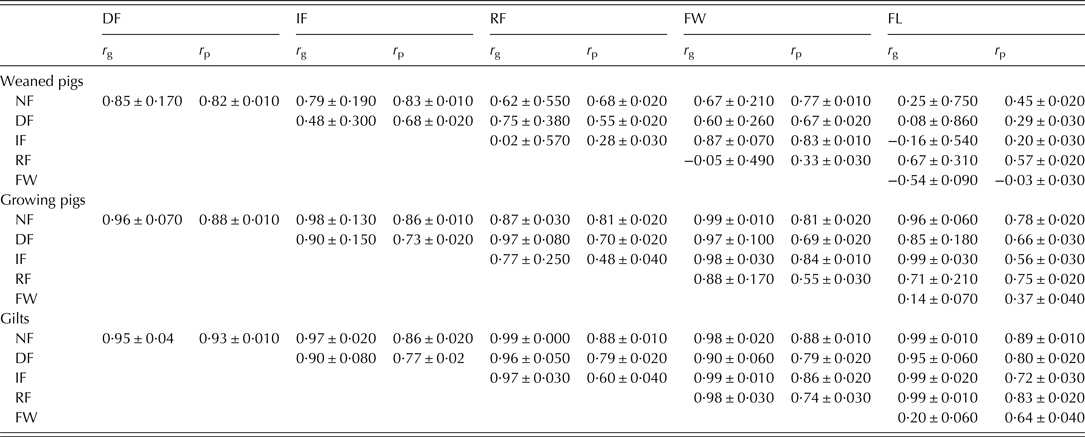
The phenotypic and genetic correlations between the behavioural traits are shown in Table 3. Nearly all traits were phenotypically and genetically correlated with NF at all ages except for NF and FL in weaned pigs. Initiated fights were highly correlated with the trait FW and RF was highly correlated with FL and DF. Small correlations were found between the traits IF and RF. There was a negative genetic relationship between FW and FL for the weaned pigs. The correlations for the growing pigs and breeding gilts between the recorded traits were high for almost all traits.
Genetic (rp) and phenotypic (rp) correlation of different age stages between the behavioural traits (number of fights: NF; duration of fights: DF; initiated fights: IF; received fights: RF; fights won: FW; fights lost: FL) within the three stages of life
Correlations within behavioural traits between different age groups
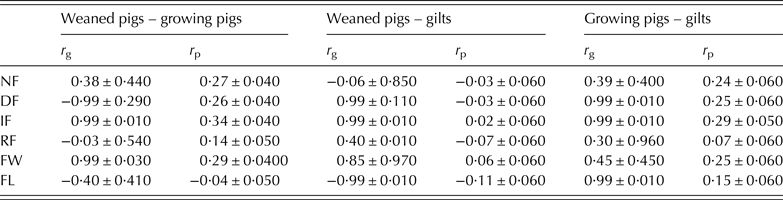
Table 4 shows the phenotypic and genetic correlations between the three age groups. The phenotypic correlations between the age groups were low. The coefficients ranged from –0·04 to 0·34 within the different traits. The lowest values were found for weaned pigs and breeding gilts, demonstrating that the correlations decreased with increasing age differences between the groups. The genetic correlations between the age groups differed from the phenotypic correlations and varied widely between the traits (r g = −0·06 to 0·99). Very high genetic correlations were estimated for the traits DF, IF and also for some estimations of the traits FW and FL; lower values were obtained for RF and NF. In case of DF and FL, genetic correlations ranged between 0·99 and −0·99 (e.g. for DF it was −0·99 for weaned pigs and growing pigs but it was 0·99 for the other two age comparisons).
Genetic (rg) and phenotypic (rp) correlations for the behavioural traits (number of fights: NF; duration of fights: DF; initiated fights: IF; received fights: RF; fights won: FW; fights lost: FL) between different age stages
DISCUSSION
Fixed and random effects
Despite intensive training on different video sequences, the observers had a significant influence on the recorded traits of agonistic interactions in weaned pigs. This significant effect of the observer implies the necessity for the definition of agonistic interaction to be absolutely clear for all observers and the inter-observer reliability to be continuously verified during the complete analysis of the videos. Linear contrasts between the three observers showed that one had significantly different results compared with the observations of the others. The influence of the divergent observer on the present results, especially on the heritabilities, was tested by excluding the animals observed by this person (n = 348 animals). The estimated heritabilities without these data did not differ from the presented results.
Pigs raised by their own dam had more agonistic interactions at weaning and rehousing in the growing building and were more aggressive than cross-fostered pigs. This effect has been seldom documented in the literature. D'Eath (Reference D'Eath2004) stated that the pigs that had been socialized before first mixing with unacquainted pigs consistently showed more aggressive behaviour. These pigs established the rank order faster due to the learning of social behavioural skills at an earlier age (D'Eath Reference D'Eath2005). However, the experimental design of allowing the interaction of complete litters before weaning (D'Eath Reference D'Eath2004) is different to cross-fostering, although a socializing effect is part of both. The cross-fostered pigs learned their social behaviour very early on, as well as how to react when mixed with unacquainted pigs. Therefore, they did not fight very often to establish a rank order. The non-cross-fostered pigs did not have this experience in the first mixing and thus obtained fewer social skills. This might be one explanation for the cross-fostering effect. Furthermore, it is also possible that the aggressiveness of cross-fostered pigs at weaning was reduced by being repeatedly beaten in fights when introduced to the litter in early life. Experiences in early life and success or failure in aggressive interactions had long-lasting effects on the animals (D'Eath Reference D'Eath2004). In commercial pig production, the heaviest animals are used for cross-fostering. The weight at weaning and rehousing in the growing building of the cross-fostered and non-cross-fostered animals was compared in the present study to avoid an effect of the weight of the pigs on the cross-fostering effect. Here, no significant differences in weight were found. The cross-fostering had no influence on the behaviour of the breeding gilts. Another point which should be discussed in further studies on the cross-fostering of pigs is how pigs that have never previously been introduced to foreign pigs react. In the present study, a distinction between these pigs and others was not possible.
In the literature, different results can be found regarding the influence of the weight of the pigs on the agonistic behaviour. Litten et al. (Reference Litten, Drury, Corson, Lean and Clarke2003) and Turner et al. (Reference Turner, Farnworth, Mendl, Erhard and Lawrence2011) stated that there is an influence of weight on the behaviour of the pigs. Heavier pigs were more active and more dominant in their studies. In contrast, Fels & Hoy (Reference Fels and Hoy2013) obtained no differences between agonistic interactions in groups sorted into light and heavy pigs. The present results do indeed show an influence of weight, which means that the heavier the pigs were, the more aggressive they were. This was observed in weaned pigs as well as in growing pigs. An explanation might be the ability of the heavier pigs to protect their own rank position from the last group of conspecifics (e.g. in the flatdeck) against the new and unacquainted pigs after remixing (e.g. in the growing building). This would support earlier observations that the previous dominance rank has a prolonged effect on the rank position in later groups (Otten et al. Reference Otten, Puppe, Stabenow, Kanitz, Schön, Brüssow and Nürnberg1997; D'Eath Reference D'Eath2004). The present results also show that the heavier pigs initiated more fights, which also could be explained by the consciousness of the pigs of their own rank position. The influence of weight decreased with the age of pigs. The variation in weight between the breeding gilts was lower (10%) than between the growing pigs (15%) and weaned pigs (20%), which could explain why weight had no impact on the agonistic interactions in breeding gilts.
The random litter effect explained small parts of the whole variance in weaned and growing pigs. The older the pigs were, the smaller the influence of the litter became and therefore the highest proportions of litter variance were found for the weaned pigs. In contrast, the behaviour of the breeding gilts was not affected by the litter component. The litter effect describes the maternal genetic and maternal environmental effect (Roehe et al. Reference Roehe, Shrestha, Mekkawy, Baxter, Knap, Smurthwaite, Jarvis, Lawrence and Edwards2009). Stukenborg et al. (Reference Stukenborg, Traulsen, Stamer, Puppe, Presuhn and Krieter2012) stated that the behaviour of the pigs was influenced by pre-weaning experiences, illustrated by the litter effect. Events before farrowing could also substantially influence the development of the brain and the behaviour of the animals (Champagne & Curley Reference Champagne and Curley2005). D'Eath & Lawrence (Reference D'Eath and Lawrence2004) stated that pigs from larger litters were more aggressive compared with smaller litters. This has also been explained by competition between piglets for a teat, or in general for a limited food resource (Fraser Reference Fraser1975; Fraser & Jones Reference Fraser and Jones1975). The influence of the litter effect in the present study was tested to determine whether there were differences due to the litter size and the behaviour of the pigs. It was shown that pigs from larger litters tended to have more agonistic interactions (P ⩽ 0·1) and therefore, it might explain part of the random litter effect.
Heritabilities
The heritabilities of NF, IF and FW were nearly the same for all age groups but differed for RF and FL across ages. Stukenborg et al. (Reference Stukenborg, Traulsen, Stamer, Puppe, Presuhn and Krieter2012) found different heritabilities between the traits and ages. They explained the differences via enhanced playing behaviour of the weaned pigs, which affected the ability to record real fighting in this age group. Hence, the results of the present study contradict expectations that the heritabilities in weaned pigs are (normally) lower than in growing pigs and breeding gilts. One explanation might be offered by Silerova et al. (Reference Silerova, Spinka, Sarova and Algers2010), who found that fighting and playing behaviour in weaned pigs could not be separated from each other. In the studies of Turner et al. (Reference Turner, Roehe, Mekkawy, Farnworth, Knap and Lawrence2008, Reference Turner, Roehe, D'eath, Ison, Farish, Jack, Lundeheim, Rydhmer and Lawrence2009), heritabilities of 0·08 and 0·46 were estimated for agonistic interactions with weaned pigs. The heritabilities also had a wide range, which is in accordance with the heritabilities found in the present study. Løvendahl et al. (Reference Løvendahl, Damgaard, Nielsen, Thodberg, Su and Rydhmer2005) estimated heritabilities for the agonistic behaviour of sows with values of 0·17–0·24 for IF and with 0·04–0·06 for RF. These results agreed with the heritabilities of the breeding gilts, which were also low for traits describing the aggressions received.
The literature suggests that agonistic interactions are related to reproductive traits. Tönepöhl et al. (Reference Tönepöhl, Appel, Voß, König Von Borstel and Gauly2013) showed that sows which initiated more fights had more piglets in total and more piglets born alive. However, sows with fewer agonistic interactions cared better for their offspring (Løvendahl et al. Reference Løvendahl, Damgaard, Nielsen, Thodberg, Su and Rydhmer2005). Therefore, it seems that the traits NF (h 2 = 0·10–0·18) and IF (h 2 = 0·09–0·13) should be the priorities for improvement and will be discussed further in later publications.
Correlations between behavioural traits within different age groups
The NF trait showed high genetic and phenotypic correlations with all traits and within all age groups except for NF and FL in weaned pigs. Turner et al. (Reference Turner, Roehe, Mekkawy, Farnworth, Knap and Lawrence2008) estimated genetic correlations between number of fights and initiated fights of 0·79 in weaned pigs. These results are in accordance with the present findings. In weaned pigs, there were high genetic correlations between IF and FW as well as between RF and FL. Lower correlations were calculated between, in particular, IF v. FL and RF v. FW. Weaned pigs who initiated fights were more often the winners and the pigs which received most of the fights were more often the losers. The phenotypic correlations were similar for growing pigs and breeding gilts, but the genetic correlations were almost all high. The genetic correlations must be treated with caution since the small number of pigs in these two age groups and the low heritabilities can lead to an overestimation of the genetic relationships. The low estimates for the correlations between FL and FW could be explained by the statements of Rushen & Pajor (Reference Rushen and Pajor1987) that there is a balance between offensive and defensive interactions in pigs. These present results agree with the parameter estimation of Stukenborg et al. (Reference Stukenborg, Traulsen, Stamer, Puppe, Presuhn and Krieter2012) and Turner et al. (Reference Turner, Roehe, Mekkawy, Farnworth, Knap and Lawrence2008). They also found low correlations between the numbers of initiated and received fights. Another explanation for the correlations might be that pigs with standoffs were not considered in the traits FL or FW.
Correlations within behavioural traits between different age groups
Some contradicting genetic correlations were estimated between the age groups, which may be due to the small sample size and the small heritabilities for these traits. For the traits DF and FL between the ages, the estimations lead to no reliable results. Phenotypic correlations decreased as the difference in age increased. These results were in accordance with Stukenborg et al. (Reference Stukenborg, Traulsen, Stamer, Puppe, Presuhn and Krieter2012), who estimated phenotypic correlations between 0 and 0·47. The relationship also increased with smaller time differences between the age groups. This is not in accordance with the statements of Clark & D'Eath (Reference Clark and D'Eath2013), who argued that aggressive behaviour is a stable and consistent temperament trait of the individual pig. The genetic correlations were again much higher than the phenotypic and showed no general trend between the age groups.
CONCLUSION
The agonistic interaction of pigs at different ages showed that cross-fostering is an important effect, especially on the behaviour of weaned and growing pigs. Thus, cross-fostered animals are less aggressive than weaned and growing pigs. Hence, one explanation might be socialization in the early life of pigs, which leads to less aggressive behaviour in further mixing situations, whilst on the other hand the cross-fostered pigs may be less aggressive due to the decisive experiences of repeated defeats in fights after having been introduced to new litters. The agonistic interactions in weaned and growing pigs cannot be considered without regard to the weight of the pigs. The heavier the pigs, the more aggressive they are. The most important traits to describe agonistic behaviour in pigs are thus the number of fights and number of initiated fights with low to moderate but consistent heritabilities for all age groups. Also, the correlations between and across traits and age levels suggest that the number of fights and the number of initiated fights are the most suitable traits for the assessment of the agonistic interactions and the aggressiveness of pigs and should therefore be considered in further studies.
We thank the network of Phänomics for the financial support of this study.