





Introduction
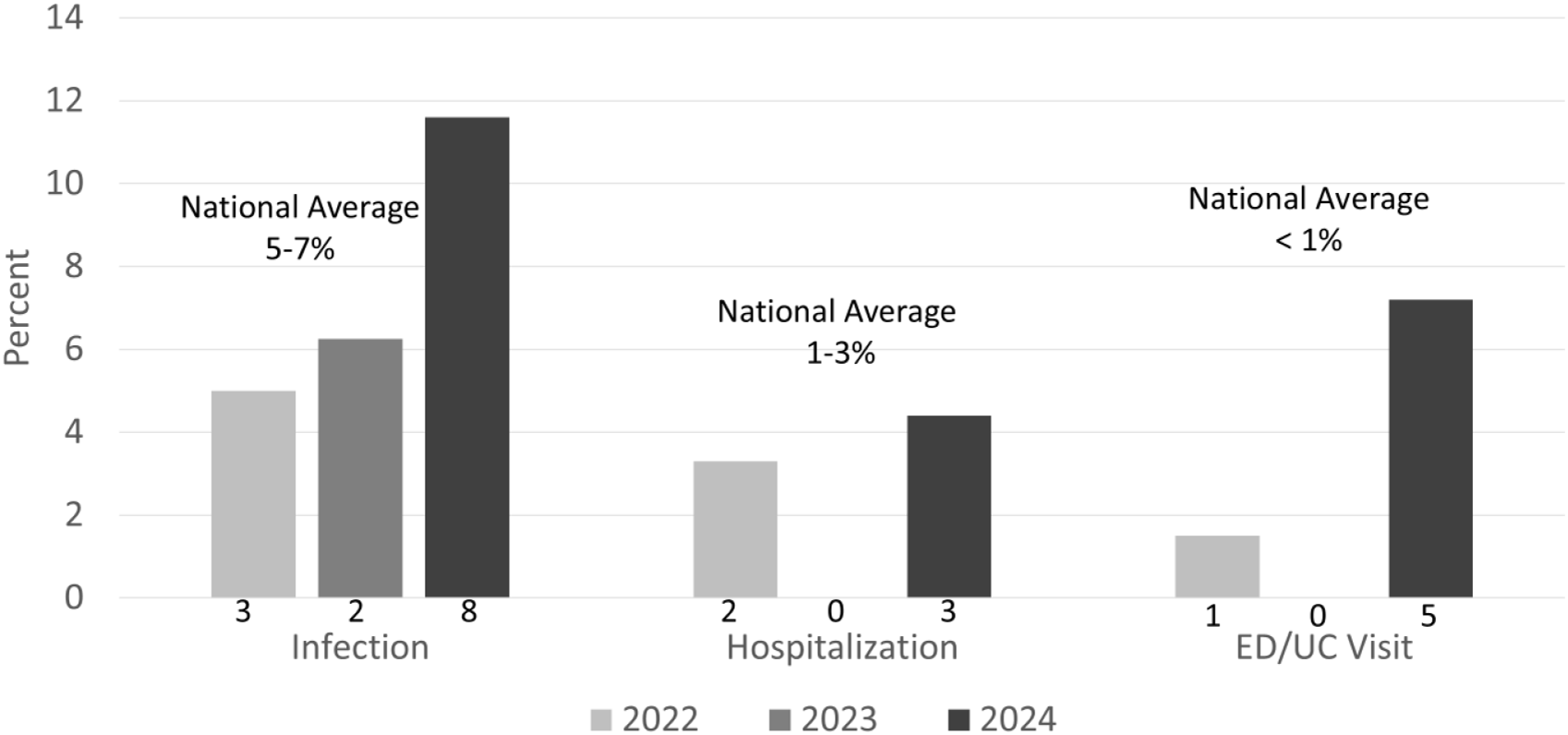
Transrectal ultrasound-guided (TRUS) prostate biopsy procedures are associated with a 5–7% postbiopsy infection risk and a 1–3% hospitalization rate. Reference Liss, Ehdaie and Loeb1–Reference Shoag, Gaffney and Pantuck2 Transperineal prostate biopsies (TPPB) have been reported to significantly reduce infectious complications. Reference Jalal, Abideen and Siddiqui3–Reference Hu, Assel and Allaf4 In 2024, Cambridge Health Alliance (CHA), a community-based, public healthcare organization serving Boston’s metro-north region experienced an increase in TRUS prostate biopsy infections, hospitalizations and medically attended visits (Figure 1). Infections (11.6%), hospitalizations (4.4%) and medical-attended visits (7.2%) exceeded the nationally reported rates.
Transrectal prostate biopsy infection, hospitalization and emergency department or urgent care visit rates at Cambridge Health Alliance in 2022–2024. The number displayed below the bar represents the number of cases.

Among a smaller cohort of patients (N = 31) undergoing TPPB by one urologist, there were no postprocedure infections in 2024. The healthcare epidemiologist engaged surgical and urology leadership to explore the feasibility of transitioning to TPPB to improve patient safety, mitigate infections and overcome the emerging challenge of ineffective oral antimicrobial prophylaxis due to fluoroquinolone and cephalosporin-resistant gram-negative enteric bacteria.
Methods
In January 2025, CHA began exclusively performing TPPB. Staff training and support were provided prior to the transition via training modules and hands-on learning. Procedures were performed in an operating room or procedure suite using both local anesthetic and sedation. Patients were placed in lithotomy position for this procedure. The perineum was prepped with ChloraPrepTM and draped. An ultrasound was placed transrectally to localize the prostate. Using ultrasound guidance, bilateral prostate blocks were administered using 2% lidocaine. Once local anesthesia was administered, the biopsies were obtained transperineally with ultrasound guidance, some with MRI fusion. Patients were given one dose of preoperative cefazolin. Postprocedure surveillance for infection, medically attended visits, and hospitalization was performed by medical record review for all cases through the 3–4-week postprocedure visit. IRB review was waived for this quality improvement project.
Results
Prior to the full transition to TPPB, 3 TRUS biopsies were performed in January 2025, resulting in 2 infections requiring hospitalization. Another TRUS case was aborted due to patient discomfort. Since the full transition to TPPB, among 94 procedures in calendar year 2025, there were no infections. Among a total of 124 TPPB procedures in 2024–2025, there were no infectious complications.
Discussion
The results of our observational and quality improvement program suggest that TPPB is safer for our patients. CHA eliminated postprocedure infections, medically-attended visits, and hospitalizations following a complete transition to TPPB. The transperineal approach does not introduce resistant coliform bacteria into the genitourinary system. The procedure also circumvents concerns related to increasing antimicrobial resistance among patients undergoing TRUS biopsies where antibiotic prophylaxis was proving to be increasingly ineffective. In addition, there is accumulating evidence that the TPPB approach does not require broad-spectrum antibiotic prophylaxis. Reference Jacewicz and Rud5 CHA has opted for anesthesia support to ensure adequate sedation in addition to local anesthesia. Clinical guidelines from the American Urological Society have not stated a preference for TPPB over TRUS due to the lack of high-level evidence and conflicting data confounded by retrospective, single-center study designs and homogenous cohorts limiting generalizability. Reference Mian, Feustel and Aziz6 A more recently published systematic review and meta-analysis of randomized control trials and prospective studies comparing local anesthetic TPPB to TRUS biopsies demonstrated lower infection and hematuria rates, comparable pain scores and urinary retention rates, with higher cancer detection rates. Reference Calpin, Hehir and Alzayer7 Targeted prophylaxis guided by rectal cultures and susceptibility data can reduce infections associated with TRUS biopsies but is challenging to implement. Reference Hu, Assel and Allaf4 Other studies cite more pain and logistical challenges associated with TPPB. Reference Bryant, Marian and Williams8,Reference Jalal, Abideen and Siddiqui3 Involving anesthesia in our workflow and utilizing a new procedure room has enabled CHA to adequately address patient comfort, anxiety, and eliminate access challenges.
In our multicultural population, TPPB eliminated postprocedure prostate biopsy infections and hospitalizations in 2025. We will be exploring eliminating antibiotic prophylaxis for TPPB in the future. TPPB circumvents increasing antimicrobial resistance which previously resulted in ineffective antibiotic prophylaxis for TRUS prostate biopsy procedures. Healthcare epidemiologists and antimicrobial stewards should collaborate with key stakeholders at their organization to evaluate the morbidities associated with prostate biopsy procedures and modify their approach accordingly.
Financial support
None.
Competing interests
None.

 Open access

