




Crossref Citations

This article has been cited by the following publications. This list is generated based on data provided by Crossref.
Fenollar-Cortés, Javier
and
Watkins, Marley W.
2019.
Construct validity of the Spanish Version of the Wechsler Intelligence Scale for Children Fifth Edition (WISC-VSpain).
International Journal of School & Educational Psychology,
Vol. 7,
Issue. 3,
p.
150.
Otero, Inmaculada
Salgado, Jesús F.
and
Moscoso, Silvia
2022.
Cognitive reflection, cognitive intelligence, and cognitive abilities: A meta-analysis.
Intelligence,
Vol. 90,
Issue. ,
p.
101614.
Mieres-Chacaltana, Manuel
Salvo-Garrido, Sonia
Dominguez-Lara, Sergio
Gálvez-Nieto, José Luis
and
Alarcón-Bañares, Paula
2023.
Psychometric Validation of the Adult Prosocialness Behavior Scale in a Professional Teaching Context.
Behavioral Sciences,
Vol. 13,
Issue. 9,
p.
761.
Gálvez-Nieto, José Luis
Salvo-Garrido, Sonia
Domínguez-Lara, Sergio
Polanco-Levicán, Karina
and
Mieres-Chacaltana, Manuel
2023.
Psychometric properties of the Teachers’ Sense of Efficacy Scale in a sample of Chilean public school teachers.
Frontiers in Psychology,
Vol. 14,
Issue. ,
Gálvez-Nieto, José Luis
Trizano-Hermosilla, Ítalo
and
Polanco-Levicán, Karina
2024.
Psychometric Evaluation of the School Climate and School Identification Measure—Student on Chilean Students: A Bifactor Model Approach.
Children,
Vol. 11,
Issue. 1,
p.
87.
Raykov, Tenko
DiStefano, Christine
and
Ransome, Yusuf
2026.
An Omega-Hierarchical Extension Index for Second-Order Constructs With Hierarchical Measuring Instruments.
Educational and Psychological Measurement,
Vol. 86,
Issue. 2,
p.
345.
Relying on work described by Jackson (Reference Jackson2003), Ree, Carretta, and Teachout (Reference Ree, Carretta and Teachout2015) recommended researchers use the first unrotated principal component associated with a principal components analysis (PCA) to estimate the strength of a general factor. Arguably, such a recommendation is based on rather old work. Furthermore, it is not a method that can be relied on to yield an accurate solution. For example, it is well known that the first component extracted from a correlation matrix of the Wechsler intelligence subtests is biased toward the verbal comprehension subtests (Ashton, Lee, & Vernon, Reference Ashton, Lee and Vernon2001).
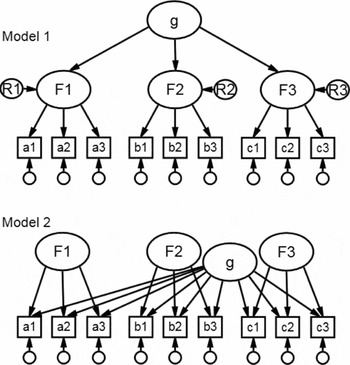
In contrast to the first unrotated principal component, it is arguably important for industrial–organizational researchers to be aware of the options of estimating the strength of a general factor via structural equation modeling (SEM). Within the context of multidimensional models, a general factor can be specified within a higher order model (see Model 1, Figure 1) or as a first-order breadth factor represented within a bifactor model (see Model 2, Figure 1). Based on either a higher order model or a bifactor model solution, the strength of a general factor can be estimated via an attractive coefficient known as omega hierarchical (ωh; Zinbarg, Revelle, Yovel, & Li, Reference Zinbarg, Revelle, Yovel and Li2005). Coefficient ωh represents the strength of a general factor on a standardized metric and ranges from .00 to 1.0. It is essentially the ratio of common variance to total variance and can be estimated relatively easily in most SEM programs (see Gignac, Reference Gignac2014b, for step-by-step instructions). A coefficient ωh of .80, for example, would imply that the general factor accounts for 80% of the total variance in the data. Gignac and Watkins (Reference Gignac and Watkins2013) found that the general factor associated with the Wechsler Adult Intelligence Scale–IV (Wechsler, Reference Wechsler2008) was associated with a very large ωh of .86. Thus, Ree et al. are correct to contend that there are some very large general factors that can be found in the literature. I suspect the general factor of personality discussed by Ree et al. would be very weak by comparison, however, when modeled and estimated appropriately via ωh (see Revelle & Wilt, Reference Revelle and Wilt2013, for example).
The two most common models used to estimate general factor variance in structural equation modeling (Model 1 = higher order model; Model 2 = bifactor model). F = factor; R = residual; g = general factor; a, b, and c = observed indicators.
What makes a model-based coefficient such as ωh particularly attractive is that it is derived from either a higher order model or a bifactor model, both of which partition the various sources of common variance into separate terms. For example, in the context of the Wechsler scales, the substantial common variance associated with verbal subtests can be “controlled” through the specification of a nested factor in a bifactor model (say, the “F1” term in Model 2). Alternatively, a higher order model would specify the unique common variance associated with the verbal subtests as a first-order factor residual (say, the “R1” term in Model 1).Footnote 1 As the verbal common variance is associated with its own term, it does not contaminate the general factor. Consequently, the strength of the general factor can be estimated accurately via ωh.
Although the higher order model and the bifactor model have some similarities, there are at least two key differences. First, the higher order model imposes a proportionality constraint on the association between the observed variables and the latent variablesFootnote 2 (Schmiedek & Li, Reference Schmiedek and Li2004). For this reason, the bifactor model tends to fit better than does the competing higher order model (Gignac, Reference Gignac2008; Reise, Reference Reise2012). Second, because of issues relevant to identification, only the bifactor allows for the simultaneous estimation of effects associated with all of the latent variables (general factor and nested factors) and a dependent variable of interest (Schmiedek & Li, Reference Schmiedek and Li2004). Across a number of considerations, the bifactor model may be considered preferable in the context of estimating the effects of a general factor and competing specific factors on a dependent variable (Brunner, Reference Brunner2008). Whether one prefers a higher order or a breadth conceptualization of a general factor is irrelevant, as omega hierarchical can be applied to both. A similar coefficient, omega specific (ωs; Reise, Reference Reise2012), can also be used to estimate the strength of secondary factors independently of the effects of the general factor (see Gignac, Reference Gignac2014b, for an accessible demonstration).
The estimation of the strength of a general factor is not a purely statistical or psychometric consideration, as interesting theories can be tested with such information. For example, Gignac (Reference Gignac2014a) tested the dynamic mutualism theory of general intelligence by plotting the strength of the general factor (ωh) across the ages of 2.5 to 90 years. The results suggested that the strength of the general factor (g) is largely constant across age, which was considered a failure to support the dynamic mutualism theory of g (van der Maas et al., Reference van der Maas, Dolan, Grasman, Wicherts, Huizenga and Raijmakers2006). Almost undoubtedly, many more useful hypotheses could be tested with ωh across many disciplines in psychology. Thus, in line with Ree et al., researchers are encouraged to consider the strength of a general factor in their data. However, I would urge all researchers to decline the option of the first component derived from a PCA, in favor of a sophisticated method such as ωh.