INTRODUCTION
Across the literature, the desire of patients with life-threatening illness to seek spiritual care in addition to standard healthcare has been varied (Murray et al., Reference Murray, Kendall and Boyd2004). However, this ambiguity has largely been created by the reluctance of patients to take action in demanding additional care. Moreover, patients typically view adding spirituality to their treatment as a burden on their doctors because it is a role outside the sphere of their professional expertise (Murray et al., Reference Murray, Kendall and Boyd2004). These views often lead to decreased distress among patients with life-threatening illness. To minimize distress and address the sometimes hidden concerns of patients, spirituality needs to be better incorporated into supportive care plans. While spirituality itself is not always discussed by patients with life-threatening illness, even within their own families, a patient's knowledge that the care team is available to discuss these matters might help a patient engage important additional resources to cope with their condition (MacAskill & Petch, Reference MacAskill and Petch1999).
According to Murray and colleagues (Reference Murray, Kendall and Boyd2004), 76% of those with life-threatening illness are cognizant of some form of spirituality in their lives. Individuals who experience life-threatening illness may become aware of their spirituality through self-reflection. One definition of spirituality indicates that it is an inherent quality in all people that drives the search for meaning and purpose in life (Hermann, Reference Hermann2001; Hampton et al., Reference Hampton, Hollis and Lloyd2007). Spirituality can manifest itself in many ways, including finding meaning and purpose in life, connecting with family and friends, nature, art, music, and sometimes creating a relationship with God (Albaugh, Reference Albaugh2003; Hill et al., Reference Hill, Pargament and Hood2000; Prince-Paul, Reference Prince-Paul2008).
While spirituality and religion appear to be similar in some ways, there are a few important distinctions. One is that spirituality represents values and/or beliefs that lend meaning and purpose to life (Woll et al., Reference Woll, Hinshaw and Pawlik2008). These transcendent values represented by spirituality have been described as being more inclusive and universal because these values originate from subjective experiences both within and outside of traditional religious customs (Elkins et al., Reference Elkins, Hedstrom and Hughes1988; Vaughan et al., Reference Vaughan, Wittine, Walsh and Shafranske1998; Moberg, Reference Moberg and Moberg1979; Hiatt, Reference Hiatt1986; Reed, Reference Reed1987; Ley & Corless, Reference Ley and Corless1988). These subjective experiences have led some researchers, including Muldoon and King (Reference Muldoon and King1995), to define spirituality as a way in which people understand and live their lives in pursuit of meaning and purpose. Others have theorized that spirituality also includes a state of peace and harmony that is capable of providing answers to ultimate questions regarding the meaning of life, illness, and death (Hungelmann et al., Reference Hungelmann, Kenkel-Rossi and Klassen1985; Highfield & Cason; Reference Highfield and Cason1983; Brady et al., Reference Brady, Peterman and Fitchett1999). Moreover, individuals can specifically employ spirituality to live through difficult situations in their lives (Brewer, Reference Brewer and Moberg1979). The most accepted definition of spirituality across the literature is “the aspect of humanity that refers to the way individuals seek and express meaning and purpose, and the way they experience their connectedness to the moment, to self, to others, to nature, and to the significant or sacred” (Puchalski et al., Reference Puchalski, Ferrell and Virani2009). Ultimately, if individuals recognize their life-threatening illness as an opportunity for spiritual growth, those individuals who have access to spirituality through meaning, purpose, connections with others, or connections with a higher power will have the spiritual resources necessary to adjust to adverse circumstances (Nadarajah et al., Reference Nadarajah, Berger and Thomas2013).
Some studies suggest that spiritual resources provide invaluable functions in adjustment to life-threatening illness, such as maintaining confidence, providing comfort, reducing distress, increasing peace, and fostering an upbeat attitude (Coughlin, Reference Coughlin2008). Although the experience of having a life-threatening illness taxes an individual's resilience and ability to cope, it can also lead to positive adaptation and increased ability to thrive.
While most subjective illness-related experiences are reported as negative in nature, some subjective changes in response to illness can lead to personal growth (Brennan, Reference Brennan2001). Observation of subjective changes in patients by the clinical staff at the pain and palliative care service (PPCS) at the NIH Clinical Center and other palliative care providers has demonstrated many times that some individuals do make positive adjustments to life-threatening illness. The PPCS initiated a research program to examine the nature of both substantial relief from suffering and personal positive change (“healing”) among patients who have had life-threatening conditions. The research program began with two qualitative studies that employed a semistructured interview process to elucidate the process by which a very high degree of healing occurred in patients who had experienced a life-threatening illness (Skeath et al., Reference Skeath, Norris and Katheria2013).
The first of these studies found that cancer survivors have adjusted to their life-threatening illnesses by holding onto hope, compensating for losses, and actively maintaining their personal lives through a process of experiential learning. This learning process allowed individuals to create or discover opportunities that might lead to maintaining or gaining some enjoyment of life even as suffering continued during the course of their cancer and recovery. When participants' new ways of functioning in the context of cancer were also repeatedly and satisfyingly applied outside the context of cancer, this was termed positive, life-transforming change (Skeath et al., Reference Skeath, Norris and Katheria2013). A second study was performed to extend our research program to patients who had survived life-threatening cardiac conditions.
The main mission of the PPCS is to provide palliative and supportive care to all patients at the NIH Clinical Center and to train physicians and nurses in all phases of this care. One of the most important components of palliative and supportive care is facilitating all aspects of healing: physical, psychosocial, and spiritual. In this article, we examine excerpts from PPCS research interviews that pertain to spirituality, purpose, and meaning to identify clinically relevant themes. We then discuss how these themes can be applied in developing effective palliative and supportive care plans that are well tailored to the needs of patients in relation to life purpose and meaning. This connection between research and clinical practice is the basis of evidence-based medicine in palliative and supportive care.
METHOD
Recruitment
Participant recruitment for the PPCS research on healing was directed toward finding participants whose experience best represented the phenomenon of interest (Wertz, Reference Wertz2005). To find the appropriate participants for the investigation, survivors of life-threatening cancer and cardiac conditions were recruited in the greater Washington, DC area using purposive sampling (Skeath et al., Reference Skeath, Norris and Katheria2013). Cancer survivors were recruited from two sites: a nonmedical holistic services organization and a research hospital. Cardiac survivors were recruited from a community hospital setting.
Procedure
Prior to their inclusion in the PPCS research studies, participants signed an IRB-approved informed consent and subsequently underwent three phases of screening. The first screening measured current distress level. This visual analog scale was an unvalidated measure that was quite similar to the visual analog Distress Thermometer (DT) instrument (Jacobsen et al., Reference Jacobsen, Donovan and Trask2005; Holland & Bultz, Reference Holland and Bultz2007; Holland et al., Reference Holland, Andersen and Breitbart2007). If an individual scored 4.0 or above (on a scale of 0 to 10) on the DT, the session would end, and the interviewer would refer the individual to a social worker or spiritual counselor. If individuals scored from 3.0 to 4, they were excluded from the study in an attempt to add an extra margin of safety so that even a moderate level of distress did not influence the interview process. The second screening involved subjective experiential criteria screening. Participants were asked to briefly list and then self-rate at least one positive subjective change they had experienced in relation to their cancer or cardiac event. If the potential participants self-reported one to three of their positive subjective change(s) as life transforming and lasting more than six months, they were eligible to take part in the study. The third and final screening was to establish sufficient speaking volume and clarity for audio recording. There were no screening failures among those who expressed an interest in participating in the study.
Participants who passed the screening criteria then began a private interview session that lasted between 30 and 115 minutes. This session involved a semistructured interview oriented toward eliciting the sequence of experiences and decisions that led to the positive life-transforming change that the participant had listed during the screenings.
RESULTS
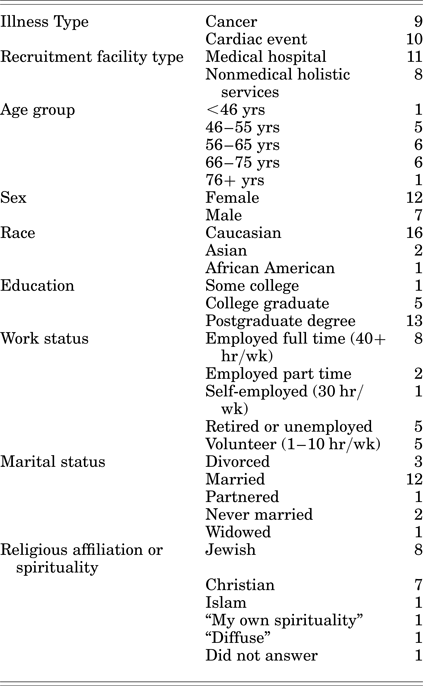
Some 19 participants (9 cancer survivors and 10 cardiac rehabilitation patients) were recruited in the two previous research studies from which our interview excerpts are drawn. The sample consisted of more females (n = 12) than males (n = 7). Participants were primarily Jewish (n = 8) and Christian (n = 7), with four being Catholic and 2 Presbyterian; one participant did not report a denomination. Approximately half the participants (n = 11) were employed. Eight participants were employed full time, while three worked part time. Almost all the participants (n = 18) had graduated from college. Many of the participants (n = 12) were married, while three were divorced. The demographic data are presented in Table 1.
Demographics of participants

This is a demographics table that reveals background information on the cancer survivors interviewed for our study.
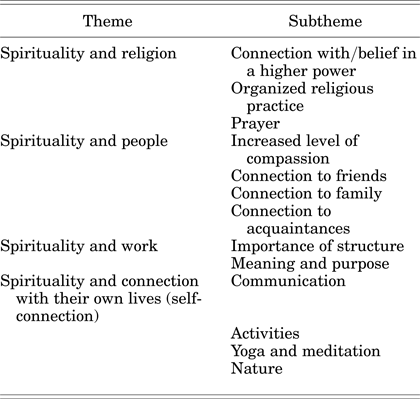
Life-transforming positive change occurred for participants in the context of life-threatening illnesses such as cardiac events and cancer. Many participants found that spirituality helped them adjust to their life-threatening illnesses. As can be seen from Table 2, participants utilized spirituality in a variety of contexts: forming greater connections with a higher power, people, their work, and their own lives. These spiritually related connections gave participants greater meaning and purpose.
Themes in spirituality essential for adjustment to life-threatening illness

This table summarizes the themes and subthemes that enabled participants to access spirituality and positively adjust to their life-threatening illnesses.
Spirituality and Religion
Participants found spirituality through their religious practice and connection to a higher power. In many instances, participants' faith and connection to a higher power strengthened after a life-threatening illness. One cardiac event survivor exemplified this enhanced connection with a higher power:
More prayer. I've always been a believer, but I felt closer somehow, than prior to the event, and probably had more dialogue between myself and God. Also, I was raised in the Baptist church, and over the last six months I've been going through the RCIA process with the Catholic Church. Been attending for a number of years, over ten years, but have never officially taken that step.
Another participant, a cancer survivor, found that she was able to connect to a higher power outside of organized religious practice:
I pray as I walk. I talk, but I'm praying and talking to God. I'm very, very spiritual. It's not that I didn't have to carve out a place for it or anything. I just turn to God all the time, and then I can say, “Look, this is not all that important, or if it is, I know You'll just work it out for me.”
This participant and many others believed that they were able to rely on a higher power to get through adverse circumstances. Another cardiac event survivor also indicated that this strength was gained from a connection with a higher power:
I tend to go less—less, but I'm still involved. I'm still involved, but, spiritually, I still believe in God. As a matter of fact, more so maybe because I've— It's grace that I survived. I mean I feel somebody—somebody decided it wasn't my time.
Spirituality and People
Participants also found spirituality through connection with friends, family, and acquaintances. These connections provided participants with a number of benefits, including meaning and purpose in life, and a greater level of compassion toward others. One cardiac event survivor was one of many who experienced spiritual growth through a connection with others:
Well, how I would say I've grown on a spiritual level is that I recognize all of these things are spiritual tools, and I see the inner connection of all these different expressions of spirituality. You know what I mean? I get it. This is just who I am in the context of my life, right? I feel that I have moved toward a different level of compassion toward other humans. That's what I would really say. I feel that I have deepened my compassion. I'm able to speak to people in a way that allows me to connect with them at that level.
Similarly, a cancer survivor also experienced a deepening of relationships by becoming more aware of others. This awareness took on greater meaning and purpose as she attempted to make the most of her time:
There's been a deepening of my love for my friends. I'm aware of the shortness of time. So I take time to be with my friends, to be conscious of their lives and what they're going through, which is related to having compassion for others, which is another one here. And to not make judgments without really knowing because there's no way to know what's really going on in somebody's life and to judge what someone has said on the spur of the moment or something that may appear to be negative. [Negativity] may have nothing to do with me and may have everything to do with an issue, a challenge, something that's going on in their lives. So that's again meaningful wisdom, compassion, you know—they're all interrelated!
Some participants decided to find closer, more meaningful relationships to get the most out of their lives. One cancer survivor demonstrated this by defining what he was looking for in a friend and by pointing out that he found meaning and purpose in his life from his family:
I think I make different choices in terms of friends. I recognize how fragile life is, and I try to be around people that help me feel more whole. And I think that's my definition of friendship—somebody who can reciprocate the caring, and aren't self-absorbed, and I can care for them and they can look out for my best interest—where most people are really caught up in themselves, they're trying to enhance their sense of importance, they're trying to jump lanes, social class lanes. They're trying to reach some level of grandiosity, some status that they're searching for. Those are the people that I don't want to be around. And so I've made better choices. I'm very obsessive about finding intimacy in people I'm around, umm (. . .) and finding meaning and purpose in my life. And my family is the centerpiece of that. And so I'm still fighting to keep alive so that I can build enough money, my portfolio, so that they can live without me. No meaning is more important than helping my family, especially my wife now, survive, maybe thrive, without me.
Other participants expressed that they gained substantial meaning and purpose from interactions with others. One cardiac event survivor also found meaning and purpose from family and work:
I think I get that [meaning in life] from family, being a parent, from work. I mean, I think family and work much more than other things. My work, not necessarily the work that I'm doing now, but my work in the past helps to define me both to myself and to my others.
Participants even expressed the importance of connecting with acquaintances. One cancer survivor illustrated the importance that most participants expressed of being open to connections with others:
So, help came in all sorts of different ways. And when I was working in the environmental field when I was diagnosed, a VP of a very powerful oil company who was kind of my nemesis if you will, but I would run into at different professional meetings. When I left my job, I left very suddenly and we had only every exchanged pleasantries at the beginnings and ends of meetings. But he called me at home and said, “I heard you left, and I am sorry to hear that you have cancer,” and he said, “I want to offer my friendship because I'm dealing with cancer, too.” Yeah, he was an older guy, you know, maybe in his early sixties at that time. And he said, “You know, I come to Washington a lot and when I'm in town I'd like to buy you a cup of coffee or, you know, if you're feeling up to it, take you out to lunch, or whatever, and just talk.” And I really didn't know what to say, but that was the first cancer survivor that I really had any contact with. And, of course, he was somebody I didn't really know, but at that point I was willing to try anything. And we developed a very beautiful friendship. He passed away about six months after that. And I went to his funeral, and he had a lot of eulogies from all parts of his life. And every single person described the same thing that I had experienced with him. And that was whenever I tried to thank him for his friendship or a particular kindness he would stop me in midsentence and say, “Just pass it on.” And so that's where my obligation that I mentioned before came from. And so he had a big influence on me.
Connections with family, friends, and acquaintances had a positive spiritual influence on those who survived life-threatening illness. Participants were able to find greater meaning and purpose in connection to the people they cared about, increasing the value of their lives. This enhanced meaning and purpose provided participants with comfort in themselves and compassion for others. These changes often allowed participants to develop closer relationships with friends and family.
Spirituality and Work
Participants also experienced spirituality within the structure and process of work or volunteer service. One cancer survivor described her work structure as something that helped in finding meaning and happiness in her life:
I really put myself into my work. And I really, I do good work, and I work hard at it. And then I feel good about it. There are other parts of my life where I might want to excel at something, but I get lazy about it, and that hasn't changed. So having like a work structure helps me like kind of do my best, and somehow like left to my own devices, or even when I went to school, you know, I did really well ‘cause those were assignments, and it’s very clear. But left to my own devices, not as much as I would like to think or think I should.
Other participants also found meaning and purpose in their lives from their work. One cancer survivor demonstrated the importance of her work thus:
As a helper in the retreat, I'm considered part of the staff, so I get to really be in the retreat whenever the staff is in the retreat. So it is like a booster shot each time. So it's like I'm getting as much as I'm giving. So that's the other part. See, the other part is having made this choice, and I've only seen this afterward, is I think I have finally found a way that is comfortable for me to do the work, the emotional work that I didn't do when I was going through my own cancer. So I can do this in the context of being in this retreat again and again and again. I'm not wailing, and there's not a lot of tears, but it's a deepening, it's a reflecting, it's a cleansing process of my own. This is going to sound really strange: I sort of justify that because I'm helping other people. I'm serving other people at the same time. It's like I have to justify taking the time to look at myself by also serving. I'm sure it is part of the same thing as my lack of self-confidence, which really held me back a lot in life, but so be it. I've done a lot of great things in life.
Spirituality and Self-Connection
Most of our participants also found spirituality from an enhanced knowledge of themselves and their own lives after their life-threatening illnesses. Some participants found this connection through communication, mediation and yoga, and activities. One cancer survivor showed a greater understanding of herself through multiple forms of communication:
Writing, talking to somebody about what matters to me. Well, for me, it's a means of communication. And it also goes hand in hand with reading, too. I read a lot. But the way it's a fault now is, it becomes not just me communicating my thoughts with myself; it becomes me communicating my thoughts to myself, which I then share with someone else—which is where the power comes in because, yeah, I am writing this, but then I have to show somebody else if you're in a workshop, and it's like you're taking a risk. You're putting it on the line. And it's something that you feel very deeply, or strongly [about], even if it's something humorous, but now it's there for someone else to see you. So in a way you are allowing somebody to see who you are. And that's not something I did previous to being sick.
Other participants, such as another cardiac event survivor, found this connection through active meditation:
How do I cope? How do I cope, generally, with stress? Well, again, it's— Faith helps a lot and the fact that I meditate, (. . .) yeah, a lot. Not in the sort of the transcendental meditation bit, but a lot of times, sort of— I mean, like, as a Muslim, I pray five times a day, but even like when I'm on the treadmill, I, a half an hour on the treadmill is half an hour of meditation for me. So there's the physical thing happening, but I'm also mentally. So whether the TV is on or not in front of me, I basically don't care because I'm in another world.
Still other participants were able to find meaning and purpose through physical activities. One cancer survivor exemplified this by using outdoor swimming as a way of practicing active meditation:
Well now, it's just pleasurable to me. I don't swim in the winter. I like outdoor swimming. So, I'm there, every day, and that's a comfort, that's a pleasure, and that's— I meditate when I swim. I just completely give into it, and no matter what was happening, if it was a horrible day, if I can swim, I'm okay. So maybe that's my form of meditation and letting things go.
DISCUSSION
Overall, participants indicated that they had found spirituality in meaning, purpose, and a deeper connection within religion, people, work, and themselves. These results may be motivated by a perceived vulnerability that our participants experienced when confronting a life-threatening illness (Berge & Holm, Reference Berge and Holm2007; Ginzberg et al., Reference Ginzberg, Solomon and Bleich2002). This perceived vulnerability may have caused our participants to engage in self-reflection and realize that life is short and precious (Czyzewski et al., Reference Czyzewski, Mariotto and Bartholomew1994; Hutton & Perkins, Reference Hutton and Perkins2008). As a consequence, participants may have chosen to change their lifestyle and reevaluate their life priorities (Baldacchino, Reference Baldacchino, Borg and Muscat2012; Greisinger et al., Reference Greisinger, Lorimor and Aday1997).
Coughlin (Reference Coughlin2008) presented a different theory that might further explain our findings and indicates that all people have goals, but people typically live their lives “on automatic” in terms of habitual patterns of behavior and ways of thinking. He postulated that the diagnosis of a potentially life-threatening illness and the treatment and survivorship experiences that follow cause people to develop a more intentional way of living that forces them to focus on their most important goals and priorities.
The above excerpts are very consistent with research findings indicating that patients may gain more focused priorities and strength from spirituality, and that these are present in multiple domains, including connection with family and friends. Murray and colleagues (Reference Murray, Kendall and Boyd2004) found that many of their participants spoke of the strength they drew from being able to sustain and sometimes deepen their relationships with their loved ones. Moreover, Coughlin (Reference Coughlin2008) theorized that people often attempt to deepen their connections with caregivers, family, and friends following a diagnosis of a life-threatening illness. These social connections provide the support needed to improve patient outcomes and to enhance overall health and quality of life (Michael et al., Reference Michael, Berkman and Colditz2002; Jackson et al., Reference Jackson, Rolnick and Coughlin2007). Due to an increased focus on social connections and support, Coughlin (Reference Coughlin2008) also suggested that many people who have survived a life-threatening illness may enjoy greater social connectedness and a sense of belonging to a community than they had experienced prior to their illness.
These excerpts also demonstrate that a connection with a higher power can improve quality of life in someone experiencing a life-threatening illness. Murray and colleagues (Reference Murray, Kendall and Boyd2004) suggested that patients who were religious found strength and comfort from their worship community and in prayer. Others have indicated that the self-reflection and more purposeful way of living can lead to an increased awareness of how people want to live their lives. This awareness may help people who experience a life-threatening illness to deepen their connection with a higher power to adapt to their illness, which may result in spiritual growth (Katz, Reference Katz2002; Wachholtz & Pearce, Reference Wachholtz and Pearce2007; Walton & Sullivan, Reference Walton and Sullivan2004).
Finally, the excerpts also suggest that individuals who experience a life-threatening illness will benefit from self-connection through meditation or work with a counselor. It has previously been reported that, while patients are often uncomfortable requesting help from counselors or spiritual guides, those who do request help greatly appreciate the resulting professional support (Murray et al., Reference Murray, Kendall and Boyd2004). Participants typically have difficulty expressing their spirituality because they do not want to upset others. However, when professional services are viewed as practical and supportive, the patients find hope and adopt a more positive outlook on life.
CLINICAL IMPLICATIONS
Understanding the components of spirituality allows us to make up a palliative and supportive care plan for each individual patient with a life-threatening illness. The plan may include support groups, yoga, meditation, nature, music, prayer, or referral to spiritual and at times religious counselors. Understanding that being present is so important to patients with life-threatening illness can help healthcare providers in their relationships with patients. Presence and just being in the present can reduce uncertainties about the duration of the friendships of those with life-threatening illness. When patients are renegotiating goals of care at critical junctures, we can provide the patients with hope and support by our presence and will never have to say that there is nothing more they can do. As healthcare providers, we also understand that life-threatening illnesses force patients to question their mortality and the meaning of their lives. Nevertheless, in many circumstances, life-threatening illness can give patients' lives greater meaning and purpose via life-transforming events.
FUTURE DIRECTIONS
Additional research is required across a more diverse sample to determine if these findings can be generalized across all population groups. Most of our participants were Jewish or Christian, employed, and well educated. Another element of a more diverse sample would be including more types of life-threatening illnesses. While cancer and cardiac events are representative of a significant portion of life-threatening illnesses, they are unique experiences that are unlikely to be analogous to such other life-threatening illnesses as stroke, chronic obstructive pulmonary disease (COPD), and HIV/AIDS. Future qualitative study is needed. Most importantly, a quantitative scale is necessary to help the healthcare clinician understand the spiritual and coping needs of the individual with a life-threatening illness. To fill this assessment gap, a spiritual and coping assessment tool will be developed by our research team.
ACKNOWLEDGMENTS
This work was funded by Intramural Research training awards to William C. Young, Sheeba Nadarajah, and Perry R. Skeath. The authors would like to thank the staff at Suburban Hospital and the Smith Farm Center for Healing and the Arts for their assistance.