The concept of the psychological contract is used to understand the dynamic nature of employment relationships and the patterns of exchange within them. The contract is broadly understood to be constituted by employee and employer beliefs regarding reciprocal commitments made within the employment exchange relationship (Coyle-Shapiro & Kessler, Reference Coyle-Shapiro and Kessler2002). The concept has academic and practical utility for exploring how beliefs about reciprocal commitments generate obligations upon each party and the reactions that ensue when, particularly, employees believe that those commitments are broken (Conway & Briner, Reference Conway and Briner2009).
Despite extensive research into the content, antecedents and outcomes of the psychological contract, disagreement and confusion remains over exactly which beliefs constitute the contract. Although early theorists focused on broader beliefs such as expectations and obligations (see Roehling, Reference Roehling1997), it was Rousseau's (Reference Rousseau1989) seminal reconceptualisation that narrowed the focus of the contract to include only beliefs regarding ‘explicit’ and ‘implicit’ promises and her work set the trajectory for subsequent research. Although Rousseau's more recent work now explicitly endorses obligations as the contract's focal beliefs (e.g., Rousseau, Reference Rousseau2010), her earlier solely promise-based account of the contract remains dominant in the contemporary literature, although clearly not all scholars (including Rousseau more recently) support it. Despite the ongoing focus upon promises, there is a dearth of theoretical investigation regarding what other fields of research understand a promise to be and how promises are conceptualised within the psychological contract literature.
Key concerns with the contemporary promise-based account of the contract are that the overall notion of promising can be variably, and often very broadly, defined. In particular, implicit promising remains only vaguely described (Conway & Briner, Reference Conway and Briner2009) and although researchers may theorise the existence of implicit promises these beliefs are rarely operationalised, making their empirical validity uncertain. Further, even studies that question the role of promises in conceptualising the contract (e.g., Roehling, Reference Roehling2008; Montes & Zweig, Reference Montes and Zweig2009) still conclude that understanding the effects of promises on employee outcomes requires further work, as does exploring where employees’ perceptions of promises originate (Montes & Zweig, Reference Montes and Zweig2009). As these problems persist in the literature clarifying the contract's constituent beliefs, particularly beliefs about promises, still represents a major challenge for researchers (Conway & Briner, Reference Conway and Briner2009). This makes it timely to re-assess how the notion of promising is used in the contract literature and the robustness of this conceptual basis, while developing avenues for future research to explore the nuances of promising, particularly to test the notion of implicit promising, in an employment context.
This paper's structure, and contribution to the contract literature, covers a number of areas. First, it provides a ‘stock-take’ of key psychological contract studies to demonstrate that, while there remains no universally accepted belief conceptualisation, an adherence to a promise-based contract remains dominant in the literature and confirms the need for a thorough theoretical analysis of this belief type. To do this, the fields of speech act theory, law and philosophy, disciplines with the clearest and most consistent theorising on the nature of promising, are drawn upon to identify the key features of a promise, how promising relates to and differs from other forms of communication and to demonstrate empirically how individuals distinguish promises from other types of commitments. Although utilising work in other fields is not uncommon in the contract literature (e.g., Rousseau, Reference Rousseau2001; Suazo, Martinez, & Sandoval, Reference Suazo, Martinez and Sandoval2009), integrating a cross-disciplinary perspective on promising has not yet been systematically undertaken in order to develop a conceptually robust and integrated account of promises. This review then forms a theoretical basis from which to examine how the use of promising in the contract field (particularly the explicit–implicit promise distinction) accords, or otherwise, with other scholarly work. Following this analysis, two broad conclusions regarding the role of promises and other belief types in the contract conceptualisation are outlined. The paper then focuses on further exploring implicit promising. Although it is demonstrated that the implicit promise notion is not supported by the cross-disciplinary research reviewed, a key contribution of this paper is to heed Conway and Briner's (Reference Conway and Briner2009: 112) call to ‘clarify and unpack the meaning of implicit promises’. By drawing on the psychological contract's basis in social exchange, the analysis particularly focuses on outlining possible conditions under which implicit promise beliefs may form in an employment context – work that is yet to be done in the literature. Throughout these discussions, an overarching conceptual model is developed outlining testable propositions to (1) explore the nuances of promising in psychological contracting; (2) unpack how promises, both explicit and implicit, are formed and construed by employees and organisational agents; and (3) assess how each promise type may influence contract breach and violation perceptions. The implications of this analysis for the roles that other belief types may play in the contract conceptualisation are also briefly outlined. Finally, scholarly and practitioner implications are discussed.
ARE PROMISES STILL DOMINANT? ESTABLISHING THE CURRENT CONTRACT BELIEF CONCEPTUALISATION
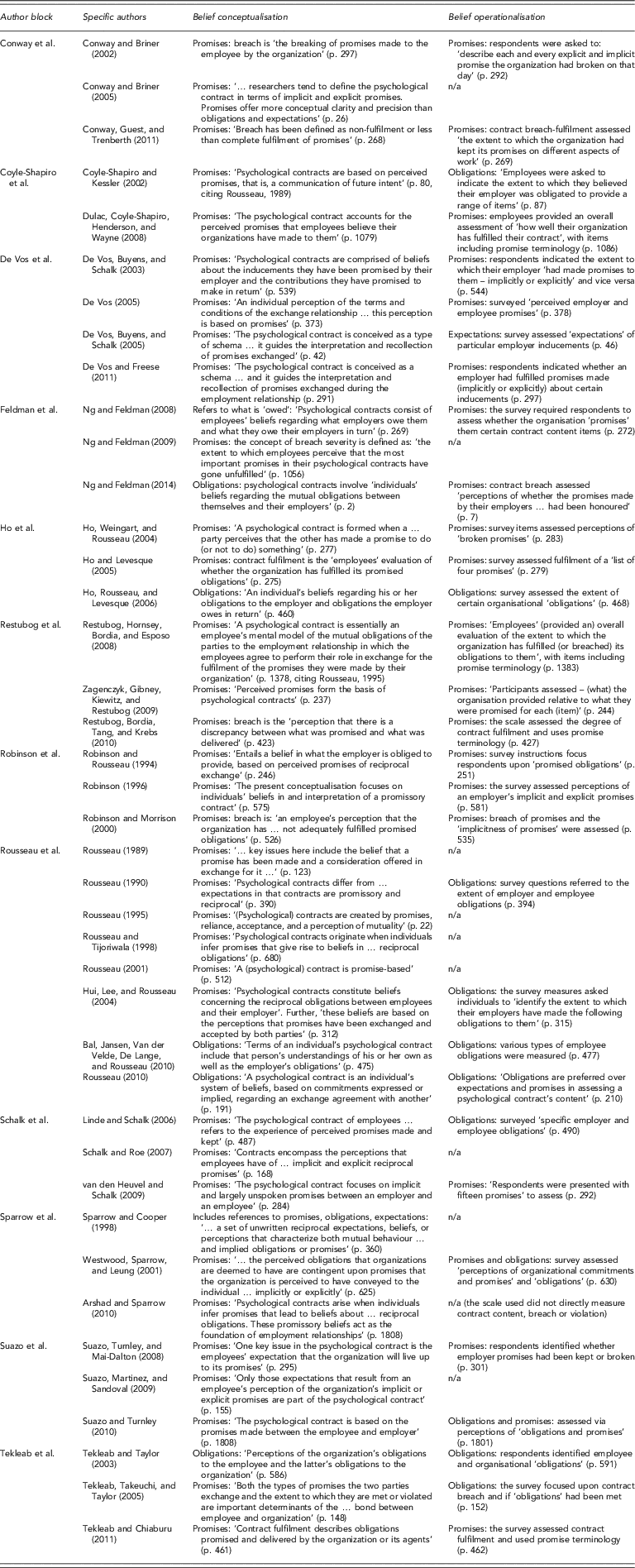
To examine the focus upon promise-based beliefs within the contemporary contract literature evidence must first be offered to demonstrate that this focus exists. This is important given the ongoing interchangeable use of, and varied sole focus upon, expectations, obligations and promises as the contract's constituent beliefs (see Roehling, Reference Roehling2008). It is widely acknowledged that Rousseau's (Reference Rousseau1989) seminal paper redirected the contract's belief conceptualisation away from the broader notion of expectations to focus solely upon beliefs about perceived promises (Roehling, Reference Roehling1997; Conway & Briner, Reference Conway and Briner2005, Reference Conway and Briner2009). Held as a distinguishing feature of the contract, promises came to be conceptualised as both implicit (conveyed through actions or indirect statements) and explicit (conveyed directly through words) (Rousseau, Reference Rousseau2001). Although Rousseau's contemporary work (e.g., Bal, Jansen, Van der Velde, De Lange, & Rousseau, Reference Bal, Jansen, Van der Velde, De Lange and Rousseau2010; Rousseau, Reference Rousseau2010) has seen her stance change to now solely employing the broader notion of obligations (cf. Table 1, author block: ‘Rousseau et al.’), her earlier promise-based work (particularly 1989, 1995 and 2001) remains influential. Indeed, many contract authors (e.g., Restubog, Bordia, Tang, & Krebs, Reference Restubog, Bordia, Tang and Krebs2010; Conway, Guest, & Trenberth, Reference Conway, Guest and Trenberth2011; De Vos & Freese, Reference De Vos and Freese2011) continue to solely utilise promises in order to conceptualise and operationalise the contract (cf. Table 1, e.g., author blocks: ‘Conway et al.; De Vos et al.; Restubog et al.; Suazo et al.’).
Key authors’ contract belief conceptualisations and operationalisations (since Rousseau, Reference Rousseau1989)

Notes. The author frequently cited as the first author of a work is used as the lead name of each ‘author block’ for descriptive purposes only.
Works are cited in chronological order.
n/a = paper is conceptual or review based or the work cited is a book.
A much-cited reason for this continued focus upon promises is Rousseau's (Reference Rousseau1989) assertion that expectations, obligations and promises imply different levels of psychological engagement, resulting in more or less intense reactions depending upon which type of belief is unfulfilled (Rousseau & Tijoriwala, Reference Rousseau and Tijoriwala1998). Rousseau (Reference Rousseau1989) argues that promise-based beliefs involve elements of trust, a sense of relationship and a belief in the existence of future benefits. Therefore, violated promises will produce more intense, emotional and organisationally detrimental responses than when broader beliefs, such as expectations, go unfulfilled (Rousseau, Reference Rousseau1990). It is also worth noting a disconnection within some studies regarding the contract's conceptualisation and operationalisation. Some authors (e.g., Hui, Lee, & Rousseau, Reference Hui, Lee and Rousseau2004; Linde & Schalk, Reference Linde and Schalk2006) suggest that promise-based beliefs solely constitute the contract, but use obligations-based measures (cf. Table 1). Where authors have consistent promise-based conceptual and operational positions within a study (e.g., Ho & Levesque, Reference Ho and Levesque2005), quantitative measures often do not distinguish between implicit and explicit promises, and so are perhaps only capturing the latter (cf. Table 1). However, some authors have sought to operationalise this promise-type distinction (e.g., Conway & Briner, Reference Conway and Briner2002; De Vos & Freese, Reference De Vos and Freese2011).
Overall, it is reasonable to say that the dominant approach in the contemporary literature continues to reflect Rousseau's (Reference Rousseau1989, Reference Rousseau1995, Reference Rousseau2001) original view that only promise-based beliefs constitute the psychological contract. However, applying the notion of promising, and in particular implicit promising, requires further investigation (Conway & Briner, Reference Conway and Briner2009; Montes & Zweig, Reference Montes and Zweig2009). For example, contemporary contract authors’ definitions of a promise usually take the following forms: ‘a commitment to, or an assurance for, some future course of action’ (Montes & Zweig, Reference Montes and Zweig2009: ); ‘a commitment to do (or not do) something’ (Roehling, Reference Roehling2008: 263); ‘the term “promises” is used here to encompass the broad array of verbal and non-verbal expressions of future intent’ (Rousseau, Reference Rousseau2001: 526); or ‘any form of communication by the organisation or an agent of the organisation can be interpreted by an employee as a promise that can create a psychological contract’ (Suazo et al., Reference Suazo, Martinez and Sandoval2009: 159). This illustrates that promises are construed differently and sometimes quite broadly, meaning that a clear and consistent outline of promising is required in the contract literature (Conway & Briner, Reference Conway and Briner2009).
This paper now focuses on this theoretical work by first explicating the notion of a promise in order to assess how the concept is applied to the psychological contract. Implicit promising, particularly, is then theoretically explored in greater depth. Figure 1 provides the overarching conceptual model which these discussions generate and outlines avenues through which explicit and, potentially, implicit promise beliefs in an employment context may develop.
Conceptual model of explicit and implicit promise development and outcomes
A CROSS-DISCIPLINARY PERSPECTIVE ON PROMISING
Although the concept of promising is referenced in many diverse fields, the most comprehensive theorising on, and examination of, the topic has occurred in the areas of speech act theory, philosophy and law. These disciplines are drawn upon here to conceptually detail the core, paradigmatic features of a promise and to outline nuanced cases of promising, which are relevant to the psychological contract. The focus in this paper will be on conditional promises, given that the contract is rooted in the notion of social exchange (Coyle-Shapiro & Kessler, Reference Coyle-Shapiro and Kessler2002), whereby employees engage in an ongoing cycle of offering something as consideration for an employer inducement and vice versa. Some authors may view this discussion of a promise as somewhat redundant given that it is perceived promises rather than actual promises which constitute the contemporary account of the contract. However, this conceptual detail is important for the later exploration of the notion of implicit promises, in order to be clear about what a promise entails.
Within the field of speech act theory, Searle (Reference Searle1969) defines a promise as a commitment on the part of a speaker to accomplish a future action. A promise is defined by nine fulfilment conditions, grouped into four main categories (as per Bernicot & Laval, Reference Bernicot and Laval1996): (1) a propositional content condition (a statement is made about a future action to be accomplished by the speaker); (2) a preparatory condition ([a] the listener would rather have the speaker accomplish that future action than not and the speaker thinks this is the case and [b] neither the speaker nor listener knows whether the speaker will actually accomplish the action); (3) a sincerity condition (the speaker intends to accomplish the action); and (4) an essential condition (it becomes the speaker's obligation to accomplish the future action). Astington (Reference Astington1990: 228) states that empirical work in the speech act field has demonstrated that adults’ conceptions of promising do align with Searle's (Reference Searle1969) analysis and that adults ‘have both the ability to produce speech acts of promising and the metapragmatic ability to judge speech acts as cases of promising or not’ (see Gibbs & Delaney, Reference Gibbs and Delaney1987).
In the philosophical literature, the characteristics that Scanlon (Reference Scanlon1998) attributes to promising are: (1) I claim to have a certain intention; (2) I make this claim with the clear aim of getting you to believe that I have this intention; (3) I do this in circumstances in which it is clear that if you do believe it then the truth of this belief will matter to you; and (4) I indicate to you that I believe and take seriously the fact that you believe the former, such that it would be wrong of me not to (accomplish my promised action). In the law literature, a promise is defined as follows: ‘by communicating a promise, the promisor informs the promisee about the proposed future receipt of a benefit’ (Goetz & Scott, Reference Goetz and Scott1980: 1266). In the process of two parties offering inducements and considerations, the promisee comes to rely upon the promisor to carry out his or her commitments (Leslie, Reference Leslie1999). As such, the obligation to keep promises is also an acknowledged moral duty (Goetz & Scott, Reference Goetz and Scott1980; Atiyah, Reference Atiyah1981) and while this duty may sometimes be opposed by reasons to the contrary, its weight does not disappear (Smith, Reference Smith1972–1973).
From the definitions presented, there is broad agreement across these three fields that a promise will usually have all of the following features: (1) there is a promisor and a promisee (or possibly more than one); (2) there is a commitment by the promisor to undertake some future action on the basis of a consideration provided by the promisee (a conditional promise); (3) the promisor intends to accomplish this action and it is under his or her control to do so; (4) the promisee will generally expect the promisor to accomplish the action and will usually come to rely on it being accomplished; (5) a promise can be spoken or written; and (6) all things being equal, it would be wrong of the promisor not to fulfil the promise, as it gives rise to an obligation on the part of the promisor to fulfil it. It should be noted that examples of non-paradigmatic cases of promising will also exist, such as promising to cause harm (which is unlikely to be an action the promisee would want fulfilled), but incorporating these are beyond the scope of this paper. Given the broad consensus across various disciplines regarding the components of a promise and its interpretation, this leads to the first set of research propositions in an employment context.
Proposition 1a : Employees’ and organisational agents’ (such as managers’) identification and interpretations of organisational promises will align with Searle's (Reference Searle1969) promising conditions as demonstrated in speech act research.
Proposition 1b : Employees and organisational agents (such as managers) can identify and understand when a conditional promise is made, as per the six broad features of promising outlined in the cross-disciplinary review.
The nuances of promising
Four nuanced cases of promising are also explored, as they are relevant to understanding the application of the promise concept in psychological contract theory. First, it is not necessary for the verb ‘promise’ to be used for either a promisor to make a conditional promise or for a promisee to understand that this promise has been made (Bernicot & Laval, Reference Bernicot and Laval1996; Rousseau, Reference Rousseau2001). For example, a manager may say, or write, to an employee: ‘If you complete this project within budget, I promise I will give you a promotion’. The promise is still conveyed if the manager instead says or writes: ‘If you complete this project within budget, I will ensure you receive a promotion’. This is because both statements are conveyed through commissive speech acts, which commit the speaker to a course of action (Searle, Reference Searle1969).
Second, as employees are exposed to a range of employer communications, it is instructive to distinguish between promises and other communications, which do not convey promises, such as assertions and opinions/guesses. In promising we are ‘underwriting the promisees' plans and hence doing something that is meant to pertain directly to their deliberations’ (Watson, Reference Watson2003: 65). Promises ‘not only bind my will by creating reasons for acting as promised but are meant to provide corresponding reasons for others’ (Watson, Reference Watson2003: 65). In contrast, an assertion focuses on claiming that something is true (Watson, Reference Watson2003). For example, ‘to assert that p is, among other things, to endorse p, to authorise others to assume that p, to commit oneself to defending p, thereby (typically) giving others standing to criticise or challenge what one says’ (Watson, Reference Watson2003: 58). A key difference is that ‘promising incurs a different justificatory burden’ to asserting (Watson, Reference Watson2003: 62). A promise implies that the promisor will act to make something happen. Assertions can simply involve making a statement and individuals have the right to challenge whether or not it is true. The person making the assertion is not committed to undertaking any future course of action to make the assertion true, as in a promise, other than to perhaps provide evidence of its truth. Opinions/guesses do not involve such elements of ‘authorising and of undertaking justificatory responsibility’ (Watson, Reference Watson2003: 58). Here ‘being committed to p amounts just to this: I will be right or wrong depending on whether or not p … and I may stick my neck out without authorising you to do so’ (Watson, Reference Watson2003: 58).
Examples of the three communications are: if a senior team member says to a junior team member (1) ‘I promise that after three years in this team you will receive a promotion’ (a promise); (2) ‘After three years in this team, most people have received a promotion’ (an assertion); or (3) ‘I bet after three years with us you'll get a promotion’ (an opinion/guess). Although other nuances exist in relation to these concepts (see Watson, Reference Watson2003), it can be concluded that promises, assertions and opinions/guesses are conceptually different. Empirically, speech act research demonstrates that in childhood individuals develop the capacity to produce and judge these different speech acts (Astington, Reference Astington1990). Astington (Reference Astington1988) found that promise comprehension evolves with age and children begin distinguishing promises from assertions between the ages of 11–13 (see also Bernicot & Laval, Reference Bernicot and Laval1996; Maas & Abbeduto, Reference Maas and Abbeduto1998).
A third nuance is provided by Atiyah (Reference Atiyah1981) who notes that promises can be made which are admissions of obligations that already exist. Cartwright (Reference Cartwright1984) suggests that this may be done to add a further moral obligation to an existing legal obligation or, where the obligation yielded by the promise is of the same order as the antecedent one, to add moral pressure to the promisor. However, he admits that the weightier the prior obligation, the less point there is in a promise to carry it out (Cartwright, Reference Cartwright1984). However, as recognised in the contract literature, the function of a promise is not only to create an obligation. Promises have additional functions, such as regulating and directing behaviour, reducing uncertainty and building trust and positive feelings to develop a strong relationship between the promisor and promisee (Montes & Zweig, Reference Montes and Zweig2009). This means there will be instances where the promisor may specifically promise to fulfil an antecedent obligation to draw upon these ‘additive’ effects of promising.
Fourth, Migotti (Reference Migotti2003: 84) notes that ‘a sound theory of promising (must) be able to do justice to the myriad ways in which we assume responsibility for the actions of others’. In psychological contracting, many ‘contract makers’ exist who play an important role in making commitments on the organisation's behalf, such as promises, to employees (e.g., managers, Rousseau, Reference Rousseau1995: 55). To account for this, Migotti (Reference Migotti2003) distinguishes between promising on one's own behalf (action-directed promises) and promising on behalf of another (result-directed promises). Action-directed promises relate to ‘promises to x, where x denotes a possible future action of the promisor’ (Migotti, Reference Migotti2003: 83). Result-directed promises ‘are promises not to x, but to get x done, where x denotes a state of affairs or accomplishment’ (Migotti, Reference Migotti2003: 83). In promising ‘to accomplish x, this includes a commitment to bring x about, or to offer reparation where this does not occur’ (Migotti, Reference Migotti2003: 84).
For example, a manager may promise an employee a monthly performance review as a condition of working in the organisation (an action-directed promise), or during recruitment a recruiter may promise an interviewee a monthly performance review as a condition of securing the role (a result-directed promise). The latter is different from the former as the recruiter is not the potential employee's manager, he or she will not be conducting the performance review and whether it is conducted or not may be out of his or her control. However, whatever the basis for making the promise, the recruiter has promised that monthly performance reviews will occur. The interviewee (assuming they accept the role) then has recourse to the recruiter if the reviews do not occur and the recruiter must then try to ensure that the promise is fulfilled. As human resources staff form one key group of ‘contract makers’ (Rousseau, Reference Rousseau1995: 55) in enacting policies and procedures, in practice employees will often contact them when such promises are not fulfilled. Therefore, whomever the ‘contract makers’ (Rousseau, Reference Rousseau1995: 55) are, whether they are action-directed or result-directed promisors, their promises stand.
This discussion further develops the basis of what constitutes a promise and leads to the next set of propositions regarding how individuals identify and interpret organisational promises.
Proposition 2a : Employees and organisational agents (such as managers) can identify the differences between conveying and receiving promises, assertions and opinions.
Proposition 2b : Employees and organisational agents (such as managers) can identify when promises of existing obligations are made, for example, in order to strengthen relationships.
Proposition 2c : Employees can identify the difference between action-directed and result-directed promises and the promisors conveying them.
Proposition 2d : Organisational agents (such as managers) understand and can identify their role as both potential action-directed and result-directed promisors.
Drawing upon cross-disciplinary sources has identified the agreed features and key nuances of promising. This now provides the basis for examining how the concept of a promise has come to be used and applied in the psychological contract literature and, in particular, how researchers’ application of the explicit–implicit promise distinction accords with this theoretical benchmark.
A PSYCHOLOGICAL CONTRACT PERSPECTIVE ON PROMISING
Promising as outlined in the previous section broadly aligns with what is termed an ‘explicit’ promise in the psychological contract literature. However, the descriptions of promises also include what is termed an ‘implicit’ promise, which is focused upon in this section. This explicit–implicit promise distinction forms the basis for how many contemporary contract scholars describe and utilise the notion of a promise (e.g., Conway & Briner, Reference Conway and Briner2002, Reference Conway and Briner2005, Reference Conway and Briner2009; Suazo et al., Reference Suazo, Martinez and Sandoval2009). The most detailed, and cited, theorising on implicit promising still comes from Rousseau's earlier work (1989, 1995 and 2001). Rousseau (Reference Rousseau2001: 531) suggests that implicit promises are conveyed through actions and arise where ‘individuals… gather accurate information regarding another's intentions from an array of indirect as well as non-verbal sources (e.g. observation, history and interactions over time)’. Implicit promises can also arise through ‘interpretations of critical incidents’ and ‘structural signals such as human resource practices’ (Rousseau, Reference Rousseau2001: 532). For example, individuals may construe promises via ‘vicarious learning’, where employees who witness the rewards given to a co-worker may believe the organisation has ‘implicitly’ promised them the same rewards for similar behaviour (Conway & Briner, Reference Conway and Briner2005: 26). Context is also viewed as important in interpreting promises, particularly implicit ones. Events where promise making is expected, such as socialisation, are times when organisational communications are likely to be interpreted as promises (Rousseau, Reference Rousseau2001). Robinson and Rousseau (Reference Robinson and Rousseau1994) also suggest that it is not promises in fact that necessarily constitute the psychological contract, but perceived promises.
Examining the notion of an implicit promise
Although constituting a key part of the contemporary contract conceptualisation, beyond Rousseau's (Reference Rousseau2001) work the notion of an implicit promise remains overly broad and vaguely defined (Conway & Briner, Reference Conway and Briner2009). Definitions largely reference the posited sources of development, such as beliefs based upon past exchanges, ‘vicarious learning’ and conclusions drawn from inferences and observations of organisational practices (Rousseau, Reference Rousseau1990; Robinson & Rousseau, Reference Robinson and Rousseau1994: 246). To explore the notion, one of the clearest examples of an implicit promise is analysed through the theoretical framework of what has been defined as a promise within this paper. This is done because in constructing the concept of an implicit promise, existing cross-disciplinary agreement on what constitutes a promise cannot be ignored. Outlining the core features of a promise now allows for a theoretical ‘testing’ of the implicit promise notion against this benchmark.
Rousseau's (Reference Rousseau2001: 527) implicit promise example is used (see also Robinson & Morrison, Reference Robinson and Morrison2000): ‘a recruiter who “mentions” the experiences that recent hires have had in the firm can be reasonably construed to promise the hearer that he or she will have the same experiences upon joining up’. For argument's sake, it is assumed that the applicant applied for a graduate role and the recruiter ‘mentioned’ during the interview that previous graduates who entered similar roles received promotions within their first three years of tenure. Taking this example in isolation, its broadness suggests that an implicit promise does not exhibit any of the core, paradigmatic features of a promise as outlined in the cross-disciplinary review of the concept. There appears to be no commitment by the recruiter to undertake some future action to bring about a promotion, or acknowledgement that it is within his or her control to do so, either directly (an action-directed promise) or on behalf of the organisation (a result-directed promise). In this instance, it is difficult to see how either the recruiter or applicant would believe that the recruiter has control over the applicant's work and performance to meet promotion requirements or has the direct authority to enact a promotion. The recruiter is providing information regarding past promotional trends or, in Watson's (Reference Watson2003) terminology, is making an assertion that the applicant can ask him or her to verify, but not a promise. In addition, although the applicant may very well want the recruiter to ensure that he or she receives a promotion, it is highly unlikely that the applicant will think from this one interaction (without any other features of a promise in place) that the recruiter (or any other organisational agent) is obligated to do so because he or she believes a promise has been made. This cursory analysis suggests that a promise in fact has not been made and that the applicant and recruiter are unlikely to think that anything other than an assertion was communicated.
As identified earlier, an argument that contemporary authors may pose to counter this analysis is that it is perceived promises, not necessarily promises in fact, which constitute the psychological contract (Robinson, Reference Robinson1996). In other words, if an employee believes or perceives a communication to be a promise, whether or not it is an actual promise, then it does constitute a promise in the psychological contract context. However, it has been illustrated by examining these ‘implicit promise-type’ events in isolation that they do not clearly meet the agreed features of a promise in fact and are also unlikely to be perceived by individuals as promises.
What this analysis means for psychological contract beliefs
These discussions raise two broad conclusions and research directions. The first is that speech act research findings regarding promise construal, and theorising in the areas of law and philosophy, do not hold in employment contexts. That is, individuals in the workplace do consistently perceive and construe employer promises (such as implicit ones) where no promises in fact exist. Montes and Zweig's (Reference Montes and Zweig2009) experimental study offers some tentative evidence that this may occur, finding that (although not explaining why) some individuals presented with a ‘no promises’ scenario still perceived promises to have been made. This would open an interesting area of research, given that promising in an employment context would be shown to occur quite differently to what other areas of scholarship suggest. Overall, if the preceding analysis of implicit promises does not hold, further work is needed to demonstrate the existence of these types of promises and to identify the mechanisms for their development.
The second conclusion is that implicit promising does not systematically occur and that individuals do not perceive the sorts of examples previously discussed as promises at all. That is, the implicit promise notion seeks to incorporate beliefs which, although relevant to understanding psychological contracting through capturing important components of the exchange relationship, are not perceived as promises by individuals and are not promises in fact. Following this conclusion that implicit promises do not exist, the dominant conceptualisation and operationalisation of the contract as solely based upon explicit promises is unnecessarily restrictive. Clearly explicit promises are one set of beliefs which will constitute part of a psychological contract, but they are not necessarily the only relevant belief type. This raises a largely unanswered question in the literature – which types or combinations of beliefs, expectations, obligations or promises, actually constitute the psychological contract and why (Coyle-Shapiro & Parzefall, Reference Coyle-Shapiro and Parzefall2008; Roehling, Reference Roehling2008)? Relatedly, expanding the contract's conceptualisation must be done without rendering the construct redundant to the broader met expectations, employee–organisation relationship and other related literatures.
The remainder of this paper will focus on expanding upon the first conclusion, given that implicit promising continues to form a key, although underdeveloped, part of the current contract conceptualisation. Even researchers who do not endorse a solely promise-based contract will generally recognise that promising forms one relevant component of the contract, making its explication important. Focusing more specifically on this type of promise is required given that the cross-disciplinary literatures reviewed do not clearly offer explanations for how implicit promises may develop, or even if they exist. This makes it incumbent upon contract researchers to conceptually and empirically clarify a key component of what is claimed to constitute a psychological contract. As Conway and Briner (Reference Conway and Briner2009) highlight, as it stands, the broadness of the concept means that almost every expectation employees hold about work could be traced back to an implicit promise, resulting in an ongoing conceptual ambiguity which makes it difficult to know what researchers are referring to, or capturing, when citing this type of belief.
To help address this issue, the following sections draw on a key mechanism underpinning the contract, social exchange, to conceptually expand the implicit promise notion and develop testable propositions for its empirical inquiry. Following this, a more cursory assessment of potential research directions flowing from the second conclusion discussed above is then provided. Given the two conclusions outlined, it should be noted that as each set of implicit promise propositions are developed, obvious alternative propositions exist. That is, instead of construing promises as part of the ongoing exchange, individuals may instead form broader beliefs, such as those about obligations.
HOW MIGHT IMPLICIT PROMISES DEVELOP? THE ROLE OF SOCIAL EXCHANGE
A theoretical limitation of the implicit promise notion is that many of the detailed examples of these promises are couched as ‘one-off’-type interactions which can be demonstrated to be conceptually flimsy, as shown above. Parzefall and Coyle-Shapiro (Reference Parzefall and Coyle-Shapiro2011: 24) counsel that investigations of the employment exchange must ‘move beyond exploring one-time “transactions”’. As such, rather than focusing on one-off interactions such as those in recruitment, an avenue for exploring implicit promise development is to more concretely detail how social exchange may influence this belief construction. Although the social exchange relationship can affect perceptions of contract fulfilment, breach and violation (Dulac, Coyle-Shapiro, Henderson, & Wayne, Reference Dulac, Coyle-Shapiro, Henderson and Wayne2008) and is positively related to various employee attitudes and behaviours (Shore, Bommer, Rao, & Seo, Reference Shore, Bommer, Rao and Seo2009), what has not been investigated is how this exchange process may, or may not, systematically give rise to beliefs in promises when, in fact, no promises exist.
Psychological contracting is underpinned by the mechanisms of social exchange and reciprocity (Dulac et al., Reference Dulac, Coyle-Shapiro, Henderson and Wayne2008). Blau (Reference Blau1964: 91) defines social exchange as the ‘voluntary actions of individuals that are motivated by the returns they are expected to bring and typically do in fact bring from others’. For social exchanges to evolve over time into trusting, loyal and mutual commitments parties adhere to certain ‘rules’, such as reciprocity or future repayment in kind (Cropanzano & Mitchell, Reference Cropanzano and Mitchell2005: 875). This basis in social exchange is what centres the contract conceptualisation on the ‘future exchange’ perceptions of employees. That is, social exchange ‘involves the principle that one person does another a favour and while there is a general expectation of some future return, its exact nature is definitely not stipulated in advance’ (Blau, Reference Blau1964: 93). Perhaps further exploring how these ‘diffuse’ future obligation beliefs (Blau, Reference Blau1964: 93) develop could shed light on how individuals may then perceive that their organisation has promised them something, implicitly, even when a promise in fact has not been made.
Reliance/dependence upon the organisation
Social exchange relations involve each party making investments to the relationship, resulting in commitments to the other party (Blau, Reference Blau1964; Molm, Peterson, & Takahashi, Reference Molm, Peterson and Takahashi1999). Through this process, over time, a sense of reliance or dependence upon the other party is created. Rousseau and McLean Parks (Reference Rousseau and McLean Parks1993: 9) also describe reliance as ‘being derived from delayed repayment’, which stems from increasing levels of trust that the other party will discharge their obligations according to the rules of reciprocity. For example, because individuals invest in a relationship in order to cultivate it, opportunity costs result as they neglect to cultivate other exchange relationships which may provide alternative sources of the inducements sought (Blau, Reference Blau1964). Further, when one partner holds fewer alternative opportunities, he or she becomes more dependent on, and committed to, the exchange relationship than the other (Blau, Reference Blau1964). For example, following Molm et al. (Reference Molm, Peterson and Takahashi1999), employee B's dependence on organisation A increases with the value of inducements that the organisation can provide; however, employee B's dependence on organisation A decreases with the employee's access to alternative sources of benefits, such as comparable employment conditions elsewhere.
This theorising links to Ng and Feldman's (Reference Ng and Feldman2008, Reference Ng and Feldman2009) notion of psychological contract replicability. Replicability refers to whether an individual believes that the particular, and perhaps unique, terms of his or her psychological contract can be readily replicated elsewhere in the external labour market (Ng & Feldman, Reference Ng and Feldman2008). The authors suggest that when employees believe that their contracts are unreplicable, they are more likely to feel bound to the organisation and this exchange will elicit a stronger sense of reciprocation within the relationship (Ng & Feldman, Reference Ng and Feldman2008). Relatedly, Ng and Feldman (Reference Ng and Feldman2007) also suggest that it is mid- and late-career employees who are likely to have become more enmeshed and embedded in both their organisations and occupations over time. That is, individuals with longer tenure and established careers within organisations will develop stronger links to their colleagues, believe they have invested more deeply in, through more contributions to, their organisations and believe that leaving would result in higher levels of financial and personal sacrifice (Ng & Feldman, Reference Ng and Feldman2007).
As employees believe they have invested more, over time, with the organisation, this can create perceptions of greater organisational obligations (Shore & Shore, Reference Shore and Shore1995). Ng and Feldman (Reference Ng and Feldman2007) also identify a temporal element to the creation of ‘unreplicable’ contract terms, namely those accruing over time such as job security. As the resultant bond between employee and employer strengthens as the pattern of investments and contributions, particularly of ‘unreplicable’ contract terms, continues this may result in employees construing their contracts as an exchange of implicit promises, rather than broader beliefs such as obligations.
Proposition 3a : Employees with longer organisational tenure will identify higher levels of dependence upon the organisation and are more likely to perceive an exchange of implicit promises within the employment relationship.
Proposition 3b : Employees who believe their psychological contracts are non-replicable are more likely to perceive an exchange of implicit promises within the employment relationship.
Social exchange relationships can also foster emotional bonds between parties as socio-emotional resources are exchanged (Shore, Coyle-Shapiro, Chen, & Tetrick, Reference Shore, Coyle-Shapiro, Chen and Tetrick2009). That is, rather than creating dependence through more ‘instrumental motives’ and unique contract terms, employees’ sense of commitment towards an organisation can be generated through a ‘genuine affection or sense of obligation’ (Ng & Feldman, Reference Ng and Feldman2008: 270). Gakovic and Tetrick (Reference Gakovic and Tetrick2003) found that regardless of work status, employees who perceive their organisation as caring are more likely to engage in social exchange, invest in their employment relationship through emotional attachment and develop a sense of obligation to remain with their organisation. This affective commitment, or levels of emotional attachment and identification with the employer (Allen & Meyer, Reference Allen and Meyer1990), has been linked to social exchange outcomes. Ng and Feldman (Reference Ng and Feldman2008) suggest that when relations are characterised by the exchange of more socio-emotional resources, such as care and support, employees are likely to reciprocate with stronger affective feelings towards their organisations. As such, it is possible that the stronger this bond of trust, emotional engagement and commitment, the greater the likelihood that employees will identify an exchange of implicit promises with their employer.
Proposition 4 : Employees with a stronger emotional attachment to the organisation, or higher levels of affective commitment, are more likely to perceive an exchange of implicit promises within the employment relationship.
Repeated patterns of exchange and the development of norms/standards of behaviour
Social exchange theorising focuses on the temporal nature of the process. As Blau (Reference Blau1964: 94) states, ‘exchange relations evolve in a slow process, starting with minor transactions in which little trust is required because little risk is involved’. This is because, at least at the beginning of a relationship, there is little assurance that what is given will be appropriately returned in the future (Blau, Reference Blau1964). A defining feature of social exchange is that discrete transactions are difficult to identify and the relationship instead focuses on a series of sequentially contingent acts (Molm et al., Reference Molm, Peterson and Takahashi1999). The equality of these relations is established only over time, through the balancing of each party giving to the other (Molm et al., Reference Molm, Peterson and Takahashi1999). As Blau (Reference Blau1964: 94) argues, ‘the benefits involved in social exchange do not have an exact price in terms of a single quantitative medium of exchange’, implying that these exchanges create enduring social patterns (Cropanzano & Mitchell, Reference Cropanzano and Mitchell2005). Given the non-specific nature of these obligations, the inferences drawn from patterns of exchange may assist in developing the implicit promise notion.
Broadly, Blau (Reference Blau1964) suggests that norms develop in societies that identify fair rates of exchange between the benefits to be provided, given the investments made. At the organisational level, drawing on legal literature, Macneil (Reference Macneil1985: 503) suggests that ‘in complex relations (such as employment), obligations, often heavily binding ones, arise simply out of day-to-day operations, habits and customs which occur with little thought about the obligations they might entail’. Leslie (Reference Leslie1999) points out that in the social exchange context, it is often hard to isolate particular promises and acts of reliance within the relationship and agreements within long-term relationships are often left implicit. This is because the closer and more interdependent the parties, the less likely it will be that promises are clearly spelled out, as the parties operate in accordance with implied understandings (Leslie, Reference Leslie1999). These ‘understandings’ can result in individuals trusting the other party to act in accordance with previously relied upon norms (Leslie, Reference Leslie1999). In psychological contracting, Rousseau and McLean Parks (Reference Rousseau and McLean Parks1993) propose that an organisation's consistency of practice may particularly influence promise interpretation.
For example, over time, as individuals become more productive and perceive that they are contributing and ‘investing’ more in their employment exchange, and in turn as they become clearer about what the organisation will provide in exchange for their contributions, a set pattern of exchange may ensue. As Dulac et al. (Reference Dulac, Coyle-Shapiro, Henderson and Wayne2008: 1092) state, ‘in longer-established employment relationships the pattern of interactions is well formed, reinforced and routinised’. Conversely, in newly formed employment relationships, the foundation for a high-quality exchange may be in place ‘but it has not been fully formed and reinforced over time’ (Dulac et al., Reference Dulac, Coyle-Shapiro, Henderson and Wayne2008: 1093). Rousseau (Reference Rousseau2001) suggests that certain repeated interactions in employment may motivate individuals to interpret organisational words and actions as promissory. For example, Rousseau (Reference Rousseau2010: 209) states that ‘non-promised aspects of employment that workers find satisfying… can over time be viewed as part of the promised status quo’ and, hence, form part of the psychological contract.
Longitudinal contract studies offer some support in finding that, over time, individuals reduce perceptions of their obligations to their employers and increase beliefs about their employers' obligations to them (Robinson, Kraatz, & Rousseau, Reference Robinson, Kraatz and Rousseau1994). Bal, De Cooman, and Mol (Reference Bal, De Cooman and Mol2013) also draw on human capital theory (Becker, Reference Becker1962) to show how employee tenure may influence contract outcomes. Human capital theory suggests that as employees’ firm-specific skills increase through longer tenure, their behaviour becomes more dependent on ‘habits and routines’ and perceptions of entitlement and commitment, rather than more ‘recent exchanges’ (Bal et al., Reference Bal, De Cooman and Mol2013: 111). Notwithstanding the operationalisation of the contract's beliefs in these studies as obligations and not promises, this suggests that, over time, as various organisational relationships and patterns of behaviour and exchange become routinised, some type of ‘accretion effect’ may occur where the accumulation of events and exchanges could encourage the perception of exchanged promises, even where promises in fact do not exist.
Proposition 5a : Employees with longer organisational tenure are more likely to identify consistent inducements and contributions to be exchanged.
Proposition 5b : Employees with longer organisational tenure are more likely to perceive that this exchange of inducements and contributions refers to an exchange of implicit promises within the employment relationship.
Sensitivity to exchange: The moderating role of individual difference
Individuals differ in how they value, and respond to, reciprocity (Cropanzano & Mitchell, Reference Cropanzano and Mitchell2005). Given its focus on sensitivity to exchange, reciprocation wariness is identified as a potential moderator for the exchange–promise outcome relationships proposed. Eisenberger, Cotterell, and Marvel (Reference Eisenberger, Cotterell and Marvel1987) identified reciprocation wariness as an individual's general fear of being exploited in interpersonal, including organisational, relationships. This results in a generalised cautiousness in reciprocating aid or beneficial treatment (Shore et al., Reference Shore, Bommer, Rao and Seo2009) and highly wary individuals, compared with those low in wariness, are less likely to be convinced of the desirability of engaging in social exchange relationships (Kamdar, McAllister, & Turban, Reference Kamdar, McAllister and Turban2006). Empirically, Shore et al. (Reference Shore, Coyle-Shapiro, Chen and Tetrick2009) found that reciprocation-wary individuals did not respond favourably to relationships involving diffuse obligations and long-term investment.
In terms of promise perceptions, wary individuals have ‘lower baseline expectations for exchange relationships, regarding what they can expect to receive from others but also what they are obligated to contribute to them’ (Kamdar et al., Reference Kamdar, McAllister and Turban2006). As a result, reciprocation-wary individuals are less likely to strongly invest in exchange relationships, be less likely to develop the mutual trust necessary for relationship dependence and be less likely to engage in and cultivate an ongoing pattern of exchanges with an employer.
Proposition 6 : Employees with high reciprocation wariness will be less likely to develop strong social exchange relationships and so will be less likely to develop beliefs about an exchange of implicit promises within the employment relationship.
Outcomes of explicit and implicit promise beliefs: Breach and violation perceptions
Looking beyond solely theorising about how promise beliefs may develop, it is important to note that a range of outcomes result from the operation of the psychological contract, including impacts upon work attitudes and behaviours. For parsimony, one of the most researched and cited outcomes is now integrated into the conceptual model, that of contract breach and violation perceptions. In line with a promise-based approach, contract breach refers to an employee identifying that an employer's promise is not met and violation is the possible negative and emotional reactions resulting from this belief (Morrison & Robinson, Reference Morrison and Robinson1997). As few studies operationalise explicit and implicit promises, the one study (known to the author) to have investigated how promise types influence breach and violation outcomes yielded mixed findings.
Conway and Briner (Reference Conway and Briner2002) hypothesised that employees’ reactions will be stronger following broken explicit promises, suggesting that any injustices will be easier to accurately judge when the promise is explicit. This follows Turnley and Feldman (Reference Turnley and Feldman1999), who claim that explicit promises will more firmly establish what employees can expect and so discrepancies are more likely to be interpreted as violations. Conversely, the ambiguity of implicit promises will likely heighten belief incongruence with organisational agents (Morrison & Robinson, Reference Morrison and Robinson1997), resulting in employees attributing any discrepant perceptions to miscommunication or misperception (Robinson & Morrison, Reference Robinson and Morrison1995). This uncertainty then delays the affective reactions associated with contract violation (Conway & Briner, Reference Conway and Briner2002). Although Conway and Briner (Reference Conway and Briner2002) found no support for this hypothesis, their results showed that on at least one measure of emotional reaction, the perception of broken explicit promises yielded significantly lesser feelings of ‘hurt’ than when implicit promises were broken. Although contrary to their hypothesis, this finding offers tentative support to the promise theorising presented in this paper and its extension to how breach and violation perceptions may develop from different promise beliefs.
The cross-disciplinary theorising previously presented, particularly that of Searle (Reference Searle1969), Watson (Reference Watson2003) and Astington (Reference Astington1988, Reference Astington1990), identified the specific characteristics of a promise (an explicit promise) and that, empirically, individuals can identify promises as a specific form of commitment. Given this, it is proposed that individuals will be able to clearly identify when explicit promises are breached. Similarly, individuals should also be able to clearly identify when implicit promises are unmet. The arguments in this paper have sought to move the implicit promise theorising beyond focusing on fairly vague and isolated examples to suggest that, via the social exchange mechanism, if implicit promises are construed then it is more likely that they will develop over time through a pattern or routinisation of exchanges, which become entrenched in what Rousseau (Reference Rousseau2001) terms an employee's contract schema. As a result, when compared to explicit promises, if employees hold implicit promise beliefs then they should be just as able to identify when routine exchanges are not fulfilled. Although not testing for statistical significance, Conway & Briner's (Reference Conway and Briner2002) study found that 59% of reported broken promises were explicit and 41% were implicit, suggesting that breaches of both were fairly readily identified by employees.
Proposition 7 : Employees will be able to similarly identify breaches of both explicit and implicit promises.
Turning to contract violation, differences in perceptions are proposed depending upon the promise type. Explicit promises are clear communications of future intent and action by one party to another. This clarity and openness would suggest that when they are breached, the promisee (such as an employee) would be more likely and willing to question this and seek reasons for it. The ability to ‘fact check’ in an attribution process to determine culpability and intentionality for the breach (Morrison & Robinson, Reference Morrison and Robinson1997) may help the promisee better understand the conditions surrounding the unmet promise and potentially stave off violation perceptions. However, because it has been suggested in this paper that implicit promises will develop over time through an accretion of exchange events, and so are more likely to be unspoken, the opportunity for open discussion of breaches will likely be less pronounced than for explicit promises. The pattern or routinisation of exchanges may also have occurred over successive managers or even organisational structures, reinforcing the difficulty in finding one organisational agent who can discuss and clarify the breach. This ‘information vacuum’ may then increase the likelihood of an implicit promise breach developing into a perception of contract violation.
Proposition 8 : Broken explicit (implicit) promises are less (more) likely to result in subsequent feelings of contract violation.
If not promises, then what? Investigating the roles of a broader set of beliefs
The second main conclusion drawn following the analysis of implicit promises was that if this notion is not empirically validated, then a psychological contract based upon explicit promises is unnecessarily restrictive. Roehling (Reference Roehling2008) identifies that a comprehensive theory of psychological contracting must account for various belief types, and empirically demonstrates that beliefs about expectations, obligations and promises are conceptually and empirically distinguishable and result in different outcomes. Montes and Zweig (Reference Montes and Zweig2009: 1258) also offer evidence that employer inducements, rather than made and kept promises, are more important in predicting outcomes such as perceived breach and behavioural intentions. They suggest that ‘integrating the study of promises, expectations, employee outcomes, perceptual tendencies, and contextual factors’ is required in the literature (Montes & Zweig, Reference Montes and Zweig2009). However, despite this research a sole focus upon promises remains a dominant and distinguishing feature of the contemporary account of psychological contracts.
Complementing the above work, and as alluded to by Roehling (Reference Roehling2008), it is also important to recognise that other beliefs, such as those about obligations, can have the same ‘normative force’ as a promise and, although not being based in a belief that a promise has been made, are still relevant to understanding employees’ psychological contracts. That is, a belief with ‘normative force’ is one where an employee perceives that his or her employer ought to provide something in the exchange, in the absence of any promise, and will act negatively if it is not provided. Given that explicit promising only captures a narrow range of issues that are relevant to the psychological contract, and given the need to validate the notion of implicit promising, a broader question also worthy of investigation is how psychological contract theorising can expand to better articulate how different types of relevant beliefs may arise over the contracting life cycle.
Many of the propositions identified in this paper relate to the temporal nature of social exchange. Specifically, it is argued that the process takes time to develop, thus the outcomes theorised here are not likely to occur immediately. For example, the theorising presented suggests that, if they develop at all, it will be over time that beliefs about implicit promises arise, as the social exchange relationship strengthens. This suggests that while newcomers may be exposed to explicit promises during socialisation, the development of beliefs about implicit promises is less likely at this stage. Instead, do newcomers focus more upon broader expectations at the start of the employment relationship which, through the process of social exchange, then later develop into beliefs about obligations and then promises? Exploring whether psychological contract beliefs form through this type of ‘trajectory’ may nuance the theory and help explicate the construct's dynamics.
Although some authors suggest that scholars should identify a focal belief upon which to centre their definition and measurement of the contract, such as promises or obligations (Roehling, Reference Roehling2008; Rousseau, Reference Rousseau2010), this may threaten conceptual clarity and could result in theoretical overlap. For example, a sole focus upon promises may constitute an unnecessarily narrow belief set, whereas a sole focus upon obligations may raise questions regarding the differentiation of the contract construct from other employee–organisation relationship frameworks, such as perceived organisational support (see Coyle-Shapiro & Shore, Reference Coyle-Shapiro and Shore2007). Where studies continue to focus on one belief type or another, the construct remains variably defined and measured. Rather than focusing on one belief type, it may be possible to identify when some beliefs are more important than others at different employment, and contracting, stages. This paper offers empirical avenues to investigate these issues regarding promises. Further work on other beliefs, such as obligations, could build more robust conceptual underpinnings for the contract construct.
IMPLICATIONS AND CONCLUSIONS
Although Rousseau's (Reference Rousseau1989) promise-based contract conceptualisation remains dominant in the contemporary contract literature, this paper has demonstrated that the use of the promise notion, particularly implicit promising, requires greater conceptual and empirical validation in an employment context. First, providing a cross-disciplinary review of promising clarified what a promise is, and what it is not, which allowed for the implicit promise notion to be ‘tested’ against this benchmark. Following this analysis, two broad conclusions were drawn regarding the roles of promises and other belief types in the contract conceptualisation. The mechanism of social exchange was then utilised to explore implicit promising, adding to a conceptual model of promise belief development, and a number of propositions for future research were developed. Finally, given the analysis of promising, broader research questions were raised regarding the roles of other belief types in the contract conceptualisation and how contract theorising can be expanded to better articulate how different types of beliefs may arise over the employment life cycle. These discussions raise a number of implications for both scholars and practitioners.
The paper provides one of the few thorough, cross-disciplinary theoretical discussions in the contract literature regarding the notion of a promise. For scholars, this conceptual clarity leads to a number of empirical opportunities to better explore what individuals actually understand promises to be in an employment context and how and why different types of communications, such as assertions and opinions, are conveyed by managers. For practitioners, this work encourages a clearer understanding of the types of commitments they may be making and how they are generated through different types of communications, such as assertions and opinions. Searle (Reference Searle1969) demonstrates how a promise is a very specific type of commitment, generating obligations upon the promisor (such as a manager) and shaping the future actions of the promisee (such as an employee). For managers, it is instructive to understand how assertions and opinions convey very different meanings when compared with promises, and managers may reflect upon how and when they use these types of communications. The distinction between result- and action-directed promises may also be particularly salient for managers’ understanding of what their employees could be viewing them as responsible for providing. For example, new managers may be entering teams where promises have been made by previous managers or other organisational agents, meaning that although they have not yet promised anything (action-directed promises), they may well be accountable for promises others have made (result-directed promises) and so are now viewed by employees as responsible for executing them. Understanding these commitments may better facilitate team transitions to new managers where patterns of promise-making have already been created.
The paper also adds to the sorely limited body of work examining the notion of implicit promising within the contract literature (see also Conway & Briner, Reference Conway and Briner2005, Reference Conway and Briner2009). For scholars, the paper suggests how the concept may operate and offers avenues to empirically demonstrate its validity by drawing more heavily upon the social exchange mechanism. For practitioners, given that contract belief congruence between employees and organisational agents has been shown to be valuable and, for example, reduce the likelihood of employee perceptions of contract breach and violation (Tekleab & Taylor, Reference Tekleab and Taylor2003), it is important to understand how and why employees may perceive communications and actions as implicit promises, even where a promise in fact does not exist and even where organisational agents do not believe that one exists. If it is shown that this does indeed systematically occur, for example as employee tenure increases and repeated exchanges and interactions ensue, it would be valuable for practitioners to understand the conditions that create these beliefs in ‘promises’, particularly as they are likely to be held accountable for their fulfilment.
Overall, the psychological contract has both academic and practical utility by investigating how the reciprocal employment exchange influences a range of employee behaviours. This paper has sought to expand upon, and offer avenues to further explore and validate, one of the core aspects of the current contract conceptualisation, its focus on promises.
Acknowledgements
The author would like to thank the Editor and the anonymous reviewers for their valuable comments and suggestions. Thanks also go to Dr Paul Formosa, Dr Stephen Cox and Dr Anne Pisarski for comments provided on previous versions of this manuscript.