Introduction
Cognitive behavioural therapy (CBT) and interpersonal psychotherapy (IPT) are the best studied psychotherapeutic interventions for the treatment of depression. Both therapies have been reported to be efficacious for the acute treatment of depression (Cuijpers et al. Reference Cuijpers, Van Straten, Andersson and Van Oppen2008). Surprisingly there are few studies directly comparing CBT and IPT. A recent meta-analysis by Lemmens et al. (Reference Lemmens, Arntz, Peeters, Hollon, Roefs and Huibers2015) reported only four trials including their own (Elkin et al. Reference Elkin, Shea, Watkins, Imber, Sotsky, Collins, Glass, Pilkonis, Leber, Docherty, Fiester and Parloff1989; Luty et al. Reference Luty, Carter, Mckenzie, Rae, Frampton, Mulder and Joyce2007; Quilty et al. Reference Quilty, De Fruyt, Rolland, Kennedy, Rouillon and Bagby2008; Lemmens et al. Reference Lemmens, Arntz, Peeters, Hollon, Roefs and Huibers2015) and concluded that there was no significant difference in efficacy between CBT and IPT.
Longer-term studies are critical in evaluating treatment efficacy in depression since recurrence is the norm for most patients (Rush et al. Reference Rush, Wisniewski, Zisook, Fava, Sung, Haley, Chan, Gilmer, Warden, Nierenberg, Balasubramani, Gaynes, Trivedi and Hollon2012). The Lemmens et al. (Reference Lemmens, Arntz, Peeters, Hollon, Roefs and Huibers2015) study was the first to extend the comparisons between CBT and IPT beyond the acute treatment phase. Following 16–20 individual sessions conducted over 7 months they assessed depressive symptoms using the BDI-II each month until 12 months. They reported that improvement in depression severity was sustained up to 1 year with no difference in efficacy between CBT and IPT.
This paper reports on the longer-term outcome of patients in the Luty et al. (Reference Luty, Carter, Mckenzie, Rae, Frampton, Mulder and Joyce2007) study noted above. Rather than report on the maintenance effects after the 16 weeks acute treatment phase we have chosen to re-analyse the data over the full 10 month period. There were four reasons for doing this. First, this makes our results directly comparable with the only other study to examine outcome beyond the acute treatment phase (Lemmens et al. Reference Lemmens, Arntz, Peeters, Hollon, Roefs and Huibers2015). Second, more sophisticated statistical analysis techniques (general linear mixed regression modelling) are now available to analyse data. Third, using data points from all 10 months improves the precision of our results. Fourth, clinicians are more interested in the outcomes of longer-term CBT and IPT. We have also re-analysed the acute outcome data at 16 weeks using an identical linear mixed effects regression model.
Our objectives were as follows:
-
1. To compare the efficacy of IPT v. CBT in reducing symptoms over 10 months of treatment (acute phase and maintenance phase) using a linear mixed effects regression model.
-
2. To study whether pre-specified patient characteristics predicted overall outcome or differential response to CBT v. IPT over 10 months of treatment.
-
3. To re-analyse the outcome after acute treatment using the same linear mixed effects regression model.
Method
Trial design
A single centre RCT with two parallel arms and equal randomisation of eligible patients to CBT and IPT.
Participants
Patients 18 years or over and currently meeting DSM-IV criteria for a non-psychotic major depressive episode is the principal diagnosis (American Psychiatric Association, 1994) were recruited from a wide variety of sources including mental health outpatient clinics, general practitioners and psychiatric emergency services. No advertising for patients was involved. Participants were required to be medication free for a minimum of 2 weeks, except for the occasional hypnotic and the oral contraceptive pill. Patients were excluded if there was a history of mania, schizophrenia or major physical illness that could interfere with assessment or treatment, current alcohol or drug dependence of moderate or greater severity or if the patient had failed to response to a recent (within 1 year) adequate treatment of either of the intervention therapies. The study was approved by the Upper South Canterbury Ethics Committee of New Zealand.
Assessment
Participants were screened over the telephone by a research nurse who checked inclusion/exclusion criteria. Those who appeared suitable for inclusion were seen by a clinician for initial assessment. Baseline assessment included a variety of structured clinical interviews and self-report measures.
Randomisation
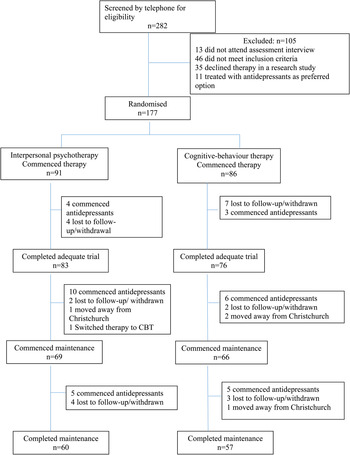
Allocation was performed by a person independent from the study. Participants were randomised on a 1:1 ratio based on a computerised randomisation sequence of permeated blocks of 20. Figure 1 shows the flow of participants through each stage of the study. Therapy commenced approximately 1 week after the baseline assessment was completed. Participants were randomised to receive approximately 16 weeks (weekly sessions) followed by monthly maintenance therapy for an additional 6 months.
Patient flow chart.

Intervention
Therapists (two psychiatrists and three clinical psychologists) provided both IPT and CBT based on the manuals of Klerman et al. (Reference Klerman, Weissman, Rounsaville and Chevron1984) and Beck and colleagues (Reference Beck, Rush, Shaw and Emery1979), respectively. The therapists were female and had at least 2 years’ experience treating people with depression and all had competency assessments prior to commencing treatment of study patients. All therapy sessions were audiotaped and listened to by an independent clinician to monitor and maintain treatment integrity (adherence and competence). The Collaborative Study Psychotherapy Rating Scale (CSPRS) (Hill et al. Reference Hill, O'grady and Elkin1992), which was developed for the NIMH study, was adapted to study treatment adherence. IPT competence was assessed with the Therapist Strategy Rating Form (O'Malley et al. Reference O'malley, Foley, Rounsaville, Watkins, Sotsky, Imber and Elkin1988) and the CBT competence was assessed with the Cognitive Therapy Rating Scale (Dabbs et al. Reference Dabbs, Carr, Frady and Riad1995).
The maintenance CBT sessions focussed on maintaining CBT treatment skills and providing relapse prevention skills. The maintenance IPT sessions continued to address problem areas of IPT with the addition of a focus on the maintenance of well-being and anticipation of further symptoms. The sessions were loosely based on the protocol of Frank (Reference Frank1991).
Group supervision was conducted throughout the course of the study. During these sessions the therapists and supervisors of each treatment met fortnightly for one and a half to two hours. Supervision sessions emphasised treatment integrity. To ensure interrater reliability the supervisors also rated randomly selected audiotapes from each therapist during the study on a monthly basis and continued to rate competency.
Outcomes
Outcome variables were defined a priori. The principle outcome variable was change in MADRS score. Secondary outcome measures (for the purposes of sensitivity analyses) were HAM-17 and BDI II. Pre-specified patient predictors of response to IPT and CBT were grouped into four domains; (a) demographic (age and gender), (b) depression characteristics (recurrent, chronic, melancholic), (c) comorbidity (panic, social phobia, alcohol abuse or dependence), and (d) personality (personality disorder symptoms, TCI dimensions).
Statistical analyses
Assessments of patients took place at 3 weeks, 6 weeks, 9 weeks, approximately 16 weeks (end of treatment), and then monthly to the 40 week mark, This resulted in 10 repeated measurements of depression using MADRS, HAM-17 and BDI II. The repeated measures data were analysed using general linear mixed effects regression models, fitted using Stata 12.0 (StataCorp, 2011). The advantages of mixed effects models include: (a) the explicit modelling of individual change across time; (b) the direct specification of fixed and random effects; and (c) robustness to missing data (StataCorp, 2011). The analyses were conducted in two steps.
-
1. In the first step, each of the demographic and baseline predictors was entered separately as a predictor in a mixed effects model with the repeated measures MADRS score as the outcome measure. These models were of the form:
(1)where Y was the score on the MADRS for person i at time t, B0i was the individual-specific intercept term, X1 represented the predictor (permitted to have an individual-specific slope), and e was an individual-specific error term at time t (t = X–26 weeks). Both X1 and X2 were permitted to have individual-specific slopes (B1, B2). $$Y({\rm it}) = B0i + B1X1i + e{\rm it}$$
-
2. In the second step of the analysis, those predictors that were found to be significantly (p < 0.05) associated with current MADRS score were entered into a multivariate mixed effects model with MADRS score as the outcome measure. These models were of the form:
(2)where ∑BjXij was the set of predictors for person i, with the remaining terms in the model as in Eqn (1).
$$Y({\rm it}) = B0i + \sum{ {\rm BjXij} + e{\rm it}} $$
-
3. In the third step of the analyses, tests of treatment by predictor interaction terms were entered into the models in a stepwise fashion, in order to examine whether there were differential responses to CBT or IPT treatment according to predictor.


Next, in order to examine the extent to which the analyses were robust to other measures of depression, the analyses above were repeated using BDI-II and HAM-17 scores in place of the MADRS scores.
Finally, in order to examine the extent to which the present analytical technique (General linear mixed models) obtained results congruent to an earlier analysis of these data (Joyce et al. Reference Joyce, Mckenzie, Carter, Rae, Luty, Frampton and Mulder2007), the multivariate analyses described above were repeated using the four repeated measures to 16 weeks.
Results
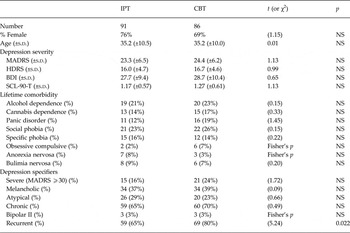
Table 1 presents the baseline demographic and clinical characteristics of those randomised to CBT and IPT. The two groups are comparable in gender, age, baseline depression severity and Axis 1 comorbidity. Although generally comparable with regard to depression specifics the CBT group included more with recurrent depression (80% v. 65% p = 0.02) and more with severe depression (24% v. 16%) although this was not statistically significant.
Baseline characteristics of the depressed patients by therapy to which they were randomised

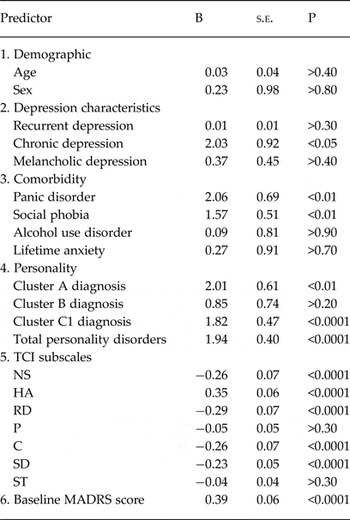
Bivariate associations between predictors and MADRS score to 40 weeks
Table 2 shows parameter estimates, standard errors and tests of significance for the bivariate associations between the repeated measures MADRS score from weeks 3 to 40 and a series of predictors related to: demographics, depression characteristics, comorbidity, personality, and baseline MADRS score. The Table shows:
-
1. Neither age nor sex (demographic predictors) were significantly associated with MADRS score over the period studied;
-
2. Of the measures of depression characteristics, only chronic depression was significantly (p < 0.05) associated with higher MADRS scores to 40 weeks, whereas recurrent and melancholic depression were not significantly related to MADRS scores.
-
3. Panic disorder and social phobia were significantly (p < 0.05) associated with higher MADRS scores, but alcohol use disorder and lifetime anxiety were not significantly related to MADRS score.
-
4. Only one of the five measures of personality disorder (Cluster B diagnosis) was not significantly associated with MADRS score. All other measures of personality disorder were significantly associated with higher scores on the MADRS to 40 weeks.
-
5. Most of the TCI subscales were significantly associated with MADRS scores, with the exception of persistence (P) (p > 0.30) and self-transcendence (ST) (p > 0.30). Harm avoidance was significantly (p < 0.0001) associated with higher scores on the MADRS, whereas novelty seeking, reward dependence, cooperativeness, and self-directedness (p < 0.0001) were significantly associated with lower MADRS scores.
-
6. Higher baseline MADRS scores were significantly (p < 0.0001) associated with higher MADRS scores to 40 weeks.
Associations between MADRS score (weeks 3–40) and baseline predictors

Multivariate model of associations between predictors and MADRS score to 40 weeks
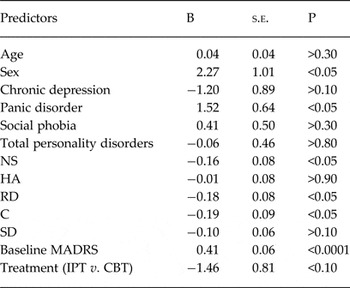
As noted in the section Methods, in the next step of the modelling procedure, the statistically significant predictors shown in Table 1 were entered into a multivariate mixed effects regression model. For the purposes of this modelling procedure, age and sex were retained in the model despite not being significantly (p < 0.05) associated with MADRS score to 40 weeks. Also, given that three of the four personality disorder cluster measures were significantly (p < 0.0001) associated with MADRS score, it was decided to use the measure of ‘total number of personality disorder diagnoses’ in the multivariate model. Finally, treatment modality (CBT v. IPT) was entered into the model simultaneously with the other predictors.
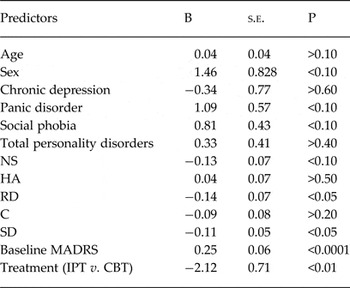
The results of this analysis are shown in Table 3, which displays the parameter estimates, standard errors and tests of significance for the final fitted model. The Table shows:
-
1. Only four predictors were found to be significantly associated with MADRS score to 40 weeks. These were: reward dependence (p < 0.05), self-directedness (p < 0.05), baseline MADRS (p < 0.0001), and treatment modality (p < 0.01). Those participants higher in reward dependence and self-directedness had lower MADRS scores to 40 weeks. Those with higher baseline MADRS scores had higher scores to 40 weeks, and those receiving CBT had lower MADRS scores to 40 weeks than those receiving IPT.
-
2. Several predictors were marginally (p < 0.10) associated with MADRS scores, including gender (females had marginally higher MADRS scores); panic disorder and social phobia (those with these disorders had marginally higher MADRS scores); and novelty-seeking (those with higher NS scores had marginally lower MADRS scores).
-
3. There was also a statistically significant (p < 0.0001) trend for time in the model, such that MADRS scores decreased over the period to 40 weeks.
-
4. There was no evidence of statistically significant (p < 0.05) interactions between treatment and any of the predictors in the model.
Multivariate associations between MADRS score (weeks 3–40) and predictors

The results of the treatment by predictor interactions analysis suggest that lower levels of depression were associated with higher scores on personality measures (reward dependence and self-directedness), lower baseline MADRS, and receiving CBT rather than IPT. Higher levels of depression were marginally associated with female gender, panic disorder, and social phobia, and lower levels of depression were marginally associated with higher levels of novelty seeking. There was no evidence of differential response to CBT or IPT by predictors.
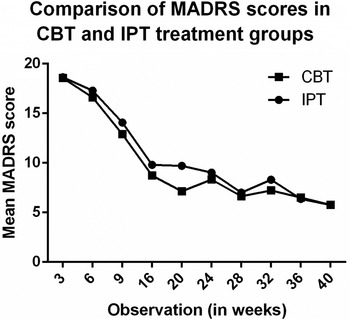
The difference in treatment modality is represented in Fig. 2, which shows the observed mean values on the MADRS for the CBT and IPT groups to 40 weeks. The figure confirms the presence of a small but detectable difference between treatment modalities in terms of symptoms as measured by the MADRS.
Comparison of MADRS scores in CBT and IPT treatment groups.

Supplementary analyses
HAM-17 and BDI measures
As noted in the section Methods, the analyses reported above were repeated, using both the HAM-17 (clinician-rated) and BDI-II (self-report) measures of depression at baseline, and at each observation to 40 weeks. The results of these analyses were largely congruent with those presented above, demonstrating significantly (p < 0.05) lower levels of symptoms to 40 weeks in the CBT group (v. the IPT group), and lower levels of symptoms for those with higher levels of reward dependence and self-directedness.
Multivariate model of associations between MADRS score and predictors to 16 weeks
Also as noted in the section Methods, we reanalysed the 16 week outcome data using an identical general linear missed effects regression model. The multivariate model of associations between predictors and MADRS scores to 16 weeks is presented in Table 4. The table shows that six predictors were found to be significantly associated with MADRS scores to 16 weeks. These were gender (p < 0.05), co-morbid panic disorder (p < 0.05), novelty seeking (p < 0.05) cooperativeness (p < 0.05) and baseline MADRS (p < 0.0001). The effect of treatment (IPT v. CBT) was marginally (p < 0.10) significant. There was no evidence of statistically significant (p < 0.05) interactions between treatment and any of the predictors.
Multivariate associations between MADRS score (weeks 1–16) and predictors

Discussion
This study reports that CBT was significantly more effective than IPT in reducing depressive symptoms over 40 weeks of acute and maintenance treatment. To our knowledge this is the first RCT to report this. The finding was consistent when using clinician rated symptoms (MADRS or HAM-17) or self-report (BDI-II). When we reanalysed the acute outcome data at 16 weeks using an identical linear mixed effects regression model, we found a trend favouring cognitive behavioural therapy but this was not significant until the end of maintenance treatment. This finding was consistent with our prior analysis (Luty et al. Reference Luty, Carter, Mckenzie, Rae, Frampton, Mulder and Joyce2007). It should be noted that the clinical relevance of this finding is limited. As seen in Fig. 2 by the end of treatment there was no overall difference in outcome. The remission rate, defined as a 60% reduction in MADRS score was achieved at some point in treatment in 77.2% of those receiving CBT and 75% of those receiving IPT. Nevertheless, CBT appears more effective than IPT particularly at the beginning of maintenance treatment.
Using a linear mixed effects regression model there were no differential predictors of response to CBT v. IPT at 16 weeks or 40 weeks. This is in contrast to what we found using step-wise multiple regressions in our prior analysis (Joyce et al. Reference Joyce, Mckenzie, Carter, Rae, Luty, Frampton and Mulder2007). We previously reported that personality pathology adversely affected outcome for patients randomised to IPT but did affect outcome for those randomised to CBT (Joyce et al. Reference Joyce, Mckenzie, Carter, Rae, Luty, Frampton and Mulder2007). The reasons that we did not replicate this initial finding may reflect the more sophisticated analysis using a general linear mixed effects regression model which allows for fixed and random effects. The analysis compares subjects over four time points rather than the beginning and end of acute treatment, and also compares MADRS scores rather than those who obtained a 60% reduction of MADRS scores.
Some variables were associated with response to treatment at 16 weeks. These were female gender, the presence of comorbid panic disorder and lower TCI novelty seeking (NS), reward dependence (RD) and cooperativeness (C) scores, which predicted poorer responses to either psychotherapy. Similar variables were also associated with overall response to treatment at 40 weeks. Of our pre-specified depression characteristics only chronicity was associated with a poorer outcome in the bivariate model but did not remain in the multivariate model. Comorbid panic disorder and social phobia predicted worse outcomes but again did not remain in the multivariate model. Personality variables were more strongly associated with outcome. Cluster A and C personality disorder diagnoses, total personality disorder symptoms, as well as NS, HA (harm avoidance), RD, C and self-directedness (SD) scores were all associated with outcome in the bivariate model. In the final model low SD and low RD were associated with a poorer outcome.
Our results regarding patient predictors of outcome are consistent with most other studies. They suggest that depression characteristics are only weakly associated with outcome with only chronicity entering the final model, and then non-significantly. While comorbid panic disorder and social phobia were associated with worse outcome in the univariate model, they were not significant in the final model. The most important patient predictors appear to be personality measures. This finding is now the most reported in the literature. A recent meta-analysis concluded that patients with co-morbid personality disorders were twice more likely to have a poor outcome than those without personality disorders (Newton-Howes et al. Reference Newton-Howes, Tyrer, Johnson, Mulder, Kool, Dekker and Schoevers2014). This finding extends to all types of treatment and may be more significant over the longer term. While we found that total personality disorder symptoms were significantly co-related with a poor outcome in bivariate analysis, the character trait of low SD (seen as a general measure of personality pathology) and the temperament trait of low RD were predictors of poor outcome in the final model.
High SD scores have been consistently related to better outcome in a number of studies. These included response to psychotherapy in eating disorders (Bulik et al. Reference Bulik, Sullivan, Carter, Mcintosh and Joyce1999) as well as treatments for alcohol dependence (Foulds et al. Reference Foulds, Mulder, Newton-Howes, Adamson, Boden and Sellman2016). RD has been less consistently related to outcome. RD is characterised as tendency to respond markedly to signals of reward, particularly to verbal signals of social approval, social support and sentiment. It is possible that such traits might be associated with a stronger patient–therapist relationship.
Limitations
Like all psychotherapy studies patients needed to be willing and motivated, which may have excluded patients with more severe or melancholic depression. Around one third of patients had missing data at some point during this study. Researcher allegiance is a known risk of bias in psychotherapy (Munder et al. Reference Munder, Brutsch, Leonhart, Gerger and Barth2013). We attempted to minimise this by using only five therapists. Two had prior training in IPT and required training in CBT. Three had prior training in CBT and required training in IPT. When outcomes were examined based on therapist there was no significant effect.
Generalisability
This study was designed to closely mimic clinical practice. All patients were referred from primary or secondary care. There were minimal exclusion criteria, for example, nearly one in five patients had a lifetime diagnosis of alcohol dependence and around one third fulfilled criteria for one or more personality disorders. Like most psychotherapy studies the majority of patients (74%) were female. All therapists were experienced and closely supervised throughout the study which may have enhanced the therapeutic response.
Conclusion
CBT and IPT are associated with a reduction in depressive symptoms, which is maintained for 10 months. CBT was modestly but significantly more effective at reducing symptoms over this period largely due to early response. In general predictors of outcome are weak. There were no differential predictors of response to IPT or CBT at 16 weeks or at 40 weeks. The most useful predictors are measures of personality pathology, which are associated with a significantly poorer outcome.
Acknowledgements
The authors would like to thank Dr Jonathan Williman for his statistical advice. We also wish to thank Andrea Bartram, Robyn Abbott and Isabel Stevens for patient and data management. This study was funded by the Health Research Council of New Zealand.
Declaration of Interest
The authors have no conflicts of interest.