


1. Introduction
Recent years have witnessed an effort to formally explicate the concept of explanatory power. In layman terms, explanatory power is a measure of the strength of explanations. The project of explicating explanatory power is related to the much older project of explicating the concept of (scientific) explanation, pioneered in Hempel and Oppenheim’s (Reference Hempel and Oppenheim1948) work. However, as Schupbach and Sprenger (Reference Schupbach and Sprenger2011) have convincingly argued, a complete analysis of explanation is not required for an analysis of explanatory power: one can investigate the logic of explanatory power without being committed to the exact logic of explanation.
The latter work, which began the most recent discussion on the subject, proceeds by explicating explanatory power in a Bayesian framework by providing a probabilistic measure of explanatory power. Crupi and Tentori (Reference Crupi and Tentori2012) accept the methodological premise of Schupbach and Sprenger but criticize the exact execution, advancing their own Bayesian measure. Much earlier investigations into the notion of explanatory power and ways of measuring it include Popper (Reference Popper1959) and Good (Reference Good1960) and more recently, following Good’s approach, McGrew (Reference McGrew2003). Schupbach (Reference Schupbach2012) and Cohen (Reference Cohen2016) compare the different measures on various dimensions.
Throughout this work, I denote with e some explanandum (the thing to be explained) and with h some explanans (the thing that explains); these letters should be read as variables in a propositional language. Intuitively, we say that the explanatory power of h 1 over e is greater than the explanatory power of h 2 over e whenever h 1 is better than h 2 in explaining e. Schupbach and Sprenger (Reference Schupbach and Sprenger2011) explicate the notion of the explanatory power of h over e as the ability of h to decrease the degree to which e is surprising, or increase the degree to which e is expected. This general idea of explanatory power will be assumed throughout this work.
The concept of expectedness is valuable as it is directly related to the notion of conditional probability: whenever the explanans h makes the explanandum e more expected, the probability of e given h is higher than the probability of e (i.e.,  ).
Next, Schupbach and Sprenger put forward some conditions of adequacy (CAs) that any measure Ep must satisfy in order to count as an explanatory measure.Footnote 1 Below is a list of those CAs (taken from Schupbach and Sprenger Reference Schupbach and Sprenger2014) that are crucial for my discussion.
CA1. There exists an analytic function g such that, for any contingent e, h and any regular P,  . Values of Ep(e, h) range in [−1, +1].
CA1 states that an explanatory measure Ep(e, h) is a function that takes an explanandum e and an explanans h and returns a value between −1 and 1 and that is sensitive to the values of  ,
 , and P(e). The range [−1, 1] is stipulated by Schupbach and Sprenger without much justification; although this assumption can be contested, this work will not take issue with it.
CA2–CA4 make explicit the connection between explanatory power and expectedness, understood in probabilistic terms.
CA2. Ceteris paribus, the greater the degree of statistical relevance between e and h, the greater the value of Ep(e, h).
CA3. If h 2 is probabilistically independent from e, h 1, and their conjunction, then  .
CA4. If ¬h logically entails e, then the values of Ep(e, h) do not depend on the values of P(h). Formally, there exits a function f such that if  , then either
 or
 .
For a critical discussion on these CAs, see Crupi and Tentori (Reference Crupi and Tentori2012, 366) and Schupbach and Sprenger (Reference Schupbach and Sprenger2014).
Schupbach and Sprenger show that any measure Ep satisfying CA1–CA4 must be a monotonically increasing function of the posterior ratio  (Reference Schupbach and Sprenger2011, 112). From CA1 to CA4, taken together with three additional CAs (see 112–13), Schupbach and Sprenger derive a unique measure of explanatory power ℰ:
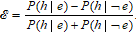
They then prove their theorem 3 about ℰ, which is important for my discussion (115):
Theorem 3. If  … and
 , then:
[i] if
 , then ,
[ii] if
, then , and[iii] if
, then .


According to theorem 3, whenever we add an irrelevant explanandum e′ to e, if h has a positive (negative) explanatory power over e, then h has a lower positive (higher negative) explanatory power over  (cases i and ii). If h was irrelevant to e, h stays irrelevant with regard to
 (case iii). When we focus on the case of positive explanatory power (case i of the theorem), theorem 3 seems intuitive: when we add totally irrelevant explanandum e′ to an explanation, the explanation weakens. This is because the explanans h only explains one of the conjuncts but not the conjunction as a whole. For example, the explanatory power of “there is a fire in the library” (h) would be weakened if it needed to explain that “it is Wednesday” (e′) in addition to explaining the rising smoke above the library (e).
Theorem 3, however, was not accepted without criticism. Crupi and Tentori have argued that the theorem’s second case is counterintuitive and should be rejected (Crupi and Tentori Reference Crupi and Tentori2012, 370). Their criticism rests on a principle they call Explanatory Justice (EJ), which states that “a certain amount of explanatory success of h concerning e, no matter how large, cannot be extended ‘for free’” (370). EJ states that irrelevancy cannot improve explanation. Case i of theorem 3 seems to respect EJ, in that adding an irrelevant explanandum strictly decreases the explanatory power of h. In contrast, Crupi and Tentori think that case ii of the theorem fails to satisfy EJ. They argue as follows: in cases in which  , h fails to explain e. When we add an irrelevant e′ to e, we get that
 (by theorem 3, case ii). Adding e′ mitigated the failure of h in explaining e. But this is a direct violation of the EJ principle: we increased the success of explanation h; that is, we mitigated its failure “for free” by adding an irrelevant explanandum. The process of adding irrelevant explananda can be repeated such that each time the value of h is mitigated more and more. Crupi and Tentori conclude that such a result is highly troubling for any respectable measure Ep. I will call this criticism the EJ criticism.
In response, Crupi and Tentori formalize the EJ principle as a CA (CA-EJ) in the following manner (Reference Crupi and Tentori2012, 371):
CA-EJ. For any two different e, e′: if e′ is probabilistically independent from e, h and their conjunction, then:
• if
, then • if
, then .


This CA states that whenever h fails to explain e (has negative explanatory power), adding an irrelevant e′ will not change its degree of negative explanatory power, and whenever h has positive explanatory power, adding an irrelevant e′ will decrease its explanatory power.
Crupi and Tentori then define a new explanatory measure that satisfies this CA together with other CAs that are sufficiently similar (for our discussion) to those of Schupbach and Sprenger that I presented earlier. Their resulting measure is ℰ*:
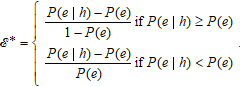
Measure ℰ* will be discussed throughout the next section of this essay. For the remainder of this section, I present two of Schupbach and Sprenger’s (Reference Schupbach and Sprenger2014) arguments against Crupi and Tentori’s EJ criticism.
First, Schupbach and Sprenger argue that Crupi and Tentori rely on the fact that lack, or failure, of explanatory power is an ambiguous concept. When h has negative explanatory power with respect to e, and when we add 1,000 irrelevant explananda to e, we would by all means like to say that h became much less relevant to this long conjunction. Irrelevance is represented with  , so it makes sense that the ℰ approaches zero in such cases, and this is exactly what case ii of theorem 3 says. However, ℰ* does not approach zero in such cases; that is, it does not become less and less relevant when adding 1,000 irrelevant explananda, which is counterintuitive. Such a response, however, can be interpreted as a clash of intuitions regarding the notion of explanatory power, and in what follows (sec. 2) I put forward an argument against ℰ* that does not depend on such intuitions. In section 3, I readdress the ambiguity of negative explanatory power.
Schupbach and Sprenger’s second argument against the EJ criticism relies on a De-Morgan equivalence and on the following symmetry condition on explanatory measures:  .Footnote 2 According to this condition, whenever the value of Ep(e, h) is negative, we should understand h as explaining the negation of e. If according to Crupi and Tentori, whenever
 and e′ is independent of e, h, and their conjunction, then

then, by symmetry

By the De-Morgan equivalence, it follows that  .Footnote 3 This, Schupbach and Sprenger argue, is also counterintuitive; why should h explain ¬e with the same strength it explains the logically weaker
 ? The explanatory power of h to ¬e should be greater than that of
 . Again, the counterintuitive result is even worse in cases of 1,000 irrelevant explananda (the logical equivalence still holds). This problem does not arise with the explanatory measure ℰ.
In the reminder of this article I wish to defend Schupbach and Sprenger’s original measure ℰ from the EJ criticism. In section 2, I show how a similar argument of violating EJ can be used against Crupi and Tentori’s own proposed measure ℰ*. This will show that ℰ* does not fulfill its creators’ standards. In section 3, I defend the measure ℰ against the EJ criticism.
2. Explanations with Irrelevant Disjuncts
As mentioned, the EJ principle informally states that it should not be possible to extend explanatory success for free. In what follows, I show that it is possible to increase the value of measure ℰ* when it is below zero by adding irrelevant propositions to the explanans by disjunction. Then, a similar argument that Crupi and Tentori made against Schupbach and Sprenger’s measure can be made against their own proposed explanatory measure. If an explanans h has a negative explanatory power over some event e, it seems intuitively unreasonable that after appending some irrelevant explanation h′ to h by disjunction, the explanatory power of  over e will increase. But this, I will argue, is what Crupi and Tentori’s measure predicts. An example illustrates this point:
Example 1. Let e, h, and h′ be such that
• e = Die A returned two even numbers in two consecutive rolls.
• h = Die A is a normal die, apart from the fact that the side with the number 6 was erased and replaced with the number 1.
• h′ = Die A is red.
Assume that  ,
 , and
 (the color of the die is irrelevant to its outcome).
In such a situation it is clear that since  the explanatory power of h over e is negative:
 . This can be intuitively clarified by observing that if h is true, then e is more surprising and less expected. Now, if you ask “why did the die return two even numbers?” the explanation “either because I erased the 6 and replaced it with a 1 or because the die is red” is not a better explanation than “because I erased the 6 and replaced it with a 1.” Both explanations are bad. Respecting the informal idea behind EJ, we would not want to increase the power of h by adding to it the probabilistically irrelevant h′ by disjunction. But proposition 1 implies that we can do exactly that (proof in the appendix):
Proposition 1. If  and
 ,
 and
 , then
 .
Since  , the adding of irrelevant information (“the die is red”) supposedly increases explanatory power for free. Clearly, this violates the EJ principle as it was informally characterized by Crupi and Tentori. Proposition 1 is counterintuitive for the following reason: we have an h that fails to explain e as it makes e more surprising. We weaken h by adding to it the irrelevant h′ by disjunction. Just by this weakening, there is no reason to suppose that the explanation becomes any better or more powerful. Logically weaker explanations should not result in more powerful explanations. But proposition 1 shows that this is the case, at least when Crupi and Tentori’s measure ℰ* is considered.Footnote 4
What can be done then? One option is to expand the EJ CA (CA-EJ) such that it will cover the disjunctive explanations cases to something like CA-EJ*.
CA-EJ*. For any two different e, e′ and two h, h′, if  ,
 ,
 ,
 ,
 , and
 , then
1. if
, then 2. if
, then 3. if
, then 4. if
, then .


The new clauses state that whenever h has a positive explanatory power over e, adding to the explanans an irrelevant disjunct will result in a decrease of the explanatory power, but whenever h has negative explanatory power over e, adding irrelevant explanation by disjunction does not change its explanatory power.
As proposition 1 shows, the measure ℰ* violates clause 4 of CA-EJ*. If it is agreed that CA-EJ* represents the informal idea of the EJ principle, then one must conclude that both ℰ and ℰ* do not satisfy the EJ principle, despite the intentions of Crupi and Tentori.
Considering ℰ, it is possible to extend Schupbach and Sprenger’s theorem 3 in the following way (proof in the appendix):
Proposition 2. For any two different h, h′: if  ,
 , and
 , then
i) if
, then ii) if
, then iii) if
, then .


Theorem 3 and proposition 2 treat irrelevant information in a uniform manner: both say that the more irrelevant information you add, the closer ℰ gets to zero. Proposition 2 also shows that ℰ violates clause 4 of CA-EJ* in addition to the violation of clause 3, which theorem 3 has shown. Clearly, if one takes theorem 3 to be a desirable result of ℰ, one should also take proposition 2 to be desirable.
Can an explanatory measure that satisfies CA-EJ* and other crucial conditions be constructed? It might very well be the case, but this is not my aim here. My aim is to show that ℰ* fails to satisfy its creators’ goals; it also violates the EJ principle. In the next section I will argue that results like theorem 3 and proposition 2 should not be a cause for concern; on the contrary, they are welcome. This will be done by a careful interpretation of the range of the discussed measures. A result of such interpretation is that the original measure ℰ of Schupbach and Sprenger avoids the EJ criticism.
3. The Measure ℰ and Explanatory Justice
It seems unreasonable to argue against the idea behind the EJ principle. Irrelevant information should not increase explanatory power. In this section, I argue that the EJ problems presented above are connected with the way we interpret the phrase “extending explanatory power” and not with the EJ principle itself.
Recall that the range of ℰ is [−1, +1]. From Crupi and Tentori’s criticism, it follows that they understand the phrase “extending explanatory power” as a move to the right direction on the interval [−1, +1]. This is why they think that  is counterintuitive whenever
 holds (where e′ is irrelevant). According to Crupi and Tentori, whenever h is fixed and the value of Ep given e 1 is to the right of the value of Ep given some other e 2 for any two points on the interval [−1, +1], the explanatory success of e 1 is greater than of e 2. Although this is a very commonsensical interpretation of the values of Ep, it is not necessary to accept it. In fact, there are some good reasons to reject such an interpretation.
This interpretation leads to the counterintuitive results expressed in the EJ problems discussed above. When we consider the subinterval [−1, 0], the interpretation of “the move to the right” as an increase in explanatory success seems to conflict with our intuition regarding explanatory power. This happens both for ℰ and ℰ*, as I have shown in section 2. There is an apparent difference here between the subintervals [−1, 0] and [0, 1], since no analogous EJ argument is made against the latter subinterval. In [0, 1], it seems intuitive to understand the movement to the right as an increase in explanatory power. I will seek to clarify and explain this difference in the following paragraphs.
Given the symmetry condition on an explanatory measure, a condition that both Schupbach and Sprenger and Crupi and Tentori accept, the negative value of a measure Ep(e, h) should be understood as measuring the positive explanatory power of h with respect to ¬e. This follows immediately from the formulation of symmetry as  . This is clearly the way Schupbach and Sprenger interpret symmetry, as evident in both (Reference Schupbach and Sprenger2011, 113) and (Reference Schupbach and Sprenger2014, 10). Thus, the concept of negative explanatory power is nothing more than the positive explanatory power of the negation of the explanandum.
With this in mind, explanatory power can be interpreted on the intervals [−1, 0], [0, 1] separately. Whenever the value of the explanatory power of h given e is negative, it is interpreted as a degree of the explanatory power of ¬e. Then, one can understand an increase in explanatory power in the following way:
• the more you move to the right on [0, 1], your explanation of e gets stronger, and the more you move to the left, the explanation of e becomes weaker.
• In contrast, the more you move to the left on [−1, 0], your explanation of the negation of e gets stronger, and the more you move to the right, the explanation of the negation of e gets weaker.Footnote 5
The gist of this interpretation is that the closer you get to zero (the midpoint), the explanation gets weaker and less relevant, while the closer you get to the extreme values +1 or −1, your explanation of e or its negation gets more powerful, respectively.Footnote 6 Such a reading of ℰ dissolves the EJ criticism in the following way: whenever  , the adding of the irrelevant e′ weakens the explanatory power of the negation of e. This is expressed by the result that
 is closer to 0, the irrelevance point, than ℰ(e, h). The EJ principle is not really violated; the explanatory power of h in explaining ¬e did decrease by the addition of the irrelevant e′. The same goes for adding an irrelevant h′ by disjunction. If Crupi and Tentori are dissatisfied with this interpretation of the range [−1, 1], they should argue against the symmetry condition and not directly against the measure ℰ. However, as Schupbach and Sprenger (Reference Schupbach and Sprenger2014, 11) argued, Crupi and Tentori seem to endorse the symmetry condition with its natural interpretation.
4. Conclusion
In this work, I have traced some advancements and a recent debate in the explication of explanatory power. I tried to show how proponents of the explanatory measure ℰ can defend themselves against some of Crupi and Tentori’s criticisms. I have shown that Crupi and Tentori’s explanatory measure ℰ* also fails to satisfy an aspect of the EJ principle, that of irrelevant disjuncts in the explanans. This failure suggested that there is a more general problem here. In response, I argued that a careful reading into the original way Schupbach and Sprenger understand the concept of negative explanatory power via symmetry dissolves the EJ criticism.
This affirms Schupbach and Sprenger’s original arguments against Crupi and Tentori but lifts the debate beyond mere disagreement about intuitions. As it stands, Crupi and Tentori’s position does not satisfy its own demands and is thus inferior to Schupbach and Sprenger’s position. I conclude that there is no reason to abandon ℰ in light of Crupi and Tentori’s EJ criticism.
Appendix
Proof of Proposition 1
First we prove for all h 1, h 2, if  , then
 . Call
 and
 , then
 . We plug y and z in ℰ*:

and

Since  it follows that

so the numerator of the second fraction is larger (closer to zero). So

It is now sufficient to show that  whenever both are smaller than P(e), and when
 ,
 , and
 . To do so, we use x to represent the difference between
 and P(e)P(h), such that

Thus,

Now we consider  :

by logical equivalences and the rules of probability. We now plug in the underlined equation, and use the assumed independences:
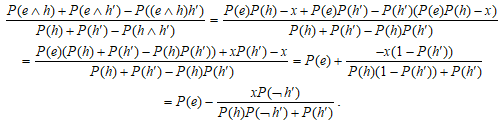
It is clear that
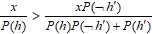
(as  , where all parameters are strictly between 0 and 1) and so that

which is

By the first step of the proof, we get  . QED
Proof of Proposition 2
We start with the second case of the proposition. To show that  , it is sufficient to show that the numerator of ℰ(e, h) is smaller than the numerator of
 . We start by calculating the numerator of ℰ(e, h). By assumption,

for some positive fraction α that is less than 1. Similarly,

for some positive fraction β. The numerator of ℰ(e, h) is

By observation, this expression is negative, as needed. Now we consider the numerator of  :
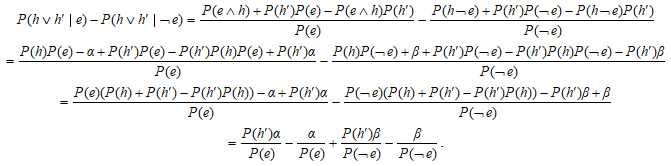
Since  and
 are positive, the numerator of
 is larger than of ℰ(e, h). Also, since
 and
 are smaller than
 and
 by observation, it holds that

so case ii holds. By very similar calculation (replacing the −α with +α and +β with −β), case i is proven.
For case iii we assume  (so
 ) and consider
 (the numerator of
 :

as needed. The numerator of  is zero, so
 . For ℰ(e, h), consider its numerator:
 . So,
 , as needed. QED



