Sichuan Province, known as the Land of Abundance, is located in southwest China. The Yangtze River and its tributaries flow through the mountains of Western Sichuan and the Sichuan Basin. Unfortunately, people who live in Sichuan endure a great deal of suffering because of earthquakes. An earthquake with a magnitude of 8.0 on the Richter scale occurred in Wenchuan County on May 12, 2008. This earthquake was the most catastrophic since the founding of new China. Nearly 70 000 people died during this disaster, and millions of families lost their homes. On April 20, 2013, a magnitude 7.0 earthquake occurred in Lushan County, affecting more than 2 million people. These frequent earthquakes affected the communities and lives of people in Sichuan.
Health-related quality of life (HRQOL) is related to self-reported chronic diseases (eg, diabetes and cancer) and their risk factors (eg, social support and mental disorders). HRQOL measurements can help determine the burden of preventable diseases, injuries, and disabilities, and, in turn, provide valuable insights into the relationships between HRQOL and risk factors. Obtaining HRQOL measurements also aids in monitoring the progress in achieving national health objectives.Reference Moriarty, Zack and Kobau 1 Shortly after the Wenchuan earthquake, many researchers became concerned with certain vulnerable groups.Reference Tian, Jia and Duan 2 , Reference Zhang, Hu and Reinhardt 3 In 2013, another 5 years later, Lushan experienced an earthquake. However, few studies have been conducted to assess the general HRQOL of residents living in post-earthquake zones.
To adapt refers to making changes or adjustments to fit or survive in a given environment. Adaptation denotes the process of adjusting to changed conditions. In the field of natural disasters, this concept has been applied to policy responses,Reference Smit, Burton, Klein and Street 4 particularly for climate change.Reference Füssel 5 The definition of adaptation involves the multifaceted characteristics of systems, including ecological, economic, social, and political aspects. Studying the adaptation of survivors under post-disaster conditions may help accelerate recovery and serve as a guide to prepare for future disasters.Reference Berke, Kartez and Wenger 6 However, most adaptation or vulnerability studies have focused more on climate change than on other types of natural hazards. Thus, limited information is available on the adaptation of residents living in post-earthquake zones.
Previous studies have indicated that mental healthReference Green 7 and family cohesionReference Tatsuki and Hayashi 8 were associated with the adaptation to harsh conditions (APHC) after disasters. Experience and adaptation related to these incidents promote the civic mindedness of survivors in a community.Reference Takeda, Tamura and Tatsuki 9 Furthermore, disaster reconstruction significantly predicts the recovery of survivors.Reference Tatsuki and Hayashi 10 Therefore, this study surveyed residents living in the post-earthquake zones of Sichuan to determine the effect of HRQOL on APHC. The objectives of this study were to (1) provide empirical information about the HRQOL and APHC of residents living in post-earthquake zones; (2) analyze the effects of HRQOL on APHC and elucidate the effect mechanisms; and (3) provide the government and social organizations with suggestions for improving the APHC of residents living in post-earthquake zones.
Methods
Data were obtained from a sample survey of 5 counties in Sichuan in May and June 2013. Multistage sampling was mainly used. First, 5 cities (Aba, Guangyuan, Deyang, Ya’an, and Chengdu) were selected from 39 areas greatly affected by the earthquakes. Then 1 county (Wenchuan, Qingchuan, Mianzhu, Lushan, and Dujiangyan) was selected from each city, and 400 survivors were randomly selected from each county. All selections were performed by simple random sampling.
Questionnaires were mainly distributed in the resettlement area that was built for survivors after the earthquake. Each participant independently completed the questionnaire under the instructions of investigators. A total of 1672 questionnaires were returned from the 2000 distributed, indicating an effectiveness rate of 83.6%.
Health-Related Quality of Life
The study uses a 12-item Short Form Health Survey (SF-12) to measure HRQOL. SF-12, which is a shorter version of the 36-item Short Form Health Survey (SF-36), helps to evaluate the quality of care in managed care plans and other health care applications. The validity of the Chinese version of the SF-12 has been previously proven.Reference Lam, Tse and Gandek 11 , Reference Liang and Wu 12 The SF-12 briefly reproduces 8 domain profiles with few items. It is a practical alternative to the SF-36Reference Gandek, Ware and Aaronson 13 , Reference Failde, Medina, Ramı´rez and Arana 14 while it promotes efficiency and decreases economic costs. Unlike the 5-dimensional European quality of health scale, SF-12 is sensitive to differences related to slight morbidity.Reference Johnson and Coons 15 Previous studies have also proven that SF-12 is a feasible and acceptable approach for evaluating earthquake survivors.Reference Kun, Wang and Chen 16 , Reference Xu and Ou 17
SF-12 has 8 domains: physical function (PF), role physical (RP), bodily pain (BP), general health (GH), vitality (VT), social function (SF), role emotional (RE), and mental health (MH). The scale can also be divided into 2 domains: physical component summary (PCS) and mental component summary (MCS). PCS includes PF, RP, BP, and GH, and MCS includes VT, SF, RE, and MH.
Adaptation to Harsh Conditions
The complete success or the full recovery of a community’s former status involves multiple factors,Reference Xu and Li 18 and it may require a long time, because post-disaster reconstruction is an extensive long-term project that requires 7 to 10 years of economic development, risk mitigation, and poverty alleviation.Reference Dunford and Li 19 The Lushan earthquake intensely affected 32 areas, including Ya’an, Chengdu, and Deyang, causing various degrees of damage to infrastructures. 20 The investigation was conducted 1 month after the Lushan earthquake, in May and June 2013. The investigation conducted at that particular time could potentially measure well the APHC of residents living in post-earthquake zones. Therefore, the APHC has some available reference values.
The Chinese government has given tremendous effort to the post-earthquake reconstruction of Sichuan. An official 2008 document, titled “Master national plans for reconstruction work after Wenchuan earthquake,” emphasized public services (including education, technology, health services, and social security), infrastructure, and ecological environment during reconstruction. 21 Based on this document, we developed a simple scale to measure the APHC of residents living in post-earthquake zones. The respondents were asked to evaluate the extent to which they have adapted to the bad ecological environment and the poor infrastructure, health service, social security system, education system, and technology system. A 5-point scale (“totally not,” “not much,” “moderate,” “much,” and “very much”) was used; a higher score indicated that the respondent had better opinions toward APHC.
Results
Reliability Tests
Reliability tests were conducted on the 2 scales. Reliability was evaluated by determining the system variation proportion of the scales, and it was reflected by the Cronbach α coefficient, which was expressed as follows:
 $$\alpha ={K \over {K{\minus}1}}\left( {1{\minus}{{\sum_{{{\rm i=1}}}^{K} \sigma _{{{\rm Y}_{i} }}^{2} } \over {\sigma _{X}^{2} }}} \right)$$
where K is the number of samples,
 $\sigma _{{\rm X}}^{2} $
is the variance of the total sample, and
 $\sigma _{{{\rm Y}_{{\rm i}} }}^{{\rm 2}} $
is the variance of observed samples. Internal consistency was considered good when the coefficient ranged from 0.7 to 0.8, and reliability was considered very good when the coefficient ranged from 0.8 to 0.9.
Reliability analyses for both scales showed that most of the Cronbach α coefficients of a single item were larger than 0.80. The overall Cronbach α coefficient for the SF-12 and APHC scales was 0.829 and 0.828, respectively. These values indicated good reliability of the scales. The α coefficients of each domain in SF-12 were as follows: 0.802 for PF; 0.807 for RP; 0.812 for BP, GH, and VT; 0.815 for SF; and 0.810 for RE. Only MH had a coefficient less than 0.80 (0.796).
For the domains of the APHC scale, the coefficients were 0.804 for bad ecological environment, 0.794 for poor infrastructure and technology system, 0.803 for poor health services, 0.811 for poor social security system, and 0.800 for poor education system. All coefficients of the domains indicated good internal consistency of a single domain. The results showed that the data were reliable for both scales.
Statistical Analysis
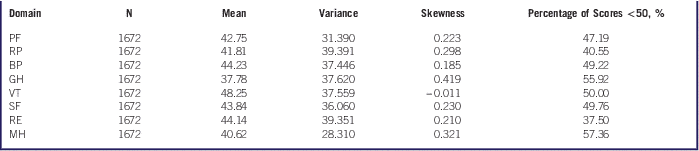
Table 1 shows a descriptive statistical analysis for SF-12, including the mean value. All data were less than the midpoint of the total score (equal to 50). GH had the lowest mean value of 37.78. The skewness of all domains except VT was larger than zero, indicating that the data distribution of most domains was right skewed. The percentage of scores was less than 50 and ranged from 37% to 58%, indicating that the majority of residents living in post-earthquake zones viewed their HRQOL as poor.
Descriptive Statistics for 12-Item Short-Form Health Survey

Abbreviations: BP, bodily pain; GH, general health; MH, mental health; PF, physical function; RE, role emotional; RP, role physical; SF, social function; and VT, vitality.
Table 2 shows the frequency of the APHC scale, including the proportion of the “totally not” option. This option was proportionately larger than the others, indicating that more respondents thought that they could not adapt well to APHC. Among the domains, bad ecological environment had the largest percentage of the “totally not” option (46.35%). The “very much” option was the smallest percentage, indicating that few respondents thought that they had good APHC. The sum of the “totally not” and “not too much” percentages were greater than that of the “much” and “very much” percentages, indicating that many survivors had not adapted well to APHC.
Frequency for Adaptation to Harsh Conditions Scale

Confirmatory Factor Analysis
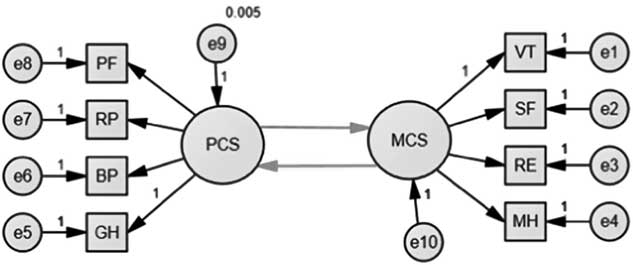
Confirmatory factor analysis (CFA) was used to confirm the correlations among several variables that were presented in the model. Several indicators could be used to evaluate the CFA model. For example, the corrected Akaike information criterion could be used to alleviate the complexity of the model (excessive parameters), whereas Browne-Cudeck criteria (BCC), Bayes information criteria (BIC), and Akaike information criterion could be used to compare several models. For the present study, 2 indicators (BCCL and BICL) were selected as the evaluation standard. A larger value corresponded to a better model, and the largest value was 1. PCS and MCS had mutual influence correlations according to the CFA model (Figure 1).
Confirmatory Factor Analysis (CFA) for the 12-Item Short-Form Health Survey. BP indicates bodily pain; GH, general health; MCS, mental component summary; MH, mental health; PCS, physical component summary; PF, physical function; RE, role emotional; RP, role physical; SF, social function; and VT, vitality.

Figure 1 shows that model 2 was the best model, because the values of BCCL and BICL were both 1, the ratio of the χ2 to the degree of freedom (χ2/df) was 1.50, and the P value was .07. This model reached the standard when the significance level was .05. Thus, MCS showed a significant effect on PCS, whereas PCS showed an insignificant effect on MCS.
Structural Equation Model
The structural equation model (SEM) is widely used in various fields of social sciences. This method estimates the relationship among the observed variables, represents latent variables and factors in a group, and analyzes the relationships among the latent variables. The SEM comprises 2 parts: a testing model or CFA, which aims to test the suitability of the observed variables to measure latent variables or factors; and a structural equation that assesses the correlations among latent variables.
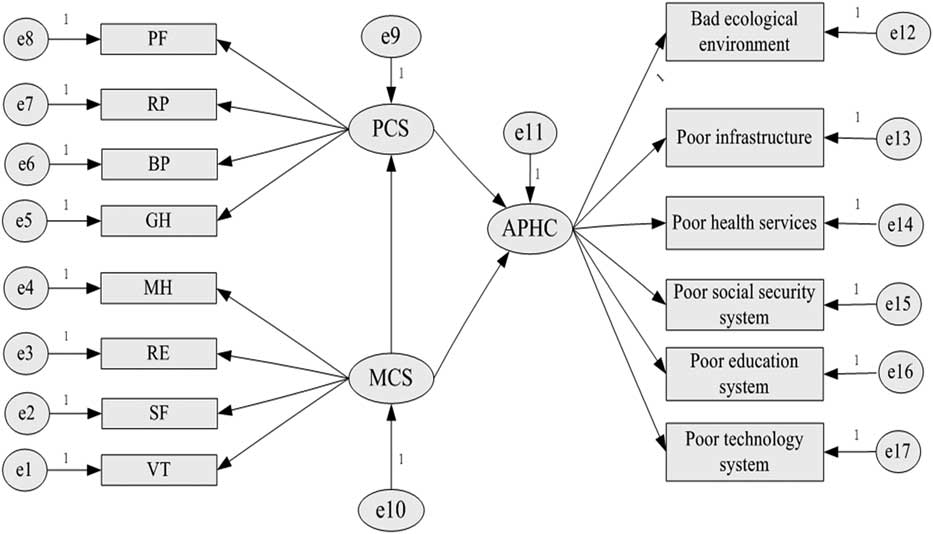
The results of the SEM indicated that PCS had a direct effect on APHC and that MCS exerted an indirect effect by affecting PCS. The SEM model (Figure 2) was established to analyze the effect of PCS and MCS on the APHC of residents living in post-earthquake zones. Except for PCS and MCS, a new latent variable APHC was created to present the APHC of residents living in post-earthquake zones.
Structural Equation Model for the Impact of Health-Related Quality of Life on Adaptation to Harsh Conditions (APHC). See Figure 1 for the explanation of abbreviations.

SEM Goodness of Fit
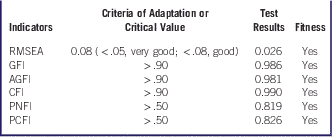
Table 3 shows parts of the indicators for the total goodness of fit of the SEM model. The indicators reached the acceptable standard of a model and were close to the best value, suggesting that the model fit the actual observed data. The external quality and convergent validity of the model were good. In this model, χ2=163.400, df=76, χ2/df=2.150 (<3), and estimated value of the root mean square error of approximation=0.026 (<0.05). In addition, the goodness-of-fit index (GFI), adjusted GFI, and comparative fit index (CFI) were above 0.90. Parsimonious normed fit index and parsimonious CFI were above 0.50. These results showed that the total goodness of the fit was good and acceptable.
Indicators for the Goodness of Fit of Structural Equation Model

Abbreviations: AGFI: adjusted goodness-of-fit index; CFI, comparative fit index; GFI, goodness-of-fit index; PCFI: parsimonious CFI; PNFI, parsimonious normed fit index; RMSEA, estimated value of the root mean square error of approximation.
Path Coefficients for SEM
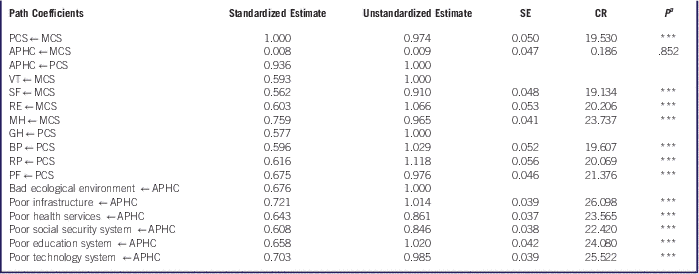
The results of the estimated path coefficients for the SEM are provided in Table 4, and includes the standardized and unstandardized estimates; the standardized error; the critical ratio, which is equivalent to the t-value or z-value; and the P values. The standardized and unstandardized estimates contained certain differences. This study used standardized estimates to analyze the influence size of all variables and to compare the values of each coefficient as a whole.
Path Coefficients for Structural Equation Model

a P<.0001 indicated by triple asterisks (***).
Table 4 showed the following findings:
-
∙ MCS significantly affected PCS. MCS exhibited the largest effect on PCS when the values of the overall standardized factor loadings were compared. This finding indicated that the psychological health of the survivors influenced their physical health.
-
∙ PCS significantly affected AHPC. The factor loading of the PCS was 0.936, which was second only to the factor loading of MCS to PCS. Results indicated that the PCS of residents living in post-earthquake zones affected APHC.
-
∙ MCS had an insignificant effect on APHC. The P value was.852, which was not considered statistically significant. The results indicated that the MCS of residents living in post-earthquake zones did not directly affect APHC but indirectly affected PCS.
-
∙ The standardized factor loadings of the latent variable APHC to the 6 observed variables were significant. The path coefficients of poor infrastructure (0.721) and poor technology system (0.703) were relatively larger than those of the others. The path coefficients of bad ecological environment (0.676), poor education system (0.658), and poor health services (0.643) followed. The path coefficient of poor social security system was the smallest at 0.608. The results indicated that the APHC of residents living in post-earthquake zones had the greatest effect on the adaptation to poor infrastructure and the least effect on the adaptation to poor social security system.
Discussion
This study examined the HRQOL and APHC of residents living in post-earthquake zones and the effect of HRQOL on APHC. The main findings of this study were as follows: (1) the majority of respondents had not adapted well to post-disaster harsh conditions and viewed their HRQOL to be relatively poor; (2) HRQOL positively affected APHC and PCS showed a direct and greater effect, whereas MCS showed an indirect effect by directly affecting PCS; (3) APHC had the greatest effect on the adaptation to poor infrastructure, followed by the adaptation to poor technology system, bad ecological environment, poor education system, and poor health services. The adaptation to poor social security system had the smallest effect.
The results of this study disclosed that residents living in post-earthquake zones hold pessimistic attitudes toward their health and APHC, which is a major concern. The recovery of HRQOL and the improvement of APHC require long-term and consistent attention, yet nearly half of the respondents believe that they absolutely cannot adapt to the bad ecological environment.
Previous studies have shown that the service function of the ecosystem in Sichuan was seriously damaged by the earthquake.Reference Chen, Wu, Yang and Zhang 22 Critical ecosystem services (water retention, soil conservation, and carbon storage) experienced considerable loss.Reference Wang, Fu and Xu 23 Earthquakes caused frequent geohazards that resulted in a great loss of people and harmed the local ecological environment.Reference Yin, Wang and Sun 24 This study showed that nearly 64% of the respondents have not adapted to the bad ecological environment. Thus, the government must realize the urgent need to reduce ecological damage in post-earthquake reconstruction work, particularly in areas with mountains and rivers.
HRQOL influences the adaptation of residents living in post-earthquake zones to harsh conditions to a varying extent. Previous studies have shown that an emergency medical response system is important after a major earthquake.Reference Zhang, Liu and Li 25 Moreover, the government organizes assistance policies that can alleviate the negative effects of earthquake on health.Reference Liang and Wang 26 , Reference Liang and Cao 27 Social support is related to the HRQOL of survivors.Reference Ke, Liu and Li 28
This study shows that HRQOL significantly affects the APHC of residents living in post-earthquake zones, mainly in their physical health. This finding highlights the important effect of physical health on APHC and resilience of sustained life. In addition, the essential role of infrastructure points out the great importance that improved infrastructure has during post-disaster reconstruction. Decision makers should focus on the recovery of the physical health of survivors by providing medical care and completing the construction of infrastructures.
Limitations
This study has a number of limitations. Because earthquakes affect not only various cities in Sichuan but in nearby provinces such as Gansu and Shaanxi as well, future studies should expand the sample scale. Also, the present study focuses solely on how the HRQOL of survivors affects their APHC. The scale is designed to reflect the situation in China and may not be applicable to other countries. In addition, adaptation is a dynamic process; the scale cannot reflect the changes through time because this study used cross-sectional data.
Conclusions
This study assessed the HRQOL and APHC of earthquake survivors in China and explored the effect of HRQOL on APHC. Studies on adaptation have rarely focused on natural hazards. To our knowledge, this study investigated APHC with a new perspective that is innovative in the field of public health preparedness. We developed an APHC scale based on post-disaster conditions in Sichuan. The majority of the residents surveyed believed that they had not adapted well to the difficult post-disaster conditions. The findings showed that HRQOL significantly affected APHC and that PCS had a greater and direct effect, whereas MCS had no direct effect on APHC. In addition, APHC had the greatest effect on the adaptation to poor infrastructure and the least effect on the adaptation to poor social security system. Government and society efforts need to be focused on the reconstruction and APHC improvement of earthquake survivors in Sichuan, China.
Acknowledgments
This paper is supported by the General Program of National Natural Science Foundation of China (71173099 & 71473117), the Youth Program of National Natural Science Foundation of China (70903002), and the Program for New Century Excellent Talents in University (NCET-11-0228).