

Introduction
Conservation planners and practitioners need good information about species population sizes and ranges when deciding how to allocate limited resources, in order to maximise the efficacy of their conservation efforts (Bottrill et al. Reference Bottrill, Joseph, Carwardine, Bode, Cook, Game and Possingham2008). However, such data are not often available, especially for those species that live in fragmented ranges, or which are not subject to consistent and long-term monitoring (Canessa et al. Reference Canessa, Guillera‐Arroita, Lahoz‐Monfort, Southwell, Armstrong, Chadès and Gimenez2015, Franklin Reference Franklin2010). Whilst recognising the need for “ground-truthing”, satellite remote-sensing data have become increasingly important to fill gaps in conservation knowledge, since they offer a way to collect ecological information over a wide temporal and spatial scale without requiring people on the ground to monitor a species or habitat (Rose et al. Reference Rose, Byler, Eastman, Fleishman, Geller, Goetz and Wilson2015). Satellite remote sensing has been used in conservation science to estimate the change in the range and population of various species, including waterfowl (Harrity et al. Reference Harrity, Stevens and Conway2020, Long et al. Reference Long, Zefania, Ffrench-Constant and Szekely2008), to track the rate of degradation of specific ecosystems (Alonso et al. Reference Alonso, Muñoz-Carpena, Kennnedy and Murcia2016), and to measure the efficacy of ecosystem restoration projects (Cordell et al. Reference Cordell, Questad, Asner, Kinney, Thaxton, Uowolo and Chynoweth2017). We used satellite remote sensing to determine the extent of change in the potential habitat of the Endangered Lake Titicaca Grebe (Rollandia microptera) since 2001.
The Lake Titicaca Grebe is endemic to the binational watershed of Lake Titicaca, in Peru and Bolivia (Fjeldså Reference Fjeldså2004, Fjeldså and Krabbe Reference Fjeldså and Krabbe1990, Fjeldså Reference Fjeldså1981), whose conservation status is ranked as “Endangered” (BirdLife International 2021b). It is a member of the monophyletic family Podicipedidae of the order Podicipediformes, a group of conservation priority (O’Donnell and Fjeldså Reference O’Donnell and Fjeldså1997), due in large part to the inability of many species to adapt to anthropogenic disturbances through their reliance on wetlands and low propensity to disperse (O’Donnell and Fjeldså Reference O’Donnell and Fjeldså1997, Fjeldså Reference Fjeldså1984). This vulnerability to anthropogenic change is especially pronounced for endemic grebes isolated in one or a few lakes, of which three, the Atitlan Grebe (Podilymbus gigas), the Colombian Grebe (Podiceps andinus), and the Alaotra Grebe (Tachybaptus rufolavatus), have gone extinct in the last 50 years (BirdLife International 2021a, Fjeldså Reference Fjeldså1993, Hunter Reference Hunter1988). In addition to its endemicity, the Lake Titicaca Grebe has been singled out as a conservation priority because it is an Evolutionarily Distinct and Globally Endangered (EDGE) species (Jetz et al. Reference Jetz, Thomas, Joy, Redding, Hartmann and Mooers2014).
Few surveys have been carried out to provide an adequate baseline figure for its population. However, a series of censuses from the early 2000s suggested that the species was experiencing a rapid population decline (Martinez et al. Reference Martinez, Arabinar and Gutierrez2006, Konter Reference Konter2006, Engblom et al. 2001 unpublished). Martinez et al. (Reference Martinez, Arabinar and Gutierrez2006) suggested that the main driver of this decline was by-catch from monofilament nets that had become increasingly popular around Lake Titicaca. However, although by-catch is undoubtedly a major threat to the species, it is just one of many potential forces that could be reducing the grebe population, including increased pollution in Lake Titicaca (Ibarguchi Reference Ibarguchi2014, Rieckermann et al. Reference Rieckermann, Daebel, Ronteltap and Bernauer2006), competition with introduced salmonids as has harmed other endemic grebe species (Martinez et al. Reference Martinez, Arabinar and Gutierrez2006), and potentially also habitat loss. This last driver is considered important because of a recent rapid lowering of the water level in some of the outlying parts of the Lake Titicaca watershed, especially in Lake Poopó and parts of the Desaguadero River (Perreault Reference Perreault2020, Torres-Batlló et al. Reference Torres-Batlló, Martí-Cardona and Pillco-Zolá2020).
The Lake Titicaca Grebe is entirely aquatic, since its legs appear to buckle when on dry land (Loza-del Carpio et al. Reference Loza-Del Carpio, Mamani Flores and Loza-Del Carpio2019), and its wings are too weak to allow it to fly. It is piscivorous, and forages mainly in open water far from the lake shore (Fjeldså Reference Fjeldså1981). However, it spends its evenings and its breeding period closer to the shore, relying on the wetlands, and especially wetland mosaics, for nesting (Fjeldså Reference Fjeldså1981). The species is highly territorial, and large numbers of aggressive unpaired individuals that lack territories may be challenging territory holders (Fjeldså Reference Fjeldså1981). This suggests that the extent of potential breeding habitat around Lake Titicaca is a limiting factor for the grebe’s population. The species appears to be well adapted to take advantage of any new breeding territory which may occur due to changes in water level, as shown by the existence of a large breeding population in the seasonally dry Laka Jahuira River during the rainy season (Konter Reference Konter2006), and observations of grebes colonising parts of the Lake Titicaca floodplain that are temporarily flooded during the rainy season (Fjeldså Reference Fjeldså1981).
Authors disagree as to how best to categorise the different zones of aquatic vegetation in Lake Titicaca. Iltis and Mourguiart (Reference Iltis, Mourguiart, Dejoux and Iltis1992), Raynal-Roques (Reference Raynal-Roques, Dejoux and Iltis1992), and Guerlesquin (Reference Guerlesquin, Dejoux and Iltis1992) separated Lake Titicaca into three broad aquatic vegetative zones; totora wetland, llacho, and chara, while Tutin (Reference Tutin1940) separated it into the Zanichella–Potamegaton Association, the Myriophyllum–Elodea Association, the Chara Association, and the Sciaromium Association. Totora areas are dominated by sedges, chiefly Schoenoplectus californicus, but with some S. acutus, which can grow several metres above the surface of the water (Raynal-Roques Reference Raynal-Roques, Dejoux and Iltis1992). In the late twentieth century totora wetlands were amongst the most common around Lake Titicaca (Iltis and Mourguiart Reference Iltis, Mourguiart, Dejoux and Iltis1992), but earlier work suggested totora limited to sheltered bays and did not constitute an important ecosystem of its own, instead being superimposed locally on to the Myriophyllum–Elodea Association (Tutin Reference Tutin1940), suggesting a significant expansion in the twentieth century. Llacho areas are dominated by Myriophyllum spp. and Elodea spp. (Iltis and Mourguiart Reference Iltis, Mourguiart, Dejoux and Iltis1992). Llacho areas are characterised by milfoils and other softer aquatic plants which often occur more clumped in distribution than totora, and float near the surface (Iltis and Mourguiart Reference Iltis, Mourguiart, Dejoux and Iltis1992). Chara (Chara spp.) is an alga which occurs frequently in Lake Titicaca (Guerlesquin Reference Guerlesquin, Dejoux and Iltis1992). Historically chara was limited to depths of 9–12 m (Tutin Reference Tutin1940), but more recently blooms of chara have occurred on the surface of the lake, albeit still in areas where lake depth is too great for totora or llacho (Guerlesquin Reference Guerlesquin, Dejoux and Iltis1992). The Myriophyllum–Elodea Association includes what later authors referred to as totora and llacho. The Chara Association corresponds to the chara as described by Guerlesquin (Reference Guerlesquin, Dejoux and Iltis1992). The Zanichella–Potamegaton Association and the Sciaromium Association are both sub-aquatic and irrelevant for this study.
Of the main types of wetland around Lake Titicaca, there is debate as to whether totora or llacho is the more important breeding habitat for the Lake Titicaca Grebe. Fjeldså (Reference Fjeldså1981), Fjeldså (Reference Fjeldså2004), Kent et al. (Reference Kent, Webber and Steadman1999), and Pulido Capurro (Reference Pulido Capurro2018) considered the totora wetland to be the main breeding habitat of the Lake Titicaca Grebe, considering it sympatric with the White-tufted Grebe (Rollandia rolland), which is also found in the totora. However, Martinez et al. (Reference Martinez, Arabinar and Gutierrez2006) considered the totora to be less important as a breeding habitat for the Lake Titicaca Grebe than the less dense llacho-dominated landscapes, a view supported by recent observations by author EGMT. Furthermore, there is some palaeoecological evidence that grebe bones correlate with totora seeds, suggesting that the extent of totora has influenced the grebe population in the past (Bruno et al. Reference Bruno, Capriles, Hastorf, Fritz, Weide, Domic and Baker2021). In this paper we focus on the extent of the totora wetlands since we cannot differentiate between chara or other algal vegetation and llacho using satellite imagery. Whilst this may risk underestimating the potential area of habitat suitable for the Lake Titicaca Grebe, it is generally agreed that chara is not an important habitat for the species, and we considered it prudent to focus on the most likely potential habitat.
Historically, the extent of totora around Lake Titicaca has been heavily managed by the indigenous communities that surround the lake (Banack et al. Reference Banack, Rondón and Diaz-Huamanchumo2004, Stanish Reference Stanish2012, Erickson Reference Erickson and Lentz2000, Levieil and Orlove Reference Levieil and Orlove1990, Reference Levieil, Orlove, Dejoux and Iltis1992). Totora has been harvested by the local people for at least 3,500 years (Erickson Reference Erickson and Lentz2000), and has been used for the construction of houses, boats, and as feed for cattle, sheep, and, historically, for llamas. The harvesting of totora is traditionally tightly regulated by the extended local families in each village, also called ayllus (Levieil and Orlove Reference Levieil and Orlove1990, La Barre Reference La Barre1948), and disputes over totora used to be frequent in the area around Lake Titicaca (Levieil and Orlove Reference Levieil and Orlove1990, La Barre Reference La Barre1948). Totora harvesting is usually restricted to the dry season when fresh green totora is rare (Banack et al. Reference Banack, Rondón and Diaz-Huamanchumo2004, Heiser, Reference Heiser1978, La Barre Reference La Barre1948, Tutin Reference Tutin1940). This harvesting breaks up the dense totora wetlands and creates a mosaic with open water channels which may be a seasonally important habitat for the Lake Titicaca Grebe. However, the growth of construction from concrete and increased use of modern boats appears to have reduced the economic importance of totora (Orlove et al. Reference Orlove, Levieil, Treviño, Dejoux and Iltis1992), and in turn weakened many of the traditional controls on its harvesting (Banack et al. Reference Banack, Rondón and Diaz-Huamanchumo2004, Levieil and Orlove Reference Levieil and Orlove1990). Even the water dwelling Uru Uru, the ethnic group who traditionally most relied on totora from the lake (La Barre Reference La Barre1941), appear to have abandoned the use of traditional totora boats, apart from showing them to tourists (Stanish Reference Stanish2012). Palaeoecological evidence suggests that wetlands around Lake Titicaca were much more extensive in the past, especially at the height of the Tiwanaku civilisation around the lake (Erickson Reference Erickson and Lentz2000), suggesting that the extent of totora has been influenced by the economic activities of the area for several thousand years. There is evidence of burning of totora fields as the plant is no longer valued economically by villagers around the lake (Stanish Reference Stanish2012), but the extent of these burnings is unclear.
While humans are a significant influence on the extent of totora around Lake Titicaca, they are not the only factor that influences totora extent. Given the nature of the totora plant, lake depth is also important, both on a seasonal and a long-term basis (Moreau et al. Reference Moreau, Bosseno, Gu and Baret2003). Since the introduction of totora by humans between 3,500 and 5,000 years BP (Erickson Reference Erickson and Lentz2000, Heiser Reference Heiser1974), Lake Titicaca has experienced fluctuations in lake levels which mean that the lake level has at times been over 70 m lower than the present level (Weide et al. Reference Weide, Fritz, Hastorf, Bruno, Baker, Guedron and Salenbien2017, Baker and Fritz Reference Baker and Fritz2015, Baker et al. Reference Baker, Seltzer, Fritz, Dunbar, Grove, Tapia and Broda2001, Mourguiart et al. Reference Mourguiart, Corrège, Wirrmann, Argollo, Montenegro, Pourchet and Carbonel1998). In the twentieth century alone there has been a 7-m change in the lake level (Hampton et al. Reference Hampton, McGowan, Ozersky, Virdis, Vu, Spanbauer and Fritz2018), and there have been periods of significant flooding which has influenced the extent of aquatic vegetation in the region (Hampton et al. Reference Hampton, McGowan, Ozersky, Virdis, Vu, Spanbauer and Fritz2018, Pawley et al. Reference Pawley, Fritz, Baker, Seltzer, Dunbar, Munawar and Hecky2001). Furthermore, the wider altiplano was covered extensively by lakes and wetlands for much of the Pleistocene (Placzek et al. Reference Placzek, Quade and Patchett2011, Rigsby et al. Reference Rigsby, Bradbury, Baker, Rollins and Warren2005, Cross et al. Reference Cross, Baker, Seltzer, Fritz and Dunbar2001), and the fact that the Lake Titicaca Grebe is a phylogenetically basal species suggests that it existed through this much wetter period in the altiplano (Fjeldså Reference Fjeldså1981). In addition to these long-term changes in lake level, Lake Titicaca experiences seasonal variations in lake level associated with precipitation causing the lake level to vary by up to several metres within the course of a single year (Lima-Quispe et al. Reference Lima-Quispe, Escobar, Wickel, von Kaenel and Purkey2021, Moreau et al. Reference Moreau, Bosseno, Gu and Baret2003). This long-term history of volatility in water levels and associated vegetation communities means it is likely that the Lake Titicaca Grebe has evolved behavioural mechanisms to rapidly colonise temporary breeding grounds. These temporary patches of totora in turn can act as bridges between otherwise isolated populations of Lake Titicaca Grebe, for instance those that exist in Lake Arapa and Lake Umayo.
Methods
Study area
Lake Titicaca is a large freshwater lake bridging Peru and Bolivia. The lake has a surface elevation of 3,812 m, and a surface area of approximately 8,372 km², although this has varied greatly over time. The lake forms the core of the Lake Titicaca basin, a large and relatively flat part of the Andes, known as the altiplano. Several rivers feed into Lake Titicaca, including the Desaguadero River and the Ramis River, as well as several large lakes that connect or until recently connected with Lake Titicaca, including Lake Poopó, Lake Uru Uru, Lake Arapa, and Lake Umayo.
Dataset
Granules of Landsat 4, 5, 7, and 8 data from the United States Geological Survey (USGS), were acquired from 2001 to 2020, inclusive. We used WRS-2 path 233 and rows 71–72, and WRS-2 path 1 and rows 71–72. These tiles cover both Lake Titicaca itself, and the various rivers and outlying lakes that make up its watershed, including the Desaguadero River and the Laka Jahuira River, both of which supported Lake Titicaca Grebe populations in the past (Engblom et al. 2001 unpublished, Konter Reference Konter2006). Each pixel has a resolution of 30 m × 30 m, which allows us to detect all but the smallest stands of totora.
Pixel level quality assurance information was used to mask clouds and hence used temporal compositing to calculate mosaics of the annual mean surface reflectance from all valid observations in six wavebands: blue, green, re, nir, mir1, and mir2. We excluded the year 2011 as there were too few valid cloud-free observations acquired in this year.
Classification and validation
All data analysis was carried out in TerrSet, version 19. We used ground reference data provided by author ERGT on the distribution of totora and open water in the Bahia de Puno in 2020 and 2013. The 2020 data were used to train the classifier; the 2013 data were used to validate the model.
Linear spectral unmixing (Settle and Drake Reference Settle and Drake1993) was used to estimate the proportion of each pixel comprising the end-members totora and water, and then hardened the result to a categorical map. This classification was restricted using a mask to the area of the wetland ecosystem. We then measured the accuracy of the model using Cohen’s kappa, which measures the accuracy of the classifier on a random set of marked pixels not used in the creation training or testing of the classifier while taking into account the odds of correct results occurring due to chance (Congalton and Green Reference Congalton and Green1999). Finally, we counted the number of pixels classified as totora in each year to derive our area estimates.
Following the logic of Long et al. (Reference Long, Zefania, Ffrench-Constant and Szekely2008) and Mladenoff and Sickley (Reference Mladenoff and Sickley1998), population estimates for each year were obtained by multiplying the area of totora by the average population density found across their study sites by Martinez et al. (Reference Martinez, Arabinar and Gutierrez2006) with the area we found. Finally, we used the standard deviations of the grebe’s population density reported by Martinez et al. (Reference Martinez, Arabinar and Gutierrez2006) to estimate uncertainty. This population estimate assumed that the Lake Titicaca Grebe uses the entirety of the totora wetlands of Lake Titicaca as their breeding territory. We consider that the evolutionary history of the Lake Titicaca Grebe, as well as observations of the species in temporary areas of suitable breeding territory (Konter Reference Konter2006, Fjeldså Reference Fjeldså1981), suggest that the species is able quickly to colonise areas of totora.
Although previous population surveys failed to discover any significant areas of totora where the Lake Titicaca Grebe was absent, it is clear that other species, such as R. rolland, compete with the Lake Titicaca Grebe for breeding sites in the totora (Fjeldså Reference Fjeldså1981); R. rolland prefers to nest in landward areas and R. microptera in lakeward areas. We therefore also provide a more conservative estimate of the potential population of the Lake Titicaca Grebe, which assumes that the species occupied only half of the potential breeding territory of the totora. While we recognise that this percentage of totora occupation is arbitrary, the lack of literature describing the percentage of territory in totora occupied by different species of waterfowl as breeding territories effectively renders any percentage of the totora being occupied by the grebe as arbitrary and so we consider a conservative estimate justified.
Plots for the extent of totora and potential population of the grebe were constructed using the programme “R”. For both the population and the area of totora, a change was considered significant if it was greater than the 95% confidence interval of the figures for each year.
Results
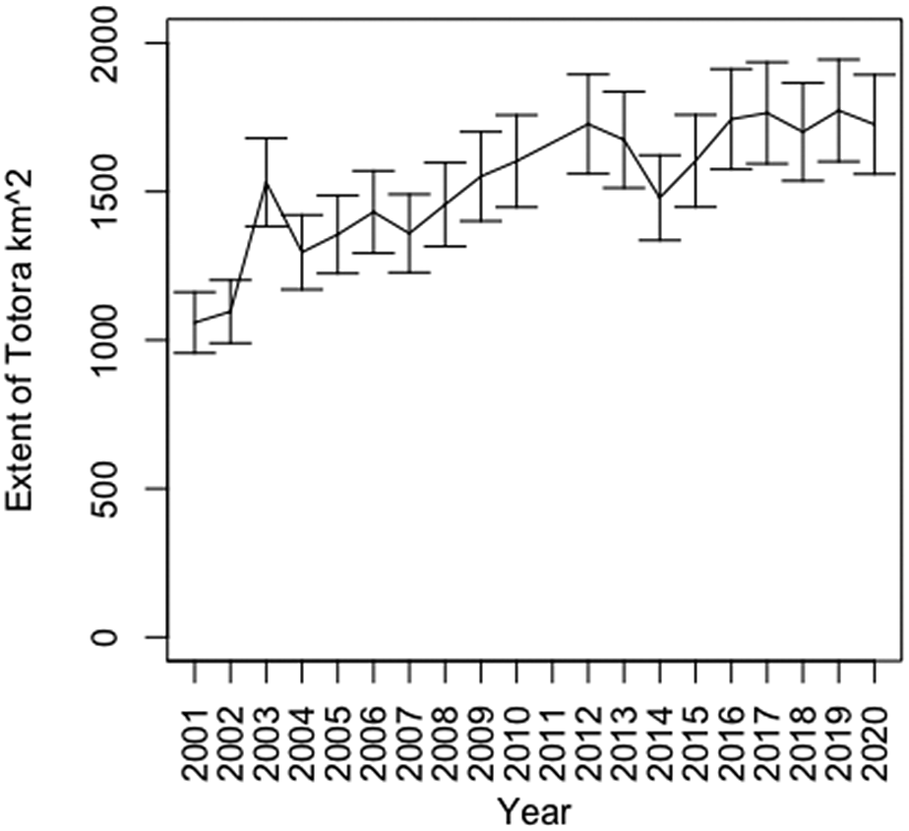
The Cohen’s kappa of our classifier for totora of 0.91 indicates excellent accuracy. Contrary to expectation, we found no discernible decline in the extent of totora around Lake Titicaca since 2001. Instead, we observed that the extent of totora appeared stable, with most years not observing any change that was greater than the uncertainty of the area estimate (Figure 1). Although in a few years (e.g. 2004 and 2014) the extent of totora in the watershed had declined, this decline was less than the uncertainty in the area estimate, and overall the extent of totora increased by more than the area uncertainty estimate between 2001 and 2020.
Change in the extent of totora in the Lake Titicaca watershed, 2001–2020, according to the model developed in this paper. The error bars depict the 95% confidence interval of the extent of totora in the Lake Titicaca watershed.

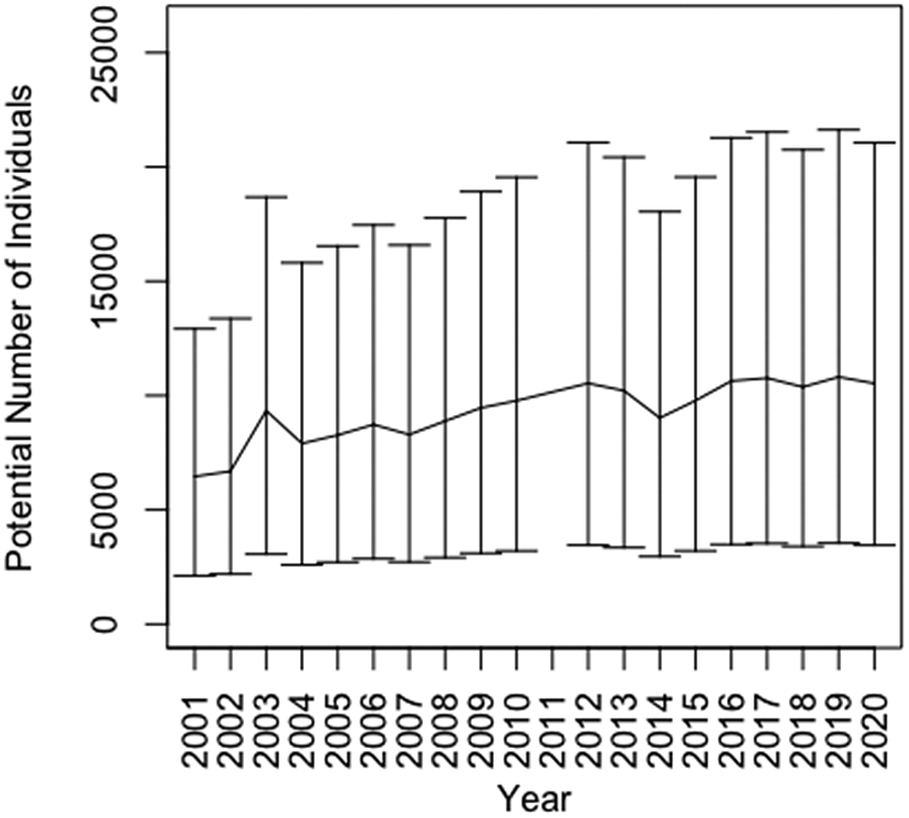
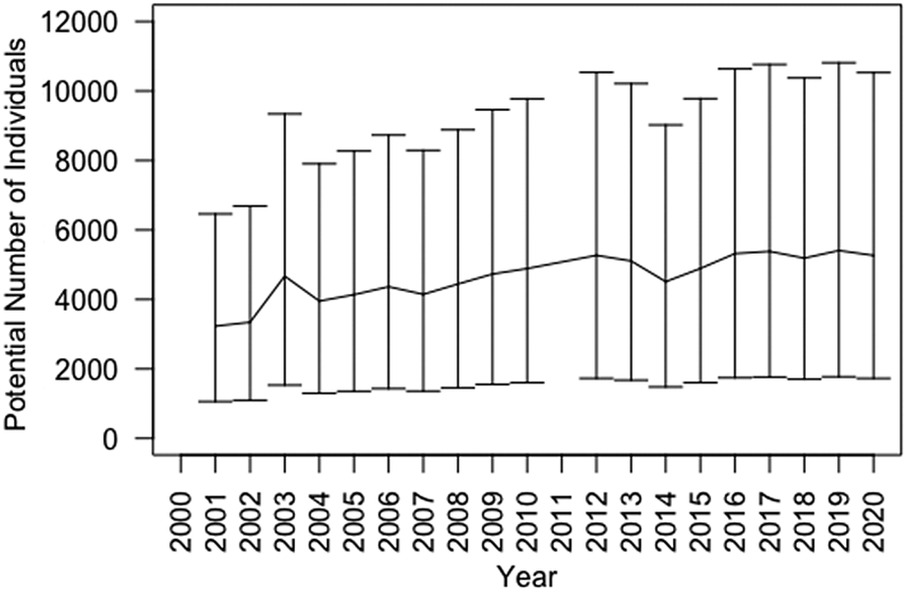
Observed population densities of the Lake Titicaca Grebe (Figure 2) have been extremely variable, ranging from 35.4 individuals/km2 to 0.5 individuals/km2; even excluding these extreme values, the species appears to have a very variable population density, averaging around 6.1 individuals/km2. As such, our estimates for the potential population of the Lake Titicaca Grebe vary widely, ranging from a potential minimum of 2,118 individuals in 2001 to a potential maximum of 21,626 in 2019, assuming that the species occupies the entirety of the totora wetlands. Our more conservative population estimate, which assumes that the grebe occupies half of the potential breeding habitat (Figure 3), showed the same pattern of change in potential population, with a potential minimum of 1,054 individuals in 2001 and a potential maximum of 10,813 individuals in 2019. In neither of our more liberal conservation population estimates did the population size of the Lake Titicaca Grebe exceed the 95% uncertainty of its population, meaning that there was no statistically significant change in potential population of the Lake Titicaca Grebe between 2001 and 2020 according to our study.
Potential population of the Lake Titicaca Grebe, 2001–2020, determined by multiplying the potential habitat area by the average population density of grebes found by Martinez et al. (Reference Martinez, Arabinar and Gutierrez2006), assuming grebes occupy the entirety of the totora. Error bars come from the standard deviation in the size of Lake Titicaca Grebe found by Martinez et al. (Reference Martinez, Arabinar and Gutierrez2006).

Potential population of the Lake Titicaca Grebe, 2001–2020, determined by multiplying the potential habitat area by the average population density of grebes found by Martinez et al. (Reference Martinez, Arabinar and Gutierrez2006), assuming grebes occupy half of the area of totora. Error bars come from the standard deviation in the size of the Lake Titicaca Grebe found by Martinez et al. (Reference Martinez, Arabinar and Gutierrez2006).

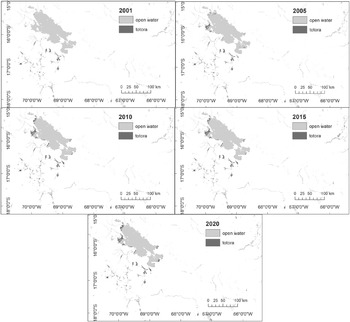
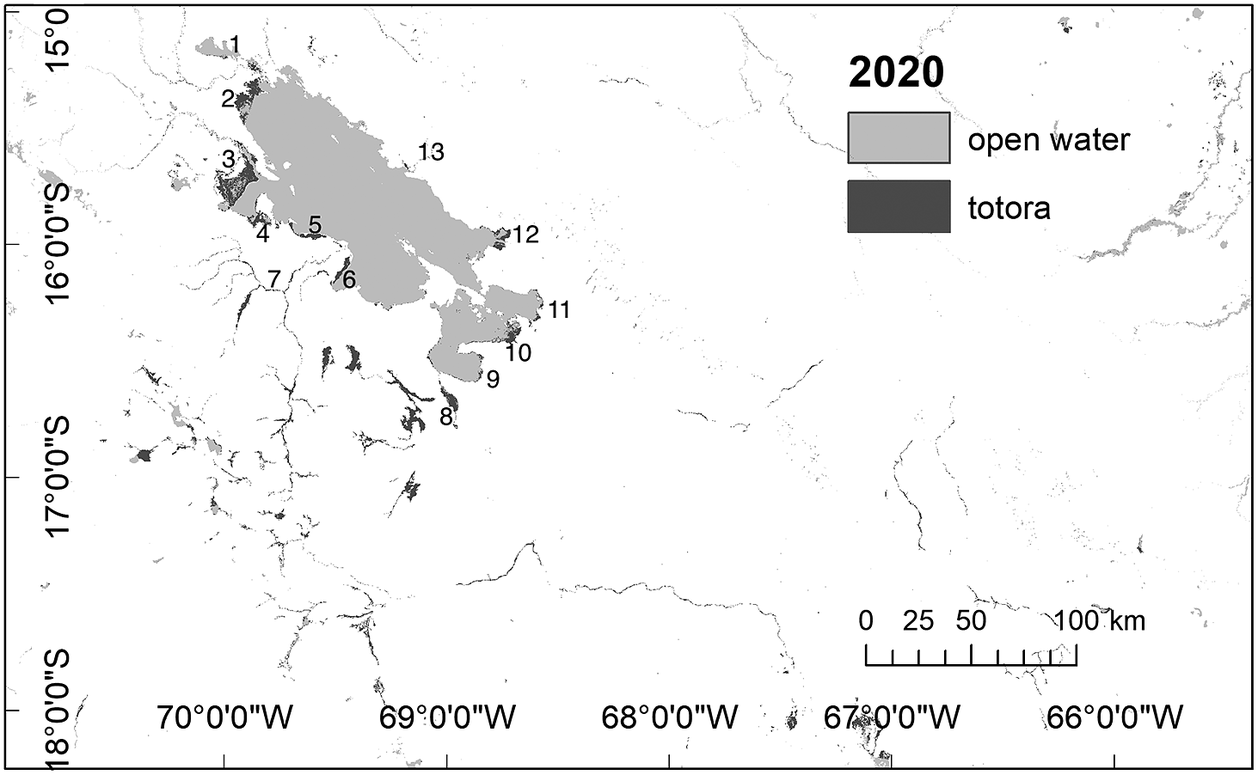
The location of the totora wetlands appears to have changed slightly during our period of study. In spite of a documented rise of pollution in the area (Beltrán Farfán et al. Reference Beltrán Farfán, Palomino Calli, Moreno Terrazas, Peralta and Montesinos Tubée2015), an increase in totora in the Puno Bay area is apparent. Totora may be resilient to heavy metal pollution (Blanco Reference Blanco2019), and the Puno Bay area is part of the Reserva Nacional de Titicaca. This is an officially protected area in Peru, even if an underfunded one, since it suffers regularly from incursions from illegal fisheries and totora harvesting. An apparent increase in totora extent at the mouth of the Desaguadero River is also discernible. This is another well-established area for the Lake Titicaca Grebe. We detected evidence for a reduction in the extent of totora in the Laka Jahuira River which is consistent with the drying up of Lake Poopó over the course of this study. One of the most stable totora habitats appears to be in the Ilave River and its tributaries, which to our knowledge have not been surveyed for Lake Titicaca Grebe. Finally, we also identified several areas in Lake Titicaca where totora appears to be extensive and stable (Figure 4). These areas are probably home to breeding populations of the Lake Titicaca Grebe, and should be the focus of future population surveys of this species (Figure 5).
Selected maps showing the change in the extent of totora in the Lake Titicaca watershed. Maps show the results of our model which shaded each granule as being either totora or open water.

Detailed map of sites of extensive totora coverage in or connected to Lake Titicaca in 2020. 1: Lake Arapa, Peru; 2: Reserva Nacional del Titicaca, Peru; 3: Puno Bay, Peru; 4: Chucuito, Peru; 5: Ariputi, Peru; 6: Juli, Peru; 7: Ilave River, Peru; 8: Desaguadero River, Peru and Bolivia; 9: Guaqui, Bolivia; 10: Batallas, Bolivia; 11: Puerto Perez, Bolivia; 12: Achacachi, Bolivia; 13: Escoma, Bolivia.

Discussion
Population estimates of the Lake Titicaca Grebe are necessarily based on limited data. However, we have established through satellite imagery that the Lake Titicaca watershed includes enough totora wetland for a potential population of up to tens of thousands of individuals. Other factors, such as pollution and fishing pressure, might be expected to reduce numbers substantially below this potential carrying capacity. Nevertheless, it is significantly greater than the estimates of 250–999 individuals on which BirdLife International’s (2021b) conservation status of Endangered was based. Even the more conservative potential population figure suggests a population of up to about 5,000 individuals. This is not the first suggestion that the Lake Titicaca Grebe population might exceed that on which the IUCN categorisation was made. Both surveys of the Lake Titicaca Grebe made two decades ago identified more than 1,000 individuals. A survey in 2003 estimated at least 2,582 individuals at 22 sites across Lake Titicaca (Martinez et al. Reference Martinez, Arabinar and Gutierrez2006), while a later survey identified 1,100 individuals living in the Laka Jahuira River, a tributary of Lake Titicaca which is not thought to be a major population centre for the species (Konter Reference Konter2006).
Despite the age of these surveys, it would require a precipitous population decline of over 50% to reduce a population of several thousand in one portion of the lake to fewer than 1,000 birds in the species’ entire range in 15 years. Whilst not unprecedented in other species (Menz and Arlettaz Reference Menz and Arlettaz2012, Wiles et al. Reference Wiles, Bart, Beck and Aguon2003, Hutchings Reference Hutchings2000), including grebes (Dinesen et al. Reference Dinesen, Chamorro, Fjeldså and Aucca2019, Guevara et al. Reference Guevara, Santander, Soria and Henry2016, Fjeldså Reference Fjeldså2004), we suggest that firmer evidence is necessary before such a precipitous decline could be declared, especially when the species continues to be sighted regularly around Lake Titicaca (DAV, pers. obs.). Whilst possible, the apparent availability of suitable habitat suggested by our study indicates that further surveys are urgently required to inform the IUCN categorisation of the Lake Titicaca Grebe.
Further corroborating evidence that the IUCN estimate of the Lake Titicaca Grebe’s population size may be underestimated comes from reported incidences of by-catch by fishermen and from modelling of global bird abundances. Whilst no comprehensive data exist on the number of birds caught as by-catch by fishermen in Lake Titicaca, it is known that grebes are caught frequently in monofilament nets. Martinez et al. (Reference Martinez, Arabinar and Gutierrez2006) suggested that most Bolivian fishermen catch a grebe as by-catch every fortnight. As with the population of grebes, there are no recent published statistics on the number of fishermen around the lake. In 1992, it was estimated that some 3,000 individuals derived their main income from fishing in the Lake Titicaca area (Orlove et al. Reference Orlove, Levieil, Treviño, Dejoux and Iltis1992). They did so in crews that consisted mainly of either solitary or pairs of fishermen (Orlove Reference Orlove2002), but the number has probably increased in parallel with the increase in the general population around the lake. It is unclear how these figures relate to rates of by-catch and the grebe’s population dynamics. However, modelling of global bird abundances places the likely population of Lake Titicaca Grebes at around 8,887 individuals (Callaghan et al. Reference Callaghan, Nakagawa and Cornwell2021). This is almost halfway between our liberal population estimate based on the assumption that the grebe occupies the entirety of its potential breeding habitat, and our conservative estimate based on its occupation of half the potential breeding habitat. It suggests therefore that the species may occupy most, though not all, of the totora wetlands as breeding territory.
Although we suggest that the population may exceed the IUCN population estimate, we do not recommend a change in its IUCN threat category at this time for two reasons. First, our analysis can only suggest a potential grebe population size based on the little we know of its breeding habitat preferences. Further research into habitat preference may suggest a smaller potential population. Secondly, our analysis does not consider the intensity of fishing around the lake. Given that by-catch from monofilament nets is thought to be the greatest threat to the Lake Titicaca Grebe (Martinez et al. Reference Martinez, Arabinar and Gutierrez2006), that fishing with monofilament nets is a relatively recent phenomenon which lacks a history of sustainable management like many other indigenous fisheries have, and that much of such fishing occurs in marshes that surround Lake Titicaca (Orlove Reference Orlove2002, Orlove et al. Reference Orlove, Levieil, Treviño, Dejoux and Iltis1992), it is likely that much of the area whose vegetation is suitable for the Lake Titicaca Grebe fails to support grebe populations because of fishing.
We suggest that future research should involve greater direct population monitoring of the grebe. This should include extensive population surveys, since no survey of the whole lake area has been undertaken since 2003 (Martinez et al. Reference Martinez, Arabinar and Gutierrez2006). Any change in the IUCN category of the species must be based on observed population change. Any population survey would have to include the Ilave River, since our study suggests this potentially offers much suitable habitat for the Lake Titicaca Grebe. Finally, extensive study should be undertaken to quantify the impact of fishing by-catch on the population. Only by such intensive re-evaluation might the IUCN categorisation be informed.