




No CrossRef data available.
New Politics and Class Politics in the Context of Austerity and Globalization: Welfare State Regress in 18 Countries, 1975–95
Published online by Cambridge University Press: 27 August 2003
Abstract
The relevance of socioeconomic class and of class-related parties for policymaking is a recurring issue in the social sciences. The “new politics” perspective holds that in the present era of austerity, class-based parties once driving welfare state expansion have been superseded by powerful new interest groups of welfare-state clients capable of largely resisting retrenchment pressures emanating from postindustrial forces. We argue that retrenchment can fruitfully be analyzed as distributive conflict involving a remaking of the early postwar social contract based on the full employment welfare state, a conflict in which partisan politics and welfare-state institutions are likely to matter. Pointing to problems of conceptualization and measurement of the dependent variable in previous research, we bring in new data on the extent of retrenchment in social citizenship rights and show that the long increase in social rights has been turned into a decline and that significant retrenchment has taken place in several countries. Our analyses demonstrate that partisan politics remains significant for retrenchment also when we take account of contextual indictors, such as constitutional veto points, economic factors, and globalization.Author names are in alphabetical order and they share equal responsibility for the manuscript. Early versions of this paper were presented at annual meetings of the Nordic Political Science Association in Aalborg, 2002, and the American Political Science Association in San Francisco, 2001, the International Sociological Association RC 28 meeting in Mannheim, 2001, the International Sociological Association RC 19 meeting in Tilburg 2000, and the American Sociological Association in Washington, DC, 2000, as well as at various seminars. For constructive comments on different versions of the manuscript we thank Rainer Lepsius, Anders Lindbom, Ingalill Montanari, John Myles, Michael Shalev, Sheila Shaver, and Robin Stryker, as well as other participants in these meetings. We want to thank Olof Bäckman, Stefan Englund, Ingrid Esser, Helena Höög, and Annita Näsström for very valuable help and Dennis Quinn for providing us his data on international financial deregulation. Our thanks are also due to three anonymous referees for careful reading. This research has been supported by grants from the Bank of Sweden Tercentennial Foundation and the Swedish Council for Social Research.
Information
- Type
- ARTICLES
- Information
- Copyright
- © 2003 by the American Political Science Association
What is the relevance of socioeconomic class and of class-related parties for government policymaking in the Western democracies? For at least half a century this question has generated intensive debates in political science as well as in sociology. In retrospect we can discern a cyclical pattern in the relative significance accorded to class in debates within the social sciences, a pattern evident also in analyses of welfare state development, one major arena for policymaking. During the first decades after the Second World War, the role of class and class politics waned as social scientists pronounced the end of ideology and the “embourgeoisement” of the working class, and the logic of industrialism saw welfare states as functional necessities of industrial societies.1
For example, Bell 1957 and Kerr et al. 1960.
For example, Alford 1963 and Goldthorpe et al. 1971.
The power resources approach originates in debates on the role of relative deprivation for manifest conflict (Korpi 1974), provides an alternative to the different faces of power discussed in the community power debates (Korpi 1985), and has been applied in the context of welfare state development (Korpi 1978, 1983, 1989, 2001). For partly parallel and complementary work see, e.g., Esping-Andersen 1985; Hicks 1999; Huber and Stephens 2001; Huber, Ragin, and Stephens 1993; Kangas 1991, 1994; Myles 1984; Palme 1990; and Stephens 1979.
In the 1990s, however, the role of class and class-related parties again came to wane.4
For analyses and debates see Clark and Lipset 2001 and Evans 1999a.
In this paper we analyze the relevance of class politics in Western democracies, and do this through the lens of its role in welfare state regress during recent decades. This area of research has also seen a waning of the class-political perspective, which is often criticized with arguments similar to those discussed above, however, with globalization added as a new factor restricting the space for redistributive politics. The decreasing role of class has also been seen to reflect that welfare states themselves have changed the context for politics as well as the bases for interest group formation. Thus in a series of pioneering and challenging works, Pierson (1994, 1996, 2000, 2001) has argued that while the power resources approach was fruitful in analyses of welfare-state expansion, it cannot explain retrenchment after the mid-1970s. This is because retrenchment is assumed to be a distinctive process, reflecting the “new politics of the welfare state,” which is likely to follow new rules and to involve new types of interest groups different from those operating during the long phase of welfare-state expansion. In the new politics perspective the forces driving retrenchment are conceived as emanating largely from the advance of postindustrial society, which generates permanent austerity. While permanent austerity is a universal force pressing for retrenchment, politics is still held to matter, however, with the earlier class-based actors—primarily political parties and trade unions—now being largely replaced by new interest groups of welfare-state clients.
Proponents for the new politics of the welfare state have advanced three major lines of arguments questioning the role of socioeconomic class and the power resources approach in the context of welfare state retrenchment. First, this approach views relations between employers and employees as a zero-sum conflict and has neglected the positive role of employers for welfare state development (Pierson 2000; cf. also Pontusson and Swenson 1996). Second, it is maintained that in the retrenchment phase political contexts and goals of policymakers have changed markedly. While in the expansion period politicians could carry through generally popular reforms, retrenchment policies are unpopular, and politicians have to cope with the “negativity bias” among voters, who have come largely to support existing welfare-state programs. Politics then becomes the art of “blame avoidance,” in which political leaders attempt to escape voters' wrath when unpopular measures have to be taken. Third, by their very existence, welfare states have generated new and strong interest groups among recipients of various benefits, such as pensioners, the disabled, and health care consumers but also among welfare-state employees. The emergence of these new groups is assumed to “make the welfare state less dependent on the political parties, social movements, and labor organizations that expanded social programs in the first place,” somcthing explaining why “there appears to belittle correlation between declines of left power resources and the magnitude of retrenchment” (Pierson 1996, 147, 174). As a result of these factors, retrenchment is likely to be a relatively limited phenomenon. In a comparative study, Pierson (1996, 150) thus came to the conclusion that “what is striking is how hard it is to find radical changes in advanced welfare states.”
We argue that the power resources approach to welfare-state development, focusing on the role of socioeconomic class in distributive conflict, remains relevant also in the context of retrenchment. Because of a nontheoretical conceptualization of the dependent variable—the welfare state—and the use of social expenditures as its main operationalization, earlier analyses of retrenchment have reached premature conclusions on the extent of welfare-state regress and on the role of class-related politics in this context.
Our theoretical discussion is centered on the conceptualization of welfare states, the basis for our hypothesis of the continued relevance of class in Western democracies, the role of employers, and differences in policy contexts during periods of expansion and retrenchment, and on the role of welfare-state institutions for policy feedbacks in the context of retrenchment. In the empirical analysis we also include contextual factors such as constitutional structures, economic pressures on governments, and indicators on globalization, while we only briefly discuss issues related to processes of the specific economic and political integration in Europe. Our empirical analysis of retrenchment brings in a new type of dependent variables, that is, indicators quantifying key aspects of social citizenship rights. This increases our possibilities to describe the extent and causes of retrenchment and to move from case studies to comparative analysis of a larger number of countries. The analysis covers 18 countries with uninterrupted political democracy after the Second World War—Australia, Austria, Belgium, Canada, Denmark, Finland, France, Germany, Ireland, Italy, Japan, The Netherlands, New Zealand, Norway, Sweden, Switzerland, the United Kingdom, and the United States.
THE WELFARE STATE AND CLASS
An analysis of the nature, causes, and extent of welfare-state retrenchment must begin with a discussion of the dependent variable, the welfare state. In Europe, since the late nineteenth century Verein für Sozialpolitik in Imperial Germany, and up to the present, scholarly texts on social policy have defined their subject matter in broad terms as including, in addition to social insurance and social services, also labor markets, employment policies, and parts of industrial relations.5
Examples include Elmér 1958, Kuusi 1964, and Flora 1986.
The use of the “welfare-state effort” indicator (social expenditures/GDP) dates back to the pioneering work of Wilensky 1975.
In the power resources approach attention is focused on the assets, or power resources, which actors bring into distributive conflicts and, if necessary, can bring to bear in asserting their interests.7
Power resources refer to capabilities of actors to reward or to punish other actors.
For recent debates see Goldthorpe 2002 and Grusky and Weeden 2002.
We owe the “logic of the situation” term to Goldthorpe 2002, who points to its origin in the works of Karl Popper.
Bounded rationality assumes that actors are satisfying rather than maximizing, have limited information and information processing capability, and may consider also nonmaterial values.
On labor markets and in employment relations major differences in the logic of situations, constituting lines of potential cleavages, are found between employers and employees but also among employees. Employment relations are typically characterized by positive sum conflict and involve two major types of power resources—economic assets and labor power or human capital. While economic resources, such as shareholding, can be accumulated to individual actors or small groups of actors, labor power or human capital is much more difficult to concentrate on the individual level. In employment relationships, individual employees relying only on their human capital are therefore typically subordinated to employers deriving their power from ownership of various forms of capital. Assuming boundedly rational actors, although collective action can improve the efficacy of economic resources as well as of labor power, in employment relationships the potential benefits of collective action are greater for employees than for employers. But employees do not constitute a homogeneous category. Positions on the labor market and in production units differentiate employees in terms of the specificity of their human assets as well as with respect to possibilities for employer monitoring of the work process (Goldthorpe 2000).11
Goldthorpe's (2001, chap. 10) class schema is based on two dimensions: degree of asset specificity and degree of employer difficulty in monitoring employee performance. Apart from mixed categories, this scheme generates two opposite poles. Occupations combining high asset specificity with great difficulties for employer monitoring generate a “service relationship” characterizing high-grade professionals, administrators, and managers, while occupations with low asset specificity and easy employer monitoring generate a “labor contract” characterizing manual workers.
While familiar, we must here recall the asymmetric effects of political democracy on the logic of the situation of different socioeconomic categories. Democracy annulled the traditional correlation between the right to vote and socioeconomic class, while on markets the distribution of economic resources remained not only markedly unequal but also clearly correlated with class. These asymmetric effects on the socioeconomic patterning of constraints and opportunities create important differences among classes in the logic of situation in markets and politics. Actors relying primarily on economic resources can be expected to favor market distribution, while especially categories of citizens relatively disadvantaged in terms of economic resources and relying primarily on their labor power are likely to attempt to combine in the sphere of politics to modify outcomes of, and conditions for, distributive processes on markets.12
Here of course obstacles to collective action pointed out by Mancur Olson (1965) must be kept in mind. The role of these obstacles is likely to increase with the number of actors involved.
The power resources approach thus leads to a conceptualization of welfare states in terms of policies to affect outcomes of, and conditions for, distributive processes in the sphere of markets so as to decrease inequality and/or poverty. In this context legislated social insurance programs and social services, which change outcomes of market distribution, are of course important and form major parts of what T. H. Marshall (1950) once called social citizenship rights. When it comes to modification of conditions for market distribution, of key relevance are policies that affect citizens' participation in distributive processes on labor markets. In this context the level of unemployment becomes important in a double way. It is thus central for outcomes of distributive conflicts, such as levels of wages and inequality. As studies on the “wage curve” have shown, there tends to be a negative relationship between unemployment levels and wage levels; in labor markets with low unemployment, wages tend to be higher than in labor markets with high unemployment (Blanchflower and Oswald 1994). Furthermore, the level of unemployment itself can be seen as partly an outcome of distributive conflict and as a “worker disciplinary device” (Shapiro and Stiglitz 1984) and is, moreover, likely to be affected by political decision making. Full employment empowers wage and salary earners and where unemployment is low, their position is likely to be stronger than where unemployment is high (Korpi 2002). For postwar Europe, William Beveridge (1944) set the goal for “full employment in a free society” as a level of unemployment below 3%. While the right to employment nowhere was legislated as a claim right, in most rich countries outside North America in the decades after the Second World War full employment in this sense became what could be called a social protoright in the sense that governments keyed their policies towards maintaining a very low level of unemployment. Especially in Western Europe, what can be described as an implicit social contract came to include well-developed social insurance programs and social services in combination with full employment, a triad widely seen as a unity forming “the Keynesian welfare state.”
The nontheoretical convention of viewing welfare states in terms of social expenditures has left major sectors of social and economic policies outside the scholarly view. In the analysis of retrenchment, the level of unemployment is of major relevance as an indicator of retrenchment in itself.13
This is often overlooked in earlier studies. Castles (2001) and Huber and Stephens (2001) belong to those few who have discussed the role of unemployment for welfare-state retrenchment. As we have argued earlier, it is, however, necessary to view the return of mass unemployment in itself as an essential part of retrenchment (Korpi and Palme 2000).
EMPLOYERS, UNEMPLOYMENT, AND AUSTERITY
As noted above, critics have argued that the power resources approach views the employment relationship as a zero-sum conflict and has not analyzed the positive role of employers in welfare-state development. The first part of this criticism is plainly wrong.14
Thus, for example, in an early exposition of the power resources approach, the “Historical Compromise” between capital and labor in Sweden in the late 1930s is described as partially “an economic growth strategy of class conflict, intended to increase the total national product so that a ‘zero-sum’ type of conflict between labor and capital could be turned into a ‘positive-sum’ type of conflict: both parties could thereby profit from the increase in the total product even if their relative shares were not substantially changed” (Korpi 1978, 83).
Employer influence on welfare-state development is reflected, for example, in the time order in which the major social insurance programs were introduced in the Western countries (Väisänen 1992). Here work accident insurance, freeing employers from costly court procedures and abolishing one problematic area for interfirm competition, was typically the first type of program to be introduced. In contrast, unemployment insurance, with its implications for reservation wages and wage setting, met strong resistance and was typically the last form of social insurance legislated. In the continued development of welfare states, employers have tended to prefer institutional solutions that leave a large scope for markets. It would thus appear that the first-best choice of business interests is a quite limited welfare state. Yet we find differences among employers, for example, between small and large firms (Martin 1998), and under changing constellations of societal power, business interests have learned to live with their second-best or even lower-order choices, something generating “varieties of capitalism” (Hall and Soskice 2001). Also, welfare-state programs can thus be seen as an aspect of positive-sum conflicts between employers and employees. Yet such programs represent an aspect that employers have found less enticing than have employees. We therefore second the warning by Pierson (2000, 795) for the “suggestion that welfare states were in fact built by employers, for employers.”
While employers have generally attempted to influence ongoing social policy reforms, the specific role of employers in welfare-state development is reflected in the fact that it is difficult to find evidence for major social policy reforms where business interests have been the main originators and protagonists. Here the United States would appear to provide a relevant test case. In the absence of major left parties of the type found in Europe and without strong and centralized trade unions, the United States is a country where the first-best choice of business interests with respect to welfare-state development can be expected to have had the greatest chances of being realized. After the end of the First World War, the United States saw the development of employer initiatives in the area of employee insurance and services, generating what sometimes has been described as “welfare capitalism.” Yet as is well known, in the comparative literature on welfare states the United States is often described as a “laggard.” The basic parts of its social insurance programs—social security, unemployment insurance, and family assistance—were introduced in the mid-1930s against the backdrop of the Great Depression and in one of the rare periods when the majority in both chambers of Congress as well as the presidency was held by Northern Democrats (Amenta, Bonastia, and Caren 2001; Hacker and Pierson 2002; Hicks 1999; Quadagno 1994; Skocpol 1992). In this context Skocpol and Amenta (1985, 272–73) argue that “by 1934–35 virtually all politically active business leaders and organizations strongly opposed national and state-level pensions and social insurance” and that “had any sort of business influence really been decisive in Congress, there would have been no Social Security Act.”
The power resources approach indicates that because of their interest in profitability and control over the labor force, employers are likely to be especially concerned about full employment with its implications for bargaining power, wage levels, and the position of labor in political processes. In Western countries, full employment has a short history, which shows interesting variations among countries. Abruptly breaking the long history of high unemployment before the Second World War, in almost all of our 16 countries outside North America, full employment became a centerpiece of the postwar social contract; in 1955–73 their average unemployment was 2.1%. In the United States, however, the social contract had different contours and unemployment levels remained more than twice as high, 4.9%.15
American “exceptionalism” in this respect is discussed, for example, by Weir (1987). Up to the early 1980s, Canadian levels of unemployment largely followed the U.S. pattern.
Very briefly sketched, the coming of full employment after the Second World War is likely to reflect the sea change in relations of power, when in that period, for the first time in the history of Western capitalism, in most of our countries outside North America left parties emerged either in government positions or as main contenders for government power, and average levels of unionization doubled in comparison with levels between the wars. While conservative and centrist parties retained their traditional first preference for low inflation, they saw the top priority for full employment stressed by the left as having superior electoral appeal and therefore very difficult to oppose. Against the background of increasing inflation, decreasing profit ratios and increasing labor militancy, conservative, and centrist policymakers searched for ways to make low inflation and wage costs to replace full employment as a top priority, but they were held back by the widespread conviction that governments that allowed high unemployment would be unseated by voters. When unemployment rose in connection with the oil shocks in the 1970s, governments could more easily be exonerated for allowing unemployment to increase. These shocks thus served primarily as catalysts in a transition, where the conscious pursuit of full employment was reverted to a pursuit of low inflation and persistent high unemployment became a reality (Korpi 2002).
The crucial aspect of this development for the empirical purpose of this aricle is that the return of mass unemployment came to have major consequences for government fiscal balances. In most European countries, for political reasons governments attempted to care for the swelling armies of the unemployed by relaxing conditions for access to benefits in invalidity, accident, and unemployment insurance, as well as through preretirement pensions.17
Thus, for example, in many European countries the labor force participation rates of men in the 55 to 65-year category have been halved after the 1970s.
While we largely agree with Pierson on the long-term relevance of these factors for government financial balances, it is necessary to recognize that government budget imbalances during the 1975–95 period analyzed here were clearly associated with the return of high levels of unemployment. During the period of rising unemployment, in most countries we thus find sizable negative correlations between rates of unemployment and general government financial balances.18
The following correlations refer to the period 1970–90, but to the period 1970–95 in the countries of the European Free Trade Area (Austria, Finland, Norway, Sweden, and Switzerland), where massive increases in unemployment were delayed to the 1990s. We find strong negative correlations (−80 or higher) in seven countries (Australia, Belgium, Canada, Denmark, Finland, France, and The Netherlands) and medium levels (−.50 to −.79) in five countries (Austria, Italy, Sweden, Switzerland, and the United States) but lower negative levels in five countries (Germany, Ireland, Japan, Norway, and the United Kingdom) and zero correlation in one (New Zealand).
NEGATIVITY BIAS, WELFARE-STATE INSTITUTIONS, AND DRIVING FORCES
In the new politics perspective, the phase of welfare-state expansion during the three decades following the end of the Second World War often appears as a relatively uncomplicated competition among politicians to provide voters with widely popular reforms, while in the retrenchment phase politicians mobilize negativity bias when they attempt to deprive voters of entrenched social rights. While we agree that expansion and cutbacks represent different contexts for political dynamics, negativity bias and blame avoidance were of relevance also in the expansion phase. This reflects the fact that reforms had to be paid for by tax increases. Instead of a head-on confrontation for or against social policy reform, in most Western countries the partisan political debate came instead to focus on the “trade-off” between levels of taxation and social reform. Here the formulation that “reformers needed only to overcome diffuse concern about tax rates” (Pierson 1996, 144) fails to capture the intensity in the debates on tax levels. In this debate, negativity bias was clearly activated when voters were asked to give up money from their own pocketbooks in return for future, often less concrete benefits. Furthermore, rising levels of taxation greatly increased the role of the state, and “big government” was widely portrayed as a threat to freedom and democracy, as “the road to serfdom.”19
In these decades and in most Western countries, books such as Hayek's (1944) The Road to Serfdom were often evoked as arguments against increased taxes and welfare-state expansion.
Increases in total taxation were of a magnitude that few, if any, would have dared to predict. In the OECD countries, from 1960 to 1980 the average increase in total government revenues as a percentage of the GDP was about 75%; in countries such as Sweden and Denmark, tax levels doubled.20
OECD 1998, Table 6.6.
As noted above, a central argument in the new politics perspective is that, as a result of policy feedbacks, welfare states have generated major new interest groups of clients, largely defined in terms of benefit recipiency, such as retirees, the disabled, and health-care consumers. It is, however, necessary to specify the bases as well as the forms of policy feedback. While benefit recipiency via some forms of “operant conditioning” is one relevant base for such feedback, we must remember that the clearly largest and most important potential base consists of risk-averse citizens, who benefit from social insurance even if the need to claim benefits has not materialized. The power resources approach has long underlined the role of policy feedbacks from welfare states, as well as the different ways in which welfare states tend to structure such feedbacks (Kangas and Palme 1996; Korpi 1980a, 1980b, 2001; Palme 1990). In this perspective policy feedbacks do not come primarily from undifferentiated categories of recipients; instead they emanate from the risk-averse citizenry, structured into different constituencies by welfare-state institutions.
In attempts to explain differences among welfare states in terms of policy feedbacks, a typology of welfare states can be fruitful. The great merit and appeal of Esping-Andersen's (1990) influential typology of “the three worlds of welfare capitalism” is that it captures some significant characteristics of welfare states, and, moreover, by placing political labels on the models, it hints at the political origins of the different policy configurations. This typology is hence useful for global descriptive purposes. Yet for the purpose of examining various consequences of welfare states, the great advantage of this typology becomes problematic insofar as it mixes causes, mediating variables, and outcomes. Korpi and Palme (1998) addressed these problems by using welfare-state institutional structures as mediating variables forming the basis for a typology, which has the considerable advantage that it can be related to the extensive theorizing on institutions and, furthermore, lends itself to analytical uses and hypothesis testing about causes and outcomes as well as for more precise descriptions of country differences and their changes over time.
One basic hypothesis behind this institutional typology is that in a society where potential cleavages such as socioeconomic stratification, status, ethnicity, religion, economy sector, and region form a mosaic of cross-cutting lines among citizens and provide competing bases for the formation of citizens' identities and interests, welfare-state institutions can be used to emphasize some of these potential lines and bases and to suppress others. Thereby institutions can come to delineate citizens into categories varying in the degree of homogeneity in terms of resources as well as risks. Socioeconomic stratification differentiates citizens in terms of economic resources and human capital. This stratification is also related to the distribution of some of the relevant risks, such as poverty and unemployment, both of which have traditionally been markedly higher among manual workers than among salaried employees. Some other risks are, however, less clearly related to socioeconomic structures. Thus aging is a human fate and the risk for illness has to be reckoned with in all socioeconomic categories. It can be hypothesized that the role of welfare-state institutions for the formation of identities and socioeconomically based interest groups will be greatest with respect to aging and sickness, where risks are universally shared. In contrast, risks for unemployment, work accidents, and poverty have traditionally been socially skewed to such an extent that institutions limited to these specific areas are likely to be of less relevance for wide-based interest-group formation.21
Trade union-associated state-supported unemployment insurance programs found in four of our countries (Belgium, Denmark, Finland, and Sweden) are widely seen as increasing union membership (Rothstein 1989). Yet the risk for unemployment has traditionally been socioeconomically skewed to the disadvantage of manual workers to an extent making it unlikely that unemployment insurance programs can mobilize more broad-based support against cutbacks.
Thus, for example, in recent decades the most rapidly growing category of benefit recipients have been the unemployed. Yet historically it has proved very difficult to mobilize the unemployed for political action.
The typology by Korpi and Palme includes five ideal-typical models of social insurance institutions reflecting the structure of old age pensions and sickness insurance. These models are defined in terms of three separate aspects of institutional differences: criteria for benefit eligibility, principles for benefit levels, and forms of program governance. The targeted model typically gives minimum benefits after a test of need. The voluntary state-supported model organizes a number of voluntary funds, where eligibility depends on membership contributions but benefits often tend to be relatively low. The state corporatist model was originally introduced in Germany by Bismarck and involves compulsory membership for the economically active population in occupationally segmented insurance organizations with benefits clearly related to previous earnings but conditions and financing differing between insurance organizations. Unlike the other models, the state corporatist one involves joint governance by representatives for employers and employees.23
What we here term the state corporatist model was an application of “classical” corporatist ideology, which was very influential in Europe during the centrury before the end of the Second World War (Bowen 1947; Durkheim [1902] 1964; Elbow 1953). This theory was developed as an attempt to solve what in nineteenth-century Europe was referred to as “The Worker Question.” The classical corporatist strategy was intended to counteract socialist attempts to mobilize the dependent labor force on the basis of class by instead implementing institutions segmenting employees on the bases of occupation and by engineering cooperation between employees and employers in the administration of institutions, a strategy coming into flower in fascist Italy between the two world wars. Classical corporatism thus has roots very different from what later has been termed liberal or neo corporatism emerging in countries where labor movements have been strong enough to be drawn into tripartite political bargaining with employers' confederations and governments.
The emergence and change of these institutional models have often been associated with intensive conflicts among socioeconomic interest groups and different political tendencies (Korpi 2001). Social insurance institutions must thus be seen as embedded in larger social settings and structures of power. Once in existence, however, institutions can be assumed to mediate and to amplify effects of the contexts in which they are embedded. Our hypothesis is that in the long run, basic security institutions are likely to generate a split of interests and identities between the middle classes and the workers. This is because basic security programs tend to have relatively low replacement rates, insufficient to maintain accustomed standards of living of better-off categories of citizens, who therefore are likely to develop various types of private solutions. While workers remain primarily dependent on the public programs, middle classes will have more or less well-developed private solutions and are therefore less likely to give support to public programs, which for them are of more marginal importance. Targeted programs will, in addition, also tend to create splits within the working class, separating the poor from the better-off workers.
In contrast, with their clearly earnings-related benefits state corporatist and encompassing programs decrease the need for separate middle-class solutions and tend to “crowd out” private forms of insurance, leaving the middle classes as well as workers largely dependent on public programs and therefore as potential sources of support for these programs. However, these two models bring in the middle classes into very different contexts. In the state corporatist model, the insured are included as several separate occupational categories in programs with conditions and benefits differing from those of others, each program governed by representatives for employers and employees in a public–private legal context. Thereby this model of social insurance institutions generates separate organized interest groups capable and willing to act in their specific interests. In the encompassing model, middle classes find themselves in a much more heterogeneous setting within universal programs that also include all other citizens; in such a context interests have to be mobilized from the outside, primarily via political parties. These two types of institutions may therefore play different roles and have differing consequences during expansion and during retrenchment.
Since they cover risks that are relatively equally shared by all socioeconomic categories, the institutional structures of pension and sickness programs are likely to be the most important ones for policy feedbacks in welfare-state development. These two programs have the same institutional structures in all but four of our 18 countries. In these four countries (The Netherlands, New Zealand, Switzerland, and the United States) we take the structure of pension programs to define dominant institutions.24
These four countries have basic security pension programs but sickness insurance is targeted in New Zealand, voluntary state supported in Switzerland, absent in the United States, and state corporatist in The Netherlands. In contrast to the state corporatist countries, during the postwar period The Netherlands did not introduce new programs with this model. The voluntary state-subsidized type of program no longer dominates in any of the pension systems in our countries. This means that we are left with four institutional categories among our countries.
Among driving forces, a key hypothesis in the new politics strand of thought to be tested here is that traditional partisan politics is largely irrelevant for welfare-state retrenchment.25
For a questioning of this hypothesis, see Green-Pedersen and Haverland 2002 and Levy 2001.
This indicator is from the Comparative Welfare States Data Set (Huber, Ragin, and Stephens 1998).
THE SOCIAL CITIZENSHIP INDICATOR PROGRAM
As noted above, while useful, the expenditure-based welfare-state effort indicator used in most studies of retrenchment is associated with serious problems, which are aggravated in the context of retrenchment. Thus, for example, rising unemployment levels have tended to raise social expenditures, thereby increasing the nominator, while lower GDP growth rates negatively affect the denominator in this indicator. The consequences of an economic crises may therefore appear as increases in welfare-state efforts.
We here introduce a new basis for the study of retrenchment by considering cuts in social citizenship rights in major social insurance programs, using preliminary data from the Social Citizenship Indicator Program (SCIP), the archive of which now is under construction and has required a massive and prolonged work involvement (see Methodological Appendix).27
The concept of social citizenship goes back to T. H. Marshall (1950). The data archive within The Social Citizenship Indicator Program (SCIP) is under construction at the Swedish Institute for Social Research, Stockholm University.
In the context of an analysis of retrenchment, these three programs thus differ favorably from old-age pensions systems, where changes in rules are often intended to affect benefits in a more or less distant future, and current benefit changes may reflect political decisions made decades ago. Retrenchment in pension programs will be analyzed in a different context.
Needless to say, however, although the variables used here are central, they do not exhaust possible areas where retrenchment may appear. Thus, for example, in the above three programs we do not include changes in rules referring to waiting days, duration, conditions for benefits, and the like. Even more importantly, we cannot consider here areas such as social services, health-care services, family policy, and social assistance programs. While several program changes can be seen as a restructuring or recasting of welfare states, we argue that those observed here can be described as retrenchment.29
For discussions of terminology in the analysis of welfare-state change, see Ferrera and Rhodes (2000) and Pierson (2001).
CONTOURS OF RETRENCHMENT IN SOCIAL RIGHTS
To what extent has there been retrenchment in social citizenship rights in our countries in terms of replacement rates in sickness, work accident, and unemployment insurance? We have calculated net replacement rates (that is, after taxes and social sccurity contributions) for earnings at the average wage level of production workers. Net levels have been assessed for two types of households—a single-person and a four-person family (including one earner, a dependent spouse, and two minor children)—and for two durations—a short period (the first week after waiting days) and a longer period (a year consisting of 26 weeks of benefits and 26 weeks of normal earnings). For each insurance program, we use the annual average of these four indicators (see Methodological Appendix for details). Decreases in net replacement rates reflect at least three types of factors: (1) politically made decisions to cut benefit levels, (2) political “nondecisions,” that is, the failure to raise benefit levels and ceilings in the face of increasing wages, and (3) taxation of benefits that is “claw-back” via taxation. In this context it must, however, be remembered that net replacement levels are also affected by changes in the denominator, i.e., in earnings and the taxation of earnings.
To give a long-term perspective on recent changes in social citizenship rights, we begin by looking at the development of average net replacement rates in sickness, work accident, and unemployment insurance during the period 1930–95. Taken as an average of existing programs in our 18 countries, we find roughly similar patterns of change in the three programs, but at different levels. Partially as a reflection of their specific roles in the socioeconomic class structure, the lowest replacement rates are found in unemployment insurance, while work accident insurance clearly has the highest rates, with sickness cash benefits as the intermediate category (Figure 1, left). From starting levels in 1930 of about 35% for unemployment, 40% for sickness, and close to 60% for accident insurance, the long-term increase in benefit levels peaked in the 1975–85 period, at about 65% for unemployment, 70% for sickness, and 85% for accident insurance. Thereafter the increase turned into a decrease, and up to 1995, replacement levels fell by close to 10 percentage points for unemployment and about 5 percentage points for sickness and accident insurance.

The above averages do, however, hide large variations in developements of individual countries. This is illustrated by developments in the United Kingdom, which has had a long period of Conservative government wedded to market-liberal policies. In the 1930s, in Britain the average net replacement rate in sickness insurance was somewhat above 20%, while unemployment insurance replaced about 35% and work accident insurance about 45% (Figure, right). The postwar introduction of the Beveridgian welfare state with flat-rate benefits increased replacement levels in sickness and work accident insurance by about 10 percentage points.30
This increase primarily reflected the introduction of supplements for dependents, features already earlier found in unemployment insurance, which therefore remained relatively stable.
These figures thus show that in terms of indicators studied here, the British welfare state has been rolled back to a pre-Beveridge level, at or below that of the 1930s. They indicate a radical change in an advanced welfare state, a change carried through by a Conservative party within a constitutional structure with few veto points and in the context of a markedly weakened Labour Party and a largely defeated trade union movement. The cuts in social insurance programs in combination with the return of mass unemployment during the Thatcher period indicate that while the conclusion of Pierson (1994, 161), “The British welfare state, if battered, remains intact,” could be seen as correct with respect to the National Health Service, it was clearly premature when it comes to social insurance and unemployment. This conclusion reflected a pioneer stage in retrenchment analysis with problematic empirical data31
In a parallel way, Alber (1996) criticized Pierson's failure to identify declining replacement levels in mean-tested programs in the United States.
As indicated above, the basic data used here concern net replacement rates for the years 1975, 1980, 1985, 1990, and 1995 in each of the three short-term social insurance programs. For causal analyses, we summarize changes in benefit rates in our programs in each of our countries by three separate indicators reflecting different aspects of retrenchment: (1) cuts in each of the three programs in a country as the decline up to 1995 from the peak observation year during the 1975–90 period, (2) cuts as events in each of the three separate programs defined in terms of the decrease between two consecutive years of observation, and (3) cuts in at least one of the three programs during a five-year period. This third indicator is used in event history analysis. In Australia, Canada, and the United States, benefits in work accident programs are largely determined by states and provinces rather than at the national level. Such benefit changes can therefore not be easily interpreted in terms of national-level political decision making, and in these three countries, work accident programs are therefore excluded from causal analyses. In the United States also benefit levels in unemployment insurance are set at the state level but decisions on the introduction of taxation have been taken at the federal level. Furthermore, the United States lacks a national sickness cash benefit program. In the United States we can thus include only changes in unemployment insurance benefits.
As a preliminary overview of retrenchment in net replacement rates from 1975 to 1995, Table 1 shows our first indicator, that is, declines from an initial peak year up to 1995 in each of the three programs by type of social insurance institutions.32
Discarding increases in benefits, we thus look here at absolute rather than at relative decreases, and large cuts can therefore be more likely to appear in countries with initially higher replacement levels. The decline from peak year up to 1995 is of course a crude index, which does not reflect all changes since 1975. Yet it is helpful in giving a first overview, and the two other indicators reflect all changes during the period.
Note that while in a global characterization in terms of the three worlds of welfare capitalism, Denmark is classified as belonging to the social democratic one, in our typology based on the institutional characteristics of the two main social insurance programs—in contrast to Finland, Norway, and Sweden—it clearly falls into the basic security one. In the context of retrenchment in social insurance, this appears to be a fruitful choice.

The state corporatist countries have a quite distinct pattern. Here Austria, France, Germany, and Italy show no or only a moderate decline in sickness and work accident insurance, while unemployment benefits have been cut. Belgium experienced a major decline in unemployment insurance but saw a sizable decline also in sickness insurance. Drops in replacement levels in unemployment insurance were large also in Italy but smaller in Austria, France, and Germany. In Japan all three programs have remained practically unchanged. Among countries with encompassing institutions, relatively large reductions have been made in Sweden and Finland, while Norway has lowered only unemployment benefits. Declines in Sweden are of about the same order as those in The Netherlands.
For an analysis of the effects of potential causal factors, we begin by using our second indicator specifying cuts as events within each of the three insurance programs. On the basis of information on average net benefit levels in each country and each program for the years 1975, 1980, 1985, 1990, and 1995, we have delineated events as cuts between two adjacent observation years. Using available information each of these events has been assigned to a specific year and government. We are concerned here with cuts in benefit levels that can be seen as results of political decision making in the social policy area, but as noted above, our net benefit replacement rates also reflect changes in wages, the taxation of wages, and measurement errors. Furthermore, small changes are difficult to relate to political decision making. We therefore focus on events defined as major cuts involving decreases in net benefit rates of at least 10 percentage points in a program, events that can be described as clear cases of retrenchment. When summed over all three programs for all 18 countries in this way, we define 37 major cuts (for a specification of cases see Methodological Appendix). These cuts have been distributed into categories defined in terms of independent variables referring to economic contexts, welfare-state institutions, constitutional veto points, globalization, initial benefit levels, and partisan cabinet composition, and the number of country-years under risk in each of these categories has been determined. Since observations here characterize countries, they are unlikely to be independent and potential causal factors can be expected to be relatively strongly intercorrelated. We have therefore chosen a simple analysis of data in terms of the number of cuts per 100 country-years under risk in each of these categories in all 18 countries. To specify the role of confessional parties as well as of the state corporatist and the encompassing models, all of which are concentrated to Europe, we also show results for a more homogeneous set of the 13 European countries.
In the characterization of economic contexts for government policymaking, we have used variables that, directly or indirectly, capture internal and external economic pressures on governments (see above). Since the risk for cuts can be assumed to reflect not only the economic situation during the year in which cuts are made but also the situation in the immediately preceding years, we look here at three-year weighted lags34
The weights are 1 for year t, 0.5 for year t−1, and 0.25 for year t−2 for unemployment, government financial balances, capital account deregulation, current account deregulation, capital account balance, current account balance, and export–import dependence. We also tested unweighted lags (t−1) but found roughly similar results.
We also examined changes in unemployment levels but they do not yield easily interpretable results.

Again we find indications that the dominant types of social insurance models differ with respect to the risk for cuts. Looking at the three most common types of institutions, the highest risk for cuts are associated with basic security institutions, followed by encompassing institutions, with state corporatist institutions having the lowest risks for cuts. As noted above, since 1975 benefit levels in Australia with the targeted model have decreased in sickness and unemployment insurance, but not in ways that these decreases are here defined as major events. The potential relevance of constitutional veto points is indicated by the fact that we find the clearly highest risks for cuts in countries with no veto points, however, those with the highest number of veto points have only somewhat lower risks than the medium-level countries.
With regard to globalization and external economic pressures, we find lower risks for cuts at low levels of capital account deregulation and current account deregulation but smaller differences between medium and high levels. The states of current account and capital account balances show no discernible trends and are therefore not included in the tables presented here. Where export–import dependency is low, risks for cuts are lowest, but there is no difference between medium and high levels of dependency.
To test a key hypothesis in the new politics strand of thought that retrenchment is largely unrelated to traditional political parties, we examine relationships between cabinet party compostion and the risk for cuts, distinguishing three traditional political categories: left, confessional, and secular conservative–centrist parties (see Methodological Appendix). Since several countries have frequently had coalition governments, we have also examined the relevance of the party of the prime minister in governments participating in cuts. These results are similar to those for cabinet composition and are therefore not shown in the tables. The data indicate that the risk for major cuts has clearly been lowest with left cabinet representation and highest when secular center–right parties have been in government, with confessional parites somewhere in the middle.
Since we here define cuts in absolute terms, large cuts are statistically more likely to appear at high rather than at low initial benefit levels. This circumstance introduces a potential complication in the testing of some of our hypotheses. As noted above, according to the “growth to limits” hypothesis we can expect the highest risks for cuts at high rather than at low initial levels. Furthermore, by definition state corporatist and encompassing institutions are likely to have higher initial levels than targeted and basic security institutions, and confessional and left governments may have higher initial levels than secular conservative–centrist ones.36
The average net replacement rates of the three programs for the years 1975, 1980, 1985, and 1990 are 84.2% for encompassing, 78.1% for state corporatist, 57.3% for basic security, and 28.7% for the targeted model. In this period differences in average net benefit rates by cabinet composition are relatively small (left, 74.1%; confessional, 77.8%; and secular centrist–conservative, 65.8%), reflecting that government changes are more frequent than major shifts in benefit levels and the frequent presence of coalition governments in Europe.
Looking at the interplay between dominant institutions and cabinet compostion, we find that in the 18 countries as well as in Europe, irrespective of institutional model, the lowest risks are found for left parties (Table 2, B). For all three party categories, state corporatist institutions tend to have the lowest risks. In all institutional contexts, left parties tend to have the lowest risks. Especially in Europe, secular center–right parties are associated with higher risks for cuts in the context of basic security institutions than with encompassing ones. In both Finland and Sweden, following the massive increase in unemployment and the resulting crises of public finances in the 1990s, cuts were made by cabinets of different colors, yet cuts exceeding the 10% limit applied here were made only by center–conservative coalition governments (Kautto 2000; Palme and Wennemo 1998). In Europe confessional parties show higher risks for cuts in the context of basic security institutions than within the state corporatist ones, but very high risks within encompassing institutions. The latter observation appears to reflect the fact that in the three Nordic countries with encompassing institutions, the small confessional parties have only been in government position as coalition partners to secular center–right parties.
In the interplay between government fiscal balances and cabinet composition, among all parties risks are low with good balances. For left parties in all 18 countries the risk for major cuts are somewhat higher where balances have been worst, whereas in Europe, no trend appears. Secular center–right parties have higher risks with the worst balances but the highest risks at the medium level of imbalances.37
This reflects the relatively large number of cuts carried out by the Conservative government in Britain but also the National government in New Zealand, cuts that thus may reflect a relatively strong ideological component.
Turning to the interplay between cabinet composition and capital account deregulation, at low levels of deregulation we find low risks for all parties (Table 2, C). For left parties the risk remains low also with increasing deregulation. At medium and high levels of capital account deregulation risks are higher for confessional parties and, especially, for secular center–right parties. Increasing current account deregulation has small effects for left parties but increases risks for cuts for secular center–right parties, while confessional parties show the highest risks at medium levels of deregulation. With respect to export–import dependency, little association is found for left parties, while secular center–right parties have their highest risks at medium levels and confessional parties at high levels of dependency.
Event history analysis can be used for further explorations of relationships between the above independent variables and the risk for cuts. Again, we will limit the number of independent variables and use regression estimates primarily as indications of the direction of effects and the probability that they differ from zero. Quite frequently decisions on cuts have affected more than one of our three branches of insurance. As the dependent variable we therefore now use our third indicator of cuts, defining an event as cuts in at least one of the three programs in a country during a year. The number of major cuts so defined is 19 for all our countries and 15 for the European ones. We estimate intensity regressions for repeated events based on an exponential model with a constant hazard rate.38
See Blossfeld and Rohwer 1995. Estimates for period-varying hazard rates show similar results.
For the 18 countries, unemployment shows positive effects well significant at conventional levels (Table 3, A). The state of government financial balances has the expected negative sign and is significant. The effects of dominant social insurance institutions (following the results in Table 2, trichotomized as state corporatist, encompassing, and other models) shows the expected negative signs, indicating that risks are lowest for the state corporatist model and second lowest for the encompassing one but reach significance only in Europe. Veto points have the expected negative sign but effects are not significant. Effects of globalization in terms of deregulation of capital accounts and current accounts are weak and go in different directions. Among all 18 countries export–import dependency has a significant positive effect, which, however, does not reach significance in Europe. Initial benefit level has an insignificant effect with an unexpected negative sign. Left cabinet representation has the expected negative sign and is significant among all countries as well as in Europe, while secular center–right cabinets have the expected positive signs, which also are significant in both categories of countries. Coefficients for confessional cabinet participation are close to zero, indicating that effects are somewhere between those of left and those of secular center–right cabinets.

Combining left party government and unemployment, coefficients for left cabinets remain negative and significant in both categories of countries and unemployment retains the expected positive sign but is not significant in Europe (Table 3, B). With both left cabinets and financial balances in the equations, they both retain the expected sign but only the left cabinet coefficient is significant. This also holds with left cabinet together with institutions. When left cabinet is combined with veto points, it again remains significant in both country categories, while veto points are significant only among all 18 countries. Combining left cabinet with the two indicators of globalization, left cabinet remains significant while effects of deregulation appear weak and have mixed signs. With export–import dependency left cabinet remains significant and negative, while the positive effect of dependency is significant only among all 18 countries. When combined with initial benefit levels, left cabinet retains significant negative effects while initial levels are of little relevance.
DISCUSSION
Through the lens of its role in welfare-state regress, the overarching issue addressed in this paper concerns the role of socioeconomic class and of class-related politics for “who gets what, when, and how” in Western democracies. Debates on the relevance of class are often muddled by differences in views on the class concept. Among many social scientists, class brings to mind manifest conflict between selfconscious collective actors, typically blue-collar workers, internally united by norms and values. In the absence of these manifestations, from such a perspective the death of class is a diagnosis close at hand. Instead we use the class concept here to designate individuals' positions in employment relations and labor markets and to differentiate categories of positions that are relatively similar in terms of resources and opportunities that they provide and the constraints they set for actors in conflicts of interest. In this perspective, it is an empirical question to what extent differences in “the logic of situation” of these multiple categories generate manifest conflict, specific norms and values, and differences in life chances. Just as the absence of strong and vocal feminist movements in countries such as Saudi Arabia need not imply that in this country gender is irrelevant for structuring life chances of men and women, the relative peacefulness on the streets in capitals of Western democracies need not indicate that socioeconomic class, defined in the above terms, has lost its importance.
Research with the new politics perspective has opened up important areas for exploring classical social science hypotheses on the bases for partisan politics. We have pointed at problematic aspects of the new politics arguments related to the conceptualization of welfare states and the nature of empirical evidence and have brought in greatly improved data for an analysis of retrenchment in a larger number of countries. In the perspective outlined here the present retrenchment of the welfare state as well as its earlier expansion can be seen as outcomes of distributive conflict under changing relations of power among major interest groups. Here the level of unemployment plays a key role, both as an outcome of distributive conflict and as a “risk factor” for retrenchments in social insurance.
Our empirical data make possible an analysis of retrenchment based on the development of core aspects of social citizenship rights, that is, legislated benefits in three short-term social insurance programs, forming unidimensional dependent variables well suited for comparative and causal analyses. In attempts to disentangle the separate effects of institutions, parties, constitutional veto points, austerity, and globalization, we do, however, face the severe problems in macro-comparative causal analyses generated by often marked correlations among independent variables. Concentrating on major cuts in net replacement rates in the three programs, we find that the long gradual increase in average benefit levels characterizing developments up to the mid-1970s has not only stopped but turned into a reverse. This downward deviation from the upward trend cannot easily be interpreted as a kind of natural “growth to limits,” since the largest cuts tend to come in countries with initially relatively low benefit levels; instead this reversal indicates a significant retrenchment. Yet in contrast to the universal demise of the full employment component of Western welfare states, this decrease cannot be described as a universal rollback of social insurance programs. There are, however, important differences in levels of cutbacks among countries, and in several of them cuts have been of a size that indicates major retrenchment. In the United Kingdom, the rollback has been profound, taking replacement levels back to or even below their levels in 1930. Also in Ireland, Denmark, and New Zealand we find major cutbacks and somewhat smaller ones in Belgium, The Netherlands, and Sweden. These findings stand in contrast to previous accounts of no or little retrenchment.
As argued above, the demise of full employment and cutbacks in social insurance rights have been closely related, and can be seen as two aspects of distributive conflicts in the reworking of postwar social contracts. In many countries, for political reasons the return of mass unemployment was met by efforts to maintain minimum living standards among the unemployed through easier access to benefits in unemployment, sickness, and invalidity insurance and by measures allowing for exit from the labor force via preretirement pensions. In countries such as Belgium, Denmark, and The Netherlands these emergency solutions eventually needed restructuring, but such restructuring need not necessarily involve benefit cuts of the type we have used here as indicators of retrenchment.
Globalization and postindustrial developments have affected many of the parameters within which distributive conflicts take place. Yet, in a clear contrast to the new politics hypothesis of no or only a marginal role for partisan politics in the retrenchment phase, our analyses show that the probability for major cuts in these insurance programs have to a significant extent been associated with partisan government composition. The risk for major cuts has been significantly lower with left party representation in cabinets, while the opposite holds true for secular conservative–centrist goverments. In the expansionary phase, confessional parties have often been seen as functional equivalents to left parties, at least with regard to social insurance programs. Here we find that they form an intermediate category, in Europe, having risks for cuts between those of the left and those of the secular center–right.
Among economic factors, general government fiscal balances and levels of unemployment appear to be of some relevance, but not to the extent that they overshadow the role of partisan politics. As discussed above, budgetary strains have been relatively closely correlated with increases in unemployment. In retrenchment processes, to a considerable extent, austerity thus appears to be an endogenous factor. The interpretation of differences with regard to export–import dependency is complicated since the lowest export–import dependency is found in our eight largest countries, that is, Australia, Canada, France, Germany, Italy, Japan, the United Kingdom, and the United States. As is well known, there tends to be a relatively strong correlation between the size of countries and their export–import dependency.
By focusing on benefit recipients, the new politics perspective has tended to overlook major policy feedbacks coming from the much larger categories of risk-averse citizens, for whom the main relevance of social insurance is that is decreases risks. Policy feedbacks from welfare states can be expected to reflect interactions between institutions and the socioeconomic distribution of risks and resources among citizens. What we have called dominant welfare-state institutions are likely to impress templates on potential lines of cleavages and bases for interest and identity formation among citizens, thereby affecting patterns of mobilization for collective action. This institutional perspective shifts our focus from “classless” benefit recipients to institutions of relevance for the structuring of citizens' definitions of their interests and identities along socioeconomic lines. While benefit recipiency plays a role, and recipients of old age pensions form important electoral categories and, with the United States as the prime example, often are represented by organized pressure groups, recipients in other programs have been difficult to organize, something most clearly evident with respect to unemployment benefits and means-tested benefits.
Our approach points to the importance of the ways in which welfare-state institutions structure interests of risk-averse citizens, and our typology based on institutions can help us to explain—rather than merely to label—structural differences among countries. The results presented here indicate that it is fruitful to continue to explore the effects of these institutional differences. The state corporatist welfare states have been labeled “frozen” (Palier 2000), with the exception of unemployment insurance a largely accurate labeling. Our focus on institutional structures indicates that to an important extent this resistance to change is likely to reflect the organization of economically active citizens into separate insurance institutions based on occupational categories with differing conditions and benefits and governed in a private–public context. These occupationally segmented programs thus bring together categories of citizens where relatively homogeneous interests are concentrated and, because of its specific forms of governance, can be readily mobilized to self-defense. During the first decade after the end of the Second World War, state corporatist institutions proved their resilience in largely resisting attempts by left parties to transform them in the direction of universalism (Korpi 2001). In the retrenchment period, in countries such as France, Germany, and Italy, government proposals for cuts have generated strikes and demonstrations, typically initiated by unions involved in the management of different autonomous bodies within the state corporatist systems. The actors here have not been recipients of cash benefits but instead preorganized bodies of insured risk-averse citizens, which have defended their particular social rights.
In contrast, the encompassing welfare state brings in the middle classes together with all other citizens under the same umbrella. While the institutional structure of the state corporatist welfare state creates something resembling well-organized regiments that can be mobilized with short notice, in the encompassing model insured citizens are more like a heterogeneous collection of civilians who need external agents, at first hand political parties, to be activated.39
Thus, for example, when the first postwar center–right government in Sweden legislated cuts in sickness insurance programs in 1981, this legislation was challenged by the Social Democratic opposition and was a significant factor in the Social Democratic victory in the following election.
In this context we must, however, recall the problems for causal interpretations generated by correlations among welfare-state institutions, parties, and constitutional veto points. To exemplify, in Europe the presence of the state corporatist model is strongly correlated with the strength of confessional parties. On the average, with the exception of unemployment insurance, the state corporatist model has had the lowest risks for major cuts. In the two countries with strong confessional parties but the basic security model, Ireland and The Netherlands, governments dominated by confessional parties have carried through major cuts. This pattern may point to the relevance of institutions over partisan politics. Yet in Belgium, one of the state corporatist countries, coalition governments led by confessional prime ministers made major cuts in unemployment insurance and sizable ones also in sickness benefits, partly bypassing the parliament and ruling by decree. This exception may reflect structural as well as political factors. In Belgium the dramatic rise in unemployment since the mid-1970s was coupled with greatly increasing regional and linguistic conflicts as well as with conflict among unions and employers' organizations. One of the outcomes of these tensions was long-lasting and extremely high government budget deficits as well as increased unit labor costs relative to its main trading partners.
The constitutional veto point variable appears relevant. Because of its correlations with welfare state institutions and government composition, however, the specific roles of these various factors need to be further explored. Thus, for example, among the six countries conventionally classified as having the fewest veto points, four, Denmark, Ireland, New Zealand, and the United Kingdom, have made the largest benefit cuts but they also share the basic security model in their social insurance programs. The remaining two, Norway and Sweden, both have the encompassing model and have had less cuts than the first-named four countries. To complicate interpretations, all countries with the state corporatist model have constitutional veto points, yet among them Germany, with both federalism and bicameralism, is the only country with more than one veto point. The clearly highest number of veto points are found in Switzerland and the United States with the basic security model, where they would appear to have been of importance in the phase of expansion, and in Switzerland also for the absence of major cutbacks.
It should be noted that we do not argue that the different forms of new politics have been irrelevant. Yet it remains for those who make general claims about the retrenchment era to design comparable indicators of their critical variables and to use them for testing hypotheses boyond the cases studies that have hitherto served as their primary empirical bases. For social sciences at large, their hypothesis on the demise of class politics is a key issue. Our hypothesis of the continued relevance of class in democratic politics in Western countries is based on two considerations. One refers to differences in the nature of power resources controlled by actors differently positioned in labor markets, of particular importance being the extent to which their assets can be concentrated to a few actors or require broad-based collective action to increase efficacy. The other reflects the asymmetric effects of political democracy on the logic of situations of different socioeconomic classes, reshaping the logic of situations in politics but with only modest changes in the logics prevailing in markets. Welfare states can be seen as outcomes of efforts to use politics to effect outcomes of, and conditions for, market distribution. As our empirical data indicate, such class differences in the logic of situations, manifested in partisan politics, have remained relevant also during welfare-state regress.
A demise of class-related politics could come about through changes in class-party linkages or through changes in class structures and human values, while absolute standards of living appear less relevant. The link of parties to socioeconomic categories can not be taken for given. As has long been noted, variations in party strategies and policies can be of greater relevance for patterns of class voting than are changes in class structures (Korpi 1983, 107–9; Sartori 1969). As argued by Evans (1999b) it is difficult to find evidence for drastic declines in class voting in the Western countries. Yet to the extent that, for example, the globalization of capital markets comes to decrease the capacity of national governments to respond to national economic problems, this may weaken the rationality of voting. In Europe the increasing role of institutions such as the Economic and Monetary Union and the Maastricht stability pact may come to have similar effects.
For socioeconomic class to lose its potential role in structuring distributive conflicts and outcomes, the relevance of the world of work and of citizens' positions in employment relations would have to be undermined by a dilution of class differences in assets or overshadowed by nonmaterial life values. Comparative studies on long-term changes in social mobility, however, do not indicate increasing trends in social fluidity between different socioeconomic classes (Erikson and Goldthorpe 1992). Furthermore, even with increasing material standards, relative positions are still likely to matter. In recent decades with drastically rising levels of unemployment and in many countries also increased income inequality, it would appear that the material bases of life are likely to remain central concerns for most citizens. Proponents for postmaterialism have claimed that a change in values is now taking place. But the world of work is relevant not only for material values; it also differentiates citizens in terms of factors such as prestige, status, and opportunities for self-actualization. Therefore distributive conflicts generated in labor markets and employment relations still appear to be basic for most citizens. Paraphrasing a great American author, Mark Twain, we conclude that—again—the rumors about the death of class are considerably exaggerated.
METHODOLOGICAL APPENDIX
The Social Citizenship Indicator Program (SCIP) is under construction at the Swedish Institute for Social Research, Stockholm University. In the data collection we strive for high standards with respect to comparability over time and among countries. The data archives contain information on the nature of social citizenship rights in five major social insurance programs—old age pensions, sickness insurance, work accident insurance, unemployment insurance, and family benefits—in 18 countries for 14 observation years 1930–95. To give an idea of the work investment involved in this undertaking one can mention that an OECD report containing a one-page table presenting net benefits rates in one program (unemployment) at one time point required no less than 332 pages of text explaining sources and ways of calculation to show how they were derived (OECD, 1999). While all OECD countries are not included in our database, we have five programs and 14 time points. Yet multiplying by a factor of 70 does not convey the size of the task, since comparison of change over time adds major problems for finding comparable information from different years, and we collect data also for variables other than replacements. When completed, the SCIP database will include more than 200,000 data points based on information that literally have been spread all over the Western world and often difficult to locate, access, and codify. To make data collection of this type possible, the International Sociological Association has established the following ethical guidelines: “Databases should not be regarded as being in the public domain until the researchers who have assembled them have specified the sources of their data and the methods by which they were constructed…. Interim data sets should be available for inspection of their accuracy by other scholars” (International Sociological Association Bulletin No. 72, 1997).
Average Net Replacement Rates
In sickness, work accident, and unemployment insurance entitlements to cash benefits are given at the level of average production worker wages. Here we use an indicator giving net replacement rates for an average of four components, that is, for a single person and for a four-person family (with one economically active spouse and two minor children) during a short period (the first week after waiting days) and during a longer period (26 weeks with benefits). In some countries benefits have long been taxed, while in others taxation has come more recently. Where benefits have been untaxed, net replacement rates during the short period are taken as the ratio net benefit/net wage; where benefits are taxed, as the ratio gross benefit/gross wage (assuming that one weekly benefit does not significantly affect taxation). Since taxation is always levied for a one-year period, for the longer period we have taken account of taxation in terms of a year consisting of 26 weeks of benefits and 26 weeks of normal earnings. Here we use an index consisting of three components: (a) net income during a year consisting of 26 weeks of benefits and 26 weeks of normal earnings, (b) net income during a year consisting of 52 weeks of normal earnings, and (c) net income during a year consisting of only 26 weeks of normal earnings. The index defines net replacement during the longer period as equal to (a−c)/(b−c).
Definitions of Major Cuts
As an indication of the timing of the 37 cuts of at least 10 percentage points in different countries and the primary nature of these events, it can be mentioned that 16 of them reflect direct decreases of benefits, while 12 are results of tax claw-backs and nine reflect the freezing or reduction of benefit ceilings. Referring to unemployment insurance as U, sickness as S, and work accident as W, we find the following patterns. Straightforward cuts in benefit levels took place in Finland (S, 1992), Ireland (U, S, W, 1988), The Netherlands (U, 1985), New Zealand (U, S, 1991), Sweden (U, S, W, 1993), and the United Kingdom (U, S, W, 1980, and U, S, W, 1984). Tax claw-backs are relevant in Belgium (S, W, 1977, and U, 1985), Ireland (U, S, W, 1993), New Zealand (U, S, 1990), the United Kingdom (U, S, W, 1982), and the United States (U, 1980). Freezing or reduction of benefit ceilings is observed in Canada (U, 1980), Denmark (U, S, W, 1982), Finland (U, S, 1980), Italy (U, 1990, and U, 1995), and Switzerland (S, 1980). Accumulated cuts resulting from the freezing of ceilings for replacements have been assigned to the year of decision. In some countries, more than one form of cutting was made simultaneously.
Cabinet Composition
Years with coalition cabinets and years with changes of cabinets are weighted according to the proportion of seats held by the party in cabinet and the proportion of the year during which the cabinet existed. Left parties are defined as the traditional social democratic parties and the parties to their left. Confessional parties include the European Christian–Democratic parties and their fraternal protestant parties. Because of the traditionally strong role of the Catholic church in Ireland we have included its two major parties, Fianna Fáil and Fine Gael, in the confessional category. The results remain essentially similar when years are weighted by the number of cuts registered for each year.
Constitutional Veto Points, Economic Indicators, and Globalization
The variable on constitutional veto points is from Huber, Ragin, and Stephens's (1998) Comparative Welfare States Data Set (http://www.lisproject.org/publications/welfaredata/welfareaccess.htm). Data on capital account deregulation and current account deregulation as described by Quinn (1997) were supplied by the author. Data on current account and export/import as percentage of GDP were taken from OECD 1999, while the capital account indicator was excerpted from the IMF (various years) Balance of Payments Yearbook.
References
Alber Jens
1996
Selectivity, Universalism, and the Politics of Welfare Retrenchment in Germany and the United States
Paper presented at the Annual Meeting of the American Political Science Association in San Fransisco
Alford Robert R.
1963
Party and society
Chicago
Rand McNally
Amenta Edvin
Bonastia Chris
Caren Neal
2001
US Social Policy in Comparative and Historical Perspective
Annual Review of Sociology
27
213-34Google Scholar
Bell Daniel
1967
The End of Ideology: On the Exhaustion of Political Ideas in the Fifties
New York
Free Press
Blanchflower David
Oswald Andrew
1994
The Wage Curve
Cambridge, MA
MIT Press
Beveridge William
1944
Full Employment in a Free Society
New York
W. W. Norton
Blossfeld Hans-Peter
Rohwer Götz
1995
Techniques of Event History Modeling: New Approaches to Causal Analysis
Mahwah, NJ
Lawrence Erlbaum
Bonoli Giuliano
2001
Political Institutions, Veto Points, and the Process of Welfare and State Adaptation
The New Politics of the Welfare State
Pierson Paul
Oxford
Oxford University Press
238-64
Bowen Ralph H.
1947
German Theories of the Corporative State
New York
Whittlesey House
Castles Francis G.
2001
On the Political Economy of Recent Public Sector Development
Journal of European Social Policy
11
195
211Google Scholar
Clark Terry Nichol
Lipset Seymour Martin
1991
Are Social Classes Dying?
International Sociology
6
4
397
410Google Scholar
Clark Terry Nichol
Lipset Seymour Martin
2001
The Breakdown of Class Politics
Washington, DC
Woodrow Wilson Center Press
Clayton Richard
Pontusson Jonas
1998
Welfare-State Retrenchment Revisited: Entitlement Cuts, Public Sector Restructuring, and Inegalitarian Trends in Advanced Capitalist Societies
World Politics
51
October
67
98Google Scholar
Durkheim Emilé
[1902] 1964
The Division of Labor in Society
Glencoe, IL
Free Press
Duverger Maurice
1954
Political Parties: Their Organization and Activity in the Modern State
London
Methuen
Elbow Mathew H.
1953
French Corporative Theory 1789–1948. A Chapter in the History of Ideas
New York
Columbia University Press
Elmér Åke
1958
Svensk socialpolitik [Swedish Social Policy]
Lund
Gleerup
Erikson Robert
Goldthorpe John H.
1992
The Constant Flux. A Study of Class Mobility in Industrial Societies
Oxford
Clarendon Press
Esping-Andersen Gösta
1985
Politics Against Markets: The Social Democratic Road to Power
Princeton, NJ
Princeton University Press
Esping-Andersen Gösta
1990
The Three Worlds of Welfare Capitalism
Cambridge, MA
Polity Press
Evans Geoffrey
1999a
The End of Class Politics? Class Voting in a Comparative Perspective
Oxford
Oxford University Press
Evans Geoffrey
1999b
Class and Vote: Disrupting the Orthodoxy
The End of Class Politics? Class Voting in a Comparative Perspective
Geoffrey Evans
Oxford
Oxford University Press
323-34
Ferrera Maurizio
Rhodes Martin
2000
Recasting European Welfare States
London
Frank Cass
Flora Peter
1986
Growth to Limits
Berlin
Walter de Gruyter
Goldthorpe John H.
2000
On Sociology: Numbers, Narratives, and the Integration of Research and Theory
Oxford
Oxford University Press
Goldthorpe John H.
Lockwood David
Bechhofer Frank
Platt Jennifer
1971
The Affluent Worker in the Class Structure
Cambridge
Cambridge University Press
Green-Pedersen Christofer
Haverland M.
2002
The New Politics and Scholarship of the Welfare State
Journal of European Social Policy
12
1
43
51Google Scholar
Hacker Jacob S
Paul Pierson
2002
Business Power and Social Policy: Employers and the Formation of the American Welfare State
Politics & Society
30
2
277
325Google Scholar
Hemerijck Anton
Unger Brigitte
Visser Jelle
2000
How Small Countries Negotiate Change: Twenty-Five Years of Policy Adjustment in Austria, The Netherlands, and Belgium
Welfare and Work in the Open Economy. Diverse Responses to Common Challenges
Scharpf Fritz W.
Schmidt Vivien A.
Oxford
Oxford University Press
175
263
Hicks Alexander
1999
Social Democracy & Welfare Capitalism: A Century of Income Security Politics
Ithaca, NY
Cornell University Press
Huber Evelyn
Stephens John D.
2001
Development and Crises of the Welfare State. Parties and Policies in Global Markets
Chicago
University of Chicago Press
Huber Evelyn
Ragin Charles
Stephens John D.
1993
Social Democracy, Christian Democracy, Constitutional Structure, and the Welfare State
American Journal of Sociology
99
3
711-49Google Scholar
Huber Evelyn
Ragin Charles
Stephens John D.
1998
Comparative Welfare States Data Set
http//www.lisproject.org/publications/welfaredata/welfareaccess.htm
IMF. Various years
Balance of Payments Year Book
Washington, DC
International Monetary Fund
Immergut Ellen
1992
Health Politics. Interests and Institutions in Western Europe
Cambridge
Cambridge University Press
Inglehart Ronald
1997
Modernization and Postmodernization: Cultural, Economic, and Political Change in 43 Societies
Princeton, NJ
Princeton University Press
Kangas Olli
1991
The Politics of Social Rights. Studies on the Dimensions of Sickness Insurance in OECD Countries
Stockholm
Swedish Institute for Social Research, Stockholm University
Kangas Olli
1994
Regressions, Qualitative Comparisons and Welfare State Clusters in the Politics of Social Security
The Comparative Political Economy of the Welfare State
Janoski Thomas
Hicks Alexander M.
Cambridge
Cambridge University Press
Kangas Olli
Palme Joakim
1996
The Development of Occupational Pensions in Finland and Sweden: Class Politics and Institutional Feedbacks
The Privatization of Social Policy
Shalev Michael
London
Macmillan
211-40
Kautto Mikko
2000
Two of a Kind? Economic Crises, Policy Responses and Well-Being during the 1990s in Sweden and Finland
SOU—Reports of the Government Commissions
2000
83
Stockholm: NorstedtsGoogle Scholar
Kerr Clark
Dunlop John T.
Harbinson Friedrich H.
Myers Charles A.
1960
Industrialism and Industrial Man
Cambridge
Cambridge University Press
Korpi Walter
1974
Conflict, Power and Relative Deprivation
American Political Science Review
68
December
1569-78Google Scholar
Korpi Walter
1978
The Working Class in Welfare Capitalism: Work, Unions and Politics in Sweden
London
Routledge & Kegan Paul
Korpi Walter
1980a
Social Policy and Distributional Conflict in the Capitalist Democracies. A Preliminary Comparative Framework
West European Politics
3
3
296
316Google Scholar
Korpi Walter
1980b
Approaches to the Study of Poverty in the United States: Critical Notes from a European Perspective
Poverty and Public Policy. An Evaluation of Social Science Research
Covello Vincent T.
Boston, MA
G. K. Hall
Korpi Walter
1983
The Democratic Class Struggle
London
Routledge and Kegan Paul
Korpi Walter
1985
Power Resources Approach vs. Action and Conflict: On Causal and Intentional Explanation in the Study of Power
Sociological Theory
3
2
31
45Google Scholar
Korpi Walter
1989
Power, Politics, and State Autonomy in the Development of Social Citizenship: Social Rights during Sickness in Eighteen OECD Countries Since 1930
American Sociological Review
54
3
309-28Google Scholar
Korpi Walter
2001
Contentious Institutions: An Augmented Rational-Actor Analysis of the Origins and Path Dependency of Welfare State Institutions in the Western Countries
Rationality and Society
13
2
235-83Google Scholar
Korpi Walter
Palme Joakim
1998
The Paradox of Redistribution and the Strategy of Equality: Welfare State Institutions, Inequality and Poverty in the Western Countries
American Sociological Review
63
5
661-87Google Scholar
Korpi Walter
Palme Joakim
2000
Distributive Conflict, Political Mobilization and the Welfare State: Comparative Patterns of Emergence and Retrenchment in the Westernized Countries
Paper presented at the annual meeting of the American Sociological Association, Washington, DC
Kuusi Pekka
1964
Social Policy for the Sixties: A Plan for Finland
Helsinki
Finnish Social Policy Association
Levy Jonah D.
2001
Partisan Politics and Welfare Adjustment: The Case of France
Journal of European Public Policy
8
2
265-85Google Scholar
Lipset Seymour Martin
1960
Political Man: The Social Bases of Politics
New York
Doubleday
Mares Isabela
2000
Strategic Alliances and Social Policy Reform: Unemployment Insurance in Comparative Perspective
Politics & Society
28
June
223-44Google Scholar
Marshall Thomas H.
1950
Citizenship and Social Class and Other Essays
Cambridge
Cambridge University Press
Myles John
1984
Old Age in the Welfare State. The Political Economy of Public Pensions
Boston
Little Brown
OECD
1998
Historical Statistics
Paris
Organization for Economic Cooperation and Development
OECD
1999
Statistical Compendium
CD-Rom. Paris
Organization for Economic Cooperation and Development
Olson Mancur
1965
The Logic of Collective Action: Public Goods and the Theory of Groups
Cambridge, MA
Harvard University Press
Pakulski Jan
Waters Malcolm
1996
The Death of Class
London
Sage
Palme Joakim
1990
Pension Rights in Welfare Capitalism. The development of Old-Age Pensions in 18 OECD Countries, 1930 to 1985
Stockholm
Swedish Institute for Social Research, Stockholm University
Palme Joakim
Wennemo Irene
1998
Swedish Social Security in the 1990s: Reform and Retrenchment
Stockholm
Ministry of Social Affairs
Pierson Paul
1994
Dismantling the Welfare State? Reagan, Thatcher, and the Politics of Retrenchment
Cambridge
Cambridge University Press
Pierson Paul
2000
Three Worlds of Welfare State Research
Comparative Political Studies
33
6–7
791
821Google Scholar
Pierson Paul
2001
The New Politics of the Welfare State
Oxford
Oxford University Press
Pontusson Jonas
Swenson Peter
1996
Labor Markets, Production Strategies, and Wage Bargaining Institutions—The Swedish Employer Offensive in Comparative Perspective
Comparative Political Studies
29
2
223-50Google Scholar
Quadagno Jill
1994
The Color of Welfare
New York
Oxford University Press
Quinn Dennis
1997
The Correlates of Change in International Financial Deregulation
American Political Science Review
91
3
531-51Google Scholar
Rothstein Bo
1989
Marxism, Institutional Analysis, and Working Class Power: The Swedish Case
Politics and Society
18
3
317-45Google Scholar
Sartori Giovanni
1969
From the Sociology of Politics to Political Sociology
Politics and the Social Sciences
Lipset S. M.
Oxford
Oxford University Press
65–100
Shapiro Carl
Stiglitz Joseph E.
1984
Equilibrium Unemployment as a Worker Discipline Device
American Economic Review
74
3
433-44Google Scholar
Skocpol Theda
1992
Protecting Soldiers and Mothers. The Origins of Social Policy in the United States
Cambrige, MA
Harvard University Press
Skocpol Theda
Amenta Edwin
1986
States and Social Policies
Annual Review of Sociology
12
131-57Google Scholar
Soskice David
1990
Reinterpreting Corporatism and Explaining Unemployment: Co-ordinated and Non-co-ordinated Market Economies
Labour Relations and Economic Performance
Brunetta Renato
Dell'Aringa Carlo
London
Macmillan
Stephens John D.
1979
The Transition from Capitalism to Socialism
London
Macmillan
Swank Duane
Martin Cathie JO
2001
Employers and the Welfare State. The Political Economic Organization of Firms and Social Policy in Contemporary Capitalist Democracies
Comparative Political Studies
34
October
889
923Google Scholar
Thelen Kathleen
1999
Why German Employers Cannot Bring Themselves to Dismantle the German Model
Unions, Employers and Central Banks: Wage Bargaining and Macro-Economic Regimes in an Integrating Europe
Iversen Torben
Pontusson Jonas
Soskice David
New York
Cambridge University Press
Väisänen Ilkka
1992
Conflict and Consensus in Social Policy Development: A Comparative Study of Social Insurance in 18 OECD Countries, 1930–1985
European Journal of Political Research
22
3
307-27Google Scholar
von Hayek Friedrich A.
1944
The Road to Serfdom
London
G. Routledge & Sons
Weir Margaret
1987
Full Employment as a Political Issue in the United States
Social Research
54
377
402Google Scholar
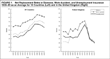
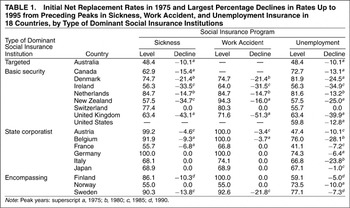
Initial Net Replacement Rates in 1975 and Largest Percentage Declines in Rates Up to 1995 from Preceding Peaks in Sickness, Work Accident, and Unemployment Insurance in 18 Countries, by Type of Dominant Social Insurance Institutions
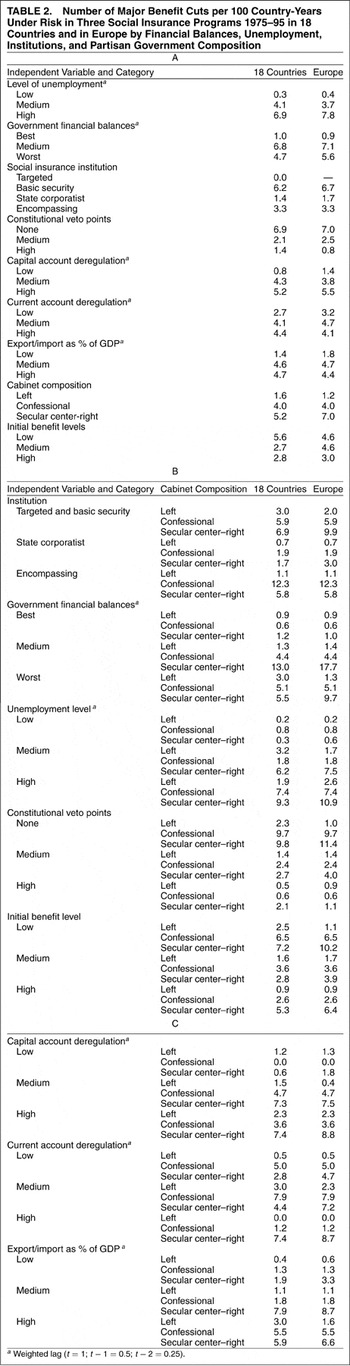
Number of Major Benefit Cuts per 100 Country-Years Under Risk in Three Social Insurance Programs 1975–95 in 18 Countries and in Europe by Financial Balances, Unemployment, Institutions, and Partisan Government Composition
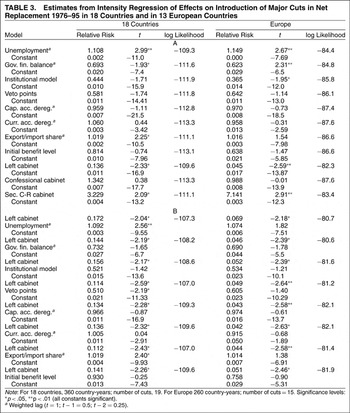
Estimates from Intensity Regression of Effects on Introduction of Major Cuts in Net Replacement 1976–95 in 18 Countries and in 13 European Countries
 You have Access
- 641
- Cited by
Comments
No Comments have been published for this article.