Implications
Our study demonstrates the potential of seaweeds as a source of microminerals in dairy cattle. The algae supplement is well accepted by the animals and significantly improves mineral status (particularly iodine and selenium) of the animals.
Introduction
European Union regulations stipulate that at least 60% of feed on organic farms must be fresh or conserved forage; limiting the routine use of vitamin and mineral preparations (Commission Regulation (EC), 2008), Limiting the use of concentrates and relying on soil minerals (which can be low in some areas) can lead to some mineral deficiencies (Blanco-Penedo et al., Reference Blanco-Penedo, Shore, Miranda, Benedito and López-Alonso2009). Within organic livestock, dairy cattle are possibly the animal species in which nutrition plays the major role because of their great nutritional requirements during early lactation, and to meet them the organic regulations allow a higher proportion of concentrate feed (50%) compared with other livestock groups (EC, 2008).
Galicia is a coastal region (35% of the total Spanish coastline) with an abundance and wide diversity of species of seaweed and the tradition of collecting seaweeds after storms, to use such as fertilizer (correcting the soil pH) and even as feed for livestock (López-Mosquera et al., Reference López-Mosquera, Fernández-Lema, Villares, Corral, Alonso and Blanco2011). It is well known that brown seaweeds are rich in amino acids, trace elements and vitamins; and also have antioxidant, antimicrobial and inmunomodulatory activities (Allen et al., Reference Allen, Pond, Saker, Fontenot, Bagley, Ivy, Evans, Schmidt, Fike, Zhang, Ayad, Brown, Miller, Montgomery, Mahan, Wester and Melton2001). So far, macro-algae research in animal nutrition has focused on its nutritional value and the animal performance response to dietary supplementation (Dierick et al., Reference Dierick, Ovyn and De Smet2009; Rjiba et al., Reference Rjiba, Chermiti and Mahouachi2010). However, and despite the high micro-mineral content of most algae species, their use as mineral supplements has hardly been studied, except for iodine (I). Seaweed supplements in livestock are considered a way to increase I content of animal products, for instance porcine meat (Dierick et al., Reference Dierick, Ovyn and De Smet2009), to provide a high level of I in food I deficient areas. I excretion in milk, proportional to dietary I supplements (European Food Safety Authority (EFSA), 2005a; Flachowsky, Reference Flachowsky2007; Franke et al., Reference Franke, Meyer, Wagner and Flachowsky2009a) is a good way to provide I to deficient human populations. Recent studies in Denmark (Rasmussen et al., Reference Rasmussen, Larsen and Ovesen2000), Norway (Dahl et al., Reference Dahl, Opsahl, Meltzer and Julshamn2003), United Kingdom (Bath et al., Reference Bath, Button and Rayman2012), Germany (Johner et al., Reference Johner, von Nida, Jahreis and Remer2012; Köhler et al., Reference Köhler, Fechner, Leiterer, Spörl, Remer, Schäfer and Jahreis2012) and Spain (Rey-Crespo et al., Reference Rey-Crespo, Miranda and López-Alonso2013) indicate that organic milk has significantly lower I concentrations compared with the conventional milk (up to 60%). However as far we are aware, no experiments have been conducted on algae supplementation in dairy cattle.
In a previous study to evaluate the mineral content of conventional and organic milk in NW Spain (Rey-Crespo et al., Reference Rey-Crespo, Miranda and López-Alonso2013) it was found that essential trace element concentrations in organic milk were significantly lower compared with conventional milk. Furthermore, Galicia is an I-deficient or ‘goitrous’ area where I dietary supplementation using I salt is recommended (SEEN, 2009). The use of marine-algae in organic dairy nutrition could benefit animal health and improve the I content of milk.
This study was designed to assess the feasibility of using seaweeds from the Galician coast as a source of minerals in organic dairy cattle. The main objective was to evaluate the animal response to the supplement by measuring mineral status in blood plasma and the mineral concentration in milk. Because of the potentially toxic metal content of seaweed (especially for arsenic and mercury, EFSA, 2005b and 2008), toxic metal determinations were performed.
Material and methods
Farm of study
This study was conducted in an organic dairy farm located in the Province of Lugo (Galicia-Spain) (latitude: 43.006, longitude: −7.749). The farm was selected because of its history of low I and selenium (Se) status based on previous blood serum analysis. Permission for the procedures of the experiment was granted by the Bioethical Committee of the University of Santiago de Compostela (Spain).
The farm is typical of organic dairy farms in NW Spain, with a loose housed system with slatted floor, beds with sand and a tie-stall system for individual feeding. It has 48 Holstein Friesian cows in lactation with a mean milk production of 19.6 l/day. The animal’s diet consists mainly of local forage (white clover and perennial ryegrass mixture) at pasture or preserved as hay and silage in the winter, and 5 kg of purchased concentrate/day per animal after milking (independently of production capacity or stage of lactation) representing 23.5% of feed intake. Main nutritional components of the fresh-forage (dry matter (DM) basis) during the experiment were: 16.6% DM; 19.5% CP; 53.5% NDF; 27.5% ADF and 64.5% organic matter. The concentrate feed was made of organic wheat (40%), organic barley (39%), organic soya bean meal (15.1%), sodium bicarbonate (2%), calcium carbonate (1.7%), dicalcium phosphate (1%), sodium chloride (0.6%) and minerals (0.6%) and the nutritional composition was (DM basis) 14% CP, 2.40% crude fat, 4.19% crude fibre and 7.87% ash.
Algae supplement
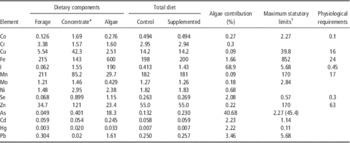
The seaweeds were from the Galician coast and were generously provided by Porto Muiños S.L. (Cerceda, A Coruña, Galicia, Spain). Six algae species were preliminarily selected (considering as criteria abundance and price): Sea Lettuce (Ulva rigida), Kombu (Laminaria ochroleuca), Sweet Kombu (Saccharina latissima), Furbelows (Saccorhiza polyschides), False Carragheen Moss (Mastocarpus stellatus) and Japanese Wireweed (Sargasum muticum) and their mineral (toxic and trace element) composition determined by inductively coupled plasma-mass spectrometry (ICP-MS). Based on the mineral composition of the diet, the physiological requirements and the maximum admissible levels (Table 1) a supplement composed by Sea Lettuce (Ulva rigida) (as flakes, 80%), Japanese Wireweed (Sargasum muticum) (flakes, 17.5%) and Furbelows (Saccorhiza polyschides) (powder, 2.5%) was formulated to give 100 g/animal per day and the chemical composition of the algae mixture determined again (Table 1).
Essential trace and toxic element concentrations (mg/kg DM) in the dietary components (forage, concentrate and algae supplement), total dietary element ingestion for both control and supplemented animals (assuming a total daily DM intake of 18.7 kg/animal, of which 4.4 kg are concentrate and 0.1 kg algae supplement (supplemented group)), estimation of the algae supplement contribution (%) to the total daily mineral intake, maximum statutory limits (EC, 2002 and 2003) and physiological requirements (NRC, 2001)

DM=dry matter; Co=cobalt; Cr=chromium; Cu=copper; Fe=iron; I=iodine; Mn=manganese; Mo=molybdenum; Ni=nickel; Se=selenium; Zn=zinc; As=arsenic; Cd=cadmium; Hg=mercury; Pb=lead.
* Concentrate have 0.6% of a mineral premix containing Cu (30 mg/kg), Zn (120 mg/kg), Mn (100 mg/kg), Fe (100 mg/kg), Co (2 mg/kg), Se (1.2 mg/kg) and I (2 mg/kg).
† For complete feedingstuffs (in parenthesis for seaweed meal). Data have been converted from the original sources expressed as ‘complete feed’ assuming a 88% DM.
Experimental design
For this study 16 of the 48 Holstein Friesian lactating cows were selected to obtain a homogenous group and then were randomly assigned to the control and algae-supplemented groups. No statistically significant differences (P>0.05) between the control and algae-supplemented groups were observed for number of lactation (3.5±0.7 and 4.4±0.7, respectively), stage of lactation (154±41 and 165±44 days) and accumulated milk production (3786±977 and 3804±901 l) at the beginning of the experiment. Before the experiment, the algae supplement was given to some animals to check for feed acceptance and no animal refused the concentrate containing algae. A discriminative triangle sensorial test by a trained panel was performed to check for milk sensorial variations and no statistically significant differences (P>0.05) were observed. During the experiment both the control and algae-supplemented groups had the same feeding and management with the exception of the algae supplement, which was mixed with the concentrate feed and given to the animals at their morning milking for a period of 10 weeks.
Heparinised blood (5 ml) samples were collected from the coccygeal vein after the morning milking previous to beginning the experiment (week 0) and at 2-weeks intervals (n=5). At the last sampling (10 weeks) individual milk (100 ml) samples from the complete milking were collected for analysis.
Sampling processing
All samples were refrigerated immediately and transported to the laboratory. Plasma was obtained by blood centrifugation at 3000×g for 15 min within 4 h of collection and triplicate subsamples were stored at −20°C pending analysis. Various aliquots of milk samples (25 ml) were frozen at −20°C for chemical analysis.
Plasma (2 ml) samples were added 2.5 ml of 69% nitric acid to obtain a cold digestion for 1 h, after that 0.5 ml of hydrogen peroxide 33% w/v was added and samples were placed in a thermostatic block at 120°C for 60 min to complete the digestion, after that 2 ml of Milli-Q ultrapure water was added. After cooling down, the digested samples were transferred to polypropylene sample tubes and diluted to 10 ml with Milli-Q ultrapure water. Milk samples (1 ml) were acid digested in 8 ml of 69% nitric acid and 2 ml of 33% w/v hydrogen peroxide in a microwave digestion system (Ethos Plus; Milestone, Sorisole, Italy). Digested samples were transferred to polypropylene sample tubes and diluted to 15 ml with Milli-Q ultrapure water. For total I determination samples were prepared using an alkaline extraction procedure at high temperature (EN, 2007). The alkaline extraction was performed with tetramethylammonium hydroxide (TMAH) 25% (w/v) in water. All solutions were prepared by using ultrapure water of resistance 18 MΩ/cm obtained from a Milli-Q purification system (Millipore Corp., Bedford, MA, USA). Nitric acid (69%), hydrogen peroxide 33% w/v and TMAH were purchased from Panreac (Barcelona, Spain).
Elements present at very low concentrations (arsenic (As), cadmium (Cd), cobalt (Co), chromium (Cr), iodine (I), lead (Pb), mercury (Hg), nickel (Ni) and selenium (Se)) were determined by ICP-MS (VG Elemental PlasmaQuadSOption, Thermo Scientific, Waltham, MA, USA). Elements at higher concentrations (copper (Cu), iron (Fe), manganese (Mn), molybdenum (Mo), and zinc (Zn)) were determined by inductively coupled plasma-optical emission spectrometry (ICP-OES; Perkin Elmer Optima 4300 DV, Perkin Elmer Instruments, Norwalk, CT USA). Samples were analysed in triplicate. An analytical quality control programme was applied throughout the study. Blank values were run alongside samples and subtracted from the sample readings before the results were calculated.
The limits of detection in the acid digest were calculated as three times the standard deviation of the reagent blanks. The limits of quantification, expressed as a concentration in the sample, were calculated on the basis of the mean sample weight and volume analysed. All plasma and milk samples were above the quantification limits except for Cd (0.077 µg/l, 9% samples below this limit), Hg (0.454 µg/l, 3%), Mn (0.517 µg/l, 9%) and Pb (0.825 µg/l, 53%) in plasma and Cd (0.026 µg/l, 28%), Cr (0.126 µg/l, 3%) and Hg (0.296 µg/l, 100%) in milk. Analytical recoveries were determined from an in-house reference material (ultrafrozen cattle plasma) and a certified reference material (non-fat milk powder NIST SRM-1549), mean recoveries being between 81% and 113% (plasma) and 87% to 121% (milk) in all cases.
Statistical analysis
All statistical analyses were done using the program SPSS for Windows (v.19.0). To calculate mean metal concentrations in the samples, non-detectable concentrations were assigned a value of half quantification limit. Normal distribution of data was checked using a Kolmogorov–Smirnov test. The effect of the algae supplement on the trace and toxic metal concentrations in plasma was evaluated by using a repeated measure ANOVA with treatment (control and algae supplement) as fixed main factor and sampling date as a repeated-measured effect; the interaction between treatment and sampling date was included in the model. The effect of the algae supplementation on the milk mineral composition was evaluated by using a Student’s t-test. The variability on the metal excretion in milk was evaluated by using the CV. Finally, the association between metal concentrations in plasma and milk at the end of the experiment was evaluated by the Pearson correlation coefficient.
Results and discussion
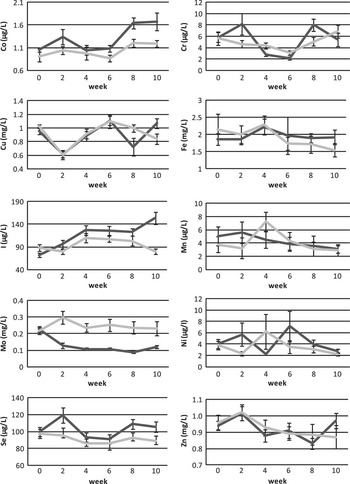
In general, mineral concentrations in the basal diet (control group) were within the adequate range (according to Puls, Reference Puls1994; National Research Council (NRC), 2001; Suttle, Reference Suttle2010) to satisfy the physiological requirements, except for I (0.5 to 2.0 mg/kg DM) and Se (0.3 to 1.0 mg/kg DM) that were at a very low concentration in the forage (Table 1). The algae supplement had a higher Fe and Se, but especially I content, compared with the forage and the concentrate feed, representing 1.66%, 2.08% and 68.9% of the total dietary intake, respectively. The inclusion of the algae supplement to the basal diet allowed for covering the physiological requirements for I, although Se concentration was still marginal. No maximum statutory limits have been adopted by the European Union for seaweed products as feedstuffs, even though the inclusion of the algae supplement to the diet did not exceed the maximum statutory limits for complete feedingstuffs (Table 1). In general, trace mineral plasma concentration was adequate (according to Puls, Reference Puls1994) at the beginning of the experiment (time 0) (Figure 1). The only exception was I, and as in previous analysis, animals showed I plasma concentrations below the adequate levels (100 to 400 µg/l; Puls, Reference Puls1994). Although the farm has a history of low Se status, plasma Se concentrations were adequate at that time. No statistically significant differences were observed for any trace element concentrations between control and algae supplemented animals at the beginning of the experiment. When evaluating the effect of the algae supplement on the mineral status during the experiment, a positive effect was observed for I (P=0.008) and Se (P=0.05) and nearly significant for Co (P=0.071), the algae-supplemented cows showing significantly higher plasma concentrations of these elements in all the analysis. On the contrary, the algae-supplemented animals showed statistically significantly lower (P=0.000) Mo plasma concentrations than the controls throughout the experiment. No statistically significant effect of number of lactation and stage of lactation, as well as interactions between treatment (algae-supplemented and control) and time, frequency of lactation and stage of lactation were found for any trace element.
Scatterplots showing essential trace element concentrations in plasma of the algae-supplemented (dark line, n=8) and control (light line, n=8) groups during the experiment.

The effect of the algae supplementation on the Se, and especially, I animal status could be expected due to the low status of these elements on the farm. Both Se and I are microminerals with a very good response to dietary supplementation (Schöne et al., Reference Schöne, Leiterer, Lebzien, Bemmann, Spolders and Flachowsky2009; Franke et al. Reference Franke, Meyer, Wagner, Hoppen and Flachowsky2009b; Cook and Green, Reference Cook and Green2010) and the algae supplementation allowed the maintenance of an adequate I and Se status during the experiment – note that although plasma Se concentrations were adequate at the beginning, they tended to decrease during the experiment in the control animals. On the contrary, the reduction of the plasma Mo concentration in the algae-supplemented group was not clear. In ruminants Mo metabolism is related to Cu and sulphur (S). At high Cu and S diets ruminants may excrete the majority of ingested Mo in faeces, due to the formation of insoluble thiomolybdates in the rumen (Suttle, Reference Suttle2010). Copper concentration in the algae supplement was lower than in the rest of the diet (Table 1), and the S concentration has not been determined in our study. However, sulphate seems to be a typical component of marine algal polysaccharides, related to high salt concentration in the environment and to specific aspects of ionic regulation (Ruperez, Reference Ruperez2002). It is unlikely that the decrease of the plasma Mo concentrations found in the algae-supplemented animals could pose any animal health disturbance by itself, since Mo concentrations are within the adequate levels in these animal species (10 to 100 µg/l according to Puls, Reference Puls1994). However, and because of the great and well-known importance of Mo on Cu metabolism in ruminants (Suttle, Reference Suttle2010), the possible effect of the variation of the Cu : Mo ratio deserves further investigation.
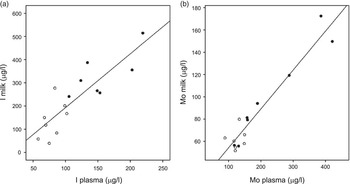
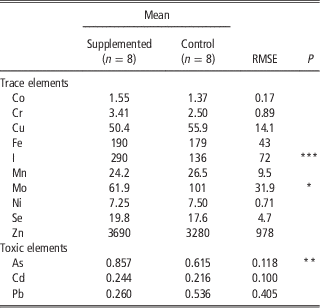
Overall, trace mineral concentrations in milk are within the adequate range (according to Puls, Reference Puls1994) during the experimental period both for the control and algae-supplemented cows (Table 2). The algae supplement had a statistically significant effect on the I and Mo concentrations in milk, and as in blood, I concentrations increased (ca. 113%) and Mo decreased (ca. 63%). I excretion in milk has been extensively studied (Rasmussen et al., Reference Rasmussen, Larsen and Ovesen2000; Dahl et al., Reference Dahl, Opsahl, Meltzer and Julshamn2003; EFSA, 2005a; Bath et al., Reference Bath, Button and Rayman2012; Johner et al., Reference Johner, von Nida, Jahreis and Remer2012; Köhler et al., Reference Köhler, Fechner, Leiterer, Spörl, Remer, Schäfer and Jahreis2012) because of its importance on the human diet in areas of I deficiency, particularly in populations far from the sea where fish consumption (the main source of I) is low and milk products represent the main source of I. I excretion in milk is proportional to dietary I (Flachowsky, Reference Flachowsky2007; Franke et al., Reference Franke, Meyer, Wagner and Flachowsky2009a) and it can be predicted using the models proposed some decades ago by Alderman and Stranks (Reference Alderman and Stranks1967) or recently by Franke et al. (Reference Franke, Meyer, Wagner and Flachowsky2009a) (milk I (µg/kg)=293.3 feed I (mg/kg DM) −64.0, R 2=0.97). Mean I concentration in organic dairy milk in our experiment (136 µg/l) is very similar to that found in other studies in Denmark (167 µg/l; Rasmussen et al., Reference Rasmussen, Larsen and Ovesen2000), Norway (127 µg/l; Dahl et al., Reference Dahl, Opsahl, Meltzer and Julshamn2003) and United Kingdom (144 µg/l; Bath et al., Reference Bath, Button and Rayman2012). In these studies, mean I concentration in conventional milk was up to 60% higher (268, 232 and 249 µg/l, respectively) than that found in organic milk and very similar to the milk I concentration of our algae-supplemented cows (290 µg/l). These results indicate that, at least within the conditions of our experiment, I from the algae supplement is an effective way to increase milk I content to a similar level to that in the conventional one, using inorganic I supplements. When evaluating the relationship between I in plasma and their excretion in milk (Figure 2a) a strong association was found (r=0.856, P=0.000), which indicates that I concentration in milk can be estimated from the plasma I, and consequently (as previously indicated) from the dietary intake. On the contrary, little information exists on Mo excretion in milk. However, considering the strong association between plasma and milk Mo (r=0.958, P=0.000, Figure 2b) our results indicate that Mo excretion in milk is highly dependent on the plasma Mo concentrations.
Scatterplots showing the relationship between iodine (a) and molybdenum (b) concentrations in plasma and its excretion in milk at the last sampling time in the algae-supplemented (●) and control (○) animals.

Trace and toxic element concentrations in milk (µg/l) in the algae-supplemented and control cows

RMSE=root mean square error; Co=cobalt; Cr=chromium; Cu=copper; Fe=iron; I=iodine; Mn=manganese; Mo=molybdenum; Ni=nickel; Se=selenium; Zn=zinc; As=arsenic; Cd=cadmium; Pb=lead.
Results are presented as mean values in wet weight. Details of sampling are given in the text.
Asterisks denote significant differences between groups at the *P<0.05, **P<0.01 or ***P<0.001 level.
When considering the variability (analysed as the CV) of the trace mineral excretion in milk it was observed that variability was generally lower for the algae-supplemented group compared with the control, especially for I (21 v. 58%) and Mo (15 v. 42%). These results indicate a uniform individual response to the algae supplement and guaranties that the mineral content in milk would be easy to standardise.
The main toxic metal present in algae is As and in fact the EU has set a specific maximum limit for seaweed meal (40 mg/kg compared with 2 mg/kg for complete feedstuff), however, most of the arsenic is in the organic form which has a low toxicity for animals (EFSA, 2005b). For the other toxic metals, the concentrations in the algae supplement in our study are one to three fold higher than in the forage and concentrate feed, however due to its low rate of inclusion in the diet their contribution to the total dietary intake is very low (Table 1). Toxic metal concentrations in plasma of the algae-supplemented animals (Supplementary Figure S1) were in general very low throughout the whole experiment, (no animal exceeded the normal concentrations in cattle blood according to Puls, Reference Puls1994) and did not statistically differ from the control animals.
Mercury concentrations were below the quantification limits in all milk samples analysed in our study. For the other toxic element concentrations in the algae-supplemented group were very low, and only statistically differed from the control group for As (Table 2). No maximum statutory limits have been established for As, Cd and Hg, and all milk samples showed As concentrations below 1 µg/l, which means that their contribution to the total dietary intake is negligible (for more information see EFSA, 2005b). Lead concentrations were also well below the maximum statutory limit established by the EU (20 µg/kg wet weight; EC, 2006). The lower degree of variation on the toxic metal excretion in milk (estimated as the CV) of the algae-supplemented group compared with the controls indicate (like for the essential-trace elements) an uniform individual response to the algae supplement.
Conclusions
The results of our study demonstrated the potential of seaweeds from the Galician coast as a source of micro-minerals in dairy cattle. The algae supplement significantly improves the mineral status of the animals, particularly I and Se. However, the effect of the algae supplement on the Mo status in cattle requires further investigation because of its great relevance on Cu metabolism in ruminants. New research is needed to evaluate the potential benefits of the algae, not only related to the mineral intake but also considering their antioxidant, anti-microbial and inmunomodulatory activities, particularly on milk production, the reproductive function and resistance to diseases.
Acknowledgements
This work was supported by the Spanish Government (project code AGL2010-21026) and Centro Tecnológico Agroalimentario de Lugo (CETAL). The authors thank Porto Muiños S.L. for generously providing the seaweeds for the experiment; Aula de Productos Lácteos for sensory analysis of milk; Angel Rivas Lamas from Granxa Cosesal (Friol, Lugo) for providing animals and for all the work and patience during the experiment; and Lucia Casanova Iglesias and staff of RIAIDT for their technical assistance.