Sainfoin (Onobrychis viciifolia) is a robust leguminous forage plant and an interesting alternative to lucerne (Medicago sativa) in dry regions. It contains high concentrations of condensed tannins (Wang et al., Reference Wang, McAllister and Acharya2015) if compared to other forage plants in European regions (Jayanegara et al., Reference Jayanegara, Marquardt, Kreuzer and Leiber2011). Besides anthelmintic properties (Werne et al., Reference Werne, Perler, Maurer, Probst, Hoste, Drewek and Heckendorn2013), condensed tannins may also influence the ruminal protein metabolism and subsequently feed protein efficiency (Waghorn, Reference Waghorn2008). By building complexes with proteins at the high pH of the rumen and releasing these again at pH <3.0 in the abomasum, condensed tannins may support efficient digestion when diets contain excess protein (Jonker and Yu, Reference Jonker and Yu2017), which can be the case in high quality pastures. This may improve protein efficiency and reduce ammonia load of rumen and liver. Finally, excretion of easily volatile nitrogen compounds via urine may be reduced (Wang et al., Reference Wang, Terranova, Kreuzer, Marquardt, Eggerschwiler and Schwarm2018), which would reduce eutrophication of groundwater and release of greenhouse gases.
Although the mechanisms described generally work for goats as well as sheep (Al-Kindi et al., Reference Al-Kindi, Dickhoefer, Schlecht, Sundrum and Schiborra2016), the specific effects of sainfoin on goats' protein digestion and efficiency is less clear (Waghorn, Reference Waghorn2008) and only scarcely investigated. Therefore, the current study was carried out to assess effects of feeding a daily controlled amount of sainfoin (instead of lucerne) to dairy goats on indicators of protein efficiency under in-practice conditions in a commercial dairy goat farm. As valuable indicators we considered the development of protein and urea concentrations in milk and their absolute daily yields. Our hypothesis was that in goats fed sainfoin compared to goats fed lucerne, the proportion of milk protein to milk urea should increase, indicating an improved utilization of feed proteins at the rumen and abomasum.
Animals, materials and methods
Experiment and analysis
The experiment was carried out in July and August 2015, on a farm of the canton Valais in the south-west Swiss Alps. All animal-related procedures were in compliance with the Swiss animal welfare act, the animal welfare ordinance, as well as the animal experimentation ordinance, and these procedures were approved by the responsible authority (Cantonal Veterinary Office, Valais, Sion).
A herd of 20 Alpine goats was virtually divided into two groups (‘Lucerne’ and ‘Sainfoin’; n = 10), balanced by milk yield (means and standard deviations: Lucerne, 1.93 ± 0.33 kg/d; Sainfoin, 1.84 ± 0.45 kg/d), days in milk (means and standard deviations: Lucerne, 182 ± 14.7 d; Sainfoin, 184 ± 15.1 d) and load of gastro-intestinal parasites. These initial traits were assessed 7 d before the start of the experiment. The two groups were kept in one herd, separated only during milking twice daily. During each milking, every goat of group Lucerne individually received 350 g (fresh matter) of pelleted Medicago sativa, while the goats of group Sainfoin were provided 350 g of Onobrychis viciifolia pellets, resulting for all animals in a daily total of 700 g of the respective pellet. Additionally, each animal was given 50 g (fresh matter) of corn grit at each milking, as a source of starch. During the day, the herd grazed pasture for 5 h, containing 35–45% ryegrass (Lolium perenne), 11–20% other grass species, 15–25% clover species and 13–28% of various herbs (average biomass coverage ratios, estimated on five 1 m2-plots according to Willems et al. Reference Willems, Kreuzer and Leiber2013). The remaining time, in barn, goats were always provided with a late-harvest grass-rich hay (main species Festuca rubra, Phleum pratense and various herbs) ad libitum. The documentation of feed offer is provided in online Supplementary Figs S1–S3.
At day 7, 21, 35 and 49 after the onset of the experiment, milk samples were taken from all animals and analysed for solids (urea, fat, and protein content) by medium infrared spectrometry (Milkoscan FT1, FOSS, Hillerod, Denmark).
The sainfoin (Onobrychis viciifolia, variety Perly) was produced from a 2nd cut sward in 2014 in Switzerland. The produced pellets had a diameter of 8 mm. Lucerne pellets (8 mm diameter) were obtained from a commercial merchant. Condensed tannin content of the experimental pellets was analysed photometrically. Details are provided in the online Supplementary file. Crude protein (CP) was analysed by the Dumas-method (Vario Max Cube, Elementar, Germany); crude fibre and ash were analysed by NIRS (NIR-Flex 500, Büchi, Switzerland). These analyses were done in triplicate in all feeds. Proximate composition of all feeds is displayed in Table 1.
Feed proximate constituents (per kg DM ± standard deviation; n = 3)

Statistical analysis
The data were analysed using STATA/IC 13.1 (StataCorp LLC, 4905 Lakeway Drive, College Station, Texas 77845–4512, USA). Data were subjected to a mixed linear model analysis. Feeding treatment (sainfoin or lucerne) served as fixed factor. We accounted for repeated measurements per goat with a random intercept and a random slope in time. Data were corrected for the baseline values obtained prior to the experiment.
Results and discussion
The experimental pellets and the corn grit offered to the goats were always completely eaten. Sainfoin contained more condensed tannins and less crude protein than lucerne (Table 1). The nutritive quality of the pasture swards was high (219 g/kg CP), while the hay offered in barn had a rather low CP content (112 g/kg DM; Table 1). An average CP content of 130–160 g/kg DM of the actually eaten diets around the day is assumed.
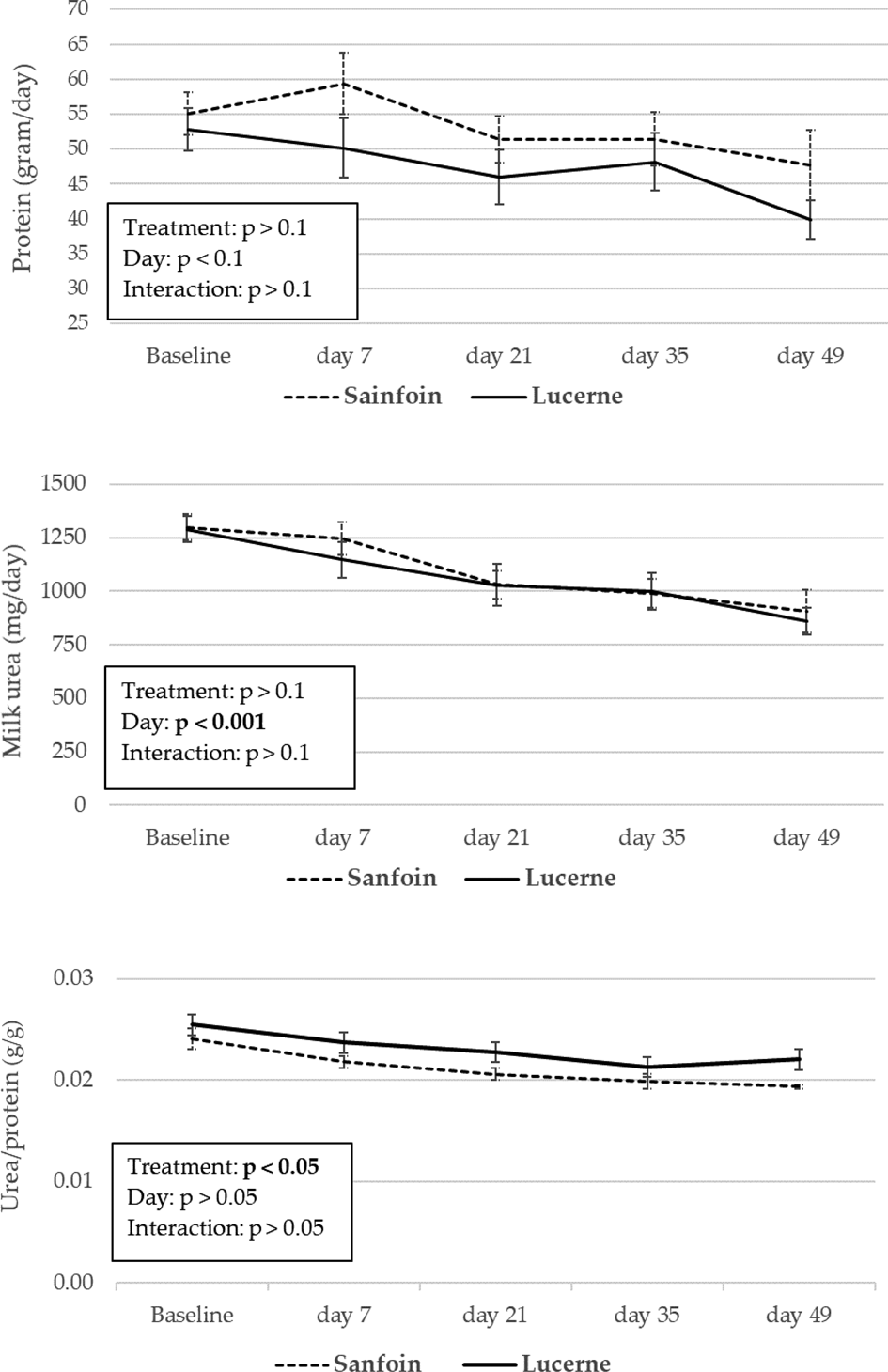
Due to the goats approaching late lactation, milk yields dropped in both groups during the seven weeks (P < 0.001; online Supplementary Fig. S4) with no difference between groups Lucerne and Sainfoin (P > 0.05). The same was true for daily yields of protein and urea (P > 0.05; Fig. 1). Fat-, protein- and urea concentrations in milk did also not differ between the two groups (online Supplementary Figs S5–S7). For the ratio of milk urea to milk protein a treatment effect was found (Fig. 1), indicating a lower urea:protein ratio in the milk for group Sainfoin. This might be carefully interpreted as an indicator of improved protein utilization at the rumen (Nousiainen et al., Reference Nousiainen, Shingfield and Huhtanen2004). However, the higher net energy content of the sainfoin pellet (Table 1) is a sufficient explanation for this effect.
Daily yields of milk protein, milk urea, and urea:protein ratio in milk of Alpine goats supplemented with either sainfoin or lucerne pellets (n = 10).

The lower CP concentration in the sainfoin pellets implies that the dietary crude protein offered to group Sainfoin was slightly smaller than that to group Lucerne; the difference was 14.0 g/animal/d; assuming equal intake rates of pasture and hay. Nonetheless, group Sainfoin did not show a steeper drop in daily milk protein yield than did group Lucerne. It can be assumed that, to some degree, feed protein was better utilized by group Sainfoin (Al-Kindi et al., Reference Al-Kindi, Dickhoefer, Schlecht, Sundrum and Schiborra2016). However, again, different net energy in the treatment pellets (Table 1) can explain this finding, and also an increased intake in the Sainfoin group cannot be excluded. Thus, a convincing indication for dietary tannin effects on protein efficiency was not found.
On the other hand, tannins may have an inhibitory impact on rumen fermentation (Waghorn, Reference Waghorn2008), including in the range that was found in the sainfoin pellets of the current study (Jayanegara et al., Reference Jayanegara, Marquardt, Wina, Kreuzer and Leiber2013). If the inhibitory effect overrules the effect of ruminal protein bypass and digestion in the small intestine, a reduction in performance should be the consequence, at least in the long term. Such impact did not occur in group Sainfoin over the seven weeks of the present experiment. The small or absent effects might be due to low CT concentrations in relation to the total diet. However, the 700 g administered daily to each goat are a considerable part of the daily DM intake (approximately 25%), which makes it unlikely that higher supply could be realized in practice. Another potential explanation for the lack of effects is due to saliva containing proline, which inactivates CT and is particularly expressed by browsers (Waghorn, Reference Waghorn2008). In general, if the given concentration of sainfoin would be effective against gastro-intestinal parasites (Werne et al., Reference Werne, Perler, Maurer, Probst, Hoste, Drewek and Heckendorn2013), there seems to occur no adverse (and no beneficial) side-effect on milking performance and protein efficiency.
In conclusion, replacing lucerne in the diet of dairy goats with 700 g/d sainfoin pellets (approximately 25% of the diet) for 7 weeks in late lactation did not lead to a convincing effect on milk protein and urea concentrations or yields. Thus, at least, sainfoin in the given form and amount can be supplied to goats under practice conditions without adverse effects on milk protein yields and milk urea secretion. However, our results provide no specific support for the application of sainfoin to improve feed protein efficiency in dairy goats under commercial conditions.
Supplementary material
The supplementary material for this article can be found at https://doi.org/10.1017/S0022029920000965.
Acknowledgments
This work was financed by the Swiss Federal Office for Agriculture, the cantons of Valais, Graubünden, Fribourg. Special thanks go to the Agricultural Centre Visp both for the financial support and for the implementation of the experiment.