Internal variation in stateless nations’ national movements
Variation in secessionism among sub-state nationalists is part of one of the ‘great puzzles of ethnic politics’ (Hale, Reference Hale2008: 1). Although Ukrainians and the citizens of the Baltic republics chose independence from the Soviet Union in 1991, the Central Asian republics remained bastions of non-secessionism. Sub-state nationalists in the Basque Country, the Igbo territory in Nigeria's First Republic, and Quebec have historically been more inclined toward independence than Catalonia in Spain, Yorubaland in Nigeria, and Nunavut in Canada (Díez Medrano, Reference Díez Medrano1999; Hale, Reference Hale2008: 57). Most scholars who have focused on the problem of variation in secessionism have centered their attention on across-case, national movement-level variation. Typically, such scholars have chosen to focus on paired comparisons of national movements in which one case is clearly pro-secessionism while the other is non-secessionist, such as Ukraine–Uzbekistan, Basque Country–Catalonia, etc. (Conversi, Reference Conversi1997; Díez Medrano, Reference Díez Medrano1999). They have failed to investigate the complex heterogeneity of political orientations within national movements. This article focuses instead on within-case variation,Footnote 1 and opts for a ‘sub-national’ research design, choosing the sub-state national party (and its militants) as its primary unit of analysis. I am interested in the national movements of sub-state national societies in states with well-established democracies and advanced economies. There is a dearth of systematic comparative research into the sources and patterns of internal variation in the political orientation of sub-state national movements. Why do some nationalists opt for a secessionist orientation while other nationalists within the same national movement opt for a variety of non-secessionist orientations? This article aims to uncover the sources of such within-case variation in national movements.
Variation in secessionism is also interesting because separatism ‘is widely held to be the culmination of national development, the peak manifestation of nationalism, reflecting a nation's collective desire to establish or protect its own state in the international arena, one that is equal or superior in status to all other states…’ (Hale, Reference Hale2008: 3). Yet, we find many sub-state nationalists that opt for a variety of non-secessionist orientations. Thus, to investigate the sources and patterns of variation in secessionist (and non-secessionist) orientations among nationalists within a national movement is a useful contribution.
In the political party systems of sub-state national societies,Footnote 2 there is a recurring empirical pattern. Although all nationalists pursue nation-affirming and nation-building goals, the national political partiesFootnote 3 of sub-state national movementsFootnote 4 tend to bifurcate and, at times, trifurcate, into two or three basic political orientations: independentism, autonomism,Footnote 5 or federalism.Footnote 6 Thus, some sub-state nationalists seek their own state while others seek an autonomous special status, or their objective is to become a constituent unit within a classic federation. These are competing forms of nationalism: they all agree that the nation exists but they disagree on the degree of sovereignty the nation should seek.
Internal variation within national movements is an undertheorized area in the study of secessionism. In order to understand secessionism among nationalists, one must also study non-secessionism among nationalists. In the social sciences, the more common research agenda has been to study ‘secessionism’, how it arises, and what can be done to control it (Hale, Reference Hale2000; Hechter, Reference Hechter2000a: Ch. 7; Cornell, Reference Cornell2002; Lustick et al., Reference Lustick, Miodownik and Eidelson2004). The most methodologically defensible way to study the political behavior of secessionist nationalists is precisely to compare and contrast them with the diverse varieties of autonomist nationalists and federalist nationalists. If we want to explain nationalist secessionism, we must study it in conjunction with the complex varieties of nationalist non-secessionism, in all of its pro-autonomy and pro-federation varieties. Placing variance at the center of our research agenda is more likely to provide us with the most significant advances in our understanding of secessionist nationalism, and of its counterparts, autonomist nationalism and federalist nationalism (Varshney, Reference Varshney2002: 6; Mahoney and Goertz, Reference Mahoney and Goertz2004: 653–654).
What is distinctive about this contribution is that I have chosen to focus on the complex rainbow of political preferences expressed by nationalists. The internal variation within national movements has been insufficiently investigated, and there is a paucity of scholarship squarely centered on investigating this question (Gellner, Reference Gellner1983: 1; Hobsbawm, Reference Hobsbawm1991: 9; Breuilly, Reference Breuilly1993: 2; Brubaker, Reference Brubaker1998: 276; Smith, Reference Smith1998: 73; Keating, Reference Keating2001: 7; Hale, Reference Hale2008: 244).
My findings show that sub-state nationalists inhabit a ‘moral polity’ in which reciprocities are expected and notions of the common weal and mutual accommodation are essential. The central state's perceived failure to meet these expectations is an important factor that contributes to the radicalization of nationalists’ preferences.
In addition, my research shows that sub-state nationalism is not just a binary competition between secessionist nationalism and non-secessionist nationalisms. Instead, we need to recognize that non-secessionist nationalisms (both in their pro-autonomism and pro-federation varieties) are complex, and that there are important sub-gradations within the pro-autonomism and pro-federation camps. In the autonomist camp, there are strong autonomist parties that have sovereigntist impulses (even if their discourse is very ambiguous), and there are non-sovereigntist autonomist parties that principally just make demands for limited self-government, etc. Similarly, in the federalist camp, there are federalist parties that adopt a radical asymmetric federalist stance and assert their right to national self-determination, while others are more conservative and their proposed model of federation is less asymmetric. Thus, nationalists are divided into the secessionist nationalist and the non-secessionist nationalist camps, with the latter being composed of two important sub-camps. There are the strongly decentralizing nationalists that generally opt for non-secessionism (the sovereigntist autonomists and radical asymmetric federalists) and there are less-decentralizing nationalists that also opt for non-secessionism (the traditional autonomists and mainstream federalists).
In sum, the nationalists that pose the greatest challenge to the institutions of the central state are the secessionists, followed by sovereigntist autonomists and radical asymmetric federalists. Aside from this group of ‘strong decentralizers’, independence-seeking nationalists are of course those that radically challenge the territorial integrity of the state. But sovereigntist autonomists and radical asymmetric federalists also question the current institutional arrangement of the state, as they demand constitutional changes in the state in order to accommodate them. Mainstream federalists and traditional autonomists do not pose a strong challenge to the central state.
Varieties of nationalism and existing theories of secessionism
How do the existing theoretical traditions in the study of secessionism explain the puzzle of the internal variation in national movements? The literatures on nationalism and secessionism are interrelated and the principal theories of separatism are rooted in underlying theories of ethnicity (see, e.g. Weber, 1978; Hechter, Reference Hechter2000a; Beissinger, Reference Beissinger2002; Hale, Reference Hale2008: 59, 57), but for purposes of this article I will focus on the dominant theories of secessionism. According to Hale (Reference Hale2008: 32), the structure of the divide in the literature on secessionism tracks the divide in the underlying theories of ethnicity between those theorists who think ethnic identification is inherently conflictual (mainly primordialists) and those who see it as being almost entirely epiphenomenal (instrumentalists).
The literature on secessionism – which generally assumes that only secessionist nationalism needs to be considered – can nevertheless be usefully surveyed in order to identify some of the arguments that have been made in relation to stateless nationalists’ diversity of political orientations. In general, the existing theories can be seen as different frames that social scientists have used to understand the dynamics of secessionism, and non-secessionism. The principal theories of secessionism that have a bearing on the issues addressed here can be broadly classified as the culturalist paradigm (which has its roots in the primordialist tradition) and the materialist paradigm (exhibiting the lineage of the instrumentalist tradition).
The culturalist paradigm of secessionism
Roots in the primordialist tradition
The culturalist paradigm is rooted in the primordialist tradition, which views ethnic identities as age-old and enduring. This tradition is centered on the intrinsic power of ethnic differences, and argues that ethnic differences are based on ancient animosities, caused by inherent differences in culture, language, race, etc. It argues that ethnicity is inherent to humanity, ‘meaning that all of us inevitably search for, or can be easily be made to care for, our ancestry’ (Varshney, Reference Varshney2003; Hale, Reference Hale2008: 15). The culturalist paradigm of secessionism is thus rooted in what Hale called ‘Hard Ethnicity-as-Conflictual Theories’. In this tradition, people derive dignity, self-esteem, and/or belonging from being part of an ethnic group. People's ethnic ties are inherently linked with their deepest feelings, and core needs for dignity and self-esteem (Hale, Reference Hale2008: 16).
National consciousness arguments
Theorists in the culturalist paradigm of secessionism argue that the driving force for separatism is to be found in the innate human tendency to identify with one's national or ethnic group and to consider one's territorial grouping as a ‘nation’, which is presumed to lead to the formation of a pro-separatism orientation. These theorists see the formation of national consciousness as the key development that will lead to the emergence of a secessionist orientation (Geertz, Reference Geertz1967; Brass, 1991; Meadwell, Reference Meadwell1993: 218; Taylor, Reference Taylor1994; Smith, 1998; Davidson, Reference Davidson2000; Hale, Reference Hale2008: 58). The national consciousness thesis is built on theories of ethnicity that place culture and identity and the importance of a sense of belonging in the foreground when accounting for the strength of identities. Nationalism is seen as a strongly held social bond, deeply intertwined with a person's sense of self. The nation is a community of common ancestry with an ancient lineage, which makes a claim for political recognition on these grounds (Smith, Reference Smith1998: 22).
These national consciousness arguments cannot account for the internal variation in national movements. The main problem with this approach is that explaining separatism is reduced to explaining the rise of national consciousness (Hale, Reference Hale2008: 58). A linear and mechanistic relationship is assumed to exist between the development of national consciousness and the rise of secessionism. For example, those posing national consciousness as the driving force of separatism are stymied by the case of the Uzbeks, ‘a group that was consistently unionist yet had at least as strong a sense of national distinctiveness vis-à-vis Russians as did Ukrainians’, who chose the secessionist path (Hale, Reference Hale2008: 138). This theoretical tradition assumes the existence of a form of national consciousness–determinism, and postulates that all nationalists would want to align their nation with a state. This is not the case: many nationalists opt for non-secessionism, both in its pro-autonomy and pro-federation varieties. This tradition may be able to explain how nationalist sentiment emerges out of a sense of national consciousness, but it cannot explain why and how nationalist sentiment translates into both secessionist nationalism and the complex varieties of non-secessionist nationalism.
The materialist paradigm of secessionism
Roots in the instrumentalist tradition
The materialist paradigm is rooted in the instrumentalist tradition, which argues that ethnic differences are only valuable because of their instrumental value, whether for economic or political purposes, and that ethnicity is instrumentalized by elites (Varshney, Reference Varshney2002). For instrumentalists, ethnicity is basically a mask for a bundle of interests. The materialist paradigm of secessionism is thus rooted in what Hale called ‘Ethnicity-as-epiphenomenal theories’, which reject completely the idea that ethnicity embodies its own intrinsic value. Ethnic politics is instead a function of other more mundane pursuits, such as power, material resources, economic status, or security (Hale, Reference Hale2008: 25).
Economic and material interests
The materialist paradigm of secessionism also assumes that most nationalists would naturally want to opt for the secessionist orientation, but postulate that economic or material conditions may dissuade some nationalists from advocating independence (Booth et al., Reference Booth, James and Meadwell1993; Breton et al., Reference Breton, Galeotti, Salmon and Wintrobe1995). The materialist thesis maintains that nationalists at the microfoundational level exhibit instrumental rationality, adjusting their political mobilization goals in accordance with the expected costs of achieving their objectives (Rabushka and Shepsle, Reference Rabushka and Shepsle1972; Bates, Reference Bates1974; Brass, Reference Brass1975; Hardin, Reference Hardin1995; Hechter, Reference Hechter2000a).
The economic viability of the proposed independent state and the ‘costs of transition to independence are a constraint on the mobilization of support’ for independentist nationalism (Meadwell, Reference Meadwell1989; Hechter, Reference Hechter1992; Meadwell, Reference Meadwell1993: 228; Hechter, 2006). Many in this tradition would argue that ‘richer regions are more likely to display separatism than poorer ones because they want to avoid having their resources redistributed…’ (Hale, Reference Hale2008: 60).
Materialist approaches also assume a universal human tendency among nationalists to seek to align their nation with a sovereign state. As in the case of the national consciousness approach discussed above, this assumption does not hold: many nationalists opt for non-secessionism, both in its pro-autonomy and pro-federation varieties and sub-varieties. Moreover, the main problem with this approach is that, by itself, it is unable to explain the attitudes and beliefs of nationalists, which are laced with non-instrumental considerations, such as ‘the notions of self-respect and dignity, not with a narrowly defined self-interest’ (Varshney, Reference Varshney2003: 91).
The preference-formation processes of nationalists can hardly be explained with instrumental-rational arguments, that is, as a means to a self-interested end. A materialist approach typically misses much of what motivates ethnic or nationalist behavior. This approach lacks ‘sensitivity to historically inherited attitudes and power relations among groups’ and ignores how ‘structured patterns of domination and subordination and a history of suffering have customarily shaped answers to these questions, not pure instrumental rationality’ (Varshney, Reference Varshney2003: 93). In addition, a materialist approach fails to recognize that nationhood, as part of the sphere of ‘culture, … is embedded in our life; it preexists as a framework of meaning, within which human deliberation and rationality operate’ (Varshney, Reference Varshney2003: 92).
Another difficulty facing the advocates of the materialist paradigm is that recent experimental research has demonstrated the ubiquity of non-self regarding motives, which questions the materialist paradigm's model of the self-regarding actor. The evidence has shed light on a nexus of behaviors known as ‘strong reciprocity’, which is a predisposition to cooperate with others, and to punish those who violate the norms of cooperation (Gintis et al., Reference Gintis, Bowles, Boyd and Fehr2005: 8). Recent research has shown that economists and other social scientists fail to understand core questions in their fields ‘if they insist on the self-interest hypothesis and rule out heterogeneity in the realm of social preferences’ (Fehr and Fischbacher, Reference Fehr and Fischbacher2005: 152). The research has shown that ‘in addition to economic self-interest, social preferences shape the decisions of a substantial fraction of people. A person exhibits social preferences if the person does not only care about the economic resources allocated to her but also cares about the economic resources allocated to relevant reference agents’ (Fehr and Fischbacher, Reference Fehr and Fischbacher2005: 153). Thus, instead of assuming the existence of a single type of ‘profit maximizing’ or ‘utility maximizing’ individual, ‘a better foundation for explaining human behavior is the assumption that multiple types of individuals exist in most settings’ (Ostrom, Reference Ostrom2005: 253). Therefore, predictions based on ‘the model of the self-regarding actor often do not hold up under empirical scrutiny, rendering the model inapplicable in many contexts’ (Gintis et al., Reference Gintis, Bowles, Boyd and Fehr2005: 7). This article argues that the materialist paradigm is inadequate to explain variation in secessionism.
Accounting for the internal variation in national movements
The national consciousness and the materialist paradigms of secessionism are inadequate to understand the reasons for the internal variation in national movements. I propose instead a novel approach, which I denominate the ‘moral polity’ thesis. My approach begins by recognizing the heterogeneity of motivations behind the adoption of diverse nationalist orientations, and this acknowledgment has been incorporated in the methodology I followed during my fieldwork.
Sub-state national movements are located within multinational states, where the central state is often controlled by the majority group that is dominant at the state-wide level. The sub-state nationalist movements encompassed by my scope conditions are generally not nationalisms of exclusion, where a dominant group in a sub-state society tries to exclude minority groups from power on the basis of ethnic characteristics alone. If anything, because of the majority–minority dynamic that is created in multinational states, they are exemplars of what Varshney calls the ‘nationalism of resistance’ to the central state. Dignity and self-respect form the microfoundations of the latter kind of nationalism (Gagnon, Reference Gagnon2003: 295; Varshney, Reference Varshney2003: 86). My research findings on how nationalists form their preferences for their chosen political orientation show that sub-state nationalists do not always exhibit instrumental rationality, and exhibit instead non-instrumental behavior, and I further show that their nationalist discourse is intertwined with non-instrumental notions of collective dignity and self-respect, expectations of mutual reciprocity (vis-à-vis the majority group), and a sense of identity that is enmeshed in historical memories (Varshney, Reference Varshney2003: 91).
My findings show that independentists and strong decentralizers (the strong autonomists and radical asymmetric federalists) form their preferences in large part because they perceive that the central state is not able to accommodate their sub-state national society and because they are aggrieved by ‘majority nation’ nationalism, with independentists being most discontented with the central state and the state nationalism of the ‘majority nation’. Traditional autonomists and mainstream federalists, on the other hand, perceive the central state as capable of reciprocating and accommodating their sub-state national society and are less concerned about state nationalism.
In this sense, my account of the attitudes and discourses of stateless nationalists shows ‘sensitivity to historically inherited attitudes and power relations among many groups…’ (Varshney, Reference Varshney2003: 93). Custom and culture have helped to create a general expectation of reciprocity between sub-state nationalists and the societal majority, mediated through the institutional apparatus of the central state (Hale, Reference Hale2008: 80).
These sub-state nationalists have expectations about what is fair treatment by the central state, and notions about what obligations emerge due to common membership in the same state. These nationalists thus inhabit a ‘moral polity’ (to adapt E.P. Thompson's famous phrase, ‘moral economy’) where human reciprocities are expected and notions of collective dignity, the common weal, and mutual accommodation are essential (Thompson, Reference Thompson1971). Instances of reciprocity help to generate integrative bonds, subjective feelings of solidarity, trust, and social unity (Molm et al., Reference Molm, Collett and Schaefer2007). Intersubjective relations of reciprocity between sub-state nationalists and the majority-nation that controls the central state are critical for explaining why some stateless nationalists opt for independentism or strongly decentralizing alternatives, while others opt for varieties of nationalism that are less decentralizing. State-wide solidarity and unity may be promoted by a culture of reciprocity and accommodation between sub-state nationalists and the institutional matrix of the central state. These are social values that are particularly critical in multinational states.
My theory draws on the work of ‘moral economy’ theorists such as E.P. Thompson and James C. Scott, and thus my ‘moral polity’ thesis represents a novel adaptation of the ‘moral economy’ approach to a different field: the study of secessionism and the varieties of non-secessionism among sub-state nationalists. Yet it also draws on three other strands of political theory. My findings show a strong affinity with the recent findings of social scientists working on the role of trust and reciprocity in plural societies, such as Russell Hardin, Elinor Ostrom, and Margaret Levi. It also presents linkages with theorists who have explored the role of trust and norms of reciprocity as components of social capital in the functioning of democratic institutions, such as Robert Putnam. Finally, although my theory is derived from my empirical findings, it shares some of the normative aspirations of political theorists who have written on plurinational democratic states, mutual accommodation and recognition between peoples, and liberal varieties of nationalism, such as Taylor, Kymlicka, Tamir, Miller, and Keating. Let us finesse the contribution that each of these building blocks makes to the ‘moral polity’ thesis.
The most distinguished practitioner of the ‘moral economy’ approach in history was Edward P. Thompson, but other distinguished scholars of political science and anthropology such as James C. Scott have written in this tradition. E.P. Thompson's majestic oeuvre on the development of the English working class between 1780 and 1832, and how it came to ‘feel an identity of interests as between themselves, and as against their rulers and employers’ (Thompson, Reference Thompson1963: 11) and his work on the social roots of ‘food riots’ in 18th century England (Thompson, Reference Thompson1971), have embodied elements of this approach. He wrote against historians guilty of a crass economic reductionism, which obliterated the complexities of motive, behavior, and function, and who presented an ‘abbreviated view of economic man’ (Thompson, Reference Thompson1971: 78). These historians presented a ‘spasmodic’ view of how 18th century colliers responded to economic conditions: for the former, the latter simply clapped their hands intermittently on their stomachs, responding mechanically to economic stimuli. Thompson's approach was to focus instead on the moral assumptions and the moral world of social configuration in the 18th century:
The food riot in eighteenth-century England was a highly-complex form of direct popular action, disciplined and with clear objectives. How far these objectives were achieved – that is, how far the food riot was a ‘successful’ form of action – is too intricate a question to tackle within the limits of an article; but the question can at least be posed (rather than, as is customary, being dismissed unexamined with a negative), and this cannot be done until the crowd's own objectives are identified. It is of course true that riots were triggered off by soaring prices, by malpractices among dealers, or by hunger. But these grievances operated within a popular consensus as to what were legitimate and what were illegitimate practices in marketing, milling, baking, etc. This in its turn was grounded upon a consistent traditional view of social norms and obligations, of the proper economic functions of several parties within the community, which, taken together, can be said to constitute the moral economy of the poor. An outrage to these moral assumptions, quite as much as actual deprivation, was the usual occasion for direct action (Thompson, Reference Thompson1971: 79).
The moral economy approach's distinctive focus on social norms, and subordinate groups’ moral assumptions about mutual reciprocities and notions about the common weal, presents an important theoretical framework that helps us understand subordinate groups’ social and cultural world, and how these moral assumptions frame these groups’ political mobilization efforts. Although this approach was applied by Thompson to laborers in 18th century England, it has been successfully exported to other spatial and temporal coordinates.
James C. Scott adopted a ‘moral economy’ perspective in his study of peasant politics and the historical development of agrarian society in Lower Burma and Vietnam. Taking note of the centrality of the subsistence ethic in the peasant household, Scott focused on the moral content of the subsistence ethic. ‘The problem of exploitation and rebellion is thus not just a problem of calories and income but is a question of peasant conceptions of social justice, of rights and obligations, of reciprocity’ (Scott, Reference Scott1976: vii). Reflecting on some of the major peasant rebellions of the 1930s, including the Saya San Rebellion in Burma, which was ultimately crushed, Scott wrote that if we ‘understand the indignation and rage which prompted them to risk everything, we can grasp what I have chosen to call their moral economy: their notion of economic justice and their working definition of exploitation – their view of which claims on their product were tolerable and which intolerable. Insofar as their moral economy is representative of peasants elsewhere…we may move toward a fuller appreciation of the normative roots of peasant politics’ (Scott, Reference Scott1976: 3). Furthermore, ‘the peasant's idea of justice and legitimacy, our analysis suggests, is provided by the norm of reciprocity and the consequent elite obligation (that is, peasant right) to guarantee – or at least not to infringe upon – the subsistence claims and arrangements of the peasantry. Thus, a central feature of the peasant's reaction to the violation of his rights is its moral character’ (Scott, Reference Scott1976: 188). Scott noted early on that his approach, which begins in the domain of economics, must end in the study of peasant culture and religion, and the cultural basis – within the peasantry's ‘little tradition’ – of moral dissent and resistance (Scott, Reference Scott1976: viii, 233), which his later work fully developed (Scott, Reference Scott1990).
The moral economy approach has therefore been successfully applied to diverse spatial and temporal settings. My ‘moral polity’ thesis adapts this approach to a novel setting, and delves into the moral assumptions of a social configuration: sub-state nationalist leaders and militants in contemporary multinational democracies, who are a distinctive minority within their own state. Following Thompson, (Reference Thompson1971: 78), I argue against a crass economic reductionism, which obliterates the complexities of motive and behavior, and presents an ‘abbreviated view of economic man’. My findings show that independentists and strong decentralizers (strong autonomists and radical asymmetric federalists) form their preferences in large part because they perceive that the central state is not able to accommodate their sub-state national society and because they have little trust in the central state. Sub-state nationalists thus inhabit a ‘moral polity’ where reciprocities are expected and notions of collective dignity, the common weal, and mutual accommodation are essential. The perception among these sub-state nationalists that their expectations of reciprocity have been violated by the central state is a factor that contributes to the increasing radicalization of nationalists’ political preferences.
Trust and expectations of reciprocity thus play a central role in my account of the discourse and attitudes of sub-state nationalists. There are in fact gradual, expanding, concentric circles of trust – ‘radius of trust’ according to Fukuyama (Reference Fukuyama1996) – from the most immediate interpersonal relations to more abstract orientations directed at social objects and institutions (Sztompka, Reference Sztompka1999: 42). Social trust is thus the belief that the agents in charge of institutions have the right intentions toward the truster and are competent to do what the truster expects them to do, which is the encapsulated interest conception of social trust (Cook et al., Reference Cook, Hardin and Levi2005: 2; Hardin, Reference Hardin2006: 17–19). Trusting, reciprocity, and trustworthy behavior exhibit high variance. These are not unchanging, universal attributes of all individuals but rather the result of multiple contextual attributes (Ostrom and Walker, Reference Ostrom and Walker2003: 5). ‘All reciprocity norms share the common ingredient that individuals tend to react to the positive actions of others with positive responses and to the negative actions…with negative responses’ (Ostrom and Walker, Reference Ostrom and Walker2003: 42).
With respect to the role of the state and how citizens relate to it, where asymmetries in power exist, pronounced asymmetries ‘will almost certainly prevent trust from arising and will lead to distrust’ (Farrell, Reference Farrell2004: 91). Confidence in the reciprocal animus of state agents makes citizens more cooperative with government (Cook et al., Reference Cook, Hardin and Levi2005: 161). In this regard, the case of Quebec is cited as follows: ‘[t]he history of francophone Canadians offers an example of a group who believe that their interests are ill served by the central government, both by its institutions and by its leaders…Their long-term solution has been to demand provincial autonomy, especially for Quebec, and to threaten secession…Although the particulars are different, within the United Kingdom, Scotland uses a similar strategy in its relationship to England’ (Cook et al., Reference Cook, Hardin and Levi2005: 162).
Social capital refers to ‘features of social organization, such as trust, norms, and networks, that can improve the efficiency of society by facilitating coordinated actions…’ (Putnam, Reference Putnam1993: 167). Most forms of social capital, such as trust, are ‘moral resources’. Trust is an essential component of social capital, and it is an asset that stimulates cooperation. Social trust in modern industrial societies can arise from two related sources: norms of reciprocity and networks of civic engagement (Putnam, Reference Putnam1993: 169, 171; Hardin, Reference Hardin2006: 89). The most important of the norms undergirding social trust are norms of reciprocity. My findings show that sub-state nationalists inhabit a ‘moral polity’ in which generalized reciprocities are expected, and the central state's perceived failure to meet these is a factor that contributes to the radicalization of nationalists’ preferences.
Albeit my theory is derived from my empirical findings, some of the policy implications that can be drawn from it have strong affinities with the normative aspirations of political theorists working on mutual accommodation and recognition between nations (Smith, 2004). The policy implications of my work are consonant with much of the liberal nationalist canon. According to these theorists, in multinational democracies it is a legitimate function of the state to accommodate and recognize the various nations that coexist within a state's boundaries. ‘This can be done by creating public institutions which operate in these national languages, using national symbols in public life (e.g., flag, anthem, public holidays), and allowing self-government for national groups on issues that are crucial to the reproduction of their language and culture (e.g., schemes of federalism or consociationalism to enable national minorities to exercise self-government)’ (Tamir, Reference Tamir1993; Taylor, Reference Taylor1994; Kymlicka, Reference Kymlicka1995; Kymlicka, Reference Kymlicka2001: 39). Such liberal nationalist regimes typically have a more open and plural definition of the national community (Keating, Reference Keating2001). Public institutions may be stamped with a particular national character, but individuals who do not belong to that national group are not constrained in expressing their own national identity. There is a public space for the free expression of views that have diverse national allegiances. ‘People are free to urge the adoption of a different national language, or even to seek the secession of a region to form a separate state’ (Kymlicka, Reference Kymlicka2001: 40). The institutions of the state, in the view of liberal nationalists, ought to be willing to accommodate those minority nations that democratically insist on their national distinctiveness (McRoberts, 1997).
Finally, my moral polity thesis finds some echo in recent research on the causes of separatism. Hale (Reference Hale2008: 72) argues that the key factor ‘determining whether a Region will secede is whether or not the Central government of a union state is exploitative or peaceful’. Variation in separatism over time and space depends on five factors, and two of these are related to the central state. Thus, the actions of the central state can notably alter regional leaders’ and masses’ perceptions of the state and whether they are likely to experience exploitation or accommodation in a future union state. Thus, the politics of separatism is in large part about shaping regional beliefs about the nature of the central government (Hale, Reference Hale2008: 72).
National movements, national parties, and nationalists
I rely principally on an analysis of the discourse and attitudes of the leaders and militants of the eight national partiesFootnote 7 of two sub-state national societies: Quebec and Catalonia. My scope conditions encompass the national movements of sub-state national societies located in states with well-established democracies and advanced economies.Footnote 8 The national movements of Quebec and Catalonia are two of the most important cases of sub-state nationalism encompassed by my scope conditions. Despite some notable differences between these two societies,Footnote 9 their national movements exhibit similar political dynamics: the tripartite taxonomy between secessionists, autonomists, and federalists is well established, and this article accounts for this internal differentiation.
My work is centered on within-case variation, and opts for a ‘sub-national’ research design, choosing the sub-state national party (and its militants) as its primary unit of analysis (Gerring, Reference Gerring2004). In Québec, the parties studied are: the Parti Québecois (PQ), the Parti Libéral du Québec (PLQ), and the Action Démocratique du Québec (ADQ). In Catalonia, they are: Esquerra Republicana de Catalunya (ERC), the federation of Convergència i Unió (CiU) – consisting of Convergència Democràtica de Catalunya (CDC) and Unió Democràtica de Catalunya (UDC) – the Partit dels Socialistes de Catalunya (PSC), and Iniciativa per Catalunya-Verds (IC-V).Footnote 10
Scholars who have studied the political party systems of Quebec and Catalonia seem to agree that practically all of the political parties that are present in their respective parliaments are ‘national parties’ (Meadwell, Reference Meadwell1993: 203–204; Caminal, Reference Caminal1998: 162; Gagnon et al., Reference Gagnon, Guibernau and Rocher2003: 298).
These national movements are trifurcated into independentists (ERC and PQ), autonomists (CDC/UDC and ADQ), and federalists (PSC, IC-V, and PLQ). I wish to finesse this tripartite taxonomy and to highlight the further refinements that arise in it as a result of our examination of the pro-autonomy and pro-federation parties.
Within the category of autonomist parties, important sub-categories exist. One of the key distinctions that should be made among autonomist parties is whether they are instrumental or teleological autonomists. Instrumental autonomist parties tend to see autonomy as a valuable vehicle for achieving their self-determination objectives for the present and the medium term, but in the long run they also consider the theoretical possibility that autonomy may be a way station or a stepping stone toward some other political alternative, closer to the ideal of sovereignty, although they can be very ambiguous in their discourse. In sum, these are sovereigntist autonomists. Teleological autonomist parties, in contrast, tend to see autonomy itself as the end result of their political quest, and, even if they may make rhetorical appeals to sovereignty, they ultimately settle for autonomy as an end in itself. In sum, these are non-sovereigntist autonomists. Both CDC and UDC are instrumental autonomist parties, as well as the ADQ (although its decentralizing animus is weaker). Parties such as the Partido Popular Democrático in Puerto Rico or Femu a Corsica in Corsica are clear teleological autonomist parties.
Within the category of pro-federation national parties, one must distinguish between traditional federalist parties like the PSC and radical asymmetric federalist parties like IC-V. The PSC is a more traditional federalist national party than IC-V. The party does not invoke the right to self-determination as frequently as the other national parties of Catalonia. It is more likely to invoke dual identities than the other national parties in the principality. Very few or none of its militants express sympathy toward the pro-sovereignty cause, as is the case with IC-V. The PSC's values and proposals seem to be closer to a relatively less asymmetric conception of federalism, than to a radically asymmetric one. IC-V in its programmatic statements makes references to the right to self-determination. A significant portion of its militancy declares itself confederalist.Footnote 11 Its leaders advocate a form of asymmetric federalism, but they also emphasize the right to self-determination. It is located on the asymmetric federalism end of the continuum of pro-federation national parties.
I have sought to draw a composite portrait of the attitudes and opinions of the members of these eight national parties by conducting in-depth interviews with their top-level leadership, and also by carrying out focus group interviews with the base-level militants of these parties and obtaining direct questionnaire responses from them.Footnote 12
I set out to interview leaders and militants who were the most articulate and prototypical exponents of their nationalist ideology (independentist, autonomist, and pro-federation nationalist ideologies). I was successful in sampling the best exponents of their nationalist ideology by selecting my interviewees according to the orientation of the political party they were active in, by interviewing key figures in the recent political history of these societies, by conducting focus group interviews with randomly chosen groups of militants from various neighborhoods, and by attending key party congresses and assemblies where the most militant activists could be found.
I have sampled both upper echelon party leaders and base-level militants who do not have positions of leadership within the national parties, allowing me to cross-check the responses from elites and militants and to present a cross-strata portrait of these nationalists’ discourse.
The inadequacy of the national consciousness thesis
Independentists, autonomists, and federalists all have a strong sense of sub-state national consciousness. National consciousness is a ‘more or less passive expression of collective identification among a social group’ (Davidson, Reference Davidson2000: 14). It is a form of shared self-awareness.
Independentist nationalists and their national consciousness
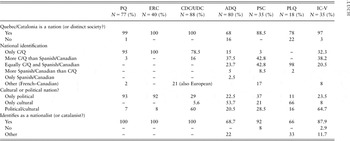
The militants of the PQ and ERC are strongly nationalist in their discourse. As Table 1 shows, the militants of the PQ and ERC are unambiguously nationalist, consonant with their independentist orientation. The militants from these two parties are virtually indistinguishable in their degree of nationalist sentiment, except that ERC militants expressed slightly more unfavorable views of Spain than PQ militants of Canada.
National consciousness among sub-state nationalists. Responses from PQ, ERC, CDC/UDC, ADQ, PSC, PLQ, and IC-V militants (N = 370)

PQ = Parti Québecois; ERC = Esquerra Republicana de Catalunya; CDC = Convergència Democràtica de Catalunya; UDC = Unió Democràtica de Catalunya; ADQ = Action Démocratique du Québec; PSC = Partit dels Socialistes de Catalunya; PLQ = Parti Libéral du Québec; IC-V = Iniciativa per Catalunya-Verds.
Autonomist nationalists and their national consciousness
As Table 1 shows, the militants of the ADQ strongly identified Quebec as a nation or as a distinct society and their own party as a nationalist party. Most were inclined to identify strongly with Quebec, but they were less monolithic than the independentists in their self-identification, given that some were willing to express a dual national identity. But still the number of ADQ militants expressing a strong Québecois identity were in the majority (Bariteau, 2005). The militant base of the two Catalan parties, CDC and UDC, were strongly nationalist in their responses, on all the criteria (especially CDC).Footnote 13 In essence, their responses are comparable to the independentists’ responses. The difference in terms of national consciousness between autonomists and independentists is negligible or small. Most autonomists, in sum, are not any less nationalist than independentists.
Federalist nationalists and their national consciousness
Benoît Pelletier was the Minister responsible for Canadian Intergovernmental Affairs and was one of the most prominent members of the PLQ government of premier Jean Charest. He explained: ‘First of all I think there is no doubt that Quebec is a nation by itself, and the question is whether the PLQ agrees with that principle, and the answer is yes. We believe Quebec is a nation. Second, how do we define a nationalist in Quebec? We define nationalist as someone who agrees with the fact that Quebec is a nation and who wants the blossoming of that nation. Of course, there are different ways to make that nation blossom. One of the ways is full sovereignty which is what the PQ is promoting, blossoming through state sovereignty. In our case we are promoting the blossoming of Quebec as a nation through its adhesion to the Canadian federal system. So, I would describe myself as being a nationalist federalist. And the supporters of the PQ would be nationalist sovereigntists… Being a nationalist here is someone who is very sensitive to, I would say, the strengthening of Quebec as a political entity…Now is the PLQ a nationalist party? I think it is. Is it a party that accepts all the dimensions of Quebec identity? The answer is yes’.Footnote 14
Jaume Bosch, the vice-president of IC-V, explained the nature of his party as follows: ‘We define ourselves as a national party, which is a meaningful self-definition. Within IC-V there are militants that define themselves as nationalists, even as independentists, and there are others that are federalists… In colloquial terms, to define ourselves as nationalists does not make us uncomfortable, but we believe the term “national party” describes us better’.Footnote 15
As Table 1 shows, the militants of the radical asymmetric federalist party (IC-V) overwhelmingly identified their society as a nation, and their party as a catalanist–nationalist formation.
Of all the party militants examined here, the militants of the mainstream federalist parties (such as PSC and PLQ) were the least monolithic in their sub-state national identification, even though an overwhelming number of them identified their society as a nation (or a distinct society) and their own party as a nationalist party. Some of these militants express dual national identities. However, the mainstream federalist parties have articulated a discourse and an official party line that is most definitely national in its tone and character. Moreover, the majority of PSC militants strongly identify themselves as Catalanists.Footnote 16
Most autonomists, in sum, are not any less nationalist than most independentists. The same is true for an asymmetric federalist formation like the IC-V, vis-à-vis independentists or autonomists. Moreover, most militants of traditional federalist parties (PSC and PLQ) share the discourse and attitudes typical of militants of ‘national parties’, even if some express dual national identities and are less monolithic in their national identification with their sub-state society.
In sum, a constant, widely held sub-state national consciousness among sub-state nationalists, cannot explain the puzzle of the internal variation in national movements.
The inadequacy of the materialist thesis
The materialist thesis would lead us to expect that nationalists are primarily concerned with the effect of their chosen political orientation on their economic and material well-being. We would expect secessionist nationalists and those nationalists who hold highly decentralizing orientations to be wary of the economic consequences of their chosen orientation. Contrary to the expectations of the materialist thesis, my findings show that especially those militants who opt for secessionism and the most decentralizing alternatives gave greater weigh to non-economic considerations in accounting for how they formed their preference for their chosen political orientation. Independentists especially, and sovereigntist autonomists and radical asymmetric federalists, have relegated economic considerations to a tertiary role.Footnote 17
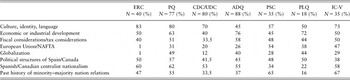
The last section of my questionnaire asked the militants to evaluate the relative impact of various factors (using a 10-point scale) on their decision to opt for their preferred political orientation. These various factors generally represented cultural/social, political, and economic/material considerations, as can be seen in Table 2.
Analysis of the political orientation of sub-state nationalist militants (N = 370)Footnote 1

ERC = Esquerra Republicana de Catalunya; PQ = Parti Québecois; CDC/UDC = Convergència Democràtica de Catalunya/Unió Democràtica de Catalunya; ADQ = Action Démocratique du Québec; PSC = Partit dels Socialistes de Catalunya; PLQ = Parti Libéral du Québec; IC-V = Iniciativa per Catalunya-Verds; NAFTA = North American Free Trade Agreement.
1 Percent of responses of militants that indicated this factor was ‘important’ in accounting for their decision to opt for autonomism. ‘Important’ = answered 8, 9, 10 on the 10-point scale in the questionnaire.
I observe that for independentist nationalists and strong decentralizers (instrumental autonomists and radical asymmetric federalists), considerations of language, culture, and identity weigh most heavily in accounting for their preferences, showing that (as one would expect of committed nationalists) considerations of identity are of primary importance. Therefore, since the levels of national consciousness are more or less comparable among the militants of these national parties (see also the discussion around Table 1), we need to consider how the other factors examined here account for how they opt for their preferred orientation.
For independentists and strong decentralizers, the bloc of political factors weighed more heavily than the bloc relating to economic and material considerations in accounting for their preference. Thus, to be specific, these militants indicated that they form their preference in response to majority nation/central state nationalism. They also perceive that the political structures of the central state are unable to accommodate their society as a sub-state national community.
But what exactly is ‘majority-nation nationalism’ and what is it about the political structures of the central state that upsets these nationalists? Militants in the ERC Focus Group no. 2, performed in the ERC party office in the neighborhood of Horta-Guinardo in Barcelona, were very responsive. I asked them if it was possible to transform Spain into a decentralized federation. One militant responded ‘it is not possible, because centralization forms part of the Spanish mentality. It goes against the Spanish tradition to be for federalism … Their mentality has always been one of homogenizing everything’.Footnote 18
The militants of traditional federalist parties, such as the PSC and the PLQ, indicated that the existence of majority nation centralist nationalism was basically irrelevant in accounting for their decision to opt for federalism.Footnote 19 Traditional federalists not only believe that federalism per se is a superior political orientation, but, in addition, their interpretation of the openness and pluralism of the political institutions of the central state is much more generous than that of independentists or strong decentralizers.
My findings show that those nationalists who pose the greatest challenge to the institutions of the central state assert that a calculus of their material well-being, or economic considerations in general, are not a primary or even a secondary consideration for them. Instead, they indicate that political factors (their reaction against ‘majority-nation nationalism’ and their perception of non-accommodation by the central state) weighed more than economic and material considerations in accounting for their preference. The adequacy of the materialist thesis is in doubt.
Varieties of sub-state nationalism and the moral polity of the stateless nationalist
Both the national consciousness thesis and the materialist thesis are inadequate to explain internal variation in national movements. Why do some nationalists opt for a secessionist orientation while other nationalists within the same national movement opt for a variety of non-secessionist orientations? Those nationalists who advocate secessionism and highly decentralizing alternatives do so because they have a negative perception of the central state and of the nationalism of the ‘majority nation’, as reciprocity and accommodation between sub-state nationalists and the institutional matrix of the central state are deemed to be unlikely.
Sub-state nationalist militants, the central state, and ‘majority nation’ nationalism
The militants of all eight parties were asked in my questionnaire about their perception of the central state and of the ‘majority nation’ that generally controls the apparatus of the central state (i.e. Canada and Spain).
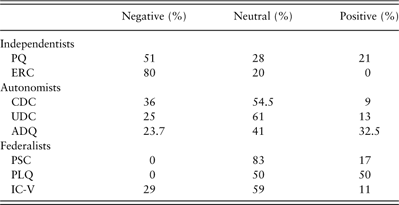
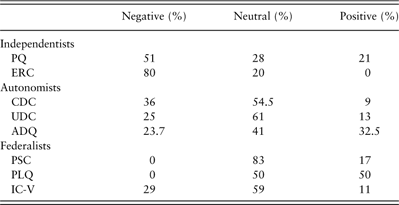
Independentists had remarkably negative opinions of the central state and of its dominating nationalism (see Table 3), with 80% of ERC respondents and 51% of PQ respondents indicating their negative views. PQ militants wrote that Canada was in their eyes an ‘occupying force for the last 250 years’, a ‘foreign country that has prevented Quebec from being born’, a ‘British dominion to which we are forced to belong’, a ‘fictive country and a relic of colonialism’, etc. One representative view of ERC respondents about Spain is that ‘it is the representation of power in its most perverse form: the legitimation of the right to conquest, plunder, the greatest obstacle to the development of the Iberian peoples…’.
Sub-state nationalist militants’ attitudes vis-à-vis the Central State (N = 370)
PQ = Parti Québecois; ERC = Esquerra Republicana de Catalunya; CDC = Convergència Democràtica de Catalunya; UDC = Unió Democràtica de Catalunya; ADQ = Action Démocratique du Québec; PSC = Partit dels Socialistes de Catalunya; PLQ = Parti Libéral du Québec; IC-V = Iniciativa per Catalunya-Verds.
At least one-quarter (or more) of autonomists held negative views of the central state, while most of the rest had neutral views, and few had positive views. The militants of the instrumental autonomist parties had few positive views of the central state. As one CDC militant commented about Spain: ‘[It is a] state that does not want to let us be. A state with different nations of which one, the Castillian belligerent, has imposed itself’. By contrast, the militants of the mainstream federalist parties had no negative views of the central state, and most expressed either neutral or highly positive views of it. As one PLQ militant commented about Canada: ‘I am Québecois and Canadian. In the same way that an Alsacian would say that he is French as part of his identity. Canada is my state, which situates me within the world, it is the place where I live, a guarantee of a quality of life, and it is a citizenship with the added bonus of my Québecois sense of belonging’. Radical asymmetric federalists were closer in their responses to the pattern expressed by instrumental autonomists than federalists. As one IC-V militant wrote: ‘Spain is a state that dominates by right of conquest other peoples and to which I have to belong juridically (irremediably), but I don't have there my heart or my mind’.
In sum, what is notable is the gap in the perception of the central state and of the nationalism of the ‘majority nation’ between less-decentralizing nationalists and those nationalists that advocate secession, and the highly decentralizing political orientations. The latter have negative or neutral attitudes toward the central state and the perceived nationalism of the ‘majority nation’, while less-decentralizing nationalists (federalists and teleological autonomists) have positive or neutral attitudes toward the central state and have no grievance against ‘majority nation’ nationalism. As one ERC militant wrote: ‘In the last 500 years, Castille (which dominates the Spanish state) has never respected us, why would it do so now?’. And another wrote: ‘…in our case, [our] party is “nationalist” because there is a Spanish nationalism which is much stronger (4 to 1) that does not respect Catalan society…’. Moreover, the evidence presented here shows that independentists have clearly more negative opinions of the central state than even sovereigntist autonomists and radical asymmetric federalists. Thus, independentists are distinguished by their marked lack of trust in the central state and in the perceived state nationalism of the ‘majority nation’, which is more notable than that expressed even by sovereigntist autonomists and radical asymmetric federalists, as the evidence presented in Tables 2 (and the discussion therein) and 3 show.
Conclusion: the moral polity of the stateless nationalist
Revisiting sub-state nationalism
It is clear that sub-state nationalism is not exclusively an independence-seeking phenomenon and that internal variation within national movements has been underinvestigated. I also argue that we need to reject a related dualism: the internal variation within sub-state nationalist movements cannot be reduced to a simplistic dualism between secessionist nationalism and non-secessionist nationalism. Instead, we need to recognize that non-secessionist nationalisms are complex and that there are important sub-categories within the pro-autonomism and pro-federation camps. There are strong autonomist parties that have sovereigntist impulses (even if mostly rhetorical and ambiguous), while others are content with just making demands for limited self-government, etc. Also, there are federalist parties that adopt a strong asymmetric federalist stance and assert their right to national self-determination, while others are more conservative and their proposed model of federation is more uniform and symmetric.
The inadequacy of alternative approaches
I have demonstrated that one of the principal versions of the cultural approach, the national consciousness thesis, is also unsatisfactory. Most autonomist militants exhibit the same level of national consciousness as independentists. The same is true for militants of radical asymmetric federalist parties vis-à-vis independentists or autonomists, and for many of the militants of mainstream federalist parties, although some of the latter may also express dual national identities. In sum, most of the leaders and militants of the eight political parties examined here have comparable levels of national consciousness, and value their national identity and their cultural distinctiveness very highly. All of these are also ‘national parties’, which assert that the sub-state nation exists.
The materialist thesis has also been shown to be unsatisfactory. My findings show that those nationalists who pose the greatest challenge to the institutions of the central state assert that a calculus of their material well-being, or economic considerations in general, are not a primary or even a secondary consideration for them, and this poses a serious challenge to the proponents of the materialist thesis.
The moral polity of the stateless nationalist
Central state institutions matter, but they matter because what is important is the perception among sub-state nationalists of the nature of these institutions, and whether there is a perception that the central state and the ‘majority nation’ (in the past and in the present) are capable of reciprocity and accommodation (Hale, Reference Hale2008: 80). Sub-state nationalists have expectations about what constitutes fair treatment by the central state, and notions about what obligations emerge due to common partnership in a plurinational state. Reciprocities are expected and notions of collective dignity, the common weal, and mutual accommodation are predominant (Thompson, Reference Thompson1993). Reciprocity is a valuable social commodity, because it helps to generate bonds of solidarity, social cohesion, and state-wide unity.
The evidence from the interviews with the top-level leaders and the focus group interviews, as well as the questionnaire responses, confirms that norms and expectations about reciprocity help to explain why some nationalists opt for independence or strong forms of decentralization while others opt for less-decentralizing orientations.Footnote 20
Independentists and strong decentralizers (sovereigntist autonomists and radical asymmetric federalists) indicate that they formed their preference because of a perception that the political structures of the central state, influenced by ‘majority nation’ nationalism, are unwilling to accommodate their society as a national community. Also, the evidence collected here demonstrates that independentists have markedly more negative opinions of the central state and of ‘majority nation’ nationalism than even strong autonomists and asymmetric federalists. It seems that independentists have the lowest trust in the central state, the most negative perceptions of state nationalism, and are the most pessimistic about the likelihood of reciprocity and accommodation between the center and the sub-state society.Footnote 21
On the other hand, the militants of traditional federalist parties have considerably more trust in the institutions of the central state. Mainstream federalists and teleological autonomists assert that the political institutions of the central state are capable of reciprocating and accommodating their sub-state national society and have no grievance against state nationalism, whereas independentists and strong decentralizers (instrumental autonomists and radical asymmetric federalists) disagree.
Thus, in a multinational democracy where the political structures and the animus of the central state are unaccommodating, federalist and autonomist sub-state nationalisms that do not strongly challenge the state's integrity are less likely to thrive and compete successfully with the other (more centrifugal) sub-state nationalisms that are its adversaries. Central state managers should encourage institutional and political developments that promote an ethos of plurinational reciprocity if they wish to promote state stability.
Acknowledgments
I would like to thank the European Studies Center at St Antony's College, University of Oxford, for the very productive year I spent there during 2010–2011 as Santander Fellow in Iberian and European Studies. I wish to thank Prof. Jane Caplan and Prof. Kalypso Nicolaïdis for making the stay there worthwhile. I would also like to thank the National Science Foundation for NSF Grant no. SES-0706689 during 2007–2009. Also, I wish to express my appreciation to the European University Institute in Florence, Italy for its institutional support during 2007–2009, the Institut Barcelona d'Estudis Internacionals (IBEI) for hosting me in 2009, and the Collegio Carlo Alberto (URGE) in Turin, Italy for the post-doctoral fellowship it offered me for 2009–2010. I thank James C. Scott and Rogers M. Smith for their comments on an earlier version of this paper.