As the number of women participating in the policy arena has increased over time, so have the number of studies that have focused on the impact of gender on policymaking. Most of these studies examine whether the sex of policymaking elites (e.g., Palmer and Simon Reference Palmer and Simon2003; Poggione Reference Poggione2004; Rosenthal Reference Rosenthal1998a, Reference Rosenthal1998b; Swers Reference Swers1998) or nonelites (e.g., Djupe, Sokhey, and Gilbert Reference Djupe, Sokhey and Gilbert2007; Howell and Day Reference Howell and Day2000; Norrander Reference Norrander1999) leads to variances in political behavior and/or preferences, or whether the sex of elites affects the perception of elites by nonelites (e.g., Dolan Reference Dolan2004b; Sanbonmatsu Reference Sanbonmatsu2002; Smith and Fox Reference Smith and Fox2001). Here, we look at a topic that has received scant attention in the social sciences: how policymaking elites' perceptions of external actors are affected by the actors' sex (see Mattei Reference Mattei1998, one of the few studies addressing this question). Specifically, we focus on the impact of attorney sex on U.S. Supreme Court decisions. While the literature is replete with examples of how nonelites' perceptions of women are influenced by gender-based stereotypes, we examine the relatively novel question of whether elites, in this case Supreme Court justices, are also influenced by gender stereotypes.
While scholars have examined the influence of gender in appellate courts, such studies focused largely on the question of whether a judge's sex influences his or her voting behavior (e.g., Allen and Wall Reference Allen and Wall1993; Collins and Moyer Reference Collins and Moyer2008; Davis, Haire, and Songer Reference Davis, Haire and Songer1993; Gryski, Main, and Dixon 1986; Songer and Crews-Meyer Reference Songer and Crews-Meyer2000; Songer, Davis, and Haire Reference Songer, Davis and Haire1994; Walker and Barrow Reference Walker and Barrow1985). The findings are mixed, ranging from no effects in the U.S. Courts of Appeals (Songer, Davis, and Haire Reference Songer, Davis and Haire1994), to conditional effects (e.g., Allen and Wall Reference Allen and Wall1993 and Gryski, Main, and Dixon Reference Gryski, Main and Dixon1986, finding that judge sex matters only in cases raising women's issues), to substantial effects in both the federal appellate courts (Peresie Reference Peresie2005) and state supreme courts (Songer and Crews-Meyer Reference Songer and Crews-Meyer2000). Mixed findings are also evident in the literature on trial court judges (see, e.g., the findings of Gruhl, Spohn, and Welch [Reference Gruhl, Spohn and Welch1981] that women and male judges sentenced males at similar rates, but women judges doled out heftier sentences to female offenders; the report by Kritzer and Uhlman [Reference Kritzer and Uhlman1977] of no differences in sentencing among male and female judges; and the notation by Walker and Barrow [Reference Walker and Barrow1985] of several differences between male and female U.S. District Court judges).
Few studies, however, have examined the effects of the sex of the attorney on judicial decision making despite the vast amount of research to suggest that attorneys play an important role in the decision-making process of American judges (e.g., Haynie and Sill Reference Haynie and Sill2007; Johnson, Wahlbeck, and Spriggs Reference Johnson, Wahlbeck and Spriggs2006; McAtee and McGuire Reference McAtee and McGuire2007; McGuire Reference McGuire1993; Reference McGuire1995; Reference McGuire2000). Most, if not all, of the attorney gender studies focus solely on the impact of the attorneys' sex on jury decision making (Cohen and Peterson Reference Cohen and Peterson1981; Hahn and Clayton Reference Hahn and Clayton1996; Hodgson and Pryor Reference Hodgson and Pryor1984; S. Johnson Reference Johnson1985; McGuire and Bermant Reference McGuire and Bermant1977; Sigal et al. Reference Sigal, Braden-Maguire, Hayden and Mosley1985; Villemur and Hyde Reference Villemur and Hyde1983). All of these studies, moreover, are mock juror experiments, primarily conducted by psychologists. Some studies find no relationship between the sex of the attorney and mock juror verdicts (e.g., Cohen and Peterson Reference Cohen and Peterson1981; S. Johnson Reference Johnson1985; Sigal et al. Reference Sigal, Braden-Maguire, Hayden and Mosley1985). Others conclude that mock jurors are more likely to vote in favor of male attorneys (Hahn and Clayton Reference Hahn and Clayton1996; Hodgson and Pryor Reference Hodgson and Pryor1984; McGuire and Bermant Reference McGuire and Bermant1977), and in their experiment, Nora K. Villemur and Janet Shibley Hyde (1983) find that mock jurors are more likely to acquit a rape defendant when the defense attorney is a woman. Clearly, the results of these studies are mixed. Furthermore, since the collective knowledge on the topic is the result of a series of experiments, it is subject to questions of external validity. Finally, these studies are limited to jury decision making, which is conceptually distinct from judicial decision making. In fact, to this date, no one has studied the relative influence of attorney sex in the appellate courts of the United States, including the Supreme Court.
Whether female counsel begin from a position of disadvantage when arguing before the Court is an important issue to address, given recent research indicating the challenges women attorneys face simply in being assigned Supreme Court cases. A recent study finds a substantial gender gap in the Supreme Court bar in the period 1993–2001, a gap that did not appear to narrow over this time period (Sarver, Kaheny, and Szmer Reference Sarver, Kaheny and Szmer2008). Although the study suggests a gender gap in the number of women on brief before the Court, the discrepancy among male and female counsel is particularly notable in the realm of oral arguments. Indeed, most Supreme Court oral arguments are contests between male attorneys and, thus, male attorneys accrue the advantages of being repeat players before the Court (Sarver, Kaheny, and Szmer Reference Sarver, Kaheny and Szmer2008). When women counsel represent parties in oral arguments in this context, therefore, they most often confront male opposing counsel. An important question to ask is whether their gender presents additional obstacles in persuading the minds of the individual justices to support their cause.
In addition, while one would not expect overt sexual discrimination on the part of Supreme Court justices, it is certainly possible that an attorney's sex could influence the justices' perspectives in a nuanced way. Indeed, there are a fair share of studies documenting the operation of gender-based expectations and stereotypes of women attorneys working in lower-court arenas (see, e.g., Hahn and Clayton Reference Hahn and Clayton1996; Hodgson and Pryor Reference Hodgson and Pryor1984; McGuire and Bermant Reference McGuire and Bermant1977; Villemur and Hyde Reference Villemur and Hyde1983). It remains an empirical question, therefore, whether an attorney's sex can affect his or her chances of winning over the justices sitting on the Supreme Court.
BACKGROUND
To understand the causal mechanisms behind the potential influence of attorney sex on U.S. Supreme Court decision making, one must synthesize two separate lines of research: studies of the influence of attorney expertise on judicial decision making and studies examining how individuals are influenced by the sex of other actors.
Attorney Influence on Supreme Court Decision Making
Like most political decision makers, the justices rely on other actors for information,Footnote 1 including law clerks (Peppers Reference Peppers2006; Wahlbeck, Spriggs, and Sigelman Reference Wahlbeck, Spriggs and Sigelman2002), amicus curiae (Collins Reference Collins2004, Reference Collins2008), and attorneys (T. Johnson Reference Johnson2001, Reference Johnson2004). According to Timothy R. Johnson (Reference Johnson2004), the justices use oral arguments to gather information about the policy implications of their decisions, as well as the preferences of external actors that could influence the impact of the Court's decisions. Moreover, others contend that appellate litigators can clarify the facts and issues for the judges (Wahlbeck Reference Wahlbeck1997) or even construct persuasive legal arguments (Haire, Lindquist, and Hartley Reference Haire, Lindquist and Hartley1999). Finally, we know that the justices utilize the information presented in the oral arguments and briefs during various aspects of the decision-making process. For example, Johnson (Reference Johnson2004) finds that the justices frequently refer to materials from oral arguments in all aspects of the decision-making process, from conference discussions to oral arguments. Similarly, Pamela Corley (Reference Corley2008) points out that most majority opinions borrow significant amounts of text from litigant merits briefs.
Regardless of the sources and types of information relied upon by the justices, the degree to which the Court utilizes attorney-supplied information is at least a partial function of the expertise of the attorney supplying it. According to Kevin T. McGuire (Reference McGuire1995) and Timothy R.O. Johnson, Paul J. Wahlbeck, and James F. Spriggs (2006), the justices are more reliant upon information if they believe that the source is credible. While no one has directly tested the credibility hypothesis, studies suggest that the justices are more influenced by attorneys with prior Supreme Court litigation experience (McGuire Reference McGuire1995; Wahlbeck Reference Wahlbeck1997). McGuire (Reference McGuire2000) also finds some evidence of a relationship between prior Supreme Court clerkships and Court decisions. We also know that an assortment of attorney characteristics (e.g., experience, clerkships, law school alma mater, certain types of government employment, and geographic proximity to the Court) influenced Justice Harry Blackmun's informal assessments of attorneys' oral argument performances and, in turn, those assessments partially explain the other justices' votes (Johnson, Wahlbeck, and Spriggs Reference Johnson, Wahlbeck and Spriggs2006). Similarly, Corley (Reference Corley2008) finds that Supreme Court majority opinion authors are more likely to borrow language from litigant briefs written by attorneys with more prior litigation experience, as well as those from the U.S. Solicitor General's Office.
In sum, it is apparent that lawyers can and do influence Supreme Court decision making. The justices rely on these external actors to provide information to the Court in briefs and oral arguments, and they are more likely to utilize information presented by highly capable lawyers. Presumably, these lawyers are more credible and/or persuasive. The open question, which we examine in this article, is whether the sex of the orally arguing attorney affects the justices' decision making.
Gender Schema Theory
Given the prior research on attorney influence on appellate judicial behavior, one would expect attorney sex to play a role if it affects the justice's perceptions of the attorney's credibility. If a justice employs “gender schemas,” his or her perception of the attorney's credibility could be affected.Footnote 2 A schema is “a cognitive structure that enables an individual to make sense of and impose structure on the many stimuli with which he or she is bombarded in the course of daily living” (Matland Reference Matland1994, 278, citing Nisbett and Ross Reference Nisbett and Ross1980). A schema does this by serving as “a mental representation of a category of objects, events, or persons and their typical characteristics” (Haslett, Geis, and Carter Reference Haslett, Geis and Carter1992, 57). Individuals, schema theorists suggest, employ multiple types of schemas, with such structures serving essential tasks in information processing (e.g., Conover and Feldman Reference Conover and Feldman1984; Haslett, Geis, and Carter Reference Haslett, Geis and Carter1992). Schemas play a key role in the “organization” of information insofar as “people order the elements of their environment to reflect the structure of relevant schemas” and “influence ‘what information will be encoded or retrieved from memory’” (Conover and Feldman Reference Conover and Feldman1984, 96, citing Taylor and Crocker Reference Taylor, Crocker, Higgins, Herman and Zanna1981, 98). Moreover, while schemas can serve as “heuristic” devices in the face of too much information, they can also be used as an aid in the event of “missing information” (Conover and Feldman Reference Conover and Feldman1984, 96–97).
Undoubtedly, biological sex is a “basic category” by which one individual is likely to assess another individual (Haslett, Geis, and Carter Reference Haslett, Geis and Carter1992, 57–58). Thus, an individual's “gender schema” would involve those things deemed to be “‘the typical attributes’ of men and women,” and it is through perceptions of such traits that gender schemas can work to perpetuate gender stereotypes (Haslett, Geis, and Carter Reference Haslett, Geis and Carter1992, 58, citing Taylor and Crocker Reference Taylor, Crocker, Higgins, Herman and Zanna1981). As Beth Haslett, Florence L. Geis, and Mae R. Carter (1992, 58) explain, “as soon as we notice that someone is a woman, all of the stereotypic attributes of the category ‘women’ are . . . activated.” Moreover, this process can take place without full awareness or ill intent (Haslett, Geis, and Carter Reference Haslett, Geis and Carter1992, 58, citing Tsujimoto Reference Tsujimoto1978).
In this process, as described by Virginia Valian (Reference Valian1999), individuals naturally assign different attributes, physical and mental, to men and women. Men are viewed as independent, strong, and rational; women are seen as communal, emotional, and nurturing. It is not hard to understand, therefore, how the application of gender schemas might ultimately lead to the “overrating” of men and the “underrating” of women (Valian Reference Valian1999, 1045; Reference Valian2005, 198). Indeed, because individuals tend to form impressions about men and women from extreme cases, an individual's view of the sexes can be quite polarized, overly intensifying schematic applications of gender attributes to the benefit of one and the detriment of the other (Valian Reference Valian1999).
While the influence of attorneys before the Supreme Court is a partial function of certain experiential characteristics, it is possible that immutable traits like sex also play a role. Indeed, scholars have found evidence of the use of gender schemas and negative gender stereotyping in a number of contexts. For example, researchers have found that people are more likely to assume that men are leaders (Butler and Geis Reference Butler and Geis1990; Porter and Geis Reference Porter, Geis, Mayo and Henley1981), and public perceptions of women political candidates are biased on gender stereotypes (Huddie and Terkildsen Reference Huddie and Terkildsen1993; Kahn Reference Kahn1996; Sanbonmatsu Reference Sanbonmatsu2002). Elites, like women professors, are often discriminated against by their colleagues as a result of the negative application of gender schemas (Valian Reference Valian2005). In addition, the women witnesses testifying before the Senate Judiciary Committee hearings during the David Souter confirmation process were given less time to speak then similarly situated males, and the points made by women witnesses tended to be undermined by the responses of the male senators (Mattei Reference Mattei1998). Similarly, media elites apply gender schemas to their coverage of women politicians, which, in turn, influences public perceptions (Kahn Reference Kahn1992).
HYPOTHESES
Attorney Sex
How does the application of gender schemas play out in the legal profession? In short, stereotypical female traits do not mesh well with what the law and legal practice represents and expects, placing women lawyers in a “double-bind” (Jamieson Reference Jamieson1995; Ostrow Reference Ostrow2004; Radin Reference Radin1990; Rhode Reference Rhode2002). Women are expected to work harder, yet they are still rated as less competent (Ostrow Reference Ostrow2004). Male attorneys are rewarded for ruthless behavior in the courtroom, but female lawyers are deemed unprofessional if they behave in the same manner (ABA 2001; Ostrow Reference Ostrow2004; Pierce Reference Pierce1995; Rhode Reference Rhode2002). So-called “gendered” behavior, moreover, is remembered and oftentimes serves as a further basis to thwart women's advancement. For example, instances in which a woman leaves work early to tend to a sick child will often leave a greater impression than her professional accomplishments (See, e.g., Ostrow Reference Ostrow2004).
It is also possible that the use of gender schemas in the legal context manifests itself in other ways. For example, sex-based perceptions among law school professors can lead to sex-based segregation among law faculty (Kornhauser Reference Kornhauser2004). Among lawyers, women generally earn less than their male counterparts with similar experience and qualifications (ABA 2001; Epstein et al. Reference Epstein, Robert Saute and Gever1995; Noonan and Corcoran Reference Noonan and Corcoran2004), and women attorneys working in law firms are less likely to receive promotions than similarly situated males (Epstein et al. Reference Epstein, Robert Saute and Gever1995; Noonan and Corcoran Reference Noonan and Corcoran2004). Clients, moreover, might also apply gender schemas in their perceptions of women lawyers. For example, in an analysis of the language employed by attorneys and clients, Bryna Bogoch (Reference Bogoch1997) finds that clients are more deferential to men, even though the content of the language used by the attorneys did not vary across sex. In addition, Laura R. Winsky Mattei (Reference Mattei1998) concludes that the male senators on the Judiciary Committee treated women witnesses testifying in the Souter confirmation hearings with less respect (as to both the time allocated for testimony and the number of interruptions) than the male witnesses. Finally, Kenneth L. Karst's (2003) anecdotal examinations of Supreme Court justice opinions identified gender stereotypes that were employed by some justices to rationalize weakening equal protection standards for women.
All of the previous evidence in analogous contexts makes it plausible to posit that Supreme Court justices might apply gender schemas when cognitively processing information presented by Court advocates. Obviously, subconscious stereotypes of male and female attorneys will only affect the justices' perceptions of the attorneys' arguments if the sex of these actors is known. In the context of Supreme Court litigation, however, the justices are clearly aware of the sex of the orally arguing attorney. Given the substantial evidence of the negative application of gender schemas in the legal world and related contexts, we expect to find that justices apply gender schemas when judging the credibility of the information presented by women attorneys in oral arguments. The use of these schemas, we posit, will generally result in the devaluation of the information conveyed by women attorneys. Since the Supreme Court's decisions are a partial function of attorney credibility, we hypothesize the following:
- H1:
Supreme Court justices are less likely to decide in favor of parties represented by a female orally arguing attorney when the opposing oral argument is presented by a male attorney.
Justice Ideology
While we expect the sex of legal counsel to have a significant effect on the nature of Supreme Court decisions, we must consider the possibility that another variable, ideology, might magnify or mitigate this effect for a given justice. Scholars have long noted the important influence of judicial ideology in the decision-making processes of Supreme Court justices (e.g., Segal and Spaeth Reference Segal and Spaeth2002). Hence, as discussed in the following, the ideology of the justice is a key control variable that is included to account for the likelihood that liberal justices are more likely to cast a liberal vote than their conservative colleagues. Although the influence of judicial ideology is likely to be quite pronounced in this manner, it is also possible that a justice's ideology might influence the application of gender schemas.
There is, in fact, some anecdotal evidence of a relationship between judicial ideology and the treatment of women lawyers. According to data presented by Todd Peppers (Reference Peppers2006, 21), four of the five conservative justices serving on the Court at some point between the 1993 and 2001 terms (Antonin Scalia, Clarence Thomas, William Rehnquist and Anthony Kennedy) were significantly less likely to hire female law clerks than their liberal colleagues. Indeed, at least 70% of the clerks hired by the four male conservative justices were men, while four of the five liberal justices (John Paul Stevens, Ruth Bader Ginsburg, Blackmun, and Stephen Breyer) had female clerk percentages, ranging between 36% (Stevens and Blackmun) to over 40% (Breyer and Ginsburg). Conversely, the four conservative males had female clerk percentages of 13% (Scalia), 16% (Rehnquist and Kennedy), and 30% (Thomas). Only Sandra Day O'Connor (over 40% of her clerks were women) and Souter (23%) did not scale ideologically.
While we know that there is a relationship between ideology and perceptions of women in other contexts (e.g., Koch Reference Koch2000) and that ideology tends to affect the justices' selection of women clerks, how could ideology modify the justices' perceptions of the information presented by female attorneys? One might hypothesize that justices who tend to support more liberal political positions might also tend to apply gender schemas in ways that are not as disadvantageous toward women. For example, those who are more committed to supporting women's rights, including equal employment rights (i.e., judicial liberals), might be more wary of traditional gender stereotypes. These justices might assign different traits to their characterizations of that which is typically male and female in a way that might neutralize any preconception that the female role does not mesh with that of a legal advocate. Furthermore, if there is even partial overlap in the types of arguments, goals, and strategies emphasized or accepted by women and liberal jurists, the possibility for gender bias to negatively affect the likelihood of litigant success should be alleviated, at the very least. Thus, the influence of one's ideological preferences may extend beyond evaluation of the substantive issues raised in the case to affect how a given judge evaluates the attorneys presenting the legal arguments as well. These possibilities lead to the generation of a second hypothesis:
- H2:
Conservative justices will be less likely to vote in favor of parties represented by female orally arguing attorneys, whereas liberal justices will be inclined to offer further support or, at the very minimum, will not be less inclined to support litigants represented by female orally arguing attorneys.
Women's Issues
Finally, the credibility that a justice attaches to the information presented by a woman attorney could be influenced by the type of legal issues the attorney raises via “issue stereotypes” (see Dolan Reference Dolan2004a, 78). In particular, we might expect the use of gender schemas to work to the advantage of women attorneys in those areas in which women attorneys might be perceived to have enhanced credibility – that is, cases involving sex discrimination, privacy, crimes against women (e.g., rape), prostitution, obscenity, and so on. This is consistent with prior research on public perceptions of women politicians, including studies by Kathleen Dolan (Reference Dolan2004a), Leonie Huddie and Nayda Terkildsen (1993), and Kira Sanbonmatsu (Reference Sanbonmatsu2002). All three studies find that voters are more likely to believe that women legislators can handle “women's issues,” while Jennifer L. Lawless (Reference Lawless2004) finds more negative perceptions of potential women presidents' abilities to handle more male issues, like warfare. Finally, there is also some evidence that elites are more likely to hold positive gender stereotypes with respect to women dealing with women's issues. For example, Sue Thomas (Reference Thomas1994) finds that women sponsors of legislation involving women, family, and child-related issues were generally more successful than their male counterparts. In the context of Supreme Court litigation, therefore, we expect that the justices will use gender schemas in these cases as a heuristic for substantive expertise. Since substantive expertise likely enhances the judge's perceptions of the credibility of the attorney (Haire, Lindquist, and Hartley Reference Haire, Lindquist and Hartley1999), presumably the perceptions of the credibility of women attorneys are enhanced in women's issues cases. Therefore, we hypothesize the following:
- H3:
Supreme Court justices are more likely to side with women lawyers in cases involving women's issues.
DATA AND METHODS
The data set for the analysis includes the orally argued cases from the U.S. Supreme Court's 1993–2001 termsFootnote 3 as identified from The Original U.S. Supreme Court Database.Footnote 4 Specifically, we test two sets of models. We first examine whether the sex of the orally arguing attorney who is advocating the liberal position in a case makes any substantive difference in individual justices' decisions to cast a liberal vote. This initial analysis, therefore, provides potentially important evidence of the employment of gender schemas in Supreme Court litigation and, thus, constitutes a test of H1. We then explore the more nuanced ways in which gender schemas might operate by altering our dependent variable to predict the likelihood of a justice supporting the position of the woman attorney when she opposes male counsel. Through this analysis, we are thus able to test both H2 and H3. Further, by limiting both models to the subset of Court cases in which female attorneys square off against male attorneys in oral argument (21.7% of all cases), we are able to limit our analysis to those instances in which attorney sex is most likely to matter.
Given the possibility that cases in which women appear as advocates in oral arguments might systemically differ from those in which they do not, and that this, in turn, might influence their success in influencing the justices to support their position, steps must be taken to avoid the biased coefficients that could result from selection bias (see Heckman Reference Heckman1979; also, see Hall and Bonneau Reference Hall and Bonneau2006 for a recent example of a judicial politics study employing a selection model). We thus employ Heckman two-stage probit regression models to test our various hypotheses. These models each include a selection equation, in which we model the likelihood of a woman attorney appearing on one side of the oral argument, as well as an outcome equation, in which we predict either the likelihood of a liberal vote (Model 1) or the likelihood of a justice voting in favor of the woman attorney's position (Model 2). In addition, in all of the models, following Johnson, Wahlbeck and Spriggs (Reference Johnson, Wahlbeck and Spriggs2006) and others (e.g., Lindquist and Solberg Reference Lindquist and Solberg2007; Maltzman, Spriggs, and Wahlbeck Reference Maltzman, Spriggs and Wahlbeck2000; Zorn and Van Winkle Reference Zorn and Van Winkle2000), we account for possible correlations between error terms by calculating robust standard errors clustered by the justice.
SELECTION MODEL
The selection equation is the same across both Heckman models we present. Consequently, the dependent variable in the first stage (i.e., the selection stage) of both Heckman models is whether a woman attorney provided the oral argument on one side of a Supreme Court case. The variable is coded “1” if this condition was satisfied and “0” otherwise.Footnote 5
Although the literature on women attorneys' participation in High Court litigation is very limited (see, e.g., Sarver, Kaheny, and Szmer Reference Sarver, Kaheny and Szmer2008), it is suggestive of a few predictors that should be included in the selection model. First, we predict that the presence of a woman attorney on one side of a case will be a function of the party types litigating before the Court. In their analysis of women attorneys' participation in Supreme Court litigation, for example, Sarver, Kaheny, and Szmer (Reference Sarver, Kaheny and Szmer2008) found that the federal government tended to be represented by male counsel at oral argument. When women appeared in Supreme Court cases, they were typically employees of private practice firms, state and local governments, or interest groups/associations, or they were legal aid counsel. In addition, and perhaps even more relevant, Sarver, Kaheny, and Szmer (Reference Sarver, Kaheny and Szmer2008) also report that female orally arguing attorneys before the High Court were in the lowest quartile of bar experience among the participants in the sample. Of course, one of the possible advantages of repeat players is their ability to hire “better” counsel (Sheehan, Mishler, and Songer Reference Sheehan, Mishler and Songer1992, 464). Thus, on average, we should see such litigants (who tend to score higher on party capability measures) tend to hire male attorneys.
Consequently, we include in our selection models two party capability variables – one for the respondent and one for the petitioner. We employ the traditional measure of this concept, whereby litigants are categorized on the basis of organizational characteristics; numerical values are assigned to each category on the basis of an assumption of relative levels of resources, experience, and other advantages (e.g., Songer and Sheehan Reference Songer and Sheehan1992; Songer, Sheehan, and Haire Reference Songer, Sheehan, Haire, Kritzer and Silbey2003). Starting with this premise, we constructed the following typology:Footnote 6
1 = Individual persons 4 = Subnational governments
2 = Non-Fortune 500 corporations 5 = Fortune 500 corporationsFootnote 7
3 = Interest groups 6 = United States
We hypothesize that increases in each variable will be associated with decreases in the likelihood of a woman attorney participating in Supreme Court oral arguments.
In addition, Sarver, Kaheny, and Szmer (Reference Sarver, Kaheny and Szmer2008) note that when women attorneys appear before the Supreme Court, they are more likely to appear in cases raising women's issues than in nonwomen's issue cases. Although they do not offer a reason for this finding, one possibility is that decisions to assign a woman to a women's issue case are also driven by gender-based assumptions that a woman might be more successful in these particular cases. Thus, we include a women's issue dummy variable, coded “1” if the case included a so-called women's issue, “0” if it did not. To determine whether the case involved a gender-related issue, we utilized the coding convention developed by Thomas G. Walker and Deborah J. Barrow (Reference Walker and Barrow1985) and followed by Jennifer Segal (Reference Segal2000). In both studies, “women's issues” were operationalized to include sex discrimination and harassment, reproductive rights, maternity rights, and issues involving equal employment opportunity. In addition, Walker and Barrow (Reference Walker and Barrow1985) considered nonemployment affirmative action cases involving gender issues.Footnote 8
There are also several factors that might affect the participation of women attorneys but lack the same degree of theoretical support. However, since this part of the analysis is primarily exploratory, we control for these factors without a priori expectations regarding the direction of the coefficients. For example, the appearance of female counsel in oral argument might also vary in interesting ways across other issue areas. Consequently, we include three other dummy variables indicating the presence or absence of a criminal issue, a civil liberties/rights issue, or an economic issue.
Decisions to hire male or female counsel might also systematically differ according to other case characteristics, including the complexity and saliency of the case. To test whether such factors do, indeed, influence a woman attorney's selection, we include two additional dummy variables in our selection equation in order to tap the presence of either a complex or salient case. To measure case complexity, we utilized the measure developed by Forrest Maltzman, Spriggs, and Wahlbeck (Reference Maltzman, Spriggs and Wahlbeck2000)—the factor scores from a factor analysis of the issues and legal provisions in the case. The saliency measure, on the other hand, is a dummy variable coded “1” if the New York Times included a front-page story relating to the Court's decision in the case and “0” otherwise (see Epstein and Segal Reference Epstein and Segal2000).
Outcome Model (1): Predicting the Likelihood of a Liberal Vote
The second stage of our first Heckman model predicts the likelihood of a justice casting a liberal vote. Unless otherwise noted, the independent variables are operationalized to account for the adversarial nature of Supreme Court litigation, in which each side is represented by legal counsel. In other words, the impact of an attorney on the Court's decisions is a function of not just the attorney's characteristics but also those of his or her opponents. Indeed, it is the competitive advantage (or disadvantage) that one party has in relation to its opponent that should affect the outcome. As such, most of the variables discussed here are actually the difference of the values for the parties advocating the liberal and conservative outcomes, with higher values typically indicating an advantage for the party arguing in favor of the liberal outcome.
Attorney sex
In order to isolate those circumstances under which attorney sex is most likely to be relevant, we limited our sample to only those cases in which male attorneys confronted female attorneys in Supreme Court oral arguments. We then included one measure of attorney sex: the sex of the orally arguing attorney.Footnote 9 In this situation, we know that the justices are aware of the orally arguing attorneys' sex and, thus, this sets up an optimal test for the use of gender schemas, since a prerequisite of gender schema theory is that the sex of the actor of interest is known.
To collect the data, we first identified the relevant names from the reporters and oral argument transcripts. In most instances, the attorney's sex was apparent from the name. In approximately 3% of the cases in which the names were gender neutral, we relied on the title (e.g., Mr. or Ms.) applied to the attorney in the transcripts of the oral arguments, or, in rare instances, an Internet search identifying pictures or gender-specific titles/pronouns on law firm Websites. The variable woman attorney on liberal side is coded “1” if the party advocating a liberal outcome was represented by a woman attorney at oral argument and “0”if the woman attorney was advocating a conservative outcome. Given our hypothesis, as well as the operationalization of the dependent variable, we expect to find a negative coefficient for this variable, indicating that the justices are significantly less likely to cast a liberal vote if the party advocating such an outcome is represented by a woman attorney.
Attorney capability
Since we are examining the influence of attorneys on judicial decision making, we included two variables that control for other attorney characteristics beyond sex. The first is a measure of attorney capability or expertise. Several studies (e.g., Corley Reference Corley2008; Johnson, Wahlbeck, and Spriggs Reference Johnson, Wahlbeck and Spriggs2006; McGuire Reference McGuire1995; Reference McGuire2000; Wahlbeck Reference Wahlbeck1997) have identified a causal linkage between various elements of attorney expertise and U.S. Supreme Court behavior. Moreover, given the possibility that women may be less likely to have the opportunities to develop expertise, (e.g., prior U.S. Supreme Court clerkships and litigation experience; see Sarver, Kaheny, and Szmer Reference Sarver, Kaheny and Szmer2008), the variable is necessary to control for the possibility that any observed influence of attorney sex on judicial decision making is a function of the possible disparity in expertise. The variable is constructed from the factor scores derived from a factor analysis of six characteristics that each reflect an aspect of attorney expertise:Footnote 10 experience in the U.S. Solicitor General's Office; prior litigation experience before the U.S. Supreme Court;Footnote 11 prior clerkship with the Supreme Court;Footnote 12 attendance at an elite law school;Footnote 13 some sort of academic honor received in law school;Footnote 14 and participation on the law review.Footnote 15 The actual variable (attorney capability) is the difference between the expertise scale values for the orally arguing attorneys advocating the liberal and conservative outcomes.Footnote 16
Litigation team size
While the previous measure focuses on the quality of the attorneys participating in Supreme Court litigation, the quantity of attorneys participating on a given litigation team before the Supreme Court might also influence the justices' votes. The size of the litigation team could provide several benefits, including increased research power, prehearing moot courts, and the augmented ability to anticipate all counterarguments (Szmer, S. W. Johnson, and Sarver 2007). Indeed, Szmer, Johnson, and Sarver (Reference Szmer, Johnson and Sarver2007) and Susan B. Haire and Laura P. Moyer (Reference Haire and Moyer2008) find that parties represented by more lawyers are more successful in litigation before the Supreme Court of Canada and the U.S. Courts of Appeals, respectively. Taking this into account, the litigation team size variable measures the difference between the natural logarithm of the number of attorneys representing the parties advocating liberal and conservative outcomes. More specifically, taking into account the possible diminishing returns of larger attorney teams, this variable is the difference of the logarithmically transformed values. On the basis of the posited advantages of larger attorney teams, we anticipate finding a positive coefficient.
Judicial ideology
Of course, we also include a variable to control for the influence of ideology on the justices' decision making (e.g., Segal and Spaeth Reference Segal and Spaeth2002). This variable is incorporated to control for the possibility that the justices' treatment of women attorneys is actually a function of ideology—that perhaps women attorneys are more likely to work for parties advocating liberal outcomes. For the purposes of our analysis, the policy preferences of the justices are the Martin and Quinn (Reference Martin and Quinn2002) Posterior Mean Ideal Point estimates for the respective justice and term.Footnote 17 Positive values indicate that the justice was a conservative, while negative values indicate that the justice was a liberal. Therefore, we expect to find a negative coefficient for the justice ideology variable.
Amicus curiae
We also included two variables that account for the influence of amicus curiae on the U.S. Supreme Court: amici support and U.S. amicus support. Amici provide supplemental information to the Court, typically in the form of briefs. They may provide legal arguments as well as information regarding the preferences of external political actors (Epstein and Knight Reference Epstein, Knight, Clayton and Gillman1999). Since there is some evidence that amicus presence affects Court decision making (e.g., Collins Reference Collins2004; Reference Collins2008), and similar concepts have been controlled for in other studies of attorney expertise (e.g., McAtee and McGuire Reference McAtee and McGuire2007; McGuire Reference McGuire1995), we included the amici support variable, which is the difference between the natural logarithmFootnote 18 of the number of amicus briefs for and against a liberal outcome, as identified using Lexis, Westlaw, and the U.S. Reports.Footnote 19 We also included the variable U.S. amicus support to account for the special role of the United States as an amicus. Scholars have found that the support or opposition of the United States as amicus curiae has a significant impact on Supreme Court decision making on the merits (e.g., Jeffrey Segal Reference Segal1990; Segal and Reedy Reference Segal and Reedy1988). U.S. amicus support was coded “1” if the U.S. amicus brief argued a liberal position, “–1” if the U.S. position was conservative, and “0” if the United States did not submit an amicus brief. We expect to find a positive coefficient for both amicus variables.
Party capability
We also included two party-capability variables to account for the tendency of judges to favor parties with certain advantages, including superior material resources, prior litigation experience, and the ability to hire quality legal representation (see Galanter Reference Galanter1974). We employ the same party-capability scale used in the selection model. Specifically, we include two variables in the first outcome model: party capability (liberal side) and party capability (conservative side). Increases in the former variable ought to be positively related to the dependent variable, while increases in the latter should be negatively related to the dependent variable.
Lower court direction
Finally, we included a measure to take into account the Court's strong tendency to reverse lower court decisions. Indeed, from 1993 to 2001, the Supreme Court reversed the lower court almost 60% of the time. This also controls for the possibility that any observed relationship between litigator sex and Supreme Court decision making is a function of a propensity for women attorneys to represent one type of party (respondent or petitioner). However, in a subset of Court cases—those involving lower court conflicts—the Court's tendency to reverse the lower court may not be operable or may be otherwise diminished (see, e.g., Collins Reference Collins2004, 820, citing Segal and Spaeth Reference Segal and Spaeth2002, 200–2). Specifically, the variable, lower court direction, is coded “−1” if the direction of the lower court decision was liberal in a nonconflict case, “0” if the case was granted certiorari due to an apparent conflict, and “1” if the direction of the lower court decision was conservative in a nonconflict case. If the tendency is for the Court to reverse (in nonconflict cases, at least), then we would expect to find that a justice will be more likely to vote for a party advocating a liberal outcome if the lower court decision was conservative in a nonconflict case. We thus expect a negative relationship between this variable and the likelihood of a liberal vote.
Outcome Model (2): Predicting the Likelihood of a Justice Supporting the Woman's Position
While the first outcome model will test whether attorney sex affects the likelihood of a justice casting a liberal vote, it does not address the potentially more interesting questions concerning the existence of conditional relationships between attorney sex and other key variables. For example, are women more successful in cases that involve women's issues? Does the ideology of the judge affect the degree to which he or she will side with arguments made by women attorneys? Does the gender of the justice make a difference in his or her support of women litigators? Given these questions, we developed a second Heckman model in which the dependent variable of the outcome model is the justice's vote for (1) or against (0) the party represented by the woman attorney at oral argument.Footnote 20
Because of the possibility of selection bias, we include the same selection equation utilized in our first Heckman model, and again, the sample of votes is limited in the outcome equation to those cast in cases in which male attorneys confront female attorneys in oral argument. In terms of the outcome or second stage of the model, the same concepts employed in our initial analysis are included, though they are operationally defined in a different manner, given the alteration of the dependent variable. As noted earlier, attorney sex is reflected by the dependent variable in Model 2. Amici support, U.S. amici support, attorney capability, and litigation team size are the differences of the values for the woman orally arguing attorney (or the side she represents) and the male orally arguing attorney (or the side that he represents). For example, positive values of attorney capability indicate that the woman attorney is more capable than her male counterpart. In addition, the impact of the justices' attitudes on their decisions is estimated using the ideological congruence of the justice and the position advocated by the woman attorney. Following the logic discussed in Johnson, Wahlbeck, and Spriggs (Reference Johnson, Wahlbeck and Spriggs2006, 106–7), the ideological congruence variable is equal to the Martin-Quinn score described earlier if the party represented by a woman favored a conservative outcome; it is the negative value of the Martin-Quinn score if the woman attorney argued in favor of a liberal outcome. Higher values indicate increased congruence, such that we would expect that the attitudinally oriented justice would be more likely to vote in favor of the woman attorney.
We again include two party-capability variables in the equation. We expect increases in the party-capability measure of the side represented by the female attorney to be positively related to the likelihood of a justice voting to support her position, while increases in the party-capability score of the side represented by the male attorney should be negatively associated with the likelihood of a justice voting in support of the woman attorney's position. Similarly, we also account for the Court's tendency to reverse decisions. Thus, we include whether the lower court supported the position of the woman attorney. This variable, lower court for woman, is coded “1” if the lower court sided with the woman attorney's position in a nonconflict case, “0” if the case was granted certiorari due to the presence of a lower court conflict, and “–1” if the lower court supported the position of the male attorney in a nonconflict case. Given the Court's tendency to reverse nonconflicts cases, we expect a negative relationship between this variable and the likelihood of a justice voting to support the side represented by the woman attorney before the Supreme Court.
We also included three new variables: justice gender, women's issue, and justice ideology. Justice gender controls for the possibility that women justices may be more or less likely to side with parties represented by women attorneys. Indeed, in other contexts, like voter perceptions of candidates for congressional office, women are more likely to favorably assess women candidates (Dolan Reference Dolan1998; Reference Dolan2004a; Sanbonmatsu Reference Sanbonmatsu2002), something that Dolan (Reference Dolan2004a, 92) calls the “affinity effect”: Women share a group identity and are therefore more likely to support other women. Moreover, Karst (Reference Karst2003) finds anecdotal evidence that the sex of the justice affects the use of gender stereotypes in judicial opinions. On the basis of these findings, we might expect to find a significant relationship between the sex of the justice and that of the attorney. However, many gender schema studies find that women are equally likely to employ gender schemas when evaluating women in a variety of contexts (e.g., Biernat, Manis, and Nelson Reference Biernat, Manis and Nelson1991; Butler and Geis Reference Butler and Geis1990; Porter and Geis Reference Porter, Geis, Mayo and Henley1981), including jury decision making (e.g., Hodgson and Pryor Reference Hodgson and Pryor1984). The justice gender variable is coded “1” for the women and “0” for the men. Given the lack of gender diversity on the Court, we treat this variable as a control since any findings would not be generalizable.
The women's issue variable is a dummy variable coded “1” if the case included a so-called women's issue, “0” if it did not. The operationalization of this variable is the same as that employed in our selection model. Given the hypothesis described earlier, we would expect to find a positive coefficient for this variable, reflecting the posited increased perception of credibility for woman attorneys in these types of cases.
Finally, to test whether conservative justices are more likely to devalue arguments of women attorneys as a result of negative stereotypes, we included the Martin-Quinn measure of the justice's ideology (note that this is conceptually distinct from the ideological congruence variable). As noted, higher values of the Martin-Quinn score indicate that the justice is more conservative. We expect to find a negative coefficient, indicating that conservative justices are less likely to side with the party represented by the woman attorney at oral arguments.
RESULTS
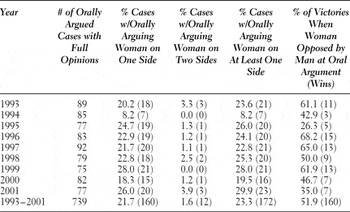
Before discussing the results of our two Heckman models, we first direct the reader to Table 1, which includes a description of the rates of participation and success of women attorneys in oral arguments across the time period of our study. As seen in the table, except for the 1994 term, participation by women attorneys is fairly consistent. Overall, during the nine terms we investigated, women participated in 172 cases. In 160 of those cases, the woman attorney faced a male counterpart, and the woman lawyer was victorious 83 times—a success rate of just under 52%. In other words, in terms of majority outcomes, women attorneys are not losing more cases than their male counterparts. Such is consistent with the results of a multivariate model in which we predicted the likelihood of liberal majority outcomes, including in the model various controls that might also account for the Court's decision (direction of lower court decision, Court ideology, party capability, amici support, U.S. amicus support, attorney capability, and litigation team size), along with a variable indicating the sex of the orally arguing attorney (results not shown). Here, as well, we found no statistically significant relationship between the orally arguing attorney's sex and the Supreme Court majority's outcome. That said, neither analysis is able to tap the operation of gender schemas, which would require an examination of individual-level behavior – that is, of the justices' individual votes. We thus turn to the results of our two Heckman models.
Women attorneys' participation and success rates in oral arguments before the U.S. Supreme Court, per term, 1993–2001

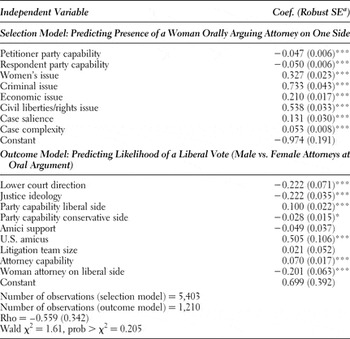
Table 2 presents the results of the first Heckman model. As seen in the table, all of the variables in the selection model appeared to be related to the presence of a woman orally arguing attorney on one side of a Supreme Court case. As expected, the coefficients of both party capability variables were negative as hypothesized, and the coefficient of the women's issues variable was positive as hypothesized. It is interesting that according to this analysis, women are more likely to appear on one side of a case (as opposed to not at all) if it raises a criminal, economic, or civil liberties/rights issue, as opposed to the excluded issue types (i.e., miscellaneous, judicial power, federalism, etc.).Footnote 21 In addition, women are actually more likely to appear on at least one side if the case is either complex or salient. However, as noted in the table, the Wald χ2 test of independent equations did not reach statistical significance; thus, there is no support that a selection model is necessary in this instance. Consequently, we estimated the outcome model in which we predict the likelihood of a justice casting a liberal vote using a traditional probit estimation. Given that those results produced no substantive changes in terms of the direction and significance of the variables, we report the outcome model as produced in the two-stage Heckman analysis.
Model 1—Heckman model predicting the presence of a woman litigator in a Supreme Court case and likelihood of a liberal vote

Notes: p < 0.05 = *; p < 0.01 = **; p ≤ 0.001 = *** (one-tailed tests for all variables, except salience, complexity, and the criminal, civil rights, economic issue variables in the selection model)
aRobust standard errors are clustered on judge.
Turning to those results, most of the variables are statistically significant and in the expected direction. One exception is the amici support variable. Apparently, as the number of briefs filed on behalf of the liberal side grows in relation to those filed on behalf of the conservative side, the justices are no more likely to cast a liberal vote. In addition, although litigation team size appears to be of much importance in other judicial contexts (see, e.g., Szmer, Johnson, and Sarver Reference Szmer, Johnson and Sarver2007), it did not appear to provide any advantage to counsel in our sample of Supreme Court votes.
Of most theoretical interest, however, are the results pertaining to the attorney sex variable. Indeed, the results provide clear evidence that the justices are less likely to cast a liberal vote if a woman attorney is presenting the liberal position in a case in which she confronts a male attorney, holding all other variables that would likely influence this decision constant.Footnote 22 Thus, the findings pertaining to attorney sex are not reflecting ideological disagreement with the woman attorney's position in the case. The model, of course, controls for justice ideology. This is also not a function of party capability or the attorney's level of expertise, as those issues are accounted for as well in the model. Rather, the results are highly suggestive that women attorneys who confront male counsel in oral argument appear to begin from a point of disadvantage when attempting to persuade the individual justices.
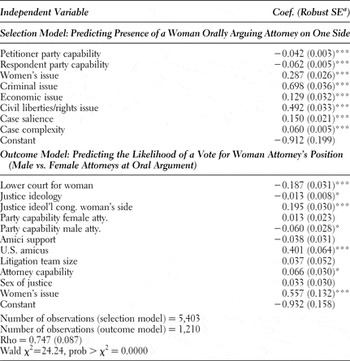
We thus turn to Table 3, our second Heckman two-stage analysis. Again, we begin with the results of the selection equation in which we predict the presence of a woman attorney presenting the oral argument on one side in a Supreme Court case. While the substantive results of the selection model are identical to those in Table 2, the Wald χ2 test of independent equations is highly significant. Thus, those factors that increase the likelihood of a woman appearing on at least one side of a case have some relation to those factors that then influence the justices' decision to support the position favored by the woman attorney.
Model 2—Heckman model predicting the presence of women litigators in a Supreme Court case and likelihood of a vote for the woman attorney's position

Notes: p < 0.05 = *; p < 0.01 = **; p ≤ 0.001 = *** (one -tailed tests for all variables except salience, complexity and the criminal, civil rights, economic issue variables in the selection model)
aRobust standard errors are clustered on judge.
The outcome model itself is also of great interest. All of our control variables are statistically significant and in the expected direction, with the exception of amici support, litigation team size, party capability (female side), and justice gender. The finding with respect to the party capability variable for the side represented by the woman attorney is not particularly surprising, given that this variable is strongly correlated to the attorney capability variable. In addition, the results for the justice gender control are also not surprising, given the lack of gender diversity on the Court and the mixed findings in prior studies of juror and attorney sex at the trial level.
Most importantly, however, the coefficients for the women's issue and justice ideology variables are consistent with our hypotheses. The former is positive and statistically significant at the 0.001 level, indicating that the justices are more likely to vote for women attorneys in cases that involve women's issues.Footnote 23 The justice ideology coefficient, moreover, is negative and significant at the 0.05 level, indicating that more conservative justices are less likely to support parties represented by women attorneys at oral arguments. Given that the model also accounts for a justice's ideological agreement with the position that the woman attorney is arguing in the case, the results pertaining to the women's issue variable suggest that no matter what position the woman attorney is advocating, the chances of an individual justice voting to support her position increase. However, no matter which position she is arguing (e.g., liberal or conservative), she begins from a point of disadvantage with more conservative members on the bench.
To aid in interpreting the Heckman probit results, we computed marginal effects, holding continuous variables to their mean values and noncontinuous variables to their modal values.Footnote 24 When holding the other variables constant in this manner, a given justice is 22% more likely to cast a liberal vote if the U.S. government files an amicus brief in support of the liberal position, a result which certainly highlights the importance of this particular control variable. Moreover, increases in a justice's conservatism were associated with the justice being 9.7% less likely to cast a liberal vote. Of course, the directionality of the lower court decision also plays a very important role and, thus, is a crucial control. As compared to a situation in which the Court grants certiorari due to a conflict, if no conflict is present and the lower court's decision was liberal, a justice is 9.7% less likely to cast a liberal vote. It is interesting that under this scenario, a judge is 8.8% less likely to cast a liberal vote if the woman attorney is arguing the liberal position. Thus, the magnitude of the influence of the attorney sex variable is almost as substantial as that of justice ideology and the nature of the lower court's decision.
Marginal effects for the second Heckman model, whose second stage predicts votes in favor of the woman attorney's position, were computed in a like manner (i.e., holding variables constant at either their mean or modal values, as appropriate). Again, individual justice decisions to cast votes in favor of the side represented by a woman attorney are heavily influenced by a justice's ideology, the presence of the United States as amicus, and the nature of the lower court decision. Increases in the ideological congruence between a justice and the side advocated by the woman increase the likelihood of the justice voting in support of the woman attorney's position by 10%. In addition, if the United States files an amicus brief in support of the woman attorney's position in a case, a justice is over 20% more likely to vote in a like manner. Even while controlling for ideological agreement, an increase in the justice's conservatism decreases the likelihood of a justice voting in support of the woman attorney's position by about 0.7%, a fairly modest effect by comparison. What is not modest, however, is the advantage that women attorneys seem to have in women's issue cases. Holding other variables constant, a justice is nearly 19% more likely to vote in favor of the woman attorney's position if she provides the oral argument in a women's issue case.
DISCUSSION
It is vital to clearly convey what the present study suggests and what it does not suggest. First, the analyses presented here do not suggest that women attorneys are more likely to lose their cases when they argue before the Supreme Court. In fact, when one examines participation rates among women counsel and their corresponding success rates in securing a majority, they fair pretty well. However, that does not mean that gender schemas are inoperable constructs among the Supreme Court justices. Indeed, when modeling the likelihood of an individual justice casting a liberal vote (Model 1), the study suggests a negative relationship between the dependent variable (the vote) and an attorney's sex. Thus, we hypothesized that if gender schemas do influence the Court, their influence is likely limited in effect to a subset of the justices. In addition, we recognize that the use of gender schemas can potentially cut both ways—they can work to the disadvantage or advantage of women attorneys. Our approach for assessing these conditional relationships was to examine whether support for a woman attorney's position differed among liberal or conservative justices, while also accounting for their ideological agreement/disagreement with the woman's side in the case. In addition, we also examined whether a woman attorney had an easier time persuading the justices to vote in support of her position if she argued either the liberal or conservative position in a women's issue case.
With respect to the former, we do find that conservative justices are less likely to side with women attorneys. This suggests that conservative justices are more likely to cognitively process the information presented by women through a biased filter. Specifically, women attorneys may be presumed to be less credible and, as such, the information they provide to conservative justices might be discounted. Since the justices' decisions are partially a function of information, and the justices are more likely to rely upon information that they perceive to be more credible, male attorneys have a disproportionate advantage in persuading conservative justices.
It would also seem that the impact of gender schemas is conditional upon the type of issue raised in the case. Specifically, U.S. Supreme Court justices are more likely to side with female attorneys in women's issues cases (sex discrimination and harassment, reproductive rights, maternity rights, and issues involving equal employment opportunity), no matter which ideological position the woman attorney happens to be advocating in the case. This is likely a reflection of the influence of a gender stereotype that women lawyers are more capable of addressing these issues. In essence, gender acts as a heuristic for substantive legal expertise in these cases. As such, the justices attach more credibility to the information presented by women attorneys in these cases, and are therefore more likely to side with them.
CONCLUSION
Why is it important to determine the impact of an attorney's sex on the decision making of the justices? First, among students of the judicial process, it expands our understanding of the role of attorneys. Up until now, political scientists have focused more on experiential characteristics of the attorneys (e.g., Johnson, Wahlbeck, and Spriggs Reference Johnson, Wahlbeck and Spriggs2006; McGuire Reference McGuire1995) while other fields have paid attention to the role of women attorneys at the trial level (e.g., Hahn and Clayton Reference Hahn and Clayton1996; Nelson Reference Nelson2004). The question of whether attorney sex might influence Supreme Court decision making had not been addressed; yet in other institutional environments and workplaces, gender issues inform institutional dynamics and interpersonal relationships. Given the Court's lack of gender diversity among those who sit on the bench, the predominance of male clerks (Peppers Reference Peppers2006; Szmer Reference Szmer2005), and the male-dominant Supreme Court bar (Sarver, Kaheny, and Szmer Reference Sarver, Kaheny and Szmer2008), how the justices perceive women who participate in this context is of obvious importance.
Here, we find evidence that an attorney's sex does not influence the outcome of U.S. Supreme Court decisions. However, our analysis of individual-justice behavior does suggest that the sex of the attorneys presenting oral arguments may influence the receptivity of those arguments on the part of the individual justices. It is interesting that from the perspective of the woman attorney, gender schemas can operate in a positive fashion in women's issues cases. Female advocates, on the other hand, have a more difficult time persuading conservative justices to side with their cause, holding other variables constant. Thus, to the extent that gender schemas are at work here, this study suggests that they can work to the advantage or disadvantage of women attorneys in Supreme Court litigation.
Perhaps most importantly, this study contributes to the broader examination of the impact of gender in politics. In particular, most of the prior political science studies involving the impact of gender stereotypes or schemas have focused on the way in which the mass public perceives elites (e.g., Dolan Reference Dolan1998; Kahn Reference Kahn1996; Koch Reference Koch2000; Sanbonmatsu Reference Sanbonmatsu2002), as opposed to the impact of schemas held by elites on their perceptions of other elites (but see Mattei Reference Mattei1998 for one exception). Here, however, we indicate the possible use of gender schemas by political elites. While one might think that elites, particularly those as educated as the justices serving on the High Court, might be far less inclined to utilize gender schemas, our results suggest this is not necessarily the case.
Thus, we believe it is important for scholars to investigate further those variables that might bear on this relationship, including the impact of gender diversity on the bench. While we controlled for the potential effects of justice sex, the U.S. Supreme Court, due to its lack of gender diversity, is not the ideal venue in which to make generalizable conclusions. Given the theoretical interest in the question, we strongly suggest future research that examines the role of attorney sex on other courts, particularly those with more gender diversity among the judges. Venues like the U.S. Courts of Appeals and state supreme courts are more gender diverse and, therefore, are ideal contexts for examining the interplay between justice and attorney sex. To the extent that recent studies applying the critical mass theory to the lower courts suggest that the presence of a significant number of female judges on a court can affect the behavior of both male (Boyd, Epstein, and Martin Reference Boyd, Epstein and Martin2007) and female judges (Manning, Carp, and Collins Reference Manning, Carp and Collins2007), extension of the present research to these venues could be particularly fruitful. Furthermore, the lower courts decide more cases involving women's issues and would, therefore, serve as excellent subjects for studies of the possible interaction of women's issues and attorney sex.
Finally, with respect to the Supreme Court itself, further analysis should be undertaken to explore the possibility of change over time in the justices' perceptions of women. Due to data limitations, we were unable to extend our analysis beyond the 2001 term. However, with the appointments of Justices John Roberts and Samuel Alito, both under the age of 60, and with the first appointment of President Barack Obama (Justice Sonia Sotomayor), a woman who is also relatively young, studies to determine whether this younger cohort has had any effect on women attorneys' efforts in persuading the justices might prove especially insightful.