Introduction
Production of resonant harmonic generation during short pulse laser interaction with matter has been one of the most prominent area of research for last few decades because of various applications in technology and sciences (Burnett et al., Reference Burnett, Baldis, Richardson and Enright1977; McPherson et al., Reference McPherson, Gibson, Jara, Johann, Luk, McIntyre, Boyer and Rhodes1987; Li et al., Reference Li, Huillier, Ferray, Lompr and Mainfray1989; Huillier and Balcou, Reference Huillier and Balcou1993; Elahi and Ghoranneviss, Reference Elahi and Ghoranneviss2014). Harmonic generation due to the interaction of a highly intense laser with plasma is an important non-linear process. It was found that when a highly intense laser penetrates through the plasma, it gives rise to transverse plasma current density, which was found to be highly non-linear and relativistic hence, it results in the coherent harmonic generation in the forward direction. In past few decades, scientists have focused their attention more on the generation of second and third harmonic radiations in laser-induced plasmas (Tewari and Tripathi, Reference Tewari and Tripathi1980; Brandi et al., Reference Brandi, Maianeto and Guerra1996; Mori et al., Reference Mori, Takahashi and Kondo2002; Wadhwani et al., Reference Wadhwani, Kumar and Jha2002; Zheng et al., Reference Zheng, Tanaka, Sentoku, Offenberger, Kitagawa, Kodama, Kurahashi, Mima and Yamanaka2002; Jha et al., Reference Jha, Mishra, Raj and Upadhyay2007; Ghorbanalilu, Reference Ghorbanalilu2012; Vij et al., Reference Vij, Kant and Aggarwal2016, Reference Vij, Aggarwal and Kant2017). Second harmonic shift by plasma frequency revealing facts about the stimulated Raman scattering has been reported successfully by Krushelnick et al. (Reference Krushelnick, Ting, Burris, Fisher, Manka and Esarey1995). Also, a scheme was proposed in order to increase the efficiency of second harmonic generation (SHG) by taking into consideration the density ripple into the interactive region (Parashar and Pandey, Reference Parashar and Pandey1992). Based on density transition a significant enhancement in the SHG was reported in plasma (Kant and Thakur, Reference Kant and Thakur2015). Due to the dispersive nature of the medium, there is a phase mismatch between the pump and second harmonic pulses. This phase mismatch increases the importance of wiggler magnetic field or density ripple, which satisfies the phase matching condition. Self-focusing imparts a key role in enhancing the second or third harmonic generation in plasma (Singh and Walia, Reference Singh and Walia2011; Kant et al., Reference Kant, Gupta and Suk2011a; Walia, Reference Walia2016; Kumar et al., Reference Kumar, Aggarwal and Gill2018), so, in order to have stronger self-focusing, tangential plasma density ramp was introduced in plasma (Kant et al., Reference Kant, Saralch and Singh2011b; Aggarwal et al., Reference Aggarwal, Kumar and Kant2016).
It was observed that the laser beam acquires a minimum spot size with upward plasma density ramp after traversing certain distance, which helps in the stronger self-focusing of the laser beam. Also, a report was presented by Singh et al. (Reference Singh, Jain and Parashar2002), that for resonant SHG density ripple in plasma may be employed. They found that the incident laser beam energy and density ripple are responsible for the increase in the efficiency of harmonic generation of second order. Effect of the ponderomotive force and wiggler magnetic field and on the SHG in underdense plasma was examined by Askari and Noroozi (Reference Askari and Noroozi2009). They made a conclusion that wiggler magnetic field has vital importance in producing a transverse harmonic current and to ensure phase-matching condition. Under the influence of wiggler magnetic field the resonant harmonic generation by twisted laser–plasma interaction was analyzed by Vaziri et al. (Reference Vaziri, Sohaliya and Bahrampour2015). The additional momentum to the second harmonic is provided by the wiggler magnetic field and they also employed Laguerre Gaussian techniques to improve the harmonic generation of second order. Under the influence of azimuthal magnetic field, a report was presented on electron acceleration by a frequency chirped circularly polarized laser pulse by Ghotra and Kant (Reference Ghotra and Kant2015). The azimuthal magnetic field and chirp impart a major role in the enhancement of the electron dynamics and interaction of laser with electron or plasma.
In the present paper, we introduced a model to enhance the harmonic generation of second order in plasma by considering exponential density transition profile. Wave number necessary for phase matching condition is provided by wiggler magnetic field as wiggler magnetic field offers the additional angular momentum to second harmonic photon; hence, the process becomes resonant. Further enhancement in the harmonic generation of the second order of an intense short pulse laser in plasma under the influence of magnetic wiggler with exponential density transition is seen. The contents of this paper are organized as follows. In the section ‘Theoretical considerations’, we describe the variation of normalized wiggler wave number ck w/ωp0 with normalized propagation distance ξ and normalized amplitude of the second-harmonic wave A 2/A 1 with normalized propagation distance ξ. The numerical results are discussed in the section ‘Result and discussion’, and the conclusions are presented in the section ‘Conclusion’.
Theoretical considerations
Nonlinear current density
By considering the propagation of Gaussian short pulse laser in a preformed plasma channel having electron density n 0, electric and magnetic fields of the laser can be given as,
 $$\vec{E} = A(\hat{x} + i\hat{y})\exp [-i({\rm \omega} t-kz)],$$
 $$\vec{B} = \displaystyle{{c\vec{k} \times \vec{E}} \over {\rm \omega}}, $$
 $$A^2 = A_0^2 \exp \left[ {\displaystyle{{-{(t-(z/v_{\rm g}))}^2} \over {{\rm \tau}^2}}} \right]$$
where k = (ω/c)η, is the wave number, ω is the frequency of pump laser pulse, τ is the laser pulse length, η is the refractive index of plasma and v g(= cη ≈ c), is the group velocity and c is the velocity of light in vacuum. Further oscillatory velocity of electrons due to laser can be obtained as
 $${\vec v}_{{\rm \omega}, k} = \displaystyle{{e\vec{E}} \over {mi{\rm \omega} {\rm \gamma} _0}}{\rm e}^{-i({\rm \omega} t-kz)}$$
where, e and m are electronic charge and rest mass, respectively. γ 0 ≈ (1 + a 2/2), a = eA/mωc is laser field strength parameter. Also, plasma frequency is ωP = (4πn(ξ)e 2/m)1/2 and the plasma density ramp profile is represented as n(ξ) = n 0exp (ξ/d), where ξ = z/R d, is normalized propagation distance,  $R_{\rm d} = kr_0^2, $ is diffraction length and d is the adjustable constant. The refractive index in the limit
 ${\rm \omega} _{\rm p}^2 /{\rm \omega} ^2\ll 1,$ can be given as
 $${\rm \eta} ({\rm \omega} ) = 1-\displaystyle{{{\rm \omega} _{{\rm p}0}^2 \exp ({\rm \xi} /d)} \over {2{\rm \omega} ^2{\rm \gamma} _0}}$$
We consider a wiggler magnetic field is applied to the plasma
 $$\vec{B}_{\rm w} = B_0(\hat{x}-i\hat{y})e^{ik_{\rm w}z}$$
For SHG in plasma k 2 > 2k 1 as plasma is dispersive medium. To make the process resonant, the phase matching condition demand  ${\rm \omega} _2 = 2{\rm \omega} $ and
 $\hbar k_2 = 2\hbar k_1 + \hbar k_{\rm w}$. In order to achieve phase matching condition required wiggler wave number is provided by the wiggler magnetic field as given below
 $$k_{\rm w}\approx \displaystyle{{3{\rm \omega} _{{\rm p}0}^2 \exp ({\rm \xi} /d)} \over {4{\rm \omega} {\rm \gamma} _0c}}$$
The electron velocity  ${\vec v}_{{\rm \omega}, k}$ beats with wiggler magnetic field
 $\vec{B}_{\rm w}$ to produce a ponderomotive force
 $\vec{F}_{\rm p}^{\rm {\prime}} $ at (ω,k + k w),
 $\vec{F}_{\rm p}^{\rm {\prime}} = -{\vec v}_{{\rm \omega}, k} \times \vec{B}_{\rm w}(e/2c) = \hat{z}({\rm e}^2AB_0/mc{\rm \omega} {\rm \gamma} _0){\rm e}^{-i[{\rm \omega} t-(k + k_{\rm w})z]}$ can be written as
 $$m\displaystyle{{d{{\vec v}}^{\,\prime}} \over {dt}} = \hat{z}\displaystyle{{{\rm e}^2AB_0} \over {mc{\rm \omega} {\rm \gamma} _0}}{\rm e}^{-i[{\rm \omega} t-(k + k_{\rm w})z]}$$
The electron velocity  ${{\vec v}}^{\,\prime}$ due to
 $\vec{F}_{\rm p}^{\rm {\prime}} $ can be deduced as
 $${{\vec v}}^{\,\prime} = -\hat{z}\displaystyle{{{\rm e}^2AB_0} \over {m^2ic{\rm \omega} ^2{\rm \gamma} _0}}{\rm e}^{-i[{\rm \omega} t-(k + k_{\rm w})z]}$$
Using Eq. (7) in the equation of continuity,  $\partial n/\partial t + \nabla . (n{\vec v}) = 0,$ the electron density perturbation n′ at (ω, k + k w),is obtained as
 $$\eqalign{ {n}^{\prime} &= \displaystyle{{(\vec{k} + {\vec{k}}_{\rm w}) . {{\vec v}}^{\,\prime}n_0\exp ({\rm \xi} /d)} \over {\rm \omega}} \cr &= \displaystyle{{{\rm e}^2AB_0(k + k_{\rm w})n_0\exp ({\rm \xi} /d)} \over {m^2ic{\rm \omega} ^3{\rm \gamma} _0}}{\rm e}^{-i[{\rm \omega} t-(k + k_{\rm w})z]}} $$
Second harmonic nonlinear current density due to the beating of electron density perturbation with  ${\vec v}_{{\rm \omega}, k}$ can be written as
 $$\eqalign{\vec{J}_{2{\rm \omega}, 2k + k_{\rm w}}^{\;NL} & = -\displaystyle{1 \over 2}{n}^{\prime}{\rm e}{{\vec v}}_{{\rm \omega}, k} \cr &= (\hat{x} + i\hat{y})\displaystyle{{n_0{\rm e}^4A^2B_0\exp ({\rm \xi} /d)(k + k_{\rm w})} \over {2m^3{\rm \gamma} _0^2 c{\rm \omega} ^4}}{\rm e}^{-i[2{\rm \omega} t-(2k + k_{\rm w})z]}} $$
Also, the existence of a self-consistent second harmonic field  $\vec{E}_{2{\rm \omega}} = (\hat{x} + i\hat{y})A_2{\rm e}^{-i[2{\rm \omega} t-(2k + k_{\rm w})z]}$ is noticed. The linear current density
 $\vec{J}_{2{\rm \omega}} ^{\;L} $ due to
 $\vec{E}_{2{\rm \omega}} $ is,
 $$\vec{J}_{2{\rm \omega}} ^{\;L} = -\displaystyle{{n_0{\rm e}^2{\vec{E}}_{2{\rm \omega}} \exp ({\rm \xi} /d)} \over {2im{\rm \omega}}} $$
Second harmonic field
By using Maxwell's equations the wave equation governing the second harmonic field can be given as
 $$\nabla ^2\vec{E}_2 = \displaystyle{{4{\rm \pi}} \over {c^2}}\displaystyle{{\partial {\vec{J}}_2} \over {\partial t}} + \displaystyle{1 \over {c^2}}\displaystyle{{\partial ^2\vec{E}_2} \over {\partial t^2}}$$
Following the technique used by Sodha et al. (Reference Sodha, Ghatak and Tripathi1974), and hence, Nanda and Kant (Reference Nanda and Kant2014), the spot size evolution equation for pump laser can be obtained as
 $$\eqalign{{{\partial ^2f_1} \over {\partial {\rm \xi} ^2}} =\; &{{{({\rm \omega} _{{\rm p}0}/{\rm \omega} )\sqrt {1-\lpar {{\rm \omega}_{{\rm p}0}^2 /{\rm \omega}^2} \rpar } \exp ({\rm \xi} /d)} \over {(1-\lpar {{\rm \omega}_{{\rm p}0}^2 /{\rm \omega}^2} \rpar \exp ({\rm \xi} /d))-({\rm \xi} /2d)\lpar {{\rm \omega}_{{\rm p}0}^2 /{\rm \omega}^2} \rpar \exp ({\rm \xi} /d)}}} \cr &\times \left[ {\displaystyle{{2k{\rm^{\prime}}_1{\rm \omega}_{}} \over {{\rm \omega}_{{\rm p}0}f_1^3}} -\displaystyle{{k{\rm^{\prime}}_1A_{10}^2 R_{\rm d}^2 \in_2\in_S{\rm \omega}} \over {\in_0r_0^2 f_1^3 \in_0{\rm \omega}_{{\rm p}0}}}\exp \left\{ {-\displaystyle{{\in_2A_{10}^2} \over {2\in_0f_1^2}}} \right\}} \right]} $$
where  $k{\rm ^{\prime}}_1 = kc/{\rm \omega}, {\rm \varepsilon} _2 = {\rm \varphi} (E_1E_1^* )$ and φ is the nonlinear part of the dielectric constant. Equation (12) shows the variation of the beam width parameter f 1 with the normalized distance of propagation ξ.
Hence, the wave equation for the second harmonic field is given by
 $$\eqalign{& \displaystyle{{\partial ^2{\vec{E}}_{2{\rm \omega}}} \over {\partial z^2}}-\displaystyle{1 \over {c^2}}\displaystyle{{\partial ^2{\vec{E}}_{2{\rm \omega}}} \over {\partial t^2}}-\displaystyle{1 \over {c^2}}\displaystyle{{\partial ^2\vec{J}_{2{\rm \omega}} ^{\,L}} \over {\partial t^2}} = \cr & \quad -\displaystyle{{4{\rm \pi}} \over {c^2}}2i{\rm \omega} \vec{J}_{2{\rm \omega}} ^{\,NL} = (\hat{x} + i\hat{y})Q_2{\rm e}^{-i[2{\rm \omega} t-(2k + k_{\rm w})z]}} $$
where,  $Q_2 \!=\! -i{\rm \omega}_{{\rm p}0}^2 \exp ({\rm \xi} /d)aA{\rm \omega}_{\rm c}(k + k_{\rm w})/{\rm \omega} ^2c{\rm \gamma}_0^2, \;{\rm \omega}_{\rm c} \!=\! eB_0/mc,\! a =eA/ m{\rm \omega} c,\;{\rm \omega}_{{\rm p}0}^2 = 4{\rm \pi} n_0e^2/m$.
For further simplification of equation (13) considering the group velocity of second harmonic approaches to c and  $k_2 = (2{\rm \omega} /c)(1-{\rm \omega} _{{\rm p}0}^2 \exp ({\rm \xi} /d)/8{\rm \omega} ^2{\rm \gamma} _0),$ we obtain
 $$\displaystyle{{\partial A_2} \over {\partial z}} + \displaystyle{1 \over c}\displaystyle{{\partial A_2} \over {\partial t}} = \displaystyle{{Q_2} \over {2ik_2}}$$
By using a new set of variables z′ = z, t′ = t − z/c, Eq. (14) reduces to
 $$\displaystyle{{\partial A_2} \over {\partial {z}^{\prime}}} = \displaystyle{{Q_2} \over {2ik_2}}{\rm e}^{-i{\rm \Delta} z}$$
where, Δ = k 2 − 2k − k w. For the Gaussian pulse,  $a^2 =\! a_0^2 \exp (-{t}^{\prime 2}/{\rm \tau} ^2),\;a_0 =\! eA_0/m{\rm \omega} c, {\rm \gamma} _0 = [1 \!+\! (a_0^2 /2)\exp. (-{t}^{\prime 2}/{\rm \tau} ^2)]^{1/2},$ is a function of time. One cannot have phase matching (Δ = 0) for a harmonic generation at all times for a given k w. If one matches the wiggler wave number at the maxima of the laser pulse (t′ = 0), that is,
 $$k_{\rm w}\approx \displaystyle{3 \over 4}\displaystyle{{\rm \omega} \over c}\displaystyle{{{\rm \omega} _{{\rm p}0}^2 \exp ({\rm \xi} /d)} \over {{\rm \omega} ^2{\rm \gamma} _{00}}}$$
where,  ${\rm \gamma} _{00} = [1 + (a_0^2 /2)]^{1/2}$. At all other times, we have Δ = k w((γ 00/γ 0) − 1). Further Eq. (15) gives,
 $$A_2 = \displaystyle{{Q_2} \over {2k_2}}\displaystyle{{[{\rm e}^{-i{\rm \Delta} (({\rm \gamma} _{00}/{\rm \gamma} _0)-1)z}{^\prime} -1]} \over {k_{\rm w}(({\rm \gamma} _{00}/{\rm \gamma} _0)-1)}}$$
At a distance z = L, the normalized second harmonic amplitude can be deduced as
 $$\left \vert {\displaystyle{{A_2} \over {A_1}}} \right \vert = \left \vert \matrix{\displaystyle{{{\rm \omega}_{\,p0}\exp \left( {\displaystyle{{\rm \xi} \over d}} \right)} \over {2{\rm \omega} \left[ {1 + \displaystyle{{e^2A_0^2} \over {2m^2{\rm \omega}^2c^2}}\exp (-{{t}^{\prime}}^2/{\rm \tau}^2)} \right]}}\displaystyle{{eA_0} \over {m{\rm \omega} c}}\displaystyle{{{\rm \omega}_c} \over {\rm \omega}} \times \hfill \cr \left[ {\displaystyle{\matrix{1-\displaystyle{{{\rm \omega}_{\,p0}^2} \over {2{\rm \omega}^2{\left( {1 + \displaystyle{{e^2A_0^2} \over {2m^2{\rm \omega}^2c^2}}\exp (-{{t}^{\prime}}^2/{\rm \tau}^2)} \right)}^{1/2}}} \hfill \cr \quad + \displaystyle{3 \over 4}\displaystyle{{{\rm \omega}_{\,p0}^2 \exp \left( {\displaystyle{{\rm \xi} \over d}} \right)} \over {{\rm \omega}^2{\left( {1 + \displaystyle{{e^2A_0^2} \over {2m^2{\rm \omega}^2c^2}}} \right)}^{1/2}}} \hfill} \over \matrix{3\left( {1-\displaystyle{{{\rm \omega}_{\,p0}^2 \exp \left( {\displaystyle{{\rm \xi} \over d}} \right)} \over {8{\rm \omega}^2{\left( {1 + \displaystyle{{e^2A_0^2} \over {2m^2{\rm \omega}^2c^2}}\exp (-{{t}^{\prime}}^2/{\rm \tau}^2)} \right)}^{1/2}}}} \right) \hfill \cr \quad \left( {\displaystyle{3 \over 4}\displaystyle{{{\rm \omega}_{\,p0}^2 \exp \left( {\displaystyle{{\rm \xi} \over d}} \right)} \over {{\rm \omega}^2{\left( {1 + \displaystyle{{e^2A_0^2} \over {2m^2{\rm \omega}^2c^2}}} \right)}^{1/2}}}} \right) \hfill \cr \quad \left( {\displaystyle{{{\left( {1 + \displaystyle{{e^2A_0^2} \over {2m^2{\rm \omega}^2c^2}}} \right)}^{1/2}} \over {{\left( {1 + \displaystyle{{e^2A_0^2} \over {2m^2{\rm \omega}^2c^2}}\exp (-{{t}^{\prime}}^2/{\rm \tau}^2)} \right)}^{1/2}}}-1} \right) \hfill}}} \right] \times \hfill \cr \exp \left[ \matrix{\displaystyle{3 \over 4}\displaystyle{{i{\rm \omega}_{\,p0}^2 \exp \left( {\displaystyle{{\rm \xi} \over d}} \right)} \over {{\rm \omega}^2{\left( {1 + \displaystyle{{e^2A_0^2} \over {2m^2{\rm \omega}^2c^2}}} \right)}^{1/2}}}\displaystyle{{L{\rm \omega}_{\,p0}} \over c} \hfill \cr \quad \left( {\displaystyle{{{\left( {1 + \displaystyle{{e^2A_0^2} \over {2m^2{\rm \omega}^2c^2}}} \right)}^{1/2}} \over {{\left( {1 + \displaystyle{{e^2A_0^2} \over {2m^2{\rm \omega}^2c^2}}\exp (-{{t}^{\prime}}^2/{\rm \tau}^2)} \right)}^{1/2}}}-1} \right)-1 \hfill} \right] \hfill} \right \vert $$
Equation (18) describes the variation of the normalized amplitude of the second-harmonic wave |A 2/A 1| with normalized propagation distance ξ.
Result and discussion
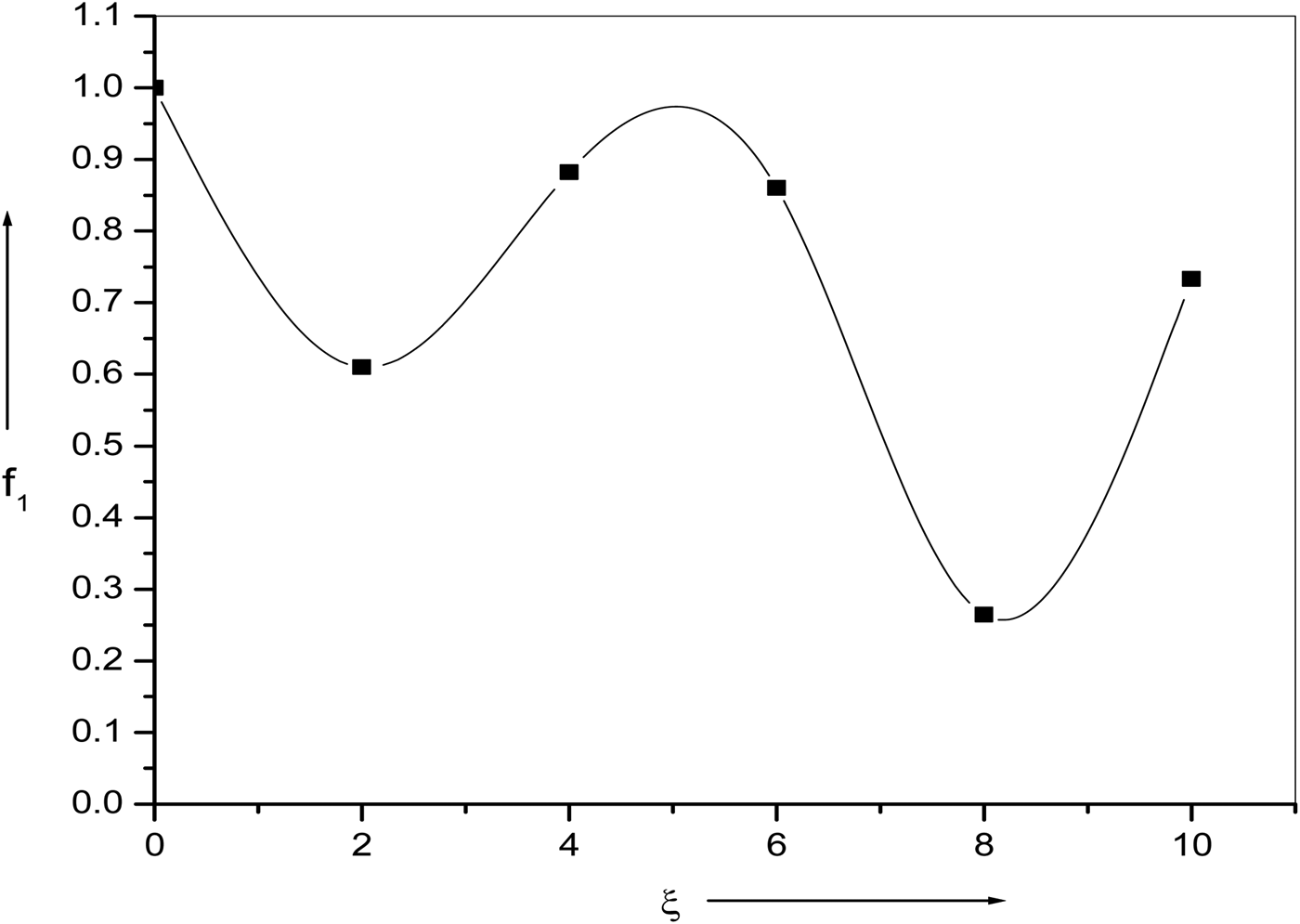
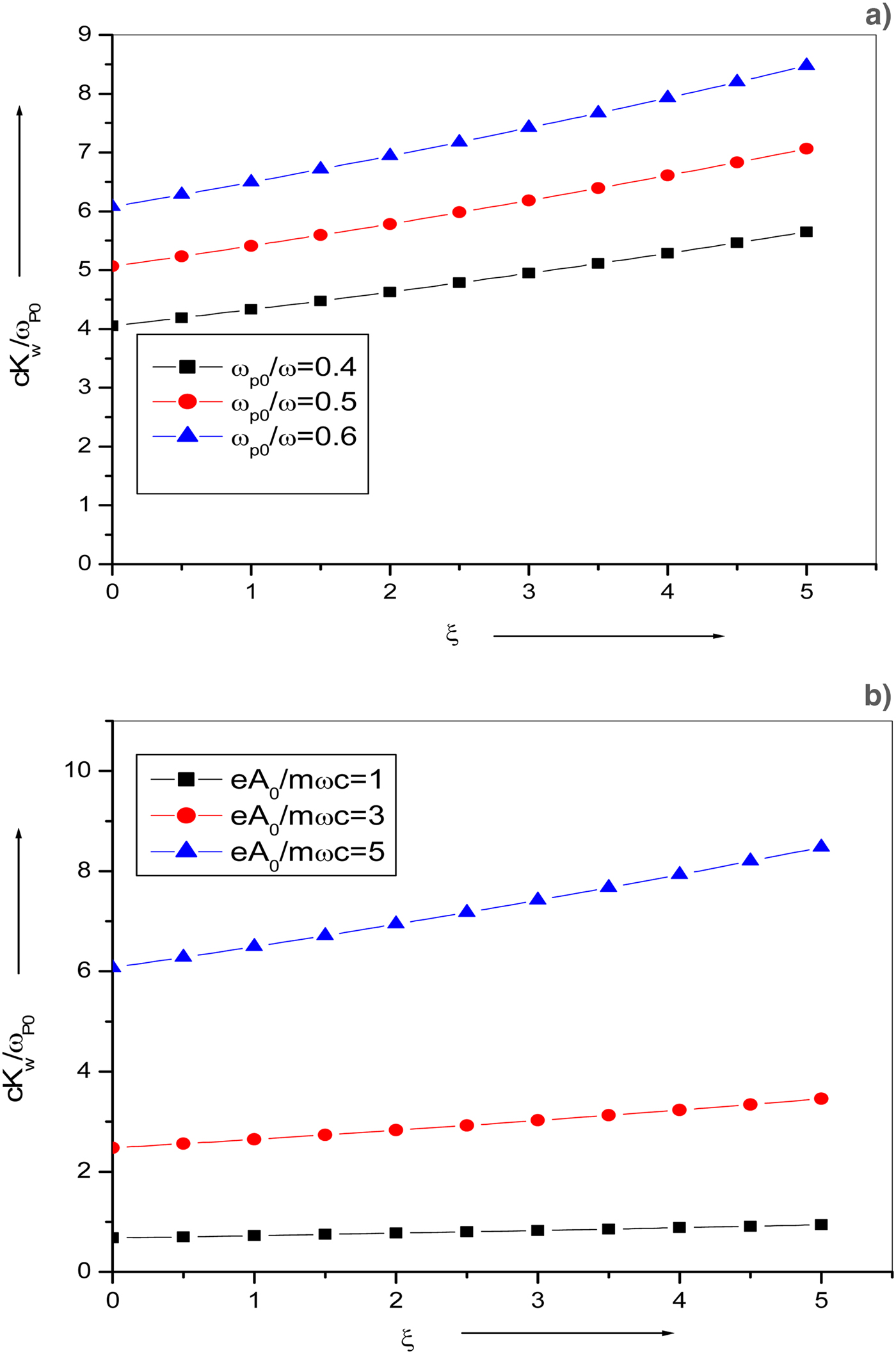
We have numerically solved Eqs. (5), (12) & (18) for normalized wiggler wave number ck w/ωp0, beam width parameter f 1 and normalized amplitude of the second harmonic wave |A 2/A 1|, corresponding to an initial plane wave front at ξ = 0, f = 1 and ∂f/∂ξ = 0. For a typical case, plasma irradiated by a 10.6 μm CO2 laser (intensity I 0 ≈ 1016 W/cm2), wiggler magnetic fieldB 0 = 100 kG, plasma length L = 10 cm, wiggler period turns out to be ≈ 0.2 cm. Group velocity mismatch between the pump pulse and the second harmonic pulse is significant in high-density plasma and effect increases with increase in the plasma density. Figure 1 depicts the variation of beam width parameter of the pump laser with the normalized propagation distance. The other parameters are  ${\rm \omega} r_0/c = 18,\;{\rm \varepsilon} _2A_{10}^2 /{\rm \varepsilon} _0 = 1$ and d = 8. One may clearly see that stronger self-focusing occurs at ξ = 8 and beam width parameter reaches its minimum value f 1 = 0.26,because of the dominance of nonlinear term in Eq. (12). We have also plotted the variation of normalized wiggler wave number ck w/ωp0 with normalized propagation distance ξ for different values of (a) normalized plasma frequency ωp0/ω and (b) normalized intensity parameter of pump laser eA 0/mωc in Figure 2. The other parameters are t′/τ = 0.8, eA 0/mωc = 5 and d = 8. It is seen that the wiggler wave number required for phase matching increases with plasma density and the intensity of the pump laser. Further, wiggler strength ≥10 kG is required to achieve high efficiency of SHG. The variation of normalized wiggler wave number ck w/ωp0 with t′/τ, was reported by Sharma et al. (Reference Sharma, Jaloree and Parashar2013), and they concluded that the required wiggler wave number is having larger values for higher plasma density. Figure 3 depicts the variation of normalized second harmonic amplitude with propagation distance for different values of
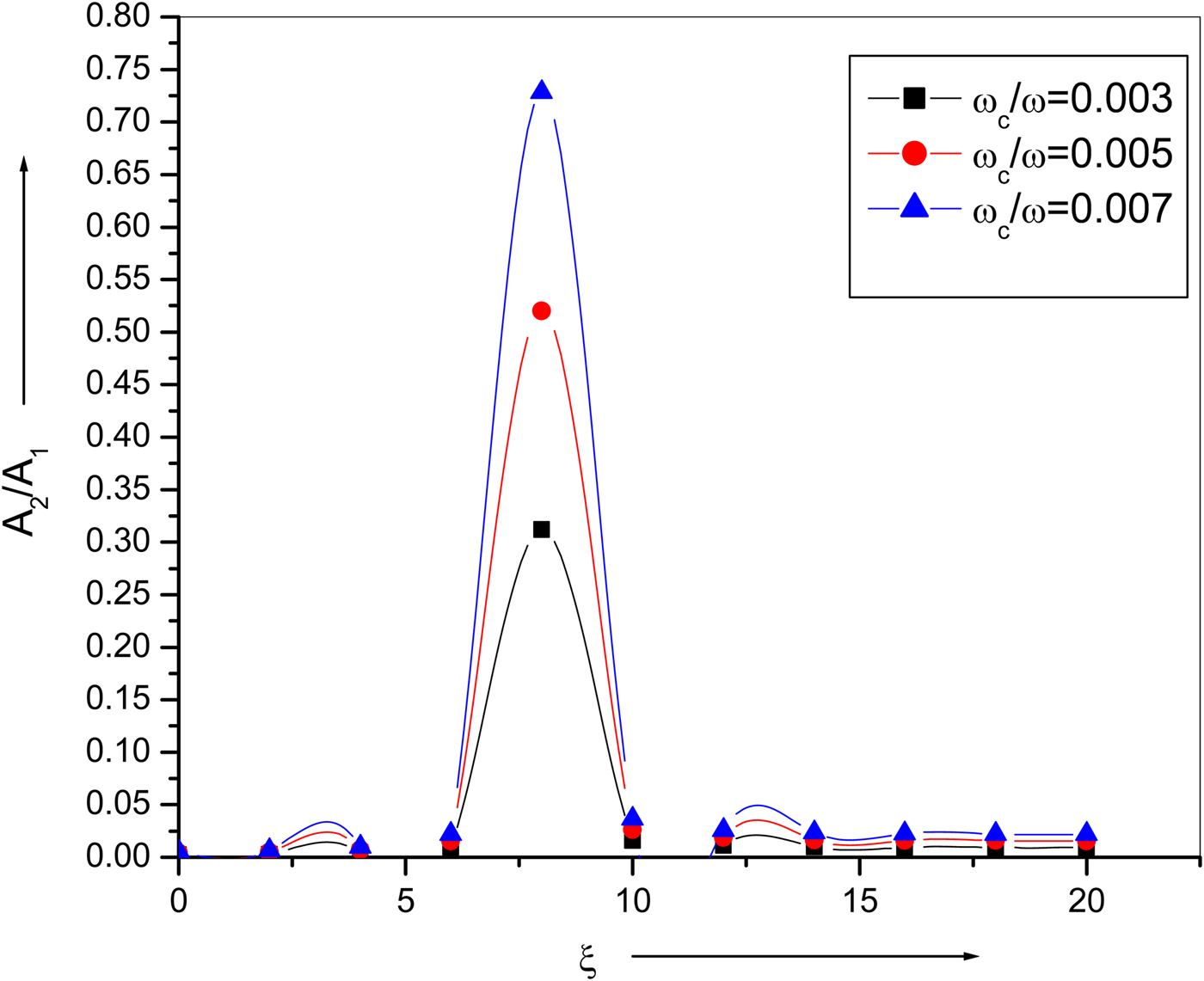
 ${\rm \omega} _{\rm c}/{\rm \omega} = 0.003,\;0.005\; \,\& \,0.007$. The other parameters are the same as taken in Figures 1 and 2. It is observed that amplitude of harmonic generation of second order enhances with the rise of the wiggler magnetic field because the dynamics of oscillating electrons is changed under a Lorentz force which further modifies the plasma wave and hence, affects the second harmonic considerably. One may clearly see that enhancement in the SHG becomes effective for ωc/ω = 0.007 at ξ = 8 and reaches its maximum value A 2/A 1 = 0.75. Similar results were found by Kant and Thakur (Reference Kant and Thakur2015) and they observed that maximum enhancement in the SHG occurs for ωc/ω = 0.2 and reaches its maximum value A 2/A 1 = 0.35. Figure 4 depicts the variation of normalized second harmonic amplitude with the propagation distance at different values of normalized pump intensity parameter,
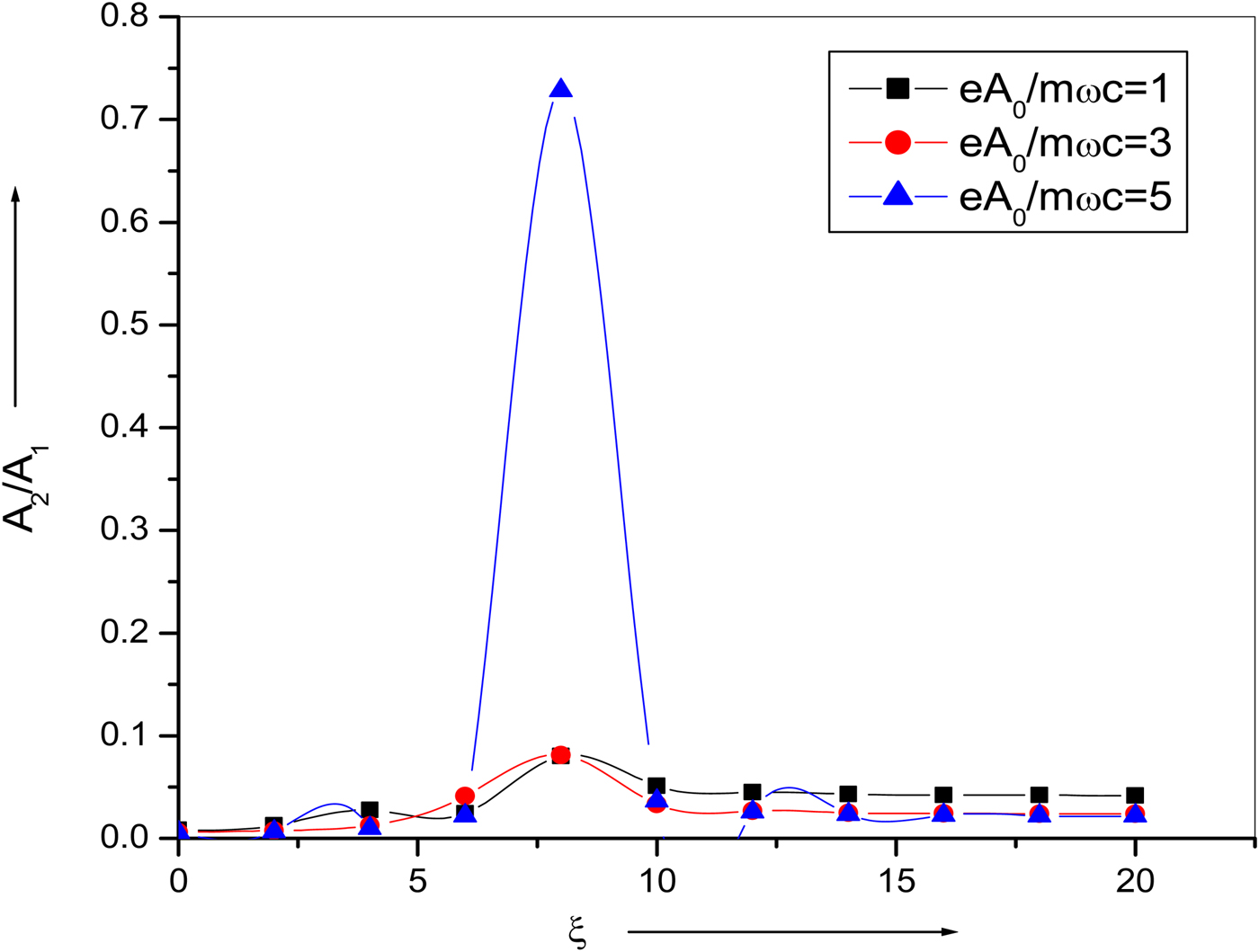
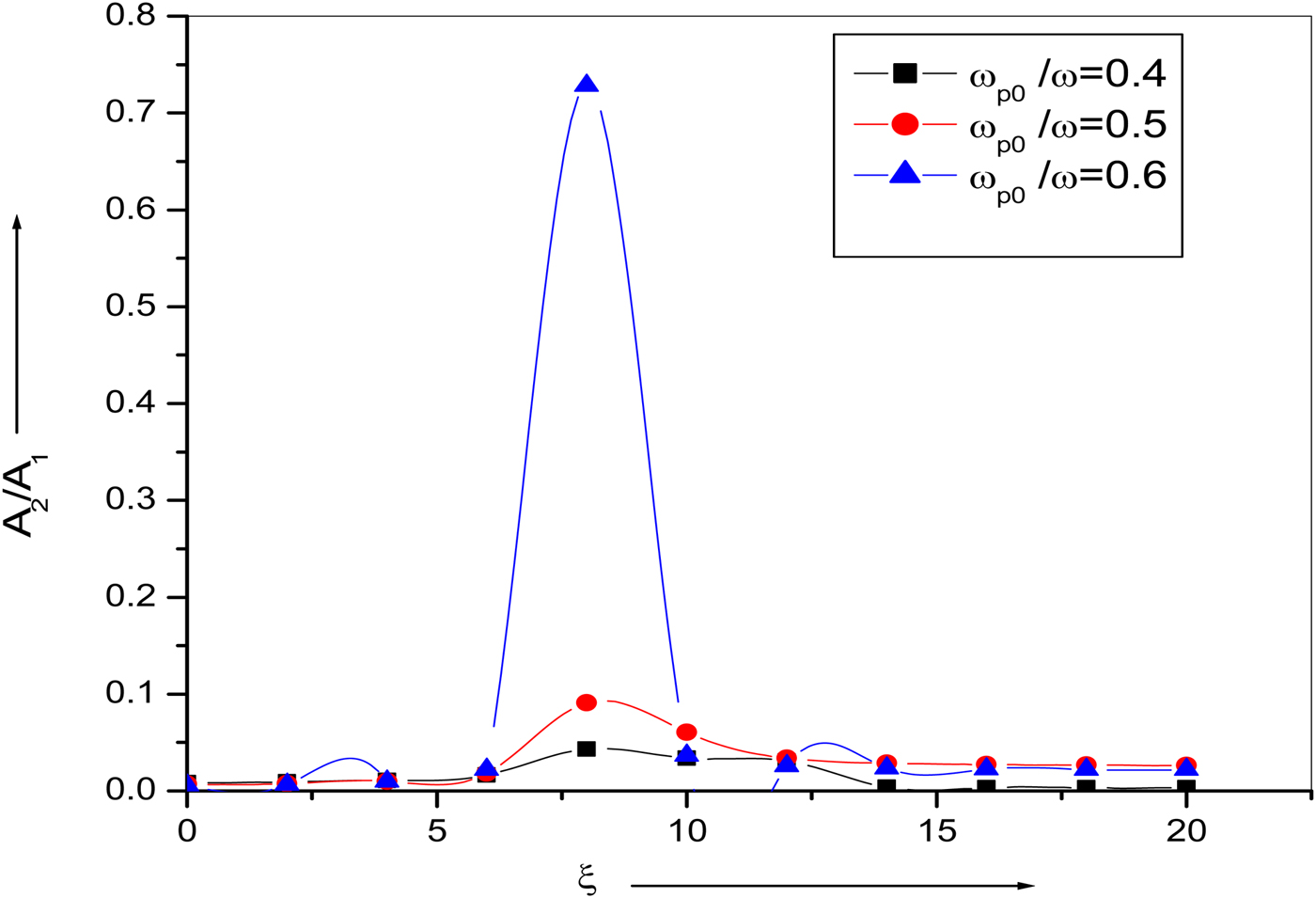
 $eA_0/{\rm \omega} mc = 1,\;3\;{\rm \&} \,5,$ (corresponding intensity I 0 ≈ 1.3 × 10¹³, 1.2 × 10¹⁴ and 3.3 × 10¹⁴ W/cm2, respectively), other parameters are same as taken in Figure 1. One may clearly notice that as we increase the intensity of the pump laser, the amplitude of the second harmonic enhances. With the increase of the intensity of the pump beam, a rise in the amplitude of SHG in clusters was observed by Aggarwal et al. (Reference Aggarwal, Vij and Kant2015). Significant enhancement in the SHG for higher values of plasma frequency is also reported in Figure 5. It is obvious from figures that second harmonic amplitude enhances at ξ = 8, whereas self-focusing of pump laser becomes stronger for exponential plasma density ramp. It has been found that the effect of the inertial ponderomotive force is negligible for ωp0/ω < 0.8, but is considerable for ωp0/ω > 0.8. A sharp increase in the normalized second harmonic amplitude is seen for ωp0/ω = 0.6 (corresponding electron density is 2.02 × 1020 cm−3). It is because SHG shows an oscillatory behavior with the density of the plasma channel and peaks at certain plasma density. Similar effects were obtained by Askari and Noroozi, (Reference Askari and Noroozi2009). They reported that the efficiency of SHG depends on laser and plasma frequencies. A sharp rise in the SHG at ωp0/ω = 0.792 was observed.
Variation of beam width parameter of the pump laser beam with normalized propagation distance. The other parameters are  ${\rm \omega} r_0/c = 18,\;{\rm \varepsilon} _2A_{10}^2 /{\rm \varepsilon} _0 = 1$ and d = 8.

Variation of normalized wiggler wave number with normalized propagation distance for different values of (a)  ${\rm \omega} _{{\rm p0}}/{\rm \omega} = 0.4,\;0.5\,\& \,0.6$ at eA 0/mωc = 5 and (b)
 $eA_{10}/m{\rm \omega} c = 1,\,3\; \,\& \,5$ at ωp0/ω = 0.8. The other parameters are t′/τ = 0.8 and d = 8.

Variation of normalized second harmonic amplitude with normalized propagation distance for different values of  ${\rm \omega} _c/{\rm \omega} = 0.003,\;0.005\,\& \,0.007$. The other parameters are
 ${\rm \omega} \,r_0/c = 18,\;{\rm \varepsilon} _2A_{10}^2 /{\rm \varepsilon} _0 = 1,\;{t}^{\prime}/{\rm \tau} = 0.8,\;{\rm \omega} _{{\rm p}0}/{\rm \omega} = 0.6,\;eA_{10}/m{\rm \omega} c = 5$ and d = 8.

Variation of normalized second harmonic amplitude with normalized propagation distance for different values of  $eA_{10}/m{\rm \omega} c = 1,\,3\; \,\& \,5$. The other parameters are
 ${\rm \omega} \,r_0/c = 18,\;{\rm \varepsilon} _2A_{10}^2 /{\rm \varepsilon} _0 = 1,\;{t}^{\prime}/{\rm \tau} = 0.8,\;{\rm \omega} _{{\rm p0}}/{\rm \omega} = 0.6,\;{\rm \omega} _{\rm c}/{\rm \omega} = 0.007$ and d = 8.

Variation of normalized second harmonic amplitude with normalized propagation distance for different values of  ${\rm \omega} _{{\rm p0}}/{\rm \omega} = 0.4,\,0.5\; \,\& \,0.6$. The other parameters are
 ${\rm \omega} r_0/c = 18,\;{\rm \varepsilon} _2A_{10}^2 /{\rm \varepsilon} _0 = 1,\;{t}^{\prime}/{\rm \tau} = 0.8,\;{\rm \omega} _{\rm c}/{\rm \omega} = 0.007,\;eA_{10}/m{\rm \omega} c = 5$ and d = 8.

Conclusion
A slowly varying exponential plasma density ramp is found to be crucial for laser–plasma interaction. The physics behind this is that self-focusing of pump laser induces a transverse intensity gradient and hence, gives rise to a plasma wave at the pump pulse frequency. Further, it is known that the wiggler wave number provides the required angular momentum for the phase matching condition to be satisfied. Enhancement in the resonant SHG of an intense short pulse laser in plasma embedded with a magnetic wiggler with density transition is seen. It is observed that the amplitude of the second harmonic pulse rises with pump intensity, wiggler magnetic field, and initial plasma frequency. Present model may be helpful in the study of laser-induced fusion in which harmonic generation of second order imparts a key role. Also, it is found that the efficiency of SHG enhances on account of self-focusing of pump laser with the increase of the pump pulse and wiggler magnetic field under exponential plasma density ramp.