Introduction
Endocrine disrupting chemicals including phthalates and phenols and metals are toxicant classes of global concern, especially to pregnant women and children.Reference Woodruff, Zota and Schwartz1–Reference Katsikantami, Sifakis and Tzatzarakis4 In recent years, studies in the United States, Canada and Denmark have measured dozens to hundreds of chemicals among pregnant women or women planning pregnancies and found phthalates, phenols and metals to be among the most widely detected.Reference Woodruff, Zota and Schwartz1–Reference Lee, Fisher, Davis, Arbuckle and Sinha3, Reference Arbuckle, Liang and Morisset5–Reference Arbuckle, Marro and Davis7 For example, in the Canadian Maternal-Infant Research on Environmental Chemicals (MIREC) study, the phenols triclosan (TCS) and bisphenol A (BPA) as well as metabolites of di (2-ethylhexyl) phthalate (DEHP) were detected in >95% of first trimester maternal urine samples.Reference Lee, Fisher, Davis, Arbuckle and Sinha3, Reference Arbuckle, Marro and Davis7 While the exposure landscape varies by region, diet, occupation and cultural practices around the globe, phenols, phthalates and metals are near ubiquitous. Electronic waste recycling in African, South American and Asian countries leads to community-wide exposures to toxic metals.Reference Chen, Dietrich, Huo and Ho8 In 30 countries with available data, water supplies were found to be contaminated by phenols, reflecting widespread use of personal care products.Reference Montes-Grajales, Fennix-Agudelo and Miranda-Castro9 These examples suggest that endocrine disrupting chemical and metal exposures will remain a public health concern for the foreseeable future. As such, it is imperative that the extent of exposure and its adverse effects on vulnerable populations (e.g., developing children) are known.
In line with the Developmental Origins of Health and Disease (DOHaD) hypothesis, prenatal exposures to endocrine disrupting chemicals and metals are associated with offspring health in animal and epidemiological studies, with effects on anthropometry, puberty, neurodevelopment, and more often observed years after the exposure.Reference Ferguson, Peterson and Lee10–Reference Harley, Aguilar Schall and Chevrier17 Birth weight, a routinely collected clinical measure, is considered an indicator of future health with extremes at the low or high end correlated with cardiovascular and metabolic disease risk and other complications later in life.Reference Barker18–Reference Johnsson, Haglund, Ahlsson and Gustafsson20 Prenatal exposures to toxicants, including lead, arsenic, cadmium, DEHP and butylparaben (BuPB), are associated with lower birth weight individually or in combination.Reference Govarts, Remy and Bruckers21–Reference Geer, Pycke and Waxenbaum24 Examining relationships between early gestational exposures with fetal biometrics from standard prenatal ultrasound screening could provide further insight into windows of susceptibility for effects on growth. Significant associations between decreased estimated fetal weight from ultrasonography and DEHP metabolitesReference Ferguson, Meeker and Cantonwine25 were observed in a Boston birth cohort (n = 482), suggesting metrics of fetal growth as a promising yet largely unexplored outcome for environmental epidemiology.
This study was designed to characterize three classes of prevalent toxicants of concern to pregnant women and developing children – phthalates, phenols and metals – using first trimester urine samples from a subset of 56 mothers with full-term and healthy newborns from the Michigan Mother–Infant Pairs (MMIP) study. We conducted exploratory analyses to identify exposure predictors and associations of exposures with birth weight and second trimester fetal biometrics. These analyses were conducted as an initial exposome pilot study through support from the US National Institute of Environmental Health Sciences’ Children’s Health Exposure Analysis Resource (NIEHS CHEAR).
Methods
Study population
The MMIP project is an ongoing birth cohort study based out of the University of Michigan Von Voigtlander Women’s Hospital. Women were recruited between 2010 and 2017 during their first prenatal visit and were eligible to participate if they were at least 18 years old, conceived naturally, had a singleton pregnancy, were between 8 and 14 weeks gestation and intended to deliver at the University of Michigan hospital. Approximately 250 MMIP subjects have delivered as of 2017, and findings from a subset of these subjects were previously published.Reference Marchlewicz, Dolinoy and Tang26–Reference Watkins, Milewski, Domino, Meeker and Padmanabhan28 For the analyses described here, a subset of mothers recruited between 2012 and 2015 were selected for extensive exposure assessment of endocrine disrupting chemicals and metals and planned epigenomic and metabolomics analyses as a CHEAR pilot study. To be included in this subset of 56, inclusion criteria for the mother–infant pairs were: complete survey data, availability of all biospecimen from mother and child and family not included in previous exposure assessment. Owing to the low prevalence of racial or ethnic minorities and maternal smoking, in an effort to reduce the confounding factors in a relatively small sample size, only Caucasian, non-Hispanic, non-smoking mothers with full-term newborns (⩾37 weeks gestation) were included.
The participating women provided informed, written consent before participation. The University of Michigan Medical School Institutional Review Board approved all study procedures.
Survey data and sample collection
At the first trimester study visit, women were administered a survey to collect information on demographics, smoking status and potential exposure sources for endocrine disrupting chemicals in the past 3 months (fast food, canned food, haircare products, perfumes and cosmetics). Spot urine and venous blood samples were collected from MMIP mothers during the first trimester prenatal visit and on arrival at the hospital for delivery. Urine samples were collected in polypropylene containers, transferred into glass vials and stored at −80°C before analysis.
Birth outcomes
Data were collected from the health records on gestational age, birth weight (measured at delivery), birth length and head circumference measured the day after delivery. Gestational age was recorded as the healthcare provider’s best estimate from either the last menstrual period or ultrasound, as recommended by the American Congress of Obstetricians and Gynecologists. Fenton z-scores were calculated to standardize birth weight by completed gestational weeks and by sex using the Fenton Growth Chart updated in 2013.Reference Fenton and Kim29
Fetal anthropometry
Fetal morphometrics including biparietal diameter, head circumference, abdominal circumference and femur length were abstracted from a clinical ultrasound performed in the second trimester at the time of fetal survey. Published growth reference curves were used to standardize measurements based on gestational age.Reference Verburg, Steegers and De Ridder30
Exposure assessment: endocrine disrupting chemicals
Panels of 12 phthalate metabolites and 12 environmental phenols were quantified in maternal urine samples collected during the first trimester study visit at the NSF International Applied Research Center Laboratory (Ann Arbor, MI, USA) via isotope dilution liquid chromatography/tandem mass spectrometry (MS). Methods were modified from our previously published workReference Watkins, Milewski, Domino, Meeker and Padmanabhan28, Reference Perng, Watkins and Cantoral31 to include more analytes. The analytical methods are based on the Centers for Disease Control and Prevention (CDC) laboratory procedure manuals for phthalate metabolites and environmental phenols (method no. 6306.03 and 6306.01, respectively), and the analysis was conducted on a TSQ Vantage triple quad/Transcend II instrument with Ultimate 3000 high-performance liquid chromatography pumps. For phthalates, the analytes included metabolites of DEHP: mono (2-ethyl-5-carboxylpentyl) phthalate (MECPP), mono (2-ethyl-5-hydroxyhexyl) phthalate (MEHHP), mono (2-ethylhexyl) phthalate (MEHP), and mono (2-ethyl-5-oxohexyl) phthalate (MEOHP) and dibutyl phthalates (DBP): mono-isobutyl phthalate (MIBP) and mono n-butyl phthalate (MnBP). Concentrations of mono-benzyl phthalate (MBzP), mono-carboxy isononyl phthalate (mCINP), mono (3-carboxypropyl) phthalate (MCPP), mono (6-COOH-2-methylheptyl) phthalate (MCOMHP), monoethyl phthalate (MEP) and mono-isononyl phthalate (mINP) were also determined. For environmental phenols, the analytes were bisphenols (BPA, BPF, BPS), parabens (butyl, ethyl, methyl and propyl paraben [BuPB, EtPB, MePB, PrPB]), 2,4 and 2,5-dichlorophenol (DCP24, DCP25), benzophenone-3 (BP3), triclocarban (TCC) and TCS.
Exposure assessment: metals and metalloids
Metals were quantified in the first trimester maternal urine samples at the NSF International Laboratory via isotope chromatography plasma tandem MS following a protocol based on CDC method 3018.3 with modifications for an expanded metal panel and an iCAP RQ instrument (Thermo Scientific). The 17 metals analyzed were arsenic, barium, beryllium, cadmium, chromium, copper, mercury, manganese, molybdenum, nickel, lead, selenium, tin, thallium, uranium, tungsten and zinc (As, Ba, Be, Cd, Cr, Cu, Hg, Mn, Mo, Ni, Pb, Se, Sn, Tl, U, W and Zn). One sample with insufficient urine quality and quantity was excluded from metals analysis.
Quality control procedures during the exposure assessment of all toxicants included assessing intra- and inter-day variability and accuracy through replicates spiked at different concentrations. The laboratory also participates in external proficiency testing programs for many of the measured analytes. Concentrations below the limit of detection (LOD) were assigned a value of LOD/√2. Specific gravity of maternal urine samples was measured via a handheld device (ATAGO Company, Ltd, Tokyo, Japan) to account for variability due to urinary dilution.Reference Pearson, Lu, Schmotzer, Waller and Riederer32
Statistical analysis
Descriptive statistics were computed for demographics, birth outcomes, survey responses and toxicant concentrations. The molar sums for metabolites of DEHP (MECPP, MEHHP, MEHP and MEOHP) and DBP (MIBP and MnBP) were calculated by summing metabolite concentrations divided by their respective molar mass. Exposure sum variables were calculated by first ranking concentrations of each toxicant into tertiles, assigning 0, 1 or 2 to the first, second and third tertiles, respectively, followed by taking the sum of assigned integers within each class (phthalate, phenol or metal), as well as a comprehensive sum of all chemical agents. Continuous variables failing to depict a normal distribution were transformed by the natural logarithm for further analysis.
Toxicants that were not detected in at least 30% of samples (mINP, TCC, Be, U and W) were excluded from multivariate and bivariate single-exposure analyses. Bivariate associations were evaluated between chemical agents and birth outcomes, survey responses and demographic factors using Spearman correlation coefficients, Wilcoxon rank-sum tests and Kruskal–Wallis tests as appropriate. Multiple linear regression models, adjusting for specific gravity, gestational age and infant gender (when appropriate), were used to regress chemical agents on birth weight, Fenton z-scores and fetal biometrics. Toxicants were analyzed individually, summed within their respective class (phthalate, phenol and metal), and all-inclusive sum of agents measured based on tertiles as described earlier. Phenols BPF and BPS were also described and analyzed as detect/non-detect due to a high percentage of concentrations below LOD. All statistical analyses were conducted using SAS 9.4 (Cary, N.C.).
Results
Demographics and birth outcomes
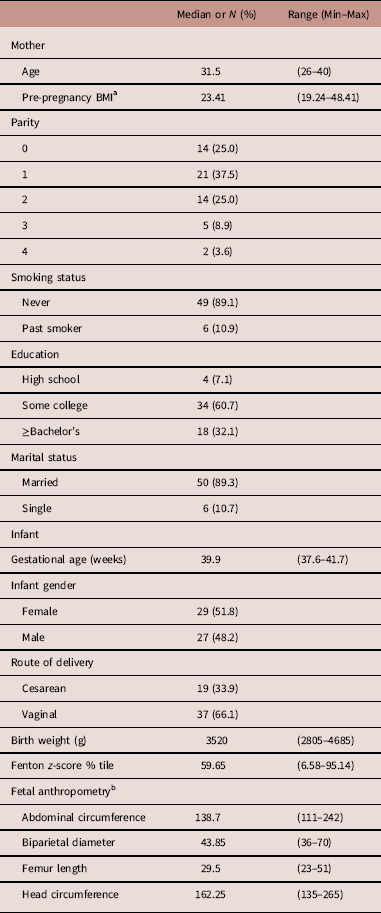
Characteristics of women and infants of the MMIP cohort subset are displayed in Table 1. The cohort comprised (n = 56) non-Hispanic Caucasian women, with a median age of 31.5 years (interquartile range = 6). Before pregnancy, women were typically within the normal body mass index (BMI) range (median = 23.41 kg/m2). The homogeneous group was primarily married (89%), never smokers (89%) and reported some degree of undergraduate college education or higher (92%). The majority of women currently had at least one child (parity ⩾1). All births were full term by design and of normal birth weight (median = 3520 g). After adjusting for gestational age, infants were average in size compared to the general population (Fenton z-score median percentile = 59.7). When separated by sex, females had a median percentile of 54.4 while males were slightly larger (median percentile = 62.7; see Supplementary Table S1 for sex-stratified anthropometry). Most births were vaginal (66.1%).
Demographic characteristics of the MMIP study (n = 56)

a n = 53
b Units = mm
Exposure assessment
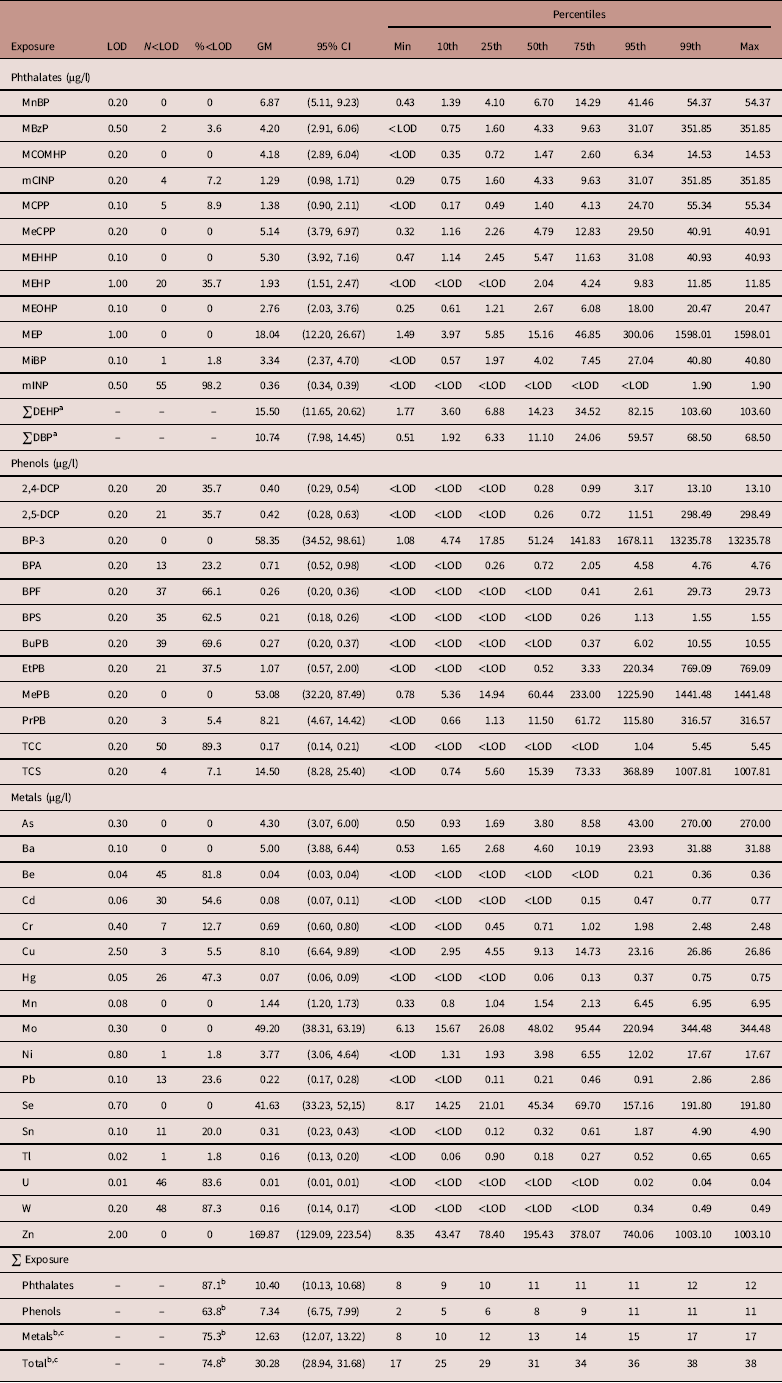
Distributions of phthalate, phenol and metal concentrations from first trimester maternal urinary samples are depicted in Table 2. All phthalate metabolites except MEHP and mINP were highly detected (>90%) and most metabolites were moderate to highly correlated (Supplementary Table S2). Fewer phenols were above the LOD and were weakly to moderately correlated with one another (Supplementary Table S3). Most metal concentrations were highly detected (>60%), and were significantly correlated with one another, except Hg (Supplementary Table S4).
Phthalate, phenol and metal concentrations in the first trimester maternal urine samples (n = 56)

∑ Exposure reflects the number of chemicals above LOD in each class (phthalate, phenol and metal) and all-inclusive sum (total); ∑ Phthalates: MnBP, MBzP, MCOMHP, mCINP, MCPP, meCPP, MEHHP, MEHP, MEOHP, MEP, MiBP, mINP; ∑ Phenols: 2,4-DCP, 2,5-DCP, BP-3, BPA, BPF, BPS, BuPB, MePB, PrPB, TCC, TCS; ∑ Metals: As, Ba, Be, Cd, Cr, Cu, Hg, Mn, Mo, Ni, Pb, Se, Sn, Tl, U, W, Zn; Total: ∑Phthalates, ∑Phenols, ∑ Metals
a Units: µg/l
b Percent of chemicals above LOD
c n = 55 women; GM: Geometric mean
P -values <0.05 are highlighted in bold.
Out of 41 toxicants analyzed, women in this cohort had an average of 30 detected (range 17–38) during their first trimester of pregnancy including an average of 11 phthalate metabolites, 8 phenols and 13 metals. Summed scores based on tertiles of exposures for each toxicant reveal a distribution across the sample ranging from mothers in the lowest tertile for nearly all the toxicants to mothers in the highest tertile for almost all analytes (Supplementary Table S5).
Predictors of exposure biomarkers
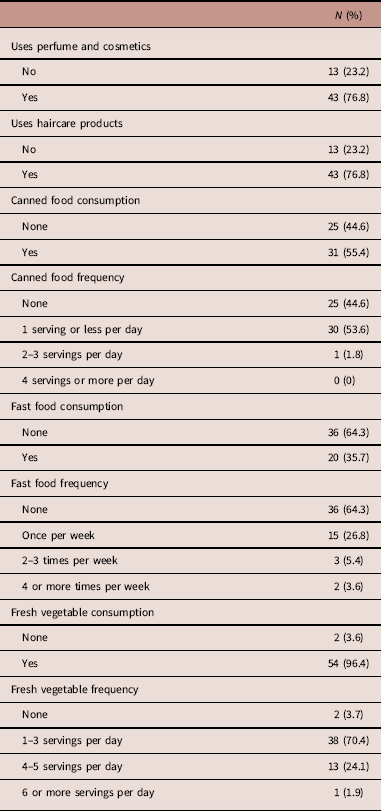
Frequency of survey responses to possible endocrine disrupting chemical sources, including diet and personal care products during the first trimester can be found in Table 3. Concentrations for metabolites, mCINP (Wilcoxon rank-sum test P = 0.002), MCPP (P = 0.04), meCPP (P = 0.02) and MiBP (P = 0.01) were higher for those who ate fast food, while an inverse relationship was detected for MnBP (P = 0.004; Supplementary Table S6). With phenols, 2,5-DCP, MeBP and TCS (P = 0.03) were higher among those who consumed fast food (Supplementary Table S7). Concentrations of BPF were higher for those who not only consumed canned food (P = 0.03) but also for those who reported higher frequency of consumption per week (P = 0.02; Supplementary Table S8). Few significant relationships were detected among survey responses and metals (Supplementary Table S9). However, concentrations of Se (P = 0.01), Sn (P = 0.02) and Zn (P = 0.02) were higher in those who reported fast food consumption.
Maternal self-reported product use, fast food and vegetable consumption

Exposures and size at birth
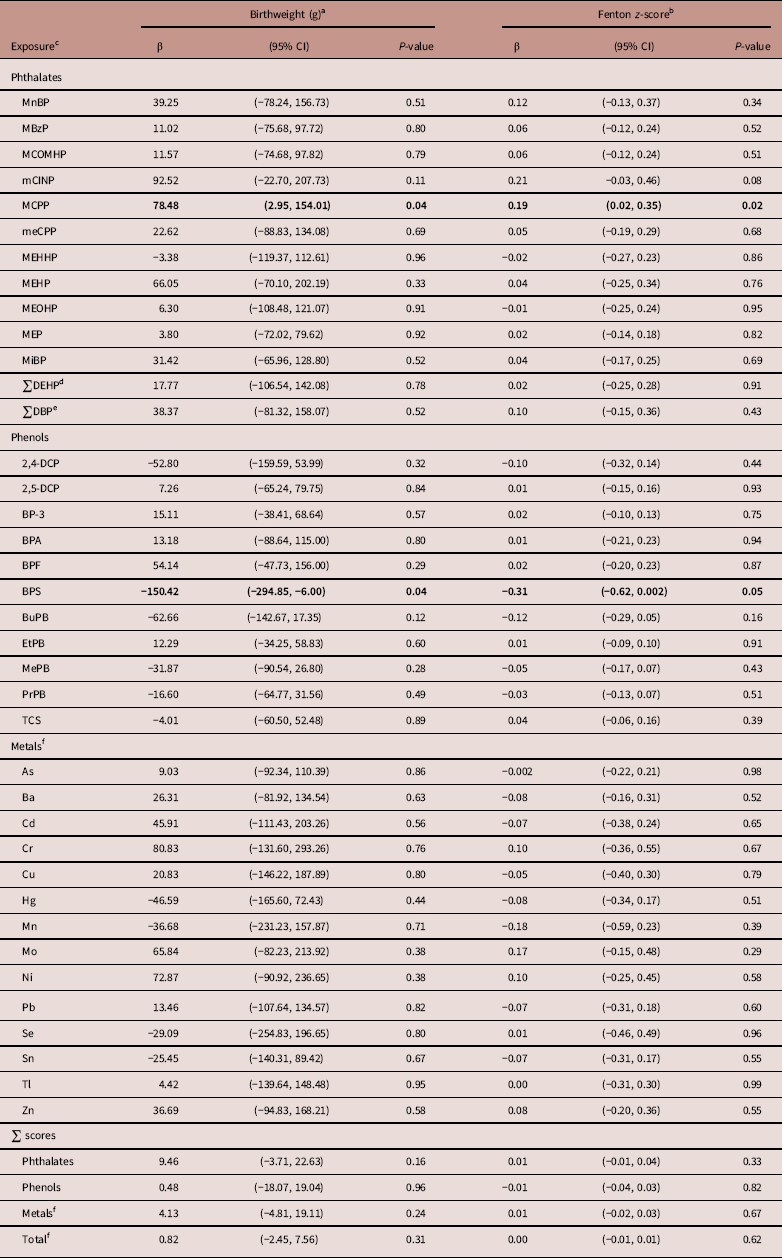
The associations of phthalates, phenols and metals that were detected in at least 30% of samples with birth weight and Fenton z-scores are displayed in Table 4. Several significant associations were observed (P <0.05). One unit of natural log-transformed MCPP concentration was associated with a 78.48 g increase in birth weight [95% confidence interval (CI): 2.95, 154.01; P = 0.04] and a 0.19 increase in Fenton z-score (95% CI: 0.02, 0.35; P = 0.02). We identified a significant decrease in birth weight (β = −150.42 g, 95% CI: −294.85; −6.00; P = 0.04) and Fenton z-score (β = −0.31; 95% CI: −0.62, 0.002; P = 0.05) with increasing BPS concentrations. Since BPS was only detected in 37% of samples, we examined this association with dichotomized BPS (detect v. non-detect, see Supplementary Table S10) and the relationship with lower birth weight (P = 0.04) and Fenton z-score remained (P = 0.02) among mother–infant pairs with detectable BPS. No significant relationships were observed between metals or summed scores of phthalates, phenols or metals with birth weight or Fenton z-score.
Associations between exposure biomarkers (µg/l) and birth outcomes (n = 56)

a Multiple linear regression models were run for each toxicant/element adjusting for specific gravity, gestational age and gender
b Multiple linear regression models were run for each toxicant/element adjusting for specific gravity
c Natural log-transformation
d ∑DEHP includes metabolites: MeCPP, MeHHP, MEHP and MEOHP
e ∑DBP includes metabolites: MnBP and MiBP
f n = 55
P-values <0.05 are highlighted in bold.
Exposures and fetal size
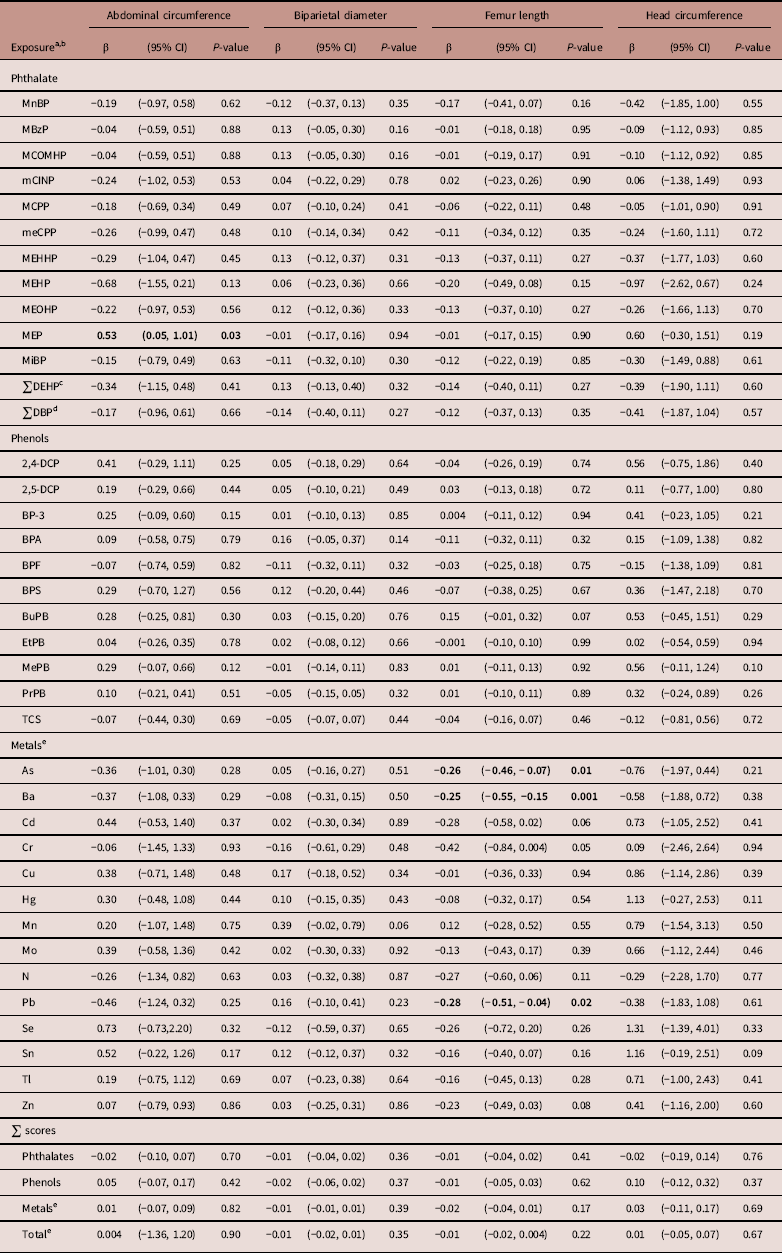
Regression analyses for toxicants with standardized fetal anthropometry are depicted in Table 5. MEP was positively associated with abdominal circumference (β = 0.53, 95% CI: 0.05, 1.01, P = 0.03) while the metals As (β = −0.26, 95% CI: −0.46, −0.07; P = 0.01), Ba (β = −0.25, 95% CI: −0.55, −0.15; P = 0.001) and Pb (β = −0.28, 95% CI: −0.51, −0.04; P = 0.02) were all negatively associated with femur length. Relationships between fetal anthropometry measurements and summed exposures were not statistically significant.
Associations between exposure biomarkers (µg/l) and standardized fetal anthropometry in mm (n = 56)

a All analyses adjusted for specific gravity and gender
b Natural log-transformation of exposure
c ∑DEHP includes metabolites: meCPP, MEHHP, MEHP and MEOHP
d ∑DBP includes metabolites: MnBP and MiBP
e n = 55
P-values <0.05 are highlighted in bold.
Discussion
In the MMIP cohort, we report widespread exposure to endocrine disrupting chemicals and metals in the first trimester maternal urine samples with an average of 30 toxicants detected out of 41. Some toxicants were near ubiquitous with detection in >90% of samples including all essential elements, non-essential elements (As, Ba, Tl), 10 phthalate metabolites, BP-3, MePB, PrPB and TCS. Toxicants that are increasingly being detected in humans in recent decades, MCPP and BPS,Reference Zota, Calafat and Woodruff33, Reference Chen, Kannan and Tan34 were significantly associated with higher and lower birth weight, respectively, among this pilot sample from MMIP. We also observed associations between decreased second trimester femur length and metals, suggesting the potential utility of fetal biometrics in understanding windows of susceptibility.
MMIP along with other recent environmental epidemiology studies is moving beyond assessment of highly studied toxicants (e.g., As, Cd, BPA) to characterize trends in the ever-changing exposome and ultimately adverse health outcomes associated with these exposures. We detected an average of 30 out of 41 endocrine disrupting chemicals and metals measured in urine with a maximum of 38 detected in an individual. Similarly, Woodruff et al. observed high detection levels among many chemical classes, including phenols, phthalates, metals and pesticides measured in biological samples from 268 pregnant women who participated in the 2003–2004 cycle of National Health and Nutrition Examination Survey (NHANES).Reference Woodruff, Zota and Schwartz1 In the Canadian MIREC study, multiple classes of chemicals were detected in the maternal first trimester urine samples with socio-demographic characteristics predicting concentrations of some chemicals but not all.Reference Lee, Fisher, Davis, Arbuckle and Sinha3, Reference Lewin, Arbuckle and Fisher35 For example, DEHP metabolites were detected in 98% of participants, and concentrations were independent of socio-demographic characteristics.Reference Lee, Fisher, Davis, Arbuckle and Sinha3
The MMIP sample in this study comprised a well-educated and healthy group of Caucasian women with exposure levels similar to or lower than those reported in NHANES. The toxic burden carried by pregnant women in vulnerable populations and the subsequent health effects on mother and child are likely to be greater due to region-specific, socio-economic status (SES)-related and/or environmental justice issues such as urban air pollution, access to fresh produce or clean water, proximity to industrial operations, consumer product use patterns and more. For example, in a sample of predominantly black pregnant women from New York, MePB and PrPB urinary concentrations were four times greater than that observed in MMIP.Reference Pycke, Geer, Dalloul, Abulafia and Halden36 Exposure to metals is a global concern with disproportionate burdens posed on many populations including those living near outsourced electronic waste recycling sitesReference Chen, Dietrich, Huo and Ho8 or populations with As or Pb contaminated water supplies.Reference Hanna-Attisha, LaChance, Sadler and Champney Schnepp37, Reference Hopenhayn, Huang and Christian38
In the MMIP study and NHANES, fast food consumption was associated with higher exposures to parent phthalates such as DEHP and DiNP.Reference Zota, Phillips and Mitro39 We also observed associations between fast food consumption and 2,5-DCP, MePB, TCS, Se, Sn and Zn, but the extent to which frequent consumers of fast food are exposed to these chemicals and elements is unknown. While canned food consumption and BPA were not significantly correlated, we did observe higher BPF concentrations by frequency of canned food consumption. This reflects the changing landscape of bisphenols in consumer products with BPA being replaced by other bisphenols with endocrine-disrupting potential.Reference Chen, Kannan and Tan34 Overall, there is a need to characterize the recent exposome of diverse maternal populations – by global region, race, ethnicity and SES – to better understand the relevant chemical mixtures of most concern for maternal and child health.
We observed an association between higher birth weight and first trimester MCPP, a phthalate metabolite on the rise in the United States according to trends in NHANES data from 2000 to 2012.Reference Zota, Calafat and Woodruff33, 40 MCPP is a metabolite of the parent di-n-octyl phthalate (DOP) and other high molecular weight phthalates. These parent chemicals are widely used as plasticizers in diverse products including flooring, vinyl gloves, adhesives and food packaging. Although few animal studies to-date have modeled prenatal exposure to the primary parent compound (DOP) or to MCPP directly, epidemiological studies suggest that MCPP exposure in early pregnancy affects the mother. For example, lower free triiodothyronine (T3) and higher BMI were associated with higher urine MCPP among pregnant women.Reference Johns, Ferguson and Soldin41, Reference Bellavia, Hauser and Seely42 Lower maternal thyroid hormone levels and higher BMI increase the risk for larger offspring.Reference Vrijkotte, Hrudey and Twickler43, Reference Kim, Sharma, Sappenfield, Wilson and Salihu44 In a different subset of MMIP participants recruited in the study’s early years, we previously reported significant associations among female newborns between first trimester MCPP and increased birth length, as well as maternal urinary MCPP at delivery and higher birth weight.Reference Watkins, Milewski, Domino, Meeker and Padmanabhan28 However, in the Infant Development and the Environment Study (TIDES, n = 753), no significant associations between first trimester maternal MCPP and birth weight were observed among male or female infants.Reference Sathyanarayana, Barrett and Nguyen45 The association between average MCPP throughout pregnancy and birth weight was also not significant among newborns from the LIFECODES study.Reference Ferguson, Meeker and Cantonwine25 Given the mixed evidence for MCPP’s effects on fetal growth, the potential impact of MCPP on pregnant women and the timing-specificity of this relationship, the influence of MCPP on birth outcomes requires further research.
While the pool of research on birth outcomes and phthalate or BPA exposures is growing, few studies apart from MMIP have investigated emerging chemicals of concern such as parabens and TCS with birth outcomes. Associations between parabens and decreased gestational age at birth, increased odds for preterm birth and low birth weight with increasing BuPB concentrations in cord blood plasma were observed among immigrants living in Brooklyn, New York as well as an association between TCC and decreased gestational age at birth.Reference Geer, Pycke and Waxenbaum24 While our study only includes term neonates by design, we observed a similar trend of lower birth weight with increasing maternal first trimester BuPB (P = 0.12). We also observed a significant association between decreased birth weight and BPS – a replacement chemical for BPA with endocrine-disrupting potential that has recently been detected in populations from around the world.Reference Chen, Kannan and Tan34 Prior evidence suggests that BPS crosses the placenta in humans,Reference Liu, Li and Wu46 and this is one of the first studies to our knowledge to examine associations between birth outcomes and BPS. Rodent models of perinatal BPS exposure have identified health effects manifesting later in life, including at dose levels below the recommended daily intake for humans. Health effects observed were altered maternal behavior in mice,Reference Catanese and Vandenberg47 overweight and metabolic complications in adult male mice,Reference Ivry Del Moral, Le Corre and Poirier48 and altered gene expression in the prefrontal cortex of juvenile female rats.Reference Castro, Sanchez and Torres49 Thus the short- and long-term effects of prenatal exposures to BPA replacements merit further investigation in human populations.
Second trimester fetal biometry measurements are part of standard prenatal care in the United States and elsewhere, and accessing this data provides an additional window of susceptibility to examine the influence of environmental exposures.Reference Cantonwine, Ferguson and Mukherjee50 While work in this area is limited to date, positive associations between maternal BMI and adiposity with fetal biometricsReference Cantonwine, Ferguson and Mukherjee50, Reference Lopes, Souza, Figueiroa and Alves51 as well as decreased estimated fetal weight with DEHP metabolitesReference Ferguson, Meeker and Cantonwine25 have been reported. Metals (As, Ba, Pb) were negatively associated with femur length in this study. In vitro, human exposure relevant doses of arsenic inhibit osteoblast differentiation.Reference Wu, Lu and Chan52 Prenatal lead exposure has previously been associated with decreased birth weight and length and higher risk of small-for-gestational-ageReference Gonzalez-Cossio, Peterson and Sanin22, Reference Taylor, Golding and Emond53, Reference Wang, Li and Hao54 as well as decreased osteoblastogenesis.Reference Beier, Maher and Sheu55 Findings in the MMIP cohort may reflect an earlier window to detect effects on fetal growth that should be considered in future research.
This study involved extensive first trimester exposure assessment of emerging endocrine disrupting chemicals (e.g., parabens, BP-3), and we are the first to our knowledge to report associations between BPS and birth weight as well as between metals and fetal biometrics. These relationships merit future exploration in large and diverse cohorts since this pilot study had several limitations. The sample size was small, and associations would not have remained statistically significant after accounting for multiple comparisons. Low statistical power, the relatively small range of exposure levels among MMIP participants, inability to perform sex-stratified analyses and exclusion of preterm infants may have biased our results toward the null. Urinary measures from the first trimester were available, yet blood is a better biomarker for some metals (e.g., Pb, methyl-Hg), and exposures later in pregnancy may also influence birth size.Reference Geer, Pycke and Waxenbaum24, Reference Watkins, Milewski, Domino, Meeker and Padmanabhan28 Owing to the sample size, statistical analyses were tested for linear relationships between outcomes and exposure biomarkers. We did not additionally test for non-monotonic relationships (e.g., U-shaped response with health effects observed in cases of deficiency and excess) that might occur for essential elements such as Se, Zn or Cu.Reference P. Mattson and Calabrese56 We did not replicate a previously reported association from a different subset of MMIP participants between first trimester maternal BPA and lower birth weight.Reference Veiga-Lopez, Kannan and Liao27 This is likely due to a difference in biomarkers as unconjugated BPA and BPA glucuronide were measured in plasma in the previous study while total urinary BPA was measured in this set of MMIP participants. The homogenous sample is a limitation for generalizability of results but a strength for reducing confounding (e.g., from maternal smoking and race). Characterization of the MMIP exposome lays the groundwork for future in-depth exploration supported by CHEAR of biophysiological mechanisms (epigenomics, metabolomics, oxidative stress markers) by which metals, phenols and phthalates may ultimately influence child health.
In conclusion, associations between first trimester exposure biomarkers with birth weight (increased with MCPP; decreased with BPS) and with femur length estimated during ultrasonography (decreased with As, Ba, and Pb) were observed in the MMIP cohort. Although this study had several limitations, it serves as an introduction to the future of comprehensive exposure assessment in children’s health research, and in particular, through the NIEHS CHEAR program. Exposure measures were provided by CHEAR, a resource that fulfills the need for sophisticated and thorough exposure assessment within multiple children’s health cohorts that can ultimately be combined. The data generated from CHEAR will be made publically available and will be used to assess relationships between toxicant exposures with outcomes such as birth weight in a large and diverse sample from multiple studies. This will allow for sufficient power to accommodate more sophisticated statistical analysis of the health impacts of exposure to mixtures in addition to individual chemicals or classes of chemicals. The CHEAR program will add not only exposure biomarker data but also measures of biological responses including metabolomics, epigenomics, endocrine function, inflammation, oxidative stress and others in an effort to advance risk assessment and increase mechanistic understanding of toxicity in children.
Supplementary material
To view supplementary material for this article, please visit https://doi.org/10.1017/S204017441800106X
Acknowledgements
The authors acknowledge Samantha Milewski and Steven Rogers for recruiting participants and collecting samples.
Financial Support
This work was supported by the National Institute of Environmental Health Sciences (NIEHS) Children’s Health Exposure Analysis Resource (CHEAR) program (grant no. U2CES026553, J.D.M.) in addition to the following grants from the National Institutes of Health: grant nos. R01ES017500 (V.P.), P01ES022844 (V.P.), P30ES017885, and 1UG3 OD023285-01. Grant RD83543601 (V.P.) from the US Environmental Protection Agency (US EPA) also supported this work. Contents are solely the responsibility of the grantees and do not necessarily represent the official views of the National Institutes of Health or the US EPA. Further, the US EPA does not endorse the purchase of any commercial products or services mentioned in the publication.
Conflict of Interest
None.
Ethical Standards
The authors assert that all procedures contributing to this work comply with the ethical standards of the relevant national guidelines on human experimentation (set by the US Department of Health and Human Services) and with the Helsinki Declaration of 1975, as revised in 2008, and has been approved by the University of Michigan Medical School Institutional Review Board.