Introduction
Performance-based management (PBM) has become a dominant form of management in many Western societies, also in the health care sector. In this paper, PBM is understood as a form of governance in which: (1) desired results are specified in advance in measurable form; (2) some system of monitoring measures performance against that specification; and (3) feedback mechanisms are linked to measured performance (Bevan and Hood, Reference Bevan and Hood2006). These concepts are reflected in some types of accreditation, regular evaluations, hospital rating systems, etc. It has been argued that PBM represents a trend towards marketization of health care service delivery (Cacace et al., Reference Cacace, Ettelt, Brereton, Pedersen and Nolte2011: 6–8), and a vast literature has developed to assess preconditions for and effects of PBM (cf. Groene et al., Reference Groene, Skau and Frølich2008; de Vos et al., Reference de Vos, Graafmans, Kooistra, Meijboom, Van Der Voort and Westert2009). Existing reviews have focused on studies published primarily in medical journals and to some degree presupposed the purpose with PBM as well as the involved regulatory mechanisms (Marshall et al., Reference Marshall, Shekelle, Leatherman and Brook2000b; Fung et al., Reference Fung, Lim, Mattke, Damberg and Shekelle2008; Groene et al., Reference Groene, Skau and Frølich2008; de Vos et al., Reference de Vos, Graafmans, Kooistra, Meijboom, Van Der Voort and Westert2009). One systematic review from 2002 identified two diverse approaches to the conception of PBM showing that the studies build on different assumptions about the rationale for introducing such systems as well as different perceptions of what constitutes valid knowledge about system performance, indicating a need for further study of the assumptions governing PBM (Freeman, Reference Freeman2002). A widely recognized reading of organizational studies (Hatch, Reference Hatch1997), similarly suggested a need to appreciate the influence of implicit assumptions when comparing studies from different research traditions. Building on these insights, the present study analyses a wide range of studies of PBM in hospitals and similar organizations to elucidate the theoretical assumptions on which they build. By comparing medical studies with analyses of PBM from the social sciences (e.g. anthropology, sociology, political science and economics), we seek to deliver a multi-faceted, interdisciplinary understanding of how PBM influences the health care sector. The synthesis is not a standard, systematic literature review but rather a theoretical contribution, which is meant to increase reflectivity when approaching new governance tools in the health care sector whether from the perspective of research or applied health governance.
Method
The literature search was performed in two stages. In stage one, studies were sought in the following databases: MedLine, Sociological Abstracts, ERIC, FRANCIS, Worldwide Political Science Abstracts and Web of Science using the following terms combined with OR: performance data, performance indicator, quality assessment, quality performance, quality rating, quality improvement, quality control and benchmarking in combination with terms describing the setting (hospital, health care, health service, public sector) via the AND-function. Search results were refined by adding the following terms: policy, management, regulation, control and inspection. At this stage, criteria for inclusion were: studies of preconditions for and effects of PBM systems in the hospital sector. Criteria for exclusion were: intra-system indicator refinements; non-English publication. This search yielded predominantly studies from medical and economic traditions. To achieve our purpose of contributing new theoretical insights about PBM based on interdisciplinary literature analysis, a second literature search was performed to retrieve also studies from sociological, political science and humanistic traditions. At this stage, we used more overarching search terms since the social science and humanities literature typically address PBM in a generic sense. We searched Sociological Abstracts, Worldwide Political Science Abstracts, AnthroSource and Web of Science (social science and humanities) databases using the following terms combined with OR: audit, accountancy, accountability, assurance, performance-based management and evaluation. Results were refined by adding the following terms using AND: hospital, health care, health service, public sector, policy, management, regulation, control and inspection. We also broadened the inclusion criteria to include studies that did not examine PBM specifically in a hospital setting but analysed it as a governance form across, for example, health care, education and other public sectors.
Summaries of the retrieved studies were made upon reading by Ane Lind and Sarah Wadmann, and the summaries were organized in analytical categories in a bottom-up process (cf. Clarke, Reference Clarke2005). The categorization of the studies was based on similarities and differences in assumptions about (a) purpose and (b) governance mechanism of PBM reflected in the studies. With governance mechanism we drew upon the understanding found in Miller and Rose (Reference Miller and Rose2008): we looked for perceptions of how PBM can alter human and organizational behaviour, including understandings of motivation and agency of organizational agents. Three analytical categories were formed and termed: the ‘functional’, the ‘interpretive’ and the ‘post-modern’ perspective. We found that the studies could be ordered in these groups since they shared an analytical approach to PBM as a form of governance even when the studies within each category presented different results. While all the retrieved studies were placed in one of the three categories, not all were easily categorized, mainly because theoretical assumptions remain implicit in several studies on PBM. In cases of doubt, studies were discussed and categorized after agreement was obtained among the authors of this article. Because categorization reflects the perception of the author group, it may not be in accordance with the perception of the authors’ of the original studies. Whereas the categories highlight analytical differences, they are not mutually exclusive. Individual studies occasionally describe several dimensions of PBM and all dimensions may not confer to one category. Elements of particular studies may therefore fit better in one category than in others.
Results
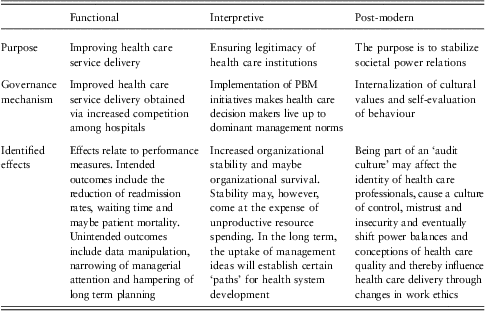
Studies categorized as ‘functional’ shared a view of the purpose of PBM as a means to improve health care service delivery, and the governance mechanism was assumed to be increased competition among hospitals. Studies categorized as ‘interpretive’ explained the purpose differently as they explained the adoption of PBM with institutional and individual agents striving for public legitimacy (rather than health care optimization), and the governance mechanism was assumed to be inter-subjective desires to live up to societal norms of what constitutes good management. These studies focus on the psychological, social or emotional reasons for strategic manoeuvreing at the level of individual agents and organizations to achieve desired goals – irrespective of their health outcome. Finally, we found a group of studies, which we categorized as ‘post-modern’. In these studies, PBM is analysed as a socio-cultural phenomenon primarily serving the purpose of stabilizing societal power relations. These studies understood the governance mechanism as working through internalization of values expressed in PBM by health (and other) professionals and self-evaluation of their behaviour in accordance to these values, but put no emphasis on strategic manoeuvreing. In fact, individual actors were described as subjected to changes in their own values without conscious adaptation. The various perspectives will be described in more detail in the following, and Table 2 summarizes how they differentiate.
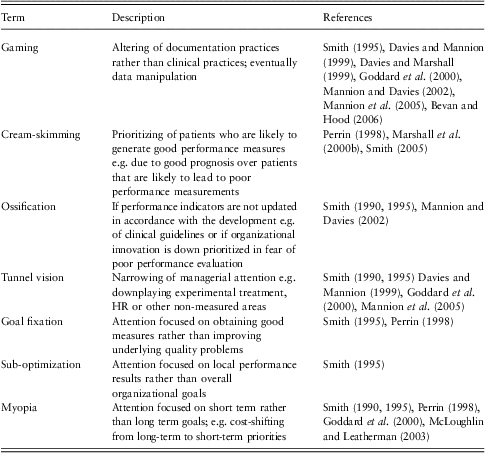
Unintended consequences of PBM systems

PBM = performance-based management.
PBM in a functional perspective
In the studies, we categorized as functional, PBM is understood as a management tool serving the purpose of performance and/or quality improvement of health care service delivery by means of market-based mechanisms (e.g. Smith, Reference Smith1990, Reference Smith1995; Davies and Mannion, Reference Davies and Mannion1999; Goddard et al., Reference Goddard, Mannion and Smith2000; Marshall et al., Reference Marshall, Shekelle, Leatherman and Brook2000b; Lansky, Reference Lansky2002; Marshall et al., Reference Marshall, Shekelle, Davies and Smith2003; Bevan and Hood, Reference Bevan and Hood2006; O'Neill Jr., Reference O'Neill2006). The idea is that the disclosure of performance data will promote transparency (Hibbard et al., Reference Hibbard, Slovic and Jacquelyn1997; Longo et al., Reference Longo, Land, Schramm, Fraas, Hoskins and Howell1997; Hibbard et al., Reference Hibbard, Stockard and Tusler2003; Faber et al., Reference Faber, Bosch, Wollersheim, Leatherman and Grol2009), reduce information asymmetry (Maynard and Bloor, Reference Maynard and Bloor2003) and thereby spur competition between hospitals since patients obtain information that enable them to choose provider based on treatment quality (Davies and Mannion, Reference Davies and Mannion1999). In this strain of literature, PBM is discussed as an element in a move towards more patient-centred health care (Hibbard et al., Reference Hibbard, Slovic and Jacquelyn1997; Hibbard et al., Reference Hibbard, Stockard and Tusler2003). In health care systems with pay for performance or fee for service payment systems, it creates an economic incentive for hospitals to obtain good performance measures (Marshall et al., Reference Marshall, Shekelle, Leatherman and Brook2000b). Hereby, this perception of PBM rests on the assumptions that: (1) health care quality can be measured by performance indicators, and (2) individuals will use the information as a basis for health care provider choice to seek what they perceive to be the best possible health care given they are free to choose. Hereby, these studies share a conception of motivation as utility maximization and build on an idea of free human agents. Thus, within this thinking agency is perceived as a rational choice; decision-makers – whether patients or hospital management – are expected to choose the solutions they believe will lead them to obtain their goals.
Sharing these basic assumptions of motivation and agency, several of the studies in the functional perspective critically assess preconditions for the functioning of PBM systems, including measurement methods, data validity and patients’ choice behaviour. Several studies discuss advantages and limitations of different types of performance indicators (process, outcome or structural indicators; Hatry et al., Reference Hatry, Gerhart and Marshall1994; Goddard et al., Reference Goddard, Mannion and Smith2000; Mannion and Goddard, Reference Mannion and Goddard2001), and specific PBM systems are analysed in terms of their ability to capture what is perceived as health care quality (Brook et al., Reference Brook, McGlynn and Shekelle2000; Shepperd et al., Reference Shepperd, Charnock and Cook2002; Barker et al., Reference Barker, Pearce and Irving2004; Rowan et al., Reference Rowan, Harrison, Brady and Black2004; Smith, Reference Smith2005; Bevan and Hood, Reference Bevan and Hood2006). Suggestions for improving particular PBM systems are offered by some authors (Davies, Reference Davies2001; Smith, Reference Smith2002; Snelling, Reference Snelling2003; Smith, Reference Smith2005) while others argue that it is not possible to adjust for all sources of bias since the phenomenon is so complex (Epstein, Reference Epstein1995; Perrin, Reference Perrin1998; Lilford et al., Reference Lilford, Mohammed, Spiegelhalter and Thomson2004). Many authors question the validity of performance measurements (e.g. Epstein, Reference Epstein1995; Davies and Mannion, Reference Davies and Mannion1999; Davies, Reference Davies2001; Mannion and Goddard, Reference Mannion and Goddard2001; Mannion et al., Reference Mannion, Davies and Marshall2005; Brown and Lilford, Reference Brown and Lilford2006; Calnan and Rowe, Reference Calnan and Rowe2008), including time-lag between performance measurements and performance disclosure leading to an outdated – and thereby spurious – basis for hospital management (Davies and Mannion, Reference Davies and Mannion1999; Davies, Reference Davies2001; Mannion and Goddard, Reference Mannion and Goddard2001; Bevan and Hood, Reference Bevan and Hood2006). Though critical towards PBM systems, the studies retain a focus on the expected outcome and limit themselves to investigating the performance measures already addressed by the PBM system. We have therefore categorized them as functional. A considerable number of studies are devoted to the investigation of what informs patients’ choice of health care providers. It is shown that patients generally think that information about hospital performance should be publicly available (Mannion and Davies, Reference Mannion and Davies2002; Magee et al., Reference Magee, Davis and Coulter2003) but also that they may not understand it (Hibbard and Jewett, Reference Hibbard and Jewett1997; Davies and Marshall, Reference Davies and Marshall1999; Epstein, Reference Epstein2000), and rarely seek the information (Schneider and Epstein, Reference Schneider and Epstein1998; Laing and Hogg, Reference Laing and Hogg2002; Magee et al., Reference Magee, Davis and Coulter2003), because other types of information (e.g. peers’ experiences) tend to be more important for their provider choice (Schneider and Epstein, Reference Schneider and Epstein1998; Marshall et al., Reference Marshall, Shekelle, Leatherman and Brook2000a, Reference Marshall, Shekelle, Leatherman and Brook2000b; Mannion and Davies, Reference Mannion and Davies2002; Magee et al., Reference Magee, Davis and Coulter2003; Marshall et al., Reference Marshall, Shekelle, Davies and Smith2003) they prefer primary care providers to make choices about hospital treatment for them (Laing and Hogg, Reference Laing and Hogg2002; Magee et al., Reference Magee, Davis and Coulter2003) or their choice is based on loyalty towards local hospitals (Schneider and Epstein, Reference Schneider and Epstein1998; Magee et al., Reference Magee, Davis and Coulter2003). Based on focus group interviews, Magee et al. (Reference Magee, Davis and Coulter2003) found that English citizens did not value information about death rates but preferred information such as hospital facilities, public transportation, waiting time, and the specialization, experience and success rates of individual physicians. While the authors express skepticism about the ability of performance indicators to inform consumer choice about hospital care, they do not challenge the basic understanding of PBM as a market-based management tool, and therefore we have categorized the studies as functional. Some studies observe that hospitals tend to react on the implementation of hospital PBM programs even if patients do not respond strongly on the performance information and irrespective of their ranking, and suggest that PBM systems govern organizational change due to a competition possibility (Marshall et al., Reference Marshall, Shekelle, Leatherman and Brook2000b; Mannion et al., Reference Mannion, Davies and Marshall2005). The mechanism suggested is peer comparison (Cacace et al., Reference Cacace, Ettelt, Brereton, Pedersen and Nolte2011), and in that sense the conception of the governance mechanism still rests on market thinking.
Since the studies characterized as functional often focus on specific management programs, they attempt to measure specific effects of PBM systems. While it is often observed that the implementation of PBM programs spurs the initiation of quality improvement initiatives in hospitals (Marshall et al., Reference Marshall, Shekelle, Leatherman and Brook2000b; Hibbard et al., Reference Hibbard2003; Mannion et al., Reference Mannion, Davies and Marshall2005), the effects in terms of care delivery and patient outcomes are not clear (Goddard et al., Reference Goddard, Mannion and Smith2000; Marshall et al., Reference Marshall, Shekelle, Leatherman and Brook2000b; Marshall et al., Reference Marshall, Shekelle, Davies and Smith2003). Only few studies measure patient outcomes following the implementation of PBM programs. Examples include Merle et al. (Reference Merle, Moret, Pidhorz, Dujardin, Gouin, Josset and Graveleau2009) who conclude that readmission rates after hip fracture surgery in two out of three French hospitals dropped significantly after the implementation of a number of self-identified performance indicators. No differences on functional ability, mortality or duration of hospitalization were observed (Merle et al., Reference Merle, Moret, Pidhorz, Dujardin, Gouin, Josset and Graveleau2009). In an American context, Werner and Bradlow (Reference Werner and Bradlow2010) found that the publication of hospital performance data (measured by process indicators) is associated with reduced mortality rates, shorter duration of hospitalization and lower readmission rates (Chassin et al., Reference Chassin, Hannan and DeBuono1996; Werner and Bradlow, Reference Werner and Bradlow2010). Chassin et al. (Reference Chassin, Hannan and DeBuono1996) concluded that a marked reduction in cardiac surgery mortality (41% during the first year after implementation) in New York State hospitals could be attributed partly to the introduction of the PBM system and partly to improved treatment technologies. It has, however, also been suggested that the observed effects on mortality can reflect changed reporting behaviour rather than or in addition to actual system improvement (Green and Wintfeld, Reference Green and Wintfeld1995 discussed in Goddard et al., Reference Goddard, Mannion and Smith2000). Indeed several studies discuss how economic incentives can lead to changes in data registration or even data manipulation (Smith, Reference Smith1995; Davies and Mannion, Reference Davies and Mannion1999; Davies and Marshall, Reference Davies and Marshall1999; Goddard et al., Reference Goddard, Mannion and Smith2000; Mannion and Davies, Reference Mannion and Davies2002; Mannion et al., Reference Mannion, Davies and Marshall2005; Bevan and Hood, Reference Bevan and Hood2006).
In several studies, it is argued that the introduction of PBM systems can lead to unintended effects that may even influence health care delivery in undesirable ways. As such consequences are still limited to ‘function’ understood as performance according to criteria similar to those used in PBM systems, we find that they share assumptions with the rest of the literature here termed functional. The possible, unintended consequences identified in the studies are summarized in Table 1 using the terms proposed by Smith in his classical study (Reference Smith1995). While Smith derives the possible adverse effects from economic theory and analysis of incentive structures, the occurrence of ‘tunnel vision’ and ‘data manipulation’ is also confirmed empirically, for example, in the British health care system by Mannion et al. (Reference Mannion, Davies and Marshall2005). Whether pointing to positive or negative effects, the studies we categorize as functional subscribe to an idea of utility maximizing agents implying an understanding of human behaviour as strategic and motivated by self-interest – whether focusing on patients or health care providers. While these studies are able to deliver precise instructions for system changes, these recommendations will, however, build on assumptions about what motivates behavioural change that are criticized for being very restrictive since social and cultural aspects of human action are ignored.
Conception of purpose, governance mechanism and effects in the three analytical perspectives on PBM
PBM = performance-based management.
PBM in an interpretive perspective
The studies categorized here as interpretive seek to explain the dissemination of PBM by moving beyond the proclaimed intentions and instead investigating how the involved actors interpret legitimate action. The studies take as a starting point the observation that management systems such as PBM often proliferate even if it can rarely be determined whether they constitute the most effective solution to the experienced problems and may become detached from the organizational functions they were meant to address. Based on these ascertainments, the studies in the interpretive perspective offer explanations of why it is so (Dahler-Larsen, Reference Dahler-Larsen1999; Erlingsdóttir, Reference Erlingsdóttir1999: 57; Lindholm, Reference Lindholm1999: 132; Power, Reference Power1999: 4; Pettersen and Nyland, Reference Pettersen and Nyland2006; Wehmeier, Reference Wehmeier2006; Gendron et al., Reference Gendron, Cooper and Townley2007). In the studies, it is suggested that PBM programs are adopted as a consequence of policymakers and other agents striving to obtain legitimacy (Dahler-Larsen, Reference Dahler-Larsen1999; Power, Reference Power1999: 94–97; Vrangbæk, Reference Vrangbæk1999: 41; Sahlin-Andersson, Reference Sahlin-Andersson2003: 239; Gendron et al., Reference Gendron, Cooper and Townley2007). From the functional perspective, the implementation of management systems that merely serve symbolic functions would be perceived of as irrational. However, the interpretive studies explain that it can still be rational to adopt PBM systems (Power, Reference Power1999: 89): by adhering to external expectations about what constitutes responsible hospital management, the organization gains legitimacy and thereby funding possibilities increases (whether financing of hospital services is based on public funds, or contracts with insurance companies, health maintenance organizations or others that demand health care services on behalf of patients). So, the point is that PBM may not be adopted because it is perceived as the most effective solution to experienced problems at local hospitals but because it has come to be perceived as a good management tool by those who hold authority to allocate funds to the hospitals. Further, the detachment of PBM programs from organizational core functions may protect the delivery of health care services in situations where hospitals face contradictory managerial expectations (Dahler-Larsen, Reference Dahler-Larsen1999; Jespersen, Reference Jespersen1999: 163; Pettersen and Nyland, Reference Pettersen and Nyland2006), for example, due to the introduction of several (and sometime conflicting) health care reforms within a short time span (Vrangbæk, Reference Vrangbæk2003: 57, 63). So, in an interpretive perspective the purpose of introducing PBM systems is to obtain organizational legitimacy and thereby organizational survival by adhering to dominant management norms (Lindholm, Reference Lindholm1999: 133; Wehmeier, Reference Wehmeier2006). In contrast to the functional perspective, the governance mechanism is not explained in terms of market-based mechanisms but rather in terms of societal norms that influence organizational behaviour according to a logic of appropriateness. Hereby, the studies we have characterized as interpretive share the understanding that what motivates behavioural change is to live up to external expectations. According to these studies, organizational behaviour is shaped and changes over time reflecting dominant norms of what constitutes responsible hospital management (Lindholm, Reference Lindholm1999: 132). In the interpretive studies, the conception of agency is therefore more restrictive than in the functional studies. While it is assumed that decision-makers are able to manoeuvre somewhat strategically, the repertoire from which management solutions can be chosen is limited by dominant social norms.
Even if the PBM systems are perceived to serve symbolic functions, several of the interpretive studies point out that the organizational effects can be very real. In the short run, it is pointed out, that the implementation of PBM systems can contribute organizational stability since it is likely to increase stakeholders’ confidence in the organization when they receive the information they expect in the way they expect (Lindholm, Reference Lindholm1999: 136). However, achieving stability may require allocation of considerable time and other resources to activities that may have little direct bearing on formal objectives (Davies and Lampel, Reference Davies and Lampel1998; Jespersen, Reference Jespersen1999: 165–166; Pettersen and Nyland, Reference Pettersen and Nyland2006). This may lead to skepticism among employees about management goals (Jespersen, Reference Jespersen1999: 165–166). The introduction of external systems for performance evaluation may also hamper employee-driven quality assurance initiatives (Davies and Lampel, Reference Davies and Lampel1998; Power, Reference Power1999: 135; Freeman and Walshe, Reference Freeman and Walshe2004; Wehmeier, Reference Wehmeier2006). Furthermore, even if the management systems are often presented as objective and economically necessary instruments, the introduction of PBM systems can gradually shape the understanding in organizations of what constitutes important problems, possible solutions and desirable goals (Dahler-Larsen, Reference Dahler-Larsen1999; Power, Reference Power1999: 97; Pentland, Reference Pentland2000; Sahlin-Andersson, Reference Sahlin-Andersson2003: 304; Wehmeier, Reference Wehmeier2006; Gendron et al., Reference Gendron, Cooper and Townley2007). Therefore, the uptake of fashionable management ideas can have far-reaching consequences since it is likely to establish certain ‘paths’ for health system development (Tuohy, Reference Tuohy2003). Since the studies in the interpretive perspective analyse PBM within a broader societal context, programme-specific recommendations for the refinement of PBM systems are not to be derived from these studies. Rather, they offer understandings of the political and cultural ideas underlying PBM as a form of governance and point at more far-reaching implications of introducing such management principles in health care delivery. Several authors anticipate that an introduction of private sector logics in public sector service delivery will entail hospitals being measured and assessed on criteria incompatible with medical logics and therefore push health care delivery in unforeseen and possibly undesirable directions (Davies and Lampel, Reference Davies and Lampel1998; Erlingsdóttir, Reference Erlingsdóttir1999: 58; Jespersen, Reference Jespersen1999: 143; Vrangbæk, Reference Vrangbæk1999: 40; Walshe, Reference Walshe2002; Dent, Reference Dent2005; Pettersen and Nyland, Reference Pettersen and Nyland2006).
PBM in a post-modern perspective
The studies we have categorized as post-modern approach PBM as a socio-political and cultural phenomenon, that is, as an ‘audit culture’ reflecting and influencing the wider political order in the surrounding society (Strathern, Reference Strathern2000a). So, while the interpretive studies explore PBM as a governance system within a managerial realm, the studies categorized as post-modern investigate it as a phenomenon that permeates and shapes Western societies at a much more fundamental level. The interest in PBM revolves especially around what the management systems produce in terms of power effects (rather than health and quality outcome as in the functional tradition). In the studies, it is explained that the audit culture constitutes a certain understanding of governance, which imply the introduction of certain surveillance systems (Strathern, Reference Strathern2000a, 2000b). Since ‘audit thinking’ has become an integral part of the culture in Western societies, it shapes the way individuals think about health care quality. The post-modern studies provide examples showing the governance idea can become so ingrained that it is not really questioned; alternatives become very hard to consider; and the only answer to failed governance attempts ironically becomes more surveillance of the same kind (Amit, Reference Amit2000: 215–218). Shore and Wright (Reference Shore and Wright2000) describe, for example, how PBM becomes an obvious governance form when organizational problems are understood as a consequence of lack of control: PBM in this way serves as a solution producing its own problems, by assisting in the definition of, for example, ‘lack of competition’, ‘lack of quality control’, etc. as important issues to be addressed. In a post-modern perspective, the purpose of PBM systems can therefore not be seen as very specific. Rather it has become a largely unquestioned way of understanding public sector governance, and since it becomes constitutive for the way organizational problems are understood it tends to reproduce societal power relations (Shore and Wright, Reference Shore and Wright2000: 72).
The authors in this perspective draw upon post-structuralist ideas about governance when they explain how individuals adopt cultural norms and come to evaluate their own thoughts and behaviour in accordance to them; in this view, we become our own evaluators (Amit, Reference Amit2000: 217; Shore and Wright, Reference Shore and Wright2000: 76–77; Strathern, Reference Strathern2000a: 283, Reference Strathern2000b). In a post-modern perspective, the governance mechanism can thereby be understood as an internalization of cultural norms and values, and therefore hospital managers and employees come to understand and evaluate their practices within an ‘audit logic’. So, in a post-modern perspective, PBM has become part of the way we think about core concepts such as quality, management and health care. In this perspective, motivation is therefore not understood as attempts to comply with external norms to improve organizational survival chances as in the interpretive perspective, but rather to act in accordance with internalized understandings of what constitutes rational behaviour. While the studies lend themselves to critique in terms of structural determinism, the analyses of PBM as audit culture imply possibilities for a dynamic conception of agency since ideas about what constitutes rational management must be continuously reaffirmed to remain dominant. Dominant cultural ideas can from this point of view be challenged by contra discourses and other forms of oppositions, and the cultural studies share a goal of contributing awareness and reflection about PBM as a certain way of thinking governance.
The studies we categorise as post-modern point at very fundamental effects of this audit culture such as the altering of meanings of core concepts. For instance, health care quality can come to be understood in accordance with a logic of measurability. The authors warn that other understandings of what it means to deliver good care (Shore and Wright, Reference Shore and Wright2000: 72) or be a responsible leader (Grey and Garsten, Reference Grey and Garsten2001) is left out, and that important experiences and other forms of ‘tacit knowledge’ will be lost in that process. While studies in the functional perspective highlight the promotion of patient centeredness by PBM system, studies in the post-modern perspective tend to discuss consumer choice more in term of the responsibility that patients are expected to assume for their choices (Amit, Reference Amit2000). Further, it is explained that the formulation of standards for good practice changes behavioural norms and tend to substitute professional autonomy for external control (Shore and Wright, Reference Shore and Wright2000: 78). This, it is explained, is likely to affect professional self-conceptions and possibly reduce engagement, loyalty and perceived responsibility (Shore and Wright, Reference Shore and Wright2000: 77–78; Waring, Reference Waring2007; Shore, Reference Shore2008) since the control aspect of PBM questions professionalism. Further it is underlined that it may lead to a distrustful and insecure work environment (Amit, Reference Amit2000: 217; Giri, Reference Giri2000: 174; Shore and Wright, Reference Shore and Wright2000: 77–78; Strathern Reference Strathern2000a: 4, Reference Strathern2000b). In an interview-based investigation of possible effects of audit-systems in British hospitals, it was indicated that documentation and control came to dominate over care aspects to a degree where nurses became indifferent towards their work (Cooke, Reference Cooke2006). In this way, in a post-modern perspective, it is shown that PBM holds potential to reshape professional cultures of health care delivery. Thus, while the studies in the interpretive perspective focus on organizational stability and long-term consequences for health system development, the studies in the post-modern approach are concerned with implications for interpersonal relations (culture of mistrust) and alterations of the conception of health care quality and health professionals’ identity.
Conclusion
In this study, three analytical approaches to the study of PBM have been constructed based on a literature synthesis: a ‘functional’, an ‘interpretive’ and a ‘post-modern’ perspective. We have shown that there are several ways of understanding PBM and multiple explanations of the introduction of such management systems into the health care sector. PBM can be viewed as a management tool designed to improve the quality of health care services by disclosing performance data to the public, as it is the case in the approach we have termed ‘functional’. However, studies taking a functional approach have also shown that sometimes PBM does not meet the expectations and produce unintended effects. Seeking to explain this (e.g. by pointing to the use of inadequate performance indicators), the studies in the functional perspective still rely on assumptions about rational choice and it remains implicit how and why organizational agents react the way they do. In contrast, the studies in the interpretive and post-modern perspectives focus on explaining the adaptation of PBM systems and the ways in which PBM can alter understandings of what constitutes, for example, good care and responsible management. The two perspectives provide different explanations, which we might view as complementary rather than competing. While the studies in the functional perspective tend to focus on short-term organizational effects of PBM systems, studies conducted from the interpretive and post-modern perspectives often point to broader implications of PBM, that become manifest in the long run. The divergent perspectives on PBM temporality reflect differing conceptions of causality. Whereas studies in the functional perspective adopt a linear understanding of causality, studies undertaken from an interpretive or post-modern perspective assume that the adoption of PBM rarely stems from analysis of existing organizational problems; rather PBM is adopted because it already resonates with some values and it in turn helps identifying the problems that organizations will address. Why then adopt PBM? In an interpretive perspective, emphasis is on the symbolic value of PBM as a means of ensuring the legitimacy of health care institutions. From a post-modern perspective, PBM is understood as a socio-political phenomenon having unacknowledged implications for the values organizational actors orient themselves towards. Each tradition helps us appreciate different aspects of PBM and attunes our attention to different caveats and possibilities. The functional tradition can facilitate the development of refined tools for PBM; the interpretive tradition can dismantle some of the illusions of rationality and encourage more careful problem analysis in the process of adaptation, implementation, dissemination and recapture; and the post-modern tradition can provoke consideration of easily forgotten potential implications relating, for example, to work ethics and the reduction of health care quality to measurable items. Our synthesis has illustrated how each perspective throws light on different aspects of PBM and, in consequence, how each approach is selective. The key point is therefore that it is important to consider all perspectives in health care quality management to ensure vigilant use of shifting popular management tools.
Acknowledgements
The authors would like to thank two anonymous reviewers for their valuable comments and suggestions to improve this article.
Conflicts of interest statements: Sarah Wadmann and Klaus Hoeyer: Employer: University of Copenhagen; no conflicts of interests to declare. Hans Okkels Birk: Employer: University of Copenhagen and Region Zealand; no conflicts of interests to declare. Ane Lind: Employer: The Danish Haemophilia Society; no conflicts of interests to declare. Sarah Johansen: Employer: Spine Center Copenhagen, Glostrup University Hospital; no conflicts of interests to declare, Funding: N/A.