INTRODUCTION
American evangelical radio broadcasting overseas followed in the wake of the rise of the United States to global power after 1945. Evangelicals embraced the Pax Americana with a spectacular surge in missionaries – part of the “greatest spurt of growth in the two-century career of modern missions.”Footnote 1 The postwar American evangelical expansion into missions was fueled by the growth of parachurch agencies, including radio broadcasting. American evangelicals exported abroad their confidence in broadcast-based revivalism as early as 1931 with the establishment of the first missionary radio station in Latin America (Station HCJB) at the dawn of the radio age. The establishment after 1945 of an American “networked empire” of strategic military bases, territorial possessions, and friendly regimes allowed evangelicals to build stations overseas, supplementing their extensive purchase of airtime on foreign commercial outlets.Footnote 2 By 1980, the three giants of American global religious broadcasting – HCJB, the Far East Broadcasting Company, and Trans World Radio – were the most significant private broadcasters in the world, rivaling the major government services Radio Moscow, Radio Peking, and Voice of America (VOA) in transmitter power, program hours, broadcast languages, and volume of listener mail.
The Cold War provided a critical impetus to evangelical expansion abroad, allowing broadcasters to develop their enterprise overseas.Footnote 3 The Cold War dramatically heightened the value of international radio to state authorities for propaganda purposes. The decision of the VOA and BBC in 1946 to continue wartime broadcasting in light of deteriorating relations with the Soviet Union led American and British policymakers to create the various frameworks that legitimized direct international broadcasting to foreign audiences, paving the way for private parties such as evangelical preachers to take to the foreign airwaves.Footnote 4 Combating Communism abroad motivated missionary broadcasters directly and provided a strong source of appeal for financial support among rank-and-file evangelicals.Footnote 5 With the descent of the Iron and Bamboo Curtains, broadcasting became the only means for reaching populations in the Soviet Union and China with the Gospel, accentuating radio's role in the principal Cold War theaters of Europe and Asia. While evangelicals avidly opposed Communism at home and abroad, thereby demonstrating their avid American patriotism, they interpreted the threat of godless materialism in spiritual terms as a rival false religion that threatened the global future of Christianity. For evangelical soul winners, the primary goal remained not political victory, but the salvation of the heathen and the worldwide extension of the Kingdom of God.
Evangelicals’ global engagement during the Cold War period has received relatively little consideration from scholars. Yet evangelicals’ missionary idealism, coupled with their strong sense of American exceptionalism, ensured that they remained even more globally minded after World War II than their countrymen. “American evangelical internationalism” took several forms during the postwar period.Footnote 6 In addition to radio broadcasting and traditional missionary work overseas, evangelical entrepreneurs found further ways to extend their influence across the globe. During the Korean War, Bob Pierce launched World Vision, a new form of evangelical agency: “relief & development organizations that operated outside the sphere of evangelical missions.”Footnote 7 World Vision's growth since the 1950s has been remarkable; it is currently the largest Christian relief and development (“r & d”) organization in the world and the “eight largest philanthropy of any kind in the US.”Footnote 8 Several similar evangelical organizations followed in its footsteps, including Samaritan's Purse, Food for the Hungry, and Compassion International.Footnote 9 The 1970s saw the advent of a novel type of evangelical humanitarianism, as Third World poverty became an acceptable evangelical cause. Christian r & d organizations helped evangelicals come to terms with the loss of direct missionary influence in the postcolonial world and to forge a new internationalism that bypassed older divides and dichotomies. Rather than diminishing, the “transcultural orientation” of American churches picked up pace during the 1980s and continued into the twenty-first century. American churches gave themselves more than ever before to overseas ministries during the century's first decade.Footnote 10 The number of full-time missionaries abroad in the early 2000s considerably exceeded their number at the supposed high-water mark of the 1950s, augmented massively by the addition of the new institution of short-term missionary labor.Footnote 11 In sum, rather than retreating from the world stage during the second half of the twentieth century, American evangelicals developed a renewed globalism and made major contributions to the growth of a worldwide Christianity.Footnote 12
American evangelicals have long exploited modern media techniques in order to carry their message to the world. A study of global radio broadcasting by American evangelicals presents a picture of a dynamic movement stretched between home and abroad and oscillating between creative and conservative impulses. In exporting broadcasting overseas, evangelicals projected both idealistic hopes and deeper fears. The missionary radio enterprise conveyed a quasi-utopian belief in the power of radio to conquer physical distance and overcome geographic, political, and cultural boundaries on behalf of the Gospel. As John Broger, a founder of the Far East Broadcasting Company, claimed enthusiastically to a crowd of supporters,
We have indeed witnessed a new era in the task of reaching the world for the Lord Jesus Christ. For not only is the missionary voice-enabled to span 8000 miles in one direction … But also there is no island of the Pacific so remote that radio cannot reach it, nor a mountain of the Asiatic mainland so high that radio cannot send it the glorious gospel message.Footnote 13
Unique in the international arena, American evangelicals combined private initiative in both religion and radio, fueling innovative activity abroad. David Barrett, former editor of the World Christian Encyclopedia, characterized international broadcasting as “the major single innovation” of the present missions era.Footnote 14 In organizational terms, international religious broadcasters pioneered the transformation of the conservative evangelical missionary movement from “more generalized” self-sufficient, faith-based mission societies to highly specialized, technologically driven “parachurch agencies,” which became the “dominant form of late-twentieth-century American evangelicalism.”Footnote 15 Broadcasting in the mission field gave evangelicals greater scope for innovative activity than at home, since station ownership involved them in the major areas of broadcasting – transmission, program production, and reception – on a daily basis.
At the same time, evangelicals’ embrace of broadcasting reflected conservative anxiety over cultural marginalization at home and abroad. The rise of radio broadcasting during the 1920s coincided with the culmination of the modernist crisis and the “Great Reversal” of evangelicals’ historically privileged place within American culture. Fear of modernist trends, which helped prompt the conservative evangelical move to “redeem the radio dial” at the start of the broadcast era, also fueled movement to expand the Kingdom of God in the mission field through the application of mass media.Footnote 16 Parachurch mission agencies, such as radio broadcasting, promised a solution after 1945 to a world in the process of massive change, as the demographic and religious balance of power shifted between the global South and North. Evangelical communication abroad thus involved a dual movement of hope and anxiety, forward-looking innovation and rearguard-focussed conservation.
The Far East Broadcasting Company (FEBC) exemplified the paradox of evangelical communication abroad, which was especially apparent in the area of reception. Founded in the Philippines in 1948 by a group of Pentecostals from California, FEBC rapidly became the dominant Protestant broadcaster in Southeast Asia. To address acute radio shortages in the Philippines, FEBC developed customized portable receivers for the mission field, or “Portable Missionaries,” as a “unique way of gospel broadcasting.” FEBC's Portable Missionary department embodied the dynamics of conservative evangelical innovation-in-use. On the one hand, evangelicals demonstrated considerable entrepreneurial initiative and both technical and organizational savvy in the custom production and importation of radio receivers, the establishment of indigenous distribution networks, the adaptation of collective listening, and the arrangement of receiver maintenance throughout the Philippines island archipelago. At the same time, however, FEBC's managers and staff worked to restrict radio usage, organize formal clubs under their oversight, enforce ownership rights over receivers, and hard-wire (or pre-tune) radios to ensure exclusive reception of religious programming. Seeking to control reception through technical means, evangelical broadcasters overseas endeavored to monopolize the process of evangelism to a degree unprecedented with earlier print and face-to-face methods. While entrepreneurial and creatively implemented, FEBC's reception activities were nonetheless highly conservative in practice, even reactionary, due to broadcasters’ single-minded dedication to the overarching goal of conversion.
THE RISE OF AMERICAN EVANGELICAL GLOBAL RADIO, 1931–1945
The growth of missionary radio was propelled by two sets of crises facing conservative evangelicals, the first in the USA during the 1930s and the second overseas after World War II. The 1920s marked the climax of the modernist conflict within American Protestantism, culminating in the large-scale exodus of fundamentalists from mainline denominational institutions and the eclipse of evangelicals’ centuries-long place of privilege within American culture. A previous generation of scholars has argued that conservative evangelicals responded to the challenges of modernism and secularization after the Scopes trial in 1925 by retreating into separatist strongholds, where they went about the long-term task of constructing an evangelical counterculture.Footnote 17 Recent work has suggested that conservative evangelicals developed grassroots organizations and media outlets to remain on the offensive in the larger campaign for the soul of Christian America.Footnote 18
The crisis of the 1920s fueled the growth of two areas of activity for conservative evangelicals: radio broadcasting and missions. Evangelicals embraced radio immediately as the first new medium of mass persuasion since printing in the early nineteenth century.Footnote 19 Early radio preachers like Paul Rader in Chicago enjoyed considerable success on the airwaves, indicating the important role that broadcasting played within American fundamentalism from the advent of the popular mass medium. Along with other organs such as Bible colleges, prophecy conferences, and magazine publications, radio helped to hold the fragmented conservative evangelical community together in the years after the Scopes trial.Footnote 20 From the early 1920s, radio broadcasting appealed to fundamentalists as a direct medium that bypassed established churches, pastors, and denominational structures and allowed them to raise financial support for their separatist institutions.Footnote 21 Charles Fuller used the highly successful and nationally syndicated Old-Fashioned Revival Hour as a “mass marketing tool” to advertise Fuller Seminary, and he “promoted the school over the nation's airwaves,” while Moody Bible Institute shrewdly employed the call letters WMBI in Chicago to develop into a Mid-western evangelical hub.Footnote 22 Radio also permitted fundamentalists – those “marginalized populists” – to maintain a degree of public visibility and a self-belief in the legitimacy of their cause before the American people.Footnote 23
If evangelicals left denominational organizations to go “back to the frontier” during the 1930s, the mission field represented a frontier abroad.Footnote 24 Media and missions have always been linked in the evangelical mind, both at home and overseas.Footnote 25 Like radio, foreign missions provided a focal point for conservative evangelicals in the United States during the crucial transitional decades of the early twentieth century. Beginning in the 1930s, independent faith missions became increasingly popular outlets for conservative Protestants disillusioned with the mission boards of the major mainline Protestant denominations.Footnote 26 While mainline agencies underwent decline, independent missions experienced major growth in funds and numbers. Missions were “integrated throughout the fundamentalist movement,” where they reinforced the work of other institutions. Bible schools provided the primary training ground for missionaries, maintaining occasional interlocking directorates with mission boards, while Bible conferences and magazines publicized the mission field and recruited volunteers, and Sunday schools and local congregations reinforced missions as the ideal for Christian service. Conservative evangelicals revitalized Protestant missions, more than doubling the total number of personnel in the field between 1930 and 1980.Footnote 27 By 1980, ten out of eleven North American Protestant career missionaries came from conservative agencies.Footnote 28
Pioneer missionary broadcaster Clarence Jones joined together the twin expansionist impulses of radio and foreign missions. A young evangelist from Chicago, a protégé of Paul Rader, and a member of Rader's radio team, Jones viewed radio primarily through a premillenialist lens as an instrument of missions because he believed it would provide simultaneous global coverage of the gospel, speeding up world evangelization, and thereby preparing the way for the Second Coming. He overcame initial resistance to the use of radio in the mission field from his own mentor and home church (Paul Rader and the Chicago Gospel Tabernacle), foreign mission boards, and the general missionary public. Jones pioneered a new form of faith mission, the specialized parachurch organization, which would see remarkable growth over the first half of the twentieth century in areas such as Bible translation, aviation, sound recordings, correspondence and extension courses, and radio broadcasting.Footnote 29 Organizing corporations for their broadcasting activities separate from mission societies gave evangelical groups greater autonomy and flexibility in operations and facilitated direct fundraising from church supporters. In late 1931, Jones created the first parachurch organization dedicated to broadcasting, the World Radio Missionary Fellowship, which oversaw the initial Protestant missionary radio station overseas in Quito, Ecuador (Station HCJB). Jones's approach of establishing parachurch agencies in the USA became the model for evangelical broadcasting abroad. While prominent evangelical preachers continued to buy airtime on foreign stations during the 1930s, evangelicals added no missionary stations between 1931 and 1945. Unlike the purchase of domestic airtime, operation of foreign-owned stations entailed considerable overhead costs and required significant on-site personnel. Overseas station expansion, therefore, awaited the end of the Great Depression, as well as the close of worldwide military hostilities; the growth in evangelical missionary broadcasting would take place under the aegis of postwar American global power.
THE POSTWAR EXPANSION OF AMERICAN EVANGELICAL GLOBAL RADIO, 1945–1970
The global ascendancy of the United States after World War II presented American evangelical broadcasters with a historic window for expansion abroad. World War II marked a significant turning point in American foreign relations – the country's permanent entry onto the world stage. The USA emerged from the war as a global military and economic superpower, whose influence could be felt in all parts of the world.Footnote 30 During the postwar period, the USA built up a global network of strategic bases. By 1955, the USA had 450 bases in thirty-six countries with thousands of minor facilities worldwide.Footnote 31 In addition, the American government possessed thousands of islands, four thousand square miles in total area with a larger combined population than the overseas territories of Britain and France.Footnote 32 The USA employed strategic bases and island possessions to provide a “hub of information, communication, and military systems” in a “networked empire,” which the VOA and private wireless cable companies utilized to conduct global telecommunications.Footnote 33
American evangelicals employed America's networked empire after World War II to aggressively expand broadcast activities abroad. Evangelical radio thrived at home during the postwar period; in 1948, evangelicals aired over 1,600 weekly radio programs.Footnote 34 Evangelicals embraced radio broadcasting overseas as a direct medium that could reach foreign audiences in their homes and public places, bypassing church institutions and state authorities. American evangelicals profited from the permanent withdrawal of the NBC and CBS networks from the field of international radio in 1947 to ratchet up their private activities overseas.Footnote 35 In the following decade, evangelicals anchored stations in major world regions: FEBC in the Philippines (Southeast Asia, 1948), Station ELWA in Liberia (West Africa, 1954) and Trans World Radio in Tangiers and Monaco (Europe, 1954). Broadcasters had organized sixteen radio stations on medium wave and shortwave abroad by the mid-1950s, reaching audiences in Central and South America, the Caribbean, Asia, sub-Saharan and North Africa, and Europe. In countries where broadcast licenses or frequencies were not available, evangelicals turned to commercial solutions. In 1956, evangelical preachers purchased airtime in fifty-six countries on 1,200 different stations.Footnote 36 By 1970, evangelicals had set up a global Gospel radio network that included forty-five proprietary stations and eighty transmitters, producing over six hundred hours of programming per day.
As evangelicals expanded enthusiastically abroad after 1945, they confronted a world beyond America's borders undergoing massive change. Writers singled out three troubling worldwide developments among others that threatened the future of evangelical Christianity and created a sense of urgency: moral corruption on a widening scale, rapidly growing world populations, and the steady advance of non-Christian religions. Evangelical leaders identified deteriorating social conditions worldwide, including the increase of corruption and moral degradation, obscene literature, crime, racial prejudice, and general immorality, as a major cause for alarm. Of even greater concern to North American evangelicals was the growing tide of irreligion in the world due to the failure of Western missions. In Missions’ Race against Time, a recruitment pamphlet, M. A. Darroch, home director of Sudan Interior Mission, a major independent faith mission, painted a grim picture of the state of Protestant missions in the global South. Darroch feared that the number of heathens in the world was increasing at a far faster rate than Christianity. “Hell is a huge place,” Darroch despaired.Footnote 37 Due to explosive population growth, Darroch estimated that from four hundred to 750 million people, or three-fourths of the previous generation, had “gone out into a Christless eternity, having never heard of the love of Christ.” In surveying the mission field in 1955, Arthur Glasser echoed concern over teeming world populations: “At least 110 thousand souls a day are slipping into a Christless eternity, without hope and without God.”Footnote 38 An internal report prepared by the Billy Graham Evangelistic Association (BGEA) in December 1960 painted an even more distressing portrait of the decline of Christian influence on a global scale. According to the report, “Christian missions were ‘fighting for their lives’ to keep from being buried alive under an avalanche of population growth.”Footnote 39 Finally, Darroch and other conservative evangelical leaders warned of the growth of “ensnaring world religions” as a final, gravest cause for missionary concern. Overseas, evangelicals faced a far greater number and range of competitors for converts than at home. Darroch feared that competing world religions and ideologies were rapidly outpacing the Protestant churches, including the Catholic Church in India and Africa, Islam in Africa, Buddhism in South Asia, Shintoism in Japan, and Communism worldwide. The BGEA echoed Darroch's concern: “For every convert to Protestantism,” the report wrote, “there are two converts to Roman Catholicism, five converts to Islam and nine converts to communism.” Christianity, it appeared, had “lost the race against time and opportunity” and the closing of European empire risked bringing the era of Western Christendom to an end.Footnote 40
Despite major increases in personnel after the war, missionaries expressed concern over a lack of adequate personnel for the task of preaching the gospel to every creature on earth. As missionary and evangelist Paul Haines wrote in 1946, “our past methods of evangelization … have definitely proven themselves to be woefully inadequate when we consider the great scope [of the] unfinished task at this late date.”Footnote 41 A field report of the Far East Gospel Crusade lamented, “The mere trickle of evangelical missionaries is far overbalanced by the activity of our spiritual enemies.”Footnote 42 In 1956, J. C. Percy, executive secretary of the Interdenominational Faith Mission Association, the major conservative evangelical mission agency, echoed a similar sentiment concerning the failure of the Church to keep track with the growth of the world's population (then at 2·65 billion people): “The world population is constantly increasing but without a commensurate increase in spiritual activity to reach these souls for Christ.” In his preface to the World Christian Handbook in 1957, Sir Kenneth Grubb stated succinctly, “the churches of the world are not increasing in proportion to the growth of population.” As a leading evangelical cleric in India put it, “The birth rate is beating the re-birth rate.”Footnote 43 In June 1963, the International Christian Broadcasters, the professional association of missionary broadcasters, endorsed the conclusions of the BGEA report concerning the growth of missions, which it reprinted on its editorial page: “despite … large-scale missionary advances, things are not good in the world … The percentage of Christians in the world has been steadily declining.”Footnote 44
The talk among evangelical missions of a global crisis reflected demographic and religious shifts under way in the world during the transition to the postcolonial era. After 1940, the global South experienced major growth in population resulting from the rapid introduction of modern medical and transportation technologies, while Europe's population suffered the devastating effects of two world wars.Footnote 45 Population changes, in turn, contributed to the emergence of a global Christianity whose fundamental axis shifted southward. While the Christian percentage of world population would remain unchanged from the year 1800 to 2000 at roughly 33 percent, the geographic basis of the world's Christian population was undergoing a sea change. In 1900, the figure of Christians worldwide identified as “European” stood at 70 percent. A century later in 2000, less than one-third (28 percent) of world Christians would come from Europe, while 60 percent of all professing Christians would live in the global South and East.Footnote 46
The global crisis and challenges after World War II fed the premillennial worldview of conservative evangelicals. “The present unrest of nations,” Darroch wrote, “points to the approaching climax of the ages, the return of Christ.” Evangelical broadcasters embraced radio as the divinely appointed medium to address the new global realities facing Western missionaries at mid-century. A rhetoric of conversion, bolstered by premillennial theology, led evangelicals “to endorse radio as a God-given means of evangelizing the unsaved souls.”Footnote 47 Reuben Larson, the co-founder of Station HCJB, highlighted the efficiency that radio offered in completion of the Great Commission by virtue of its simultaneous coverage: “In these last days of this age, God has added radio as a special instrument that man may use to herald God's message farther and faster than ever before.”Footnote 48 Writing in 1946, Clarence Jones promoted modern communication and transportation technologies as a missionary expedient for evangelicals in a rapidly changing global environment: “With radio in missions properly developed … the Church can cover the world with the ‘good news’ more completely and consistently today than in any generation.” Radio provided mass coverage and sped up the proclamation of the gospel by increasing its rate of circulation: “We can circle the globe with messages in ways that our fathers never dreamed of … in five years we will finish the task which our Lord declared would bring in the great consummation of the age, bring in the everlasting kingdom and the righteousness of our God.”Footnote 49
Faith in broadcast technology, interpreted promisingly through the grid of premillennial theology, allowed leading American evangelicals to maintain confidence that they could address the world crisis by reaching large populations in a short period of time with existing missionary personnel. In the view of Robert Bowman, cofounder of FEBC, “without radio we would never accomplish the task of world evangelism,” since the world was growing too fast and there were not enough missionaries.Footnote 50 Major evangelical voices endorsed mass media as the answer for the contemporary worldwide mission field. In a special issue dedicated to a “New Era for Christian Communication,” Christianity Today described the “third great revolution in human history,” which offered “worldwide information networks for presenting our Lord to a needy audience of billions” and directly linked advances in communication within a premillennial outlook to world population growth: “These methods of mass proclamation are providentially available at the very time the population is … exploding.” In his address to the annual convention of the National Religious Broadcasters (NRB) in 1967 in Chicago, President Eugene Bertermann identified radio and television as “uniquely suited in this century to overcome obstacles and hindrances to missionary outreach,” including “the worldwide population explosion, poverty, automation, leisure, the shrinking of time and space, rising nationalism, and the resurgent world religions.” Ben Armstrong, director of Trans World Radio and later the first executive director of NRB, linked the use of mass media in The Electric Church to both population growth and heightened premillennial expectations. God would use the “electric church to revitalize the older forms of churches, empowering them to keep up with the twentieth-century challenges of a rapidly expanding population and a rapidly diminishing time span before the return of Jesus Christ.”Footnote 51
As they expanded abroad, evangelicals adapted their broadcasting approach to the environment of the mission field. Evangelical radio in the US built off the separatist impulse within American fundamentalism. Prevented by early federal regulations from owning radio stations and kept off the air by mainline denominations, which received free access to the major networks, independent evangelical preachers raised their own funds and purchased commercial airtime, maintaining their independence from mainline institutions.Footnote 52 Overseas, evangelicals had to procure station licenses from foreign governments and win over local publics who had often been previously exposed to denominational mission work. Rather than their separatism, evangelical broadcasters stressed their public-service contribution, the interdenominational character of their faith missions, and the deterritorialized nature of their broadcasting power.
Missionary broadcasters made their transmission facilities freely available to the executive branch as well as local government agencies in host countries, agreeing to function as national outlets for countries that lacked communication infrastructure.Footnote 53 Over time, evangelicals developed news reporting capabilities and imported a small number of specialized programs from foreign sources to promote their public-relations image.Footnote 54 Operating proprietary stations gave evangelicals control over all aspects of program transmission – power levels, frequencies, regularity and hour of broadcasts, as well as languages and content – which they closely coordinated in an attempt to increase effectiveness and maximize the impact of broadcasts on foreign audiences. The aural quality of radio, its liveness and lack of transcription, not only allowed evangelicals to reach vast areas of the global South with high illiteracy rates, but also gave them considerable influence over listeners, who relied on broadcasters for the frequency and timing of programs as well as translations and content material.Footnote 55 Despite their public disavowal of politics and claims of nondenominationalism, missionary broadcasters spread a highly politicized and sectarian religion – an Americanized version of evangelicalism, based on a rhetoric of conversion, market orientation, and quasi-utopian celebration of technology.Footnote 56
The experience of mainline Protestant groups in radio differed from evangelicals both at home and abroad. Like evangelicals, mainline denominations in the USA embraced radio by the late 1920s, working closely with the Federal Council of Churches to secure free “sustained” airtime on the major broadcasting networks. Mainline Protestant groups called into question the commercialization of radio by sectarian fundamentalist preachers and challenged evangelicals’ narrow treatment of the public interest. After the war, mainline Protestant groups also became active in foreign broadcasting. The scale, organization, and purpose of their efforts, however, contrasted markedly with those of evangelicals. In December 1948, the Foreign Missions Conference of North America (FMCNA), which included members from the major mainline denominations, created a Committee on Radio, Visual Education and Mass Communication (RAVEMCCO) to coordinate missionary media activities. RAVEMCCO oversaw two radio projects in Asia – in the Philippines and South Korea – that were considerably less ambitious in all phases of broadcast operations than their evangelical counterparts. In part to keep costs down, the FMCNA identified missionary radio as a cooperative venture between existing mission boards and agencies rather than the purview of separate parachurch agencies. Finally, grouping radio along with other audiovisual media, mainline Protestant denominations placed primary emphasis in the use of mass media in the mission field on education rather than evangelism. In their approach to radio, mainline Protestants adopted a rhetoric of communion, or community building, rather than conversion.Footnote 57
THE FAR EAST BROADCASTING COMPANY, 1948–1970
FEBC formed the cornerstone of missionary radio expansion in South Asia after World War II. FEBC began modestly. In 1945, three Pentecostals from the greater Los Angeles area – former navy serviceman John Broger, Robert Bowman, and William Roberts – with common backgrounds in radio and interest in foreign missions pooled a thousand dollars to form a missionary broadcasting organization.Footnote 58 War veterans had an importance influence on postwar evangelical missions and FEBC was one of several parachurch agencies founded by military personnel during and immediately after the war.Footnote 59 FEBC's founders originally sought to reach China, long a major target for Protestant missionaries, through the establishment of a network of Christian AM radio stations. The resumption of civil war in 1946, however, forced FEBC's organizers to relocate to the Philippines, where Broger arrived the day after formal independence in July 1946. FEBC's organizers found a ready opening to establish a station in the Philippines, due in part to the country's lack of communication infrastructure. With support from local Filipino elite, Broger acquired a license and an inexpensive abandoned American military property outside Manila, quickly dubbed “Christian Radio City.” The Communist victory in 1949, which permanently closed off the mainland from Western missionary activity, consolidated the strategic and spiritual primacy of China for FEBC. China became FEBC's principal target during the ensuing Cold War, completely inaccessible to the Gospel by any other means than radio.
FEBC's organizers found a strongly sympathetic broadcasting environment in the Philippines, the legacy of American colonial rule. In one of the first countries in Asia to adopt radio in 1922 and one of the few locations in the region to allow private stations after 1945, broadcasting in the Philippines was largely patterned after the American commercial system, with use of advertising, program formats and styles, station call letters, and receivers all imported from the USA.Footnote 60 After independence, FEBC also benefited from America's “special relationship” with the Philippines, which continued American economic and military influence through informal means. The American government negotiated free entry of goods from the USA, a waiver of import duties, and a fixed exchange rate between the Philippine peso and the dollar. The country functioned as a regional anchor of America's networked empire, with twenty-three military, naval, and air bases on the islands. The signing of the Mutual Defense Treaty in 1951 confirmed the long-term commitment of the USA government to a major presence in the Philippines in order to project American power in East and Southeast Asia and anchor America's forward defenses in the Far East.Footnote 61
During an initial period from 1948 to 1954, FEBC pursued a dynamic expansion strategy following a Bible-based model laid down by Clarence Jones at HCJB and itself patterned after the first chapter of the Book of Acts. Like the Apostles of the first-century church, radio expansion was to occur simultaneously along several vectors, beginning with the local Jewish population in Jerusalem and gradually expanding outward to take in the surrounding “nation” of Judea and then the gentile populations of Samaria, Asia Minor, and the “Uttermost Part” of the earth. FEBC began at the local level with the first station DZAS (“Jerusalem”), which went on the air on medium wave in June 1948 at 1 kW, providing coverage of the greater Manila area and the island of Luzon (northern Philippines). FEBC then added its national operation (“Judea”) with station DZH6 a year later at 2 kW on shortwave – a requirement necessitated by the scattered island geography of the Philippine archipelago. Regional treatment (“Samaria”) and global outreach (the “Uttermost Part” of the earth) followed with the additions of further shortwave stations (DZH7, DZH8, and DZB2) that targeted overseas audiences in China, Japan, India, the Middle East, Europe, Russia, Africa, and North America. The result was a dense matrix of broadcasting zones, which extended out from Manila to the Luzon mainland, the Philippine archipelago, and the Southeast Asia region in a series of elongated, eccentric circles, with expanding geographic reach as well as diminishing degrees of effective broadcast control.
From 1954 to 1970, FEBC established itself as a major regional and global broadcaster, increasing transmitter power and adding further stations in Southeast Asia and North America. In the early 1950s, FEBC received field reports of jamming by Communist officials in mainland China and the Soviet Union – a sign of its growing international effectiveness and implication in the global Cold War. The company responded by undertaking a new phase of expansion, continuing its “move toward higher powered transmitters.” FEBC acquired two surplus 50 kW shortwave transmitters from the former US Office of War Information (now the VOA), installing the first in the Philippines for external service and converting the second to medium wave for use on the island of Okinawa, directed at the Chinese mainland. Missionary broadcasters like FEBC enjoyed a complex relationship with the US government, sharing Cold War priorities, surplus equipment, and technical data, but conflicting over institutional cultures, use of scarce frequencies, and sectarian programming. FEBC took advantage of the American military occupation of the island to establish two further local AM stations on Okinawa for American servicemen and Ryukyuans. In September 1959, FEBC entered the western hemisphere when it purchased Station KGEI, one of only three private shortwave stations in the continental USA, which it operated out of Belmont, California, targeting listeners in Latin America.
FEBC's aggressive expansion strategy illustrated its directors’ confidence in the potential of broadcast technology for worldwide evangelism. By 1970, FEBC occupied a “completely unchallenged position” as “the largest private international broadcasting operation in the world.”Footnote 62 It had five primary transmitting sites: Christian Radio City in Manila and Bocaue in the Philippines, three sites in Okinawa, and Belmont, California. In total, FEBC's twenty stations employed seven transmitters on nineteen different frequencies, broadcasting nine hundred hours per week to international audiences – totals exceeded at the time only by government broadcast services Radio Moscow, Radio Peking, and the VOA. In the Philippines, DZAS competed effectively with commercial and government stations, ranking as high as the fourth most popular station in the country. The station's international broadcasts rested on extensive program production by indigenous staff overseas and partner missionaries in the field. The company operated seven recording studios in Tokyo, Bangkok, Bangalore, New Delhi, Singapore, Hong Kong, and Manila and produced four thousand hours of programming each month in over forty languages. FEBC had developed a global, as well as a local and regional, public. The station reported ten thousand letters a month from around the world, suggesting a potential listening audience of as many as 8–12 million people worldwide.Footnote 63
PORTABLE MISSIONARIES AT FEBC, 1949–1970
Broadcast conditions in the mission field differed substantially from the American market, producing novel constraints as well as new opportunities for innovative activity, especially in the area of reception. Reception posed the largest obstacle to evangelicals’ realization of their idealistic hopes about broadcast technology as a mass medium for the mission field. As the most intimate point of contact between broadcasters and listeners, reception practices also afforded evangelicals the greatest opportunity to interact with and influence local audiences.
Reception conditions in the global South posed extreme challenges for international broadcasters in the decade after World War II. Most of the world's radio receivers were concentrated in the industrial West, particularly in the USA. According to George Codding, author of UNESCO's major report in 1959, more than half of the world's 350 million receiving sets lay in North America, with another third in Europe and one-sixth in Asia, Africa and the Near East combined.Footnote 64 Without domestic manufacturing facilities or a consumer electronics market, the Philippines in 1949 had an estimated total of a mere 79,000 receivers for 19 million people – a mere 0·4 percent of the population, or only four radios per 1,000 inhabitants.Footnote 65 Moreover, radios were concentrated in the urban capital, Manila, while 70 percent of the country's peasants lived in rural villages, or barrios, often in remote areas. Along with the severe shortage of receivers, the island geography and linguistic diversity of the Philippines made it extremely difficult for international broadcasters to reach rural listeners during the first decade after formal independence in 1946.
Evangelicals publicly identified the extreme shortage of receivers as a problem in the global south after World War II well before the development of a commercial radio market. In the Philippines, FEBC's directors responded to the “receiver problem” in an innovative manner, forming a special department to custom-design and assemble vacuum-tube radios shortly after beginning broadcasts in 1948.Footnote 66 Staff members quickly dubbed radios “Portable Missionaries” (PMs). FEBC designed its receivers to be durable, inexpensive, and exclusively dedicated to FEBC's stations. FEBC's custom-made sets were cheap, sturdy, and highly functional, employing local materials together with electronic components imported from the USA. A small crew of Filipino workers assembled sets in FEBC's workshop (or bodega), “tropicalizing” them for the Philippines’ harsh, humid climate. The original PMs came with five American-produced vacuum tubes; a large heavy-duty battery pack that normally lasted three to six months; a large, six-inch speaker; mahogany cabinets bearing the station's logo; and an aluminum chassis obtained from melted fifteen-inch acetate recording discs. The initial cost of sets was thirty dollars to FEBC. Sets were originally designed on shortwave, destined mainly for the Philippine archipelago, south of the Luzon mainland.Footnote 67
After 1948, the size and shape of PMs would vary with subsequent changes in design, most notably the addition of transistors. FEBC missionaries nonetheless described the PM radios in affectionately diminutive terms as “little boxes.” Ironically, the large dimensions of the six-inch speaker, mandated for group listening, dictated the minimum size of the radio, while the weight of the speaker magnet (along with mahogany materials and dry-cell batteries, later reduced by the use of metal casings and flashlight batteries) contributed to the not insignificant heft of the “portable” radio – considerably heavier than its counterpart in advanced Western consumer markets.Footnote 68
Receiver shortages in the Philippines allowed evangelicals to develop a set of closed and proprietary receiving practices, epitomized by pre-tuning.Footnote 69 FEBC's workers fixed the frequency of the first radios they assembled. FEBC's directors pre-tuned Portable Missionaries to simplify set use, reduce the high cost and heavy weight of receivers, extend the limited life of the battery, and better compete with Communist propaganda.Footnote 70 Most importantly, however, FEBC's preference for radios with a single, locked wavelength derived from a desire to control set usage, maximizing the effectiveness of receivers by linking them exclusively with evangelical programs and transmissions. As a result of pre-tuning, PMs had an extremely simple user interface; initially, listeners used only a single knob to operate on/off power, volume, and tuning.Footnote 71 Once assembled, FEBC radio engineers undertook extensive testing of new PM models to ensure stabilization of pre-tuned frequencies – a key requirement for the specialized devices if they were not to destabilize and become useless.Footnote 72
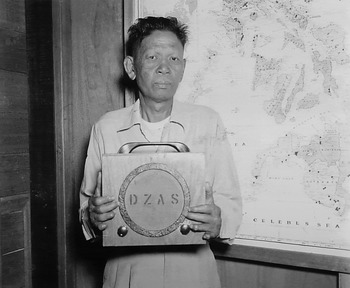
An early PM model distributed at the main office in Manila to Feliciano B. Paano, a Christian leper and writer from the island of Palawan. Note the map in the background, indicating the location of PMs in the archipelago.

Distribution of PMs proved an enormous logistical challenge for FEBC. The shortage of station personnel and limited stock of receivers, coupled with the lack of commercial distribution channels in the Philippines, forced FEBC to develop its own in-house distribution methods. The PM department utilized preexisting missionary networks, developed new partnerships with local evangelists and national church workers, and deployed its own indigenous staff intensively. FEBC placed its first radio receiver pre-tuned to DZAS in the field in March 1949, less than one year after the station commenced broadcasts, concentrating receiver operations initially in Luzon and the Central Visayan and gradually expanding south into the Mindinao islands. Staff member Jose Abello took the first PM back home with him to Capiz, Panay. Free Methodist missionary John Slosser took the second PM to his post in Agusen on Mindanao. The travels of Rev. P. Castro, a type of latter-day circuit rider, typified the work of numerous Filipino pastors for the station. Castro carried ten “traveling radios” on horseback during a fourteen-day tour of isolated mountain barrios in Bauguen in the province of Ilocos Sur. Rev. Isobelo Montejo, a staff worker in the PM department, undertook one of his first of many PM tours of Isabela Province, covering twelve towns on foot in eight days in mid-1952. A Filipino evangelical barely five feet tall, FEBC publicity described Montejo as “a small but victorious Christian soldier” on “a solitary mission from Christian radio city Manila” to the front lines of a “final life or death struggle in Asia.”Footnote 73 Montejo's report of his travels, publicized in the August 1952 edition of the Far East Broadcaster, highlighted how his trip effectively combined distribution and maintenance of PMs with traditional street preaching and evangelism. In all, at a cost of fifty-four pesos (twenty-seven dollars), Montejo contacted twenty set holders, replaced six dead batteries while returning three sets for replacement and accepting orders for new PMs, oversaw forty-five conversions, and enrolled sixteen students in a Tagalog Bible school in a notably productive visit.Footnote 74
FEBC placed PMs in strategic public locations in order to increase their visibility and maximize their broadcast effectiveness. Missionary broadcasters built here on colonial precedent. Beginning in the 1920s, US colonial authorities used receiver license fees to purchase radio sets, which they placed in public places such as municipal squares in order to disseminate government information from Manila to remote island locations. PM staff selected its public locales carefully, including “schools, prisons, hospitals, churches, and former Huckbalahap [Communist] resettlement areas.”Footnote 75 FEBC targeted groups that were physically, culturally, or organizationally isolated from the main Philippine population and who lacked radio reception. FEBC succeeded in placing PMs in the new Bilibid prison (south of Manila), where it was relayed over the PA system to six thousand prisoners. Following a personal request from the provincial governor of Sulu, FEBC also sent a PM to the provincial prison on the island of Jolo.Footnote 76
FEBC also sent PMs to main hospitals and clinics, leprosariums, and government settlement areas for captured Huckbalahap rebels (Huks). Sr. Crews, a psychological warfare officer in the Philippine Department of National Defense, offered to extend the offices of the National Defense Department in distributing up to ten thousand radios in the country.Footnote 77
The PM department geared distribution of pre-tuned receivers to the small niche audiences of indigenous communities located in remote areas of the Philippines. FEBC's use of pre-tuned PMs among indigenous communities showed how FEBC broadcasters partnered with mission agencies and carefully integrated reception with language production and program transmission. In the Mindinao islands, FEBC coordinated its PMs with production of language broadcasts by the C&MA Ebenezer Bible Institute in Zamboanga City. In 1956, building on the work of New Tribes Mission, FEBC placed twenty-five PMs among the “savage and head hunting Ilongots” in various villages in Pugo, Maddela, and Nueva Vizcaya, with the goal of establishing local churches.
The station later made similar efforts to reach the Moro peoples and Dumagat tribesmen through radio, connecting battery-powered reception on pre-tuned radios with broadcast transmission of vernacular programs on specific station transmitters and frequencies.Footnote 78 Pre-tuning thus fixed not merely a frequency, but a relationship between reception and numerous broadcasting elements, including transmission on different wavelengths and frequencies, tribal languages, and programs in order to maximize the effectiveness of broadcasts for indigenous tribal audiences. When Isabelo Montejo retuned to Nueva Vizcaya in 1966, he reported that the Ilongots had laid down their arms and that many had been “directly or indirectly brought to Christ through the Ministry and influence of [the] PMs.”Footnote 79
FEBC widened the impact of its relatively small number of PMs through not only strategic placement and coordination of reception, but also the promotion of collective radio listening. The Philippines had extremely low per capita radio ownership, yet nearly one-quarter of people without radios listened in once a week on a group basis.Footnote 80 The Radio Control Board of the Philippines calculated that the country averaged 22·5 persons per radio set.Footnote 81 FEBC took several carefully gauged measures to ensure collective listening of its radios: PM staff offered PMs free of charge, carefully selected PM holders, and restricted PM usage. FEBC sought initially to place PMs in the care of “responsible natives,” particularly Filipino evangelicals and village pastors.Footnote 82 An early publicity photo depicted Assistant Station Manager Max Atienza explaining to two Philippino users, Modesto Buta and Demostones Cenit, “the responsibilities connected with being entrusted with the PM.” Buta and Cenit then took the radio back to their village of Malibog on the island of Cebu.Footnote 83 FEBC's staff imposed a conditional “PM Loan Agreement” on set holders, who consented orally “to fulfill certain conditions of usage.” The station agreement stipulated that a borrower could turn on a PM only for group audiences and that the radio holder had to “invite other people to listen.” In addition, the PM department designated its radios exclusively for villages because communal listening habits were strongest there.Footnote 84
Ilongot tribesmen with a PM, 1961.

As a result of station measures, FEBC estimated the size of their group PM audiences from thirty to two hundred listeners for a single radio receiver over a month's time, with occasional figures as high as two thousand and even 4,500.Footnote 85 Regulation of pre-tuned radios for collective listening at the village level could be highly effective. Broger gave public accounts to American supporters of large numbers of conversions that took place because of PMs, since they could attract two hundred to five hundred people over an extended period of time.Footnote 86
A PM in a local barrio of five hundred people on the mainland of Luzon. The radio accounted for at least two conversions and was featured in the Far East Broadcaster (Feb. 1954).

To extend collective listening as well as increase formal oversight over PMs, FEBC established community radio clubs (“PM Clubs”) throughout the Philippines.Footnote 87 PM staff sought to select “DZAS PM Club captains” from its list of evangelical Christians. Club captains traveled to the Manila compound to receive training and instruction, before returning to their barrios with PMs in hand.
Captains were given important organizational duties, which included overseeing the proper operation of the community radio, maintaining set care, recruiting club members, conducting evangelism, collecting money, and reporting monthly to the station. Bowman reported that the PM Club captain did not have to be a Christian, but it is probable that the occurrence of non-Christian captains was relatively rare in the Catholic Philippines, where it was dictated by the demands of geographical remoteness. Bowman was careful to justify the selection of a non-Christian to a fellow evangelical leader by highlighting the results that followed from the action: the captain was converted, organized a neighborhood church (with sixty-seven converts), and successfully evangelized his home province. The captain had to prove “diligent in inviting neighbors” by placing a large sign outside the door (“DZAS PM Club everybody welcome!”) and then had to actively encourage listeners to respond to FEBC's evangelistic radio programs.Footnote 88 To help pay for the ongoing cost of radio batteries (which now lasted on average six months, due to advances in transistor technology), the captain collected club dues of one peso per month from members. Finally, the PM Club captain had to report monthly to Manila on several topics, such as reception conditions, the total number of monthly listeners, and incidents of conversion, thereby enabling the “PM national office” to monitor the effectiveness of its radios in the field.Footnote 89 Ubaldo Sable in Barrio Buenavista, Santiago, Isabela Province, acquired a radio in 1954 and was not an untypical PM Club captain. When station personnel visited her five years later, her husband and forty other village members had reportedly converted and the barrio was stockpiling materials to build a chapel, hoping to hire a full-time pastor.
FEBC had simple and effective means of enforcing compliance with club duties. If the PM Club captain did not abide by the agreed terms with the station, he or she faced recall of the set – a serious consequence in light of the country's extremely low per capita radio ownership level.Footnote 90 PM Club reports indicate a high degree of enforcement of collective listening. Captains reportedly used roughly half of their sets to invite neighbors; they also conducted open-air meetings, placed sets in marketplaces, and employed PMs in churches, while indulging only a tiny fraction of community radios for personal pleasure.Footnote 91
In addition to collective listening, FEBC capitalized on the placement of PMs in remote rural settings to enhance their effectiveness. The arrival of a PM in a barrio was a major event in the life of the community, since almost all villages lacked electricity, connecting it with the outside world. In 1952, Broger produced a photo essay and 16 mm promotional film of the delivery of a PM into a rural barrio, staging a triumphal entry of the receiver that was carried shoulder-high as a treasured prize in a parade-like procession, in order to show evidence of the PM's popularity for American supporters. FEBC also took advantage of the media properties of radio to increase the attractiveness of broadcasts to local audiences. The aurality of radio, which gave FEBC programs a personal voice and imminent presence, appealed to illiterate and preliterate groups in the Philippines.Footnote 92 Radio receivers also possessed strong aesthetic appeal in prescientific cultures. According to missionary reports, local audiences in the Philippines experienced a sense of wonderment when they first encountered radio, connecting the physical artifact with the spiritual realm. One account from the Far East Broadcaster in 1950 describes the impact of a PM: “It brings wonders to the people. They said ‘God is inside the Radio receiver.’”Footnote 93 Broger listed as the selling points of PMs to his American audiences that they aroused great popular interest. People in the Philippines became fascinated with the radios because they could understand programs in their own language, attributing their distinctive power to the divine and saying “God's in the box.”Footnote 94 FEBC also deliberately benefited from the distantiating capabilities of radio, which particularly impressed preindustrial peoples. A letter writer recounted in 1950 how one indigenous group in the Philippines greeted radio: “[the mountain people] are wondering how wise the inventor of the Radio [is] that we can hear the voice in America and also in Manila,” as well as the city of Jolo in the southwestern province of Sulu.Footnote 95 A Filipino letter writer in 1950 from the barrio of Piaz in the town of Villasis on Luzon described the wonderment of a group of two hundred PM listeners at radio's ability to span the globe, noting that “the listeners were surprised how the little receiver is rendering a great service in bringing the whole world the words of God.”Footnote 96 Thus FEBC missionaries took advantage of the aural, aesthetic, and electromagnetic properties of PMs, as well as their novelty, to exoticize the medium and enhance the appeal of their message.
A typical DZAS PM club in the home of Ubaldo Sable in barrio Buenavista, Santiago, Isabela Province (1959).

FEBC's in-house production quantities of PMs could not keep pace with growing demand from a radio-starved Filipino public.Footnote 97 FEBC therefore supplanted internal efforts by purchasing finished sets from an exclusive commercial supplier: the multinational firm Philips Electronics.Footnote 98 Philips manufactured pre-tuned radios in the Netherlands, which it sold worldwide for rural community education.Footnote 99 Reflecting the emergence of a global transistor radio market, cheap commercially produced pre-tuned radios allowed FEBC to expand its community radio club network in the Philippines during the 1960s. By August 1969, FEBC established over 1,650 PM radio communities, nearly 70 percent of which employed pre-tuned Philips transistor radios. At its peak, FEBC had pre-tuned radio clubs on thirty-five islands and in all of the Philippines’ sixty-seven provinces on all four FEBC shortwave transmitters and in eight different language areas, with a reported monthly audience of nearly 27,500 people.Footnote 100
Local use of pre-tuned radios by evangelical missionaries was not restricted to the Philippines, but spread throughout the global South. FEBC distributed radios in Okinawa and, following its move into South America, placed numerous PM radios in rural Mexico.Footnote 101 Mission agencies placed over eight hundred PMs on FEBC's behalf in Thailand, Japan, Indochina, Formosa, and other South Asian countries. American missionary stations around the world, including HCJB in Ecuador and ELWA in Liberia, distributed radios in the thousands during the postwar period in an effort to address receiver shortages in their respective countries. From 1956 to 1959, conservative evangelical engineers and broadcasters based in Chicago organized a “Missionary Transistor Receiver” project to custom-design and mass-produce a transistor radio for the mission field, eventually supplying six hundred “Villager” radios to missionary users around the world.
Two interrelated worldwide political and technological developments brought about the end of missionary use of pre-tuned radios: decolonization and the emergence of a worldwide consumer electronics industry. Political independence in Asia and Africa and the establishment of national broadcasting services produced mounting pressure from postcolonial audiences for commensurate listening freedom on the radio dial. Freedom of reception was facilitated by the growing global stock of transistor radio receivers. Whereas 180 million receivers existed worldwide in 1950, the number exploded to 906 million receivers by 1970, though well over two-thirds remained concentrated in Europe and the Americas.Footnote 102 The growth of the transistor radio market entailed the retrenchment of missionary radio receiver departments, as inexpensive radios began to reach remote areas of the global South. In the Philippines, improvement in communication infrastructure, the advent of cheap transistor radios, and the spread of Western-style individual listening habits rendered FEBC's receiver department obsolete by 1970, creating a new highly competitive commercial media environment. Missionary radio stations closed down their in-house receiver departments, including their proprietary purchasing, distribution, and maintenance operations. In Liberia, in recognition of the dawn of a new era of listener autonomy in postcolonial Africa, evangelical station ELWA conducted its first listener surveys and adopted a more audience-centered approach to programming, experimenting with contemporary music styles and program formats. Closure of receiver departments coincided with the broader movement during the 1970s to indigenize (or internationalize) foreign missions, as broadcasting organizations ceded increasing control over station operations and management to foreign nationals. The end of proprietary reception, therefore, meant the end of a particular era in missionary broadcasting. Henceforth, a more complex global dynamic emerged between home and field. While national leaders oversaw day-to-day running of stations and arranged local program production, American officials continued to raise financial support in the USA, provide significant executive direction, and supply a steady diet of syndicated American religious programming.
CONCLUSION
During the twentieth century, American evangelical missionary broadcasters integrated conservative religion with state-of-the-art communication technology on a global scale, beginning in South America and spreading to all the major regions of the world after 1945. American missionary radio broadcasting was borne of a complex mixture of conservative reaction and expansionist opportunism. Under the influence of premillennial theology and an American confidence in technology, evangelicals responded to two major crises in the twentieth century by embracing radio broadcasting, first at home and then abroad. The climax of the confrontation with modernism in the 1920s encouraged evangelicals’ initial move into domestic broadcasting, precipitating the establishment of the field of missionary radio abroad a decade later. Faced with a world crisis after World War II, conservative evangelical missionaries turned to radio as a divine provision that, despite the grim odds posed by exploding Third World populations and rapidly rising world religions, would allow fulfillment of the Great Commission and expedite the return of Christ to earth.
Missionary broadcasters like FEBC viewed broadcasting technology in highly spiritualized terms, shaped by premillennial expectations. FEBC's directors did not view the airwaves as an inert ether, but as a spiritually charged medium, the realm of Satan, Prince of the Air, as well as the “Airway of Salvation.” Radio broadcasting, therefore, did not merely supplement missionary activity, but operated as an indispensable weapon in the spiritual battle of the twentieth century – the “AIR ARM of the Missionary Effort.”Footnote 103 Because FEBC's directors viewed radio receivers as spiritual instruments – “Ambassadors of the Gospel” and “emissaries of God” – they had little difficulty in restricting them to single frequencies. John Broger called pre-tuned PMs “the most sanctified missionaries you'll ever meet – they don't do anything but preach the gospel.”Footnote 104 FEBC staff developed affection for their “Portable Missionaries” – they brought mass media to the mission field, mechanized the process of radio reception, and reduced the traditional labor-intensive missionary requirement of face-to-face evangelism, dramatically improving evangelical productivity during the postwar period.
FEBC's portable-receiver department demonstrated in microcosm the dynamics of American evangelical communication during the twentieth century. Evangelical organizations such as FEBC showed initiative and imagination in their broadcasting operations overseas, as they had at home. Evangelicals first identified the receiver problem in the global South after World War II, formulating a practical response in comprehensive, instrumental terms: how to design, produce, distribute and maintain radio receivers in underdeveloped markets and harsh tropical climates in a way that maximized broadcasting effectiveness. FEBC tackled the problem of reception creatively, forming partnerships with mission societies, national station staff, and local church workers that redefined missionary activity in a postcolonial setting as a form of indigenous collaboration. Yet FEBC's innovation-in-use also cast a more disturbing shadow. Innovative activities in the area of reception during the postwar period perpetuated a set of traditional social relations and proprietary attitudes carried over from the colonial missionary era. FEBC's managers benefited from the underdeveloped receiver market in the Philippines prior to 1970 and sought through a limited form of technical control (pre-tuned radios) to define Filipino nationals as collective missionary subjects rather than as autonomous listeners and independent, postcolonial agents. FEBC missionaries sought to benefit from America's global network of strategic assets after 1945 to construct an “informal empire” of influence.Footnote 105 If proprietary reception efforts fell short by the 1970s in the face of the indigenous movement in missions, evangelical influence persisted in more hidden ways in the framing of an Americanized Gospel built around entrepreneurial initiative, commercial funding, and technological power.
Unsurprisingly, the PM phenomenon reemerged in altered guise at the end of the twentieth century during the era of contemporary globalization. Despite extensive deregulation of the worldwide telecommunications industry, the major evangelical broadcasters once again promoted closed radio reception overseas. Paralleling their altered role in overseas broadcasting and in line with greater listener autonomy, however, evangelical organizers made no effort to control local receiver operations as they had in the missionary era, including radio distribution, maintenance, and usage. Instead, during the new global era, parachurch broadcast organizations in the USA focussed on fund-raising. Innovations in design for solar and hand-cranked radios obviated the chronic need for battery replacement, which had previously crippled radio expansion efforts. Galcom International, a small company organized in Israel by three North American businessmen, has produced and distributed nearly a million solar-powered, fixed-tuned “Go-Ye” radios to Christian radio stations around the world since 1989. HCJB Global (now Reach Beyond) sent 50,000 pre-tuned, solar-powered “SonSet” radios over the past decade at a cost of thirty-five dollars apiece to listeners in more than two dozen countries. TWR's “Radios for the World” campaign actively promotes sponsorship of similar radios for various language groups in Central and South America, Central Asia, Southeast Europe, and sub-Saharan Africa. In 2012, FEBC received 15,000 requests for radios, organizing a “Give a Radio” campaign for supporters to sponsor thirty-dollar transistor sets and eventually distributing 12,000 receivers overseas.Footnote 106 Like World Vision's use of the faces of orphans and hungry children in publicity material, radio sponsorship campaigns provided potent images of radio audiences that were easily instrumentalized for fund-raising by playing on the asymmetry of power between donors and indigenous “receivers” and then materializing solutions.Footnote 107 Campaigns to subsidize inexpensive, fixed-tuned radio receivers in the global South clearly hold strong appeal for both evangelical broadcasters and the rank-and-file churchgoers who finance them. The continued popularity of pre-tuned radios among the American evangelical public well into the new century attests to their ineradicable faith in the power of communication technology to carry out the task of global evangelization, as well as their conservative proclivity for containing the forces of global change.