Introduction
Archival professionals and scholarly editors have long adopted duplication strategies in developing methods for supporting access to original source materials in their surrogate forms. Photographic processes and editorial methods deployed in reproducing original source material contribute to the creation of surrogate collections in form of microfilm, printed documentary and facsimile editions, and more recently, digitized collections and digital editions.Footnote 1 Access and communication are supported through acts of copying, which produce objects that represent and communicate aspects of the originating materials.Footnote 2
The adoption of these practices is not limited to individuals practicing within the traditional curatorial and editing professions. Book artists often engage and publish original source materials in their works, which similarly support access beyond the originating source. This paper offers an examination of selected books that, in their content and function, communicate archival and documentary evidence. An archival reading of book art draws attention to how book artists participate in the shared practice of disseminating original sources through the creation and publication of artefactual representations.Footnote 3
In identifying these similarities and making this comparison, it is important to remain sensitive to the originating intention of an object's creator. Though evidential and informational characteristics can be read in archivally informed book art, works of this type should not be strictly reduced to these elements. However, the representational and containment functions are similar, and it is possible to read works of book art in terms of their evidential and informational characteristics; artistic values are supplemented by archival values.Footnote 4
Functional similarities: Book art, curation, and documentary editing
Books that present original source materials are curated works. The presence and absence of documentation, and the material, structural, and aesthetic characteristics of its published form, are informed by the artist's evaluation of a body evidence and communicative intention.Footnote 5 Andrea Kohashi argues that book artists bring to this process an added sensitivity to how material elements communicate information.Footnote 6 The archival environments that book artists create can be read as documentary spaces that communicate archival and documentary forms.Footnote 7 Read from an archival perspective, this shared function links the construction of artist books informed by archives with traditional forms of archival creation.Footnote 8
Parallels can also be found with documentary editing. Documentary editing is a scholarly craft concerned with supporting wider access to primary source material through selection, transcription, annotation, and publication.Footnote 9 Through this documentary translation, the contents of archival records can be more widely distributed through the dissemination of print and digital representations in published editions of archival documentation.Footnote 10
Book artists drawing on cultural, historical, and ecological documentation as their source material engage in similar publishing strategies.Footnote 11 These works represent a category of book art that can be described, on the basis of their contents, as archival.Footnote 12 This evaluation demonstrates how text, image, structure, and materiality inform the presentation of original source materials.Footnote 13
Book art, containment, and representation
The books introduced here address distinct subjects, and are materially unique, but are categorically joined by shared evidential characteristics. Each present original source material to be read, and because of this function, can be viewed as representational, archival, and documentary in their character, function, and form. Their contents include environmental, historical, and community records.Footnote 14
As a means of categorization and discussion, I use the term/category, archival book art.Footnote 15 This typology is informed by the work of art historian Hal Foster and the archival studies scholar Kathy Carbone.Footnote 16 The art historian Hal Foster defines archival art as concerned with making ‘historical information, often lost or displaced, physical present’.Footnote 17 Archival art also offers a comment on original sources themselves, drawing attention to the ‘nature of all archival materials as found yet constructed, factual yet fictive, public yet private’.Footnote 18 The archival studies scholar Kathy Carbone re-examines artistic practices, and objects, through the application of archival theory, illustrating how artists working with records ‘employ critical-aesthetic strategies to records in order to reconsider historical narratives, expose missing or silenced voices, interrogate modes of representation, or investigate relations between official and personal memory through art-making processes and works’.Footnote 19 Professor Johanna Drucker demonstrates how book artists engage in this archival critique in an examination of artist's books as documents, including their presentation and creative reformulation of archival forms and evidence.Footnote 20 This paper further extends their formulations, examining how book artists have engaged archival evidence.
The works placed in this category share common traits. Their contents feature primary source material. The book art structure serves as a mechanism for disseminating archival evidence.Footnote 21 Particular production and creative choices are reflected in the crafted records. These works provide the reader with printed copies of unique materials, disseminated in the form of book art.Footnote 22
Examining book art as a structure for supporting engagement with original sources provides a context for considering how the characteristics of bibliographic spaces inform the reading of original sources.Footnote 23 Andrea Chemero, Caroline Seigel, and Tenie Wilson note that artists’ books, as information objects, ‘push the boundaries of traditional reading while maintaining the intimate relationship that a book fosters between object and reader’.Footnote 24 What is read? How does book art, considered as an archival and documentary strategy, generative process, and environment, inform the character of sources that are reproduced through these procedures?Footnote 25 Critiquing book art from an archival perspective permits a comparison of how these works operate as evidence alongside traditional collecting repositories and scholarly editions, and engage readers. This critique also considers the place of book artists within the ecology of archival knowledge creation, taking into account how, as stated by Risa Horowitz, their work ‘complicates the way that the creative and the scholarly have been held and continue to be held at a distance from each other’.Footnote 26 This essay is an attempt to reduce this distance.
Cases of archival book art
These concerns are investigated through a close reading of three works by Christopher Davenport, Karen Hanmer, and Sara E. White.Footnote 27 Their books present distinct archival forms and expressions, and express particular material characteristics, evidences, and subjects. Each illustrate distinct methods for engaging and communicating original source material through book art.
Reproducing environmental records
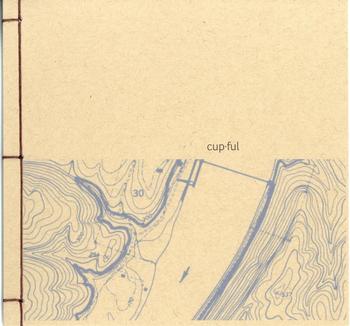
Christopher Davenport's Cupful is an examination of the ecology of Alabama's Black Warrior River and its relationship to community.Footnote 28 The Black Warrior River has been identified as one America's most endangered rivers due to the effects ‘agricultural, municipal, and industrial pollution’.Footnote 29 Hand papermaking and photography are deployed as record making systems, which generate documents Davenport uses to record the river and its ecologies. In doing so, he creates an environmental archive that serves as a vehicle for considering environmental consequences.Footnote 30 This book functions as a form of environmental criticism.Footnote 31
Cupful consists of two volumes: CUPFUL/paper and Cupful/photographs. CUPFUL/paper presents the Black Warrior River through hand papermaking. Cupful/photographs contains prints of Davenport's original photographs that document ‘sensitive and declining areas’ of the river.Footnote 32 These volumes operate as curated collections of environmental records; each presents distinct types of documentary evidence. CUPFUL/paper is described as a ‘water sample’.Footnote 33 In Davenport's words, the book functions as an ‘ecological action and record through collection and sample’.Footnote 34
Cover of Christopher Davenport's Cupful. Image courtesy of Christopher Davenport.

The material characteristics of Cupful, created through hand papermaking, photography, binding, and printing processes, influence the presentation of evidence, and the format of the representations. CUPFUL/paper is a stab bound book made up of primarily unprinted leaves of handmade paper.Footnote 35 These papers were made from water collected at critical river sites.Footnote 36 The book was bound using ‘cord/threads/fibre found at [these] locations’.Footnote 37 Its leaves are composed of ‘handmade reclaimed cotton/linen paper made with water collected from sensitive and declining areas of the Black Warrior River in Alabama’.Footnote 38 The river is framed as an original source that contains evidence of humans engagement with their environments. Hand papermaking serves as a method for generating documentary forms capable of expressing this information. Colours, smells, and particulate variations detected on each leaf reflect the variations of each documented site.Footnote 39 Hand papermaking is deployed as a translation activity. Davenport's papers present what was capturable. The reader is not viewing the river, but they are viewing records that it generated, perceiving what hand papermaking/handmade paper could capture and communicate.
Cupful/photographs supports access to photographic records that provide contextual information through visualizing the sites recorded in CUPFUL/paper. Reading Cupful/photographs alongside CUPFUL/paper provides the experience of reading a multifaceted environmental archive; the handmade papers and photographs provide access to distinct genres of records.Footnote 40 Cupful is a strategy for translating a complex set of relationships and environments into a tangible biblio-archival form, a collection of physical records generated by hand papermaking, photographic, and printing practices. Cupful demonstrates how original sources can be considered and represented using craft methodologies. A reader concerned with investigating the integrity of the Black Warrior River can review peer-reviewed scientific studies, governmental data, or reports issued by environmental advocacy organizations.Footnote 41 Cupful exists alongside, and augments, these traditional data sources.
Reproducing historical sources
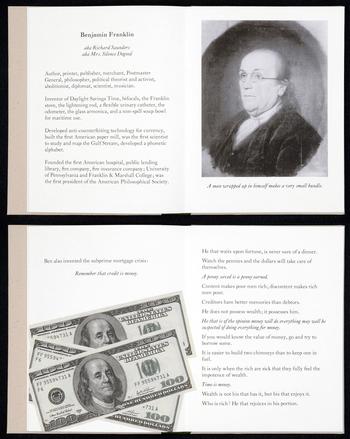
Karen Hanmer's, Franklin fatigue: Reflections on life, liberty, fortune and romance by America's founding father and Philadelphia's favorite son, introduces Benjamin Franklin's scientific, literary, and political contributions, and popular depictions of his image.Footnote 42 Hanmer ‘combines portraits and proverbs’, and presents Franklin the political figure, diplomat, scientist, and writer.Footnote 43 Hanmer gathers biographical information, quotations, and visual depictions that document Franklin's popular image and societal influence. Read as a repository, Franklin fatigue communicates representations of documentary sources, including paintings and prints, excerpts of written works, and the title page of Franklin's pseudonymously published, Poor Richard's Almanac (1733).Footnote 44
Folio images of Karen Hanmer's, Franklin fatigue: Reflections on life, liberty, fortune and romance by America's founding father and Philadelphia's favorite son. Images Courtesy of Karen Hanmer.
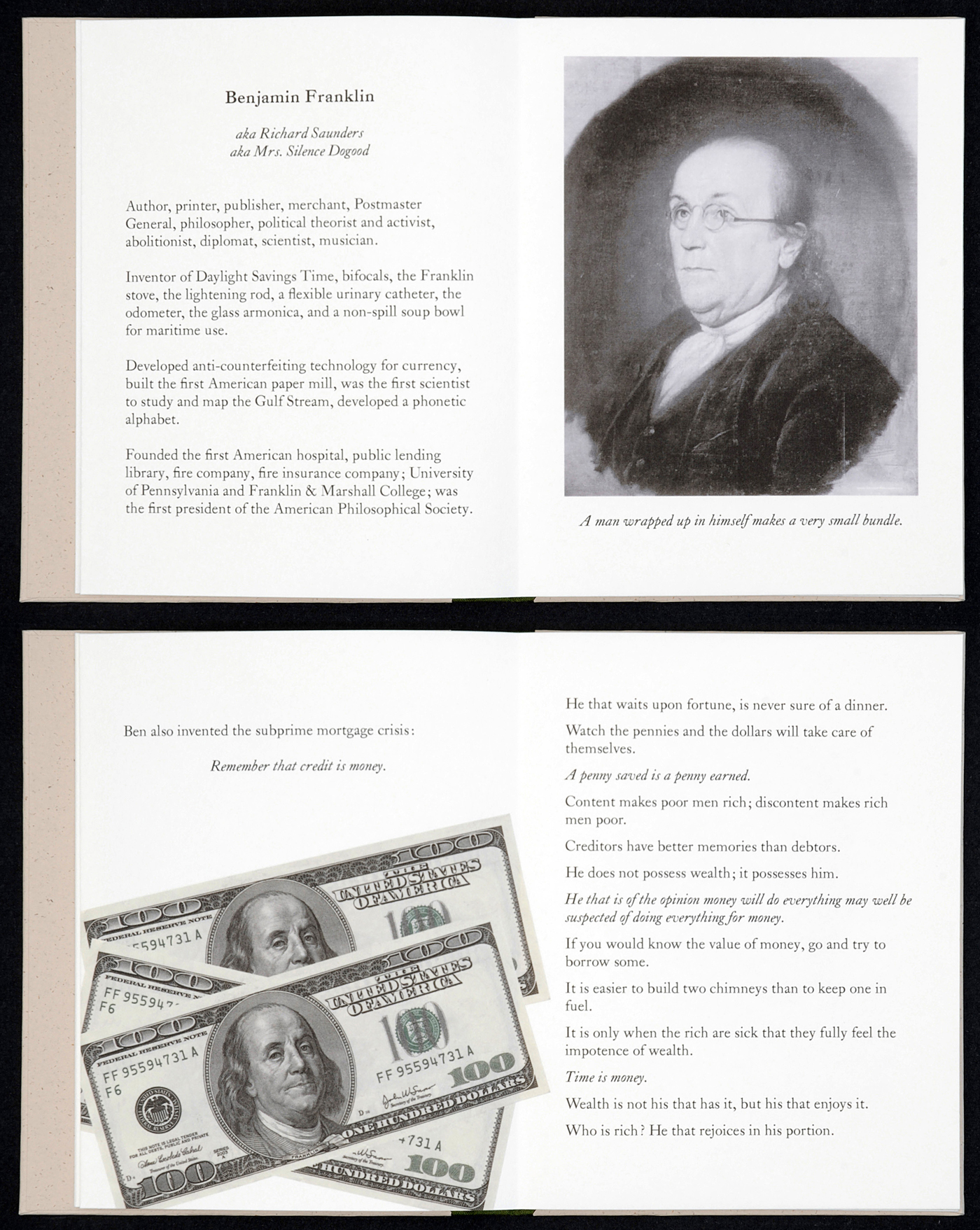
Printed records are housed within the structure of a handmade book. Their potential readings are influenced by Hanmer's curatorial, aesthetic, and constructive choices. Franklin fatigue can be read as an art object, but its contents also provide access to historical evidence. The artefacts represented can be found in museums, archives, rare book libraries, digital collections, and in published scholarly editions. Considered in relation to other works that gather Franklin material, the book serves as a particular environment for reading original source materials.Footnote 45 Franklin fatigue operates as a particular “derivative archive.”Footnote 46 Franklin narratives are communicated through artifacts.Footnote 47
Because of this function, there are similarities between Franklin fatigue and scholarly editions that contain similar Franklin material. However, despite these documentary similarities, it is important to recognize the differences between Franklin fatigue, an artistic presentation of historical documentation, and documentary editions that are purposely constructed to support scholarly investigations. However, both exhibit similar traits. Intellectually related, but physical dispersed material, is gathered according to Hanmer's curatorial and editorial intentions.Footnote 48 Franklin fatigue enables a consideration of how artistic, archival, scholarly practices relate to one another, and how works that exist at the intersection of these categories operate as information objects. The work can be read as an artistic, material, and evidential object. Hanmer demonstrates how book art, as a process, can support creative engagements with historical sources.
Communicating community documentation
Sara E. White's RIVERINE is ‘a fragmented essay about a riparian landscape in New Orleans, LA called the “batture.”’Footnote 49 White explores themes relating to landscape, environment, community, and memory. Through the inclusion of archival evidence and information, elements of a locality are documented and communicated, including its geography, community, and socio-political context.Footnote 50 The delivery of the work's content, and its representational function, is strongly informed by the book's structural elements. In describing the relationship between content, structure, and narrative, White states:
accompanied by letterpress printed imagery and textures of industrial structures and nature that inhabit this landscape located between the man-made levee and Mississippi River along the margins of the city, the book's text shifts and flows with each page-turn.Footnote 51
Content and structure operate as evidence and information, further representing the locality recorded in textual and visual elements.Footnote 52
A memory function can be read in RIVERINE, one that is explicitly assigned by the author.Footnote 53 The book ‘pays homage to communities that have existed on the batture in homes on stilts throughout history and the liminal experience of living in a place that is neither water nor solid ground, undefinable and always changing’.Footnote 54 In archival terms, RIVERVINE is a community record, offering local evidence through contextualized printed records in a book art structure.Footnote 55 White's work contributes to the preservation of the experiences of communities living on the batture, and represents the landscape itself.
This archival content is mediated through the artist's interviews, archival research, and direct experiences of meeting with community members and viewing the landscape.Footnote 56 Included in the book are original source materials contained in an archival collection. In printing selected records, White draws attention to individual archival items, but also to the existence of a larger body of related batture archival evidence. These documents include photographs, pamphlets, interview excerpts, complemented by White's original artwork, essay, and book structure. Readers engage with original sources they might not have encountered. As an information structure, RIVERVINE amplifies the communicative power of these artefacts by supporting viewing beyond their originating forms, containers, and institutions, through White's specific acts of contextualization and description.Footnote 57
Read archivally, White's book is a collection of documentary content. Batture records exist alongside White's visual depictions and narrative descriptions. Archival reception is influenced by the book's design and constructive choices, which informs when and how archival elements of the book are read.Footnote 58 Structure, discussion, description, and analysis contextualize the experiences recorded by the documentary evidence. These printed records contribute to the narrative of the book, but they can also be read singularly as archival objects, with White's art and writing operating as a form of archival description.Footnote 59 These archival representations can be read outside of the boundaries of the original artefacts, memories, and collections where they reside. RIVERVINE is an artist's book that functions as a unique archival space and reading environment.Footnote 60
Conclusion
This paper argues that works of book art, which contain published documentary representations, fulfil archival and editorial functions by providing wider access to original source material. Book artists that engage archives create book art that supports the broader dissemination of archival evidence through the construction of particular bibliographic spaces for reading documentary works.Footnote 61 Two immediate questions emerge. First, as generative practices, how are surrogates crafted and presented through book art distinct from more traditional representations of sources? And second, what reading and viewing experiences can these particular representations offer, based on the communicative affordances of book art?Footnote 62 Addressing these questions can support a discussion of how book artists contribute to the collection, preservation, and dissemination of records, archives, and cultural heritage. And secondly, how this function can be better articulated, and collaborations with curatorial and editorial professionals, supported.
The works of Christopher Davenport, Karen Hanmer, and Sara E. White support readings of original source material, influenced by their specific configurations of material, evidential, aesthetic, and narrative elements.Footnote 63 Their books function as instruments of containment, representation, and communication.Footnote 64 Each encourage discussions of the dynamics of how representations are constructed, contained, presented, and received. In expressing archival and documentary functions, archival book art provides a site for reflecting on the relationships that exist between original sources, the methods adopted in created published representations, and the factors that inform our assignment of evidential and informational characteristics.Footnote 65
Acknowledgements
This paper was originally presented at the Livres d'Artistes: The Artist's Book in Theory and Practice meeting held at Cardiff University in December of 2015. The author wishes to extend his sincerest thanks to Professor Bill Bell (Cardiff University) and the meeting organizers.