April 21, 1771, brought unusual weather conditions, namely a springtime blizzard, to the Swabian town of Göppingen. We know this because the worsted-wool weaver Ernst Jacob Vayhinger wrote about it in a chronicle that he kept from 1756 to 1784. His exact words were, “The weather is also quite something. I have a barometer, which indicates the clearest weather today, and yet it is snowing so badly. The same thing happened a year ago. As the upper wind brought rain, it [the barometer] was instead showing nice conditions, and the rain was freezing cold.”Footnote 1 While the vivid description of inclement weather certainly catches the eye, the presence of a barometer in this weaver's household in 1771 stands out even more. In fact, this weather-based technology was barely a century old in the latter half of the eighteenth century, having been invented by Evangelista Torricelli, an Italian mathematician, in 1643. To be sure, Vayhinger's malfunctioning barometer was almost certainly a water-filled glass instrument rather than the more precise mercury-based instruments of early-modern natural philosophers, but what matters here is that Vayhinger had a relatively new, ornamental wall hanging that indicated an awareness of new scientific principles. And, as this article will show, he was not at all the only one to acquire such novelties in this hometown full of Handwerker (artisans).
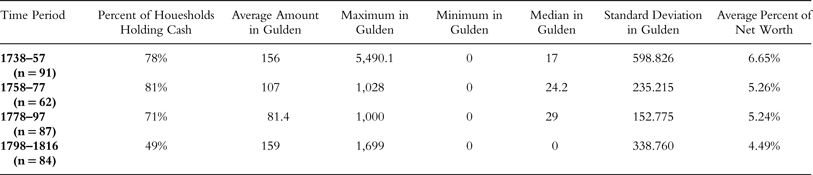
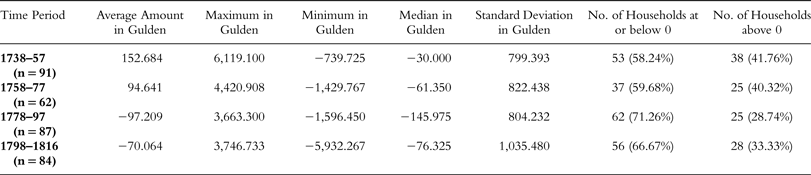
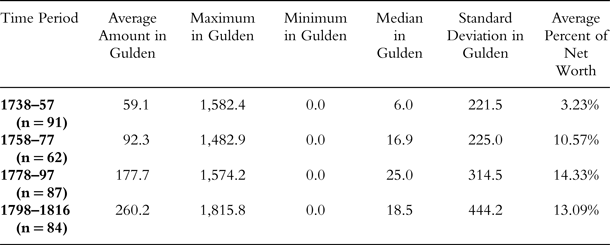
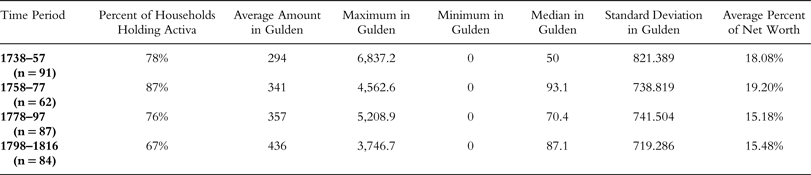
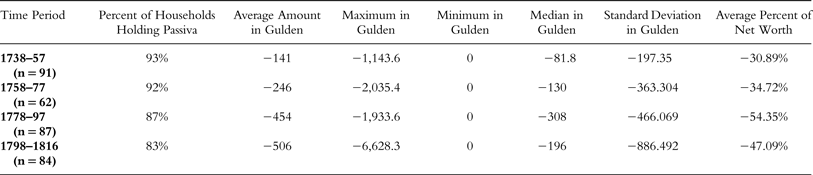
Indeed, a close analysis of more than 300 probate inventories and a handful of marriage inventories for artisan families from Göppingen clearly indicates that there were significant changes in patterns of wealth and consumption, and an intriguing mixture of continuities and changes in culture between the 1730s and 1816.Footnote 2 As the commercial activity in the town became more dynamic, the sources suggest that artisanal households became more cash- and credit-oriented (see Tables 1 and 2).
Cash Holdings by 20-Year Periods (1738–1816)

Sources: Stadtarchiv Göppingen, Inventuren & Teilungen.
Credit-Debt Balance (Activa-Passiva) by 20-Year Periods (1738–1816)
Sources: Stadtarchiv Göppingen, Inventuren & Teilungen.
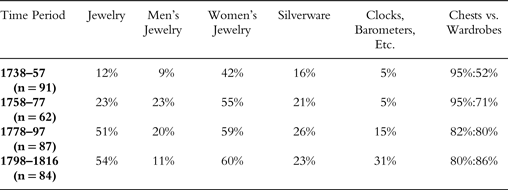
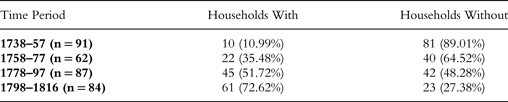
This economic dynamism brought opportunities and challenges to the artisans, thus fueling the growing disparity between the wealthiest and the poorest among them. Notwithstanding the divergence in their affluence, they adopted the novel fashions and behaviors as markets and consumerism expanded during the eighteenth century. They acquired, for instance, new clothing styles and materials, more elaborate household furnishings, and new tastes (especially for coffee and tea). Not surprisingly, some households found it economically easier than others to obtain these novel consumer durables that signaled a new attention to bourgeois respectability and civic affairs. Most of the artisanal households, however, moved toward a common set of trappings as shown by Tables 3 and 4.
Percentage of Households with Select Consumer Durables by 20-Year Periods (1738–1816)
Sources: Stadtarchiv Göppingen, Inventuren & Teilungen.
Coffee- and Teaware by 20-Year Periods (1738–1816)
Sources: Stadtarchiv Göppingen, Inventuren & Teilungen.
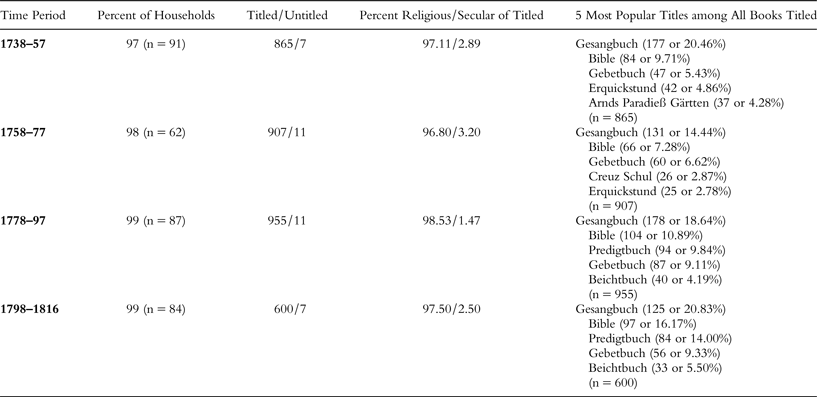
Interestingly, regardless of where they fell in the social spectrum, most of the craftspeople, as shown in Table 5, held fast to the Lutheran-Pietist literature that predominated in Württemberg during this period.
Book Ownership among Households and Five Most Popular Titles by 20-Year Periods (1738–1816)
Sources: Stadtarchiv Göppingen, Inventuren & Teilungen.
By analyzing the interplay and interrelatedness of these trends, this article will argue for a more nuanced understanding of socioeconomic and cultural change during the eighteenth century.
These trends suggest that the citizens of this town fit well the “early modern consumer” model as defined by Jan de Vries in his recent book, The Industrious Revolution: Consumer Behavior and the Household Economy, 1650 to the Present.Footnote 3 In this macroeconomic history of household economies, de Vries argued that the early-modern consumers of northwestern Europe and the British colonies of North America saw “a steady rise, generation by generation, of the number, range, and quality of material possessions.”Footnote 4 Starting in the late seventeenth century, these new consumer patterns, in particular the “broadened choice” and “the emergence of ‘incentive goods,’” brought fundamental changes to the organization of household economies, making many of them both more industrious and market-oriented.Footnote 5 To be sure, argued de Vries, this did not constitute a consumer revolution—that would not come until well after 1850—but these changes did produce “an ‘industrious revolution,’ a consumption-driven commercial phenomenon that preceded and prepared the way for the Industrial Revolution.”Footnote 6 At the heart of this argument is a careful and detailed synthesis of many disparate studies, ranging widely in not only geography and time period but also in discipline and theory.Footnote 7 For instance, when de Vries pointed to increased consumer demand during the long eighteenth century, he turned primarily to the work of scholars who study probate inventories, noting that these sources are quite rich when it comes to detailing the material culture of the “middling sort,” but are problematic because “their coverage does not extend far below” that social group.Footnote 8 This certainly is the case in those regions that formed the core of de Vries's argument about the industrious revolution (i.e., northwest Europe and the American colonies), but this is less so the case in the duchy of Württemberg. Here, “[u]nder the law code of 1567, all non-notable citizens in the duchy were required to have an inventory drawn up on each of three occasions.”Footnote 9 The first one came “within three months of every new marriage”; the second came at the death of one spouse; and the third came “when the second partner died.”Footnote 10 At each occasion, the scribes drew up detailed inventories of each person's entire landed and personal property, along with a monetary estimate of each item's value, and including any outstanding loans or debts. Thus, they effectively captured the total wealth of a household at its beginning and end. And, since these probate inventories (Inventuren und Teilungen) extended well into the nineteenth century, they have—where extant—provided historians and ethnographers/folklorists with an unparalleled insight into material culture and consumption over long stretches of time in this region.Footnote 11
Perhaps most notable among these scholars is Sheilagh Ogilvie, who has digitized approximately 9,000 marriage and probate inventories from three towns in Württemberg, dating from about 1600 to 1900. Ogilvie's ambitious project, called Human Well-being and the Industrious Revolution, investigates how consumption, gender, and social capital interacted and evolved in the developing economies of Auingen, Ebhausen, and Wildberg. And some of her findings even found their way into mainstream media, appearing in both the Boston Sunday Globe and Time.Footnote 12 Like de Vries, Ogilvie came at these sources with the eyes of a macrohistorical, economic historian, also deeply interested in clarifying our understanding of early modern socioeconomic change. Her work stresses multivariate statistical and cross-country analysis, comparing and contrasting developments in southwest Germany to those in the Netherlands and England. In her more recent publications, Ogilvie has convincingly argued that the traditional, nonmarket institutions, such as guilds, enabled certain male elites to wield their social capital to great effect in protecting their hegemony over economic capital in the late-developing economy of Württemberg. As stated, for example, in A Bitter Living, “it is no coincidence that the industrious revolution was delayed and dampened in those societies, such as Württemberg, where women were barred from many jobs and had their wages capped in others, reducing their incentive—and ability—to allocate time to income-earning work.”Footnote 13 And, in a more recent article from her current project, Ogilvie concluded that the “entrenched elites who perceived new work and consumption practices as threats” wielded their economic, social, and political might “particularly strongly against less powerful groups such as women, migrants, and the poor—central agents in any Consumer or Industrious Revolution.”Footnote 14 Her findings seemed to show that “many European economies—such as Germany [sic]—were much poorer and slower growing than the North Atlantic seaboard.”Footnote 15
My approach to similar questions stresses, on the other hand, the microhistorical, and in these efforts, I rely heavily on the sociological theories about structure and human agency as put forth by Pierre Bourdieu. Probably the most helpful of his concepts has been the notion that neither structure nor human agency triumphs over the other. Instead, as individuals interact with their social space, they rely on a system of dispositions, tendencies, and inclinations—in other words, a habitus—that not only helps them make sense of the world around them but also simultaneously to shape it. The systematicity of this “structured and structuring structure” for individuals reveals itself “in all the properties––and property––with which individuals and groups surround themselves, . . . and in the practices in which they manifest their distinction.”Footnote 16 Thus, argued Bourdieu, individuals use their possessions and behaviors as forms of not only economic capital but also cultural and social capital as they maneuver through—and frequently alter—their constantly evolving society. While not without flaws, this theory more closely resembles, in my mind, the muddled and contingent nature of human lives led than do theories that prioritize structures and institutions over agency, or vice versa.Footnote 17 Echoing this more nuanced approach to socioeconomic change, Frank Trentmann in a stimulating article about consumption as a historical category argued that scholars should move the discussion away from analytical models that focus too much on either “opposition (consumption versus production)” or on “sequence (consumer society after class society).”Footnote 18 Models such as these fail to capture “the ways and contexts in which historical actors have appropriated languages of consumption to make sense of their actions.”Footnote 19 Like Bourdieu, then, Trentmann argued for a more problematized approach to social change, one that avoids “ideal-typical constructs” presented as “holisitic, static and finished end-products.”Footnote 20
Attempting to address this issue in his macro-history, de Vries wrote at the outset of his study that most approaches to “historical consumer behavior” have left “little conceptual space for a history of consumer behavior located between the chaos of arbitrary individual impulses on one side and the remorseless push of overarching structural and institutional forces on the other.”Footnote 21 Here, in the murkiness of daily life, is where Bourdieu's theories are most helpful, because they enable us to get away from ideal-typical constructs and arguments about whether the artisans fit this or that model as they moved from one end point to another on some rigid developmental theory of modern economic growth. In Bourdieu's words:
It is not “decisions” of the rational will and consciousness or mechanical determinations resulting from external powers that underlie the economy of economic practices—that reason immanent in practices—but the dispositions acquired through learning processes associated with protracted dealings with the regularities of the field; apart from any conscious calculation, these dispositions are capable of generating behaviours and even anticipations which would be better termed reasonable than rational, even if their conformity with calculative evaluation tends to make us think of them, and treat them, as products of calculating reason.Footnote 22
Siding with Bourdieu in these vexing debates about agency and structure, the remainder of this article focuses on explaining how the Handwerker not only navigated the broad structural changes, but also shaped and made sense of them by depending on strategies, inclinations, and behaviors that seemed (consciously and unconsciously) most reasonable to them.
In turning to my microhistorical, Bourdieuian analysis of the artisans and their habitus, I first outline the milieu of their hometown. Lying on the major thoroughfare between the large, regional centers of Stuttgart and Ulm, Göppingen was––and still remains––well situated in the “urban network” of southwest Germany, which influenced the steady economic and political power this community wielded.Footnote 23 In 1703, for instance, Göppingen had a tax base of 10,897 florins, which eclipsed by two times the average tax base of 4,624 florins per Amt (township), thus putting this town among the top economic centers of the duchy at the start of the eighteenth century.Footnote 24 In addition, beginning at least as early as 1472, the town council of Göppingen officially served as the Obergericht, or appellate court, for the villages in the countryside surrounding the town, and it also eventually became the administrative center for the Amt.Footnote 25 Whereas agriculture tended to dominate the regional economy, handicrafts, especially those involved in weaving, dominated the local, urban economies.Footnote 26 Initially, the majority of weavers in Göppingen focused on broadcloth, but during the second half of the sixteenth century, weaving a new woolen-worsted cloth, called Engelsaite or Zeug, caught on quickly, particularly in and around the towns of Calw and Göppingen. In fact, a rivalry of sorts developed between these two centers of Zeugmacherei, beginning in at least 1589 when Calw received an official letter of confirmation from the duke establishing ordinances for the weaving of woolen-worsteds. Not long thereafter, nine years to be exact (1598), the Zeugmacher in Göppingen received a similar letter, but they always seemed to be a step behind their colleagues in Calw. The most telling moment came in 1650 when a Kaufmann, or merchant, company called the Calwer Zeughandlungskompagnie (Calw Worsted Trading Company) received a number of state privileges, including a monopoly over trade in worsteds, from the ducal government. With the duke's dispensation, a form of “state corporatism,” the merchants within the Calwer Zeughandlungskompagnie gained the upper hand in their relations with the weavers in the Swabian Black Forest, or the so-called “moderation area.” As argued by Ogilvie, however, the merchants’ advantage did not completely nullify the powers of the weavers and their guilds in that region; instead, these two corporate groups willingly negotiated with each other in an effort to protect each other's privileges.Footnote 27 As a consequence, “deadweight costs” were imposed, “economic activity” was distorted “in favour of privileged groups,” and lastly, the ordinary, unprivileged people experienced “grinding poverty.”Footnote 28 Only after the 1797 dissolution of the Calwer Zeughandlungskompagnie would the overwhelming burden of state corporatism be broken in the Swabian Black Forest.
Situated about eighty kilometers to the east, the weavers in Göppingen remained outside the company's moderation area. This exclusion from company control allowed Göppingen's proto-industry to grow at, Ogilvie argued, an impressive rate, “almost tripling between the early seventeenth and the late eighteenth centuries.”Footnote 29 Success for the worsted weavers in Göppingen did not, however, come easily. For obvious reasons, they disliked the monopoly in trade that the corporate groups in the Swabian Black Forest so staunchly defended. In fact, the privileges granted to the merchants in Calw roused a strong desire among the Zeugmacher in Göppingen to compete. Realizing that cloth in the traditional colors of brown and black simply could not vie with the new colors that were coming into fashion, the weavers in Göppingen made, for example, a concerted effort to bring a Schönfärber (dyer) to town and eventually succeeded in 1707.Footnote 30 By 1760, they could take their cloth to four different dying workshops, and by 1780, they had the choice of seven.Footnote 31 The Zeugmacher also had, according to Karl Kirschmer, a strong desire to avoid relying on merchants, hence “each [of the weavers] wanted desperately to be a vendor” and each hoped “to snatch up Hausierer Gewinne [i.e., profits from selling their wares door-to-door, or peddling].”Footnote 32 They also realized, however, that individuals could not compete with the organized company to the west, so the worsted weavers in Göppingen established their own company, called the Societät des Zeugmacherhandwerks, on August 6, 1729. By 1731 though, it had, noted Kirschmer, fallen on hard times due primarily to complaints lodged by the Calwer Zeughandlungskompagnie and the ensuing interference of the ducal government.Footnote 33 Of course, when many of the Zeugmacher in Göppingen followed their strong inclination to peddle their own wares, they consequently undercut the prices of their own organization, hampered its efficiency, and thus contributed directly to the troubles suffered by their own company. Their disabled Societät apparently struggled through the remainder of the 1730s and even experienced a relative upturn during the first five years of the 1740s, but following 1745 the original company split into two factions, the “so-called large Zeugmacherkompagnie” and the “small Zeugmacherkompagnie,” which eventually led to a mutually destructive conflict in the years from 1752 to 1754.Footnote 34
Although their attempt at forming a company eventually failed, the worsted weavers in Göppingen still persevered in their struggles against the Zeughandlungskompagnie of Calw. Indeed, as the eighteenth century progressed, the Zeugmacher, although somewhat disadvantaged, continued to make headway. Over the seventy-year period from 1720 to 1790, their numbers grew steadily from 60 to 125, and as a percentage of all Handwerker in Göppingen, they also grew from 15.38 percent (60 of 390) in 1720 to 20.83 percent (125 of 600) in 1790.Footnote 35 Much of their success and growth had to do, argued Kirschmer, with the efforts of a particular town official, the Kommerzienrat (commercial councilor) Franck.Footnote 36 During the 1760s, Frank, “an entrepreneurially active and farsighted merchant from Göppingen” who apparently despised the Calwer Zeughandlungskompagnie, worked hard to break its monopoly by collecting the woolen worsteds of the local weavers and selling them along with other types of cloth in the wider markets that were supposedly reserved for the Clawer woolen worsteds.Footnote 37 The merchants from Calw were not oblivious to Franck's activities, and eventually they gained the ear of the duke, whose government in 1769 reminded Franck of Calw's monopoly and ordered him not to “mix” the wares that he offered.Footnote 38 Kommerzienrat Franck was, however, a man of resolve, and he battled back, even gaining ground against the Calwer Zeughandlungskompagnie during the economic crisis of the 1770s. But, in the aftermath of this brief economic downturn, when it looked as though the Zeugmacher in Göppingen might fully exploit the “few good years” left for worsted weaving in Württemberg, a fire burned nearly the entire city to the ground in 1782, thus bringing the steady growth of the eighteenth century to a close and ushering in decades of economic, political, and cultural turbulence as Old Regime Europe came to an end.Footnote 39
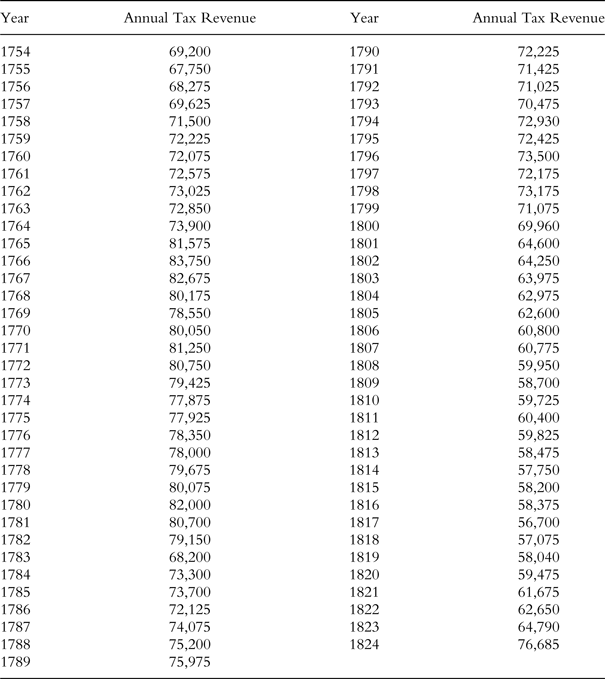
The annual commercial registers (Commerzienregister) from the town provide a bird's-eye view of the overall economic development in Göppingen between 1754 and 1824.Footnote 40 Like most hometowns, Göppingen housed many small-scale handicrafts, ranging widely across the economic spectrum, but foodstuff production (i.e., bakers and butchers) and textiles (i.e., weavers) were the most common and thus constantly constituted between a third and a half of the annual commercial revenue in Göppingen. The taxes collected from them and their colleagues in other tradecrafts between 1754 and 1771 indicate, as Graph 1 below shows, that commercial activity grew somewhat steadily.
(Color online) Total Annual Commercial Tax of All Trades in Göppingen (1754–1824). Sources: Stadtarchiv Göppingen, Commerzienregister.
Thereafter, though, the local economy slowed significantly for a couple of reasons. The widespread famine from 1770 to 1772 in Württemberg and the inevitable rise in prices played a part. The famine got so bad in 1771, that Vayhinger made the following entry in his chronicle in April of that year: “The Herr Doktor was sent out with the [city's] children into the open countryside to show them which roots were good to eat.”Footnote 41 Despite the concomitant economic slowdown, commerce continued steadily through the 1770s, but the aforementioned cataclysmic fire of 1782 reversed the economic vigor that had developed through the middle decades of the eighteenth century. While the people of Göppingen rebuilt their hometown quickly, turbulent times and a stalled economy persisted through the 1780s, 1790s, and early 1800s, largely as a result of multiple calamities. In 1794, French troops plundered the town. The watchmaker Weinmann complained that the foreign soldiers “broke into his house, destroyed the double lock, reduced the main door to pieces, and robbed the following [items]: eight clocks, two magnifying glasses, three hunting knives, one sword, one knife, three containers of flour, one loaf of bread, three pewter plates, three blouses and four child's shirts, four pairs of hose, two white caps, one fur cape, woolen yarn, and rolls of thread.” The watchmaker Weinmann might have taken some consolation in the fact that he did not have to undergo the humiliation that Baltas Methsieder experienced when the French troops forced him to give up the new boots that he was wearing at that time. The marauders did not stop there; they took the shoes off of the feet of Methsieder's journeyman, too, and “[t]hen they took everything there was.”Footnote 42 Another calamity hit just about a decade later when an outbreak of typhus afflicted the townspeople from late 1805 to early 1806. A decade later harsh weather once again brought famine (1816–17) and skyrocketing inflation to the town. Through these ups and downs, the town's population persevered, with most households relying on the flexible nature of their patchwork household economies, plying their small-scale tradecraft while also engaging in a variety of other economic activities, such as growing crops or livestock for market, renting out space within their homes, strategic and careful debt management, and seasonal Besenwirtschaft (tavern-keeping from one's household, indicated by hanging a broom, or Besen, outside the front door).Footnote 43 As mentioned at the outset, some households had more wealth and hence more flexibility than others. Thus, as Göppingen's population grew steadily from 2,900 in 1730 to 3,777 in 1800, some inhabitants, especially the wealthier, were able to take advantage of the dynamic nature of the local and regional markets that were tied to the expanding Atlantic economy.Footnote 44 By 1813, for instance, this dynamism had resulted in the establishment of four factories in Göppingen that employed 169 workers.Footnote 45 To be sure, not all regions around or groups in Göppingen were on the “fast track” of economic development, but these developments clearly brought commercialization of both production and consumption to this town.Footnote 46
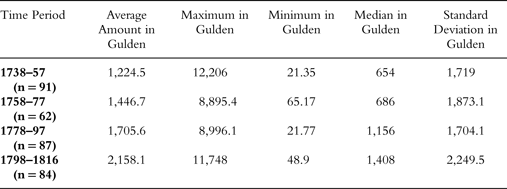
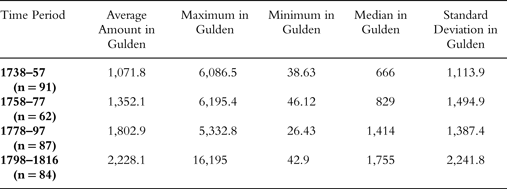
Capturing, in Bourdieu's words, “the overall volume of capital” available to the artisans, the probate inventories provide, through analysis, an intimate understanding of these developments.Footnote 47 The growing gap between the wealthiest and the poorest artisans can be clearly discerned by calculating the aggregate property and net worth of each household. Tables 6 and 7 and Graphs 2 and 3 are the result.
(Color online) Net Worth. Sources: Stadtarchiv Göppingen, Inventuren & Teilungen.
(Color online) Aggregate Property. Sources: Stadtarchiv Göppingen, Inventuren & Teilungen.
Net Worth (Aggregate Property + Loans Extended – Debts Owed) by 20-Year Periods (1738–1816)
Sources: Stadtarchiv Göppingen, Inventuren & Teilungen.
Aggregate Property by 20-Year Periods (1738–1816)
Sources: Stadtarchiv Göppingen, Inventuren & Teilungen.
Within this broad development, the economic capital of the Handwerker—cash, craft tools and supplies, loans, and debts—showed modest change over the eighteenth century as many housheolds allocated at least ten percent of their net worth to their tools and supplies of their craft. The artisans also demonstrated an overall tendency to go deeper into debt.Footnote 48 As most, if not all, of the artisans became increasingly involved in a commercial, cash economy, some of them apparently took full advantage of the growing credit networks and growing commercialization. Others lost out, but almost all apparently kept plying their trades as assiduously as their resources and circumstances would allow.
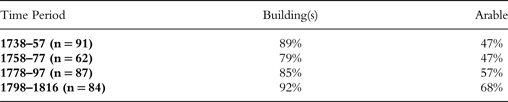
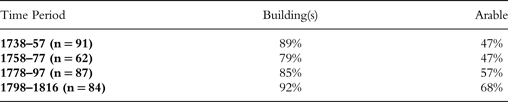
At the same time, they were also actively deploying their social and cultural capital in new ways. Most outwardly notable in their community was the widespread adoption of the new clothing styles and materials—a form of social capital—that came with the eighteenth century. And, within their homes, the artisans also shifted some of their cultural capital to the patterns and behaviors associated with a new culture of domesticity and sociability. Throughout the eighteenth century, most continued to reside in a two- or three-story house, and as shown by Table 8, most owned their dwelling as well as some property rights to various fields in and around Göppingen.
Percentage of Households that Owned Real Estate by 20-Year Periods (1738–1816)
Sources: Stadtarchiv Göppingen, Inventuren & Teilungen.
Living and work space for the artisans was almost always under one roof, with plenty of “standard urban furniture,” such as bed frames, trunks, cabinets, tables, chairs, benches, etc., for living in comfort.Footnote 49 In her study of Wohnkultur in Braunschweig, Ruth-E. Mohrmann found that such furniture remained predominant throughout much of the eighteenth century, while the novel and “luxurious urban furniture,” such as writing desks, coffee tables, upholstered easy chairs, sofas, wardrobes, bookcases, and display cabinets, did not become fashionable among the ordinary city dwellers in the Germanies until well after mid-century. Some Handwerker in Göppingen were evidently early adopters of these more luxurious urban furnishings.
Indeed, close analysis of the probate inventories clearly reveals striking changes to the physical interiors of their residences during the eighteenth century. Certain pieces, such as basic chests and trunks, which were once considered “standard” and were found in nearly all households, began a steady decline in popularity around mid-century. At the same time, not surprisingly, certain “luxurious” pieces, such as wardrobes and clocks, appeared more and more frequently. Indeed, from 1738 to 1757, about fifty-seven percent of households included a wardrobe, but that figure grew to about eighty-seven percent from 1798 to 1816. Perhaps most dramatic of all was the introduction of and rapid rise in the popularity of clocks, barometers, and other wall hangings such as portraits and paintings. In the earlier period, such items could be found in only one of twenty artisanal households in Göppingen, but by the later period they could be found in one of three households. The clocks and barometers might have been hung conspicuously on a wall in the home as a way of asserting that the inhabitants had full command over “the new forms of cultural knowledge regarding timing and chronology” and the concepts of weather, too.Footnote 50 Paintings and engravings could also be found now on the walls of some artisans. The first probate inventory to include a “portrait” came from the household of a Zeugmacher in 1752, but twenty-six years would pass before another painting or engraving appeared in a death inventory.Footnote 51 Thereafter, during the last three decades of the eighteenth century, paintings and engravings regularly cropped up again.Footnote 52 When this pattern of consumption is combined with the more widespread adoption of other “luxurious urban” furnishings, it suggests that the Handwerker were making their social space more gemütlich, an important characteristic of a bourgeois lifestyle.Footnote 53 Indeed, clocks, barometers, and paintings refined the bürgerlich house by adding a touch of class as decorative wall hangings. And, in rare cases, such as that of the Müllers in 1783, the notary even found “1. Clavier” when he assessed the estate of Anna Maria.Footnote 54 With two sons aged thirteen and twelve at the time of her death, one wonders if this Zeugmacher's spouse had been teaching them to play. One can only hypothesize, but it certainly seems to have been part of a larger trend in moving toward more domesticity and refinement.
Directly related to this trend was the growing popularity of drinking caffeinated beverages in one's home. In most towns and cities of continental Europe, prior to about 1750 drinking stimulant beverages remained a luxury that could be afforded and, hence, enjoyed only by the well-to-do. Following the mid-century, though, the costs for coffee, tea, and chocolate declined as trade with Asia expanded and became more established, and consequently the consumption of tea in England had become, by the 1750s, “an expected behaviour of people of middle rank.”Footnote 55 The inventories suggest that the Göppingen artisanate followed this consumer behavior, albeit with coffee rather than tea, not long thereafter. In fact, at the end of the 1770s, slightly more than half of the Handwerker owned the wares necessary to prepare and drink coffee and tea in their homes (see Table 4). Coffee mills were among the first items to appear in the probate inventories on a regular basis, but they were not the only items. For instance, the Widmans and Vayhingers, both of whom were contemporaries of the aforementioned Müllers in the 1780s, had not only a mill, but also a pot and cups with which to serve the coffee.Footnote 56 And the rate of ownership continued to increase, ultimately reaching 72.62 percent by the 1810s (again see Table 4). Further, somewhat indirect, evidence of the growing popularity of caffeinated beverages comes from the guidebooks used by notaries in Württemberg; that is, during the second half of the eighteenth century, they were instructed to record new foodstuffs, such as sugar, tea, coffee, and chocolate under the rubric of Kuchenspeiß on a regular basis.Footnote 57
As more and more Handwerker joined the new, caffeinated Trinkkultur, the inventories clearly suggest that they also joined what Daniel Roche has called the “sartorial revolution” of the eighteenth century. This occurred as the urban dwellers in Paris and elsewhere traded their dour colors and traditional fabrics of wool and linen for the newer, more colorful and patterned fabrics made of cotton.Footnote 58 As with the luxurious urban furnishings, the Göppingen artisanate seemed to be early adopters of the new fabrics, colors, and styles. A glimpse of the beginnings of this revolution in Göppingen comes from the probate inventory for Justina Weiß, who died in 1738 at the age of forty. Among her and her husband's possessions were quite a few items that indicated a move toward newer styles and modes of dress. For instance, in her wardrobe, Justina had a “Calamink Leible with front-piece” (worth 40 Kreuzer), a “Daßet(?) bonnet with velvet points” (worth 50 Kreuzer), a “Chagrinene bonnet” (worth 36 Kreuzer), a pair of “black, velvet-leather shoes” (worth 30 Kreuzer), four handkerchiefs including a dyed one (worth a total of 58 Kreuzer), two pairs of “striped sleeves” (worth a total of 13 Kreuzer), and one “Corallen Nuster [necklace] with eight rows, a jewel, a silver border, and a silver clasp” (worth 2 Gulden 30 Kreuzer).Footnote 59 Among her husband's possessions, the scribe listed the following items of interest: a “barchent Leiblen [male bodice/waistcoat]” (worth 45 Kreuzer) and a “pair of brown, woolen-cloth trousers” (worth 45 Kreuzer).Footnote 60 Given that the Weisses were tailors, this may explain why Justina and her husband, Johannes, owned several trendy articles of clothing, such as her floral bodice (which may have been imported), her striped sleeves, his cotton waistcoat, and his woolen trousers.Footnote 61 No doubt it made good business sense for the Weisses to advertise their craftsmanship and wares by serving as trendsetters in their community. In Laichingen during the late 1740s, tailors and others played, according to Hans Medick, a similar role as “trendsetters” in their small town society.Footnote 62 Regardless of whether business acumen or personal taste motivated the Weisses, by adding newer fabrics and styles to their modes of dress, these behaviors (conscious or unconscious) suggest that the broader structural changes had begun as early as the late 1730s.
Another source that corroborates this is the chronicle kept by Ernst Jacob Vayhinger. When this fifty-something Zeugmacher sat down in 1781 to write, he reminisced about some changes in clothing styles that had occurred almost half a century earlier (ca. 1736–37):
I must also mention something about the Tracht [costume] for men as well as for women: when I was a child of about seven or eight years, the change in dress pretty well took root. My father wore trousers that went with puttee-stockings [Wickelhosen], because the shift to trousers worn with knitted stockings [Schorterhosen] had not yet come. At the time, I attended the Latin School, and my classmates had already adopted the new fashion. My father complained that no one should make Schorterhosen, but my mother replied to him that the old-fashioned trousers were not proper, especially because I went to the Latin school. So I got the new trousers to wear, and then the old folks berated me, asking whether my mother lacked sense, because in the end I would no longer be able to walk in the new-fangled things.Footnote 63
Thanks to his mother's support, Ernst Jacob apparently became, along with his fellow pupils and the Weisses, a trendsetter of sorts. Vayhinger also commented on changes in the local dress among the peasantry: “[A]bout the Bauern I can still remember a few of [their] tall hats, which everyone wore earlier. From linen cloth, stockings were cut. . . . All women wore tall bonnets until I was about eighteen years old [ca. 1747]. Then the lower [bonnets] rose up [in popularity] and now they [i.e., the taller ones] are seldom worn.”Footnote 64 This discussion of Tracht was one of the longer digressions from the usual topics––the economy, the weather, and high politics––covered in his chronicle. While our chronicler conveyed no justification for this, the most logical explanation is that by mid-century the people in and around Göppingen had been swept along by the sea-change in clothing styles and materials. Two marriage inventories from that era seem to confirm this. When, for example, Johannes Widmann married Anna Maria in 1748, the notary recorded a long list of clothing owned by the couple, and fortuitously he noted whether those items had been personal possessions (P) or had been received as wedding gifts (W):
Source: Stadtarchiv Göppingen, B.II.2.g., Beibringen-Inventuren, 7.2–74 (1749).
While most of the wedding gifts, presumably from their parents, were the standard styles, materials, and colors , the newlyweds had among their personal possessions numerous items that were novelties at the time, such as a meerschaum pipe with silver fittings, a Calamink neckerchief, a red-striped skirt, and white cotton stockings.Footnote 71 Evidently, because their gifts tended to the traditional colors and styles, the parents of this young couple liked the new fashions about as much as Ernst Jacob's father liked his son's new-fangled trousers and stockings. Tellingly, Ernst Jacob Vayhinger and his first and only wife, Anna Barbara (died 1789), also counted among their possessions in 1755 some new fashions: Ernst Jacob had a Spanisch Rohr and a white, barchent waistcoat among his many more traditional articles, while Anna Barbara owned a violet woolen-worsted skirt, a red barchent skirt, two cotton smocks, a red charlachen bodice, three damask bonnets, a half-silk bonnet, two plain cotton bonnets, six cotton aprons (two of which were “floral”), a yellow cotton neckerchief, three white cotton neckerchiefs (two of which were striped), four handkerchiefs, one red-floral cotton waistcoat [Leiblen], and one green umbrella.Footnote 72 With numerous articles of clothing cut from cotton, many of the new colors and patterns, and fashionable accoutrements, such as the walking sticks and umbrella in their wardrobes, the Vayhingers and Widmanns had clearly taken up the new fashions in Göppingen. Incidentally, one fad that these two families missed—but that crops up in later inventories—was a frenzy for pocket watches that apparently began in the late 1790s and carried through much of the nineteenth century.Footnote 73 From the middle of the eighteenth century on, then, one can easily observe, through the lens of the inventories, the relatively rapid shift in clothing styles, materials, and colors, from traditional, monochromatic woolens and linens to vibrant, multihued clothing cut from various fabrics and perhaps imported from far afield.
By adopting the new trends in clothing and jewelry, the artisans made what Pierre Bourdieu might consider “an excellent investment in social capital.”Footnote 74 Clothing and jewelry, after all, served––and continue to serve––as outward expressions of one's position in society, and hence, such items carried a certain social utility. And, if the long history of sumptuary law is any indication, then clothing's social utility was not at all lost on the patriarchal authorities of medieval and early modern Europe. In fact, as argued by Alan Hunt in his wide-ranging survey of this topic, one cannot even begin to “understand the sumptuary impulse” without first considering clothing “as a significant component of the material, political, economic, and aesthetic culture.”Footnote 75 For the patriarchal authorities in much of Europe, clothing and other outward expressions of status remained, according to both Hunt and Ogilvie, a focal point of their ever-expanding efforts at governance, social disciplining, and regulation well into the nineteenth century.Footnote 76 This was apparently the case in Württemberg, where the ducal government issued Polizei-Ordnungen and other sumptuary laws until 1784. And, in fact, Ogilvie has pointed to specific case studies from the early eighteenth century in the Swabian Black Forest region, where women ran afoul of these regulations and were subsequently punished for doing so.Footnote 77 Not surprisingly, Ogilvie's findings have led her to concur with Hunt that “insofar as sumptuary laws were enforced, they were enforced overwhelmingly against women.”Footnote 78 Although they agreed that women served as the primary targets, Hunt and Ogilvie differed when it came to the overall impact of these sumptuary laws. On the one hand, Hunt carefully qualified his assessment of them, arguing that his “view, and it can be no more than impressionistic, is that sumptuary laws failed to penetrate significantly into the everyday world.”Footnote 79 Ogilvie, on the other hand, argued that “[l]ocal archival sources show these sumptuary norms being enforced—not perfectly, but enough to affect people's economic choices” at least through the mid-eighteenth century.Footnote 80 Following the mid-century, however, fewer cases of enforcement seem to exist. Whether this was a result of successful social disciplining by patriarchal authorities or evidence of a tipping point where market forces as well as cultural standards simply overwhelmed the authorities remains up for debate.
My evidence from Göppingen sheds only a little light on this debate. To be more specific, limitations of time and space allowed me to trace fully the life course of only ten of the 324 cases studied. Since he left a chronicle, Ernst Jakob Vayhinger was obviously chosen as one of the specific case studies. The other nine were randomly selected from three different social strata (i.e., lower, middle, and upper) interspersed over the long eighteenth century. In an effort to flesh out the lives of these artisans, both wealthy and poor, a wide-ranging search for any documentation related to them was conducted in the city and church archives. For at least these ten cases, no evidence of punishment for sumptuary violations appeared in the Gerichts- und Ratsprotokolle, 1700–1819. As noted above, however, by 1750, at least three households had acquired some of the new fashions and trinkets, and following that decade, the percentage of households that owned some female jewelry grew steadily over the next fifty years from forty-two percent to sixty percent (see Table 1 above). This consumer trend perhaps brought “a discourse” in the town that allowed the citizens “simultaneously to celebrate consumption and to put it to work in shoring up power structures.”Footnote 81 Maybe the local authorities turned a blind eye to and tolerated the new fashions, or maybe the women in those households with jewelry wore their trinkets discreetly. Ultimately, though, the research for this essay falls short when it comes to the enforcement of sumptuary laws. Admittedly much more work needs to be done to make a compelling argument about the overall impact of sumptuary legislation in Göppingen, but for the purposes of this article, two overarching points can be asserted: 1) When it came to enforcing sumptuary law, the second half of the eighteenth century seems to have differed from the first half; and 2) “[c]lothes are a powerful, if complex, form of communication.”Footnote 82
This argument about the power of clothing is not new. In fact, in his careful study of the Kleinbürgertum from 1969, Helmut Möller argued that when it came to competing with other orders, “magnificence in clothing was not only the most effective––because it fell on the most eyes and at the same time distinguished one from others––but it was also the cheapest compared with other forms of representation.”Footnote 83 Moreover, artisans and others in the lower-middle class had always, according to Möller, had an outward orientation, because they formed their attitudes and behaviors, identities and mentalities, in a public and outward manner through the church and the guild. When these public associations underwent radical change in the eighteenth century, the traditional world of the Kleinbürgertum appeared to be disintegrating. In this time of turmoil, the nature of their Außenorientierung also underwent, according to Möller, a transformation: instead of finding their identity simply through the church and the guild, these men and women found strength and identity in the expression of a set of ritualistic forms of behavior that gave meaning to their domestic morality, individual discipline, and respectability. The internalization of this strong belief in the “silent and gentle virtues” of domesticity and respectability thus became the integrative force that held together the world of the kleinbürger family.Footnote 84
Throughout the eighteenth and early nineteenth centuries, another sociocultural item, books, figured prominently in the homes of the Handwerker. In fact, of the 324 probate inventories studied, only six listed no books whatsoever (see Table 5 above).Footnote 85 Nearly all artisanal families in Göppingen owned at least one book, if not multiple volumes, in their homes, but high rates were, to be sure, not unusual in early-modern Württemberg. According to the work of Hans Medick, the denizens of Laichingen set a similar rate of ownership (i.e., 98.7 percent owned books) in the years 1748–1820, and in Nürtingen, Anja Benscheidt found that from 1770 to 1830 all the Handwerker had books in their homes.Footnote 86 Not all areas of Swabia manifested such desire for books, for in the small, rural village of Kirchentellinsfurt, Andrea Hauser discovered that “about a quarter of all households” in the eighteenth century did not possess books, thus leading her to argue that illiteracy in this town remained “considerable” until the middle of the nineteenth century.Footnote 87 This clearly was not the case for the Göppingen artisanate. In fact, by comparing titles listed in the marriage and death inventories of the handful of cases for which both documents were studied, it becomes clear that these were not static collections.Footnote 88 Other scholars, who have closely studied the book collections of artisans in Swabia, have also concluded that these items were not simply dust collectors but rather significant cultural goods that were often purchased by individuals with tastes that could change over time.Footnote 89
While religious subjects dominated the reading material found in most eighteenth-century households, in a few rare instances, secular topics could be found. For instance, when a notary recorded the death inventory of the Zeugmacher Johannes Schwarz in 1742, he found “1. Faulhabers Rechenbuch” among the fourteen texts in his household.Footnote 90 A handful of other artisans owned either the Faulhaber or another arithmetic text.Footnote 91 Other temporal topics, ranging from legal codes and politics to history and geography, caught the fancy of a few craftspeople. By and large, however, those individuals tended to belong to the political leadership of Göppingen through either their position as guild masters or members of the town council.Footnote 92 Most families, on the other hand, owned only religious literature, such as Bibles, hymnals, and prayer books. Gesangbücher were the most common in Göppingen and apparently elsewhere in Lutheran Swabia, but not lagging far behind were Bibles and books of prayers and sermons (see Table 5 above).Footnote 93 Among the most popular authors were Johann Friedrich Starck (1680–1756), Phillip Friedrich Hiller (1699–1769), Johann Christoph Bilhuber (1702–62), Friedrich Christian Steinhofer (1706–61), and Immanuel Gottlob Brastberger (1716–64), all of whom drew concrete analogies between the sufferings of Christ and the everyday sufferings of ordinary Swabians. For example, Brastberger wrote sermons that contained passages adumbrating similar parallels between the physical and spiritual worlds. According to his Evangelische Zeugnisse der Wahrheit zur Aufmunterung im wahren Christenthum . . . (1758), “the Church of God [was] nothing other than the multitude in which its members would, through the Word and the Sacraments, be called to the community of God and His grace and should [also] be brought to the state of blessedness by the common intention of godly love.”Footnote 94 Brastberger instructed his readers to live every day as if it were “Christtag,” or the day of Christ's birth; his exposition on “true piety” asked individuals to work in “the service of the Lord” and to follow truly and faithfully in the footsteps of Christ.Footnote 95 As argued by Hartmut Lehmann, many of these authors studied with Johann Albrecht Bengel, who was the first truly dynamic theologian of Württemberg Pietism and a strong proponent of “biblical eschatology”; as such, his followers worked hard “between the years of 1750 and 1770 to fill in” the discernible gaps between their mentor's immaterial mysticism and the material.Footnote 96
In essence, then, these authors offered their readers instruction on how to live an everyday, pious life that would eventually lead them to salvation. They beseeched their audience to take the same route that Christ had followed to salvation, to be prepared for the moment of judgment. His was not a wide, easy footpath of self-gratification and “unbridled lust” with an “entrance flanked on each side by the two naked statues of Bacchus and Venus”; his was a narrow, meager footpath of hardship and humility.Footnote 97 Readers were implored to travel down the latter, for the former would bring them in the end only to ruin and eternal damnation. In Württemberg, a “region in which Pietism laid down its most solid and enduring roots,” this trope of godly living dated back to at least the late seventeenth century.Footnote 98 That was when, according to Martin Brecht, the wars of Louis XIV brought such dire consequences to parts of the duchy, that many of its inhabitants “understandably interpreted them as the result of God's wrath, or even as signs of the end times.”Footnote 99 This millenarianism, along with the “ecclesiastically critical” views of theologians both within and without the region, led “some pastors” in Württemberg to become not only “early supporters of [Philip Jakob] Spener” (1635–1705) but also early adopters of his notion of “Collegia pietatis.”Footnote 100 In 1684, for example, Eberhard Zeller (death after 1692) held several of these devotional meetings in Göppingen, moving shortly thereafter onto Stuttgart and Calw to establish conventicles, which were then banned by the Church's Consistory.Footnote 101 Although radical Pietism remained largely a minority movement throughout the eighteenth century in Württemberg, the notion that Privatversammlungen (or Collegia pietatis) served a fundamental role in creating a more thoughtful, pious laity continued to spread even among more orthodox Lutherans. In fact, when the ecclesiastical authorities issued their Pietistenreskript of 1743, they included the “unprecedented” recommendation that “devotional meetings” be made “an integral part of church constitution in Württemberg,” thus suggesting that certain elements of Pietism were well on the way to being fully integrated into the state church during the eighteenth century.Footnote 102
Hymnals, according to Christian Bunners, formed “an important strand of the osmosis between orthodoxy and the wider Pietistic movements of the era.”Footnote 103 Indeed, from the seventeenth century onward, as they “became less expensive to produce and literacy spread,” hymnals became more and more popular among the ordinary folk.Footnote 104 Moreover, since they served as “an expression of and stimulus for individual and collective piety,” Gesangbücher carried the “codified messages of pietistic devoutness” to those folks “who stood more remote from the movement.”Footnote 105 Focusing on the theme of living a pious life in the material world as had Jesus Christ, hymnals effectively produced a verification, privatization, and individualization of faith. This argument about the internalization of religiosity seems in many respects similar to the argument put forth by Möller about the internalization of domesticity and respectability, and indeed, they most likely went hand in hand for many outwardly oriented folks during the eighteenth century. For the artisans in Göppingen, who experienced these overlapping processes of internalization, the image of an arduous path to heaven must have struck a chord. They, like many other folks in Swabia, struggled hard to piece together a respectable living during times that never guaranteed success or even stability. All that one could do was work, work some more, and hope for the best. Their task, physically and spiritually, was to hold on and see it through to the end, which, according to Hans Medick, came “less from the ethic of disciplined-pragmatic Durchkommen [i.e., success], . . . and more from one of Durchhalten [i.e., persistence].”Footnote 106 The difficult circumstances of the eighteenth and nineteenth centuries, combined with the influences of Pietism in Württemberg, led its ordinary folk, argues Andreas Gestrich, to this ethic of “constant work,” one that emphasized “Durchhalten, Beharren im Guten, [and] Ausharren bis Ende.”Footnote 107 Ultimately, then, for most artisans, their preference in reading material—according to Bourdieu, an important component of their cultural capital—remained firmly entrenched in an evangelical Lutheranism that both consecrated and reflected well their customary, everyday labors as they toiled for goodness and for the endurance to see it through to the end.
On the surface it might appear that this trend of holding firm to traditional religious structures conflicted with the movement toward new forms and features of bürgerlich domesticity. The evidence from Göppingen, however, suggests something else. Indeed, the two forces may have, in a society marked by a steadily increasing gulf between the wealthiest and the poorest, worked in concert for artisans. Württemberg Pietism and especially its more material message of individual perseverance provided the craftspeople of Göppingen, regardless of wealth, not only with inspiration for tackling their daily trials and tribulations but also with a reasonable sanctification of those endeavors and occasional successes. Indeed, as argued by Peter Kriedte, this particular work ethic among “[p]ietistic Handwerker, cottage workers, and workers” meant that they contributed differently to “the establishment of proto-industrial and industrial capitalism.”Footnote 108 Unlike their wealthier brethren (the merchants, entrepreneurs, and factory owners), who may or may not have been obsessed in some Weberian way with the rationalization of productivity and profit, most artisans, day laborers, and other ordinary folk found solace and comfort in their ethic of putting in a respectable and reasonable day's work. Consequently, even though some artisans fell behind economically, their long-standing cultural roots in—and steady consumption of—pietism kept the artisans firmly connected with one another, even as the broader structural changes to their community increased stratification among them. The new material culture and all of its inherent bourgeois meaning served, in essence, the same function of holding them together as certain con-sumer goods, such as clocks, coffee- and tea sets, and new wardrobes, came to connote good, bürgerlich domesticity. Therefore, as the Handwerker in Göppingen consciously and unconsciously altered the social space around them, including the gap that widened between the rich and the destitute, most of them found strength and identity in the messages and meanings conveyed by both Württemberg Pietism and the novel material culture. Indeed, they seemed to approach the world around them with, in the words of Anthony LaVopa, a “doctrine of self-renunciation and self-transcendance” that “obviated the need for compromises between mobility and order, individual potentialities and social constraints.”Footnote 109 And, when one considers the argument that “partible inheritance nurtured good citizenship and a strong sense of civic community,” the desire for coherence rather than divergence must have been further buttressed.Footnote 110 Therefore, the trends in social and cultural capital formed a core set of ritualistic behaviors that gave Handwerker culture coherence, stability, and expression as it slowly metamorphosed from an outward-oriented corporatism to an inward-oriented domesticity and respectability.
This set of inclinations constituted, however, only part of the artisans’ entire habitus as they interacted with the changing social space around them. As argued above, they clearly exhibited other tendencies, dispositions, and behaviors, especially when it came to their economic capital. The craftspeople steadily allocated, for instance, a significant chunk (ten to fifteen percent) of their net worth to the tools and supplies of their tradecraft as they persevered through the economic vicissitudes of the mid to late eighteenth century. During the same period, the artisans also developed an apparent willingness to take on more debt in the growing commercial credit networks. By managing their economic capital in these ways, the Handwerker in Göppingen engaged their household economies with the growing commercialization of the eighteenth century in a fashion that fit well with the other tendencies, inclinations, and behaviors that made up their habitus. That is, they used their economic capital, and apparently borrowed more over the course of the century, to ply their trade while simultaneously acquiring the trappings of refined bourgeois domesticity. Given their strong adherence to the concepts of persistence as opposed to success, and community as opposed to individualism, this must have seemed to be a most reasonable approach to the ever-changing world around them. From this perspective, it appears then that the artisans’ cultural capital may have acted as something of an internal constraint when it came to the so-called industrious and consumer revolutions. Rather than rapidly expanding or even altering their household economies to take full advantage of the growing commercialization, the artisans in Göppingen seem to have been content with making it through, especially since most of them were able, without much apparent effort, to participate in the new consumer patterns and behaviors that developed in the eighteenth century. To be sure, as Ogilvie reminded us, manifold external constraints—many of which were employed by patriarchal authorities—hindered the commercialization and expansion of production and consumption in many southwest German communities, but this microhistorical analysis suggests that the Handwerker themselves may have contributed to the sluggishness of both conspicuous consumption and capitalist development in Württemberg. Their reasonable approach to the broad structural changes that were occurring in their world called for patience and humility instead of profit-maximization and ostentation. More significantly, though, by taking this problematized approach to socioeconomic change, this close analysis of the inventories from Göppingen not only bolsters Jürgen Schlumbohm's argument that “‘economic’ strategies should not be isolated from ‘social’ and ‘cultural’ aspects of behavior,” but it also seems to get us closer to the muddled and contingent lives led and shaped by ordinary folk at least in Göppingen.Footnote 111 In that town, over the course of the eighteenth century, many ordinary artisans saw “broadened choice” and “the emergence of ‘incentive goods,’” as well as the concomitant fundamental changes to production and consumption that made their households more market-oriented and industrious.Footnote 112 Those changes, however, were clearly shaped by the habitus of the Handwerker.
APPENDIX
Annual Tax Revenue for the City of Göppingen (1754–1824)
Craft Tools & Supplies by 20-Year Periods (1738–1816)
(Color online) Craft Tools & Supplies in Gulden. Sources: Stadtarchiv Göppingen, Inventuren & Teilungen.
Average Percent of Net Worth Devoted to Craft Tools & Supplies. Sources: Stadtarchiv Göppingen, Inventuren & Teilungen.
Activa (Loans Extended) by 20-Year Periods (1738–1816)
Passiva (Debts Owed) by 20-Year Periods (1738–1816)