The psychological toll of caring for a person with motor neuron disease (MND) is well established (Harris et al., Reference Harris, Thomas and Thomas2018) with the experience described as unrelenting (Aoun et al., Reference Aoun, Connors and Priddis2012). Carers may assist the individual with MND in managing physical, psychological, and neurobehavioral changes (de Almeida et al., Reference de Almeida, do Carmo Santana and de Carvalho2021). Most people with MND live at home where their physical and psychological functioning can be significantly influenced by the support received in that environment. Consequently, carer psychological well-being (PWB) can be salient for the functioning of MND patients. Due to the demands of their role, numerous studies consistently demonstrate that MND carers experience substantial burden, depression, anxiety, poor quality of life, strain, fatigue, and reduced social contacts (Gluyas et al., Reference Gluyas, Mathers and Hennessy Anderson2017; Harris et al., Reference Harris, Thomas and Thomas2018).
There is increasing recognition that the PWB of carers of people with MND needs to be addressed. Descriptive studies have dominated MND carer research, with a recent increase in research directly focusing on interventions for MND carers (Gluyas et al., Reference Gluyas, Mathers and Hennessy Anderson2017; Harris et al., Reference Harris, Thomas and Thomas2018). While the focus has turned to carer PWB, the concept itself has not been well defined.
Psychological well-being
The term “psychological well-being” has evolved and is increasingly used as an outcome measure in health intervention studies. However, conceptualizing and defining the term, as well as providing a rigorous approach to research, has proven to be challenging (Dodge et al., Reference Dodge, Daly and Huyton2012). This is an evolving theoretical and research domain in psychology, with open debate about the merits of the superiority of the concurrent hedonic, eudaimonic, and integrative approaches. The hedonic approach focuses on the degree to which people experience positive emotions of feelings and happiness and has sometimes been referred to as “subjective well-being” (Diener, Reference Diener2000). It comprises both affective (mood, happiness) and cognitive components, as well as satisfaction (Fava and Ruini, Reference Fava and Ruini2003). In contrast, the eudaimonic approach emphasizes the functioning components of PWB and is inclusive of a six-factor structure of purposeful behavior: self-acceptance, environmental mastery, positive relationships, personal growth, purpose in life, and autonomy (Ryff and Keyes, Reference Ryff and Keyes1995). The variety of approaches, concepts, and measures can make it difficult to compare studies, and given the potential for theoretical overlap, many researchers have taken an integrative approach, realizing the value of both approaches in defining and measuring PWB.
This systematic review takes an integrative approach, encompassing both perspectives since numerous studies have noted higher levels of hedonic or eudaimonic PWB are associated with positive outcomes (Vazquez et al., Reference Vazquez, Hervas and Rahona2009). In addition, the field of interventions designed to improve the PWB of MND carers is relatively new and, as such, an integrative approach to this review allows the potential for greater inclusiveness of studies. While there has been an increase in ideas and studies focusing on the PWB of MND carers, a systematic review of interventions has not yet been conducted. This review aims to (1) summarize the interventions designed to improve the PWB of MND carers; (2) assess the quality of the studies designed to improve the PWB of MND carers; and (3) evaluate the effectiveness of interventions designed to improve the PWB of MND carer.
Method
Conducting and reporting of this systematic review was based on the Joanna Briggs Institute (JBI) methodology for quantitative, qualitative, and mixed-methods reviews (Aromataris and Munn, Reference Aromataris and Munn2020) and Preferred Reporting Items for Systematic Reviews and Meta-Analyses (PRISMA) guidelines (Moher et al., Reference Moher, Liberati and Tetzlaff2009).
Data sources and search strategy
The search strategy process intended to cover a broad range of intervention studies designed to improve the PWB of MND carers. Keywords (and their variations) used in the searches are detailed in Box 1. A three-stage search strategy was employed. An initial limited search of CINAHL, PubMed, ProQuest, Scopus, and PsychINFO using pre-specified keywords was undertaken, followed by an analysis of the text words contained in the title and abstract and of the index terms used to describe the article. The second search used all identified keywords and index terms in a thorough search across all included databases. The third step involved searching for additional studies through the reference lists of all included studies. Only reviews published in English were included. Studies published before 1990 were excluded because MND care has significantly changed over the last 30 years and we were not expecting to find any relevant papers before 1990 (the “earliest” relevant paper we were aware of before doing this review was published in 2013). All articles published from 1990 to June 2021 were considered. Inclusion criteria comprised studies that were quantitative or qualitative or both (mixed-methods) if the quantitative or qualitative component could be extracted separately. Interventions needed to be carer-based and designed specifically for the purpose of improving carer PWB. Interventions could be delivered to individuals or groups and be inclusive of any mode of delivery, duration, and dose. The review included studies targeting spousal, family, and informal carers of people with MND and excluded professional or paid carers from government or private providers. Furthermore, the review included carers of people with MND independent of the disease stage and care setting.
Search terms
Keywords (and their variations) used in the searches included those related to Condition: (“motor neuron* disease” OR MND or “amyotrophic lateral sclerosis” OR ALS), Population (famil* OR informal OR spous*) AND (carer* OR caregiv*) and Intervention (*behavio*r therapy” OR “cognitive behavio* therapy” OR CBT OR “acceptance and commitment therapy” OR ACT OR mindfulness OR relaxation OR meditation OR counsel*ing OR grief OR bereavement OR “social support” OR “family therapy” OR “art therapy” OR “dance therapy” OR “music therapy” OR “*complementary therap*” OR *Exercise OR Yoga OR “person centered*” OR “dignity therapy” OR psychotherap*OR psychosocial OR psychological OR treatment OR training OR education* OR program.
Study selection
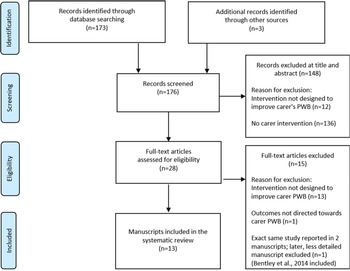
Outcomes of interest were any related to the PWB of carers, inclusive of any psychologically related (hedonic or eudaimonic) outcomes. Outcomes could be measured using any validated instrument, via observation or by self-report and measured before, during, or immediately after the intervention or after a follow-up period. The recommended JBI approach to a mixed-methods systematic review (MMSR) was followed. This process included JBI recommended screening protocols, design-appropriate standardized quantitative and qualitative critical appraisal forms to assess inclusion and methodological quality, and standardized data extraction tools as advocated by JBI (Stern et al., Reference Stern, Lizarondo and Carrier2020). Selective reporting bias was further evaluated by comparing measurements and outcomes in papers with published protocols (where available), and methods and results were compared in papers without published protocols. The three reviewers separately assessed all studies to decide on in- or exclusion and disagreement was resolved by discussion. Data were subsequently extracted by two reviewers from the 13 selected papers with standardized JBI tools appropriate to each research design (Aromataris and Munn, Reference Aromataris and Munn2020) (PC and TE: quantitative data; PC and ACH: qualitative data) using agreed narrative evidence descriptors. Study selection is displayed in the PRISMA flowchart (Figure 1).
PRISMA flowchart of paper selection.

Results
Demographic summary of the studies
In total, 13 papers were included (Figure 1), describing 12 studies as one study published quantitative and qualitative components of their research in separate papers (de Wit et al., Reference de Wit, Vervoort and van Eerden2019, Reference de Wit, Beelen and Drossaert2020). Of the 12 studies, 6 included mixed methods, 4 used only quantitative methods (Creemers et al., Reference Creemers, Veldink and Grupstra2014; van Groenestijn et al., Reference van Groenestijn, Schröder and Visser-Meily2015; Kavanaugh et al., Reference Kavanaugh, Cho and Fee2020; Pagnini et al., Reference Pagnini, Phillips and Haulman2021), while another 2 employed solely a qualitative approach (Marconi et al., Reference Marconi, Gragnano and Lunetta2016; Cipolletta et al., Reference Cipolletta, Gammino and Francescon2018). The included papers were all published between 2013 and 2021, with 8 of the 13 papers published since 2017. Of the 12 studies, 4 were conducted in Australia (Bentley et al., Reference Bentley, O'Connor and Kane2014; Aoun et al., Reference Aoun, Deas and Kristjanson2017, Reference Aoun, Hogden and Kho2018; Ugalde et al., Reference Ugalde, Mathers and Hennessy Anderson2018), 3 in the USA (Creemers et al., Reference Creemers, Veldink and Grupstra2014; Steinhauser et al., Reference Steinhauser, Olsen and Johnson2016; Kavanaugh et al., Reference Kavanaugh, Cho and Fee2020), 3 in Italy (Marconi et al., Reference Marconi, Gragnano and Lunetta2016; Cipolletta et al., Reference Cipolletta, Gammino and Francescon2018; Pagnini et al., Reference Pagnini, Phillips and Haulman2021), and 2 in the Netherlands (van Groenestijn et al., Reference van Groenestijn, Schröder and Visser-Meily2015; de Wit et al., Reference de Wit, Vervoort and van Eerden2019, Reference de Wit, Beelen and Drossaert2020). A total of 530 MND carers were studied in the quantitative component of the review, and 239 in the qualitative element.
Studies were based on applications of psychological treatments (e.g., Cognitive-Behavioral Therapy: van Groenestijn et al., Reference van Groenestijn, Schröder and Visser-Meily2015; Mindfulness and/or Meditation: Marconi et al., Reference Marconi, Gragnano and Lunetta2016; Ugalde et al., Reference Ugalde, Mathers and Hennessy Anderson2018; Pagnini et al., Reference Pagnini, Phillips and Haulman2021; Dignity Therapy: Bentley et al., Reference Bentley, O'Connor and Kane2014; Acceptance Commitment Therapy: de Wit et al., Reference de Wit, Vervoort and van Eerden2019, Reference de Wit, Beelen and Drossaert2020), and processes (e.g., Self-disclosure: Steinhauser et al., Reference Steinhauser, Olsen and Johnson2016), while others were founded in individualized case management or needs (Creemers et al., Reference Creemers, Veldink and Grupstra2014; Aoun et al., Reference Aoun, Deas and Kristjanson2017, Reference Aoun, Hogden and Kho2018), support groups (Cipolletta et al., Reference Cipolletta, Gammino and Francescon2018), or carer skill for youth (Kavanaugh et al., Reference Kavanaugh, Cho and Fee2020). One study used an online intervention (Pagnini et al., Reference Pagnini, Phillips and Haulman2021).
Of the 12 studies, 6 were specifically designed for MND carers (Steinhauser et al., Reference Steinhauser, Olsen and Johnson2016; Aoun et al., Reference Aoun, Deas and Kristjanson2017; Cipolletta et al., Reference Cipolletta, Gammino and Francescon2018; Ugalde et al., Reference Ugalde, Mathers and Hennessy Anderson2018; De Wit et al., Reference de Wit, Vervoort and van Eerden2019, Reference de Wit, Beelen and Drossaert2020; Kavanaugh et al., Reference Kavanaugh, Cho and Fee2020). Four studies detailed interventions designed for both MND patients and carers, including services or programs tailored to the needs of both (van Groenestijn et al., Reference van Groenestijn, Schröder and Visser-Meily2015; Aoun et al., Reference Aoun, Hogden and Kho2018; Pagnini et al., Reference Pagnini, Phillips and Haulman2021) or treatment with different protocols (Marconi et al., Reference Marconi, Gragnano and Lunetta2016). Two papers described patient-based interventions and primary outcomes, with carer PWD only a secondary focus (Bentley et al., Reference Bentley, O'Connor and Kane2014; Creemers et al., Reference Creemers, Veldink and Grupstra2014).
The intensity of the intervention varied from a single 2.5-h group period (Ugalde et al., Reference Ugalde, Mathers and Hennessy Anderson2018) to eight, 90-min sessions over eight weeks (Marconi et al., Reference Marconi, Gragnano and Lunetta2016).
Critical appraisal
Methodological characteristics of studies with a quantitative component (10 studies)
Four of the 10 quantitative papers described randomized controlled trials (RCTs) with sample sizes of 15 (van Groenestijn et al., Reference van Groenestijn, Schröder and Visser-Meily2015), 27 (Pagnini et al., Reference Pagnini, Phillips and Haulman2021), 126 (Creemers et al., Reference Creemers, Veldink and Grupstra2014), and 148 (de Wit et al., Reference de Wit, Beelen and Drossaert2020) and mean participant ages ranging between 53 and 62. Five papers described uncontrolled longitudinal studies with a single treatment group and a pretest, post-test design (n range = 13–31) (Bentley et al., Reference Bentley, O'Connor and Kane2014; Steinhauser et al., Reference Steinhauser, Olsen and Johnson2016; Aoun et al., Reference Aoun, Deas and Kristjanson2017; Ugalde et al., Reference Ugalde, Mathers and Hennessy Anderson2018; Kavanaugh et al., Reference Kavanaugh, Cho and Fee2020). Four studies involved adult carers (Bentley et al., Reference Bentley, O'Connor and Kane2014; Steinhauser et al., Reference Steinhauser, Olsen and Johnson2016; Aoun et al., Reference Aoun, Deas and Kristjanson2017; Ugalde et al., Reference Ugalde, Mathers and Hennessy Anderson2018) (mean ages 57–64 years; median 61: Bentley et al., Reference Bentley, O'Connor and Kane2014), while one included 19 youth carers (aged 9–19) (Kavanaugh et al., Reference Kavanaugh, Cho and Fee2020). One paper described an observational study using a survey design (n = 117, median age 64) (Aoun et al., Reference Aoun, Hogden and Kho2018). Eight papers included a higher percentage of females (60–75%), while two studies involved more males (Creemers et al., Reference Creemers, Veldink and Grupstra2014; Kavanaugh et al., Reference Kavanaugh, Cho and Fee2020).
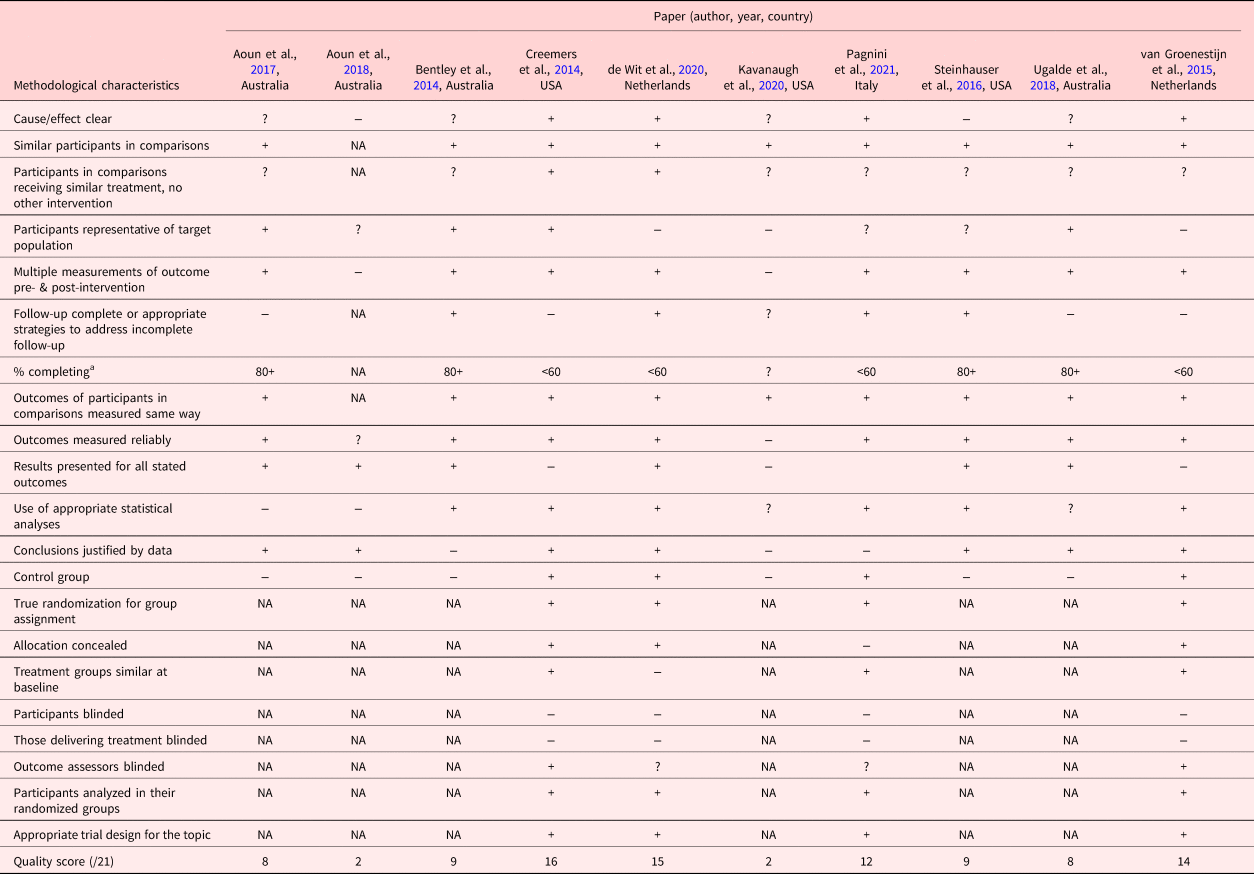
Table 1 summarizes the methodological characteristics of the quantitative studies using the JBI critical appraisal tools with a summary quality score (median 9, IQR 5.5, range 0–21) in the final row. Only the four RCTs achieved summary quality scores above 50% (score range between 57% and 78%).
Methodological characteristics of studies with a quantitative component

Key: present (+), absent (−), unclear (?), not applicable (NA).
a Studies reporting completion rates of 80% or above were assigned one point as recommended by the established guideline stating that up to 20% in-trial dropout is considered acceptable (Schulz and Grimes, Reference Schulz and Grimes2002; Furlan et al., Reference Furlan, Pennick and Bombardier2009).
The four studies using a control group were all RCTs (wait-list controls: de Wit et al., Reference de Wit, Beelen and Drossaert2020; Pagnini et al., Reference Pagnini, Phillips and Haulman2021; active controls: Creemers et al., Reference Creemers, Veldink and Grupstra2014; van Groenestijn et al., Reference van Groenestijn, Schröder and Visser-Meily2015). The causal relationship between the intervention and carer PWB was demonstrated only in the four RCTs. In all RCTs, participants were aware of their group allocation and those delivering treatments were also not blind to participants’ group allocation. Outcome assessors were blinded in two RCTs (Creemers et al., Reference Creemers, Veldink and Grupstra2014; van Groenestijn et al., Reference van Groenestijn, Schröder and Visser-Meily2015). Whether or not outcome assessors were blind to treatment assignment was unclear in two studies (de Wit et al., Reference de Wit, Beelen and Drossaert2020; Pagnini et al., Reference Pagnini, Phillips and Haulman2021). Further, whether participants were all receiving similar treatment besides the studied intervention was only clearly defined in two quantitative studies (Creemers et al., Reference Creemers, Veldink and Grupstra2014; de Wit et al., Reference de Wit, Beelen and Drossaert2020).
Representativeness of the study population was problematic in six studies (van Groenestijn et al., Reference van Groenestijn, Schröder and Visser-Meily2015; Steinhauser et al., Reference Steinhauser, Olsen and Johnson2016; Aoun et al., Reference Aoun, Hogden and Kho2018; De Wit et al., Reference de Wit, Beelen and Drossaert2020; Kavanaugh et al., Reference Kavanaugh, Cho and Fee2020; Pagnini et al., Reference Pagnini, Phillips and Haulman2021). In addition, there were sampling issues including small size and/or possible selection bias (Aoun et al., Reference Aoun, Hogden and Kho2018; de Wit et al., Reference de Wit, Beelen and Drossaert2020; Kavanaugh et al., Reference Kavanaugh, Cho and Fee2020; Pagnini et al., Reference Pagnini, Phillips and Haulman2021), disproportionately well-educated and financially stable participants (Steinhauser et al., Reference Steinhauser, Olsen and Johnson2016), rigid eligibility, and uneven group distribution (van Groenestijn et al., Reference van Groenestijn, Schröder and Visser-Meily2015).
Follow-up was complete in six studies, incomplete in three studies (Bentley et al., Reference Bentley, O'Connor and Kane2014; Steinhauser et al., Reference Steinhauser, Olsen and Johnson2016; de Wit et al., Reference de Wit, Beelen and Drossaert2020), and inapplicable in the cross-sectional survey (Aoun et al., Reference Aoun, Hogden and Kho2018). Only four studies reported intervention completion percentages of >80% (Bentley et al., Reference Bentley, O'Connor and Kane2014; Steinhauser et al., Reference Steinhauser, Olsen and Johnson2016; Aoun et al., Reference Aoun, Deas and Kristjanson2017; Ugalde et al., Reference Ugalde, Mathers and Hennessy Anderson2018), one study did not report completion rates (Kavanaugh et al., Reference Kavanaugh, Cho and Fee2020), while the four RCTs noted low completion rates (<60%) (Creemers et al., Reference Creemers, Veldink and Grupstra2014; van Groenestijn et al., Reference van Groenestijn, Schröder and Visser-Meily2015; de Wit et al., Reference de Wit, Beelen and Drossaert2020; Pagnini et al., Reference Pagnini, Phillips and Haulman2021).
Appropriate statistical analyses were evident in the RCTs. Two RCTs were sufficiently powered (Creemers et al., Reference Creemers, Veldink and Grupstra2014, n = 126; de Wit et al., Reference de Wit, Beelen and Drossaert2020, n = 148). Only two non-RCT studies (Bentley et al., Reference Bentley, O'Connor and Kane2014; Steinhauser et al., Reference Steinhauser, Olsen and Johnson2016) used appropriate statistical methods. The five uncontrolled longitudinal studies with a single treatment group and a pretest post-test design used small samples (n = 13–24) with limited statistical power.
Methodological characteristics of studies with a qualitative component (eight studies)
Six of the eight studies described uncontrolled longitudinal studies with a single treatment group and a pre-test, post-test design (n ranging from 12 to 24 carers). One study reported on qualitative research embedded in an RCT (n = 23) (de Wit et al., Reference de Wit, Vervoort and van Eerden2019), while another described a survey design (n = 117) (Aoun et al., Reference Aoun, Hogden and Kho2018). Six studies reported a higher percentage of female participants (58–100%); one did not present gender data (Marconi et al., Reference Marconi, Gragnano and Lunetta2016). All 14 participants in one study (Steinhauser et al., Reference Steinhauser, Olsen and Johnson2016) were female and described as “white.” The mean age of participants was reported in seven studies and ranged from 57 to 63 years.
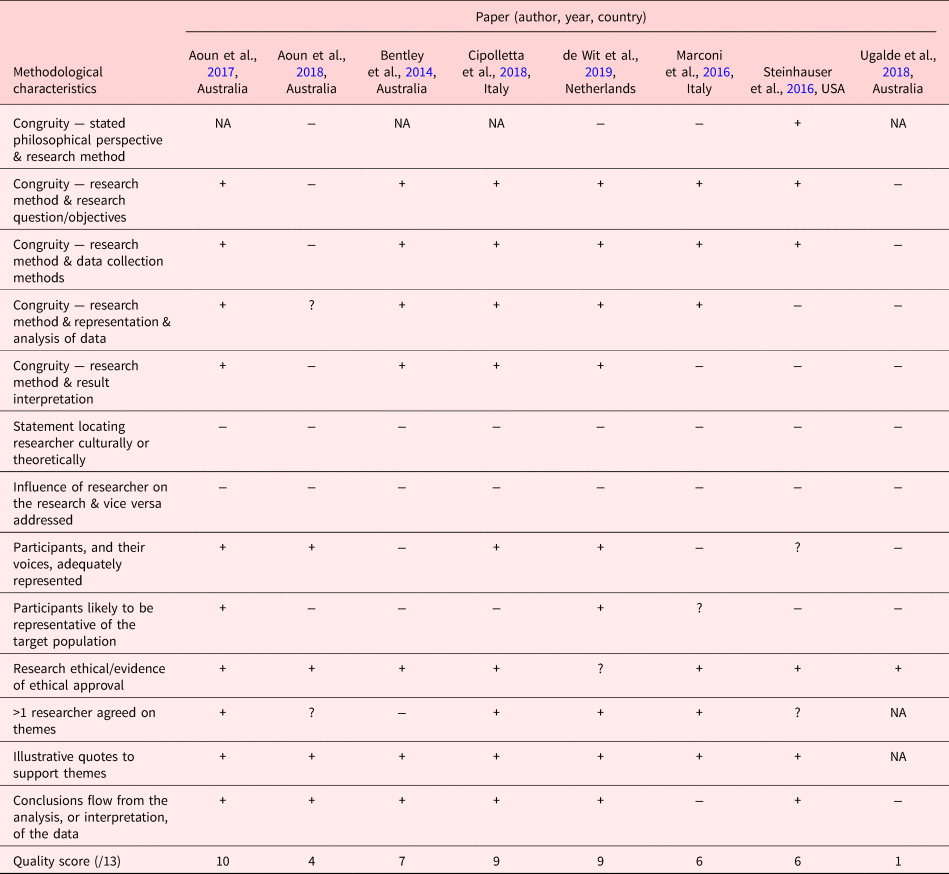
Three qualitative studies met most criteria for good methodological practice as defined by the JBI qualitative critical appraisal tool (quality scores between 73% and 80%). The other five studies demonstrated weaknesses in qualitative methodological rigor (score range: 20–60%). The median quality score was 6.5 (IQR = 3.5, range 0–13, Table 2).
Methodological characteristics of studies with a qualitative component

Key: present (+), absent (−), unclear (?), not applicable (NA).
Methodological rigor was more evident in some domains. Seven papers clearly provided a statement of ethical approval (unclear in de Wit et al., Reference de Wit, Vervoort and van Eerden2019). Seven studies presented illustrative quotes to support themes (no themes presented in Ugalde et al., Reference Ugalde, Mathers and Hennessy Anderson2018), while six studies demonstrated congruity between the research methodology and both the research question and data collection methods. Aoun et al. (Reference Aoun, Hogden and Kho2018) used open-ended questions without data analysis in a cross-sectional survey to collect intervention data during the last year of the 3-year study. Ugalde et al. (Reference Ugalde, Mathers and Hennessy Anderson2018) used responses to open-ended questions with a limited representation of participant voices or data analysis. The relationship of the conclusion to data analysis or interpretation was evident in six studies. In Marconi et al. (Reference Marconi, Gragnano and Lunetta2016), carer voices were not represented in all the domain-based illustrative quotes and conclusions sometimes grouped MND patients and carers together, while Ugalde et al.'s (Reference Ugalde, Mathers and Hennessy Anderson2018) paper made conclusions based on responses to open-ended questions with limited representation of participant voices or theme generation.
No qualitative studies presented a statement locating the researcher culturally and/or theoretically or commented on the influence of the researcher on the research, and vice versa. Additionally, congruity between the stated philosophical perspective and the research methodology was absent in all but one study (Steinhauser et al., Reference Steinhauser, Olsen and Johnson2016). These studies did not present a theoretical or philosophical perspective or if they did it was incompatible with the methodology (e.g., interpretive perspectives based on survey methodology, Aoun et al., Reference Aoun, Hogden and Kho2018; Ugalde et al., Reference Ugalde, Mathers and Hennessy Anderson2018).
Four studies did not demonstrate that more than one researcher agreed on themes (unclear: Steinhauser et al., Reference Steinhauser, Olsen and Johnson2016; Aoun et al., Reference Aoun, Hogden and Kho2018; presented quotes without any evidence of analysis: Bentley et al., Reference Bentley, O'Connor and Kane2014; Ugalde et al., Reference Ugalde, Mathers and Hennessy Anderson2018). Carer voices were represented in only four studies. The study by Steinhauser et al. (Reference Steinhauser, Olsen and Johnson2016) presented only selective data, no data were included to represent deviant cases, and a clear method of representing the data based on the presented methodology was not apparent. Quotes in Bentley et al. (Reference Bentley, O'Connor and Kane2014) and Ugalde et al. (Reference Ugalde, Mathers and Hennessy Anderson2018) are presented without significant description in the results, evidence of representation, or data analysis. In Marconi et al. (Reference Marconi, Gragnano and Lunetta2016), carer voices were not always present in illustrative quotes, and patient voices were used instead. Incongruity between the research methodology and results interpretation was present in four studies. This was exemplified by interpretive perspectives based on open-ended questions (Ugalde et al., Reference Ugalde, Mathers and Hennessy Anderson2018); open-ended questions from a survey (Aoun et al., Reference Aoun, Hogden and Kho2018), mixed carer and patient data (Marconi et al., Reference Marconi, Gragnano and Lunetta2016), and both limited and mixed (MND and cancer carer responses were mixed together) representation of the data (Steinhauser et al., Reference Steinhauser, Olsen and Johnson2016). Congruity between the research methodology and the representation and analysis of the data was not evident in the three studies. In Aoun et al. (Reference Aoun, Hogden and Kho2018), this congruity was unclear as the methodology was described as mixed-methods; however, selective responses to open-ended questions on a survey design were listed without any presentation of information regarding the data analysis methods or epistemological stance. Ugalde et al. (Reference Ugalde, Mathers and Hennessy Anderson2018) demonstrated limited evidence of representation of participant voices and no analysis of responses to open-ended questions. In Steinhauser et al. (Reference Steinhauser, Olsen and Johnson2016), a clear method of data representation based on the presented methodology was not apparent. MND and cancer carers’ responses were not separated.
Data extraction
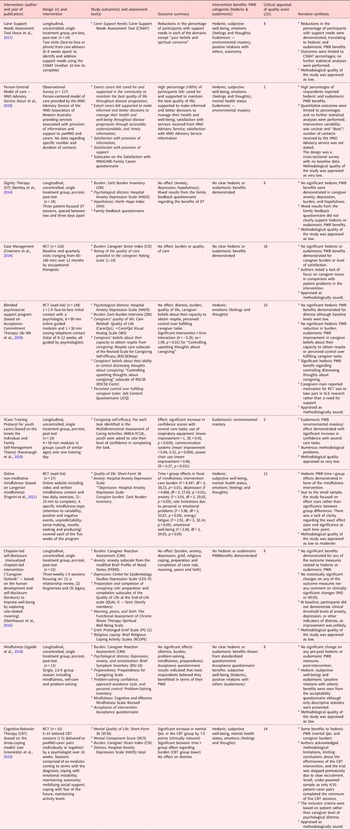
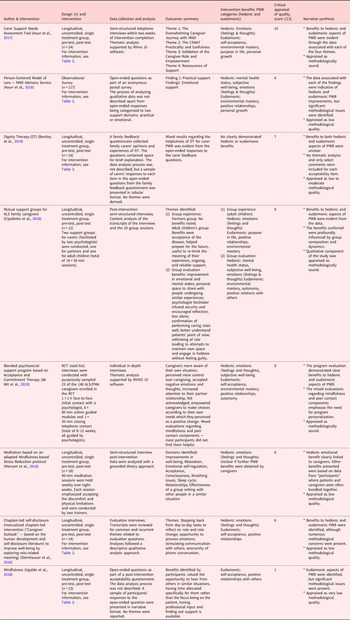
Due to the low number of studies as well as the heterogeneity of the interventions, outcomes, and measurements, data pooling for meta-analysis was not possible. Results from studies with quantitative and qualitative components are presented in Tables 3 and 4 respectively. These results are presented in a narrative manner and synthesised descriptively as recommended by the JBI guidelines for MMSRs (Aromataris and Munn, Reference Aromataris and Munn2020).
Synthesized narrative findings for studies with a quantitative component

PWB, psychological well-being; n, sample size; PwMND, person(s) with MND; QoL, quality of life; RCT, randomized controlled trial; SE, standard error.
Synthesized narrative findings for studies with a qualitative component

PWB, psychological well-being; n, sample size.
Quantitative findings
The RCTs predominantly used standardized outcome measures focusing on hedonic aspects of PWB (Table 3). No effect was demonstrated using these measures in two RCTs (Creemers et al., Reference Creemers, Veldink and Grupstra2014; de Wit et al., Reference de Wit, Beelen and Drossaert2020). Two RCTs (van Groenestijn et al., Reference van Groenestijn, Schröder and Visser-Meily2015; Pagnini et al., Reference Pagnini, Phillips and Haulman2021) reported a significant increase in the quality of life and a reduction in psychological comorbidities, although methodological concerns were present. One RCT (de Wit et al., Reference de Wit, Beelen and Drossaert2020) demonstrated a significant hedonic PWB benefit for controlling upsetting thoughts about caregiving. Results were largely unsupportive for PWB benefits in the quantitative components of the five uncontrolled longitudinal studies with a single treatment group and a pre-test, post-test design (Table 3). The one exception was the study by Aoun et al. (Reference Aoun, Deas and Kristjanson2017) (appraised as low methodological quality) where hedonic and eudaimonic PWB benefits were reported as reductions in carer support needs. Three (Bentley et al., Reference Bentley, O'Connor and Kane2014; Steinhauser et al., Reference Steinhauser, Olsen and Johnson2016; Ugalde et al., Reference Ugalde, Mathers and Hennessy Anderson2018: all appraised as low quality) of the other four uncontrolled studies did not demonstrate any benefits with standard PWB questionnaires. Hedonic and eudaimonic PWB benefits were seen from the acceptability questionnaire in Ugalde et al.'s (Reference Ugalde, Mathers and Hennessy Anderson2018) study. The remaining uncontrolled study (Kavanaugh et al., Reference Kavanaugh, Cho and Fee2020: appraised as very low methodological quality) reported a significant increase in confidence with several care tasks. The observational study using a survey design (Aoun et al., Reference Aoun, Hogden and Kho2018: appraised as low methodological quality) reported high percentages of respondents experiencing hedonic and eudaimonic PWB benefits. However, the lack of pre-post design in observational studies limits the interpretability of these results.
Qualitative findings
The three studies (Aoun et al., Reference Aoun, Deas and Kristjanson2017; Cipolletta et al., Reference Cipolletta, Gammino and Francescon2018; de Wit et al., Reference de Wit, Vervoort and van Eerden2019) appraised as methodologically sound demonstrated benefits to a range of hedonic and eudaimonic aspects of PWB (Table 4). In the mutual support group intervention, the benefits conferred were influenced by group composition and dynamics (Cipolletta et al., Reference Cipolletta, Gammino and Francescon2018). Three (Marconi et al., Reference Marconi, Gragnano and Lunetta2016; Steinhauser et al., Reference Steinhauser, Olsen and Johnson2016; Aoun et al., Reference Aoun, Hogden and Kho2018) studies appraised as low methodological quality reported benefits to both hedonic and eudaimonic aspects of PWB (Table 4). The other study (Bentley et al., Reference Bentley, O'Connor and Kane2014) reported mixed support for PWB from data derived from open-ended questions. While some eudaimonic PWB benefits were identified in the Mindfulness study (Ugalde et al., Reference Ugalde, Mathers and Hennessy Anderson2018), this was appraised as very low methodological quality.
Discussion
This is the first systematic review of interventions directly targeting the PWB of MND carers. The results indicate the dearth and recency of activity in this field as the number of included studies was low and papers describing interventions to improve carers’ PWB were only found from 2013 (8 of the 13 papers were published from 2017). Heterogeneity was evident in the types of interventions ranging from psychological treatments to support groups.
This review identified future areas of methodological development, as the included studies did not meet all the JBI appraisal tools’ criteria. Among the 10 studies with a quantitative component, only 4 described RCTs, considered as the gold standard for evaluating intervention effectiveness (Akobeng, Reference Akobeng2005). The six non-RCT quantitative studies were evaluated as low or very low methodological quality, significantly limiting the interpretability and confidence in these findings. None of these studies were able to demonstrate a causal relationship or used a control group. Additionally, it was unclear in 8 of the 10 quantitative studies whether participants received any other treatments, potentially interfering with the attribution of “effect” to the intervention studied (Akobeng, Reference Akobeng2005).
In future non-RCTs, researchers should carefully collect information regarding the most obvious potential confounders not only at baseline but also during the follow-up of the study. MND carer PWB has been linked to patient (e.g., symptom severity, emotional health, cognitive or behavioural change), carer (e.g., individual traits, problem-solving skills, coping styles), relationship (e.g., relationship satisfaction, nature of the relationship), and social factors (e.g., adequacy of social support, isolation) (Gluyas et al., Reference Gluyas, Mathers and Hennessy Anderson2017; Aoun et al., Reference Aoun, Cafarella and Hogden2021). In addition, careful investigation, measuring, and reporting of participant exposure to treatments other than the intervention that may potentially influence carer PWB are important. The optimal design to minimise influence of confounders is an RCT (Akobeng, Reference Akobeng2005). However, if using an RCT is not feasible, confounders can also be managed by using strategies such as restriction (e.g., inclusion and exclusion criteria), matching, and statistical control (Kahlert et al., Reference Kahlert, Gribsholt and Gammelager2017; Yan et al., Reference Yan, Karmur and Kulkarni2020).
Whereas appropriate inclusion and exclusion criteria are essential to reduce confounding, the use of strict criteria may negatively impact on participant recruitment and generalisability of data (e.g., van Groenestijn et al., Reference van Groenestijn, Schröder and Visser-Meily2015). Furthermore, when the inclusion of patient–carer dyads is only based on patient-related data, it may affect the relevance of carer-centric variables. For example, in cases where inclusion was based on patient rather than carer levels of psychological distress (e.g., van Groenestijn et al., Reference van Groenestijn, Schröder and Visser-Meily2015), carer-based variables associated with carer PWB may be missed and individual carer needs relevant to PWB may not be addressed.
Attrition rates were high in the included studies, with only four quantitative papers reporting intervention completion percentages of >80% (Bentley et al., Reference Bentley, O'Connor and Kane2014; Steinhauser et al., Reference Steinhauser, Olsen and Johnson2016; Aoun et al., Reference Aoun, Deas and Kristjanson2017; Ugalde et al., Reference Ugalde, Mathers and Hennessy Anderson2018). Completion rates were below 60% in each of the RCTs, consequently reducing the possibility of answering the research question or detecting clinically meaningful effects (Akobeng, Reference Akobeng2005). This is concerning as attrition rates greater than 20% involve serious threats to validity (Schulz and Grimes, Reference Schulz and Grimes2002; Furlan et al., Reference Furlan, Pennick and Bombardier2009). Managing carer attrition in longitudinal MND studies (RCTs and non-RCTs) is challenging because burden increases as MND progresses (Creemers et al., Reference Creemers, de Morée and Veldink2016) and patient deaths become common, which will directly impact carer attrition as it is closely linked to that of patients (Burke et al., Reference Burke and Pinto-Grau2018). Carer research burden minimisation plans are essential as the population is time-poor and often lacks access to essential services (Gluyas et al., Reference Gluyas, Mathers and Hennessy Anderson2017; Aoun et al., Reference Aoun, Cafarella and Hogden2021). Research burden could be reduced by using: (1) less-time demanding interventions and (2) technological methods such as self-paced, web-based interventions, home-based data collection, and telehealth. Where intervention attendance is preferred, transport provision would be enabling. Furthermore, carers may be more available and less overwhelmed earlier in the MND trajectory (Aoun et al., Reference Aoun, Bentley and Funk2013; Gluyas et al., Reference Gluyas, Mathers and Hennessy Anderson2017). Minimising exclusions post-randomisation and intention to treat analyses (Schulz and Grimes, Reference Schulz and Grimes2002) will help to manage issues associated with participant noncompliance, protocol deviations, and withdrawal, while guarding against an over-estimation of treatment effect (Gupta, Reference Gupta2011).
Recruiting difficulties could be addressed by broadening the range of eligibility criteria, including more recruitment sites (van Groenestijn et al., Reference van Groenestijn, Schröder and Visser-Meily2015) and minimising carer burden. The study with youth carers (Kavanaugh et al., Reference Kavanaugh, Cho and Fee2020) also noted distinct recruitment issues associated with this population (e.g., parental protection and isolation) and the authors suggested methods of addressing these problems in future studies (e.g., parental reassurance and ease of access).
A lack of blinding of participants and those delivering and assessing treatments were evident in the RCTs. Blinding is not always possible due to the nature of the intervention but may introduce performance and detection bias. Future studies should thoroughly assess the possibilities for blinding issues at participant, deliverer, and assessor level to eliminate or account for potential bias (Boutron et al., Reference Boutron, Guittet and Estellat2007).
Representativeness was also uncommon in the quantitative studies and future research should be cognisant of reducing such sampling error as it may introduce selection and information bias, as well as limiting external validity and generalizability (Kukull and Ganguli, Reference Kukull and Ganguli2012).
While some positive results were obtained in the qualitative studies concerning interventions for the PWB of MND carers, our review also indicated that this emerging field of research requires methodological development. Only three of the eight qualitative studies met most of the criteria of the JBI critical appraisal tool and demonstrated a range of PWB benefits in both hedonic and eudaimonic domains from the use of the Carer Support Needs Assessment Tool (Aoun et al., Reference Aoun, Deas and Kristjanson2017), mutual support groups (Cipolletta et al., Reference Cipolletta, Gammino and Francescon2018), and a blended psychosocial support program based on Acceptance Commitment Therapy (de Wit et al., Reference de Wit, Vervoort and van Eerden2019). While the remaining five studies identified a qualitative component, the study characteristics often did not meet most criteria of the critical appraisal tool. For example, some of the studies (Bentley et al., Reference Bentley, O'Connor and Kane2014; Aoun et al., Reference Aoun, Hogden and Kho2018; Ugalde et al., Reference Ugalde, Mathers and Hennessy Anderson2018) presented selective data obtained through open-ended questions. Although such responses qualify as qualitative data, free text (such as that obtained in surveys) does not constitute qualitative research (Hammarberg et al., Reference Hammarberg, Kirkman and de Lacey2016). While qualitative research may be inclusive of a wide range of epistemological and theoretical positions, best practice still requires that such frameworks are stated (Patton, Reference Patton2015; Hammarberg et al., Reference Hammarberg, Kirkman and de Lacey2016). None of the qualitative studies provided this information, disallowing any meaningful assessment of the quality and credibility of the results in the absence of an understanding of the process and perspective the researcher brought to the study (Patton, Reference Patton2015).
While some benefits to PWB were demonstrated in the included studies, it should be mentioned that the degree to which carer-specific needs were addressed in the designs of the interventions varied across studies. This has likely affected outcomes. For example, 2 of the 12 included studies (Bentley et al., Reference Bentley, O'Connor and Kane2014; Creemers et al., Reference Creemers, Veldink and Grupstra2014) incorporated solely patient-based interventions with carer PWD only a secondary focus. Unsurprisingly, these studies reported no (Creemers et al., Reference Creemers, Veldink and Grupstra2014) or less PWB improvements than patients (Bentley et al., Reference Bentley, O'Connor and Kane2014).
A broader range of PWB benefits were evident in the qualitative data when compared with quantitative outcomes. Quantitative studies largely used hedonic PWB outcome measures (e.g., mental health), with benefits suggested only in 2 (van Groenestijn et al., Reference van Groenestijn, Schröder and Visser-Meily2015; Pagnini et al., Reference Pagnini, Phillips and Haulman2021) of 10 studies despite methodological concerns. Some qualitative studies reported benefits to a range of both hedonic and eudaimonic aspects of PWB although they did not specifically or clearly demonstrate systematic decreases in clinical symptoms of mental health problems such as depression, anxiety, and carer burden. Psychological morbidity remains a serious problem in the MND carer population (Aoun et al., Reference Aoun, Kissane and Cafarella2020a), and well-designed, high-quality research demonstrating clear reductions in depression, anxiety, and burden are urgently required. Interestingly, some of the six studies using mixed-methods designs demonstrated variability in quantitative vs. qualitative outcomes. These studies reported no or limited PWB benefits in the quantitative measures yet demonstrated benefits or mixed results from the qualitative arm. This lack of concordance between quantitative and qualitative data is noteworthy in an MMSR (Stern et al., Reference Stern, Lizarondo and Carrier2020), possibly demonstrating that the varying methodologies in these studies addressed different aspects of the phenomena of interest or sensitivity issues with the outcome measures selected. Lack of power in quantitative study arms (because of small study sample sizes) is also a very plausible explanation for the lack of concordance.
Strengths and limitations
This systematic review took an integrative approach, acknowledging the value of hedonic and eudaimonic aspects of PWB as both are associated with positive outcomes (Vazquez et al., Reference Vazquez, Hervas and Rahona2009). This broad approach was advantageous given the early development of the field of inquiry, increased potential for greater inclusiveness of studies, enabled the capture of a wider range of potential intervention effects, and countered the limited view of simply defining carer PWB in terms of responses to psychological morbidity questions. Furthermore, this process encompassed quantitative and qualitative approaches, and the discordance between these types of data highlighted the importance of considering different aspects of PWB. Data pooling for meta-analysis was not possible due to the heterogeneity of the interventions, outcomes, and measurements, as well as the low number of studies.
Future recommendations
Future studies should increase attention to the methodological features associated with high-quality research which can be facilitated by using existing frameworks and checklists (e.g., JBI). Researchers should be aware of the variety of approaches to the development of health interventions prior to designing treatments (O'Cathain et al., Reference O'Cathain, Croot and Sworn2019). This knowledge can guide the development, piloting, evaluation, and implementation components of future research, while ensuring methodological rigor. Moreover, this process values what we know about MND carer needs (e.g., Aoun et al., Reference Aoun, Deas and Kristjanson2017) and can facilitate the theory identification and development necessary in a new and rapidly developing field (O'Cathain et al., Reference O'Cathain, Croot and Sworn2019).
Carefully designed mixed-methods studies can be informative as different forms of research may be better suited to capture diverse aspects of carer PWB. The inclusion of both hedonic and eudaimonic aspects of PWB may assist in obtaining a broader range of potential intervention effects and encapsulate benefits more relevant to the individual's needs. The mixed results of some studies highlight the potential value of tailoring interventions. A generic approach may not address the PWB requirements of MND carers whose individual needs may change over the disease course. Differentiating carer needs have been identified at diagnosis, maintenance, terminal, and bereavement stages (Poppe et al., Reference Poppe, Koné and Iseli2020). A “goodness-of-fit” approach, where individual risks and needs are assessed and matched to tailored treatment, has been proposed (Aoun et al., Reference Aoun, Cafarella and Rumbold2020b).
The heterogeneity among MND carers participating in the studies in this review further highlights the importance of assessing individual carer needs and tailoring interventions accordingly. Factors to consider when designing carer interventions include identifying those at higher risk of poorer PWB outcomes (Aoun et al., Reference Aoun, Kissane and Cafarella2020a) and MND patient stage (Poppe et al., Reference Poppe, Koné and Iseli2020). A narrative review of variables relevant to intervention design concluded that MND carers with limited problem-solving and coping skills, as well as those looking after patients with mental health issues, severe clinical symptoms, or neurobehavioral problems, were also at increased risk of poorer PWB (Gluyas et al., Reference Gluyas, Mathers and Hennessy Anderson2017). Poorer bereavement outcomes have also been noted in MND carers with mental health problems, lower family functioning, spousal relationships, and inadequate support (Aoun et al., Reference Aoun, Kissane and Cafarella2020a). Moreover, as most MND carers in this review were spousal, future intervention designs may consider also promoting dyadic coping, which is defined as “partners' coping responses to each other's stress resulting from circumstances outside the relationship,” especially as this variable is linked with improved PWB (Falconier and Kuhn, Reference Falconier and Kuhn2019, p. 2).
Additionally, psychological research has recently focused on the recognition and treatment of trans-diagnostic treatment targeting shared mechanisms underlying different mental health problems (Sauer-Zavala et al., Reference Sauer-Zavala, Cassiello-Robbins and Ametaj2019). This could be particularly relevant for MND carers for whom symptoms of one mental health problem (e.g., depression) may exist with related issues (e.g., burden) and treatment would involve a consideration of an individual's preexisting strengths and weaknesses.
Given the treatment access issues reported in MND research with carers (Aoun et al., Reference Aoun, Cafarella and Hogden2021), e/telehealth interventions should be given more consideration. Finally, the range of countries (in this review: n = 4, developed, Western) participating in these interventions should be broadened to increase generalizability.
Conclusion
There is a significant body of research highlighting the negative PWB impacts of the MND caregiving role. However, there remains only a limited number of studies specifically designed to improve the PWB of carers. Benefits to carer PWB were only demonstrated in a small number of studies. Most studies suffered from substantial methodological problems, rendering the overall evidence base as low. Further attention and resources need to be applied to this domain, particularly as MND carers remain neglected, mental health consequences can be severe, and may directly impact the person living with MND (Aoun et al., Reference Aoun, Kissane and Cafarella2020a).
Supplementary material
The supplementary material for this article can be found at https://doi.org/.10.1017/S1478951522000311.
Funding
This research received no specific grant from any funding agency, commercial, or not-for-profit sectors.
Conflict of interest
There are no conflicts of interest.