Feeding problem prevalence rates of up to 80% are reported for children with disabilities. This is significantly higher than the estimated 25–35% of typically developing children who exhibit feeding problems (Shreck, Williams, & Smith, Reference Schreck, Williams and Smith2004). Feeding problems are especially common in autism, with an estimated prevalence as high as 90% (Volkert & Vaz, Reference Volkert and Vaz2010).
There are numerous types of feeding problems, including pica, packing, rapid eating, refusal, and disruptive behaviours during mealtimes (Ledford & Gast, Reference Ledford and Gast2006; Martins, Young, & Robson, Reference Martins, Young and Robson2008). Selective eating, where children only eat certain types of foods while rejecting others (Twachtman-Reilly, Amaral, & Zebrowski, Reference Twachtman-Reilly, Amaral and Zebrowski2008), is the most common feeding problem. It is estimated to occur in as many as 67% of children with autism (Williams, Dalrymple, & Neal, Reference Williams, Dalrymple and Neal2000). Selectivity is often based on the type, novelty, colour, texture, preparation and presentation of foods (Ahearn, Castine, Nault, & Green, Reference Ahearn2001; Shreck & Williams, Reference Schreck and Williams2006). Children with autism are also commonly reported as unwilling to try new types of food (Shreck et al., Reference Schreck, Williams and Smith2004; Williams et al., Reference Williams, Dalrymple and Neal2000). Evidence suggests that biological factors such as genetics or gastrointestinal (GI) malfunctions are responsible for some feeding problems (Ibrahim, Voigt, Katusic, Weaver, & Barbaresi, Reference Ibrahim, Voigt, Katusic, Weaver and Barbaresi2009). According to Ibrahim and colleagues, GI problems could cause pain, abdominal bloating or irritability and constipation when eating certain types of foods, which in turn could cause feeding problems.
Particular parenting behaviours, including reinforcement of maladaptive feeding patterns, such as allowing children to leave the table when they refuse to eat, have also been shown to cause some feeding problems (Ahearn et al., Reference Ahearn, Castine, Nault and Green2001). Selective eating in particular, is associated with common autistic traits such as inflexibility, preference for sameness and ritualistic tendencies, which might explain the rigid food preferences in some children with autism (Matson, Fodstad, & Dempsey, Reference Matson, Fodstad and Dempsey2009; Twachtman-Reilly et al., Reference Twachtman-Reilly, Amaral and Zebrowski2008).
However, regardless of the underlying causes, feeding problems when left unresolved can increase the risk for nutritionally related medical problems such as rickets or other health problems, including excessive weight loss, dehydration, (Kodak & Piazza, Reference Kodak and Piazza2008; Schreck et al., Reference Schreck, Williams and Smith2004) failure to thrive, as well as learning and behavioural problems. Numerous interventions have been employed to treat feeding problems in young children. Applied Behaviour Analysis (ABA)-based interventions for feeding problems, including escape extinction, simultaneous presentation, behavioural momentum and reinforcement procedures, are among the best supported in the research literature.
Escape extinction (EE) has two forms: non-removal of the spoon and physical guidance (Kodak & Piazza, Reference Kodak and Piazza2008). In the first form, the spoon is not removed until the child has accepted the food while the second form involves a gentle pressure to the child's jaw to open the mouth (Ahearn, Reference Ahearn2002). Simultaneous presentation, which has been shown to increase acceptance of previously rejected foods, involves presenting both the child's preferred and non-preferred foods at the same time. The child is given the preferred food once the non-preferred item has been consumed. A variation of this method is to blend the two food items together in one bite. The ratio of non-preferred to preferred food is gradually increased until the previously non-preferred food is accepted and consumed on its own (Kodak & Piazza, Reference Kodak and Piazza2008).
Behavioural momentum is a technique that has been reported to increase food acceptance and consumption. This procedure involves presenting an initially empty spoon to the child's mouth, followed by a small bite on the spoon (Sharp & Jaquess, Reference Sharp and Jaquess2009). The amount of food on the spoon is gradually increased, to build a momentum, until the child accepts spoonful amounts of food (Volkert & Vaz, Reference Volkert and Vaz2010). Lastly, reinforcement for appropriate behaviours has been shown to be highly effective in motivating children with autism (Kitfield & Masalsky, Reference Kitfield and Masalsky2000; Laud, Girolami, Boscoe, & Gulotta, Reference Laud, Girolami, Boscoe and Gulotta2009; Patel, Piazza, Martinez, Volkert, & Santana, Reference Patel, Piazza, Martinez, Volkert and Santana2002). Verbal praise is the most commonly used form of reinforcement; however, alternatives such as token systems, where children are given opportunities to earn tangible reinforcers such as stickers and sweets, are sometimes necessary (Matson & Fodstad, Reference Matson and Fodstad2009).
While singular behavioural interventions have been shown to decrease feeding problems and increase food acceptance, it is thought that combinations of interventions (also called treatment packages) could produce results faster and more reliably (Ahearn, Reference Ahearn2002; Hagopian, Farrell, & Amari, Reference Hagopian, Farrell and Amari1996). The primary aim of this study was to evaluate the effects of EE combined with reinforcement on feeding problems in a child with autism with a view to increasing appropriate eating behaviours. The rationale for this choice of treatment package is that studies using EE have demonstrated reductions in food refusals, while the effects of reinforcement in increasing desired behaviour in children with autism are also well documented (Kodak & Piazza, Reference Kodak and Piazza2008; Matson & Fodstad, Reference Matson and Fodstad2009). It was predicted that a treatment package consisting of positive reinforcement and EE would significantly increase acceptance of food across three settings — breakfast, lunch and dinner. Second, any increase in food acceptance was predicted to maintain on termination of the intervention, provided that the desired eating behaviours are met with reinforcements such as verbal praise.
Method
Participant
The participant in this study was a 2-year-old girl, Anne (pseudonym), who was diagnosed with autism and pervasive developmental delay (PDD) at age 1 and exhibited feeding difficulties. Anne was reported to have no allergies to any food types. Prior to the commencement of the intervention she would only eat when being fed by her mother while sitting on a highchair. However, the main concern of Anne's parents was her tendency to refuse food and her lack of chewing as she only swallowed food placed in her mouth. Anne occasionally attempted to swallow food lumps without chewing, which could result in coughing and gagging responses. Consequently, Anne avoided and refused to consume lumpy food and would only eat mashed or pureed food.
The study took place in the home setting with her mother always present to feed Anne. The sessions took place during the times she would normally eat her meals. Sessions were videotaped to aid in data collection and to obtain interobserver agreement measures.
Materials
The materials used in this study included food served in a bowl with a spoon. A Flip Video Camcorder video camera was used for the recording of baseline and intervention sessions, and behavioural measures were recorded on a data sampling sheet (a copy of this sampling sheet can be obtained on request from the first author).
The Brief Autism Mealtime Behavior Inventory (BAMBI; Lukens & Linscheid, Reference Lukens and Linscheid2008)
The BAMBI scale was designed specifically to assess feeding problems in children with autism. BAMBI consists of 18 items which have been found to load on three factors: Limited Variety, Food Refusal and Features of Autism. Examples of items on the scale include ‘My child expels food that he/she has eaten’, ‘My child accepts or prefers a variety of foods’, and ‘My child refuses to eat foods that require a lot of chewing’. This inventory has shown good psychometric properties with a significant construct validity, high internal consistency (Cronbach's alpha of .88) and high test–retest reliability coefficient (r = .87, p < .01).
Behavior Intervention Rating Scale (BIRS; Elliott, & Von Brock Treuting, Reference Elliott and Von Brock Treuting1991)
This scale consisted of 21 items and the response scale is a 6-point Likert scale ranging from 1 (Strongly disagree) to 6 (Strongly agree). Examples of items include ‘This is an acceptable intervention for the child's problem behaviour’, ‘The intervention has quickly improved the child's behaviour’, and ‘Overall, the intervention is effective’.
Independent Variable
The independent variable was the EE procedure in combination with verbal reinforcement. A 45-minute training session was conducted to teach Anne's mother how to employ EE and verbal reinforcement, when feeding her child. The mother was instructed to give verbal praise and encouragements such as ‘very good’, ‘good girl’, ‘that's good’ every time Anne accepted a bite. Further, the mother was instructed to keep the spoon in front of Anne's face and not pull away until she accepted the bite into her mouth. If Anne was disruptive (e.g., pushing the food away, crying or blocking the spoon with her hands), thereby preventing the conduct of the EE procedure, the mother was told to reintroduce the same spoon to her. The duration of each session was restricted to 30 minutes to minimise fatigue, discomfort and stress for both Anne and her mother.
Dependent Variable
The dependent variable was the number of times (reported as a proportion of the total) Anne accepted the food offered to her. Acceptance was defined as complying with the insertion of food into her mouth and chewing/swallowing it without expulsions. The number of spoons where food was accepted was recorded for the duration of all sessions. The number of times she rejected or refused to eat a bite was also measured to enable calculation of acceptance rates. Rejection or refusal of food was defined as either turning face or body away from the food, covering the mouth when the spoon approached the lips, blocking the spoon with her hands, pushing the spoon away or spitting out food already deposited into the mouth.
Interobserver Agreement
Interobserver agreement (IOA) was obtained for one third of all sessions distributed across all phases of the treatment program (baseline, intervention and follow-up sessions across the three settings breakfast, lunch and dinner). A second observer independently viewed the video clips and measured the participant's behaviour. The first author and the second observer independently watched the video clips and scored Anne's behaviour. IOA was calculated by dividing the smaller count by the larger count and multiplying this by 100. Interobserver agreement was high, ranging from 95% to 100%.
Design
The relationship between the intervention and any observed changes in Anne's eating behaviour was assessed through a multiple baseline across settings design. Observational data were graphed and examined visually for changes in trend and level across phases. Effect sizes were calculated (Baseline vs. Intervention) as a secondary analysis using percentage non-overlapping data (PND; Scruggs, Mastropieri, & Castro, Reference Scruggs, Mastropieri and Castro1987).
Procedure
The University Human Research Ethics Committee approved the project before data collection began. Upon approval, informed consent was obtained from Anne's parents. Anne's mother was interviewed prior to the intervention where she spoke about Anne's feeding problems. She was also asked to complete the BAMBI. Her responses indicated that Anne had problems with both selective eating and food refusal. Post intervention, the participant's mother was again interviewed and asked to complete the BIRS as a measure of the social validity of the treatment.
Baseline
Baseline data at breakfast, lunch and dinner were collected prior to the intervention. During baseline, the participant's mother was asked to feed the child the way she normally would. The first author videotaped the meals and subsequently recorded the number of spoons Anne accepted or refused on a data sampling sheet.
Training session
On completion of baseline data collection in the first setting, a 45-minute training session (described above) was conducted to teach Anne's mother the EE and reinforcement procedures.
Intervention
The intervention was first introduced in the breakfast setting. During this stage, baseline data collection continued for lunch and dinner. When food acceptance to criterion had been achieved in the first setting, the second intervention setting (lunch) was initiated while baseline data collection continued for dinner. Lastly, when criterion was achieved for lunch times, intervention in the final setting was initiated.
Follow-up
One week after completion of the intervention follow-up sessions were conducted to see whether the observed behavioural changes maintained. During follow-up conditions were as in Baseline except that the mother was told she could continue to reward appropriate eating behaviours with verbal praise.
Results
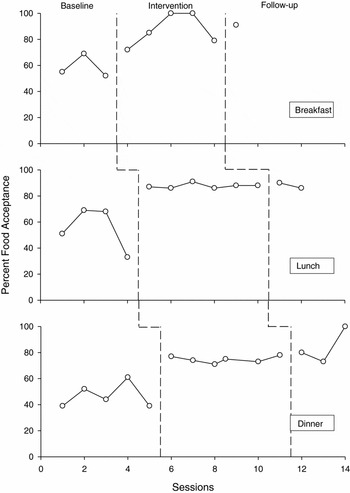
Food acceptance and refusal rates (as percentage scores) across the three experimental conditions in each of the three different settings are presented in Figure 1.
The percentage of food acceptances in baseline, intervention and follow-up at breakfast, lunch and dinner in a multiple baseline across settings design.

Baseline observations showed that the rate of food acceptance was low during baseline with some differences observed across settings (breakfast mean 59%, range 52–69%; lunch mean 58%, range 33–69%; dinner 46%, range 40–61%). The lagged introduction of the intervention in each of the three meal settings was associated with a clear increase in the rate of food acceptance and reduction in within phase variability (breakfast mean 87%, range 73–100%; lunch mean 88%, range 68–91%; dinner mean 75%, range 73% to 78%). Although greater variability is evident in the intervention data in the first setting (breakfast), the percentage of non-overlapping data (PND) (Scruggs, Mastropieri, & Castro, Reference Scruggs, Mastropieri and Castro1987) for these data was 100%, in all settings. Results from the follow-up sessions reveal that food acceptance was maintained at levels comparable to those in intervention in each setting (breakfast 91%, lunch 84%, dinner 84%).
Post intervention, the mother's responses to the Behaviour Intervention Rating Scale indicated that she was highly satisfied with the EE combined with reinforcement treatment package and has noticed improvements in the child's eating behaviours in other settings as well as in the home. Out of the 21 items, she rated 4 (Slightly agree) on one item, 5 (Agree) on 16 items, and 6 (Strongly agree) on four items. These positive responses indicate that the mother found the intervention useful and highly effective. She also indicated that she was likely to use it in the future and would recommend its use to other parents. The high scoring on all 21 items reflect positively the social validity of the present study.
Discussion
As predicted, significant increases in food acceptance were found across all three settings from the baseline to the intervention stage. The level of non-overlapping data between baseline and intervention phases (PND) suggests this was a very effective procedure (Scruggs & Mastropieri, Reference Scruggs and Mastropieri1998). Results from the follow-up sessions revealed that the behavioural gains maintained post intervention. Inspection of the data presented in Figure 1 reveals a gradual improvement over time in Anne's rate of acceptance of food in the first setting, breakfast, with a more step-like increase in food acceptance in both the lunch and the dinner settings once the intervention was initiated. This may indicate a generalisation of learning from the first setting to the others.
Post intervention, the mother continued reinforcing appropriate eating behaviours with verbal praise, and Annie maintained high levels of food acceptance. This, together with the responses on the BIRS, attests to the social acceptability of the EE combined with reinforcement procedure with Anne's mother. On completion of the study, Anne's mother also reported that Anne has accepted being fed by two different caretakers, her grandmother and a worker at the weekly playgroup she attended. This is an important improvement as previously Anne would only accept food when fed by her mother. Moreover, prior to the study, Anne refused to eat unless she was seated on a highchair. The mother reported that Anne is now being fed sitting on a normal chair with armrests at every meal.
Time constraints prevented collection of long-term follow-up data, limiting confidence in the maintenance over time of the observed behavioural changes. In addition, the usual caveats regarding the external validity of single subject studies of this nature apply. However, the findings conform with those of previous researchers (Ahearn, Reference Ahearn2003; Matson & Fodstad, Reference Matson and Fodstad2009; Patel et al., Reference Patel, Piazza, Martinez, Volkert and Santana2002) and are sufficiently robust to warrant further research testing the generalisability of these findings. This application of positive reinforcement and EE was directly beneficial to the participant's family as it helped alleviate some of the stress caused by the child's food refusals and increased the mother's opportunity to engage in activities away from her daughter. Improved quality of life evident in the mother's positive responses to the Behavior Intervention Rating Scale underscores the social validity of this study.
In conclusion, the EE and positive reinforcement treatment package significantly increased food acceptance in a young child with autism. In follow-up, the behavioural changes remained at a level similar to those found during treatment, indicating maintenance of the behavioural gains. Lastly, potential generalisation effects of the treatment package were also found across different eating-related behaviours. However, more research is needed to investigate whether the results of this study can be generalised to a wider population.