1. INTRODUCTION
The Democratic Party's embrace of racial liberalism and the Republicans' move toward racial conservatism in the mid-twentieth century represent a momentous transformation in American politics. Sometime between the late nineteenth century and the passage of the major civil rights acts of the 1960s, the two major parties essentially switched positions on civil rights issues. While there is a scholarly consensus on this very general statement, once one moves to more specific claims concerning the causes, timing and sequence of this shift, the consensus quickly erodes.
Understanding the transformation in the parties' stance toward civil rights is critically important for both substantive and theoretical reasons. From a substantive standpoint, the twentieth century struggle for civil rights is a major chapter in what is a central story in American history: race relations between African Americans and white Americans; the implications for theories of political change are equally striking.
Are changes in party alignments driven by the choices of national party elites or are they rooted in deeper coalitional and ideological dynamics? Was the break-up of the New Deal coalition of southern conservatives and nonsouthern liberals inevitable once grassroots activists forced civil rights issues onto the national political agenda, or was it the product of strategic choices by such national elites as Lyndon Johnson and Barry Goldwater? What is the role of “critical moments,” in which small, potentially random perturbations can set events on a dramatically different course? The answers reached in the case of civil rights have important implications for more recent issues in which the parties' positions have shifted, such as the GOP's embrace of social conservatism in the 1970s–1990s.Footnote 1 The theoretical stakes here demand an accurate and detailed understanding of the sequence and timing of the civil rights realignment.Footnote 2
We seek to shed new light on some of the theoretical issues that surround the civil rights realignment by examining a new data source: state political party platforms.Footnote 3 As we will demonstrate, these data indicate that, outside of the South, the Democratic Party's civil rights advocacy exceeded that of the GOP far earlier than conventional wisdom suggests. Furthermore, rather than acting exclusively as an intermediary between national party elites and masses, actors embedded in state parties played an important, early role in shaping their parties' positions on civil rights issues.
More generally, we argue that nonsouthern Democrats' ideological commitments and coalitional partners generated a strong incentive to adopt the more pro–civil rights position as grassroots activists—both within and outside the party—forcing the issue to the top of the national agenda. In contrast, by the 1940s, nonsouthern Republicans had much less intraparty pressure to embrace liberal civil rights policies. While national Democrats often sought to simultaneously tamp down and straddle the civil rights issue in order to placate the southern wing of the party, this was not a viable strategy in the long-term, as key elements of the nonsouthern majority of the party had powerful incentives to stake out a clear position on civil rights. Conversely, Republicans' core constituencies were less committed to civil rights liberalism, and were unlikely to punish moves by the party to join with southern whites in staking out a more conservative position. Rather than a choice by relatively autonomous national party elites, the civil rights realignment is best viewed as rooted in forces unleashed in the New Deal, when the Democratic Party became the ideological home of programmatic liberalism, governmental activism, and universalistic, rights-based arguments. It also became the coalitional home of progressives, Congress of Industrial Organizations (CIO) labor activists, African American voters outside of the South, as well as ethnic and immigrant groups (e.g., Jews) predisposed to civil rights liberalism. By contrast, the New Deal era solidified the GOP's ideological shift away from progressivism toward antistatism, and the party's coalitional alignment with business interests and with suburban and rural voters—none of which predisposed the party to be aggressively supportive of civil rights.
Our analysis is structured as follows. After reviewing Edward Carmines and James Stimson's issue evolution model in section 2, section 3 describes our primary data source: state party platforms from 1920–1968. Section 4 discusses our approach to coding the platforms to identify each state party's position on civil rights issues, and section 5 describes our main results. In section 6, we consider how our evidence from state party platforms fits in with other evidence on the timing of the civil rights realignment, which connects our findings concerning state party activists with the national parties' coalitional partners, electoral groups, and partisan elites in Congress. Section 7 concludes.
2. RECONSIDERING ISSUE EVOLUTION AND THE CIVIL RIGHTS REALIGNMENT
Among political scientists, the prevailing explanation for the parties' reversal is Carmines and Stimson's issue evolution model.Footnote 4 This model makes four major theoretical claims: (1) the partisan evolution on civil rights issues followed an elites-to-activists-to-masses channel; (2) national party elites had a significant amount of discretion in their actions; (3) the eventual outcome was not inevitable, but rather contained a strong element of randomness; and (4) the process followed a dynamic growth model, with the majority of change occurring during a relatively brief period of time, followed by a longer period of gradual, somewhat path-dependent change.
First, Carmines and Stimson's model places elite actors at the start of the issue evolution process, which is perhaps the central component of the authors' theory. They view politics as a Darwinian competition in which national elites frequently introduce new issues in the hope that these new entrants will strike a chord, thereby benefiting those elites. On rare occasions, a new issue evokes a large mass response, becoming important enough to create a transformation in the composition and orientation of the two parties. According to the authors, this process occurs along a prescribed path, from elite introduction to mass acceptance. National party elites first take clear and differing positions on the issue; activists then transmit these new elite positions to the mass electorate. Finally, ordinary voters perceive this difference, seeing it as important enough to merit a change in their long-term orientation toward the parties.Footnote 5 This elites-activists-masses sequence is fundamental to the theory. In a review essay on issue evolution, Carmines and Michael Wagner emphasize that “temporal ordering is critical to issue evolution; elite reorientation on the issue precedes change in the ‘cognitive and affective images of the parties,’ which comes before mass partisan response.”Footnote 6
Next, Carmines and Stimson further claim that elites have relatively broad discretion in setting their parties' positions. Elites are more than simply the first mover in a sequence, but rather act as strategic entrepreneurs, crafting and recrafting issue positions in order to compete. While Carmines and Stimson acknowledge that elites do not “control” the process in the sense that elites cannot reliably predict which messages will resonate with voters or what the later-order consequences of their actions may be, they argue that elites have a considerable amount of discretion in regard to what policy positions they introduce.Footnote 7 Barry Goldwater in particular is repeatedly mentioned as a crucial player in the Republican Party's evolution. “It is difficult to overestimate the significance of Barry Goldwater in this partisan transformation,” Carmines and Stimson write.Footnote 8 In this telling, activists, partisan identifiers in the mass electorate, or their party's history are not decisive constraints on politicians' positions when an issue evolution occurs. Instead, for the most part, elites are free to introduce new issue positions that they believe would be electorally beneficial.
Third, policy entrepreneurs' wide latitude means that issue evolution is open-ended and to a large degree random during its early stages. Since individual policy entrepreneurs with incomplete information about the effects of their actions are at the helm, the decisions they make, particularly at the start of the process, may resemble a random walk; the results of their decisions may appear logical or even inevitable only in hindsight.Footnote 9 Carmines and Stimson claim that “chance is the fundamental driving force in producing change,”Footnote 10 and that there are “no situations in the political evolution of race where … it could only have happened as it did.” Thus, if it were possible to “re-run” the civil rights era, it is likely that we would observe a nontrivially different result.Footnote 11 Only later in the process, after the critical moment, does this element of randomness decline, replaced by path dependent, self-reinforcing processes.
Fourth, Carmines and Stimson offer a specific model of partisan change, which they label the dynamic growth model. In this model, the bulk of change occurs during a relatively brief critical moment. This critical moment is followed by a longer period of path-dependent dynamic growth, during which the political system continues to slowly and asymptotically realign. Drawing on Niles Eldridge and Stephen Jay Gould's evolutionary concept of punctuated equilibrium, their model posits virtually no change before the critical moment, a brief “burst of rapid change” at the critical moment, and a subsequent secular realignment, or lengthy period of slow change to complete the transition to a new equilibrium.Footnote 12 Applying their dynamic growth model to the civil rights period, they identify a critical moment centered at 1963–1964. In this account, the prerealignment equilibrium was in place during the 1940s, 1950s and early 1960s, when both parties took moderate positions on civil rights issues, and the Republicans arguably were more supportive of civil rights legislation for much of that period. At the end of World War II, Carmines and Stimson claim that, “urban [northern] Democrats managed to avoid conflict between social welfare and race by ignoring race,” forcing Harry Truman to “turn mainly to the opposition party for support” of civil rights initiatives.Footnote 13 This supposed greater GOP support for civil rights continued through 1957–1958, when Carmines and Stimson state that, “the Republican senators were more liberal overall, which we already knew, and they were also more liberal than the Democrats within each region.”Footnote 14 Indeed, throughout the 1950s “both parties took relatively moderate stands on racial issues,” but with the GOP “being more supportive of civil rights.”Footnote 15 By the 1964 “flashpoint,” however, Johnson's record of civil rights accomplishments and Goldwater's expressed racial conservatism, coupled with the heightened salience of civil rights issues, placed the parties firmly in the midst of a critical moment.Footnote 16 The period after the mid-1960s through the Carter and Reagan administrations is identified as a long period of secular realignment following the critical moment.
We propose an alternative view of the timing and sequence of the partisan shift on civil rights. First, we demonstrate that state party activists' changing views on civil rights precede those of national elites.Footnote 17 Second, we argue that these activists and party coalitional partners constrain future elite action. Third, we cast doubt on the claim that, if one were to rerun history starting at some point prior to what Carmines and Stimson term a critical moment, one might reasonably expect a significantly different outcome. For instance, our evidence strongly suggests that if it were possible to rerun history from 1956, in all likelihood the resulting party alignments would be indistinguishable from the actual alignments. Finally, we question the usefulness of the critical moment concept for understanding the partisan shift on civil rights. Rather than a short burst of change, we show that the shift occurred gradually, having more in common with Darwin's theory of evolution than with Eldridge and Gould's punctuated equilibrium model. In making these claims, we present a fundamental reassessment of the theory and much of the (pre-1964) narrative that Carmines and Stimson provide.
While Issue Evolution is widely regarded as a landmark study and set much of the agenda for studying partisan change on major issues, several studies have challenged elements of its account of the realignment on racial issues.Footnote 18 Anthony Chen argues that Republican opposition to strong fair employment protections took root in the mid-1940s, and shows that GOP control of key legislative institutions in nonsouthern states was associated with a reduced likelihood of passage of state-level fair employment practices legislation during the period of 1945–1964.Footnote 19 Chen also examines the debate over fair employment practices in New York State during the 1940s, finding that conservative Republicans were among the bill's most vocal opponents. Based on this empirical record, Chen argues that subsequent GOP attacks on affirmative action had deep roots in the party's history, and were not a simple backlash against the alleged excesses of the civil rights movement. The GOP's alliance with big business and its free-market, antiregulatory ideology predisposed it to oppose even color-blind civil rights policies, such as a strong fair employment practices commission, well before the 1960s.Footnote 20
David Karol offers a further challenge to the issue evolution model. In examining congressional roll calls on civil rights he finds that, outside of the South, Democrats became slightly more liberal than Republicans in floor voting during the 1940s, though the differences only became dramatic in the 1960s.Footnote 21 More generally, in examining a range of postwar issues, such as defense policy, taxes, and trade, Karol shows that changes in the parties' policy positions typically do not follow the punctuated equilibrium model posited by Carmines and Stimson. Instead, he identifies coalition group incorporation, coalition maintenance, and coalition expansion as the three basic types of partisan change. He argues that the civil rights case represents a combination of coalition incorporation (as Democrats offered civil rights policies as a way to cement the support of nonsouthern African Americans and later to attract southern African Americans) and coalition group maintenance (as Republicans resisted those civil rights initiatives that were met with hostility from their traditional allies in the business community).Footnote 22
Whereas Chen and Karol challenge Carmines and Stimson's depiction of party elites' positioning, Taeku Lee takes issue with the notion that elites drive the issue evolution process. In contrast to Carmines and Stimson's elites-to-activists-to-masses chain, Lee shows how broadly based social movements mobilized mass opinion on civil rights issues. The mass public does not simply take cues from elite political actors. Instead, Lee argues that during the 1956–1965 period, an “insurgent, oppositional” sector took the initiative, challenged elites over the staging and interpretation of events, and helped reshape public opinion. Lee also provides survey evidence to illustrate that the linkage between social welfare liberalism, Democratic partisanship, and racial liberalism was already present in the late 1950s.Footnote 23
We build upon and extend these reconsiderations of the dynamics of the civil rights realignment. While Chen, Karol, and Lee each provide important challenges to the conventional political science understanding of the civil rights realignment, turning to state party platforms allows for a more refined analysis of the evolution of the two parties' stances on a range of civil rights issues over a long span of time. Whereas Karol focuses on members of Congress and presidential candidates and Lee emphasizes mass subgroups, we concentrate on the meso-level of the parties—the state and local party officials and activists who shape state party platforms, provide the “shock troops” for each party, and have been the neglected third group in this story.Footnote 24 Chen's study is pitched at the same meso-level as our analysis, but focuses on the actions of the parties in state legislatures regarding a single issue, fair employment practices laws, while our project examines the changing positions of party organizations across a wide range of civil rights issues.
Our focus on the two parties' meso-levels to understand the parties' transformation on civil rights issues also joins a growing literature on the role of party activists in shifting their parties' issue positions. Jo Freeman and Christina Wolbrecht, in separate analyses of partisan attitudes toward abortion, find that party activists concurrently drove the Republican Party's pro-life shift and the Democrats' pro-choice shift in the 1970s.Footnote 25
We believe that two primary mechanisms predisposed state party activists and officials in the Democratic Party in the North and West to be more supportive of civil rights than their Republican counterparts. First, the constituency basis of the Democratic Party included groups that were more supportive of the civil rights cause and cared more intensely about the issue than did the post-1930s Republican Party. African Americans voted decisively for Franklin D. Roosevelt in 1936 and increasingly identified as Democrats in the late 1930s and 1940s. The rise of the Congress of Industrial Organizations (CIO) as the leading force in the labor movement also likely played an important role: the CIO was far more liberal on civil rights than the American Federation of Labor (AFL), and it arguably became the single most important source of activist energy for the Democrats by the late 1930s and early 1940s.Footnote 26 In addition, other new Democratic constituencies—such as Jews—were heavily involved in the civil rights coalition, while providing key resources to the Democratic Party.Footnote 27 From the other side, it was more difficult for post-1930s Republicans to see a payoff in terms of group support from civil rights liberalism: with Democrats now clearly identified as the party favoring a strong welfare state and African Americans largely concentrated at the lower end of the socioeconomic spectrum, it was hard to envision a long-term, sustainable coalition joining the GOP's base of small and big business and farmers with poor and working class African Americans.
A second force potentially predisposing Democrats to be the party of racial liberalism is the ideological logic of the New Deal itself. As John Gerring has argued, the rendition of New Deal liberalism that took hold in the 1940s transformed the party's ideology from populism to rights-based universalism.Footnote 28 Once the Democratic Party became associated with such rights-based, egalitarian arguments, it became difficult to resist calls for full incorporation of African Americans into the political system. While ideas can be packaged together in a variety of different ways, it may be that some ideas are more compatible than others.Footnote 29 In the New Deal, the GOP embraced the cause of limited national government and states' rights—precisely the pillars that southern Democrats appealed to when defending their system of racial apartheid. By contrast, liberal Democrats' arguments in favor of an expansive national welfare state with strong unions were easier to reconcile with the arguments in favor of vigorous state and federal action on behalf of civil rights enforcement. This ideological interpretation can also be linked back to particular groups: union leaders, Jews, and African American leaders worked with a new generation of activists to define liberalism to include civil rights as a core element. Starting in the late 1940s, the group Americans for Democratic Action worked energetically on behalf of the twin causes of labor rights and civil rights, helping to shape the meaning of Cold War liberalism.Footnote 30 While we do not undertake a full exploration of these two mechanisms in this paper, section 6 offers a preliminary examination.
3. STATE PARTY PLATFORMS AS DATA
3.1 Platforms as a Measure of Party Positions
To assess the dynamics of the civil rights realignment, we utilize a new data source that we believe offers several important advantages. We have attempted to compile a comprehensive database of state party platforms covering 1920–1968,Footnote 31 coding each platform for the state party's position on a range of civil rights issues, as well as the prominence given to civil rights in the platform text. Finding platforms proved to be a difficult challenge. Nevertheless, we have collected and coded 1,021 platforms. As discussed in greater detail below, we have good coverage of twenty-two nonsouthern states (in addition to two states in the South: Texas and North Carolina).
By allowing us to locate the position of each state party across a long period of time, the platforms—which in many states were published biennially—give us a more detailed ability to detect when (and where) Democrats became the party of civil rights liberalism. The ability to compare the position of Democrats and Republicans from the same state is particularly useful, as it holds geographic constituencies constant. Furthermore, by examining how the timing of the Democratic shift varies across states, we gain leverage for understanding the sources of the realignment. State platforms are also particularly useful because they were typically neither written by masses nor by national elites. Rather, platform writers tend to come from the meso-level of the parties: state and county party chairmen and executive committee members, state legislators, mayors, amateur activists, and in a few cases, members of Congress.
To preview our results, we find that the vast majority of nonsouthern state Democratic parties were clearly to the left of their GOP counterparts on civil rights policy by the mid-1940s to early 1950s. This finding undercuts the claim that the national realignment on civil rights was highly contingent on such unpredictable events as the Goldwater nomination in 1964. Instead, it suggests that the bottom-up pressure for national Democrats to embrace civil rights liberalism was much greater than the corresponding pressure for Republicans. This pressure had been building for decades, and became difficult to suppress once grassroots civil rights activists forced the issue to the top of the nation's political agenda.
To better understand the types of political actors involved in drafting state party platforms, we examined a sample of 117 newspaper articles published in 1942 and 1950 that mention state party platforms and are included in the ProQuest Historical Newspapers database.Footnote 32 While the available newspapers were limited geographically, we nonetheless uncovered a considerable amount of information on the process in several states: typically, the state party chair or executive committee would appoint a platform committee consisting of twenty or more members. Often, a subset of the committee, which in the states we examined usually included state legislators and party officials, would draft a preliminary version of the platform. This document would then be considered by the full committee and approved by the party convention. The members of the full committee mentioned in the newspaper coverage included a mix of party officials, state legislators, and amateur activists.Footnote 33 In several cases, the platform writers solicited input from interest groups, either through public hearings or informal consultation.Footnote 34 For example, New York Democrats held a series of formal platform hearings in both 1942 and 1950, at which numerous interest groups—including civil rights groups and unions—testified. While the newspapers only occasionally reported the full text of the platforms, they provided extensive coverage of the maneuvering over key platform planks, which often reflected factional battles within the parties.Footnote 35
The state platforms thus reflect the thinking of a meso-layer of state and local party officials, state-level officeholders, state legislators, and amateur activists. In writing these platforms, the authors were no doubt attentive to what the party convention would accept, and to the need to appeal to voters and key constituency groups. While the sincerity of the individual platform writers cannot be assessed, that is arguably beside the point. Instead, the platforms indicate how each party chose to position itself on major issues.Footnote 36 If nonsouthern Democrats consistently chose to position themselves as the party of civil rights liberalism—long before the “critical period” of the early 1960s—that is evidence that the party realignment was rooted in factors that were in place by the 1940s.
It is important to emphasize that we are not arguing that the state platforms caused the Democrats to become the party of civil rights. Instead, the platforms are a measure of how the state parties positioned themselves on civil rights. In our view, the Democrats' emergence as the party of civil rights is rooted in three factors. First, the identity of the constituencies aligned with each party (which was relatively clear by 1940) pushed the parties in opposite directions. Second, the parties' more general ideologies, one of which was markedly more egalitarian and supportive of an activist national government than the other, influenced their respective civil rights stances. These two forces predisposed nonsouthern Democrats to embrace civil rights liberalism more than nonsouthern Republicans both in their state platforms and in other ways (such as state legislative action and behavior in Congress). The third factor, the increasing salience of civil rights issues on state and national agendas, which was driven by the civil rights movement, is what initially gave state and local politicians and activists an incentive to incorporate civil rights planks into state platforms.Footnote 37 When the burgeoning civil rights movement finally forced national political elites to cease straddling the issue, the earlier party transformation at the state and local level had a decisive impact. Of key importance is that when national political elites, such as Goldwater and Johnson, were taking their respective stands in 1964, they did so several years after the nonsouthern wings of their parties had already chosen sides.
3.2 How Representative Are these Paired Platforms?
In order to evaluate differences between the parties within a given state over time, one must possess a sufficient number of platforms from both parties from many different years. Unfortunately, although we have collected over one thousand platforms, we were unable to obtain platforms from both parties within some states for an adequate number of years to make such in-state comparisons possible. Nonetheless, we believe that we have sufficiently complete coverage to make valid inferences for twenty-two of the thirty-nine nonsouthern states in each year.Footnote 38
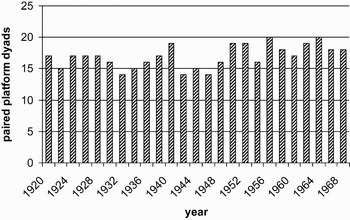
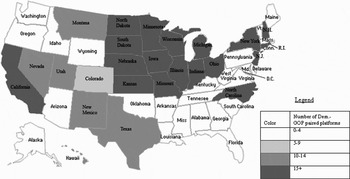
Figure 1 illustrates the number of platforms obtained for each year in the period under study, while Figure 2 displays the coverage by state. Since a complete collection of platforms from one state party is not useful without the other party's platforms in that state, the figures show only the number of “paired” Democratic and Republican platforms, with a pair defined as same-state Democratic and Republican platforms in the same year.
Paired platform coverage, by year.

Paired platform coverage, by state.

As Figure 2 illustrates, during this forty-eight-year period we have excellent coverage for the upper Midwest; acceptable coverage of New England, the Mid-Atlantic, and the mountain West; and poor coverage for the Northwest, South, and border South. The dearth of southern platforms does not limit our ability to test our hypothesis in a meaningful way, however. Southern Democrats were profoundly racist on virtually every political, economic, and social question.Footnote 39 Southern Republicans had little organizational presence in most states, meaning that one cannot readily compare the two parties there in any case. Keeping southern Democrats' racism and southern Republicans' absence in mind, the motivating question of this research is whether the national Democratic Party felt intense pressure from its nonsouthern state party affiliates to take strong pro–civil rights positions, and whether the Republican Party lacked such pressure. Fortunately, one does not need a measure of southern state parties' issue positions to evaluate this hypothesis. In other words, our focus on states outside of the South will allow us to determine whether nonsouthern Democrats and Republicans adopted similar positions on civil rights prior to the 1960s—so that, as Carmines and Stimson argue, their subsequent polarization on the issue was inherently unpredictable and driven by national elites—or, alternatively, whether nonsouthern Democrats embraced racial liberalism much earlier, making their political marriage with southern Democrats inherently unstable once civil rights policy eventually reached the top of the national agenda.
4. DATA AND METHODS
We collected 1,021 platforms published between 1920 and 1968. For some states, platforms were published in state government registers, newspapers, or in pamphlets distributed by the state parties themselves. However, for many other states, party platforms proved to be more elusive; in such cases, we hired on-site researchers to comb through libraries and state archives. Despite this exhaustive search, we were unable to obtain platforms for some states. Although it is not possible to know what proportion of the platforms issued during this period we have obtained since we do not know the total number of platforms written by state parties, we estimate that we have obtained approximately 57 percent of all platforms written by nonsouthern state parties.Footnote 40
To determine the extent to which these platforms favor or oppose civil rights measures, we conducted three distinct content analyses. First, we tallied the number of paragraphs devoted to civil rights in each platform. Carmines and Stimson conduct a similar analysis of the amount of space devoted to civil rights issues in national party platforms, noting that it constitute a “simple measure of the importance of a topic.”Footnote 41 By conducting a parallel analysis of state party platforms, we may directly compare our observations with Carmines and Stimson's, using a shared method.Footnote 42
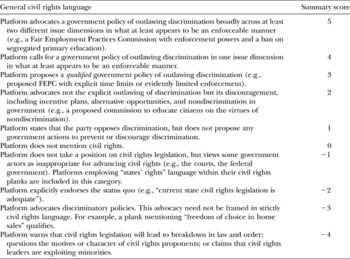
Second, we devised a ten-point (−4 to 5) ordinal scale to measure each platform's general outlook on civil rights. A platform that makes no mention of civil rights policy receives a 0. The highest value on this summary score signals that a platform advocates government policies to outlaw discrimination broadly across at least two different issue dimensions, in what appears to be an enforceable manner. For example, a platform that supports both a state fair employment practices commission with enforcement powers and a fair housing practices law would be coded as a 5. A platform that endorses the concept of equal treatment, but does not include any call for concrete governmental action receives a score of 1. Platforms that advocate discriminatory policies receive the lowest scores. For example, the 1964 Wyoming Republican platform, which expressed support for “the right to rent or sell property, [or] employ whomsoever [business owners] see fit” would qualify for a −3, because it explicitly opposes fair housing and fair employment legislation, two key civil rights proposals. A score of −4 is reserved for those platforms that most strenuously oppose civil rights legislation; many of these platforms predict “chaos” or a “breakdown in civic society” if civil rights proposals become law. Appendix Table A1 provides a summary of our coding criteria.
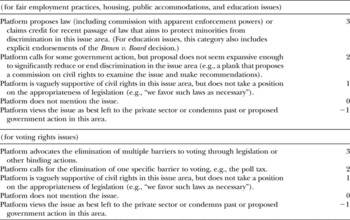
Third, we examined platforms' attention to five specific civil rights issue areas: fair employment practices, fair housing practices, desegregation of public accommodations, desegregation of educational institutions, and voting rights.Footnote 43 The scale for these measures ranges from −1 (“condemns past or proposed government action on this issue, or views the issue as best left to the private sphere”) to 3 (“claims credit for new law or commission, or proposes new law or commission that aims to protect minorities from discrimination in this area”). In the 1920s and 1930s, most platforms did not mention any of these issues, and thus received a score of 0 each. However, starting in the 1940s, it became more common for platforms to refer to one or more specific civil rights issues (see Appendix Table A2 on the coding).
Platform coding was conducted exclusively by the authors. We sought to make the criteria for coding as explicit as possible to reduce the likelihood of errors. In an effort to assess intercoder reliability and resolve potential differences in each coder's interpretation of the ratings system, both authors coded a subset of sixteen platforms. With one exception (one author assigned a summary score of 2 to a particular platform, while the other author gave the platform a 1), there was complete agreement between the two authors on every variable for every platform.Footnote 44
5. FINDINGS
5.1 Attention to Civil Rights Issues
Perhaps the most basic indicator of a party's attention to civil rights is the amount of space that it devotes to these issues in its platforms. For this reason, Carmines and Stimson examine the number of paragraphs that the national parties allot to civil rights issues during the 1932–1980 period. If a party deems civil rights important, it will devote more platform space to that issue.Footnote 45
Carmines and Stimson find that, at the national level, civil rights was not a prominent issue for either party until the 1960s. “Throughout the 1950s and the early 1960s … [b]oth northern Democrats and Republicans took moderate stands on race,” they write. “[I]ssues of race were not partisan issues as recently as the early 1960s.”Footnote 46 To the extent that differences between the parties existed before the 1960s, in most presidential election years the Republicans devoted slightly more space in their platforms to the issue. While exceptions exist (e.g., the 1948 Democratic platform edges out that year's GOP platform; in 1960 the Republicans' civil rights plank is considerably lengthier than the Democrats'), in general this tendency holds until 1964, when Democrats suddenly surpass Republicans in attention paid to civil rights. After examining their national party platform data, Carmines and Stimson observe:
Before 1960, with the notable exception of 1948, Republican platforms always gave at least as much, and usually considerably more, attention to racial concerns than Democratic platforms. This pattern changed abruptly and permanently in 1964; after that Democratic platforms uniformly accorded more importance to racial issues than their Republican counterparts.Footnote 47
Thus, Carmines and Stimson use the national platforms as evidence for the dramatic and sharp turnaround in the early 1960s.
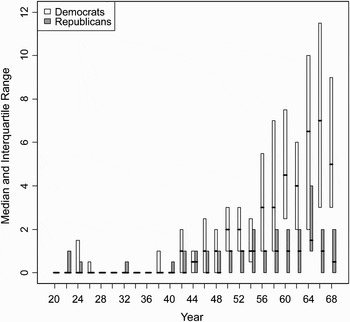
Since our parallel analysis involved multiple state platforms for each year, Figure 3 contains somewhat different information. The dark notches in the following figure show the median number of paragraphs on civil rights issues, while the associated dark and light bars show the interquartile range for the sets of nonsouthern Democratic and Republican platforms, respectively. We only include platforms in which we have both state parties in the same year, though the results look much the same if we include all of the platforms we collected.
Median number of paragraphs on civil rights.

Examining our figure, one reaches a different conclusion than Carmines and Stimson. Rather than civil rights being a Republican issue before 1960, we see the opposite. From at least the mid-1940s, it is the Democrats that devote more attention to civil rights issues. In addition, there is no abrupt and permanent change in 1964. Concerning differences between the two party's platforms on civil rights, 1964 appears to be “business as usual,” as does, arguably, every other year in the 1950s and 1960s.
5.2 State Party Civil Rights Positions
5.2.1 Summary Measure
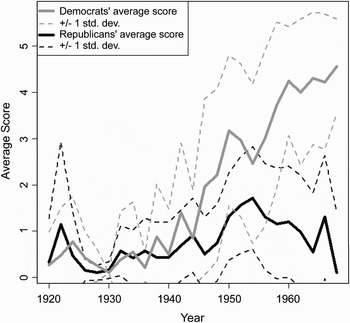
We began by examining the 423 sets of “paired platforms”—Democratic and Republican platforms from the same state and same year (a total of 846)—in our dataset. To determine when the Democrats emerge as the party of civil rights, we first calculate the average summary score (−4 to 5) for each (nonsouthern) party during the period under study.Footnote 48 As Figure 4 shows, both parties took nearly identical civil rights stances until approximately 1946, when the Democrats' average summary score began a steep ascent. In fact, in every year after 1946, the Democratic Party took a more favorable stance on civil rights issues than the Republicans—with the Democrats' position becoming increasingly liberal throughout the 1940s and 1950s (except a minor downtick in the mid-1950s). For Democrats in the North and West, the key period evidently begins with the onset of World War II and accelerates in the mid-to-late-1940s. By contrast, the Republicans took their most progressive stance on civil rights—which was still clearly to the right of their nonsouthern Democratic counterparts—during the mid-1950s, and gradually became more racially conservative thereafter. In addition, 1964 does not appear to be a “flashpoint,” “critical moment” or “burst of rapid change,” as Carmines and Stimson label that year.Footnote 49 Instead, that year saw the continuation of trends that began many years before: decreases in the Republicans' summary score and modest increases in the Democrats' score. Thus, outside the South, the realignment of the parties on civil rights had essentially already been completed before the 1963–1964 “critical” period.
Average summary score.

5.2.2 Five Specific Issue Areas
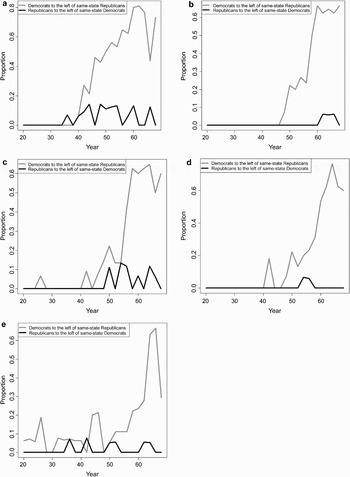
Next, we next turn to five issue areas, each of which was the subject of major legislative and legal battles: fair employment practices, fair housing, desegregated public accommodations, desegregated educational institutions, and voting rights. Figures 5a–e display the percentage of states in which the Democratic platform was to the left of the GOP platform on each issue, as compared to the percentage of times that the state Republican Party took the more liberal position on the issue.Footnote 50 For fair employment, fair housing, desegregated public accommodations, and desegregated schools, the Democrats clearly emerge as the more liberal party in the 1940s, with the gap increasing in the 1950s and 1960s.
(a) Fair employment practices position, (b) Fair housing position, (c) Public education position, (d) Public accommodation position, (e) Voting rights position.

The results from the first four of these issue measures reinforce the message from the average summary scores presented above: nonsouthern Democrats had become the more pro–civil rights party than nonsouthern Republicans markedly earlier than the mid-1960s, which Carmines and Stimson identified as the “critical moment”—the supposed “burst of rapid change” followed by a long secular realignment.Footnote 51 Instead, the key transformation in the nonsouthern Democrats' civil rights position occurred in the 1940s—which is also the period in which African Americans became solidified as a Democratic constituency and when the CIO and other liberal groups allied with the Democrats joined the fight for civil rights.Footnote 52
On voting rights issues, however, the story is somewhat more complicated; tentative Democratic steps during the 1930s and 1940s are evident, with substantial differences emerging only in the 1950s. This distinction between the parties' positions on voting rights and their stances on the other four issues can be tied to the different coalitional and ideological forces at work in the voting rights case. In contrast to supporting other civil rights issues, it may have been relatively easy for a state Republican Party to take a liberal position on voting rights. After all, poll taxes, white primaries, and other restrictions on voting were rare outside of the South, so a liberal position may have resulted in admonishing other states to change their practices but may not have impacted the state's own voting policies. Furthermore, business groups—core Republican coalitional partners—were not threatened by voting rights proposals, giving them little reason to oppose a hypothetical GOP progressive stance on voting rights.
For these three reasons, voting rights is a challenging test case for our view. Phrased another way, voting rights is arguably the policy area that would least divide the parties until the 1963–1964 critical moment. Figure 5e, however, shows that the parties' changing positions on voting rights more closely resembles the pattern evident in the other four issues than it does issue evolution's dynamic growth model. Instead of divergent positions in the mid-1940s, the Democrats tended to take slightly more progressive stances on voting rights in the 1930s and 1940s, with more substantial differences emerging in the 1950s. The timing of the partisan shift on voting rights—a hard test case for our view—is more similar to the patterns we found in the other issue areas than to a dynamic growth model.
5.3 State-by-State Comparison
The above measures have important limitations. In pooling all of the paired platforms in nonsouthern states, the analyst cannot make inferences concerning particular states. Furthermore, by restricting the analysis to the 423 sets of paired platforms (846 platforms total), we are omitting some of the 1,021 available platforms from analysis. Specifically, “orphan platforms,” or instances in which we have one party's platform but not the other for a particular state and year, are excluded. However, these orphan platforms could be useful. For example, if a given state's Democratic Party published its platforms in 1952 and 1956, but the state Republicans published their platforms in 1954 and 1958, although we do not know each party's position in the same year, some informative comparisons could be made.
We now turn to presenting summary score measures for a variety of individual states. Figures 6a and 6b show Democratic and Republican summary scores in Illinois and South Dakota, respectively.Footnote 53 As these figures show, in both states the Democrats consistently took the more progressive position in almost every year during the 1940s, 1950s, and 1960s.
(a) IL summary, (b) SD summary.

Appendix B contains similar graphs for the twenty other nonsouthern states for which we have a reasonable number of platforms.Footnote 54 As a whole, these twenty-two states are remarkably diverse. Some, such as Illinois, have significant black populations, while others, like South Dakota, do not. Except the Deep South, all regions are represented, as are states with a wide variety of types of party organizations. Remarkably, while these states vary considerably in potentially relevant demographic and political characteristics, the Democrats take the more pro–civil rights position in the vast majority of cases starting in the 1940s or early 1950s.Footnote 55
A few additional patterns are suggested in this preliminary examination of the data. As one might expect, states with small African American populations appear more likely to ignore the civil rights issue—though when such states' parties do talk about civil rights, Democrats tend to embrace the more liberal position than Republicans (for example, Montana, North Dakota, and Utah).Footnote 56 Interestingly, relative Democratic liberalism on civil rights appears to hold across a variety of state party organizations. Broadly speaking, the pattern is the same in states with parties that are dominated by party bosses, as well as those open to broad participation, and for state parties that hold presidential primaries that are open to ordinary voters as well as those that do not. Furthermore, the pattern is also the same in states where local issues take priority over national concerns when the parties choose delegates to the national convention, as well as those in which the opposite is true, and for cohesive state parties as well as those that contain two or more sizeable factions. States with strong local party organizations, such as New Jersey and New York, do not differ significantly from states with much weaker local parties, such as California.Footnote 57 In addition, states in the farm belt—such as Kansas and Nebraska—tell the same basic story when it comes to the parties' relative position, as do states in the upper Midwest (Minnesota, Michigan), and on the coasts. In sum, the commonalities across states are more striking than the differences, hinting that broad ideological developments may have played a key role in redefining the parties' position on civil rights policy.Footnote 58
The consistent story across states is also noteworthy, given the potential concern that the precise dynamics of platform-writing likely vary considerably depending on the relative strength of party machines, political amateurs, and allied interest groups. Again, this suggests that broad currents within the nonsouthern Democratic and Republican parties drove their transformation on civil rights, rather than the particular choices of a handful of well-placed elites. The meso-level of the parties—a diverse set of state, county, and local politicians, traditional activists, and new, issue-oriented amateurs—evidently responded in a similar way to contestation over civil rights policy in the 1940s–1950s. That is, nonsouthern Democrats moved to embrace civil rights liberalism while Republicans, for the most part, distanced themselves from the cause.
6. DISCUSSION
6.1 The Relationship between State and National Parties
A key question raised by our findings is how to think about the relationship between the position taken by state parties and the stance adopted in national party platforms. While nonsouthern state Democratic platforms provided much stronger support for civil rights measures than did their Republican counterparts, the national Democratic Party provided only weak support for civil rights measures in its pre-1960 platforms.Footnote 59
There are at least two distinct processes that could explain the tepid support for civil rights found in both Democratic and GOP national platforms prior to 1960. First, both parties' national activist classes could have held similar views on civil rights, supporting limited civil rights measures, and thus each party's platform accurately reflects its writers' views. Thus, the parties are virtually indistinguishable on civil rights issues, with both sets of activists holding moderate views (and Republicans perhaps slightly to the left of Democrats, on balance).Footnote 60
Second, the Republican platforms' moderate civil rights positions could have accurately reflected the views of the vast majority of Republican activists and leaders, while the Democrats' moderate position could have been the result of a compromise between that party's southern and nonsouthern wings. In this interpretation, Democratic civil rights planks are straddling an issue that deeply divides the party, with few Democratic activists actually holding the position expressed in their platform. Specifically, the true preferences of southern Democrats were far more conservative on civil rights issues, while nonsouthern Democrats may have been markedly more progressive than their national party platforms suggest.
Based on our analysis of state platforms, we believe this second explanation is correct.Footnote 61 Not only were nonsouthern state Democratic parties significantly more racially liberal than their same-state Republican counterparts, but they were also more liberal than the national Democratic Party. Nonetheless, when these nonsouthern Democrats joined with their fellow party members at their national convention, both sides moderated their civil rights views to produce a platform plank that neither side truly supported. Since the Republican Party, by contrast, did not have a viable southern component during this period, the GOP's national platforms could reflect its members' actual civil rights position, while the Democrats' platforms could not.
The first major Democratic intraparty battle over the party's national civil rights position occurred during the 1948 convention. With civil rights activists' growing demands on Democratic administrations during and immediately after World War II, as well as a renewed focus on domestic issues during the postwar period, national Democrats' earlier strategy of staying silent on racial issues became untenable. Encouraged by the famous James Rowe-Clark Clifford strategy memo, which highlighted the growing importance of African American voters in key northern states, Truman embraced an ambitious civil rights program early in 1948.Footnote 62
Nevertheless, administration forces sought to keep the southerners on board by proposing a tepid national platform for the 1948 national convention. In the face of these efforts, a diverse coalition of Democratic-allied groups, most notably the Congress of Industrial Organizations' Political Action Committee (CIO-PAC), Americans for Democratic Action, the Southern Regional Council, and the National Association for the Advancement of Colored People (NAACP), pressured the Democratic Party to adopt a strong civil rights plank, while racially conservative southern Democrats worked with national party leaders to block the plank.Footnote 63 In the end, rank-and-file delegate sentiment in favor of civil rights overwhelmed the efforts of southerners, congressional leaders, and the Truman administration to straddle the issue in the platform. Thus, the pro–civil rights camp prevailed, with the Democrats adopting what Gerring calls “the party's first strong statement of support for civil rights.”Footnote 64 While racially liberal Democrats may have won the platform battle, on the eve of the 1948 general election it seemed probable that their triumph at the convention would be a pyrrhic victory, costing their party the election. In response to the Democrats' strong civil rights position, many southern Democrats supported the States' Rights Democratic Party. With New York governor Thomas Dewey seen as the frontrunner throughout the fall campaign, the Dixiecrats' potential to siphon off votes from the Democrats could have been the final nail in Truman's coffin. Of course, in the end Strom Thurmond did not serve as a spoiler, carrying only four southern states, and Dewey did not defeat Truman. However, the close call may have convinced party leaders not to concede as much ground to civil rights proponents at future conventions. Instead, Democratic civil rights statements in the national platforms throughout the 1950s were careful attempts at compromise, not angering either side enough to cause a walkout, but not at all reflective of party activist sentiment on civil rights either.
Historian William Berman details the moves by Democratic leaders at the 1952 convention to prevent a floor fight among delegates over the wording of their party's civil rights plank. On one side, Senators Herbert Lehman (D-NY), Warren Magnuson (D-WA), and T.F. Green (D-RI), among other liberal leaders, pushed for the party to approve a civil rights plank that went beyond its watershed 1948 position. Americans for Democratic Action chairman Francis Biddle threatened a floor fight (with, he claimed, 654 delegates supporting him) if the party's 1952 civil rights plank regressed from 1948.Footnote 65 When told that a strong civil rights plank might lead to a southern walkout from the convention, Walter Reuther, United Auto Workers union president and a leader in Democratic politics, responded that he did not expect the southern delegation to act on this threat, “but if it so chooses, let this happen; let the realignment of the parties proceed.”Footnote 66 On the other side, southern delegates opposed virtually any supportive statement on civil rights. Their opposition was not to be taken lightly: party leaders were undoubtedly mindful that in 1948, ten out of the eleven southern state delegations unanimously opposed Truman's nomination because of his civil rights stance,Footnote 67 and that the walkout of thirty-five southern delegates from the 1948 convention led to the creation of the States' Rights Democratic Party that year.Footnote 68 John Sparkman, a moderate Democratic senator from Alabama (and the party's vice-presidential nominee) and African American Representative William Dawson (D-IL) worked together to write a compromise draft of the civil rights plank. Their draft was presented to the convention on a voice vote, thereby eliminating the need for delegates to take a recorded, public position. Although the compromise language passed, few seemed satisfied with it. The Mississippi and Georgia delegations formally opposed the plank as going too far, while many liberals, including the sixty black delegates whom African American Representative Adam Clayton Powell (D-NY) led off the convention floor in protest, did not think it went far enough.Footnote 69
The story of the 1956 Democratic platform's civil rights plank followed a similar narrative arc. Discontented with their party's moderate stance four years earlier, NAACP executive secretary Roy Wilkins, Lehman, and Reuther led three hundred delegates in planning a floor challenge to the 1956 platform committee's proposed civil rights plank. Only when liberal icon Eleanor Roosevelt arrived at the convention to support the compromise language for the sake of party unity did these delegates abandon their proposed challenge.Footnote 70 In both 1952 and 1956, the key was national party elites' ability to contain the pressure emanating from nonsouthern delegates for a bold civil rights platform plank that would have driven off the southerners.
The moderate civil rights planks in national Democratic platforms during the 1950s were the result of intense backroom negotiations and occasional dramatic acts on the floor. The process by which similarly mild GOP planks were adopting during this period was a comparatively staid affair. Berman observes that civil rights was simply not a contentious issue at the 1952 Republican national convention. The platform included modest language on ending segregation in the District of Columbia, passing employment antidiscrimination measures that would not “set up another huge bureaucracy,” vague “federal action toward the elimination” of various racist practices, and other moderate positions. At the same time, according to Berman, the platform contained a “renewed emphasis on state initiative, a shift designed to help Republican efforts in the South.” Only a small minority of liberal and African American delegates cared to oppose the platform; a group of African American delegates was persuaded not to introduce potentially divisive amendments on the floor; and ultimately the plank was adopted with little struggle.Footnote 71
Neither did southern Republicans, a small minority of southern voters but a sizeable proportion of convention delegates,Footnote 72 disrupt their party's moderate consensus on civil rights. Contrary to popular perceptions of southern Republicans as being comprised largely of racially liberal African American voters, Republican organizations in many southern states appear to have been nearly as unyielding on civil rights as were their same-state Democratic counterparts.Footnote 73 According to Alexander Heard, by 1928 every southern state Republican Party had a “lily-white” organization that rivaled the African American-dominated “regular” or “the black and tan” faction. During the 1928 campaign, Herbert Hoover showed open hostility to these black-dominated southern Republican organizations and supported the white alternatives in several southern states. Hoover and other Republican leaders' decisions to support the “lily whites” led some black leaders to endorse Al Smith in the 1928 election. When the conflict ended, whites controlled the state Republican parties in most southern states. By 1948, whites completely controlled the Republican apparatus in Alabama, North Carolina, Tennessee, and Virginia, and were dominant in Arkansas, Florida, Louisiana, and Texas.Footnote 74
Therefore, while moderate Democratic planks were the result of a careful compromise between regional wings, and thus were not really an accurate gauge of party opinion, moderate Republican planks accurately reflected the GOP's modest support for civil rights. A survey of 3,020 delegates to the two 1956 national conventions provides some evidence of the true gap between Democratic and Republican delegates on civil rights issues. Herbert McClosky and colleagues find that 43.8 percent of Democratic national convention delegates but only 25.5 percent of Republican delegates supported increased “enforcement of integration.”Footnote 75 The gap between the parties is even bigger when southerners are dropped from the analysis.
Although both national parties adopted similar, moderate civil rights stances throughout the mid-century period, as Carmines and Stimson observe, these similar national averages do not tell the whole story. The Democratic platform represented an effort to straddle an issue that deeply divided the party's two main wings, while the GOP was relatively unified in advocating modest civil rights advances. The political imperative for Democrats from all regions to craft compromise language for a national platform plank contributes to the false sense that Democrats and Republicans in the North and West were indistinguishable on civil rights issues before the 1963–1964 “critical moment.”
Moreover, once civil rights issues reached the top of the nation's agenda in the 1960s, and national party elites were forced to choose sides, the greater political significance of the North and West (relative to the South) encouraged Democratic national party leaders to adopt a liberal position on civil rights issues. Only 352 of the 1,521 delegates to the 1960 Democratic national convention—the convention immediately preceding Lyndon Johnson's 1964 presidential campaign—represented southern states.Footnote 76 Because the party had abolished the supermajoritarian two-thirds rule in 1936, the southern delegation no longer exercised disproportionate influence over the nomination process. As Lyndon Johnson surveyed the political landscape in 1964, the main threat to his status as Democratic leader clearly came from northern liberals skeptical of his civil rights credentials.
When pushed to choose sides between anti–civil rights southern Democrats and the increasingly pro–civil rights northern and western Democrats (whose civil rights liberalism generally far exceeded that of their same-state Republican counterparts), it is difficult to envision a prudent national politician—operating under some pressure from the state-level parties and activists—siding with the South. Recognizing both that the increasing salience of civil rights issues made obfuscation virtually impossible and that there would be negative ramifications associated with throwing his support behind either side, Johnson sensibly sided with the northern and western Democrats. In other words, it was preferable to “fear we've lost the South for a generation” than to express a similar worry over losing the rest of the nation (or simply to lose control of his own party). Similarly, the political weakness and isolation of racially liberal Republicans set the stage for Goldwater's 1964 nomination, and thus enabled his decision to pursue southern whites. In this way, Johnson and Goldwater's respective embrace of civil rights liberalism and conservatism in 1964 are better understood as responses to deeply rooted forces within their parties than as free and independent decisions by the first movers in a sequence.
6.2 The Role of Interest Groups in Shaping the Parties' Civil Rights Positions
Now that we have demonstrated that Democratic activists outside of the South pushed their party toward a pro–civil rights orientation beginning in the mid-1940s, while Republican activists did not exert comparable pressure on their party, we turn to the task of explanation. Why, outside of the South, were the Democrats more supportive of civil rights than the GOP? Although our state platforms data standing alone cannot provide an explanation, political historians offer a persuasive account: that the Democrats' New Deal ideological outlook and coalitional partners gradually steered the party toward civil rights advocacy. The GOP, which included a very different set of coalitional members and a contrasting New Deal–era ideology, did not experience the same pressure to take pro–civil rights positions. By the time the civil rights movement (which included many Democratic coalitional partners but few Republican-allied groups) had elevated civil rights to the top of the national agenda, national Democratic elites found that they had a much stronger incentive to adopt civil rights liberalism than did Republicans, because the coalitional base of the increasingly dominant nonsouthern wing of the Democratic Party had embraced that position, while national Republican leaders were pulled in the opposite direction by their coalitional partners.
6.2.1 Democratic Coalition Partners
At mid-century, a striking number of organizations could claim both strong ties to the Democratic Party and a deep commitment to civil rights. The groups under this Democratic umbrella included not only narrowly defined civil rights organizations, but also labor unions (e.g., the CIO, UAW), ethnic and immigrant groups (such as the American Jewish Congress), and progressive policy-oriented groups (most notably Americans for Democratic Action). The rich web of organizational ties among these groups and with the Democratic Party, coupled with their strong civil rights advocacy, helped move the Democratic Party toward more forceful support of civil rights than the Republicans.
Among labor unions, key CIO officials were tireless advocates of civil rights policies, contributing to the “braiding of labor and race politics,” according to Sean Farhang and Ira Katznelson.Footnote 77 The CIO leadership was committed to passing fair employment practices legislation by the early 1940s. In fact, pressure from CIO officials also contributed to the traditionally more conservative AFL's backing of fair employment practices legislation in 1945.Footnote 78 Furthermore, labor leaders, including the UAW's Reuther, played key “power broker” roles at Democratic conventions, as previously mentioned. Other powerful unions that were closely allied with the Democratic Party, including the International Ladies Garment Workers Union (ILGWU) and the Amalgamated Clothing Workers of America (ACWA), also played vocal roles in pushing for antidiscrimination legislation.Footnote 79
In addition, religious and religion-affiliated groups closely linked to the Democratic Party participated forcefully in the push for civil rights. The Anti-Defamation League, American Jewish Committee, American Jewish Congress, and the Catholic Church were all important members of both the Democratic and civil rights coalitions.Footnote 80
Leading progressive policy groups also pushed the Democratic Party toward greater civil rights advocacy. Most notably, Americans for Democratic Action (ADA) placed civil rights at the top of its agenda from the group's inception in 1947, and organized a series of rallies and high-profile events to publicly lobby the Democrats to take a strong civil rights stance in the 1948 campaign.Footnote 81 At that year's Democratic convention, 110 of the 1,234 delegates were ADA members, giving ADA considerable influence within the party.Footnote 82
When leaders from these various Democratic-allied groups joined together to support civil rights legislation—as occurred when various church and Jewish groups, unions, the ACLU, and the NAACP formed the National Council for a Permanent Fair Employment Practices Commission in 1943—the Democratic Party, which “shared” its activist class with these groups, had a strong incentive to heed their views.Footnote 83 The one Democratic leader who best exemplifies the linkages between the Democratic Party, labor unions, progressive policy groups, and civil rights advocacy is Joseph Rauh. Rauh headed the Civil Rights Coalition, a diverse collection of political groups that lobbied Congress for the passage of the 1957 Civil Rights Act.Footnote 84 He also served as ADA chairman between 1955 and 1957; served on numerous Democratic national platform committees; sat on the NAACP board of directors; and worked as UAW general counsel.Footnote 85
Furthermore, the role that these activists played within the Democratic Party may have been amplified by the fact that the party was transitioning from a patronage-focused to a policy-oriented body during this period in many states. According to Gerring:
Organizational changes within the [Democratic] Party … affected the course of liberalism in the postwar period. During this period, a new brand of party activist joined the party in large numbers. These citizen-activists were middle-class, issue-oriented, hostile to machine-politics, and interested in a broad range of non-economic policies, from foreign policy to civil rights … One must credit the efforts of these reformers for the party's first strong statement of support for civil rights in 1948.Footnote 86
Thus, the emphatic support of so many party-affiliated interest groups for civil rights legislation undoubtedly encouraged the Democrats to take more progressive positions on civil rights.Footnote 87 Interest groups in the Republican camp, by contrast, did not hold such strong attachments to the cause and, as we will explain, in some cases were openly hostile to civil rights measures.
6.2.2 Republican Coalition Partners
With far fewer coalitional ties to the labor unions and ethnic/religious organizations that were key actors in the push for civil rights, Republicans had less of an incentive to support civil rights measures. Instead, the Republican Party's ties with business interests encouraged the party to oppose or remain silent on a key early civil rights issue: the establishment of fair employment practices commissions (FEPCs) to enforce racially blind hiring policies among private businesses.Footnote 88 According to Kesselman, the Council of American Small Business Organizations, the National Association of State Chambers of Commerce, and various individual state chambers of commerce led the fight against a national FEPC. In nearly every state, the pattern was the same. For instance, in New York the major opposition came from local chambers of commerce, boards of trade, and real estate boards.Footnote 89 Speaking to a group of black GOP leaders in 1947, Speaker of the U.S. House—and former Republican National Committee chairman—Joe Martin (R-MA) conceded:
The FEPC plank in the 1944 Republican platform was a bid for the Negro vote, and they did not accept the bid. … I'll be frank with you: we are not going to pass a FEPC bill, but it has nothing to do with the Negro vote. We are supported by New England and Middle Western industrialists who would stop their contributions if we passed a law that would compel them to stop religious as well as racial discrimination in employment.Footnote 90
Martin's extraordinarily frank comments show the tension between civil rights advocacy and business interests. In three major areas of early civil rights—fair employment, fair housing, and equal access to public accommodations—the enforcement of any law would require additional government regulatory oversight of private businesses, with penalties doled out to noncomplying firms. With business owners already bristling under the expanded regulatory capacity of the New Deal state, additional government oversight was anathema to the business community.
The GOP's ties with chambers of commerce, manufacturers' associations, real estate groups, farm lobbies, and other organizations opposed to the increased government oversight of private enterprise that would come with fair employment and other civil rights legislation encouraged the GOP's drift toward racial conservatism. As with the Democrats and their affiliated groups, the relationship between the Republican Party and its key coalition members would shape the party's stance on civil rights issues, well before the 1963–1964 “critical moment.”
6.3 Parties-Masses Connections
It was not only the ties between the parties and their respective interestgroup allies that led to the Democratic Party's embrace of racial liberalism and the Republicans' association with racial conservatism. Rather, with the New Deal, the Democrats' economic liberalism made the party increasingly attractive to rank-and-file African American voters. At the same time, Republican appeals to southern voters became more common, as the GOP envisioned a future with dissatisfied southern Democrats in its fold. In both cases, the process was gradual, beginning in the mid-1930s.
6.3.1 African Americans and the Democratic Party
Although black voters' partisan loyalties had been firmly with the Republican Party since Reconstruction, cracks in the GOP–African American relationship began to appear in the 1920s and 1930s.Footnote 91 In 1928, Democratic presidential candidate Al Smith received an unprecedented number of African American votes, due to the Republicans' avoidance of black voters' concerns during the 1920s and the Smith campaign's emphasis on appealing to working-class voters.Footnote 92 Black voters returned to the Republican camp in 1932, with a majority of African Americans evidently backing Herbert Hoover. In 1936, however, northern African American voters abandoned the GOP en masse. Continued African American support for Roosevelt in 1940 demonstrated that black voters had become a part of the Democratic political coalition.
As the Democrats emerged during the New Deal as advocates of the working class and the poor, the party became more attractive to African American voters, most of whom occupied low rungs on the economic ladder.Footnote 93 Samuel Lubell, for instance, asserts that black voters, like other citizens with low economic status, were drawn to the Democratic Party as much because of economic status as race. As a result, he argues, popular perceptions during the 1950s were that the Democrats were the party of minority groups and that the GOP was the party of the Protestant bulwark.Footnote 94
During the 1950s, Alexander Heard observes this reorientation of the parties along economic lines, with African Americans sharing the Democratic umbrella with low-income whites. “Party realignments that have been taking place with in the two major parties since 1933 more and more make the Democratic Party a labor-liberal party,” he writes. Reasonable expectations, he predicts, seem “to destine the bulk of southern Negro voters for the Democratic Party.”Footnote 95 Gunnar Myrdal agrees, predicting in An American Dilemma that, with the coming reorientation of the two parties along ideological lines, “it seems fairly certain that the great majority of Negroes are going to adhere to the liberal party, provided it be consistently liberal with respect to the Negro problem.”Footnote 96 One result of this eventual restructuring of the Democrats into a broadly defined liberal party, Heard and Myrdal envision, is the movement of African American voters—both in the South and across the nation—into the Democratic Party.Footnote 97
While the New Deal's economic programs helped attract African Americans to the Democratic camp, the concurrent physical movement of southern African Americans to the urban Northeast and Midwest also tightened the ties between this group and the Democratic Party. The steady stream of African Americans entering the voting rolls of these largely Democratic cities during the first half of the twentieth century created new incentives for the party to embrace racial liberalism.Footnote 98 Thus, the immense social changes during the Great Migration, coupled with the attractiveness of the New Deal to working-class voters of all races, strengthened the relationship between African Americans and the Democratic Party.
6.3.2 Southern Conservatives and the Republican Party
Complementing this movement of African Americans into the Democratic Party was a parallel gradual reshuffling of racially conservative voters into the Republican camp. Political observers began forecasting conservative white southerners' movement into the Republican Party starting in the late 1930s amid the fights over court-packing and Roosevelt's failed purge campaign, in which the president supported primary challengers seeking to unseat conservative southern Democrats.Footnote 99 A conservative Democratic senator from Virginia, Carter Glass, complained in 1937 that “it is perfectly obvious that the so-called Democratic Party at the North is now the negro party, advocating actual social equality for the races; but most of our Southern leaders seem to disregard this socialistic threat.”Footnote 100 Glass told another correspondent in 1938 that “I have come to the conclusion that many of the northern Democrats have less use for the white people of the South than have northern Republicans.”Footnote 101 Meanwhile, Sen. Josiah Bailey (D-NC) sought support for a conservative manifesto uniting Republican and conservative Democratic senators. At the same time, FDR's 1938 purge campaign sparked public discussion of realignment.Footnote 102 Historic southern hostility to the Republican brand dating from the Civil War and Reconstruction prevented a total schism, but as the Democratic Party's identification with the causes of labor and civil rights grew, it became increasingly evident that the Democratic coalition was a marriage that could not last. Alexander Heard highlights the 1944 anti-FDR insurgencies in South Carolina, Mississippi, and Texas, along with the broader Dixiecrat bolt of 1948, suggesting that these actions “assumed enormous significance as the first step in a break that, if carried to its logical conclusion, would land them in the Republican Party.”Footnote 103
Republican Party officials, keenly aware of the growing incongruity between southern conservatives and the post–New Deal Democratic Party, moved to court racially conservative southern Democrats at least as early as 1948.Footnote 104 At that year's Republican convention, RNC chair Guy Gabrielson made a strong bid to win over the Dixiecrats to the GOP, intimating in a speech that only semantics separated Dixiecrats and Republicans. “The Dixiecrat party believes in states' rights,” he argued. “That's what the Republican Party believes in.”Footnote 105 Furthermore, during the 1948 campaign Dewey did not exploit his excellent civil rights record as governor, in contrast to Truman, who highlighted his civil rights proposals along the campaign trail.Footnote 106 Instead, Dewey, Sen. Robert Taft (R-OH), and Minnesota governor Harold Stassen stumped throughout the South,Footnote 107 and their party platform's civil rights plank in 1948 was a marked retreat from the party's 1944 stance. The GOP essentially wrote off the African American vote in 1948, preferring to attempt to break the Democrats' hold on the racially conservative “Solid South.” Taft, for instance, predicted that Dewey could carry Georgia, North Carolina, Tennessee, and Virginia by siphoning off conservative voters from the Democrats.Footnote 108
Ties between the Republican Party and conservative Democrats strengthened in the early 1950s. In 1950, Guy Gabrielson embarked on a speaking tour of the South in an effort to drum up support for a proposed “unity ticket” of Republicans and southern Democrats in the next presidential election.Footnote 109 Sen. Richard Russell (D-GA) agreed, stating that he would like to see “a very strong Republican Party in the South” and predicting that “conservatives … [of both parties] will eventually get together.Footnote 110 One year later, Gabrielson publicly called for a formalized grouping of Republicans and southern Democrats into a single party prior to the 1952 election. This unity party would then nominate a Republican–southern Democrat “balanced ticket” of either Robert Taft and Harry Byrd, Sr., or Dwight Eisenhower and Richard Russell.Footnote 111
Along with Gabrielson, Sen. Karl Mundt (R-SD) also pushed for an alliance between Republicans and southern Democrats. In his speeches from 1949 on, Mundt argued that both groups have similar philosophies.Footnote 112 He proposed, therefore, that the GOP delay its 1952 convention until after the Democrats had nominated their candidate. If the Democrats chose Truman (which Mundt expected), presumably they also would write a pro–civil rights platform. Then, the GOP would agree not to mention civil rights issues in its platform, nominate someone agreeable to the South, and convince the Dixiecrats to allow this Republican nominee to also occupy the States' Rights Democratic line on the ballot (so that southerners would not have to vote for someone with the Republican label on their ballots).Footnote 113 By the fall of 1951, Mundt and his plan had gotten enormous publicity, including the cover of U.S. News and World Report, interviews on every important syndicated talk show, and a debate segment on CBS Peoples' Platform, a popular roundtable-style debate program.Footnote 114
Although this proposed marriage of Republicans and southern Democrats was not realized at the time, the Republican Party made significant inroads in the South during the 1952 campaign. The Democratic governors of Louisiana and South Carolina publicly supported Eisenhower over their party's nominee. As southern support for Adlai Stevenson continued to wane in September 1952, a New York Times survey of likely voters in the South found that civil rights was the dominant issue in the region.Footnote 115 On election day, Eisenhower won nearly 50 percent of the white vote in the supposedly solid South.Footnote 116 While most of his gains came in the peripheral South, Eisenhower received 49 percent of the vote in South Carolina and 46 percent in North Carolina. The absence of a strong and intense pro–civil rights constituency among Republicans, combined with the shared conservative views of many southern Democrats and nonsouthern Republicans, paved the way for further Republican appeals in the South.Footnote 117 By the time Goldwater traveled to the South to stump for Nixon in 1960, he could conclude that “there's hardly enough difference between Republican conservatives and the southern Democrats to put a piece of paper between.”Footnote 118
6.4 The Parties-in-Government
The Democrats' early transition toward a racially liberal stance and the Republicans' move toward a racially conservative position in the electoral arena also had significant consequences for governance. Motivated by the New Deal, a new generation of liberal, reform-minded politicians entered the Democratic Party. As these programmatic liberals gradually replaced more patronage-oriented partisans in elected office, the Democratic Party-in-office became known for its support of progressive policy proposals.Footnote 119
While Carmines and Stimson demonstrate that there were few discernable differences between congressional Democrats' and Republicans' voting records, these roll-call votes reveal little concerning which members of Congress were instrumental in crafting the bills, shepherding them through committee (or gathering signatures on a discharge petition), and lobbying their colleagues on the floor. On all of these necessary actions for any bill to become law, the roll-call record is silent.Footnote 120
One notable case in which behind-the-scenes maneuvers clearly showed a wide gap between nonsouthern Democrats and Republicans (a gap that a glance at the roll-call record would miss) is the 1945 battle over a federal fair employment practices commission. Will Maslow observed that Republican members of the Rules Committee often joined with southern Democrats to miss committee meetings related to an FEPC, in an effort to ensure that the committee lacked a quorum, thereby preventing a floor vote on the measure.Footnote 121 Months later, when a quorum of Rules Committee members finally met to (anticlimactically) deny a rule for the bill on June 12, 1945, an intense lobbying effort began among the bill's supporters to discharge it from committee. On December 10, Rep. Albert Gore, Sr. (D-TN) reported to the House that only 50 of the 157 signers of discharge petition were Republicans.Footnote 122 This Republican indifference to and—among some Republicans on the Rules Committee—obstruction of FEPC legislation paints a very different picture of House Republicans' commitment to civil rights than their more public actions suggest.Footnote 123
Similar situations played out in the Senate as early as the mid-1940s. For instance, the year 1946 began with a confrontation between “Mr. Republican” Robert Taft and proponents of a strong FEPC. Aside from a poll tax ban and antilynching legislation, Taft believed that the federal government's role in securing civil rights ought to be limited, arguing that “it is just about as difficult to prevent discrimination against negroes as it is to prevent discrimination against Republicans … . We know the latter is impossible.” Therefore, he vehemently opposed the Truman administration's goal of a permanent FEPC. While he did vote for cloture on the bill—believing that it should get a vote—he then offered an alternative, significantly weaker FEPC bill, which would establish a commission without any enforcement powers.Footnote 124
To supplement these historical accounts, we briefly examine speeches on the floor as an indicator of preference intensity. We assume that members of Congress will take to the House or Senate floor regarding those issues that are most salient to them, either to persuade colleagues of the rightness of their views, or simply as a means of position-taking, to signal their most important stances to constituents. Speechmaking on the floor is a nontrivially costly action (both in terms of opportunity costs that busy members of Congress face, and because one's fellow members probably would not take kindly to a colleague who requested recognition on every issue that comes before Congress). Therefore, we believe that a senator or representative's decision to speak on a given issue indicates that he or she views this issue as particularly important, and desires to take action on it beyond casting a roll-call vote.
We examine speeches on the floor regarding civil rights issues in 1945, tallying the number of unique speakers by party affiliation (southern Democrat, nonsouthern Democrat, and Republican).Footnote 125 We chose to focus on 1945 because that is the year in which Carmines and Stimson begin their analysis of civil rights issues in Congress.Footnote 126 Carmines and Stimson view 1945 almost as a year zero, when both parties are essentially equally indifferent to civil rights. Thus, they consider 1945 to be well before the drastic changes in the parties' civil rights positions that they later identify. “Although obviously not the beginning of our story, 1945 does mark a good point to begin systematic analysis of congressional response to race,” they write. “The politics of race differed at the end of WWII from that at the end of Reconstruction, but not by much.” According to Carmines and Stimson, Republicans saw civil rights as a southern issue, which they could advocate with few direct costs borne by their nonsouthern constituents. Democrats were divided into the anti–civil rights southern wing and the indifferent, urban machine-dominated nonsouthern wing.Footnote 127 Our analysis of congressional rhetoric, however, suggests that the nonsouthern Democrats' greater emphasis on civil rights than the Republicans' was already evident in 1945.
In that year, ten House Democrats (7.1 percent of all nonsouthern Democratic representatives) made speeches on the floor in support of civil rights legislation. By contrast, in 1945 the Republicans could be considered at best indifferent to civil rights, with only one Republican representative (0.5 percent of the GOP delegation) making a pro–civil rights speech on the floor and in fact four making anti–civil rights speeches. While the figures in the Senate are somewhat more balanced—seven nonsouthern Democrats and five Republicans (or 18.9 and 12.5 percent of their respective party delegations) spoke in support of civil rights—taken together it is evident that the Democrats were more vocal on civil rights issues in 1945.Footnote 128 While nonsouthern Democrats' and Republicans' roll-call records may have appeared similar in 1945, the nonsouthern Democrats exhibited a greater willingness to push their colleagues, forego other action to devote time to speechmaking, and engage in active position-taking on civil rights issues.
Based on these historical accounts and our (preliminary) analysis of congressional rhetoric, there is reason to believe that the nonsouthern Democrats were more supportive of civil rights measures than Republicans in Congress by the mid-1940s, at least concerning their behavior outside of roll-call voting.
7. CONCLUSION
For our research in this paper we use a new data source—state party platforms—to challenge a prevailing view concerning the parties' civil rights positions at mid-century. The 423 “paired platforms” that we collected indicate that, in a given year and state, the Democrats were likely to have taken a stronger civil rights position than their GOP counterparts, beginning around 1946. This conclusion finds support in multiple measures, including the average number of paragraphs within the platforms devoted to civil rights, average summary score, and average score on five specific issue measures. These findings call into question the core elements of Carmines and Stimson's issue evolution thesis: that national elites are at the start of the issue evolution process; that elites have wide discretion in positioning and repositioning their parties' stances; and that the civil rights realignment was open ended in its early years, but followed a dynamic growth model, experiencing a “burst of rapid change” centered around the 1963–1964 “critical moment” and a subsequent, lengthy secular realignment.Footnote 129
Instead, we find that state party activists and officials had staked out positions on civil rights well before many national elites had fully weighed in on the subject; that national elite actors were significantly constrained in their actions and were not first movers; that path dependent lock-in was evident far earlier than Carmines and Stimson propose; and that a gradual reorientation of the parties was evident as early as the mid-1940s.
We supplement our analysis of the state parties with evidence that the Democrats and Republicans were drifting apart on civil rights during the 1940s and 1950s. Each party's key coalitional partners in the 1940s, for instance, had clear positions on early civil rights legislation, and pushed the parties toward their partner groups' favored stances. In the mass electorate, we see Democratic courtship of African Americans outside of the South, coupled with Republican indifference to those voters. In the former Confederate states, we observe growing dissatisfaction with the Democratic Party and an incipient effort by Republicans to court these discontented, racially conservative elites and voters. On Capitol Hill, a variety of sources suggest that intensity of support for civil rights measures was greater among nonsouthern Democrats than Republicans, despite a more mixed roll-call voting record. Collectively, we believe that this body of evidence, from multiple sources and concerning multiple political actors, strongly supports the claim that the reorientation of the parties' civil rights positions occurred during a long secular realignment, with many changes evident as early as the mid-1940s.
Our results indicate that the ultimate outcome of the civil rights realignment was far less contingent than Carmines and Stimson suggest. Once Democrats become the party of the welfare state, governmental activism, and labor rights, the pressure on the party to embrace civil rights liberalism became intense. Even FDR, who has been criticized (appropriately) for his refusal to put his political muscle behind the civil rights cause, made a series of appointments at the Justice Department and to the Supreme Court that helped spark early court victories on major issues, most notably the landmark Smith v. Allwright (1944) white primary decision.Footnote 130 And as southerners such as Sen. Carter Glass (D-VA) recognized, many of the same liberal policy entrepreneurs and legal professionals who formed the intellectual backbone of the New Deal also were ardent supporters of civil rights. The same groups that became important Democratic constituencies in the New Deal era— unions, Jews, liberal academics, and African Americans—were the most vigorous advocates of civil rights. By contrast, Republicans had little to lose and much potentially to gain from embracing the more conservative position on civil rights.
A defender of the issue evolution perspective might counter that this amounts to Whiggish history, in which the ultimate outcome is viewed as inevitable, when in fact reasonable counterfactuals might have led to alternative paths. Perhaps the most plausible counterfactual is that Richard Nixon would have won the White House in 1960 and pushed liberal civil rights policies.Footnote 131 But there are strong grounds to doubt that Nixon's election would have led to a substantially different path for the Republican Party. While it is true that Nixon and Kennedy took similar positions on civil rights during the 1960 campaign, Earl Black and Merle Black highlight the ways in which Nixon sought to reassure southern whites that the GOP would take a more moderate course than would Democrats.Footnote 132 Furthermore, with state-level Republicans having already moved to the right on civil rights issues, even if he were inclined to do so, Nixon would have had a difficult time holding his party together behind the sorts of strong federal action required to satisfy civil rights activists. Moreover, the roadblocks to pursuing civil rights that Nixon would have encountered had he won the 1960 election would have been heightened by the fact that his main intraparty grassroots challenge would have come from the Right, with the rise of Barry Goldwater in the late 1950s and the nascent National Review's proposed strategy of connecting southern segregationists, social traditionalists, and economic conservatives in order to expand the conservative movement.Footnote 133 By contrast, Kennedy and Johnson faced intense demands from within their core constituencies to back civil rights.
We believe that the more plausible conclusion is that the repeated efforts to create a Republican–southern Democratic coalition starting in the late 1930s were important harbingers. The key missing ingredient that blocked the consummation of these efforts was that civil rights had not yet reached the top of the national political agenda. As a result, national Democratic leaders could (barely) avoid directly confronting the issue that most divided their party. But when grassroots activists in the civil rights movement—many of whom had close ties to the Democratic Party—finally forced the issue to the top of the agenda, there was no doubt that nonsouthern Democrats would prove their most forceful allies.
Rather than a case of elite choice at a critical juncture followed by path-dependent lock-in, the civil rights realignment exemplifies how political transformations can emerge from the intersection of multiple trajectories.Footnote 134 Along the first trajectory, the party system was reshaped in the 1930s without regard for civil rights politics, as the Democrats embraced New Deal liberalism and new coalition partners in response to the Depression, and Republicans countered with a turn to antistatism. Meanwhile, on an initially separate trajectory, grassroots activists and groups gradually pushed the civil rights issue onto the national agenda.Footnote 135 Many of these activists and groups had ties to the New Deal Democratic Party due to the economic policies and ideological doctrines embraced by the party in the 1930s; but these linkages developed for reasons independent of the push for civil rights. The key is how these two trajectories intersected: when civil rights activists succeeded in pushing the issue onto the national agenda—over the opposition of national elites in both parties—it was the Democrats who were disposed to embrace the issue because of the changes along the first timeline. By remaking the Democratic Party outside of the South to be the representative of CIO unionists, African Americans, Jews, and liberal egalitarianism, the New Deal set the stage for the later realignment on the race issue—though the latter could not occur until actors on the second timeline forced the issue to the decision stage. The civil rights realignment was thus shaped by the braiding together of two distinct political trajectories over time. It was a gradual process that started in the mid-1930s, gathered momentum in 1940s as the war mobilization created a window of opportunity for civil rights activists to force fair employment laws onto the agenda, and continued into the 1950s.
The civil rights case thus points to an alternative way to think about political development than that suggested by the notion of elite choice at a critical juncture followed by lock-in.Footnote 136 While less open-ended at the start, this perspective raises the possibility that the coexistence of multiple, potentially contradictory institutional streams at any given point in time also generates less deterministic lock-in downstream.
We believe that the new state party platforms database that we have compiled for this project can prove useful beyond our current research. It may help provide insights into a wide variety of questions related to elections, policy agendas, and parties. For instance, the database might be able to answer whether or not perennially losing parties are more likely to introduce new policy alternatives in their platforms in an effort to divide and conquer the current majority party, as William Riker's examples from the early republic might suggest.Footnote 137 Other research questions might include: Under what circumstances do new policy proposals introduced in one state cross state boundaries or become nationalized? During what periods have the parties been relatively “national,” with few variations among same-label parties across states? Is the supposed postwar transition in party emphasis from patronage to issues reflected in longer, more sophisticated, or more forceful platform stances?
American federalism has given rise to political parties that are neither purely national nor local in character. The civil rights case underscores how partisan position change at the national level can be rooted in long-term dynamics that are first evident at subnational levels. Given the critical importance of states in the presidential selection process and as a training ground for members of Congress, how state party organizations position themselves on major issues may prove an important constraint on national party elites as they attempt to craft positions. Furthermore, the ability of state party organizations to adopt their own positions provides a mechanism for parties' existing and new coalition partners and ideological allies to gain an institutional foothold at the local level in advance of capturing the national party as a whole. The leaders of social movements and their interest group allies need not first win over national political elites in order to transform national party politics. Rather, at least in the case of civil rights, a series of victories at the state level paved the way for a national realignment.
APPENDIX A: PLATFORM CODING GUIDE
Summary Score

Issue Scores

APPENDIX B: STATE PARTY PLATFORM SUMMARY SCORES
For twenty-two nonsouthern states (plus North Carolina and Texas, for comparison)
Note: Platforms that received a summary score of zero were coded slightly above the x-axis (at y = 0.1). Values of y = 0 on these graphs signify platforms that we could not obtain.