I. INTRODUCTION
Crystallizations of inorganic and organic materials have always attracted great attention for the material society.Reference Cooper, Sessions and Lubetkins1–Reference Pina, Becker, Risthaus, Bosbach and Putnis4 The certain orientation of a crystal promotes the specific functional property.Reference Wang, Tang, Tan and Kotov5–Reference Stein and Norris7 It is a great challenge to produce desired crystal planes in a controllable manner. The special functional crystal plane can be induced by the template method. By using self-assembly and self-organization of organic molecules, the particular arrangement of crystals can be produced with simplicity and functionality. The Langmuir–Blodgett (LB) technique as an available method has been successfully used for inducing oriented arrangement of organic molecules on surfaces.Reference Bunker, Rieke, Tarasevich, Campbell, Fryxell, Graff, Song, Liu, Virden and Mcvay8–Reference Tang and Tai11 The oriented organic molecules can be further used for growing of inorganic crystal on surfaces. The LB technique appears to be one of the important methods for controlling crystal growth of a special crystal plane with high selectivity.Reference Backov, Lee, Khan, Mingotaud, Fanucci and Talham12–Reference Tang, Jiang and Tai16 There are several factors for the crystal growth by the LB method, including ion binding,Reference Lu, Cui, Li, Zhang and Xi13 lattice matching,Reference Mann, Archibald, Didymus, Douglas, Heywood, Meldrum and Reeves14, Reference Tang, Jiang and Tai16–Reference Lu, Wang, Zhao and Ozaki18 structural and stereo-chemical complementarily,Reference Fouquey, Lehn and Levelut17 electrostatic interactions,Reference Romualdo-Torres, Agricole, Mingotaud, Ravaine and Delhaes19 etc. The lattice parameter of two-dimensional (2D) LB film has a great influence on the crystal plane, which allows growth of the oriented crystal with a desired crystal plane.
The most common LB technique for crystal orientation growth is that the crystal, as the solute, was dissolved in the subphase or even used the supersaturated solution of crystal as the subphase during the preparation process of LB film.Reference Backov, Lee, Khan, Mingotaud, Fanucci and Talham12–Reference Sato, Kumagai, Watari and Tanakas15, Reference Heywood, Rajam and Mann20 However, due to the small volume of the trough and the microliter quantity of the solution material for preparing LB film, the crystal film can be formed with a small quantity at an air-water interface. This limits the growth of large size crystals. To produce the oriented crystal with a large size, the sequential method, which separates LB film preparation and crystal growth, can be used.Reference Lu, Wang, Zhao and Ozaki18, Reference Lu, Zhao, Zhou, Wang and Ozaki21 In addition, the sequential process can avoid the damage to quality of film formation caused by the impurity of subphase in the solutions.
In this work, the sequential method has been used for NaCl crystal growth on top of LB films. LB films were produced under the high surface pressure 30 mN/m. Atomic force microscopy (AFM) has been used to characterize the surface morphology. X-ray diffraction (XRD) allows measuring the orientation of crystals. The influence to oriented crystal growth under different quenching temperatures of the NaCl saturated solution was further explored. Interestingly, the high quenching temperature can result in multiple crystal planes in the NaCl crystals. As contrast, NaCl supersaturated solution can be facilitated to grow into single orientated (100) crystals. This method allows growing the large size ionic crystals with the desired direction. It also promises the foreground for exploring and applying of the special functional crystal materials, such as nonlinear materials, semiconductor materials, and nanoparticle materials. By turning factors affecting domain size, orientation, and quality in LB films, one can grow a crystal relevant for possible optical applications. In addition, when the LB films were settled in a simulated body environment, the self-assembling process of crystal growth gave valuable insights into the synthesis of novel biomaterials with highly controlled directions.
II. EXPERIMENTAL SECTION
A. LB film preparation
The stearic acid (SA) LB films were prepared in a trough, affiliated with an instrument (μ trough from Kibron Co., Helsinki, Finland). The 10-μL SA (Tianjin Damao Chemical Reagent Factory, Tianjin, China) solutions (2 mg/mL) were transferred onto the surface of the subphase. After 15 min, the SA film was compressed at 8 cm2/min compression rate reaching surface pressures of 10, 20, and 30 mN/m, respectively. Three kinds of SA LB films were deposited onto newly cleaved mica substrates with a dipper rate of 2 mm/min. All SA LB films were Y-styleReference Sawunyama, Jiang, Fujishima and Hashimoto22 (substrate–carboxyl-hydrocarbyl–hydrocarbyl-carboxyl), where the carboxyl group was outward to the mica substrate. AFM measurements were carried out right after the film preparations.
B. Crystallization
The 50-mL NaCl supersaturated solution was prepared in a water bath at 60 °C in a beaker. Two systematic studies were carried out to investigate NaCl crystallization.
(i) LB film surface effect: The SA LB films formed on a mica substrate at three different surface pressures (mentioned previously) were used to induce NaCl crystal growth. The saturated solution was quenched in a water bath at 5 °C until the temperature reached 20 °C. The solution in the beaker was then transferred into a 20 °C water bath. NaCl crystals along with LB films substrate were taken out and studied by XRD.
(ii) Quenching temperature effect: The 60 °C saturated NaCl solution was quenched in 20, 15, and 10 °C until the temperature fell to 20 °C. The SA LB films formed at 30 mN/m were used to induce NaCl crystal growth. In all studies, the SA LB films must be dried in air to ensure the films are not separated with the mica substrate.
C. AFM and XRD
The morphology of LB films was characterized by commercial AFM (Solver p47-pro, NT-MDT, Moscow, Russia). The AFM measurements were done by using a 140-μm scanner operated in tapping-mode (TM-AFM) in air. The probes used for imaging are rectangular Rotated Tapping Made Etched Silicon Probes cantilevers (Spring constant k = 20 N/m, tip curvature radius r < 10 nm) (Vecco, Santa Barbara, CA). All the images were analyzed by using the commercial scanning probe image processor (SPIP) software (Image Metrology ApS, version 4.5.7, Lyngby, Denmark). The crystal plane of the samples were examined by x-ray diffractometer (DX-2500, Dandong Fangyuan Instrument Co., Ltd., Liaoning, China) with Cu Kα radiation (λ = 1.54145 Å) at room temperature.
III. RESULTS AND DISCUSSION
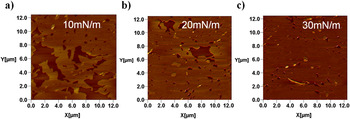
The SA LB films were prepared under three surface pressures (10, 20, and 30 mN/m). The surface morphologies of LB films were characterized by TM-AFM, as shown in Fig. 1. At a pressure of 10 mN/m [Fig. 1(a)], large surface defects exist in the SA LB film. However, the defect areas diminish with the increase of LB film surface pressure, and there are only a few defects as the surface pressure reaches 30 mN/m [Fig. 1(c)], which indicates that SA are assembled into an ordered layer.
AFM images of morphologies of SA LB films formed at three surface pressures (10, 20, 30 mN/m).

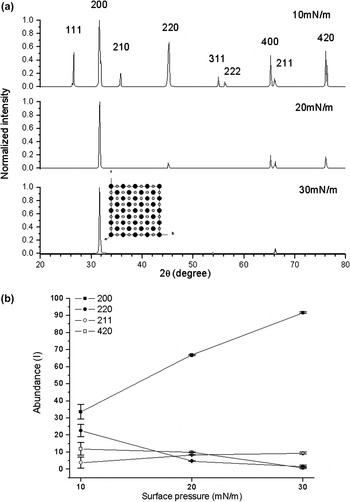
At 5 °C quenching temperature, the XRD spectra of NaCl crystals produced by 3 SA LB films are shown in Fig. 2(a). The crystal planes are identified based on the NaCl standard spectrum (ICSD: 75-0306). Clearly, at low surface pressure of 10 mN/m, nearly multiple crystal planes are present, such as (111), (200), (220), (311), (222), and (400) crystal planes. By increasing the surface pressure to 20 mN/m, several crystal plans, such as (111), (210), (311), and (222), have almost disappeared in the spectra. The NaCl (200) plane is the most dominant orientation. Interestingly, further increasing the pressure to 30 mN/m, only (200) and (211) planes can be observed and the abundance of (200) plane is nearly 90%, and integrated areas were used in the process of calculating the abundance. With the increased surface pressure from 10 to 30 mN/m, the abundance of (200) plane is dramatically enhanced from 35% to 90%, while the abundance of the other crystal planes are suppressed. The abundance of (220) plane is reduced from 20% to almost 0%. The inducing and suppressing growth of different crystal planes can be clearly illustrated in the plot of crystal plane abundance I as a function of LB surface pressure shown in Fig. 2(b). It is shown that the abundance of crystal planes (200) and (211) are enhanced by a factor of ~2.5. It is concluded that the orderly structured SA LB surface could induce or inhibit certain oriented growth of crystal planes. The (200) crystal plane is identical to the (100) crystal plane. Therefore, the (100) crystal plane is preferentially selected for the NaCl crystal growth.
NaCl crystal induced by SA LB film at three surface pressures (10, 20, 30 mN/m) at the T q of 5 °C: (a) XRD spectra (the inset in the lower panel is the model of (200) crystal plane, big circle: chloride, small circle: sodium, and (b) crystal plane abundance.

The matching between the crystal plane distances and the lattice parameters of substrates have a great influence on orientations of the crystal. To understand the selective direction growth of NaCl crystal on LB film, we compared the crystal plane distances of NaCl and SA LB lattice parameters. NaCl crystal has a unit cell parameter 5.64 Å with cubic symmetry. SA in room temperature has the stable B-formReference Goto and Asada23, Reference Malta, Celotti, Zannetti and Martelli24 with lattice parameters a = 5.59 Å, b = 7.40 Å, and c = 43.99 Å. It is most likely that 2D lattices of the head groups of SA in the LB films are identical to the projection on the a, b crystal planes. The crystal plane distances d of NaCl are summarized in Table I. The mismatching percentage Δa = na × d − a/a × 100% (Table I) between SA LB lattice parameter a and crystal plane distances d is characterized, where na is an integral number for optimal superimposition times of crystal plane distances d. For example, Δa for the (200) plane can be calculated to be 0.9% when na = 2. The smaller Δa means less mismatching. From the Table I, (211) and (200) have the best matching parameters along the a lattice direction.
Mismatch percentage Δ respective to lattice parameter a and b of crystal planes of NaCl with the optimal superimposition times n.

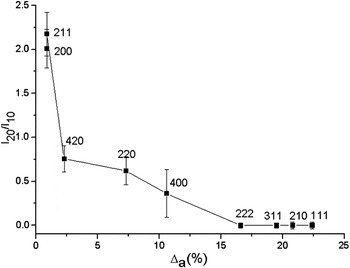
On the basis of AFM results, higher pressures can induce a higher order of LB films. A certain crystal plane is either induced or inhibited by LB films quantitatively. The Y axis in Fig. 3 is the ratio between the abundance of the crystal plane at the two preparation pressures I 20/I 10. When the higher (20 mN/m) surface pressure is used to form SA LB film compared with that of 10 mN/m, Fig. 3 clearly shows that only (200) and (211) planes are induced with a little mismatch (0.9% in Table I). The (420), (220), and (400) planes with medium mismatch are suppressed (less than 10% mismatch in Table I), while other planes with large mismatch nearly vanish. From Fig. 3, abundance of (211) and (200) planes have induced by a factor of two as contrast to that of (420), (220), and (400) planes, which is inhabited by half. The mismatching, respective to lattice b, Δb is also calculated and shown in Table I, and clearly the (400) plane has the best fitting. Because the crystal (100) plane distance has the best match for both a, b directions in the LB film, the (100) plane is preferentially selected for crystal growth. We can conclude that the template lattice parameters have a great influence on the growth of crystal planes.
Crystal plane abundance ratio I 20/I 10 (20 mN/m, 10 mN/m) as a function of the mismatching percentage Δa.

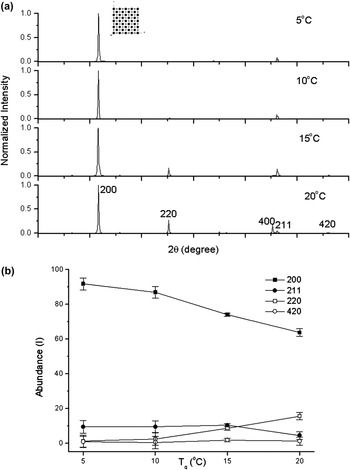
The crystal growth can be influenced by crystallization temperature. In particular, the quenching temperature (T q) can directly influence the rate of crystal growth,Reference Nyvlt25 oriented thin film growth,Reference Tsuei, Gupta, Trafas and Mitzi26, Reference Yun, Karlsson, Jonsson, Rao and Madsen27 the formation of crystallization,Reference Lotz, Wittmann and Lovinger28, Reference Varga and Karger-Kocsis29 etc. To gain insight into the temperature influence, we carried out a series of measurements to investigate the influence of the quenching temperature on the preferentially selected growth of the NaCl (100) plane. The LB films were formed at 30 mN/m resulting in the growth of the NaCl (100) plane. In addition to the quenching temperature at 5 °C (Fig. 2), the T q at 10, 15, and 20 °C have been carried out. XRD spectra of three NaCl crystals under three different quenching temperatures are shown in Fig. 4(a). By slightly increasing the T q from 5 to 10 °C, there is no significant difference. At T q of 15 °C, the (220) is observed. However, by further increasing the T q to 20 °C, the multiple crystal planes have been observed. The phenomena can be further illustrated by the plot of the abundance versus T q [Fig. 4(b)]. The (200) plane is gradually decreased from 90% to 60% at T q = 20 °C. The observations from experiments clearly indicate that the nucleation speed for crystallization is faster at a low T q, which allows to facilitate the oriented crystal growth by the LB film template method.
NaCl crystal induced by SA LB film (prepared at 30 mN/m) at four quenching temperatures (5, 10, 15, and 20 °C): (a) XRD spectra (the inset in the lower panel is the model of (200) crystal plane, big circle: chloride, small circle: sodium, and (b) crystal plane abundance.

IV. CONCLUSION
NaCl crystals are produced by the LB film template method. By controlling the LB film surface pressure and different quenching temperatures of the supersaturated solution, the single NaCl crystals are successfully produced. The NaCl (100) crystal plane is preferentially selected by the SA LB template. The experiments show the correlation between the oriented growth of a crystal plane and the lattice parameters of LB film. In addition, the lower quenching temperature can facilitate the unique growth of the preferred crystal plane, which indicates the possibility to predict and control the oriented growth of crystals by designing the lattice parameters of the LB template. The single crystal growth method based on the LB film template method can apply to organic and inorganic crystal growth in general.
ACKNOWLEDGMENTS
The authors are grateful for financial support from the Ministry of Education of China foundation of Supported Program for New Century Excellent Talents in University (NCET-07-0256); Henan Natural Science Research Office of Education project (No. 2008A14003), (No. 200714002); 2007 Henan University fund (No. 072R2D004), (No. 072RD006); and yellow river researcher fund (No. H200604).