INTRODUCTION
Toxoplasma gondii is one of the most ubiquitous parasites. The definitive host is the cat but it can be found in all warm blooded animals (including birds, marsupials and marine mammals). It is often highly prevalent with prevalences of 30–40% common in many species including humans (Dubey and Beattie, Reference Dubey and Beattie1988; Tenter et al. Reference Tenter, Heckeroth and Weiss2000). The parasite is important due to the range of diseases it causes. For example, the most devastating disease outcome is miscarriage or abortion which is particularly important in humans and domestic livestock. Additionally, it can cause a wide variety of neurological diseases especially when transmitted congenitally. These can include ocular disease and hydrocephalus (Weiss and Dubey, Reference Weiss and Dubey2009). This important role in disease is therefore of considerable concern especially as the parasite is so prevalent. An intriguing and important question, therefore, is why this parasite is so successful in both its host range and prevalence.
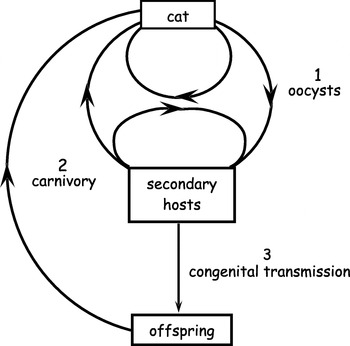
The life cycle (Fig. 1) is well understood and three principal routes are recognised: ingestion of infective oocysts shed by the cat, consumption of undercooked meat containing Toxoplasma cysts and congenital transmission (Dubey, Reference Dubey2009a). Traditionally, the main route of infection is considered to be infection by oocysts deposited in faeces by the definitive host, the cat (Hutchison et al. Reference Hutchison, Dunachie, Siim and Work1969; Dubey et al. Reference Dubey, Miller and Frenkel1970; Frenkel et al. Reference Frenkel, Dubey and Miller1970). This would imply that a high degree of contact with cats would be required to explain the very high prevalences found in many animal and human populations. Toxoplasma gondii has been reported in a very wide range of species (Tenter et al. Reference Tenter, Heckeroth and Weiss2000). However, this also includes some species that would not normally come into contact with cats (Dubey, Reference Dubey2009a). For example, the parasite has been reported in marine otters (Miller et al. Reference Miller, Gardner, Kreuder, Paradies, Worcester, Jessup, Dodd, Harris, Ames, Packham and Conrad2002), dolphins (Dubey et al. Reference Dubey, Zarnke, Thomas, Wong, Van Bonn, Briggs, Davis, Ewing, Mensea, Kwok, Romand and Thulliez2003) and arctic foxes in the Svalbard (Prestrud et al. Reference Prestrud, Dubey, Asbakk, Fuglei and Su2008a). Analysis of Toxoplasma strains in different species have shown that they are generally highly clonal (reviewed in Grigg and Sundar, Reference Grigg and Sundar2009). Clonality is usually associated with asexual reproduction. This is counter to the expectation of high genetic diversity generated by frequent infection by oocysts derived from the sexual cycle of Toxoplasma in the cat. Taken together, these data suggest that the parasite may utilise transmission cycles which bypass the cat.
The life cycle of Toxoplasma gondii. The three main routes of transmission are shown.

Some studies, based on experimental feeding of mice and detection of T. gondii in meat sources, have suggested that carnivory may be an important route which bypasses the cat (Aspinall et al. Reference Aspinall, Marlee, Hyde and Sims2002; Su et al. Reference Su, Evans, Cole, Kissinger, Ajioka and Sibley2003). A recent study of Arctic foxes from the Svalbard (an area free of cats) demonstrated frequent infection and a high degree of clonality of Toxoplasma strains in infected animals (Prestrud et al. Reference Prestrud, Asbakk, Mørk, Fuglei, Tryland and Su2008b). Although with no direct evidence, they speculated that this was due to carnivory. Risk association studies have shown that eating undercooked meat is a risk factor for congenital transmission in pregnant mothers (Cook et al. Reference Cook, Gilbert, Buffolano, Zufferey, Petersen, Jenum, Foulon, Semprini and Dunn2000; Boyer et al. Reference Boyer, Holfels, Roizen, Swisher, Mack, Remington, Withers, Meier and McLeod2005). However, a recent detailed survey of human meat sources in the USA showed that there was a low risk of infection from raw meat in humans (Dubey et al. Reference Dubey, Hill, Jones, Hightower, Kirkland, Roberts, Marcet, Lehmann, Vianna, Miska, Sreekumar, Kwok, Shen and Gamble2005). Only 7 pieces of infected meat were detected from 6282 assorted meat samples collected from supermarkets across the USA. (Two of those 7 pieces of meat were from the same supermarket and it is assumed from the same animal.) Furthermore, an older study (Rawal, Reference Rawal1959) demonstrated little difference in the prevalence of Toxoplasma in a population of strict vegetarians compared to that in a population of non-vegetarians. While carnivory could contribute to the transmission of Toxoplasma in the absence of cats, there is little direct evidence that demonstrates this role in natural transmission cycles.
Congenital transmission offers another possible mode of parasite transmission in the absence of cats. That Toxoplasma can be congenitally transmitted is well established. Early studies in mice (Beverley, Reference Beverley1959) and sheep (Hartley and Marshall, Reference Hartley and Marshall1957) established the occurrence of congenital transmission which, in the case of the mice, occurred over repeated generations. Other examples of serial congenital transmission have been established in other species (e.g. Owen and Trees, Reference Owen and Trees1998). Congenital transmission in humans is also well established (reviewed in Weiss and Dubey, Reference Weiss and Dubey2009) and is an important cause of human disease. Its role in transmission of the parasite to humans has always been considered to be relatively unimportant due to the low rates of transmission, for example 1 in 1000–10 000 live births in humans (e.g. Tenter et al. Reference Tenter, Heckeroth and Weiss2000) and 1–2% in sheep (e.g. Buxton et al. Reference Buxton, Maley, Wright, Rodger, Bartley and Innes2007a). Furthermore, the often serious consequences (abortion or miscarriage) of infection with Toxoplasma infection during pregnancy suggest that the parasite could actually select against its own transmission by this route.
The ubiquity of this parasite and the clear evidence that the definitive host (cat) is often bypassed raises interesting and important questions as to the relative importance of different routes in natural transmission cycles. While much careful and important research has been carried out in experimental infections, there are considerable challenges in addressing quantitative questions on transmission cycles in natural systems. In this paper, we review our studies which are directed at addressing these issues and place them into context with other, sometimes conflicting, studies.
TOXOPLASMA INFECTION IN SHEEP
One way of determining the importance of transmission routes is to investigate transmission in a system where one of the routes of transmission is absent or minimal. For example, the carnivorous route could be excluded as a source of transmission in a herbivorous species such as sheep. Toxoplasma infection is hugely important to sheep farmers as it is the second most important cause of sheep fetopathy in the UK (DEFRA, 2007). The accepted mode of transmission of Toxoplasma in sheep is through the ingestion of oocysts from infected pastures, water or feed (reviewed in Dubey, Reference Dubey2009b) and less than 4% of sheep persistently transmit to their offspring. Experimental studies have shown that previous infection with Toxoplasma generally results in immunity to future infection and limitation of congenital infection and abortion (Beverley and Watson, Reference Beverley and Watson1971; McColgan et al. Reference McColgan, Buxton and Blewett1988; Buxton and Innes, Reference Buxton and Innes1995). Based on these and other data, farmers are encouraged to breed from ewes that have had previous infection with Toxoplasma on the basis that lifelong immunity will protect future pregnancies. If persistent vertical transmission were important then this practice would result in an increase in parasite prevalence. This is very important as farmers may be selecting for susceptibility. To gain an insight into the relative routes of transmission, we set out to directly measure the frequency of congenital transmission of Toxoplasma in sheep.
To measure the transmission of Toxoplasma from ewe to lamb, PCR amplification of parasite DNA using the primers for the SAG1 gene were used to detect parasite DNA within lamb tissues collected immediately after lambing (Duncanson et al. Reference Duncanson, Terry, Smith and Hide2001; Terry et al. Reference Terry, Smith, Duncanson and Hide2001). Lamb tissues were collected aseptically as follows: discarded foetally-derived umbilical cord tissue was taken from liveborn lambs following birth and brain, heart and cord samples were taken from aborted lambs (Duncanson et al. Reference Duncanson, Terry, Smith and Hide2001; Terry et al. Reference Terry, Smith, Duncanson and Hide2001). In these studies, lamb cord tissue was found to be a good indicator of the infection status of internal tissues as judged by comparison of cord and brain tissue from aborted lambs (Williams et al. Reference Williams, Morley, Hughes, Duncanson, Terry, Smith and Hide2005; Hughes et al. Reference Hughes, Williams, Morley, Cook, Terry, Murphy, Smith and Hide2006). For example, a comparison of brain and cord samples from 42 aborted foetuses showed 86% agreement. The remaining 14% showed positive brain tissue and negative cord, suggesting that detection of Toxoplasma in cord is underestimating rather than over estimating infection within internal tissues (Williams et al. Reference Williams, Morley, Hughes, Duncanson, Terry, Smith and Hide2005). Extensive precautions were taken to ensure sterility, lack of contamination of samples and to evaluate the robustness of the techniques (Terry et al. Reference Terry, Smith, Duncanson and Hide2001; Marshall et al. Reference Marshall, Hughes, Williams, Smith, Murphy and Hide2004; Williams et al. Reference Williams, Morley, Hughes, Duncanson, Terry, Smith and Hide2005; Hughes et al. Reference Hughes, Williams, Morley, Cook, Terry, Murphy, Smith and Hide2006, Reference Hughes, Thomasson, Craig, Georgin, Pickles and Hide2008).
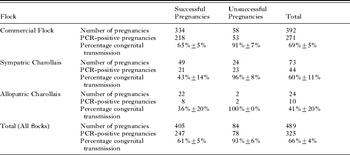
Preliminary results using a limited number of lambings showed that congenital transmission was occurring in 61% of lambings (Duncanson et al. Reference Duncanson, Terry, Smith and Hide2001). In a more extensive study over several lambings, three different flocks were examined: two sympatric flocks (ie the same farm) (commercial Suffolk Cross flock and a pedigree Charollais flock) and an allopatric flock (Charollais flock from a farm over 60 miles away). The results are presented in Table 1.
Congenital transmission of Toxoplasma gondii in sheep during successful and unsuccessful pregnancy. SAG1 PCR was used to measure infectivity with Toxoplasma. Three flocks were tested: a commercial flock from a farm near Worcester, UK, a pedigree Charollais flock from the same farm (sympatric) and a Charollais flock from a different farm (allopatric) 60 miles away. Unsuccessful pregnancies were defined as involving the loss of one or more lambs during lambing. Percentages are supplied with 95% confidence levels (+/−). (Adapted from Williams et al. Reference Williams, Morley, Hughes, Duncanson, Terry, Smith and Hide2005)

Lamb tissue was collected from a total of 489 pregnancies from all three flocks and congenital transmission was shown to be occurring in 66% of pregnancies (Table 1, adapted from Williams et al. Reference Williams, Morley, Hughes, Duncanson, Terry, Smith and Hide2005). The rate of congenital transmission was significantly higher (93%) in pregnancies that were unsuccessful (i.e. those where at least one lamb was born dead) (P<0·001). Furthermore, perhaps surprisingly, the parasite was shown to be passed on in 61% of successful pregnancies suggesting that apparently healthy lambs may be infected and could possibly contribute to infection in future generations by vertical transmission. Detailed analysis of each of the three flocks showed that, although variation was seen between the actual values for congenital transmission, when 95% confidence limits were applied, there was no significant difference between the frequency of congenital transmission between the flocks (Williams et al. Reference Williams, Morley, Hughes, Duncanson, Terry, Smith and Hide2005). This shows that there is little if any genetic effect of breed on infection or abortion rates as has been suggested elsewehere (Buxton et al. Reference Buxton, Maley, Wright, Rodger, Bartley and Innes2007b; Dubey, Reference Dubey2009b).
If, as these data suggest, vertical transmission is an important route of transmission a prediction can be made: there would be a non-random distribution of prevalence of infection amongst different sheep families exposed to the same environmental conditions (i.e. on a single farm). The alternative prediction is: there would be a random distribution of prevalence of infection amongst different sheep families exposed to the same environmental conditions (i.e. eating and drinking from the same sources).
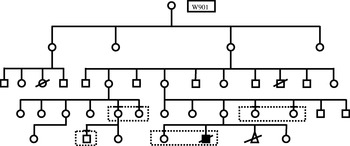
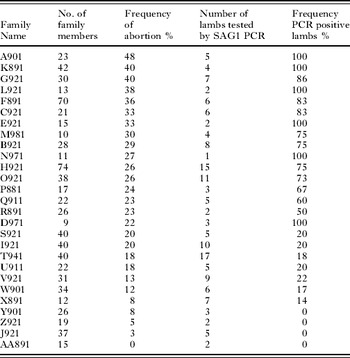
Using a pedigree Charollais flock on a single farm, this hypothesis was tested (Morley et al. Reference Morley, Williams, Hughes, Terry, Duncanson, Smith and Hide2005). Pedigree records taken from 1992–2003 were examined for the flock to construct family trees and to determine the frequencies of abortion in each family (for example, Fig. 2 and Fig. 3). During the period 2000–2003, lamb umbilical cord samples were collected from the majority of these families (where family members were still in existence) and tested for Toxoplasma infectivity by SAG1-PCR. Considerable variation was observed in the frequency of abortion in different families, with some high aborting families (e.g. Fig. 2) with abortion levels as high as 48% and others with low or zero abortion rates (e.g. Fig. 3). Table 2 shows abortion rates for each of 27 families (adapted from Morley et al. Reference Morley, Williams, Hughes, Terry, Duncanson, Smith and Hide2005). There was a significant difference from the expectations generated from a random abortion distribution (P<0·01) showing that different families were exhibiting different rates of abortion.
Tree for family K891 showing a high frequency of abortion and T. gondii infection. Symbols are as follows: Female;  Known infected female; • Aborted female;
 Aborted and infected female;
 Male;
 Known infected male; ▪ Aborted and infected male,
 Aborted male;
 Sex not recorded.
 Abortion, sex not recorded.
 Individuals in side the box,
 were tested for congenital T. gondii infection. Numbers allocated to families are derived from pedigree records but coded for anonymity.

Tree for family W901 showing a low frequency of abortion and T. gondii infection. See Figure 2 legend for key to symbols.

Frequency of abortion and infection with Toxoplasma in different families of Charollais sheep on a single sheep farm. (Adapted from Morley et al. Reference Morley, Williams, Hughes, Terry, Duncanson, Smith and Hide2005). Family names are derived from pedigree records but coded for anonymity

Measurement of Toxoplasma infection showed a highly uneven distribution of prevalence with some families showing 100% of lambs as SAG1 positive and others with 0% (Table 2, adapted from Morley et al. Reference Morley, Williams, Hughes, Terry, Duncanson, Smith and Hide2005). A significant difference was observed from the even distribution expected from random exposure (P<0·01) to oocysts. When families were ranked from high to low frequency for both Toxoplasma infection and abortion, there was a significant correlation (R=0·89, n=27, P<0·01) between Toxoplasma prevalence and abortion frequency.
These data suggest that both Toxoplasma infection and abortion frequency are not randomly distributed as would be expected if the source of infection were from a common source such as the animal feed. Furthermore, the strong correlation between frequency of Toxoplasma infection and frequency of abortion suggests that the source of Toxoplasma infection and abortion may be linked. Overall, these results support the hypothesis that high levels of vertical transmission are occurring in sheep.
If vertical transmission is occurring at relatively high frequency and generating families with high frequencies of abortion, this would suggest that there is an increased risk of abortion due to Toxoplasma when breeding from ewes from these families. It also brings into question the concepts of lifelong immunity after infection and the practice of breeding from infected ewes. To investigate this question, the family trees of sheep families were investigated to determine the frequency of infection and abortion in subsequent lambings from the same ewe (Morley et al. Reference Morley, Williams, Hughes, Thomasson, Terry, Duncanson, Smith and Hide2008). Using the sample set previously described (Morley et al. Reference Morley, Williams, Hughes, Terry, Duncanson, Smith and Hide2005), 29 ewes were identified that gave birth to successive lambs during the period when lambs were tested for Toxoplasma infection by PCR. Infected lambs were born in 31% of these successive pregnancies and 67% of those successive infections resulted in abortion (i.e. 21% overall of the successive lambs). These results demonstrate that prior infection and abortion does not provide protection for subsequent pregnancies. The risk of a subsequent infected lamb occurring following birth of an infected lamb was 69% and the risk of abortion in a subsequent lamb was 55% (Morley et al. Reference Morley, Williams, Hughes, Thomasson, Terry, Duncanson, Smith and Hide2008). These are high risks suggesting that it may not be wise to breed from infected ewes.
To date, the importance of vertical transmission in sheep has not been universally accepted. There is a considerable body of evidence that does not support this hypothesis (reviewed in Buxton et al. Reference Buxton, Rodger, Maley and Wright2006, Reference Buxton, Maley, Wright, Rodger, Bartley and Innes2007a, Reference Buxton, Maley, Wright, Rodger, Bartley and Innesb; Rodger et al. Reference Rodger, Maley, Wright, Mackellar, Wesley, Sales and Buxton2006; Dubey, Reference Dubey2009b; Innes et al. Reference Innes, Bartley, Buxton and Katzer2009 – in this special issue). While the implications of this research are extremely important for sheep husbandry and health, it will be necessary to conduct further research to reconcile conflicting hypotheses.
IMPORTANCE OF CONGENITAL TRANSMISSION IN OTHER ANIMALS
There is a large body of literature on congenital transmission in other animals (see Tenter et al. Reference Tenter, Heckeroth and Weiss2000 for review). We wished to investigate this question using similar methodologies to our sheep studies. Specifically, we wished to determine whether congenital transmission is a general phenomenon in natural populations of other mammals. We investigated this question using a wild population of mice (Mus domesticus). Two hundred mice were trapped from the Cheetham Hill area of Manchester as part of a pest control study (Marshall et al. Reference Marshall, Hughes, Williams, Smith, Murphy and Hide2004; Murphy et al. Reference Prestrud, Dubey, Asbakk, Fuglei and Su2008). These mice were tested for Toxoplasma infection by SAG1 PCR amplification from mouse brain tissue. The prevalence in this population was very high (59%) compared to other reports from studies in mice (e.g. 3% – Dubey et al. Reference Dubey, Weigel, Siegel, Thulliez, Kitron, Mitchell, Mannelli, Mateuspinillia, Shen, Kwok and Todd1995; 6·5% – Kijlstra et al. Reference Kijlstra, Meerburg, Cornelissen, De Craeye, Vereijken and Jongert2008). Of these 200 mice, 16 were found to be pregnant and 12 of these were infected with Toxoplasma (Table 3, adapted from Marshall et al. Reference Marshall, Hughes, Williams, Smith, Murphy and Hide2004). A total of 78 foetuses from these 16 animals were tested using the SAG1 PCR. As expected all foetuses from the negative mothers were negative while all positive mothers carried at least one positive foetus. This gave an overall congenital transmission rate of 75% from the cohort of 16 mice but 100% in those females determined to be infected. This study provides the first evidence that congenital transmission does occur efficiently in natural populations of mice.
Congenital transmission of Toxoplasma gondii in a natural population of mice (Mus domesticus). Summary of the results of the analysis of pregnant mice for infection with Toxoplasma gondii. Infected mice were defined as those from which an amplified SAG-1 gene product was obtained. Frequency of congenital transmission per pregnancy was defined as those pregnancies where at least 1 foetus was infected. (Adapted from Marshall et al. Reference Marshall, Hughes, Williams, Smith, Murphy and Hide2004)

IMPORTANCE OF CONGENITAL TRANSMISSION IN HUMANS
The finding in sheep that there was a high frequency of SAG1-positive lambs born which were apparently healthy (Duncanson et al. Reference Duncanson, Terry, Smith and Hide2001; Williams et al. Reference Williams, Morley, Hughes, Duncanson, Terry, Smith and Hide2005) raised the question as to whether this occurred in humans. The majority of studies suggest that congenital transmission occurs at low frequency (reviewed in Tenter et al. Reference Tenter, Heckeroth and Weiss2000; Dubey and Jones, Reference Dubey and Jones2008) with rates of 1 in 1000 to 1 in 10 000 live births reported. Sampling strategies in humans are notoriously difficult to conduct and are often based on clinical need. We used PCR testing of umbilical cord tissue, obtained at birth, to measure the infection rate in human babies. In a preliminary study conducted in Libya (Hide et al. Reference Hide, Gerwash, Morley, Williams, Hughes, Thomasson, Elmahaishi, Elmahaishi, Terry and Smith2007), it was shown that 24 PCR-positive samples were obtained from 121 pregnancies (Table 4) suggesting congenital transmission rates of 19·8%. Two of the pregnancies were unsuccessful and resulted in miscarriages but neither were associated with Toxoplasma. Thirteen of the PCR-positive samples were strain typed using the SAG3 gene by direct PCR amplification from the cord DNA samples. These included 10 SAG3 type I, 2 type II and 1 type III. The remaining samples could not be amplified to a sufficient level for typing. Studies in sheep showed that there was a reliable correlation between SAG1 positive cord tissue and SAG1 positivity in internal organs (Williams et al. Reference Williams, Morley, Hughes, Duncanson, Terry, Smith and Hide2005). Thus there is strong evidence that these babies are carrying Toxoplasma DNA despite being apparently healthy.
Congenital transmission of Toxoplasma gondii in humans. SAG1 PCR was used to measure infectivity of human umbilical cord samples with Toxoplasma gondii. Unsuccessful pregnancies were defined as involving the loss of one or more baby during birth. Percentages are supplied with 95% confidence levels (+/−)

DISCUSSION
In the sequence of investigations reviewed here, we set out to consider the importance of the vertical route of transmission of Toxoplasma gondii using a PCR-based detection assay. In the ovine host, the PCR data show that this mode of transmission may be much higher than previously thought (Duncanson et al. Reference Duncanson, Terry, Smith and Hide2001; Williams et al. Reference Williams, Morley, Hughes, Duncanson, Terry, Smith and Hide2005). As sheep will not acquire significant infection by the carnivory route, this reinforces the view that vertical transmission may be important in sheep. An uneven distribution of infection and abortion frequency in different sheep families exposed to the same environmental conditions (Morley et al. Reference Morley, Williams, Hughes, Terry, Duncanson, Smith and Hide2005) supports the view that there is either a genetic component (Buxton et al. Reference Buxton, Maley, Wright, Rodger, Bartley and Innes2007a) to infection and abortion or that there is vertical transmission of the parasite. The genetic component is unlikely since the rams used to mate with ewes were the same for all ewes irrespective of which family they came from (although different rams were used in different years). Furthermore, the overall incidence of vertical transmission was no different in other flocks (including different breeds) measured at the same time suggesting that there was not a genetic explanation for the phenomenon. An important observation was the occurrence of multiple abortion and infection from lambs born to a single ewe in sequential pregnancies. This is thought not to occur with Toxplasma but a number of instances of it were recorded in these studies (Morley et al. Reference Morley, Williams, Hughes, Thomasson, Terry, Duncanson, Smith and Hide2008). There may be an important need to review advice given on the husbandry of sheep. There is currently not consensus on the importance of vertical transmission of Toxoplasma in sheep (Buxton et al. Reference Buxton, Maley, Wright, Rodger, Bartley and Innes2007a; Dubey Reference Dubey2009b; Innes et al. Reference Innes, Bartley, Buxton and Katzer2009) but farmers are currently encouraged to breed from ewes with Toxoplasma infection on the basis of acquisition of lifelong immunity. We could be selecting for susceptibility to infection and this is an important human food source. Therefore this mode of transmission requires further investigation.
Congenital infection in humans is widely reported to be a relatively rare occurrence and often associated with severe pathology in the recipients. Our data suggest that transmission by this route may be more important than previously considered. However, the overall frequency of congenital transmission we observed in humans was lower than that observed in the sheep, suggesting that perhaps other transmission routes such as consumption of infected food and cats are also contributing to infection rates.
There are discrepancies between our data and other published results which generally show much lower rates of congenital transmission in both sheep (Dubey, Reference Dubey2009b) and humans (Dubey and Jones, Reference Dubey and Jones2008). Our studies are based on PCR alone, while the majority of other studies are based on a variety of serological methods. Initially, the PCR and serological approaches need to be reconciled (Dubey, Reference Dubey2009b). A key requirement will be the need to have as sensitive a screen as possible rather than reliance on accepted or traditional methodology in this important area of research.
There are other differences in the modes in which these studies are conducted. Many studies are based on experimental infection of animals rather than using naturally infected animals and humans as reported here. Two modes of congenital infection also exist – exogenous and endogenous transplacental transmission (Trees and Williams, Reference Trees and Williams2005). These different modes of transmission may have differing effects on the foetal immune system perhaps resulting in poor detection of infected foetuses by serological methods. For example, congenitally infected rat pups have been shown to be seronegative despite demonstrable Toxoplasma tissue cysts being observed (Dubey et al. Reference Dubey, Shen, Kwok and Thulliez1997). Additionally our data are not consistent with an age prevalence effect, again based primarily on serological data, that is widely reported in toxoplasmosis (Dubey and Jones, Reference Dubey and Jones2008). It is unclear at present why these differences exist and further research is required to elucidate these questions.
The highly clonal nature of Toxoplasma genotypes (e.g. Sibley and Boothroyd, Reference Sibley and Boothroyd1992), provides evidence that the parasite must have asexual transmission cycles which frequently bypass the definitive host, the cat. Previous work has pointed to transmission in food as the principle route for this propagation (Su et al. Reference Su, Evans, Cole, Kissinger, Ajioka and Sibley2003, Aspinall et al. Reference Aspinall, Marlee, Hyde and Sims2002). As a possible alternative, the clonality of Toxoplasma could equally well be explained by frequent vertical transmission. It is likely that the high degree of ubiquity and high prevalence of Toxoplasma gondii is generated by an interaction of all transmission routes. Therefore, as demonstrated by the body of work reviewed in this paper, the role of vertical transmission in the success of Toxoplasma gondii merits further research.
ACKNOWLEDGEMENTS
We would like to thank various funding agencies that have supported aspects of this work over the years: Wellcome Trust, Perry Foundation, Yorkshire Agricultural Society and University of Salford. We would like to thank several other co-authors of previous papers, who although have not contributed directly to this paper, have contributed to the development of this work: Drs Phil Duncanson, Rebecca Terry, Peter Marshall, Alan Maiden and David Oldfield. We would also like to acknowledge the helpful comments of anonymous referees that have improved this manuscript.