

On March 16, 2010, Professor Karl A. Gschneidner Jr., Mr. Mark A. Smith, Dr. Stephen W. Freiman, Dr. Steven Duclos, and Mr. Terence Stewart, Esq. offered testimony at a U.S. congressional hearing, “Rare Earth Minerals and 21st Century Industry,” about the grave state of the domestic rare earth industry and its dire implications.Footnote 1 Smith, the CEO of Molycorp Minerals LLC, which operates the largest rare earth mine in the Western hemisphere, underscored the urgency of the situation. “On its face it may not seem any more disconcerting than any other material dependency. However, it is the combination of three key factors that make this situation of urgent concern to policymakers.” He explained that rare earths figure critically in the clean energy and defense industries; that one country, China, controls their production; and they are actively developing their own consumptive capabilities, “leaving the rest of the world without a viable alternative.”Footnote 2 Gschneidner lamented that not long ago the United States had been the world’s leader in rare earth production, refinement, and use, but over just the last two decades, the domestic industry has virtually dissolved. He further warned that the concomitant decline of the intellectual infrastructure underlying rare earth technologies frustrated any attempts to resuscitate the industry. Gschneidner testified that “some of these [rare earth] experts have moved on to other industries, others have retired, and others have died, basically leaving behind an intellectual vacuum.”Footnote 3
The United States and much of the rest of the world dropped the “rare earth ball” in the 1990s, when China developed the technology to extract and refine rare earths, and then sold the materials cheaply on the international market. Unable or unwilling to compete with the Chinese, U.S. companies, and virtually all international concerns, simply ceased mining and refining rare earths. By the end of the twentieth century, China essentially held a monopoly on the rare earth industry, an industry that the world had grown increasingly dependent upon. After 2000, China began to raise its prices for rare earths to some markets, while limiting exports to others, sending shock waves through the industry, particularly in the West. As Gschneidner explains, “There are two potential problems. One, a lot of rare earth materials go into computers—practically all our U.S. weapons systems depend on computers. So if the Chinese act a little belligerent, it could have a very serious impact. And two, they’ve started quotas because they don’t want to export rare earths; they want to use them internally.”Footnote 4
His concerns are not merely hypothetical. In 2010, the Chinese temporarily cut off supplies of rare earths to the Japanese in retaliation for a maritime incident, demonstrating China’s willingness to use its rare earth stockpile for persuasion.Footnote 5 In the fall of 2010, the state-owned China Daily reported that after already cutting rare earth exports by 40 percent, the Chinese would further reduce exports by another 30 percent the following year.Footnote 6 Though the government officially denied this schedule, it did admit to be in the process of developing a plan to conserve its resources for domestic development.Footnote 7 In response to these policies and potentially even more devastating ones, in March 2012, the Obama administration, together with Japan and the European Union, appealed to the World Trade Organization in an attempt to force the Chinese to reduce its “export duties, quotas and other practices to control the production and supply of these materials” and end the practice of “creat[ing] pressure on U.S. and other foreign companies to move operations, jobs and technologies to China,” so far with little success.Footnote 8
This article considers the history of the domestic rare earth industry and the critical role that the U.S. government has played on its growth and decline. In his seminal essay, Carter Goodrich’s “state-in/state-out” model explores the variety of ways that government support stimulates industrial development.Footnote 9 Economic, political, social, and patriotic concerns prompt “the state” to invest in an industry and it does so in a variety of ways: making endowments, granting loans, levying bonds, gifting lands, providing technical guidance, introducing tax incentives, and enacting supportive public policies. Usually after the initial period of government support, the private sector takes over, the government retreats, and the industry thrives. The United States government stimulated the domestic rare earth industry, particularly in the 1950s and 1960s, but when the government’s support waned, private investment grew for a while, but could not sustain the domestic industry.
The Chinese experience followed a very different trajectory. In the 1980s, the Chinese government began to invest in research and development of rare earths. Soon after, it assumed control of the country’s largest reserves and directly managed the supply and price schedules. In the 1990s, the Chinese industry rivaled that of the United States, and by the end of the decade assumed dominance on the world market.
The stark contrast between the current rare earth crisis in the United States and the thriving rare earth industry in China underscores the decisive role of government involvement in this industry. Understanding the nature of the government’s role and the dynamic between the public and private sectors provides us with insight into the current rare earth crisis, and this can inform future policy regarding critical materials precisely because rare earths play an important role in modern day technology and national security.
The Growth of the Rare Earth Industry
Rare earths include the fifteen lanthanides, elements with atomic numbers 57 through 71 (lanthanum, cerium, praseodymium, neodymium, promethium, samarium, europium, gadolinium, terbium, dysprosium, holmium, erbium, thulium, ytterbium, and lutetium) along with scandium and yttrium, which exhibit many of the chemical characteristics and behaviors of the lanthanides. Most lanthanides are nearly indistinguishable from each other chemically, since the outermost electron shells are identical; it is the number of electrons in their 4f-shell that lead to variances in their physical properties that have resulted in magnetic materials of great technological importance.Footnote 10
Although rare earths were so named because many believed that they were rare, they actually exist in significant quantities.Footnote 11 They are found in certain minerals; the most common being monazite and bastnaesite. Large bastnaesite reserves exist in California and China, but prior to their discovery and development in the 1950s, the primary source of rare earths was monazite, with significant reserves in India, Brazil, Australia, South Africa, China, and Malaysia.Footnote 12
Monazite contains thorium as well as rare earths and the demand for thorium, together with a small but growing secondary market for rare earths, sustained the industry during the first half of the twentieth century. In the mid-1880s, the Austrian chemist Carl Auer von Welsbach developed the first practical use for monazite. He found that the combination of thorium and the lanthanides made effective gas mantle lights and established the Treibacher Chemische Werke in Vienna to manufacture them.Footnote 13 The American Company, Lindsay Light, went into the gas mantle business in 1902, initially importing the thorium from Germany. When World War I cut the German supply line, it began to import monazite sands from India.Footnote 14 As electricity found widespread use, the market for the gas mantles declined, and Lindsay shifted its emphasis to refining and supplying thorium and rare earths to industry.Footnote 15 The rare earth market grew after World War I as new research demonstrated their usefulness in enhancing the intensity of searchlights, motion-picture projectors, therapy-lamp carbons, and as flints used in cigarette lighters.Footnote 16 In addition to extracting rare earths for these applications, Lindsay provided the Manhattan Project with thorium and rare earths during World War II. After the war, the Atomic Energy Commission identified thorium as a critical “source material for atomic energy” and vital to strategic defense, atomic energy, metallurgy, and jet propulsion.Footnote 17
India: The First Rare Earth Crisis
As the market for thorium and rare earths increased after World War II, the demand for monazite grew. Though some reserves of monazite had been found in the United States, South Africa, and Brazil, the preferred source of monazite was the beach sands of the State of Travancore, in India, which contained higher concentrations of the desired materials than other sites.Footnote 18 By 1941, 80 percent of the monazite used in U.S. industry came from India.Footnote 19 Three years later, India provided the entire supply.Footnote 20 America’s reliance on this stock of raw materials left it vulnerable to foreign interest and foreshadowed the current rare earth crisis. An examination of the crisis that followed demonstrates the risk of such dependency.
In 1946, the nascent Indian government imposed an embargo on the export of its sands as it reassessed its strategic priorities and developed its domestic economy.Footnote 21 This new policy frustrated the United States and fed tensions between India and the United States that intensified over the next decade. Soon after gaining independence in 1947, India desperately sought financial aid to alleviate acute food shortages. On February 12, 1951, President Truman asked Congress to approve the shipment of two million tons of grain to India. Despite initial support for the humanitarian aid package, Congress’s growing awareness of the monazite embargo gave them pause for thought. Senator John M. Vorys (R-Ohio) lobbied for quid pro quo; he insisted that India commit to selling the strategic materials to the United States in exchange for the aid package.Footnote 22 Over the next several weeks, his viewpoint gained support. On February 17, 1951, Charles R. Lindsay III, president of Lindsay Light & Chemical, the principal commercial interest importing monazite, supported Vorys’s position in an open letter to Congress. He suggested that the body withhold the two-million-ton grain shipment it intended to send to India and use it as leverage to prompt India to sell the monazite sand to the United States.Footnote 23 Vigorous debate in Congress followed and on April 24, the congressional subcommittee approved the bill to send India the much-needed grain in return for access to unspecified “strategic materials.”Footnote 24 Truman signed the Emergency Indian Wheat Bill on June 15, 1951.Footnote 25 India, for its part, did not relax its embargo of monazite.
The Indian government chose to stop shipments of the critical material in 1946, at least in part because of the potential of the material to stimulate its own domestic market. The product had value and its huge underemployed population could be put to work to develop the industry. In withholding the supply of monazite from the United States, India intended to develop its own processing industry, sell the refined rare earth compounds to the United States, and retain the thorium, a strategic material in the nuclear industry, for itself.Footnote 26 Despite the obvious lesson that could have been drawn, vis-à-vis the current rare earth crisis, this experience did not inform future policy concerning access to critical materials. Over the next two decades, the United States grew dependent upon Middle Eastern oil and later in the century, it grew dependent upon Chinese rare earths.
The U.S. Rare Earth Industry
After India interrupted the supply of monazite, the United States worked to cultivate other sources for the material, both domestically and around the world. Fortunately, it did not have to wait long as prospectors discovered the rich bastnaesite reserves in Mountain Pass, California, in 1949, the largest such reserve identified in the world at that time.Footnote 27 The following year the United States Geological Survey mapped the site and then the Molybdenum Corporation of America (Molycorp) purchased the mining rights.Footnote 28 Two years later they began to extract rare earths.
Prior to World War II, the demand for rare earths had been relatively limited because not much was known about them; the difficulty scientists had in separating rare earths from one another hindered their study. Although many of the existing applications for rare earth compounds could be satisfied with a naturally occurring mixture of rare earths, known as mischmetal, real advances in the science and technology of rare earths required a deeper understanding of the properties and behavior of individual rare earth elements. Arguably, one of the most important advances in the science of rare earth chemistry was the efficient separation of individual rare earth species, accomplished in the decade following World War II at Iowa State College by chemist Frank Spedding and his students.Footnote 29
In 1947, the Atomic Energy Commission (AEC) established the Ames Laboratory on the Iowa State campus and appointed Spedding its director. His research group developed an “ion exchange chromatography” process for separating the rare earths from one another more readily than previous techniques to yield individual rare earth metals in a highly purified state.Footnote 30 Ames Laboratory set up a pilot plant to separate the rare earths using this new process and over the next few years most of the rare earth metals available nationally were separated there. The Ames group and many others improved the original Spedding, Wheelwright, and Powell patent of 1957 and the science and technology of rare earth separation and purification flourished during the 1950s and 1960s. This facilitated their study, which, in turn, generated new technology including the modern cadre of permanent magnets and optical applications such as lasers and signal multipliers.
In the 1950s and 1960s, the Ames Laboratory effectively transferred the technology to industry and the private sector took over production, though the Ames Laboratory continued to be a source for consult. They published papers, gave presentations at meetings, and welcomed visits from interested parties. In addition, the Ames Laboratory established a loan program to supply high-purity rare earths for basic research to scientists in the public and private sectors. In 1966, the AEC expanded the laboratory’s ability to support rare earth research by authorizing and supporting the creation of the Rare Earth Information Center (RIC), which responded to queries from academia and industry, and published its quarterly newsletter, RIC News. Footnote 31 The existence of the Ames Laboratory and RIC made the boundaries between public and private rare earth communities rather porous. The Ames Laboratory facilitated the transfer of rare earth technology to industry soon after its pilot plant became operational. RIC enhanced the laboratory’s ability to disseminate rare earth information, and the publication of RIC News integrated the public and private rare earth community internationally. Indeed, by 1965, Ames Laboratory became known as the “birthplace of the modern rare-earth industry” and Chemical and Engineering News proclaimed it the “Mecca of rare earths.”Footnote 32
The Rare Earth Industry Matures, 1960s–1980s
Through their investment in the Ames Laboratory, RIC, and other up-and-coming research groups in academic, national, and corporate laboratories during the 1950s and 1960, the federal government supported an intellectual infrastructure in the government and private sector that fueled the growth of new end-use industries.Footnote 33 Theoretically, national laboratories transfer basic science and technology to the private sector and corporate laboratories implement the raw knowledge into practical uses, but in reality both camps supported both basic and applied research programs that propelled the industry forward. Research and development led to discoveries that improved existing practices and opened new avenues of research and development.
Between the 1960s and much of the 1980s, Molycorp’s Mountain Pass mine supplied most of the world’s bastnaesite and, consequently, produced the bulk of the world’s rare earths. Molycorp’s capabilities grew as it expanded its lines of rare earth oxides, serving a growing U.S. and international market of end-use processors. In some cases, the materials solved technological bottlenecks; in others, they improved conventional technologies. The glass and ceramic industries polished and glazed their wares with rare earths. Rare earth fluorides increased the intensity, steadiness, and uniformity of arc lights—qualities of particular value to the searchlight and motion-picture industries.Footnote 34 Other companies used rare earth chlorides to produce mischmetal, comprising 75 percent of the material in cigarette lighter flints and improving the strength and ductility of iron as well as nonferrous metals.Footnote 35 The atomic energy industry found lanthanides important for the regulation of atomic reactions. Thus by the end of the 1950s, commercial interest in rare earths grew within the glass, ceramic, lighter flint, metallurgical, and atomic energy industries.
The industry grew dynamically over the next decade as scientists discovered even more applications for rare earths, a consequence of continued public and private investment in the intellectual infrastructure of the science of rare earths. The use of rare earths as petroleum-cracking catalysts increased gasoline efficiency and made the catalyst more versatile.Footnote 36 In 1964, Drs. Albert K. Levine and Frank C. Palilla of the research division of General Telephone and Electronics Corporation found that the rare earth europium significantly brightened the red color in the phosphor used for color televisions, which, in turn, allowed the blues and greens to be deepened, thus increasing the quality of the pictures.Footnote 37 Then, in 1965, a team of scientists, led by Dr. Karl Strnat at the Air Force Materials Laboratory on the Wright Patterson Air Force Base, discovered the samarium-cobalt (Sm-Co) permanent magnet, opening an entirely new era of rare earth technology.Footnote 38 These permanent magnets could be made smaller and stronger than their ferrous-based counterparts because of their superior energy product and held enormous promise for new applications, particularly in the electronics industry, but also for the medical and automotive industries.Footnote 39
Given the accelerated pace of scientific discoveries fueled by industry as well as the federal government, and the wide range of new applications, the demand for rare earths expanded rapidly. In 1960, the domestic market consumed approximately 1,600 metric tons of rare earth oxides, by 1965 this grew to 3,600 metric tons, in 1970 it exceeded 10,000 metric tons, and in 1973, annual consumption reached about 18,000 metric tons of rare earth oxides.Footnote 40 On the scale of production of other raw stock for industry, such as iron, aluminum, and copper, the quantities above might seem inconsequential. Two points regarding rare earth production provide some perspective. First, even from rare earth-rich minerals, like bastnaesite, the yield of pure rare elements is quite limited. A great deal of ore must be mined for rather small quantities of individual elements. Second, many of the critical uses of rare earth elements involve relatively minor additions of rare earths to an existing industrial process (for example, to improve the strength and ductility of steel).
Although Sm-Co magnets showed great promise in the mid-1960s, the relatively high cost of cobalt and the difficulty of obtaining it in sufficient quantities due to the political upheaval in Zaire undermined its availability. Furthermore, the Sm-Co alloy did not quite live up to its potential inasmuch as its magnetization decreased over time. Therefore, the search for permanent magnets continued. At a conference in November 1983, both John Croat’s group at General Motors Research Laboratories in Michigan and Masata Sagawa’s team at Sumitomo Special Metals in Japan independently announced the discovery of neodymium-iron-boron (Nd-Fe-B), a new alloy with magnetic properties even more favorable than Sm-Co and comprised of materials much more readily available and much less costly.Footnote 41 Karl Strnat, the father of the Sm-Co magnet predicted that their findings would stimulate even more interest and activity that would result in the discovery of a range of magnets “with Nd-Fe-B magnets at one extreme and Sm-Co magnets at the other.”Footnote 42
As the end-product uses for rare earths increased, Molycorp stepped up production for subsequent processing by other companies. In 1965, anticipating growth in the colored television market, they built a europium-recovery plant and increased europium oxide production dramatically.Footnote 43 In 1968, Molycorp acquired the Yttrium Corporation of America, of Louviers, Colorado, a company that began in 1966 to produce pure yttrium oxide as well as other rare earths.Footnote 44 The following year, Denison Mines, Ltd., a Canadian operation, announced that it would resume yttrium oxide production and ship “it to Molycorp for further processing.”Footnote 45 In 1969, Molycorp introduced seven new rare earths to its product line, increasing its inventory to include fifteen rare earths.Footnote 46 In 1977, Molycorp became a “wholly-owned subsidiary” of Union Oil Company (UNOCOL) and its growth and expansion continued.Footnote 47 In 1978, it constructed a bastnaesite-processing facility to serve the permanent magnet industry.Footnote 48 In 1982, a new $15 million separation plant allowed a 35 percent increase in production.Footnote 49 By the 1980s, Molycorp provided over 70 percent of the world’s supply of rare earths from its Mountain Pass mine.Footnote 50
While Molycorp dominated the mining and processing of rare-earths, other companies in the United States, Europe and Japan entered the industry to produce rare earths oxides and/or used rare earths to make end-products.Footnote 51 The manufacture of permanent magnets in the United States began immediately after their 1983 discovery. Ronson Metals and Colt Industry’s Crucible Magnetics Division began production within a year. In 1985, General Motors’ Delco-Remy Division began construction of a $70 million, 160,000-square-foot plant in Anderson, Indiana, to produce Nd-Fe-B permanent magnets for use in starter motors. They named this operation Magne-Quench (later changed to Magnequench). Despite this enthusiastic beginning, the United States did not dominate the magnet industry for long. By 1985, Japan exceeded the United States in developing the commercial market for permanent magnets in motors, computer printers, microwave tubes, and ion-beam devices.Footnote 52 In 1988, Japan boasted two new processing plants already operating, and a third planned. By 1987, the permanent magnet consulting group, Wheeler Associates, reported that Japan claimed 52.2 percent of the market for “world magnet production” with the United States and Europe trailing at 19.9 percent and 11.4 percent, respectively.Footnote 53
During the 1980s and 1990s, the demand for permanent magnets grew sharply. In 1988, Wheeler Associates reported that permanent magnet sales in the West had reached $1.455 billion, an increase of 12.4 percent since the year before and there appeared to be no ceiling in sight.Footnote 54 In 1989, a new magnet study put out by the Gorham Advanced Materials Institute estimated the permanent magnet market worth a more modest $1 billion but predicted growth at 10 percent per year. It also reported that the Nd-Fe-B magnets to be the fastest growing segment of the permanent magnet market.Footnote 55 In 1995, Wheeler Associates reported that permanent magnet sales grew 12.6 percent worldwide to above $3.2 billion and forecasted that global sales would reach $10 billion by 2005 due to the growth of the global “information highway.”Footnote 56
China Enters the Rare Earth Market
The demography of rare earth supply changed in the 1980s when a new player emerged on the scene. In the mid-1970s, the world first learned that China possessed, by far, the largest rare earth reserves, with initial estimates at 36 million tons or 50 percent of the world’s supply.Footnote 57 By comparison, the United States, with 13 million tons, held approximately 17 percent of the world’s reserves.Footnote 58
Until the 1980s, China did little to develop its rare earth industry. In the 1950s, the Bayan Obo mine in Inner Mongolia became operational as the principal iron ore supply for the Baotou Iron and Steel Company. In the late 1950s, they began to recover rare earths as well, but development of this industry remained slow and quiet. Indeed, it was not until the mid-1970s that RIC News reported that the Chinese had extensive rare earth reserves and had been mining and incorporating them into its “ferrous and non-ferrous metallurgy, machine building, petro-chemical, glass-making and ceramics, electronics, medicine, building material and light industry as well as agriculture and national defense” industries since 1958.Footnote 59 Between 1966 and 1976, the Chinese government’s preoccupation with its Cultural Revolution slowed economic development and it remained privatized under the authority of provincial governments.Footnote 60 However, during the 1980s and 1990s, the Chinese government took an active interest in developing the country’s rare earth capabilities. This required China to develop an intellectual foundation to facilitate its mining, processing, and manufacturing potential.
The Chinese government stimulated its rare earth industry by building both intellectual and physical infrastructures. According to Tang Kefeng, former Secretary of the Chinese Society of Rare Earths, in 1975 China began to modernize its scientific and technology programs, which suffered during the “Cultural Revolution,” turning to the United States, Japan, and Western Europe for technology and expertise.Footnote 61 Furthermore, it pumped resources directly into its own rare earth research and development.
The father of the Chinese rare earth industry, Professor Xu Guangxian, had encouraged the development of the industry for decades. After attending Washington University in St. Louis (M.S., 1949) and graduating from Columbia University in New York City (Ph.D., 1951), Xu returned to China and began working at Peking University.Footnote 62 There he continued his rare-earth research and lobbied for, and eventually succeeded in, establishing laboratories that focused on their study. In the early 1980s, he founded the State Key Laboratory of Rare Earth Materials Chemistry and Applications, associated with Peking University, which focused on basic research and the chemistry of rare earths. In 1987, he established State Key Laboratory of Rare Earth Resource Utilization, associated with Changchun Institute of Applied Chemistry. This laboratory concentrated on applying rare earths to the electronic and high-tech industries.Footnote 63 Interestingly, half of its staff came from the Changchun Institute, but visitors accounted for the other half, an apparent attempt to accelerate its rare earth learning curve.Footnote 64
The Chinese Society of Rare Earths, organized in 1980, established the China Rare Earth Information Center (CREIC), modeled after the Ames Laboratory’s RIC in 1985, and began the publication of a newsletter titled Chinese Rare Earth Information.Footnote 65 By 1985, about 3,000 scientists and engineers at three hundred research institutes and forty universities worked on rare earths.Footnote 66 In 1986, the industry received another shot of government support as the National High Technology Research and Development Program infused considerable funding into the development of high-tech fields of which rare earths figured centrally. Key fields that the government promoted included military and civilian applications in biotechnology, space, information, laser, automation, energy, and new materials.Footnote 67
The Chinese government also grew its capabilities by encouraging its companies to partner with foreign businesses in the industry, and they did so. In 1978 and 1979, the Japanese company Inoue Japax Research announced a joint venture with the Chinese government for research and development of rare earth technologies, “including ore analysis, ore dressing, and product application.”Footnote 68 At the same time, Mitsui Mining Company and Mitsui and Company announced that they were considering joint ventures with the Chinese to develop rare earth processing on the Poyun iron ore deposits.Footnote 69 Capitalizing on the influx of Japanese support, the government began construction of two rare earth treatment facilities to produce a total of 6,600 tons of rare earth oxides each year. Between 1978 and 1989, production of Chinese rare earths increased by 40 percent annually.Footnote 70 Foreshadowing the future, a 1982 edition of the RIC News noted that REMACOR, identified as one of the fastest growing rare earth processing companies in the United States, purchased its raw materials from China and it predicted that, inasmuch as China had the world’s largest reserves, they would make important contributions to the rare earth industry in the 1980s and 1990s.Footnote 71
The Growth of the Chinese Rare Earth Industry
During the 1980s and 1990s, China continued to develop its rare earth physical and intellectual infrastructure and capitalized on the increased demand for rare earths worldwide, particularly after the discovery of the Nd-Fe-B permanent magnet. As China mined and processed an increasing share of the world’s rare earth reserves, it began to undersell the international market, thus driving many foreign mines and producers out of business. Then, with an essential monopoly on supply in hand by the end of the 1990s, China began to develop its own end-use industries. As its domestic market grew, the Chinese government began to limit rare earth exports, sending shock waves through the industry; the world had become critically dependent upon rare earth technologies as scientists developed new applications for them.
As the permanent magnet market soared, China moved quickly to expand its rare earth industry.Footnote 72 To enhance capacity, the government encouraged joint ventures with Japan and the West and stimulated the industry directly. In May 1986, Japan and China agreed to “jointly extract, refine and use rare earths.” The Japanese companies saw the benefit of a “steady and continuous supply of rare earths from China. The Chinese, for their part, hoped to obtain advanced technology and machinery from Japan to update their methods of mining, extraction and processing of rare earths.”Footnote 73 The United States entered a similar mutually-beneficial relationship with the Chinese in 1989, ensuring American companies a place in the Chinese-dominated rare earth industry and the continued transfer of U.S. state-of-the-art technology to the Chinese. Ke Ning Da Industry of Ningbo, China, and the U.S. firm Tredas International entered a joint venture to produce forty tons of Nd-Fe-B magnets annually by updating the Chinese plant with new equipment from the United States.Footnote 74 In 1990, MPV Lanthanides formed with the merger of three companies, China Metallurgical Import and Export and the U.S. companies Pacific Chemicals and Engineering and Universal Victory, to offer rare earth–related products and services.Footnote 75 The following year the Canada Rare Earth Metal Company joined forces with the Ganjian Rare Earth Company of Ganzhou, Jiangxi, China, to build a $3.3 million plant to process two hundred metric tons of mixed rare earths worth $14 million per year.Footnote 76 Advanced Materials Resources of Toronto made several investments in Chinese industries as well, including a 60 percent interest in a three-hundred-ton rare earth oxide facility in Jiangyin, and a 60 percent interest with Beijing New Precision Alloy Company to produce permanent magnets.Footnote 77 In 1995, the Chinese firm Beijing San Huan New Materials High-Tech Incorporated and China National Non-Ferrous Metals Import and Export Corporation, together with the U.S. investment firm Sextant Group Incorporated, bought Magnequench, the subsidiary of General Motors that produced Nd-Fe-B permanent magnets.Footnote 78 As part of the purchase agreement, they promised to keep the Indiana plant running for five years. Five years and one day later they fired the workers and closed the factory—all remnants of the operation vanished—they moved the company to China.Footnote 79
With support of the Chinese government and investments from Japan and the West, China developed its rare earth intellectual infrastructure as well as mining, manufacturing, and technological capabilities. Meanwhile, the world searched for new reserves of rare earths. Australia showed promise; estimates suggested that Australia held 5.4 million tons of rare earth ores, making it the third richest country with 6.4 percent of the world’s supply.Footnote 80 The enthusiasm that many showed for the development of Australia’s reserves came to a rather abrupt halt during the early 1990s, when companies closed mines and potential end-use manufacturers failed to materialize. Many found the risk of investment too high considering the “current impact of Chinese rare earth suppliers on the rare earth market.”Footnote 81
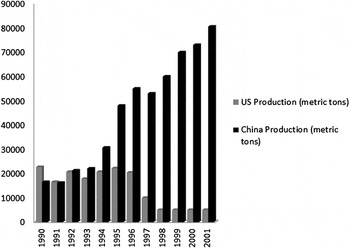
In the late 1980s, Chinese producers secured their monopoly by engaging in a price war that drove the prices down on the international market. At the same time, the Chinese government reduced the quantity of exported raw materials in favor of building its domestic processing capacity. Consequently, rare earth export revenues declined, though more rapidly than desired (40 percent from 1989 to 1990).Footnote 82 To stabilize prices, in 1990 the Chinese government nationalized a major portion of the industry and, in 1994, established a cartel of rare earth producers that adhered to a shared schedule of prices.Footnote 83 During the mid-1990s, China’s industry blossomed as U.S. production declined (see Fig. 1). In 1995, the Chinese government reported that domestic rare earth production, consumption, and export exceeded 1994 numbers: the sale of rare earth oxides increased by 56.6 percent to 48,000 metric tons and the total value of export earnings reached $271 million.Footnote 84
Production of rare earth oxides in the U.S. and China, 1990-2001. (Source: James B. Hedrick, U.S. Geological Survey—Minerals Information, 1994 Tables 1 and 8; 1996 Tables 1 and 5; 2001 Tables 1 and 6.)

In 1992, the Chinese leader, Deng Xiaoping, said: “There is oil in the Middle East; there is rare earth in China” and directed his country to capitalize on its resources to achieve economic supremacy.Footnote 85 In the 1990s, it did so masterfully. China had the resources, government support, and an international community of companies with rare earth expertise that enthusiastically looked to capitalize on the Chinese resources. Foreign concerns transferred their intellectual and technological capacities to the Chinese with joint ventures and, when necessary, set up shop in China. Despite attempts to develop other reserves worldwide, by the end of the twentieth century, China held a virtual monopoly in rare-earth mining and processing. Between 1988 and 1998, China’s production of Nd-Fe-B magnets increased from 14.4 percent to 40 percent of the world’s supply.Footnote 86 Ten years later, China was processing more than half of the global rare earth supply, exporting 10,000 tons of magnets and 34,600 tons of other products.Footnote 87 The world had grown dependent upon the Chinese industry ceding enormous power to China by virtue of their ability to control prices and the availability of rare earths. The Japanese, in particular, bitterly complained about the 100 percent price increase that the Chinese demanded for rare earths in 2005.Footnote 88 But, inasmuch as China dominated the industry so completely, Japan had little recourse.
The Decline of the U.S. Industry
As the Chinese rare earth efforts flourished, rare earth production and innovation in the United States declined. Beyond the seemingly vast rare earth resources at the command of China, several critical factors have been identified and discussed in the halls of Congress and the public news media that explain the demise of the U.S. rare earth industry. First, the cost savings realized by China in mining and refinement operations, due to government ownership of the largest producers, low labor costs, and only nominal regulation of working conditions and environmental safety, allowed them to sell their products inexpensively.Footnote 89 Conversely, in the United States, the higher costs for labor and the expense of lawsuits and compliance with an array of local, state, and federal regulations made domestic mining and processing facilities more costly. Quite simply, rare earth production in the United States became unprofitable.
U.S. environmental policies became more stringent after 1970, when President Nixon established the Environmental Protection Agency (EPA); quickly it became a bit of a thorn in the side of the rare earth industry (as well as many other sectors of the U.S. economy). Consider the fate of Lindsay Chemical Company, the oldest U.S. rare earth concern. In 1968, Lindsay became a subsidiary of Kerr-McGee. Despite robust growth and expansion in the 1960s, Kerr-McGee shut down its American operations rather abruptly in 1973. Its management explained that “economic pressures involved in complying with the EPA’s pollution standards” forced the closure.Footnote 90 Environmental concerns eventually precipitated the closure of Michigan Chemical Corporation, also once a thriving end-product producer employing rare earths. In 1965, the Michigan Chemical Corporation boasted “the world’s largest ion-exchange facility for making high purity rare earth chemicals.”Footnote 91 Beginning in 1973, lawsuits as well as Department of Natural Resource and EPA investigations of environmental contamination plagued the company. The plant closed in 1978.Footnote 92
In 1985, U.S. policy hit the industry at large with a serious blow. In the 1970s and early 1980s, the U.S. Bureau of Mines reported that metallurgical and petroleum cracking catalysts comprised the major market for rare earth stockpiles and the demand for rare earths grew, reaching a peak of 24,800 metric tons in 1984.Footnote 93 In 1985, however, consumption fell precipitously to 12,700 metric tons.Footnote 94 In that year, the U.S. government limited the amount of lead that could be added to gasoline to increase octane levels, crippling the petroleum cracking industry and, consequently, the demand for domestic rare earths plummeted to a nine-year low.Footnote 95 For the balance of the decade, rare earth oxide consumption fluctuated between 8500 and 11,800 metric tons.Footnote 96
During the 1980s and 1990s, even the rare earth giant, Molycorp, fell victim to competition from China as well as EPA and Federal Bureau of Land Management inquiries and regulations.Footnote 97 In 1991, Molycorp put its Pajareto project, a joint venture with the Mescalero Apache tribe to mine sections of their reservation in New Mexico, on hold pending an improvement in prices.Footnote 98 Molycorp’s situation worsened when a broken pipe at its Mountain Pass mine precipitated an environmental disaster in 1998. This was the straw that broke the camel’s back: Molycorp suspended mining activities at Mountain Pass in 1998.Footnote 99 The United States effectively withdrew from mining and processing rare earths and its customers turned to China.
In addition to the introduction of environmental regulations, the U.S. federal government withdrew much of its support for the transfer of technology and information that had sustained the burgeoning rare earth industry. The decline in the rare earth intellectual infrastructure in the United States can be traced back to the late 1960s. During the 1950s and 1960s, the United States government directly and indirectly supported the industry through a period of rapid growth by investing in research programs at universities, national laboratories, and the private sector. For example, the AEC supported the Rare Earth Information Center and its publication, RIC News, from 1966 to 1968, “when reductions in federal appropriations forced the AEC to withdraw its funding of RIC.”Footnote 100
Economist Carter Goodrich, in his study of government involvement in the railroad industry, points out that a decline in federal funding and support anticipates an increased investment by the private sector, and this is what initially happened with RIC News. Footnote 101 Five companies, in addition to Iowa State University’s Institute for Atomic Research, attempted to keep RIC News afloat, although support was not available for the important tasks of responding to specific rare earth queries or to compile bibliographies of rare earth publications. Footnote 102 The support for RIC News expanded in 1969, when an additional ten rare earth companies, including several of the largest international concerns, pledged support for operation and because of this, it could continue to field questions and publish its newsletter.Footnote 103 In 1988, RIC News editor, Karl Gschneidner, reported circulation at about 5,500 and individual queries exceeding one per day.Footnote 104 By 1990, support for RIC came from 140 corporations and individuals worldwide. Nevertheless, by 2002, when much of the industry dissolved in the wake of China’s dominance, private support for RIC could not be sustained and the federal government showed no interest in rescuing the organization or stimulating the intellectual infrastructure of the rare earth industry. The last issue of RIC News was published in June 2002 and its archives ceased to be updated.Footnote 105
The cessation of funding for RIC, and its eventual closure, is just one indicator of the decline of the intellectual infrastructure for U.S. rare earth science and technology. According to Gschneidner’s testimony before Congress, rare earths just ceased to be a “hot” topic in the United States. He reported that virtually no research with regard to mineral extraction, separation, or processing the oxides into useful forms goes on and this is a necessary corequisite to the development of a healthy, growing domestic industry.Footnote 106 Supporting this view, a 2010 study of the geographic distribution of rare earth technology–related patents during the period 1976–2002 by Brian J. Fifarek and Francisco M. Veloso presents a rather grim picture of the state of innovation within the U.S. rare earth industry.Footnote 107 Between 1976 and 1990, of the 5,740 patents filed, 56 percent were from the United States, 22 percent were from Japan, and 19 percent were from Europe. During the twelve years between 1990 and 2002, the shares of U.S. and European patents declined to 44 percent and 17 percent, respectively, whereas Japan’s share jumped to 32 percent, indicating the continued growth of the Asian industry.Footnote 108 Perhaps most startling are the statistics for patents involving rare earth magnets. Even before 1990, their data shows that 59 percent of the inventors were located in Japan with only about 28 percent from the United States. Between 1990 and 2002, the gap widened further with 70 percent of the patents on rare earth magnet technology filed in Japan and only 19 percent identified with U.S. innovators. The center for permanent magnet innovation, the strongest growth sector of the industry, had clearly moved to Asia, with China, India, and Australia showing increased activity.Footnote 109
The Critical Role of State Support for the Industry
The history of rare earths highlights the critical role that governments played in stimulating the rare earth industry in both the United States and China. In both instances, the government stimulated the development of both a physical and intellectual infrastructure and the industries grew. According to Goodrich’s state-in/state-out paradigm, subsequent to this initial “state-in” period, the private sector replaces the government with investment and support (“state-out”), and he documents this pattern in the development of the U.S. domestic transportation infrastructure in the nineteenth century, Japan’s economy during the Meiji Restoration, the Mexican economy in the 1940s, and during the “first five-year plan” to develop the Pakistani economy in the late 1950s.Footnote 110 Other economists have built upon, and expanded, Goodrich’s paradigm and further identified other indirect, but longer-term, government involvement in economic development. For example, James Ronald Stanfield discusses the rise of the liberal service state in Europe that “actively underwrote economic development by providing collective solutions to problems that posed important barriers to progress.”Footnote 111 Although the role of the government changed over the course of history, it has been a constant force of economic and social development.Footnote 112 Frank Dobbin and Timothy J. Dowd also see the government as a persistent force in economic policy and they show how public policies, especially business regulation, supported expansion of the railroad industry.Footnote 113 Even in the absence of direct investment, government policies can encourage the growth and strength of domestic industries.
In this context, and as a counterpoint to the experience of the rare earth sector in the United States, we can look to the government’s sustained support of the U.S. petroleum industry. Indeed, there are key similarities between the oil and rare earth industries, and the comparison provides a deeper appreciation of the relationship and responsibilities of the federal government and private sector with respect to economic development. Both the rare earth and petroleum industries initially developed their technological and intellectual infrastructure within the United States. Like the rare earths, petroleum is a strategic resource and its supply remains vital to the interests of the United States, although neither the rare earth industry nor the petroleum industry fully exploited domestic sources of raw materials; witness the continued U.S. dependence on foreign oil reserves and China’s rare earths.
Nevertheless, important differences distinguish the rare earth and petroleum industries as well and contributed, in some measure, to the failure of the U.S. rare earth industry. For example, the petroleum industry vertically integrated, whereas the U.S. rare earth industry remained rather diffuse throughout its lifetime, making it more vulnerable to global competition.Footnote 114 Perhaps most important, the extent and duration of government support for rare earths and oil differed strikingly. The government withdrew support for the rare earth industry, whereas it continued to support “Big Oil” with favorable domestic, economic, and foreign policies. These policies assisted in the cultivation of foreign and domestic markets and promoted innovation in oil drilling, refining, and transportation technologies.Footnote 115
Throughout the twentieth century, the demand for petroleum grew and U.S. federal policy continued to support the industry.Footnote 116 In the 1950s and 1960s, the U.S. supported regimes in the Middle East that allowed Western development of their oil supplies.Footnote 117 Though historians debate the extent to which “Big Oil” interests drove U.S. policy during the Persian Gulf War and the Iraq War, they agree that it played a critical role.Footnote 118 In addition to foreign policy, economic programs have bolstered the industry. Tax breaks have strengthened “Big Oil,” and the industry has been given a virtual pass with regard to such “externalities” as poisoning the environment and compromising the public’s health.Footnote 119 The federally supported interstate highway system stimulated American’s dependency on an automobile-dominated transportation system and federal subsidies have ensured low gas prices that have fueled the growing market.Footnote 120 Energy also continues to receive hefty federal support for research and development, with fossil fuels receiving 25 percent of the total allocation.Footnote 121 In addition to research at national laboratories, the government has supported research and development through grants to private corporations. This support has invigorated the industry and maintained interest at colleges and universities so that they continue to offer degree programs in petroleum engineering. In 2007, 3,700 students enrolled in petroleum engineering programs throughout the United States.Footnote 122 Mark Rubin, director of the Society of Petroleum Engineers, reports that the number of undergraduate degrees awarded in this field in the United States has tripled over the past four years.Footnote 123 A healthy intellectual infrastructure sustained in large part by continued federal support helped to maintain a healthy industry.
This is perhaps the greatest challenge facing the U.S. rare earth industry in the coming decade—revitalizing the intellectual infrastructure necessary for innovations in mining, production, and processing. While significant research into the properties of rare earth elements continues at academic institutions in the United States, interest has clearly waned since China’s ascendance. Karl Gschneidner estimates that the number of “rare earthers” in this country has fallen from twenty-five thousand at its peak in the early 1980s to approximately fifteen hundred at present.Footnote 124 The National Research Council recognized the general decline in interest in rare earth research at U.S. universities and the subsequent reduction in personnel trained in this field as early as the mid-1980s.Footnote 125 In an attempt to remedy this situation, Professor Vitalij Pecharsky, of Iowa State University and the Ames Laboratory, introduced a comprehensive online class on rare earths in 2012. “As far as I know,” he reported, “this is the only course in the country that deals with all aspects of rare earths . . . from the mine to the product.”Footnote 126 Clearly, rebuilding the rare earth intellectual infrastructure will be challenging; Gschneidner predicts that “it could take a decade or more.”Footnote 127
The technology and policy experts that testified before Congress on March 16, 2010, argued that federal support for rare earth research is critical to revitalizing the industry. Professor Gschneidner proposed that the government create and support a national rare earth research and development center to train personnel and lead innovation in rare earth science. Mark A. Smith, of Molycorp Minerals LLC, called for federal support to be directed toward (1) loan guarantees for capital-intensive projects in the private sector; (2) rebuilding the “knowledge infrastructure” by training personnel for rare earth study; (3) increasing the sharing of information between policymakers about the impact of strategic materials on national security and; (4) providing grants for rare earth research in the public and private sectors. Steven Duclos, Chief Scientist at General Electric, likewise appealed for federal support for “public-private collaborations” sharing resources and research. Dr. Stephen Freiman, representing the National Research Council, further advocated that the government directly fund “basic and policy research” on minerals, materials, and the global supply. In addition, he wants to see new collaborations between “academic organizations, industry, and government to enhance education and applied research.” Terence P. Stewart, an expert on international trade law, encouraged government support for basic and applied research outright and through tax policies.Footnote 128 Their consensus underscores the desperate state of the rare earth industry, its intellectual infrastructure, and its strategic importance to the national interest.
The United States has, indeed, started down the road to revitalizing its stalled rare earth industry. In 2008, the newly independent Molycorp Minerals LLC acquired the Mountain Pass mine from Chevron and, in 2009, restarted the processing of stockpiled bastnaesite ore.Footnote 129 With the reopening of the Mountain Pass mine in 2011, and the acquisition of several companies with the intent of vertically integrating its holdings, it is poised to reenter the international market. In March 2012, it announced the acquisition of the Canadian company Neo Materials, “creating one of the most technologically advanced, vertically integrated rare earth companies in the world.”Footnote 130 In an attempt to stimulate rare earth research and development, in March 2011 Molycorp Minerals LLC entered into a cooperative research and development agreement with the Ames Laboratory focused on developing new methods to create commercial-grade rare earth permanent magnets.
The U.S. government has also resumed “state-in” policies in an attempt to stimulate public/private partnerships. The U.S. Department of Energy (DOE) announced plans to invest up to $120 million over the next five years to establish a new Critical Materials Energy Innovation Hub as part of its Critical Materials Strategy. “The goal of the Critical Materials Hub will be to reduce U.S. dependence on critical materials and ensure that the deployment of domestic energy technologies is not hindered by future materials supply shortages.”Footnote 131 In January 2013, the DOE announced that this Critical Materials Institute will be led by a team from the Ames Laboratory in Iowa, “the birthplace of the modern rare earth industry” and the “nation’s premier research center for rare earth materials science and technology.”Footnote 132 This institute will bring together scientists from universities, national laboratories, and the private sector. It will coordinate research and development of known reserves, identify new ones, and improve the efficiency of mining, processing, and manufacturing rare earths.