1. Introduction
My first encounter with English for specific purposes (ESP) teaching was in the late 1980s. I was asked to lead a small team of teachers in designing a new English course for university students of art and design. We had just a few weeks to devise a teaching plan and materials. ESP was famously described at that time as ‘essentially a materials and teaching-led movement’ (Dudley-Evans & St John, Reference Dudley-Evans and St John1998, p. 19) and my initial encounter with ESP largely reflected this. However, I believe this description and some other characterizations of ESP have persisted rather too long. In this paper, I seek to problematize a view of ESP as essentially a practical movement and I argue that a characterization of ESP for the present time needs to reflect a broader vision of endeavours and interests.
The characterization of ESP as materials and teaching-led was a fair description in the early days of ESP. However, this characterization is not accurate for present time, especially if we consider the focus of the bulk of recent ESP literature. In this paper, I take the position that ESP is intrinsically a theoretical as well as practical undertaking and that this has been the case since its inception. I will also argue that the field could benefit from further explicit treatment of some of the theoretical bases on which it draws. Ding (Reference Ding, Hyland and Wong2019) argues that English for academic purposes (EAP) has had a lopsided development as the literature has neglected the topics of teachers and teaching but produced a plethora of linguistic analyses of specialist discourse. It is a critique that is true to an extent for ESP in general.
This paper critically examines the view of ESP as materials- and teaching-led. It firstly discusses ways this view is tenable. It then problematizes this perspective and a related critique reported by Bloor (Reference Bloor1998, p. 61) that ESP was ‘all practice and no theory.’ I will argue that ESP teaching and materials reflect theoretical perspectives of teaching and learning, although these are often tacitly held rather than explicitly stated. I will suggest that direct attention in the ESP literature to perspectives about teaching and learning has been limited and that there is a need for more review and commentary to be given to these topics. Furthermore, I will argue that studies of specialist discourse have dominated the ESP literature and that ESP at present, at least as far as the literature is concerned, is a field largely led by linguistic inquiry.
2. Arguments for the position
2.1 Conventional framing
How then can a view of ESP as materials- and teaching-led be explained? Part of the explanation lies in the way ESP has conventionally been framed in definitions. Most definitions of ESP refer first and foremost to ESP as the branch of English as a second language teaching that seeks to address students’ work or study-related needs but do not refer directly to ESP in terms of empirical or theoretical research. Such definitions are often found in the introductory sections of published works and they tend to have a comparatively strong influence on readers’ views of a field. Anthony (Reference Anthony2019, p. 1), for example, describes ESP as language teaching that ‘targets the current and/or future academic or occupational needs learners, and focuses on the necessary language, genres and skills to address these needs, and assists learners in meeting these needs.’ Hyon (Reference Hyon2018, p. 4) describes ESP's ‘core mission’ as one of preparing students to use English in their target work and study contexts. Hyland and Wong (Reference Hyland, Wong, Hyland and Wong2019, p. 2) describe ESP and EAP as ‘specialised English language teaching grounded in the social, cognitive, and linguistic demands of target situations’ and Belcher (Reference Belcher and Belcher2009, p. 1) asserts that it is ‘commitment to the goal of providing language instruction that addresses students’ own specific purposes’ that differentiates ESP from general English language teaching. I too in my writing have followed conventions and framed ESP as needs-related teaching (Basturkmen, Reference Basturkmen2006; Basturkmen, Reference Basturkmen2010). These characterizations of ESP as primarily a teaching endeavour focused on students’ target needs follow a historical tradition. In the early days, ESP was largely seen as the teaching of grammar and vocabulary of specialist registers, usually scientific and technical English (Paltridge, Reference Paltridge and Belcher2009). A view of ESP as largely teaching-led is eminently tenable if one examines the kinds of definitions reported above.
2.2 Origins and the pragmatic tradition
ESP does not have a clear and indisputable point of origin (Swales, Reference Swales1985). Rather it emerged during the 1960s and early 1970s (Dudley-Evans & St John, Reference Dudley-Evans and St John1998; Bell, Reference Bell2016), generally as a response to the increasing numbers of overseas students and professionals coming to study and work in English-speaking countries. In these circumstances, the response was to develop courses and materials to support learners with their work and study needs. Swales (Reference Swales1994, p. 201) reflected on the early development of a key journal in this field, English for Specific Purposes. He commented on the pragmatic tradition of the journal's content, which he attributed to the situation typically faced by ESP practitioners whose students were in the ‘tough and tight circumstances’ of having to function linguistically in their work or study areas. In response, ESP practitioners set out to ‘deliver maximum assistance in minimum time.’ EAP, as a distinct branch of ESP, emerged when greater numbers of non-English first language background students began studying in English-medium universities. Jordan (Reference Jordan2002) traces the beginnings of EAP in Britain to the 1960s and reports that in the early days, EAP support for international students often took the form of short-duration, pre-sessional (pre-university) courses and diagnostic language assessments. Histories of the early development of EAP in the UK (Jordan, Reference Jordan2002; Bell, Reference Bell2016) track the development of EAP largely in terms of its role in teaching. As English language teachers began to direct their attention to supporting the needs of international students studying in English-medium universities, researchers (who often came from English language teaching backgrounds) began to investigate academic language use and text types.
One of the very first monographs on ESP (Dudley-Evans & St John, Reference Dudley-Evans and St John1998) emphasized the practical teaching-focused nature of ESP saying, ‘If ESP has sometimes moved away from trends in general ELT, it has always retained its emphasis on practical outcomes … the main concerns of ESP have always been, and remain, with needs analysis, text analysis, and preparing learners to communicate effectively in the tasks prescribed by their study or work situation.’ Revealingly, this quotation continued with a comment seemingly indicative of a perceived lack of theory, ‘We believe that a theory of ESP could be outlined based on the specific nature of the texts that learners require knowledge of, or on the basis of the needs-related nature of teaching’ (Reference Dudley-Evans and St John1998, p. 1). This would seem to suggest that from the writers’ perspective the field had not developed, even decades after it had emerged, a clear theoretical basis.
2.3 High visibility of teaching and materials
In some general English language teaching (ELT) situations, teachers may use high-quality published course books and the additional resources these often include, such as web-based resources, and self-study materials. However, as ESP courses are generally developed to meet the specific needs of a particular group of learners, ESP teachers tend to spend a considerable part of their time developing materials in-house to cater to those needs (Dudley-Evans & St John, Reference Dudley-Evans and St John1998; Basturkmen, Reference Basturkmen2010). In some cases, teachers may draw on ESP published materials with titles such as English for healthcare, English for Engineering or Academic speaking, that appear relevant. However, it is often the case, that although the titles suggest the works will be relevant to their learners’ needs, closer inspection of the works reveals limited relevance. Published materials thus may have only a tangential relationship to the actual needs of the ESP learners in question. As needs analysis is one of the criterial features of ESP, this fact cannot be ignored. Having conducted a careful analysis of the group of learners’ needs, the ESP teacher or course developer is usually at pains to ensure that course content and materials directly address the needs that have been identified. The work of ESP teachers is thus often heavily consumed with material development since they tend to draw on published materials only very selectively, if at all (Belcher, Reference Belcher and Belcher2009) and can only occasionally base an ESP course around a published coursebook in the same way that may be possible in general ELT. The work of ESP teachers has been described as follows:
Like other educational endeavours, ESP assumes there are problems, or lacks, that education can ameliorate, but unlike many other educational practices, ESP assumes that the problems are unique to specific learners in specific contexts and thus can be carefully delineated and addressed with tailored-to-fit instruction. ESP specialists are often needs assessors first and foremost, then designers and implementers of specialised curricula in response to identified needs.
(Belcher, Reference Belcher2006, p. 135)
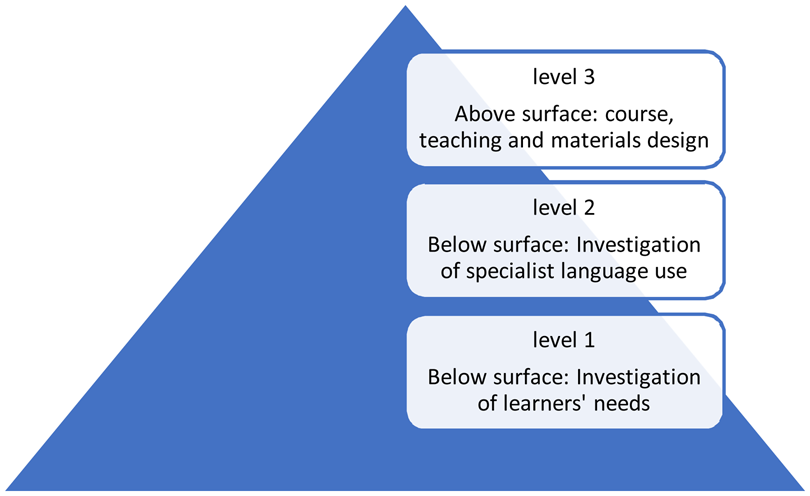
ESP teachers are often involved majorly in curriculum and materials development tasks as well as teaching. For this reason, ESP may appear to be dominated by teaching and materials. I have argued, however (Basturkmen, Reference Basturkmen2010), that a good deal of the work ESP teachers and course developers do can go unnoticed by onlookers, that is, those not directly engaged in ESP course preparation. A good deal of work is typically conducted by ESP course teachers even before teaching begins and materials devised. The course design, syllabus and the materials are the icing on the cake in the sense that they are the part of the course development that is the end stage, or final layer, of course development and the part that is visible to those on those on the outside. I proposed a representation of ESP course development. (An adapted version of this representation is in Figure 1.) The representation identifies three levels of ESP course development that are interrelated with Level 1 acting as a precursor to Level 2, and Level 2 as a precursor to Level 3. The representation takes the form of a pyramid to convey the view that a great deal of ESP course development is taken up with building the foundations (analysis of needs and specialist discourse). Unsurprisingly, it is the top level (surface level) aspects of course, materials design that are most readily noticed from the outside and this may lead to the perspective that ESP is largely about teaching and materials. But this perspective is misguided. ESP teaching and materials are grounded in major foundational work, namely, investigations of learning needs (Level 1) and specialist discourse of the field of the learners (Level 2). The fact that ESP teachers often need to devise their own unique course syllabuses and materials, and that it is these aspects of ESP that are the highly visible ‘on the surface’ features, may erroneously lead to a view of ESP as concerned only with practical outcomes and led by teaching and materials development.
Representation of ESP course development (adapted from Basturkmen, Reference Basturkmen2010)

2.4 Motivation for linguistic inquiry
Linguistic research in ESP is generally justified with reference to teaching and learning needs (Flowerdew, Reference Flowerdew2013). Published linguistic research often ends with proposals for teaching/learning applications or implications. See, for example, the final implications statement from the article abstract below. In it, the abbreviation RA refers to research article.
Implications of our findings are that visual moves go beyond textual considerations, they can disrupt the RA's chronological structure, and novice writers in the field would benefit from understanding the crucial associations between visual representations, disciplinary knowledge, and the rhetorical structure of RAs in this field.
(Moghaddasi, Graves, Graves, & Gutierrez, Reference Moghaddasi, Graves, Graves and Gutierrez2019, p. 50)
ESP can be described as teaching-led in the sense that researchers often refer to teaching and learning concerns as the motivation for linguistic inquiries. This is not dissimilar to practice in applied linguistics in general. In ESP, these concerns are usually to provide teachers, learners and materials developers with language descriptions of specialist discourse, or to develop understanding of learner needs (Mede, Koparan, & Atay, Reference Mede, Koparan, Atay, Kirkgὅz and Dikilitaṣ2018; Bi, Reference Bi2020).
3. Arguments against the position
Having discussed ways in which a view of ESP as a materials- and teaching-led movement is tenable, I would now like to discuss ways in which this view cannot be supported. I will argue that there are major caveats to a characterization of ESP as materials- and teaching-led and a related view of ESP as all practice and no theory. I will argue that ESP is intrinsically a theoretical as well as practical undertaking. I will, however, identify topics on which the field would benefit from more discussion of theoretical ideas, namely topics related to teaching and learning ESP. There has been a marked disparity between the abundance of linguistic research and related theory and the limited body of research and theory of ESP teaching and learning. I will argue that ESP, far from being practice-led, can in fact be characterized as led by linguistic description, at least as far as the literature is concerned.
3.1 Teaching practices reflect theoretical views
There is no doubt that ESP has a rich tradition of materials development. As described in Section 2.3, ESP teachers often are not in the position of being able to select a published coursebook to use as the mainstay of their teaching in the same way that some colleagues in general ELT may do. It may be the case that there are no existing published materials for the kind of group or individual learner in question, for example, a group of experienced physiotherapists or students of naval architecture. Or it may be the case that there is good quality published material, such as titles in the Cambridge Professional English Series that broadly targets a professional field such as nursing, or a study area, such as graduate writing (Swales & Feak, Reference Swales and Feak2011) but the materials may not be well aligned to the particular needs of the learners in question as identified by needs analysis. Needs analysis is one of the key characteristics of ESP teaching, and having identified the needs of their learners, ESP teachers are likely to draw only selectively on published materials to the extent that they address their learners’ needs. Because of this, ESP teaching has a long-established history of developing in-house materials either to supplement the use of published material or as stand-alone sources of materials.
However, having a rich tradition of teaching and materials development does not imply that the field is a practical one without a basis in ideas about teaching and learning. The ideas are often implicit and ESP teachers and materials developers may not necessarily explicitly set out the ideas of teaching and learning that underpin their materials or teaching plans. However, to refer to ESP as ‘all practice and no theory’ is misleading. Studies in which I and a research collaborator interviewed ESP teachers about the materials they devised brought to light the ideas they drew on and the rationales behind their practices (Basturkmen, Reference Basturkmen2010; Basturkmen & Bocanegra-Valle, Reference Basturkmen, Bocanegra-Valle, Kirkgὅz and Dikilitaṣ2018), which they often related to theoretical ideas they had encountered in their masters courses in language teaching as well as at professional conferences. ESP materials thus generally reflect theoretical ideas. Such ideas can be inferred from an examination of the kinds of language presentations and activities included in materials and teaching plans. An EAP lesson focusing on the purposes and schematic structure of design specification reports in engineering may suggest a genre-based view of writing (Paltridge, Reference Paltridge, Paltridge and Starfield2012), and a series of noticing and analysis activities in pragmatics-focused materials for nurse–patient interaction in an English for Nursing course may suggest an explicit view of pragmatics learning, a view that the learners should develop explicit knowledge (Basturkmen, Reference Basturkmen and Liontas2018a) of pragmatic features.
3.2 A field led by linguistic inquiry
ESP has a well-developed literature on linguistic descriptions of specialized English. The preface to the first edition of the ESP Journal (Mancill, Drobnic, & Romett, Reference Mancill, Drobnic and Romett1980, pp. 7–9), which later became the journal English for Specific Purposes, set out a statement of aims for the journal. The statement highlighted that the field should conduct ‘careful and constant analyses of the English used in learners’ specific fields … to provide accurate descriptions of the linguistic features that characterize the target language.’ Language description has even been referred to as ‘the’ focus of ESP (Bloor, Reference Bloor1998) and the field's literature includes reviews of the historical development of linguistic description (Swales, Reference Swales, Flowerdew and Peacock2001; Johns, Reference Johns, Paltridge and Starfield2012; Hyon, Reference Hyon2018). As indicated in Section 2.4, teaching and learning concerns are often given as the rationale for linguistic analysis type studies. However, teaching implications or applications at the end of studies can be brief and arguably the main contribution often lies in development of linguistic description per se. To the great credit of the field, a large amount of research has now been conducted to establish in-depth knowledge about language use in specialized domains, such as professional, academic and research settings.
Linguistic inquiry is the most established area of research and discussion in ESP and few would question the potential value of findings for teaching and learning ESP. An editorial from the Journal of English for Academic Purposes highlighted the limited teaching-focused research saying:
There is a danger that theory and research is outrunning practice, or at least that there are too few points of contact between them. What is actually going on in EAP classes around the world? What innovative materials, tasks, course, and methods of assessment are being used? How can we improve the practical aspects of our trade by making them better informed by theory and research? EAP prides itself on its applied nature which means that EAP specialists are ‘practitioners’ in the sense that we both research and teach. We would like this synergy to be more clearly reflected in the journal. (Hamp-Lyons & Hyland, Reference Hamp-Lyons and Hyland2005, p. 3)
But even here, the centrality of (linguistic) theory and research appears as taken for granted and teaching framed as ‘practice’ and ‘practical aspects of our trade’ rather than a potential topic of theoretical inquiry. The journal recently launched the ‘researching EAP practice’ initiative to attract submissions that were ‘more grounded and practice-based’ than would usually be seen in research articles (Hu, Reference Hu2018, p. A2).
3.3 Limited examination of teaching
Some literature on teaching and teachers has emerged. Topics include ESP teacher beliefs (Basturkmen & Bocanegra-Valle, Reference Basturkmen, Bocanegra-Valle, Kirkgὅz and Dikilitaṣ2018), teacher development (Campion, Reference Campion2016; Ding & Campion, Reference Ding, Campion, Hyland and Shaw2016; Basturkmen, Reference Basturkmen2017; Bocanegra-Valle & Basturkmen, Reference Bocanegra-Valle and Basturkmen2019), teacher working conditions and identity (Ding & Bruce, Reference Ding and Bruce2017; Tao & Gao, Reference Tao and Gao2018; Ding, Reference Ding, Hyland and Wong2019), cooperation between ESP teachers and professional or disciplinary subject specialists (Li & Cargill, Reference Li, Cargill, Hyland and Wong2019; Northcote, Reference Northcote, Hyland and Wong2019), and ways ESP teachers work around limitations in their knowledge of target work domains or disciplines (Anthony, Reference Anthony2019). Ding (Reference Ding, Hyland and Wong2019, pp. 68–70) draws attention to the anomaly between the importance of EAP as a fast-expanding area of teaching worldwide and the lack of importance accredited to EAP teachers and teaching at ‘grass roots’ level, where EAP is often treated as a profitable support service and teachers are marginalized. Ding highlights the limitations of the literature, arguing that ‘when the literature does appear’ it refers to teachers and teaching ‘latently and fleetingly’.
The ESP literature includes a wealth of case reports of teaching practices or innovations in local settings. However, there has been limited discussion in general of ideas about teaching, or the kind of metacommentary on ESP teaching that one might expect to see in a field that has often defined as a largely teaching enterprise. Case reports provide rich, contextualized insights into individual teaching efforts. They do not aim to examine, comment on or review teaching efforts across the field, however. The limited attention may be partly due to the relative difficulty of collecting data concerning teaching and learning compared to linguistic studies, which can often draw on existing texts as data, or to the perception that linguistic inquiry is the heart of ESP.
There is little commentary literature concerning ESP teaching methodologies and teaching/learning activities. To date, review, synthesis and metacommentary type works in ESP works have been very largely on the topic of linguistic inquiry – see for example Swales (Reference Swales, Flowerdew and Peacock2001) and Johns (Reference Johns, Paltridge and Starfield2012). A limited number of review works have been on the topic of needs analysis – see for example, Serafini, Lake, and Long (Reference Serafini, Lake and Long2015). Readers new to the field may indeed wonder what ESP teaching methodologies are used, and what can be said about them beyond case reports of contextualized innovations. Although there is no recognized one-size-fits-all type of approach to ESP teaching (Dudley-Evans & St John, Reference Dudley-Evans and St John1998) and some methodologies developed in ESP are drawn on in general ELT, and vice versa (Robinson, Reference Robinson1991), there are distinctive features that are more likely to be seen in ESP methodologies than elsewhere. Two of these are outlined below to illustrate.
(a) ESP teaching often draws on or adopts the teaching/learning methodologies of the target discipline or professional domain (Dudley-Evans & St John, Reference Dudley-Evans and St John1998; Basturkmen, Reference Basturkmen2010). Various professional domains (such as air safety, law, engineering and medicine) use case study methodology in teaching subject content. ESP teachers working with students in such domains also draw on case study methodology in teaching language. In a case study, students discuss a real-life scenario and tasks based on the scenario, which requires them to apply and integrate their knowledge, theory, skills and experience. This provides experience of teamwork and the case may be written up as a report or presented orally. See, for example, the Helicopter Operations Case (Shawcross, Reference Shawcross2011).
(b) ESP teaching can include long, task-based projects requiring a high level of student engagement. In a project, students often need to find resource materials themselves and although the project may start in the classroom it may move out to the real world. Herbolich's (Reference Herbolich1979) Box Kites task was one of the first published examples of an ESP project (Dudley-Evans & St John, Reference Dudley-Evans and St John1998). Herbolich taught Technical Report Writing to engineering students and the course included the topic of Manual Writing. Herbolich's innovative response was to devise a project in which pairs of students had to produce a tangible object (the kite, which needed to be able to fly) and an accompanying technical manual to explain how the kites were constructed and operated. For recent published examples of project work used in an ESP course for dietitians, see Tsuda (Reference Tsuda2012).
Often innovative materials and methodologies have been created and the literature provides good illustrations of such innovations (Stoller & Robinson, Reference Stoller, Robinson, Kirkgὅz and Dikilitaṣ2018). However, abstract discussion of ideas about teaching has been limited.
3.4 Limited examination of views of learning
If ESP were materials- and teaching-led, we might expect to see examination and discussion of views of learning in the literature. Learning is after all the flip side of teaching. We opt for certain ways of teaching, types of materials and teaching/learning activities that we believe best engender learning. However, direct attention in ESP to topics concerning learning has been restricted, although recently overviews of learning issues in academic purposes, specific purposes and workplace contexts have appeared (Basturkmen, Reference Basturkmen, Burns and Richards2018b; Hafner, Reference Hafner, Burns and Richards2018; Lockwood, Reference Lockwood, Burns and Richards2018). The editorial of the first edition of the ESP Journal clearly envisaged that teaching and learning were key topics for the field. The editorial emphasized these topics alongside linguistic inquiry saying that the journal strived to ensure that
The theories and practices of the field are based on sound assumptions concerning the nature of language learning and linguistic features of specific varieties of English…. the nature of and processes involved in language acquisition and language learning need to be explored as the basis on which methodological decisions can be made. Refining what is known about these processes can give rise to methodologies and techniques which can be evaluated as to their efficacy in terms of the purposes of the learners. (Mancill et al., Reference Mancill, Drobnic and Romett1980, p. 9)
English for Specific Purposes journal continues to identify studies of second language acquisition in specialized settings as a topic on which they welcome submissions.
Compared to the prevalence of corpus and genre-based linguistic studies there has been a modest body of research into genre-based and corpus-based ESP instruction. See, for example, studies of genre-based instruction (Hyon, Reference Hyon and Johns2002; Swales & Lindemann, Reference Swales, Lindemann and Johns2002; Cheng, Reference Cheng2007, Reference Cheng2018; Kuteeva & Negretti, Reference Kuteeva and Negretti2016) and of corpus or concordance-based instruction (Karpenko-Seccombe, Reference Karpenko-Seccombe2018; Wong, Reference Wong, Hyland and Wong2019; Smith, Reference Smith2020). Details on the high numbers of genre-based studies that have been published in key ESP and EAP journals are given in Hyon (Reference Hyon2018), a work that identifies genre learning as a future issue for research. It should be noted, however, that Swales’ (Reference Swales1990) seminal work on genre analysis in research and academic settings appeared decades ago and a multitude of genre analysis linguistic studies followed.
There may be limited direct attention in ESP to the topic of learning but – as argued above – a view of learning can be surmised from proposals for teaching/learning activities. One recurring feature of reports on ESP and EAP linguistic research is to end the reports with proposals for teaching applications or implications. It is from such end-matter that a view of learning can often be inferred. Taking Parkinson's (Reference Parkinson, Hyland and Wong2019) study of multimodal features of student texts as an example, the work ends with proposals for learning activities to ‘raise students’ awareness of a genre's rhetorical conventions with regard to visual meaning’ and for ‘explicit classroom discussion’ about how to achieve coherence between images (pp. 158–159). These proposals are suggestive of an explicit view of language learning, that is, the idea that learners should develop awareness, or explicit knowledge, about multimodal features. Specifics about the activities are not given but possibly the activities might involve inductive, deductive or guided discovery type instructional activities. For a review of terms and research concerning the role of deductive and inductive approaches and consciousness-raising tasks in language learning, see Ellis (Reference Ellis and Hornberger2008). Possibly, teachers are perceived as already conversant with the role and features of such activities and not in need of details.
Learning activities have tended to be alluded to only in passing and tacitly. As views of learning are rarely unequivocally stated in ESP, they are not much contested or debated. Such discussion or debate would more likely be generated if views were explicitly stated and writers in the field clearly took positions on their views of learning. The cumulative result of this limited discussion of how learners are understood to learn specialist varieties of English remains curiously unexamined in ESP. Empirical research in ESP has provided a substantial body of knowledge to address the question of what linguistic features and genres characterize specialist varieties, but a limited body of knowledge to address the question of how learners acquire these linguistic features and genres. Nor has there been much theoretical examination and discussion of ideas about teaching and learning. Other than case reports, these topics have tended to be alluded to only in passing and tacitly.
4. Conclusion
John Swales provided the metaphor ‘species’ to describe ESP (Bloor, Reference Bloor1998).
ESP is not a young cuckoo determined to eliminate all other birds from the nest that it has infiltrated; it is better seen as a recently-evolved species that best thrives in certain secluded and restricted kinds of habitat. (Swales, Reference Swales1985, p. 208, cited in Bloor, 1998, p. 47)
Over 30 years later it would appear that the species is now not only firmly established but also one that has come to thrive in a multitude of habitats, with English for academic purposes, English for Business Purposes as well as English for Professional and Occupational Purposes taught around the world in higher education, school contexts, technical training and workplace settings. It is a species that has a strong tradition of innovative teaching and materials design, which are usually reported as case reports, and it is often the artefacts of teaching practice, such as course and materials designs, that are highly visible and most noticeable at first sight. However, ESP is not a field that is ‘led’ by teaching and materials. Rather, as I have argued here, it is a field led largely by linguistic inquiry. Linguistic inquiry has served the field well and has resulted in the provision of up-to-date, relevant language descriptions that can be imparted to learners of the various specialist varieties of English. The field has provided the kinds of ‘careful and constant analyses of the English used in learners’ specific fields … (and) accurate descriptions of the linguistic features that characterize the target language’ alluded to by the editors of the first edition of the ESP Journal (Mancill et al., Reference Mancill, Drobnic and Romett1980, pp. 7–9).
It is somewhat paradoxical that a field with such a strong tradition of teaching and materials development has had a relatively limited research and discussion literature concerning approaches to teaching and learning. There has been a tendency to assume the advantages of, but not openly discuss, the merits of an explicit view of language learning (that learners should acquire explicit knowledge of linguistic features in academic or workplace discourses). There is debate and research in applied linguistics concerning the functions of explicit and implicit knowledge, the interface between them and their role in language learning and teaching (Ellis, Reference Ellis and Hornberger2008). Ideas about types of linguistic knowledge may be relevant to developing understanding of ESP teaching and learning. Often learners bring to the ESP class experience and ‘latent’ knowledge of language and communication practices in their disciplinary, occupational or professional fields and the ESP teacher's role may be ‘to develop a more conscious awareness so that control is gained’ (Dudley-Evans & St John, Reference Dudley-Evans and St John1998, p. 188).
I have argued in Section 2.1 that one explanation for the characterization of ESP as teaching and materials-led derives from how ESP is typically framed as a teaching endeavour in conventional definitions. I wish here to suggest a definition of ESP for current times that frames ESP as a field concerned with teaching but not entirely defined by teaching:
ESP is a theoretically and empirically based field of inquiry that aims to identify the linguistic features of specialist English varieties, the nature of ESP teaching, and to understand how specialist English can be acquired in instructed ESP and naturalistic contexts.
Naturalistic contexts could include situated learning (Lave & Wenger, Reference Lave and Wenger1991; Lave, Reference Lave2019) and English-medium instruction (Macaro, Reference Macaro2018; Pecorari & Malmström, Reference Pecorari and Malmström2018) type settings. In this definition, teaching, or instructed ESP, is one component of ESP, and it is one that should be amenable to theoretical and empirical inquiry and discussion.
This paper examined ways the characterization of ESP as teaching- and materials-led is tenable and ways it is not. I argued that the characterization is tenable in the sense that the motivation for much of the linguistic inquiry over the years has been tied to teaching and learning concerns. A perspective of ESP as all practice and no theory is not tenable at all. Not only has ESP developed linguistic theories, such as the ESP approach to genre theory (Swales, Reference Swales1990; Hyon, Reference Hyon2018), but when we examine teaching practices and materials we unearth implicit views of language teaching and learning. The latter is true in general ELT as well as ESP teaching.
I have argued that the ESP literature has relatively neglected the topics of teaching and learning, especially ideas concerning learning specialist language. Bloor once argued that ESP had been saved from wandering down ‘blind allies’ (Bloor, Reference Bloor1998, p. 61) of second language acquisition (SLA). I would argue that we can usefully draw on some SLA constructs to analyse and discuss ESP teaching and learning. ESP has typically provided concrete examples of case reports of innovative teaching and materials in local settings and proposals for teaching applications. However, there has not been robust discussion of ideas and theories concerning teaching and learning. It would be to the advantage of the field to engage more in examining its teaching methodologies and proposals for teaching/learning activities to explicate and discuss abstract understandings of teaching/learning processes.
ESP is a field led by a strong body of description of specialist texts and discourses brought into being by decades of linguistic inquiry. From this ESP draws its strength and there is no reason why ESP should not continue along this line of development. It is, however, a strength that could be supplemented by a more developed literature about teaching and learning perspectives. ESP is a species that could evolve further in this direction.
Helen Basturkmen has worked for over 20 years at the University of Auckland, where she is the coordinator of the Applied Linguistics and Language Teaching programme. She teaches postgraduate courses on discourse analysis and ESP and an undergraduate course on developing second language literacy. She has written two books on English for Specific Purposes (Routledge, 2006; Palgrave Macmillan, 2010) and edited English for academic purposes in the Critical Concepts in Linguistics Series (Routledge, 2015). Her research interests span the fields of education, professional discourse and language teaching. Before taking up her position at the University of Auckland, she lived and worked for many years in the Middle East as an ELT and ESP teacher and teacher educator.