

Introduction
Euwallacea spp. (Coleoptera: Curculionidae: Scolytinae) are polyphagous, widely distributed, invasive ambrosia beetles of economic importance (Wood and Bright Jr, Reference Wood and Bright1992). Like other ambrosia beetles, Euwallacea spp. tunnel into their hosts creating galleries onto which a symbiotic ambrosia fungus is cultivated to serve as food for the brood (Wood, Reference Wood1982; Eskalen and Stouthamer, Reference Eskalen and Stouthamer2013; Eskalen et al., Reference Eskalen, Stouthamer, Lynch, Rugman-Jones, Twizeyimana, Gonzalez and Thibault2013; CABI, 2015; Cognato et al., Reference Cognato, Hoebeke, Kajimura and Smith2015). Upon the attainment of sexual maturity and after mating with their male siblings, females fly out of their natal brood to create their own galleries. The female-to-male sex ratio in Euwallacea spp. is high, which is an evolutionary tactic of most scolytids to maximize female fitness and reduce competition by males (Hamilton, Reference Hamilton1967; Kirkendall, Reference Kirkendall1983; Normark et al., Reference Normark, Jordal and Farrell1999; Jordal et al., Reference Jordal, Normark, Farrell and Kirkendall2002; West et al., Reference West, Shuker and Sheldon2005; Peer and Taborsky, Reference Peer and Taborsky2007; Biedermann, Reference Biedermann2010; Fraser et al., Reference Fraser, Brahy, Mardulyn, Dohet, Mayer and Grégoire2014). The males on the other hand are flightless and normally stay in the natal gallery throughout their lives, but they can occasionally crawl to neighbouring galleries and mate with the females there, thus causing minimum cross breeding in the genus (CABI, 2015). The dispersal of the females and movement of infested woody materials are the key means of spread of these invasive species. Most ambrosia fungi associated with Euwallacea spp. are Fusarium spp., which cause wilts in a number of plants (Mendel et al., Reference Mendel, Protasov, Sharon, Zveibil, Yehuda, O'Donnell, Rabaglia, Wysoki and Freeman2012; Eskalen and Stouthamer, Reference Eskalen and Stouthamer2013; O'Donnell et al., Reference O'Donnell, Sink, Libeskind-Hadas, Hulcr, Kasson, Ploetz, Konkol, Ploetz, Carrillo, Campbell and Duncan2014; CABI, 2015; Cognato et al., Reference Cognato, Hoebeke, Kajimura and Smith2015).
There are 40 species in the Euwallacea genus (Beaver and Liu, Reference Beaver and Liu2010; Bright, Reference Bright2014; O'Donnell et al., Reference O'Donnell, Sink, Libeskind-Hadas, Hulcr, Kasson, Ploetz, Konkol, Ploetz, Carrillo, Campbell and Duncan2014; CABI, 2015; Cognato et al., Reference Cognato, Hoebeke, Kajimura and Smith2015; FAO, 2015). Members of the genus have pronota that are nearly quadrate, with anterior margin straight; their posterolateral margin of declivity is subacutely elevated from sutural apex to interstriae; their strial and interstrial punctures are in rows; their elytral vestiture are sparse and confined to strial and interstrial rows (Rabaglia et al., Reference Rabaglia, Dole and Cognato2006).
Euwallacea spp. vary in their ecology and life cycles. For example, E. fornicatus infests almost 100 hosts, produces a maximum brood size of 28–34 individuals, and takes about 5–6 weeks to produce a generation (CABI, 2015). On the other hand, E. destruens infests about 20 hosts, with a maximum brood size of 60–70 individuals and a generation time of over 6 months (CABI, 2015). Only a single species of Euwallacea, E. piceus, is reported in Uganda (Wood and Bright Jr, Reference Wood and Bright1992; CABI, 2015), but the extent of its spread, abundance, and associated ambrosia fungi are unknown.
In March 2015, we observed R. communis growing in gardens of robusta coffee, Coffea canephora Pierre in Kamuli District, eastern Uganda (1071 m above sea level; 00°45.438N; 33°07.802E) with symptoms and specimens similar to those of Euwallacea spp. (Anonymous, 2012; Hodel et al., Reference Hodel, Liu, Arakelian, Eskalen and Stouthamer2012; Mendel et al., Reference Mendel, Protasov, Sharon, Zveibil, Yehuda, O'Donnell, Rabaglia, Wysoki and Freeman2012; Eskalen and Stouthamer, Reference Eskalen and Stouthamer2013; Eskalen et al., Reference Eskalen, Stouthamer, Lynch, Rugman-Jones, Twizeyimana, Gonzalez and Thibault2013; Coleman, Reference Coleman2015). In a discussion with the farm owner, we learned that R. communis is used to support banana in coffee gardens, where it may end up establishing, and once established, it is conserved by farmers in the belief that it will serve as a lightning arrester. No similar symptoms were, however, observed on C. canephora and/or any other plants in the vicinity.
This study was undertaken to: (a) determine the distribution, incidence, and relative abundance of Euwallacea sp. on R. communis in C. canephora gardens in Uganda; (b) determine influence of presence of C. canephora on incidence and abundance of Euwallacea sp. on R. communis; and (c) identify ambrosia fungus of Euwallacea sp. on R. communis.
Materials and methods
Identification of beetles attacking Ricinus communis in Uganda
Specimens collected from Kamuli District were viewed under a Stereo Microscope (Model DC5-420TH; x4 magnification; National Optical and Scientific Instrument Inc.; Texas, USA) and their morphometric features compared with those of the genus Euwallacea (Rabaglia et al., Reference Rabaglia, Dole and Cognato2006; Cognato et al., Reference Cognato, Hoebeke, Kajimura and Smith2015). Voucher specimens of the beetles were deposited at the Makerere University Zoology Museum.
A survey on incidence and abundance of Euwallacea sp. on R. communis in C. canephora farms
A survey was conducted in Mpigi, Butambala, Nakaseke, Mubende, Hoima, and Kiboga districts, which were selected randomly from the major C. canephora growing regions of central and mid-western Uganda, between 6 and 11 June 2015. The districts lie in two agroecological zones of Uganda, namely Lake Victoria Crescent (LVC) and Western Mid-Altitude Farm Land (WMAFL) (Wortmann and Eledu, Reference Wortmann and Eledu1999). These agroecological zones have gentle rolling landscapes, temperatures of over 20 °C, and mean annual rainfall of 1000–1570 mm per year (Wortmann and Eledu, Reference Wortmann and Eledu1999; Wasige, Reference Wasige2009). Mean altitude for LVC is 1174 and 1198 for WMAFL. These two agroecological zones are a part of the Banana–Robusta coffee system (Kamanyire, Reference Kamanyire2000).
In each district, five C. canephora farms with mature coffee-bearing trees in which R. communis was found growing and five other farms with R. communis but without C. canephora were sampled. Such farms were uncommon, so the first five of each category that the survey team came across were sampled for the study. Owing to scarcity of such farms, sampling in Nakaseke and Butambala districts spilled over to the neighbouring districts of Luwero and Mityana, respectively. Unlike other districts, four study farms were obtained in Butambala/Mityana. Coordinates of the study farms were recorded using the geographical positioning system (Garmin eTrex® 10, Garmin International, Inc., Taiwan) and plotted on a template of the map of Uganda using ExpertGPS Map Software version 5.5 (TopoGrafix – 24 Kirkland Dr, Stow, MA). Coffea canephora farms used in this study were small holdings of approximately 0.2 ha with C. canephora spaced at about 3 × 3 m. Ricinus communis stands in these farms and the others without C. canephora ranged from 1 to 10 trees and were irregularly distributed, as most were unintentionally grown. Many other unidentified shade tree species and/or plants occurred in these gardens, yet only R. communis was found to be infested by Euwallacea sp.
In each study farm, all R. communis stands were inspected for the symptoms of Euwallacea sp. and where the farms were found to be infested, beetle specimens were occasionally sampled in each district for comparison with those observed at Kamuli District. To determine the incidence of the pest per district, all farms with at least one R. communis stand infested by Euwallacea sp. were coded as 1, whereas those with no infested R. communis stand were coded as 0. To estimate the abundance of Euwallacea sp. at various sampling farms, one R. communis stand that was at least 2 m tall was randomly selected and Euwallacea sp. holes up to 1.7 m from the ground counted. The height of the trees was selected, because young R. communis stands shorter than 2 m were scarcely infested by Euwallacea sp., and 1.7 m from the ground was convenient for data recorders to be able to count the holes.
Isolation and identification of the fungus inside galleries of Euwallacea spp.
Ricinus communis stems infested by Euwallacea sp. were sampled from the study farms described above, delivered to the laboratory at the National Coffee Research Institute (NaCORI), Mukono, Uganda, where they were surface sterilized with ethanol 70% (Unilab Kenya Limited, Nairobi, Kenya). The stems were split open using a ‘panga’ (machete) to expose the galleries of Euwallacea sp. A sterile transfer needle containing a thin layer of solidified sterile tap water agar (Oxoid Agar Technical No.3, Unipath Limited, England) was used to tap the walls of the galleries to pick up the fungal inoculum (Johnston and Booth, Reference Johnston and Booth1983). The needle was then lightly tapped at the centre of solid tap water agar in a glass Petri dish. The plate was placed in a laminar flow hood in the pathology laboratory at NaCORI at ambient room conditions (mean outdoor temperature 21.7 ± 0.2 °C and 88 ± 1.3% RH; L12:D12 photoperiod) for five days.
A sample of the white fungus that was progressively isolated from galleries of Euwallacea sp. was submitted to CABI UK for identification. At CABI, the sample was validated and processed in accordance with the CABI's in-house method for filamentous fungi and yeasts. The sample was subjected to a purity check. DNA was extracted from the sample, but it failed to amplify; thus, it was not possible to process the sample using molecular sequencing methods. Identification was made by the morphological analysis of subcultures prepared on standard media. The colony morphology of the original sample and subcultures was examined. Slides were prepared and microscopic analysis of sporulating structures was undertaken at x400 magnification. Identification was carried out based on the taxonomic keys by Shipton and Lunn (Reference Shipton and Lunn1980).
Data analysis
Data on whether or not R. communis in a given farm was infested by Euwallacea sp. (1, 0) were subjected to generalized linear modelling with binomial distribution error and logit link (Zuur et al., Reference Zuur, Ieno, Walker, Saveliev and Smith2009; Knoblauch and Maloney, Reference Knoblauch and Maloney2012), to determine variation in the incidence of the pest on R. communis with district. The model was tested for appropriateness by the computation of the dispersion parameter, i.e. the ratio of residual deviance to degrees of freedom, which was approximately 1 (Residual deviances 76.09 on 52 degrees of freedom), indicating that the model was appropriate (Zuur et al., Reference Zuur, Ieno, Walker, Saveliev and Smith2009).
Counts of Euwallacea sp. holes on R. communis stands were subjected to generalized linear modelling with the Poisson distribution error and logit link to determine variation in the abundance of Euwallacea sp. on R. communis with district and presence or absence of C. canephora (Zuur et al., Reference Zuur, Ieno, Walker, Saveliev and Smith2009; Knoblauch and Maloney, Reference Knoblauch and Maloney2012). The dispersion parameters for the model (Residual deviances 1529 on 52 degrees of freedom) indicated that the data were overdispersed; therefore, a negative binomial generalized linear model was fitted to the data to cater for overdispersion (Osgood, Reference Osgood2000; Zuur et al., Reference Zuur, Ieno, Walker, Saveliev and Smith2009).
All analyses were carried out in R-statistical computer software version 3.2.2 (R Core Team, 2015).
Results
Identification and description of Euwallacea sp.
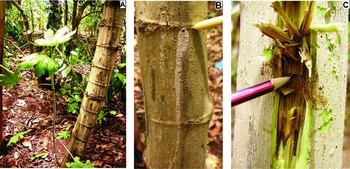
The symptoms (Fig. 1A–C) and morphological features of the beetles (Fig. 2A–D) indicated that the scolytid attacking R. communis in Uganda belongs to the genus Euwallacea. Other than the male specimen that was approximately 2 mm long, all the photographed specimens of the female, pupa, and larva were approximately 3 mm.
Symptoms of infestation of Ricinus communis by Euwallacea sp. in Kamuli District in eastern Uganda, 1071 m above sea level; 00°45.438N; 33°07.802E. (A) Ricinus communis stem with numerous Euwallacea sp. holes in a Coffea canephora garden; (B) a milky substance oozing out of a Euwallacea sp. hole (pointed at with a tip of a pen); (C) A gallery of Euwallacea sp. pointed at with a tip of a pencil. Specimens were photographed using the Sony Cyber-shot DSC-HX200V digital camera (Sony Corporation of America, NY). Photos: Egonyu, James Peter.

Images of different stages of Euwallacea sp. (A) adult female; (B) adult male; (C) pupa; (D) larva. There were various sizes of larval instars in the galleries, but the biggest instar was photographed. Eggs were scarce at the time of sampling; therefore, they were not photographed. Photography was carried out using NIKON SMZ 745T stereomicroscope connected to a PC with NIS-Elements version F 3.0 (Nikon Corporation, Japan, Tokyo). Photos: Egonyu, James Peter and Ekobu, Moses.

Teneral females are uniformly light brown, while the older females are dark brown with elytra darker distally. Strial and interstrial punctures are in rows. More than half of proximal elytral vestiture are sparser than the distal elytral vestiture, which are as dense as those throughout the abdominal sterna. Compound eyes and mandibles are black and pronotum dorsally convex and nearly quadrate with anterior margin straight. Approximately half of the posterior pronotal vestiture are sparser than those at the anterior pronotum. Side elytral and pronotal vestiture are sparse except at distal and anterior tips, respectively.
Males are uniformly as light brown as teneral females, and with the colour of compound eyes as in females, but with dark brown mandibles. Vestiture are uniformly distributed throughout the body and are as dense as distal elytral, abdominal sternal, and anterior pronotal female vestiture. Side pronatal and elytral vestiture are as in females. Approximately half of the anterior pronotum is acutely wedged.
Both larvae and pupae are white and legless.
Incidence and abundance of Euwallacea sp. on R. communis in C. canephora farms across districts
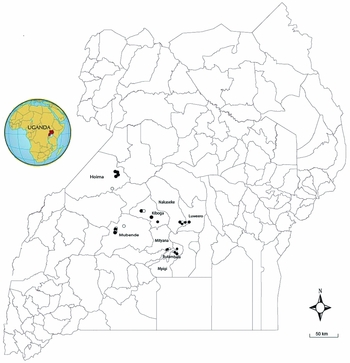
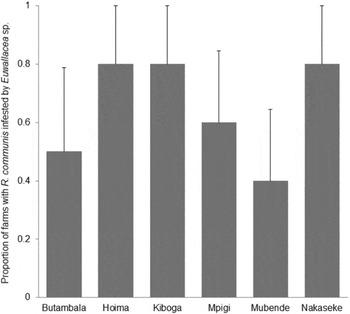
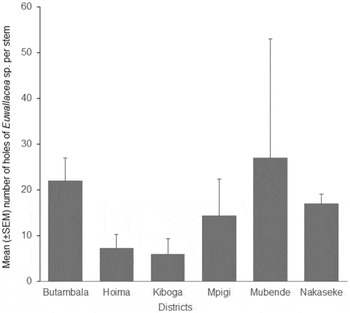
Euwallacea sp. was detected in all the districts (Fig. 3) and incidence on R. communis was not significantly different (deviance = 3.345; df = 23; P = 0.647) across districts, with the proportion of C. canephora farms with R. communis infested by Euwallacea sp. ranging from 0.3 ± 0.2 in Mubende District to 0.7 ± 0.2 in Kiboga District (Fig. 4). Similarly, there was no statistically detectable difference in the mean number of Euwallacea sp. holes per stem (deviance = 8.58; df = 3; P = 0.127), ranging from 4.8 ± 2.1 holes per stem in Hoima District to 27.6 ± 14.7 holes per stem in Butambala District (Fig. 5).
A map of Uganda showing locations of Coffea canephora farms with Ricinus communis in which the study was conducted in the respective districts. Hollow circles represent farms where R. communis was not infested by Euwallacea sp., whereas solid black circles indicate infestation of R. communis by Euwallacea sp. in the study farm. Map: Egonyu James, Peter, Ddumba, Gerald and Mukasa, Yosia.

Mean proportion (± SE) of Ricinus communis farms in the surveyed districts on which Euwallacea sp. was detected. The mean proportions were not significantly different (Deviance = 3.345; df = 23; P = 0.647).

Mean (± SE) number of Euwallacea sp. holes per stem in the surveyed districts. The mean numbers did not have detectable statistical differences (Deviance = 8.58; df = 3; P = 0.127).

Incidence and abundance of Euwallacea sp. on R. communis in relation with presence of C. canephora
The proportion of R. communis stands in C. canephora gardens that were infested by Euwallacea sp. (0.66 ± 0) was significantly higher than that of R. communis stands without C. canephora (0.31 ± 0) (deviance = 7.05; df = 56; P = 0.008). However, the mean number of Euwallacea sp. holes per stem of R. communis in C. canephora (9.0 ± 2.3) was not significantly different from that of Euwallacea sp. holes per stem of R. communis without C. canephora (13.4 ± 5.963) (deviance = 0.37; df = 56; P = 0.545).
Euwallacea sp.-associated fungus
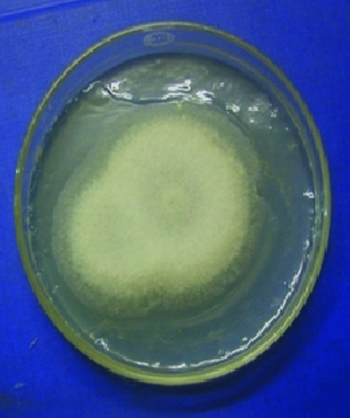
The fungus isolated from galleries of Euwallacea sp. inside R. communis (Fig. 6) was Cunninghamella echinulata (Matruchot) Thaxter (Mucorales: Cunninghamellaceae).
A 5-day-old culture of a fungus isolated from galleries of Euwallacea sp. and identified as Cunninghamella echinulata.

Discussion
Our study indicates that an unidentified beetle species in the Euwallacea genus attacks R. communis in all surveyed districts in Uganda. Although the pattern of the body vestiture of the female specimens in the current study appears similar to that of E. piceus (Anonymous, 2016), which was previously reported to occur in Uganda, the current females are longer than females of E. piceus, measuring 2.1–2.3 mm (CABI, 2015). The identity of the reported species is uncertain, and our study cannot confirm that only a single species attacks R. communis in Uganda.
Ricinus communis is a known host of Euwallacea spp. (Mendel et al., Reference Mendel, Protasov, Sharon, Zveibil, Yehuda, O'Donnell, Rabaglia, Wysoki and Freeman2012; Eskalen et al., Reference Eskalen, Stouthamer, Lynch, Rugman-Jones, Twizeyimana, Gonzalez and Thibault2013). Being a frequently occurring wild plant in many agro-ecosystems, R. communis may serve as a reservoir for Euwallacea sp. to infect other plant species with their symbiotic plant-infectious ambrosia fungi (Hodel et al., Reference Hodel, Liu, Arakelian, Eskalen and Stouthamer2012). A number of top commercial crops such as tea, cacao, citrus, mango, and guava are known hosts of Euwallacea spp. (Mendel et al., Reference Mendel, Protasov, Sharon, Zveibil, Yehuda, O'Donnell, Rabaglia, Wysoki and Freeman2012; Eskalen et al., Reference Eskalen, Stouthamer, Lynch, Rugman-Jones, Twizeyimana, Gonzalez and Thibault2013). Our discovery that the invasive Euwallacea sp. is present in 30–70% of R. communis sampling sites across surveyed districts in Uganda should be of great concern to relevant stakeholders responsible for crop pest control and also for researchers to elucidate the species identity, biology, ecology, and economic importance of the insects in the country. Moreover, although C. canephora in the vicinity of R. communis was not infested by Euwallacea sp. during this study, it remains unknown if the coffee species will not succumb to the pest in future, as it does to other scolytids such as the coffee twig borer Xylosandrus compactus Eichhoff, the coffee berry borer Hypothenemus hampei (Ferr.), and the brown coffee borer Xylosandrus morigerus (Bland.) (Rojas et al., Reference Rojas, Morales-Ramos and Harrington1999; Hill, Reference Hill2008; Egonyu et al., Reference Egonyu, Kucel, Kangire, Sewaya and Nkugwa2009; Jaramillo et al., Reference Jaramillo, Torto, Mwenda, Troeger, Borgemeister, Poehling and Francke2013; CABI, 2015).
Our results failed to show statistical differences in Euwallacea sp. holes on R. communis from one district to the other. However, mean numbers of holes were highest in Butambala and Mubende, moderate in Mpigi and Nakaseke, and lowest in Hoima and Kiboga. This pattern does not show an agroecological-based trend (Wortmann and Eledu, Reference Wortmann and Eledu1999). The lack of detection of statistical differences in these means may be due to high variations within districts (depicted by large standard errors of the means) and the small number of farms per district. Further research to ascertain causes of these variations is necessary for better insight into the ecology of the pest. In addition, studies on seasonal variations in incidence and abundance of the species across agroecological zones would help in understanding the population dynamics of the species in the country.
We found that the proportion of R. communis stands infested with Euwallacea sp. in C. canephora gardens were more than twice that of R. communis stands without the coffee trees in the vicinity, but the number of beetle holes in R. communis stands in the two environments were not significantly different. This suggests that C. canephora influences the infestation of R. communis by Euwallacea sp. but does not influence the multiplication of the pest once inside its host. The mechanism of possible influence of C. canephora on host location by Euwallacea sp. requires further investigation.
The fungus isolated from the galleries of Euwallacea sp. inside R. communis was identified as C. echinulata. To our knowledge, this may be the first report of the association of C. echinulata with a scolytid beetle. This zygomycetic fungus is popular for the industrial production of γ-linolenic acid, a precursor for the biosynthesis of several prostaglandins and an anti-inflammatory and anti-cancer agent (Gema et al., Reference Gema, Kavadia, Dimou, Tsagou, Komaitis and Aggelis2002; Papanikolaou et al., Reference Papanikolaou, Sarantou, Komaitis and Aggelis2004; Fakas et al., Reference Fakas, Papanikolaou, Galiotou-Panayotou, Komaitis and Aggelis2008). In follow-up comments in the CABI report on identification of this fungus, C. echinulata is considered a common saprobe isolated mainly from soil, especially in tropical and sub-tropical regions. Reports on association of C. echinulata with insects are twofold. First, it is a known pathogen, and hence, a potential biopesticide of many insect pests such as Elaphrothrips denticollis (Bagnall) (Suresh and Ananthakrishnan, Reference Suresh and Ananthakrishnan1984), the subterranean termite Reticulitermes flavipes (Kollar) (Zoberi and Grace, Reference Zoberi and Grace1990), the greater wax moth Galleria mellonella (Sepasi) (Raja Rishi and Balu, Reference Raja Rishi and Balu2010), and the melon weevil Acytopeus curvirostris persicus (Sepasi) (Sepasi et al., Reference Sepasi, Jahani, Mirzaee and Mohammadpour2015). Second, C. echinulata alongside other fungi was isolated from larval mines of water hyacinth miners Thrypticus truncatus Bickel & Hernández and T. sagittatus Bickel & Hernández where it was believed to be supplementing larval nourishment (Hernández et al., Reference Hernández, Pildain, Novas, Sacco and Lopez2007). Since Euwallacea spp. are known to cultivate ambrosia fungi for feeding their brood inside galleries (Eskalen and Stouthamer, Reference Eskalen and Stouthamer2013), our discovery of only C. echinulata inside galleries of Euwallacea sp. suggests that the fungus serves as food for the beetle species.
Conclusion
Euwallacea sp. was present in all the districts surveyed, with the incidence of the pest ranging from 30 to 70% of farms with R. communis infested by the pest and 5–28 holes of Euwallacea sp. found at the lower 1.7 m of each stem of R. communis. The proportion of R. communis stands infested with Euwallacea sp. in C. canephora gardens was higher than that of R. communis stands without the coffee trees in the vicinity, but the number of beetle holes in R. communis stands in the two environments was similar. The zygomycete C. echinulata appears to be the ambrosia fungus used by Euwallacea sp. as food. These findings suggest that Euwallacea sp. is widespread and abundant across R. communis stands in Uganda and, therefore, poses a threat to many economically important plants in the country that are known to be hosts of Euwallacea spp.
Acknowledgements
We thank colleagues at NaCORI, especially the Director of Research, W. W. Wagoire for administrative support, and V. Kigonya, J. Baguma and J. Kasirye for assistance with data collection; CABI UK for fungal identification, especially N. Phiri and B. Ritchie for coordinating the identification process; M. Otim and M. Ekobu of the National Crops Resources Research Institute, Namulonge, Uganda for permission to use the stereomicroscope and assistance with photography, respectively. The International Development Agency (IDA), through the Agricultural Technology and Agribusiness Advisory Services (ATAAS) project at the National Agricultural Research Organization, Uganda, supported this work.