In the fall of 2006, I was asked to chair the International Security Studies Section (ISSS) of the International Studies Association's book award committee. This was the first year of the award, and I was excited to be a part of helping to get it started within the discipline. I asked our office staff to collate a list of marketing directors at all of the presses that have booths at the annual meetings of the American Political Science Association (APSA) and the International Studies Association (ISA). We then e-mailed each director a flyer advertising the award. To my surprise, what started as a thin trickle of book submissions soon became a veritable flood. By the closing date in March 2007, 111 books had been submitted.
The actual job of reading and selecting a winner from among these books now seemed daunting. This task was complicated by the fact that a few weeks after being asked to chair the ISSS book award, I was asked to chair APSA's International History and Politics section's 2007 Jervis-Schroeder Book Award committee. Typically, I would not have agreed to chair two book awards at once, but the Jervis-Schroeder award was close to my heart. Bob Jervis was my professor in graduate school. His work influenced my scholarship profoundly and his teaching and mentoring helped shape the teacher I became. Paul Schroeder's work was inspirational to my own. His work on alliances was foundational to my last book, Dangerous Alliances: Proponents of Peace, Weapons of War (Stanford University Press, 2004). In fact, he was one of the first people I sent it to when it came out. So I said yes, and 75 more books soon arrived in my mailbox.
With 185 books to read, courses to teach, a department chair search to complete, an international trip to prepare for, and two young children to care for, I felt a bit overwhelmed. With my department chair's agreement, I commandeered a second office, just to host the books. I had a work-study student develop files with all of the titles for each award, and alphabetize the books in two areas of the second office, one for each award. Every time I entered this office, empty but for 185 of the newest works in the field, I was filled with a sense of awe and desperation. Would I really manage to get through all of the books? Would I be able to judge them fairly and accurately? How would I be able to remember the specifics of each one?
As the term wound down, I started to block off days on my calendar that would be devoted exclusively to reading. I readied myself with index cards, fresh pens, and the hard copy of the list of books for each award. On the first morning, I arrived early, entered the office, opened the first book, and began to read. Before I knew it I was drawn into a special world of just books. It was a world where the telephone doesn't ring, e-mail doesn't ding, and a certain peace prevails. No students or colleagues knew about the second office, so I became invisible to even the most persistent students. More importantly, my intellectual world came alive. With books about feminist methodologies, the preservation of civil liberties post 9/11, American grand strategy, U.S. homeland security policy, international justice, ethnic conflict, among other topics crowding me for attention, I rediscovered my love of the field of international relations. After years of reading narrowly for my research, or incrementally as journals, book reviews, and catalogues came out and when syllabi needed revising, I had to read widely and deeply. And so, I spent the spring and summer of 2007 immersed in my task of reading 185 new books in international politics.
Each book had a different message. Each spoke to me about the world in which I was living, physically and intellectually. For example, Saskia Sassen's book Territory, Authority, Rights (Princeton, 2006)—winner of the Jervis-Schroeder award—illustrates the ways the process of state building helps us understand the era of denationalization. Her numerous insights enlightened me about the condition of the state and the international system more generally, but also illuminated the analytical direction we are going in the field.
It was amazing how quickly I lost myself in this world, how quickly the time flew and how much I accomplished. Moreover, I was surprised at how much I enjoyed the reading. Until I started, part of me had been dreading the actual work. The mountain of 185 books seemed insurmountable. Yet, one book after the next engrossed me until the day's end. As I surfaced at the end of that first day, I could not believe 10 hours had passed. I had not stopped—not even for lunch—but ate my sandwich as I consumed one book after the next. The office had become my intellectual sanctuary. I scheduled another day to read and found myself eager to resume the work.
When I started a book, I first held it, examined its cover, and then opened it to the preface and acknowledgements. The stories behind the stories were compelling. Pausing to read the front matter of the books gave each a human face. Every book told a different tale of the sacrifices that had gone into the creation of each new work. The authors' personal stories revealed both inspirations and difficulties. The stories moved me—each tale different from the last. For the time I was reading each book, I felt I knew the author more intimately because I understood what each one had hoped to achieve by writing or compiling the manuscript. Taking extra time on the front matter made it more difficult for me to be dismissive of the work and reminded me of the arduous hours of research and writing that each missive embodied. It personalized each tome.
The books ranged in topics from examining the meaning of national identity in Latvia through the prism of environmental politics in Katrina Schwartz's book Nature and National Identity after Communism (University of Pittsburgh, 2006) to analysis of why preventive war decisions are made in Jonathan Renshon's book Why Leaders Choose War: The Psychology of Prevention (Praeger, 2006). The books took me to all parts of the globe, from South Africa (Helen E. Purkitt and Stephen F. Burgess's South Africa's Weapons of Mass Destruction, Indiana University, 2005) to the Palestinian territories (Rashid Khalidi's The Iron Cage: The Palestinian Struggle for Statehood, Beacon, 2006) to Korea (Chae-Jin Lee's A Troubled Peace: U.S. Policy and the Two Koreas, Johns Hopkins, 2006) and beyond, from the dawn of human civilization to the contemporary age.
Yet, the more books I read, the more I became aware that I was not just reading discrete books. Rather, the books themselves were representatives of perhaps four or five bodies of literature. I was struck as I read at how people all over the world were writing about very similar things, such as the way the private sector impinges on governmental process. There were a lot of people working on similar topics, such as territoriality, in isolation of each other. Because of long production schedules, there were gaps in knowledge—works weren't referenced that might have altered an argument because one project was in production while the other was being written. It made me wish for more mechanisms to address those imperfections and inefficiencies in the production of knowledge. While conferences certainly help, we still operate under conditions of imperfect information. If we had complete transparency and communicated effectively with each other as we developed our ideas, then the work that we produced would advance the field in that direction more quickly, with less redundancy and writing past each other. I was especially amazed at the number of people who seemed, in isolation of each other, to be moving down the ladder from the global level of analysis to the regional level. I am not sure that I would have wholly understood the significance of the burgeoning literature on territoriality and regionalism by browsing through the new literature in catalogues or at publishers' booths at the ISA or APSA annual meetings.
Based on my own perception—others may have read the books differently—the largest number of the books fell into four categories:Footnote 1 terrorism, insurgencies, 9/11, and the post 9/11 security environment; human security and humanitarian interventions; great power politics and American grand strategy; and territorial identity and regionalism. Although these categories can be broken out further into subgroupings, the books within each of these areas had crosscutting implications and constituted a growing area of knowledge in the field. There are, of course, connections between books within these areas as well. I should note that this snapshot of the field is driven by the topic of the awards. Since the book awards were in the area of international history and international security, the dominant theoretical approaches and topics follow, since many scholars in these areas do qualitative work on security questions. Samples of work from different sections in the field are likely to be different in terms of the gender distribution, topics, and the dominant theoretical approaches.Footnote 2 By far the largest grouping is the first, on terrorism, 9/11, and post 9/11 politics—a sampling can be seen in Table 1. The overwhelming number of these books is likely driven not only by scholars interested in understanding the changes and transformations wrought by 9/11, but also by publishers' keen desires to sell books on contemporary affairs.Footnote 3 According to Roger Haydon, executive editor at Cornell University Press and principal acquisitions editor for international relations books, at least at Cornell University Press, more international relations books are being sold today than were being sold a decade ago.Footnote 4
Recent Books on Terrorism, Iraq, and Post-9/11 Politics

There were also a number of books that took on issues of humanitarian crises, interventions, and the institutions that deal with them. Human security issues appeared to occupy a larger space in the security field than they did just a decade ago. Some of those titles are listed in Table 2.
Recent Books on Human Security, Institutions, Humanitarian Crises, and Interventions

One of the most significant trends in the field to me was the consolidation of knowledge regarding regional identities, the importance of territorial identity, and a regional-level level of analysis. In an era characterized by increasing globalization, a shift to a smaller unit intrigued me. For years, we have been analyzing a shrinking world, the coming together through technology and networks, as examples, making global trends in the world more pronounced. The pause in that direction is fascinating. There were, in fact, more titles on regionalism than globalization. I will be rethinking my international relations course syllabi accordingly. Some of those titles are captured in Table 3.
Identity, Territoriality, and Regionalism

Despite some of the newer trends in the field, such as the preoccupation with human rather than national security, there is still an enduring interest in the great powers of the international system. Some of the most ambitious theoretical innovations were within this category. Table 4 includes some of the titles that dealt with some of the core issues at stake for the great powers in the system. For example, what role does nuclear deterrence play in the contemporary era, and how does it work? Or, how do ideology or culture affect the way great powers conduct themselves?
Great Power Politics

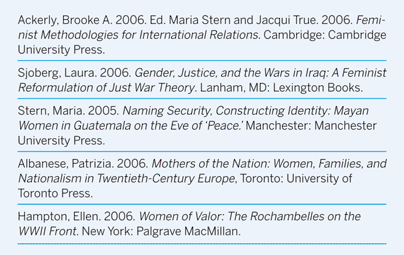
Not surprising, but disappointing, was the gender balance between men and women authors and editors. The number of women authors and editors in the two awards combined was a paltry 38 out of a total number of 237 editors and authors. Representation was better in the Jervis-Schroeder Award, with 23 out of 91 authors and editors being women. The field of international security studies still remains the domain of men: only 15 out of 146 of the editors and authors of the nominated books were women. Further, there were very few books that addressed issues of women in politics, or feminist international relations theory. Table 5 provides some of the titles in this area that were submitted for the awards.
Books on Feminist IR Theory Women's Experiences

While the gender balance, particularly for the security studies award, was disappointing, looking at book award data over time suggests that the representation of women in the field of international relations—and international security—has improved in the past 20 years. The Woodrow Wilson Foundation Award, given every year for the best book published on government, politics, or international affairs by APSA, started awarding its prize annually in 1947. The first female winner of this award was Theda Skocpol in 1993 for her book Protecting Soldiers and Mothers: The Political Origins of Social Policy in the United States (Harvard University Press, 1992). From 1947–92 no women won the award; seven women have won the award since 1993. The Gladys M. Kammerer Award, given for the best political science publication in that year or the previous year in the area of U.S. national policy, has seen seven female award winners since 1971, and 45 male. The Edgar S. Furniss book award for most exceptional contribution to the area of national or international security awarded by the Mershon Center at The Ohio State University has had four female and 20 male recipients since 1982. Of all of these book awards, the Jervis-Schroeder award seems strikingly egalitarian, with four female winners and five male winners since the award's inception in 2001.
Another trend that was noticeable to me as I read the books was the increasing use of first-person narratives in scholarly books. Several authors injected themselves into the story. I found this compelling. The use of personal anecdotes and memories to illustrate important points was a powerful device. For example, the opening of David Leheny's book Think Global, Fear Local: Sex, Violence, and Anxiety in Contemporary Japan (Cornell, 2006) was gripping especially because he discussed his own experience while riding the subway in Japan. This drew me in, while illustrating the book's main theme, making me want to continue reading. It personalized the scholarly tale in way that made the book come to life. Similarly, Joseph Nevins' injection of the first person into his story about East Timor brought an otherwise distant tale into vivid relief in his book, aptly titled A Not-So-Distant Horror: Mass Violence in East Timor (Cornell, 2005).
Given that it has been more than 15 years since I studied for my comprehensive exams, another development appeared very pronounced to me. Constructivism as an approach and theory of international politics has become well ensconced in the field. Not only did a significant number of the books adopt a constructivist research program, those that did not nevertheless often directly engaged it. This seemed a far cry from the days where everything was defined in terms of realism versus liberalism. The challenges to some of the principal schools of thought are not just ontological, but epistemological as well. There also seemed to be more openness to theoretical pluralism than I remember from my graduate school days. Instead of simply setting up tests to compare one theory to another, scholars were exploring ways to integrate key insights from more than one theoretical tradition into their work.
This may underscore the distinct contribution that books make to the field. While more “narrowly defined discipline-theory work” may appear in journals today,Footnote 5 books remain an important venue for broader, paradigmatic advancement to take place.Footnote 6
I was surprised by the high-quality work appearing in a variety of presses—not just the recognized few elite ones. Some of the most interesting books I read were from presses I had previously thought second tier or even third tier. That lesson reinforced my belief that I couldn't judge any of the books by their covers.
In the end, choosing a winner for these awards proved extremely difficult: so many of the books had outstanding qualities that warranted recognition. After several months of reading and deliberating, the other award committee members and I selected the winners. David A. Welch's appropriately titled book Painful Choices: A Theory of Foreign Policy Change (Princeton, 2005) won the ISSS book award. In my view, all the books were all winners, since each one stimulated my thinking. Reading about how actors are empowered and constrained in the contemporary international system reminded me of why I was drawn to the field of international relations in the first place. ■