1. Introduction
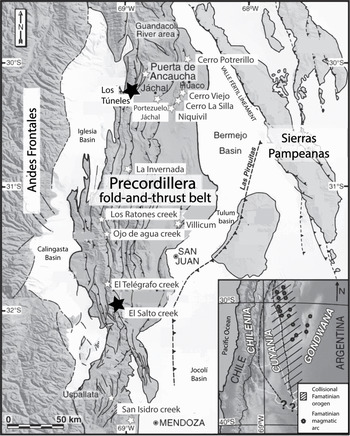
In the Argentine Precordillera, three geological domains are distinguished according to morphostructural and stratigraphic characteristics: the Eastern, Central and Western Precordillera (Ortiz & Zambrano, Reference Ortiz and Zambrano1981; Baldis et al. Reference Baldis, Berresi, Bordonaro and Vaca1982) (Fig. 1). The Central and Eastern domains comprise a Cambro-Ordovician carbonate platform, overlain by Middle Ordovician to Devonian marine siliciclastic rocks (Cañas, Reference Cañas, Cooper, Drosser and Finney1995; Keller, Reference Keller1999) that, together, constitute the so-called eastern tectofacies (Astini, Reference Astini1992). The western tectofacies, located at the Western Precordillera, exhibits a succession of deep-marine deposits, intercalated with oceanic-crust-like pillow lavas and mafic−ultramafic bodies in the westernmost sections (Kay et al. Reference Kay, Ramos and Kay1984). This domain presents a complex structure consisting of folding and metamorphism of a very low degree, in greenschist facies, during the late Silurian − Early Devonian (Buggisch et al. Reference Buggisch, Von Gosen, Henjes-Kunst and Krumm1994; Astini et al. Reference Astini, Ramos, Benedetto, Vaccari and Cañas1996). The presence of early Palaeozoic platforms towards the east (Borrello Reference Borrello1969; Ramos et al. Reference Ramos, Jordan, Allmendinger, Mpodozis, Kay, Cortés and Palma1986; Cingolani et al. Reference Cingolani, Varela, Cuerda and Schauer1987; Spalletti et al. Reference Spalletti, Cingolani, Varela and Cuerda1989) allows identification of an old continental margin in the western part of the Precordillera (Astini, Reference Astini, Pankhurst and Rapela1998; Keller, Reference Keller1999).
Location map of the Argentine Precordillera fold-and-thrust belt, overlying the shaded topographic map derived from the Shuttle Radar Topography Mission (SRTM) (adapted from Voldman et al. Reference Voldman, Albanesi and Ramos2009). Black stars indicate the studied sections while white stars indicate previously studied sections. Inset map shows the broad plate setting during Cambro-Ordovician times with the Gondwana, Cuyania and Chilenia terranes.
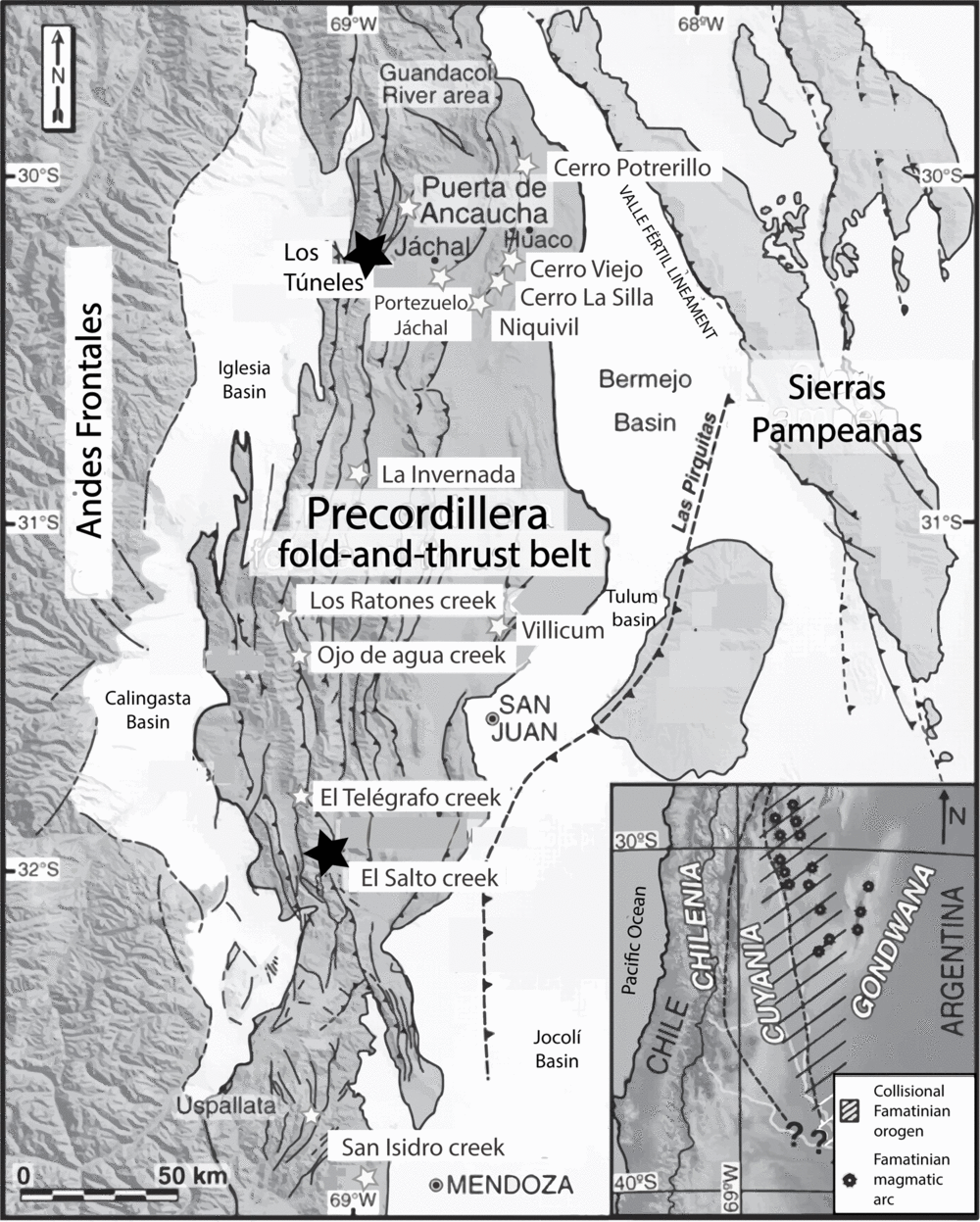
The Los Sombreros Formation corresponds to the western tectofacies of the Precordillera and represents the transition between the Central and the Western Precordillera (Cuerda et al. Reference Cuerda, Cingolani and Varela1983; Banchig, Keller & Milana, Reference Banchig, Keller and Milana1990). The formation is a disorganized unit, comprising deep-water deposits and allochthonous material derived from a shallow-water platform located to the east, and crops out in several ranges of the Western Precordillera (AJ Cuerda et al. unpub. report, 1984; Benedetto & Vaccari, Reference Benedetto and Vaccari1992; Albanesi et al. Reference Albanesi, Ortega and Hünicken1995) (Fig. 1; see details below in section 2.a). In spite of the structural complexity and the scarcity of biostratigraphic data to determine a detailed depositional scheme, a spectrum of ages ranging from the Ordovician to the Devonian was proposed for the Los Sombreros Formation (Vaccari, Reference Vaccari1988; Benedetto & Herrera, Reference Benedetto and Herrera1986; Benedetto & Vaccari, Reference Benedetto and Vaccari1992; Albanesi et al. Reference Albanesi, Ortega and Hünicken1995; Peralta, Reference Peralta2005). Recently, Voldman et al. (Reference Voldman, Alonso, Fernández, Ortega, Albanesi, Banchig and Cardó2018) documented the appearance of late Furongian and late Tremadocian conodonts species in some slumped gravity-flow deposits of the formation with synsedimentary deformational features, which suggest the existence of an active continental slope in late Cambrian – Early Ordovician times.
New conodont records from two sections of the Los Sombreros Formation located in the Tontal and Yerba Loca ranges (see below) are reported in the present contribution. The resulting data increase the knowledge of the biostratigraphy of the formation and are significant to (1) identify the source strata for the clasts of the Los Sombreros Formation in the carbonate platform of the Central and Eastern Precordillera, (2) date the formation, and (3) establish a geological correlation of the involved formation at intercontinental scale.
2. Geological framework
The Precordillera extends through the La Rioja, San Juan and Mendoza provinces, between 29° and 33° S. The Precordillera is a typical high-level fold-and-thrust belt (e.g. Astini, Reference Astini, Pankhurst and Rapela1998) c. 500 km long and 80 km wide, mainly composed of Cambrian to Carboniferous deposits, with shallow-water deposits. This region has a fundamental position in the tectonic reconstruction of Western Gondwana in the Palaeozoic, located in the external zone of the Famatinian Orogen (Ramos et al. Reference Ramos, Dallmeyer and Vujovich1998; Keller, Reference Keller1999). Its carbonate platform, Cambro-Ordovician in age, is unique in South America, and the set of basement blocks and carbonate successions in adjacent sectors constitutes the Cuyania terrane (Ramos, Dallmeyer & Vujovich, Reference Ramos, Dallmeyer and Vujovich1998). The Precordillera contains significant Ordovician index fossils, with rich and diverse conodont and graptolite faunas (Albanesi & Ortega, Reference Albanesi and Ortega2016).
2.a. Los Sombreros Formation
The chaotic Los Sombreros Formation is the basal stratigraphic unit of the Western Precordillera and is of fundamental significance for the interpretation of the Precordilleran continental slope. The formation comprises deep-water dark shales, allodapic limestones and extra-basinal clasts encased in a carbonate and shaly matrix. Limestones are finely laminated and vary from mudstone to wackestones, to laminated calciturbidites. Clasts range from gravels to hectometric blocks consisting of heterolithic and carbonate rocks. They form breccias, conglomerates and olistostromal intervals, with the blocks dispersed chaotically or arranged in stratified intervals. According to their palaeontological content, these exotic blocks were sourced from lower Cambrian to Lower Ordovician formations building the shallow-water platform located to the east (Cuerda et al. 1983; Banchig et al. Reference Banchig, Keller and Milana1990; Bordonaro, Reference Bordonaro2003; Alonso et al. Reference Alonso, Gallastegui, García-Sansegundo, Farias, Fernández and Ramos2008; Voldman et al. 2016). The formation crops out discontinuously along a N–S belt of c. 200 km in the Western Precordillera (Benedetto & Vaccari, Reference Benedetto and Vaccari1992; Albanesi et al. Reference Albanesi, Ortega and Hünicken1995). In this belt (Fig. 1), three main areas can be distinguished from south to north: the eastern flank of the Tontal Range (AJ Cuerda et al. unpub. report, 1984), the Invernada Range and the Yerba Loca Range, with the northernmost outcrops being located in the Ancaucha River area (eastern flank of the latter range; Albanesi et al. Reference Albanesi, Ortega and Hünicken1995). At regional scale, the thickness of the formation is estimated between 500 and 600 m. Voldman et al. (Reference Voldman, Alonso, Fernández, Banchig, Albanesi, Ortega and Cardó2016) interpret that most of the facies in the formation are indicative of sedimentation by gravity flows (e.g. Lowe, Reference Lowe1982; Mutti, Reference Mutti1999). The mudstones probably represent pelagic/hemipelagic sedimentation. A relatively deep-water environment is inferred from the absence of shallow-water faunas and scarce or no bioturbation.
3. Methods
In this study, 13 limestone samples (2 kg each) were collected from the Los Sombreros Formation through the El Salto creek section, located in the southern part of the Tontal Range, and 1 limestone sample of 3 kg from the middle part of the formation at the Los Túneles section, located on the southern margin of the Jáchal River, across the Yerba Loca Range (Fig. 1). At the El Salto section, only one sample from an exotic block in the middle part of the formation was productive. Both sections yielded a total of 373 conodonts, which are housed in the Museum of Palaeontology (Facultad de Ciencias Exactas, Físicas y Naturales, Universidad Nacional de Córdoba, Argentina) under repository code CORD-MP 28407-28553.
The samples were treated according to conventional laboratory techniques for the search of phosphatic microfossils (Stone, Reference Stone and Austin1987) which consist, basically, in fragmentation and washing up for posterior digestion in formic acid. The insoluble residue obtained was separated into different fractions by means of sieves, and the light and heavy fractions were divided through a heavy liquid (sodium polytungstate). Extraction of the conodonts was carried out using the ‘picking’ technique.
4. Results
4.a. Conodont faunas and biostratigraphy
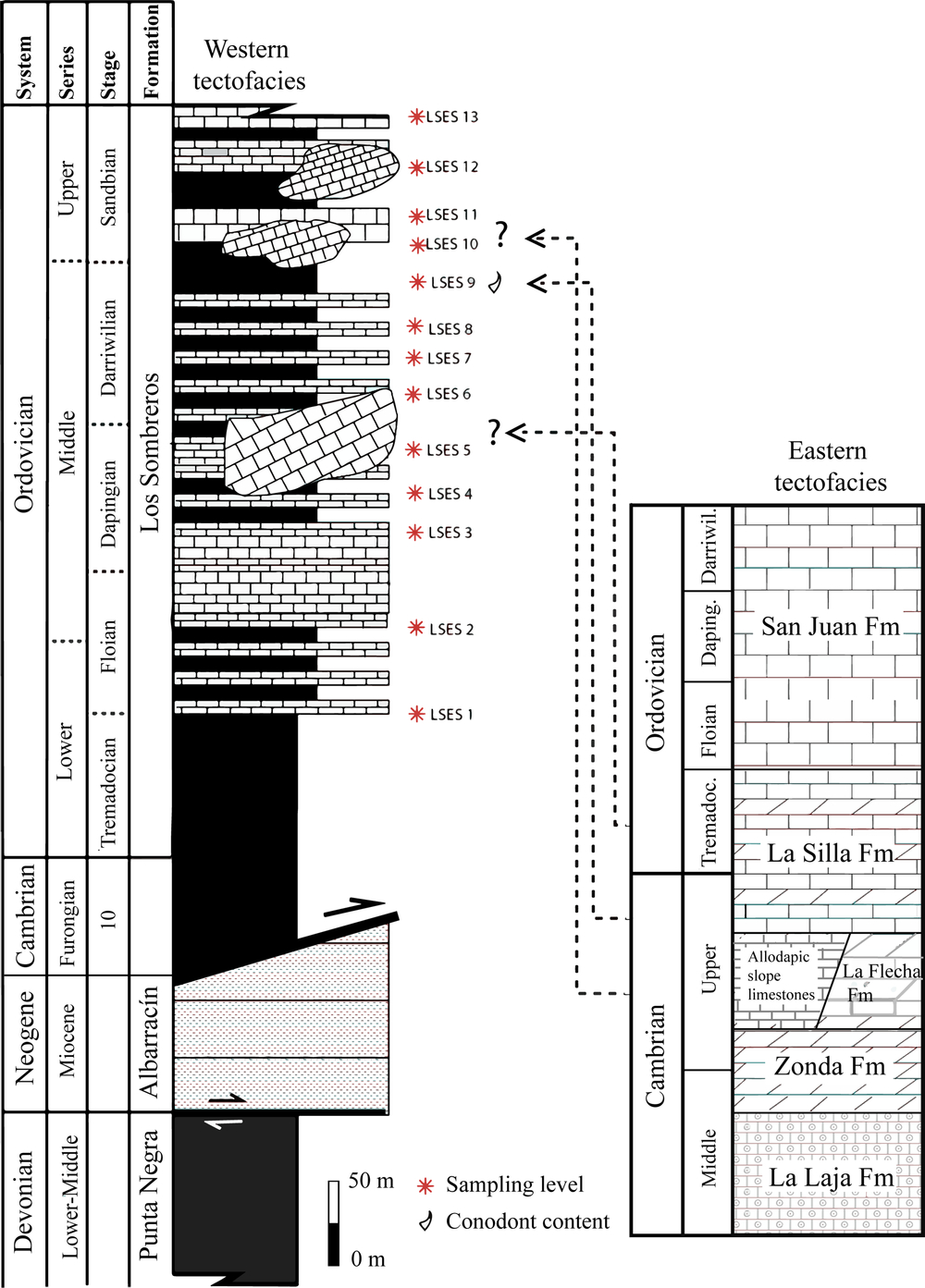
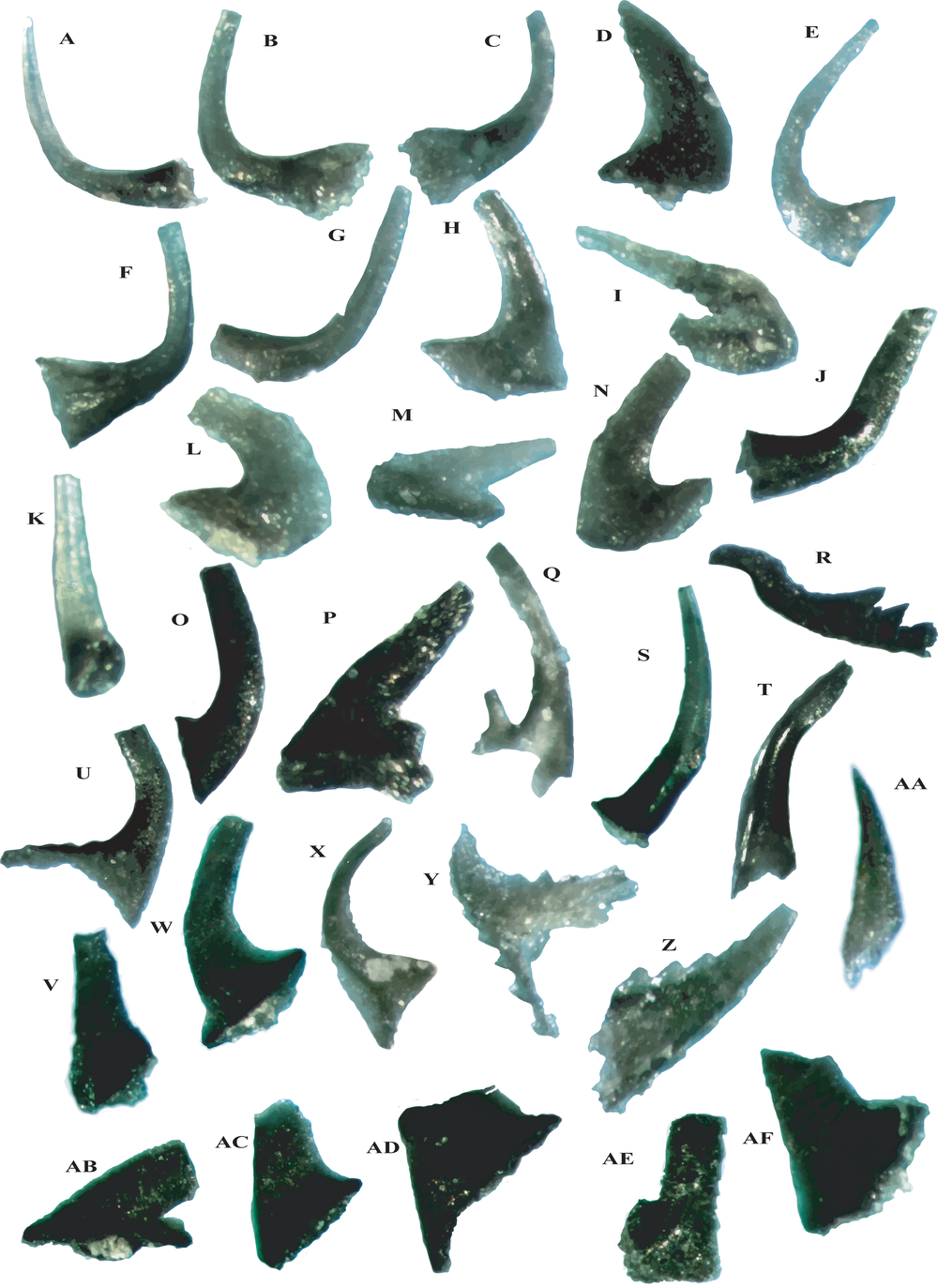
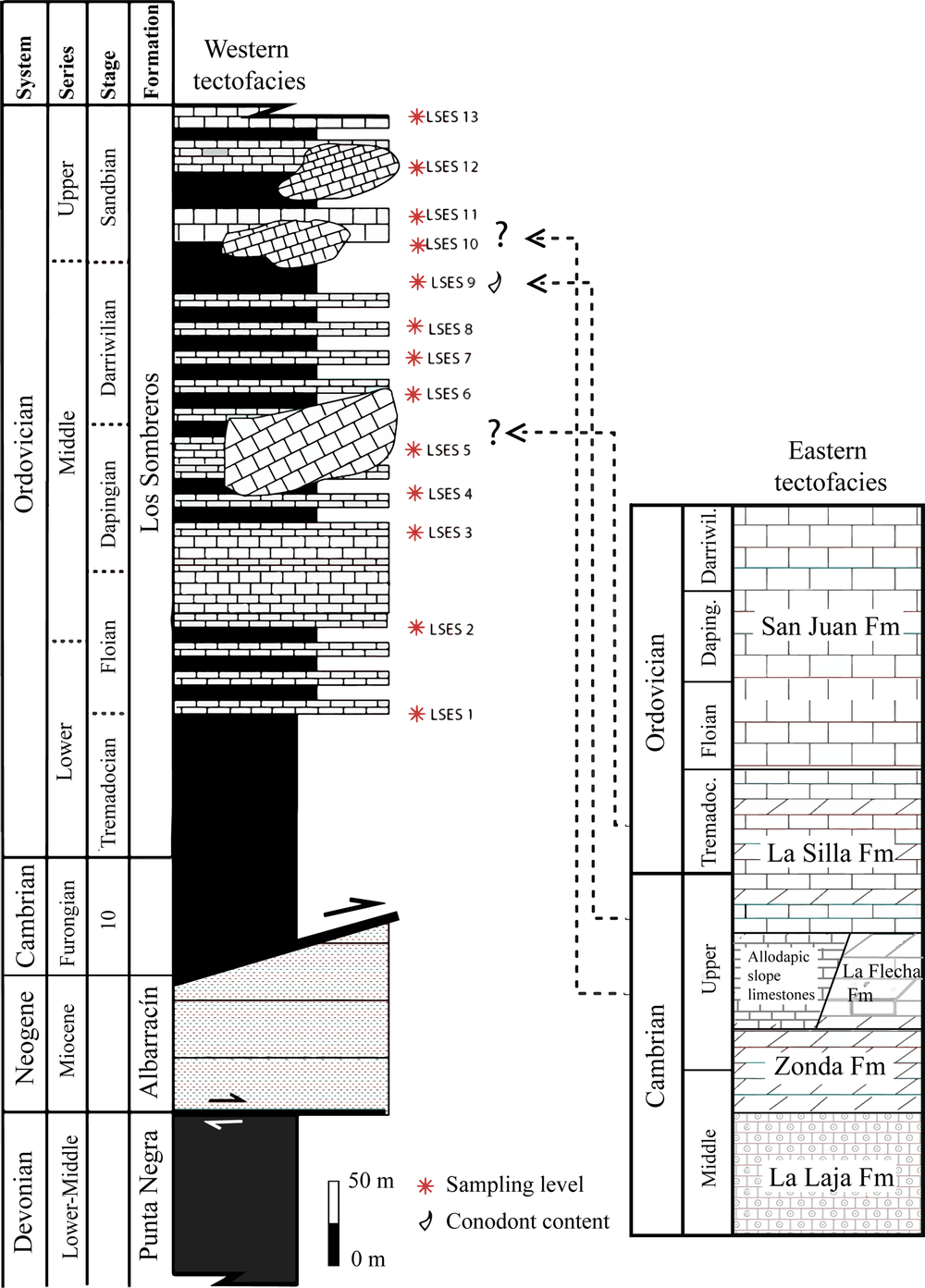
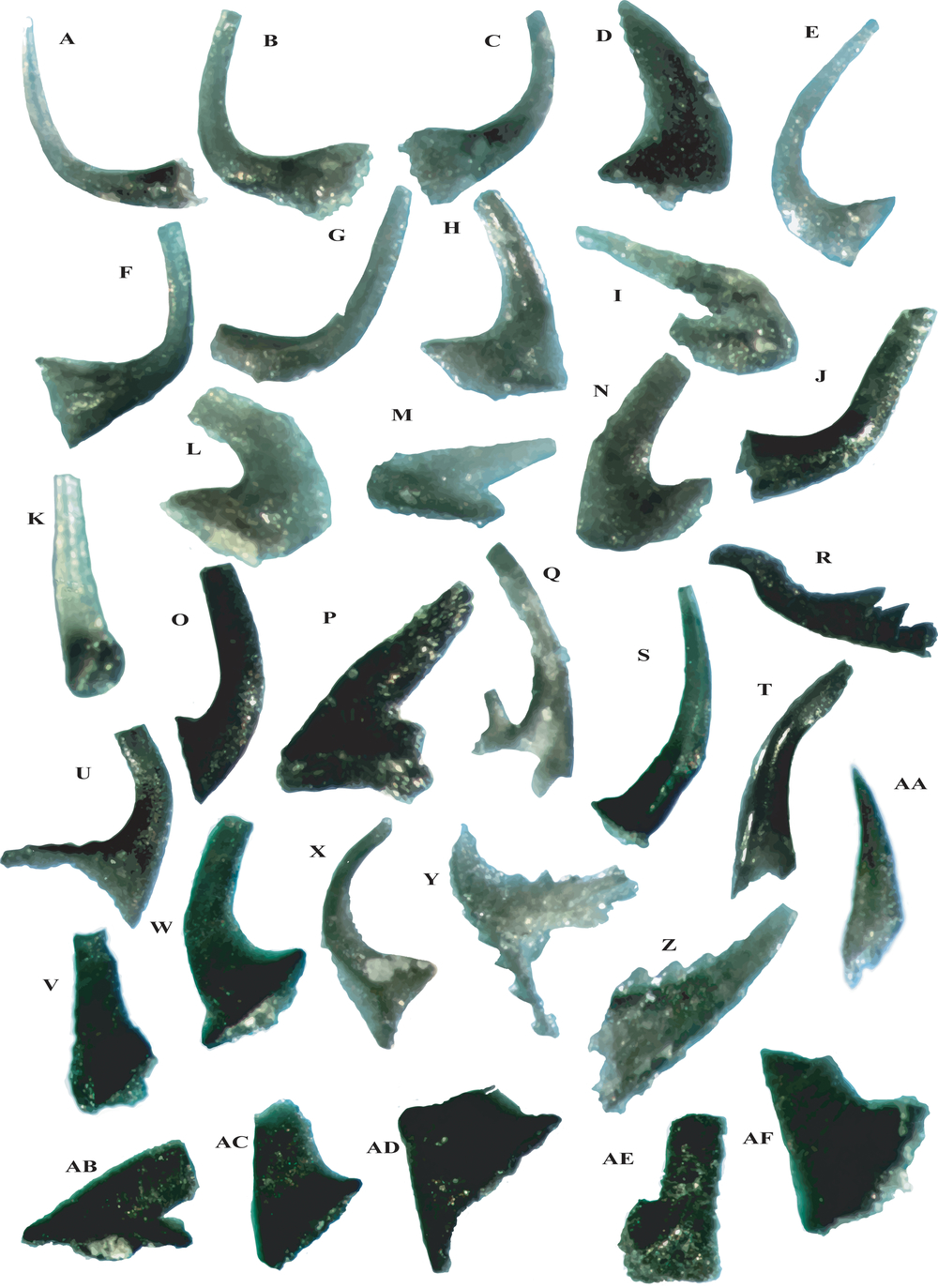
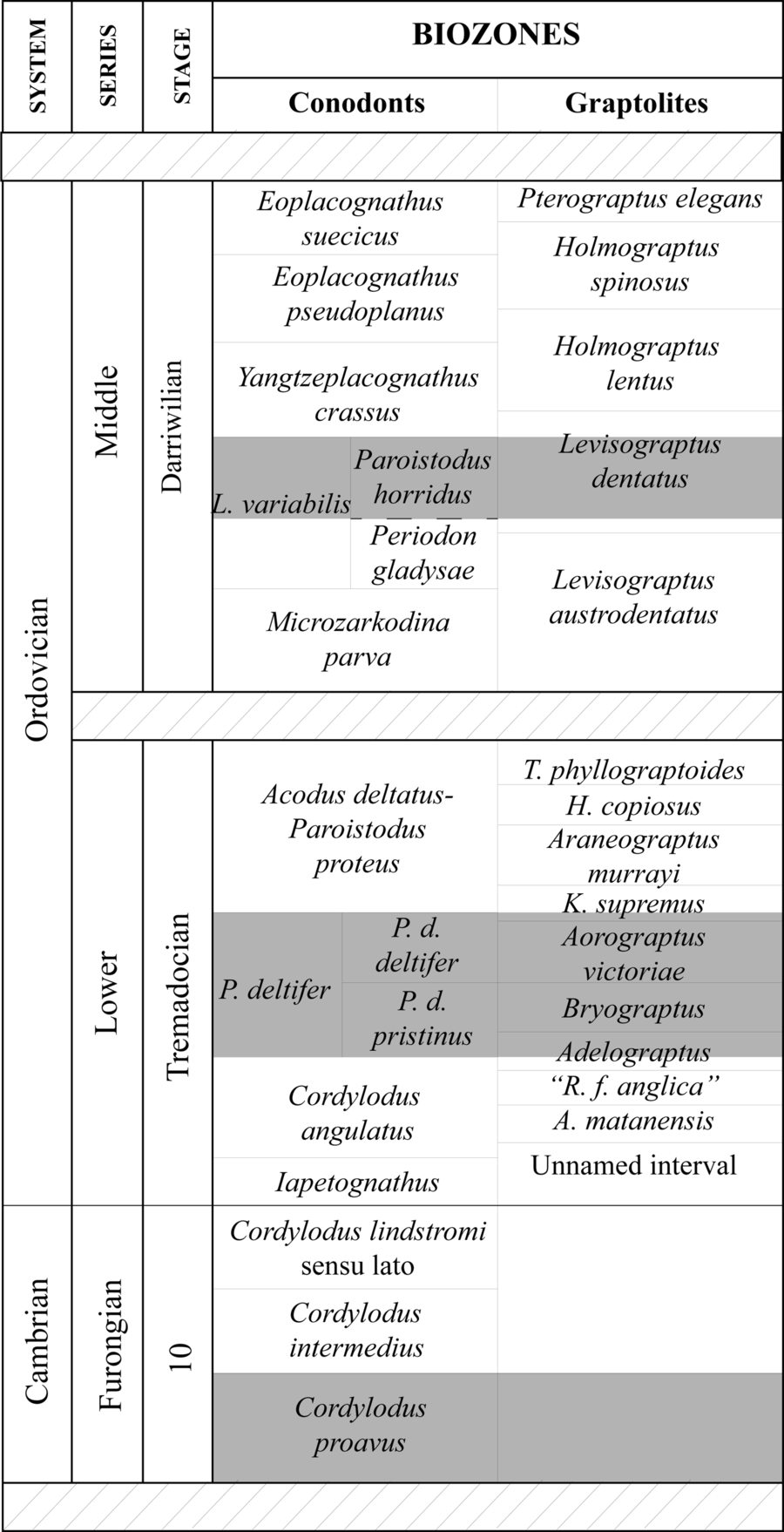
The only productive sample at the El Salto section allowed dating an interval of allodapic limestones from the middle–upper part of the formation (Fig. 2). The different species were determined considering the morphology of the diagnostic element, the denticulation patterns and the configuration of the basal cavity (number of apices, depth, position and design of its anterior margin) (Fig. 3). Cordylodus proavus (Müller) and Eoconodontus notchpeakensis (Miller) were identified from sample LSES 9. These species are representative of the Cordylodus proavus Zone, which covers part of Stage 10 of the Furongian Series, Cambrian System.
Composite stratigraphy of the El Salto area showing the tectonic superposition of structural units. The stratigraphic column of the Los Sombreros Formation displays the studied samples and the inferred origin of the clasts of variable size from the carbonate platform of the eastern tectofacies of the Precordillera.
Selected conodonts specimens from the Los Sombreros Formation. A.Costiconus costatus (Dzik), P element, lateral view, Los Túneles sample, 60×, CORD-MP 28418-28425; B.Cornuodus longibasis (Lindström), S element, lateral view, Los Túneles sample, 100×, CORD-MP 28426-28429; C.Panderodus sp., nongeniculate coniform element, lateral view, 100×, CORD-MP 28495-28496; D.Protopanderodus gradatus (Serpagli), M element, lateral view, Los Túneles sample, 60×, CORD-MP 28713; E.Drepanoistodus forceps (Lindström), S element, lateral view, Los Túneles sample 80×, CORD-MP 28437; F.Costiconus costatus (Dzik), S element, lateral view, Los Túneles sample, 100×, CORD-MP 28425; G.Protopanderodus gradatus (Serpagli), S element, lateral view, Los Túneles sample, 60×, CORD-MP 28757; H.Drepanoistodus forceps (Lindström), P element, lateral view, Los Túneles sample, 80×, CORD-MP 28438; I.Drepanoistodus forceps (Lindström), M element, lateral view, Los Túneles sample, 100×, CORD-MP 8445; J.Eoconodontus notchpeakensis (Miller), nongeniculate coniform element, lateral view, LSES9 sample, 60×, CORD-MP 28446; K.Decoriconus peselephantis (Lindström), coniform element nongeniculate, posterior view, Los Túneles sample, 80×, CORD-MP 28430; L.Drepanodus arcuatus (Pander), M element, lateral view, Los Túneles sample, 100×, CORD-MP 28431; M.Protoprioniodus simplicissimus (McTavish), nongeniculate coniform element, Los Túneles sample, 100×, CORD-MP 28758-28760; N.Drepanodus arcuatus (Pander), S element, lateral view, Los Túneles sample, 100×, CORD-MP 28775; O.Eoconodontus notchpeakensis (Miller), nongeniculate coniform element, lateral view, LSES9 sample, 60×, CORD-MP 28464; P.Cordylodus proavus (Miller), dolobrate ramiform element, lateral view, LSES9 sample, 80×, CORD-MP 28489; Q.Cordylodus proavus (Miller), dolobrate ramiform element, lateral view, LSES9 sample, 60×, CORD-MP 28490; R.Eoconodontus notchpeakensis (Miller)?, deformed coniform element, Los Túneles sample, 80x, CORD-MP 28500. S.Juanognathus jaanussoni (Serpagli), nongeniculate coniform element, lateral view, Los Túneles sample, 60×, CORD-MP 28482; T.Eoconodontus notchpeakensis (Miller), nongeniculate coniform element, lateral view, LSES9 sample, 80×, CORD-MP 28463; U.Cordylodus proavus (Miller), dolobrate ramiform element, lateral view, LSES9 sample, 80×, CORD-MP 2848928494; V.Paltodus deltifer (Lindström), Sa element, lateral view, Los Túneles sample, 60×, CORD-MP 28489; W.Juanognathus jaanussoni (Serpagli), coniform element not geniculated, lateral view, Los Túneles sample, 60×, CORD-MP 28483; X.Juanognathus jaanussoni (Serpagli), nongeniculate coniform element, lateral view, Los Túneles sample, 80×, CORD-MP 28487; Y.Baltoniodus medius (Dzik), Pb element, lateral view, Los Túneles sample, 80×, CORD-MP 28416; Z.Lenodus variabilis (Sergeeva), Sd element, lateral view, Los Túneles sample, 80×, CORD-MP 28488; AA.Coelocerodontus sp., nongeniculate coniform element, lateral view, Los Túneles sample, 100×, CORD-MP 28417; AB.Rossodus barnesi (Albanesi), M element, lateral view, Los Túneles sample, 60×, CORD-MP 28762; AC.Paltodus deltifer (Lindström), Sc element, lateral view, Los Túneles sample, 60×, CORD-MP 28490; AD.Paltodus deltifer (Lindström), P element, lateral view, Los Túneles sample, 60×, CORD-MP 28494; AE.Drepanodus arcuatus (Pander), M element, lateral view, Los Túneles sample, 40×, CORD-MP 28432; AF.Paltodus deltifer (Lindström), Sb element, lateral view, Los Túneles sample, 60×, CORD-MP 28493.
The calclithite sample taken from the Los Túneles section produced 367 conodont elements, representing the Lenodus variabilis (lower Darriwilian) and Paltodus deltifer – Macerodus dianae (upper Tremadocian) zones. These results clearly indicate a mixing of two conodont populations: a younger conodont association (lower Darriwilian) yielded by the matrix of the calclithite that provides the age of the deposit, and an older conodont association (upper Tremadocian) released by the lithoclasts that provides the age of the sourcing limestone.
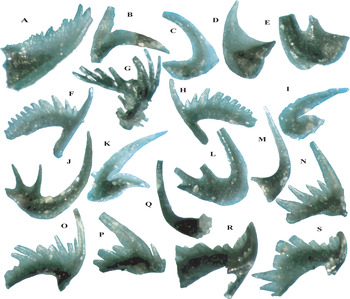
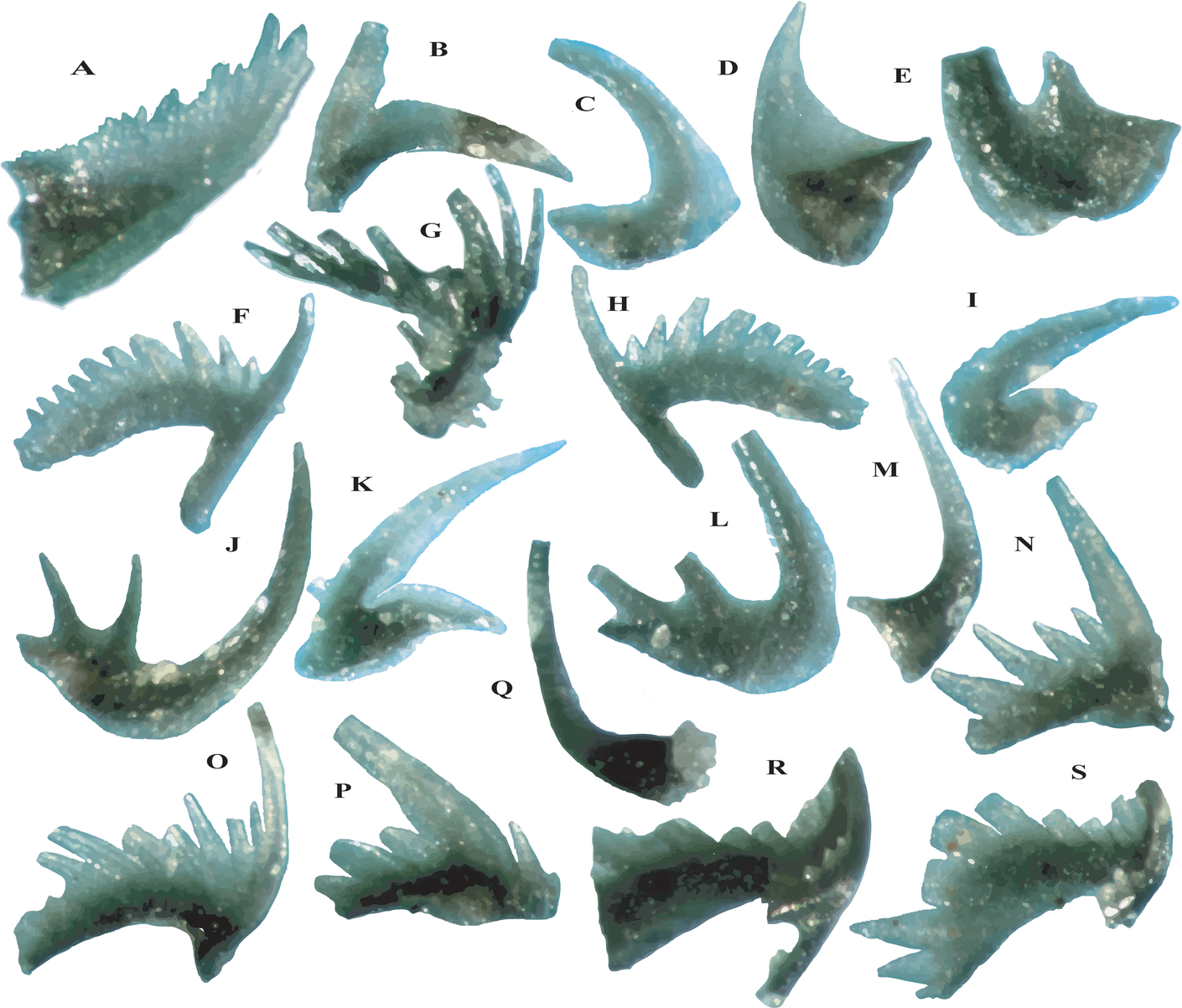
The youngest conodont association retrieved from the calcareous matrix is composed of the following species: Ansella jemtlandica (Fåhraeus and Hunter), Cornuodus longibasis (Lindström), Costiconus costatus (Dzik), Drepanodus arcuatus (Pander), Fahraeusodus jachalensis (Feltes and Albanesi), Juanognathus jaanussoni (Serpagli), Paroistodus horridus primus (Albanesi), Paroistodus horridus secundus (Albanesi), Paroistodus originalis (Sergeeva), Periodon macrodentatus (Graves and Ellison), Protopanderodus gradatus (Serpagli), Protoprioniodus simplicissimus (McTavish), Pteracontiodus cryptodens (Mound) and Semiacontiodus potrerillensis (Albanesi) (Fig. 4). The overlapping range of the referred conodont association is constrained to the Paroistodus horridus Subzone of the L. variabilis Zone, which is indicated by Baltoniodus medius (Dzik), Lenodus variabilis (Sergeeva) and the particular appearance of the subspecies P. horridus primus and P. horridus secundus (Albanesi & Ortega, Reference Albanesi and Ortega2016).
A.Ansella jemtlandica (Löfgren), S element, lateral view, Los Túneles sample, 100×, CORD-MP 28407; B.Fahraeusodus jachalensis Feltes and Albanesi, M element, lateral view, Los Túneles sample, 80×, CORD-MP 28465; C.Paroistodus originalis (Sergeeva), S element, lateral view, Los Túneles sample, 80×, CORD-MP 28515; D.Ansella jemtlandica (Löfgren), P element, lateral view, Los Túneles sample, 100×, CORD-MP 28415; E.Paroistodus horridus primus (Albanesi), S element, lateral view, Los Túneles sample, 80×, CORD-MP 28497; F.Fahraeusodus jachalensis Feltes and Albanesi, S element, lateral view, Los Túneles sample, 80×, CORD-MP 28481; G.Erraticodon alternans (Hadding), P element, lateral view, Los Túneles sample, 80×, CORD-MP 28465-28466; H.Periodon macrodentatus (Graves and Ellison), Pa element, lateral view, Los Sombreros sample, 100×, CORD-MP 28554; I.Paroistodus originalis (Sergeeva), M element, lateral view, Los Túneles sample, 100×, CORD-MP 28553; J.Paroistodus horridus secundus (Albanesi), S element, lateral view, Los Túneles sample Túneles, 80×, CORD-MP 28513; K.Periodon macrodentatus (Graves and Ellison), M element, lateral view, Los Sombreros sample, 80×, CORD-MP 28555; L.Paroistodus horridus secundus (Albanesi), S element, lateral view, Los Túneles sample, 80×, CORD-MP 28514; M.Semiacontiodus potrerillensis (Albanesi), S element, lateral view, Los Túneles sample, 60×, CORD-MP 28763; N.Periodon macrodentatus (Graves and Ellison), Pb element, lateral view, Los Sombreros sample, 80×, CORD-MP 28556; O.Periodon macrodentatus (Graves and Ellison), Sc element, lateral view, Los Sombreros sample, 80×, CORD-MP 28557; P.Periodon macrodentatus (Graves and Ellison), Pa element, lateral view, Los Sombreros sample, 100×, CORD-MP 28560; Q.Semiacontiodus potrerillensis (Albanesi), elemento S, vista lateral, muestra Los Túneles, 80×, CORD-MP 28769; R.Periodon macrodentatus (Graves and Ellison), Sa element, lateral view, Los Sombreros sample, 80×, CORD-MP 28710; S.Periodon macrodentatus (Graves and Ellison), Sd element, lateral view, Los Sombreros sample, 100×, CORD-MP 28712.
The allochthonous clasts of the calclithite yielded the conodont species Paltodus deltifer, which is diagnostic to define eponymous biozone from the Baltoscandian region and NW basins of Argentina, and the Macerodus diane Zone of the Argentine Precordillera. However, in this sample, species of the genus Colaptoconus dominate, including C. quadraplicatus (Branson and Mehl), C. priscus (Ji and Barnes) and C. cf. propinquus (Furnish), as well as specimens of Parapanderodus striatus (Graves and Ellison) and Oneotodus variabilis (Lindström), which are typical of this biozone according to Albanesi & Ortega (Reference Albanesi and Ortega1998). The species Parapaltodus numarcuatus (Lindtröm) and Scolopodus cf. floweri Repetski, determined by Lehnert (Reference Lehnert1995) for contemporary levels of the La Silla Formation in the Central Precordillera, are significant components of this biozone as well.
The youngest biostratigraphic data correspond to graptolites recorded c. 600 m from the base of the formation at the El Salto section, where rabdosomes of Orthograptus sp. along with indeterminate biserial and dicranograptid stipes suggest a Sandbian age. The rhabdosomes of Orthograptus sp. are identical to those studied in the upper member of the Los Azules Formation in the Cerro Viejo de Huaco (Ortega, Reference Ortega1987), Central Precordillera, suggesting the presence of the late Sandbian Climacograptus bicornis Zone.
4.b. Stratigraphic correlation
The identification of the Cordylodus proavus Zone (upper Furongian), the Paroistodus horridus Subzone of the Lenodus variabilis Zone (lower Darriwilian), and the determination of the Paltodus deltifer – Macerodus dianae zones (upper Tremadocian) in the Los Sombreros Formation allow us to correlate the slope deposits from the Western Precordillera with the carbonate platform series of the Central Precordillera, mainly made up by the La Silla and San Juan formations (see Keller et al. Reference Keller, Cañas, Lehnert and Vaccari1994; Albanesi et al. Reference Albanesi, Hünicken and Barnes1998, Reference Albanesi, Ortega and Hünicken2006, Reference Albanesi, Cañas and Mango2016; Mango and Albanesi, Reference Mango and Albanesi2018).
The genus Cordylodus, which appears in a block of the El Salto section, is a major component in various slope and shelf communities during the Furongian and the Early Ordovician. Specimens of the C. proavus Zone were first described in the Precordillera by Lehnert (Reference Lehnert1994), who found them in the Los Sombreros Formation of the Tontal Range. However, this was based on a single sample without accurate stratigraphic location. Recently, Voldman et al. (Reference Voldman, Alonso, Fernández, Banchig, Albanesi, Ortega and Cardó2016) reported species of the genus Cordylodus from the basal part of the Los Sombreros Formation cropping out in the eastern flank of the La Invernada Range. At regional scale, the C. proavus zone was identified in Gondwanan basins of NW Argentina, namely, in the Lampazar (Cajas Range of the Cordillera Oriental of Jujuy (Rao, Reference Rao1999; later revised by Albanesi et al. Reference Albanesi, Giuliano, Pacheco, Ortega and Monaldi2015)), El Moreno (Moya et al. Reference Moya, Malanca, Monteros, Albanesi, Ortega, Buatois, Albanesi, Beresi and Peralta2003) and Alfacito (Zeballo et al. Reference Zeballo, Albanesi and Ortega2008) localities of the Cordillera Oriental, and in the Volcancito Formation of the Famatina Range, La Rioja Province (Albanesi et al. Reference Albanesi, Esteban, Ortega, Hünicken, Barnes, Dahlquist, Baldo and Alasino2005).
The cosmopolitan distribution of the fauna from the C. proavus Zone allows a good correlation with shelf strata of Siberia, and shelf and slope deposits of North America (Barnes Reference Barnes1988; Miller Reference Miller1988; Miller et al. Reference Miller, Evans, Loch, Ethington, Stitt, Holmer and Popov2003), China (An et al. Reference An, Du, Gao, Chen and Li1981, Reference An, Zhang, Xiang, Zhang, Xu, Zhang and Yang1983; Chen and Zhang, Reference Chen and Zhang1989), Australia (Jones, Reference Jones1971; Nicoll, Reference Nicoll1991; Nicoll et al. Reference Nicoll, Miller, Nowlan, Repetski and Ethington1999), Kazakhstan (Chugaeva and Apollonov, Reference Chugaeva, Apollonov, Bassett and Dean1982; Dubinina, Reference Dubinina, Barnes and Williams1991) and Estonia (Viira et al. Reference Viira, Segeeva and Popov1987).
The presence of Paltodus deltifer represents a valuable record for intercontinental correlation, considering that it links to the conodont faunas of the ‘Ceratopyge Limestone’ (Stage AIII of the lower Oelandian) of Västergötland and Öland, Sweden, which typically correspond to the P. deltifer Zone (Lindström, Reference Lindström1955, Reference Lindström, Sweety and Bergström1971; Löfgren, Reference Löfgren1997). This biozone (lower Tremadocian) has been detected in different localities of the Baltoscandinavian region, e.g. in the Varangu Member of NE Estonia (Mägi & Viira, Reference Mägi and Viira1976), in the NW of Latvia (Dubinina et al. Reference Dubinina, Sal’nikova and Efimova1983), in several sections of the island of Öland (van Wamel, Reference van Wamel1974; Bagnoli et al. Reference Bagnoli, Stouge and Tongiorgi1988) and in other Swedish localities, such as Hunneberg, Västergötland (Löfgren, Reference Löfgren1993) and Fjäcka, Dalarna (Löfgren, Reference Löfgren1994). An equivalent interval of this biozone and the Macerodus dianae Zone can be traced through various locations in North America (e.g. in the El Paso Group of Texas and New Mexico (Repetski, Reference Repetski1982), and in western Utah and southern Oklahoma (Ethington et al. Reference Ethington, Engel, Elliott and Aldridge1987)). Also, this stratigraphic interval has been recorded in Devon Island, Arctic Archipelago (Landing & Barnes, Reference Landing and Barnes1981), Greenland (Smith, Reference Smith1991), Siberia (e.g. Abaimova, Reference Abaimova1975, Kanygin et al. Reference Kanygin, Moskalenko and Yadrenkina1989), Kazakhstan (Dubinina, Reference Dubinina, Barnes and Williams1991; Popov & Tolmacheva, Reference Popov and Tolmacheva1995), Montagne Noire, southern France (Küppers & Pohler, Reference Küppers, Pohler, Webby and Laurie1992), northern China (An et al. Reference An, Zhang, Xiang, Zhang, Xu, Zhang and Yang1983) and the Canning Basin of Australia (Nicoll & Playford, Reference Nicoll and Playford1993).
Strata corresponding to the P. deltifer Zone were documented for the first time in the Precordillera of San Juan by Keller et al. (Reference Keller, Cañas, Lehnert and Vaccari1994) in the La Silla Formation at the Cerro La Silla; this biozone was also documented for the same formation at the Portezuelo Yanso section (Albanesi et al. Reference Albanesi, Hünicken and Barnes1998), both in the Central Precordillera of San Juan Province. Another significant record of conodonts from the P. deltifer Zone was published by Heredia (Reference Heredia1995) in relation to the basal conglomerate with allochthonous clasts of the Empozada Formation, Darriwilian to Katian in age, at the San Isidro area, in the Central Precordillera of Mendoza Province, as a consequence of the Ocloyic Orogenesis (Ortega et al. Reference Ortega, Albanesi, Heredia and Beresi2007; Voldman et al. Reference Voldman, Albanesi and Ramos2009). Albanesi et al. (Reference Albanesi, Cañas and Mango2016) documented the Macerodus dianae Zone, in the section of Portezuelo Jáchal, in the Central Precordillera of San Juan, which corresponds to the upper part of the P. deltifer Zone of other regions. In NW Argentina, the presence of the biozone was also recognized in different siliciclastic shelf units of the Santa Victoria Group of the Cordillera Oriental; for example, Manca et al. (Reference Manca, Heredia, Hünicken and Rubinstein1995) and Giuliano et al. (Reference Giuliano, Albanesi, Ortega, Zeballo, Monaldi, Albanesi and Ortega2013) assigned part of the Santa Rosita Formation, exposed at the town area of Nazareno, Salta Province, to this biozone based on the record of the nominal species. Aceñolaza & Albanesi (Reference Aceñolaza and Albanesi1997) recovered a diverse fauna of conodonts from the uppermost levels of the same formation exposed in the area of Chucalezna, Jujuy Province. This biozone was particularly well studied in sections of the Alfarcito area by Zeballo et al. (Reference Zeballo, Albanesi, Voldman, Monaldi, Albanesi and Ortega2013), also from sections near the town of Purmamarca by Zeballo et al. (Reference Zeballo, Albanesi and Ortega2008) and the Blanco River section of the Aguilar Range (Rao & Flores, Reference Rao and Flores1998), all locations of the Cordillera Oriental of Jujuy Province. The P. deltifer Zone was also correlated with strata exposed at La Alumbrera creek in the Famatina Range, La Rioja Province (Albanesi et al. Reference Albanesi, Esteban, Ortega, Hünicken, Barnes, Dahlquist, Baldo and Alasino2005).
The association of autochthonous graptolites of the Darriwilian described by Ortega et al. (Reference Ortega, Banchig, Voldman, Albanesi, Alonso, Festa and Cardó2014) for the Los Sombreros Formation agrees with that of the uppermost strata of the San Juan Formation and the lower member of the Los Azules Formation, which expose in the Cerro Viejo de Huaco area of Central Precordillera. Thereby, the levels of the Los Sombreros Formation can be accurately correlated with dated strata from the contemporary carbonate platform (Mango et al. Reference Mango and Albanesi2018).
The P. horridus Subzone of the L. variabilis Zone as recognized in the present study can be correlated approximately with the middle part of the L. variabilis Zone corresponding to the Kunda Stage of the Oelandian Series in the limestone sequence of the Baltic Shield (Lindström, Reference Lindström, Sweety and Bergström1971; Löfgren, Reference Löfgren1978; Stouge & Bagnoli, Reference Stouge and Bagnoli1990, Löfgren & Zhang, Reference Löfgren and Zhang2003). In North America, a conodont fauna related to the L. variabilis Zone has been recorded in deep-water platform environments, e.g. in the Fort Peña Formation of the Marathon basin of Texas (Bradshaw, Reference Bradshaw1969), in the corresponding parts of the Lévis and Mystic Formations of Quebec (Uyeno & Barnes, Reference Uyeno and Barnes1970; Barnes & Poplawski, Reference Barnes and Poplawski1973), in the upper sequence of the Deep Kill Shale of the allochthonous Taconic from eastern New York (Landing, Reference Landing1983), in the Cow Head Group and Table Head Formation of West Terranova (Stouge, Reference Stouge1984; Pohler & James Reference Pohler and James1989), and the Road River Formation in the southern Mackenzie Mountains, Canada (Tipnis et al. Reference Tipnis, Chatterton and Ludvigsen1978).
Strata corresponding to the L. variabilis Zone were also documented in Australia and China. Watson (Reference Watson1988) illustrates this species in the Goldwayer Formation in the Canning basin, Western Australia (identified by this author as Eoplacognathus suecicus). Wang & Bërgström (Reference Wang and Bergström1995) record this biozone in the highest part of the Ningkuo Formation, Huangnitang, Zhejiang Province. Chen & Zhang (Reference Chen and Zhang1989) and An & Zheng (Reference An and Zheng1990) determined faunas corresponding to the L. variabilis Zone in southern China and Hunan, respectively.
In the Eastern Precordillera of San Juan, Sarmiento et al. (Reference Sarmiento, Gutiérrez-Marco and Rábano1995) and Mestre & Heredia (Reference Mestre and Heredia2013) recognized the L. variabilis Zone in the highest part of the San Juan Formation, exposed at the Don Braulio creek, on the western flank of the Villicum Range. Also, Sarmiento et al. (Reference Sarmiento, Vaccari and Peralta1988) recovered an association of characteristic species from the upper part of the L. variabilis Zone in the lower strata of the Rinconada Formation in the Eastern Precordillera of San Juan Province, whose genesis is partly related to that of the Los Sombreros Formation with the intervening Ocloyic Orogeny (Voldman et al. Reference Voldman, Albanesi and Ramos2009, Reference Voldman, Alonso, Fernández, Banchig, Albanesi, Ortega and Cardó2016).
At the Las Chacritas section, the P. horridus Subzone has been documented for the upper strata of the San Juan Formation (Albanesi et al. Reference Albanesi, Bergström, Schmitz, Serra, Feltes, Voldman and Ortega2013; Serra et al. Reference Serra, Albanesi, Ortega and Bergstrom2015, Reference Serra, Feltes, Ortega and Albanesi2017a; Feltes et al. Reference Feltes, Albanesi and Bergström2016). Albanesi et al. (Reference Albanesi, Ortega and Hünicken1995) recognized the L. variabilis Zone through the basal strata of the Yerba Loca Formation, which overlies the Los Sombreros Formation at the Ancaucha section, on the eastern flank of the Cerro Alto de Mayo. At the Los Túneles section, Voldman et al. (Reference Voldman, Albanesi and Ramos2009) assigned the conodonts recovered from calcareous levels of the Los Sombreros Formation to this biozone, in the same section of the present study, although the illustrated taxa correspond to the immediately younger biostratigraphic interval of middle Darriwilian age.
The presence of cosmopolitan taxa allows us to recognize fluid faunal exchange through the Iapetus Ocean (Albanesi & Bergström, Reference Albanesi, Bergström, Finney and Berry2010). Accordingly, Zeballo & Albanesi (Reference Zeballo and Albanesi2009) suggested this exchange can already be detected in the transitional interval between Cambrian and Ordovician deposits of NW Argentine basins. This situation continues during the Darriwilian, as revealed by the present study, when the maximum diversification of conodont faunas occurs in the Precordillera, with the distinction of characteristic biofacies from different marine environments (Serra et al. Reference Serra, Feltes, Henderson and Albanesi2017b).
4.c. Preservation of conodonts and palaeothermometry
Our study confirms that, as detected by Voldman et al. (Reference Voldman, Albanesi and Ramos2009), the conodont elements recovered from the Los Túneles section display two contrasting Colour Alteration Indexes (CAIs). Those conodonts assigned to the Lenodus variabilis Zone exhibit smooth surfaces and scarce mineral recrystallization, with brown colour, that correspond to CAI 3, reflecting burial palaeotemperatures between 110 and 200 °C. The conodont elements of the C. proavus and P. deltifer – M. dianae zones recovered from El Salto and the Los Túneles sections, respectively, have a black colour corresponding to CAI 5 that indicates palaeotemperatures of 300–480° C, and a very low-grade metamorphism (greenschist facies) (Epstein et al. Reference Epstein, Epstein and Harris1977). The preservation degree of these elements reveals the high temperatures undergone by the bearer rocks, as well as dynamo-thermal and hydrothermal effects (microfracturing and displacement of welded parts, creation of porosity, textural corrosion and mineral recrystallization). Thus, our data confirm those of Voldman et al. (Reference Voldman, Albanesi and Ramos2009), extending them to the El Salto section, and supporting their interpretation that the low-grade metamorphic carbonate clasts of the Los Sombreros Formation would have been sourced from the thrust sheets that emplaced onto the platform during the collision between the Cuyania Terrane and Gondwana.
5. Discussions and conclusions
Considering the complex structure of the Los Sombreros Formation and the scarcity of biostratigraphic data, the age of the olistostromal unit is controversial, having been attributed to the Ordovician (e.g. Benedetto & Vaccari, Reference Benedetto and Vaccari1992; Banchig & Bordonaro, Reference Banchig and Bordonaro1994; Keller, Reference Keller1999; Voldman et al. Reference Voldman, Albanesi and Ramos2009; Voldman et al. Reference Voldman, Alonso, Fernández, Banchig, Albanesi, Ortega and Cardó2016) or Devonian systems (e.g. Peralta, Reference Peralta2005; Peralta & Heredia, Reference Peralta and Heredia2005). However, the presence of graptolitic shales from the lower Floian (Ojo de Agua section; Banchig & Moya, Reference Banchig and Moya2002) and the lower Darriwilian (Los Túneles section), as well as the occurrence of representative graptolites of the Lower, Middle and Upper Ordovician in the El Salto creek succession (Ortega et al. Reference Ortega, Banchig, Voldman, Albanesi, Alonso, Festa and Cardó2014), indicate that the age of the Los Sombreros Formation encompasses the Ordovician.
Voldman et al. (Reference Voldman, Alonso, Fernández, Banchig, Albanesi, Ortega and Cardó2016) recognized conodont associations that belong to the upper Furongian in blocks of calcareous breccias exposed in the eastern flank of the La Invernada Range. Moreover, conodont species referable to the upper Tremadocian were obtained from calcareous breccias and clastic-carbonate turbidites occurring at the El Telégrafo and El Salto sections of the El Tontal Range, and the Los Túneles section along the Jáchal River (Voldman et al. Reference Voldman, Albanesi and Ramos2009). The present contribution confirms the presence of conodont species from the referred ages, adding other previously unreported conodont taxa.
Trilobite associations from allochthonous blocks of the lower Cambrian at the Los Túneles section along the Jáchal River, typically of the Olenellus Zone (upper stage of Cambrian Series 2) of North America, were described (Benedetto & Vaccari, Reference Benedetto and Vaccari1992).
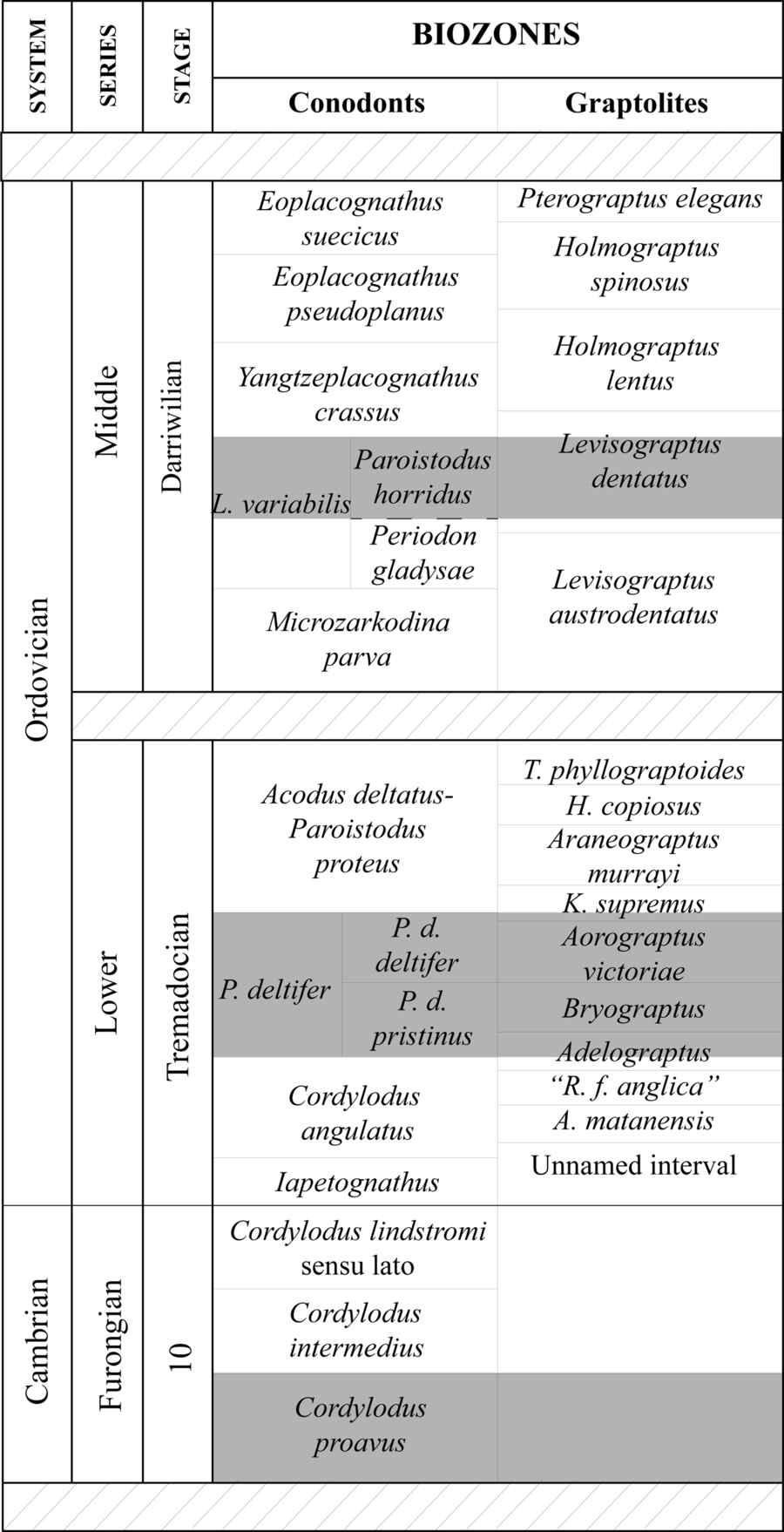
A number of autochthonous conodont species from this section were recovered by Voldman et al. (Reference Voldman, Albanesi and Ramos2009). According to these authors, the fauna is characterized by the presence of Lenodus variabilis, Fahraeusodus jachalensis, Paroistodus horridus and Periodon macrodentatus, among other taxa, which represent the Yangtzeplacognathus crassus Zone (middle Darriwilian) following the biostratigraphic scheme of Albanesi & Ortega (Reference Albanesi and Ortega2016) (Fig. 5). The conodont elements are well preserved, with a CAI 3 that represents burial palaeotemperatures of 110–200 °C. A similar age is inferred for the correlative strata exposed in the Ancaucha area, c. 10 km north of the Los Túneles study section (Albanesi et al. Reference Albanesi, Ortega and Hünicken1995). The present study reports a slightly older conodont association from the matrix of interbedded calcarenites at the Los Túneles section, which correspond to the Paroistodus horridus Subzone of the Lenodus variabilis Zone.
Conodont–graptolite biostratigraphic chart of the upper Cambrian and Lower–Middle Ordovician of Argentina (adapted from Albanesi & Ortega, Reference Albanesi and Ortega2016).
From the mixed turbidite facies that underlie the latter bearer rocks, Ortega et al. (Reference Ortega, Brusa and Astini1991) recorded a graptolite association of late Dapingian to early Darriwilian age, in agreement with the faunal record of the present work.
From slumped beds of the Los Sombreros Formation, exposed in the La Invernada Range, Voldman et al. (Reference Voldman, Alonso, Fernández, Banchig, Albanesi, Ortega and Cardó2016) recorded the occurrence of conodonts referable to the Hirsutodontus simplex Subzone of the Cordylodus intermedius Zone (upper Furongian) and the Macerodus dianae Zone (upper Tremadocian). The latter biozone was recently documented through the upper strata of the La Silla Formation (Albanesi et al. Reference Albanesi, Cañas and Mango2016) at the Portezuelo de Jáchal section, revealing that towards the late Cambrian – Early Ordovician an active continental slope area was already established.
Our work confirms the presence of a contiguous carbonate platform as source of reworked limestone layers in deeper slope environments, such as can be envisaged from the present reorganization of dispersed biostratigraphic data through the Precordilleran basin.
After the recent recognition that the deposition of the Los Sombreros Formation in its different locations through the Western Precordillera took place from the late Cambrian up to the Late Ordovician, new biostratigraphic data of this time span are contributed in the present work; namely, the Paroistodus horridus Subzone of the Lenodus variabilis Zone, which is identified at the Los Túneles section along the Jáchal River. The conodont elements of this early Darriwilian association exhibit smooth surfaces and little mineral recrystallization with a CAI 3. This colour alteration index reflects burial palaeotemperatures between 110 and 200 °C that reveal the thermal history related to the maximum sedimentary burial of strata from the Western Precordillera reached during the Devonian. The conodonts of the P. deltifer Zone recovered from clasts, which in turn were retrieved from the calcareous matrix with conodont species of the Paroistodus horridus Subzone, show typical thermal alterations caused by the effects of very low-grade metamorphism (CAI 5) with palaeotemperatures of 300–480 °C, i.e. greenschist facies.
Our records verify the hypothesis proposed by Voldman et al. (Reference Voldman, Albanesi and Ramos2009), which considers Tremadocian conodont elements distinguished by high CAI as transported in exotic calcareous blocks from the platform to the slope during the early Darriwilian sedimentation of the Los Sombreros Formation within the Ocloyic Orogeny.
Acknowledgements
We thank the Consejo Nacional de Investigaciones Científicas y Técnicas (CONICET, Argentina) for funding this work. Also, our recognition to the CICTERRA (CONICET-UNC) and the CIGEA (FCEFyN-UNC), where the research project was developed. We acknowledge Dr Aldo L. Banchig and Dr Gladys Ortega, who provided suggestions on the geology of the study area and, particularly, our colleague Belén Thalmeier for her collaboration in the field. Anonymous reviewers provided helpful comments to improve the final version of the manuscript.