

Introduction
Most outcome measures in medicine assess the reduction in symptoms of specific disorders. Such biomedically based outcome measures are clearly appropriate for some applications, notably evaluation of pharmacological interventions aimed at alleviating the symptoms of particular disorders. However, such measures have also been subject to two main criticisms. First, they are unlikely to be helpful or even valid in chronic illnesses where comorbidity is common.Reference Tinetti, Fried and Boyd 1 Thus, for example, the presence of depression in someone with rheumatoid arthritis is likely to bias that person’s responses to widely used arthritis measures.Reference Sensky and Catalan 2 , Reference Mangelli, Gribbin and Büchi 3 The second criticism is that symptom-based outcome measures fail to take account of individual values and preferences.Reference Reuben and Tinetti 4 For example, one person with rheumatoid arthritis may place particular value on optimizing manual dexterity, while another might regard mobility as a greater priority. A recent editorial on chronic pain urged clinicians to set realistic, individualized goals that prioritize function and quality of life rather than complete pain relief, and the dynamic interaction in chronic pain between biological, psychological, and social factors has been emphasized.Reference Cohen, Vase and Hooten 5
Such criticisms have led to calls for the development of person-centered outcome measures. Where these are global measures, they are by definition transdiagnostic. Almost all states of ill health involve individual suffering, and alleviation of suffering has always been regarded as an essential aim of clinical practice.Reference Sensky 6 A quantitative measure of suffering is therefore a good candidate for a global person-centered outcome measure.Reference Büchi, Buddeberg and Klaghofer 7 , Reference Sensky and Büchi 8 It has recently been proposed that mental pain might also be such a measure.Reference Fava, Tomba and Brakemeier 9 Mental pain is a state of persistent distress, commonly associated with significant physical or mental illness. Characteristic features of mental pain include a sense of hopelessness and/or helplessness, loss of meaning, loss of self, feelings of emptiness, and loss of control or autonomy. Mental pain was initially described in the context of suicidality but is considered to be very widespread. It has been argued that there are strong similarities between suffering and mental pain, including that both are transdiagnostic, both are understood by patients, and both are based on individual values and preferences.Reference Sensky 10
Several measures of mental pain have been proposed, but their properties have tended to be investigated only in the patient groups in which they were originally developed. Based on a review of the literature, the Mental Pain Questionnaire (MPQ) was developedReference Fava, Tomba and Brakemeier 9 , Reference Fava 11 to operationalize the measurement of mental pain. This 10-item self-report scale is intended as a generic clinimetric index of mental pain. In a sample of people with migraine, the MPQ was reported to behave as a unidimensional measure and showed good reliability for mild and high levels of mental pain.Reference Svicher, Romanazzo and De Cesaris 12 People with chronic migraine were found to be more disabled than those with episodic migraine, and the former group had significantly higher MPQ scores than the latter.Reference Cosci, Svicher and Mansueto 13 The MPQ has been tested in a primary care sample.Reference Guidi, Piolanti and Gostoli 14 People who had either a psychiatric disorder diagnosed according to the Diagnostic and Statistical Manual of mental disorders (DSM) 15 or a psychosomatic disorder diagnosed according to the Diagnostic Criteria for Psychosomatic Research-Revised (DCPR-R)Reference Fava, Cosci and Sonino 16 had significantly higher MPQ scores compared with those in the sample without psychiatric or psychosomatic diagnoses. MPQ scores showed significant correlations with depression and anxiety assessed by the Clinical Interview for Depression (CID),Reference Guidi, Fava and Bech 17 and with psychological distress, well-being, and quality of life (the last two being negative correlations) measured by the Psychosocial Index (PSI).Reference Piolanti, Offidani and Guidi 18
The association of increased mental pain with greater disability, and the correlations between mental pain and depression, anxiety, and impaired quality of life are to be expected if mental pain is indeed a global health outcome measure. A global outcome measure must accommodate the fact that health is defined by the individual, and will be differently defined between individuals and also across time for the same individual.Reference Mold, Blake and Becker 19 It has been argued that as an outcome measure, mental pain is person-centered and potentially global.Reference Sensky 10 To have clinical utility as a single global outcome measure, mental pain must therefore incorporate contributions from multiple sources of distress.Reference Sensky 10 For example, if one person experiences more pain but less depression and another experiences less pain but more depression, a single valid global measure should be able to capture both of these states quantitatively. Furthermore, if a global outcome measure incorporates multiple sources of distress, then it should show significant but modest correlations with individual sources of distress.
The present study aimed to test whether mental pain demonstrates these properties of a global outcome measure, in a secondary analysis of data from the migraine sample noted above.Reference Cosci, Svicher and Mansueto 13 The hypotheses tested were (a) that multiple measures of symptomatology and quality of life would each show modest but significant bivariate correlations with mental pain; and (b) that some of these measures would individually make unique contributions to overall mental pain.
Methods
Participants
Subjects were derived from the PAINMIG cohort study, described in detail elsewhere.Reference Cosci, Svicher and Mansueto 13 Participants were outpatients with migraine enrolled from September 2016 to September 2019 at the Headache and Clinical Pharmacology Center of the University Hospital Careggi, Florence, Italy. Inclusion criteria were: (1) age from 18 to 64 years and (2) a diagnosis of episodic or chronic nonrefractory migraine according to the International Classification of Headache Disorders, 3rd edition (beta version). 20 The exclusion criteria were cognitive deficits or other impairments affecting reading and understanding abilities.
The study was approved by the Ethics Committee of the University Hospital Careggi, Florence, Italy. All procedures contributing to this work comply with the ethical standards of the relevant national and institutional committees on human experimentation and with the Helsinki Declaration of 1975, as revised in 2013. All subjects gave their informed consent.
Procedure
Patients were diagnosed with migraine by the center’s physicians. Trained clinical psychologists then collected sociodemographic and clinical information and administered validated tools (see below).
Instruments
For each patient, sociodemographic information, data on pharmacological and nonpharmacological treatments, and data on the clinical history of organic diseases were collected via an ad hoc set of questions used previously.Reference Cosci, Abrams and Schruers 21
The MPQReference Fava 22 is a self-rating 10-item scale assessing mental pain. Items are rated on a “Yes/No” format. The higher the score, the higher the level of mental pain experienced. The MPQ has shown good clinimetric properties.Reference Svicher, Romanazzo and De Cesaris 12
The Migraine Disability Assessment Score (MIDAS)Reference Stewart, Lipton and Dowson 23 is a self-administered 5-item tool assessing the impact of migraine on the patient’s life and the level of pain and disability related to migraine. It has shown good psychometric properties and clinical utility.Reference Stewart, Lipton and Dowson 23
The Semi-Structured Interview for DCPR-RReference Cosci, Svicher and Romanazzo 24 is a semi-structured interview based on the DCPR-R.Reference Fava, Cosci and Sonino 16 It yields the following diagnoses: allostatic overload, health anxiety, disease phobia, hypochondriasis, thanatophobia, illness denial, persistent somatization, alexithymia, conversion symptoms, anniversary reaction, somatic symptoms secondary to a psychiatric disorder, demoralization, demoralization with hopelessness, irritable mood, type A behavior, and alexithymia. The interview focuses on the last 6 to 12 months and has 79 “Yes/No” items. The DCPR-R has shown good criterion-related validityReference Cosci, Svicher and Romanazzo 24 and a substantial minority of patients not diagnosed according to DSM-5 satisfied the DCPR-R diagnostic criteria for a psychosomatic syndrome.Reference Cosci, Svicher and Romanazzo 24
The CIDReference Guidi, Fava and Bech 17 is a clinician-administered tool derived from the Hamilton Scale for Depression,Reference Hamilton 25 which covers 20 symptomatic areas assessed on a 7-point Likert scale. The individual anchor points are specified based on severity, frequency, and/or quality of symptoms. Total scores range between 7 and 140, and these total scores were used in this study rather than the presence or absence of a diagnosis. It has shown high sensitivity to change and is an instrument of choice for a broad evaluation of affective symptomatology.Reference Guidi, Fava and Bech 17
The PSIReference Piolanti, Offidani and Guidi 18 is a 55-item self-rated questionnaire assessing stress (both perceived and objective), well-being (covering different areas: positive relations with others, environmental mastery, and autonomy), psychological distress (including sleep disturbances, somatization, anxiety, depression, and irritability), abnormal illness behavior (allowing the assessment of hypochondriacal beliefs and bodily preoccupations), and quality of life (a simple direct question on quality of life: “How do you rate the quality of your life?”). Most of the items have a dichotomous response (“Yes/No”), some are rated on a 4-point Likert scale (from “not at all” to “a great deal”), and the item on quality of life has five possible answers (from “awful” to “excellent”). The PSI provides a multidimensional assessment of psychosocial features and has shown good clinimetric properties.Reference Piolanti, Offidani and Guidi 18
Statistical analysis
Based on MPQ median total score,Reference DeCoster, Gallucci and Iselin 26 subjects were stratified into “low mental pain” (MPQ total score ≤ 1) and “high mental pain” (MPQ total score > 1) groups.
The Kolmogorov–Smirnov test was run to test normality of data.Reference Field 27 Comparisons between low and high mental pain groups were run using the chi-square test or Fisher test, when more than 20% of cells had expected frequencies less than 5, in case of categorical variables; using the t test for independent samples in case of continuous variables normally distributed; and using the Mann–Whitney test in case of continuous variables nonnormally distributed. Because of the high number of comparisons of continuous variables comparing low and high mental pain groups, Bonferroni post hoc correction was applied.
Spearman correlations were run to evaluate the association between continuous variables nonnormally distributed, and size correlations were interpreted according to Reference Reference Hinkle, Wiersma and Jurs28.
Since the literature does not suggest an a priori ranking of predictors of mental pain, general linear models (GLMs) were performed with manual backward and stepwise exclusion procedure which targeted the final strongest model that had the highest adjusted sum of squares and F values.Reference Grafen and Hails 29 The approach allows the data to determine a ranking of predicting variables based on their respective contributions to the overall variance. Candidate variables considered for inclusion in the model were variables which showed significant differences between the low and high mental pain groups. Both the diagnosis of episodic/chronic migraine and the MIDAS total score are measures of migraine severity, and both were significantly different in the low and high mental pain groups. The distinction between chronic and episodic migraine, based on the number of days per month with migraine attacks, has been questioned.Reference Chalmer, Hansen and Lebedeva 30 Furthermore, the MIDAS total score is the gold standard continuous measure of disability due to migraine. For these reasons, only MIDAS scores were included in the model.
The Statistical Package for Social Sciences version 21 and MiniTab version 19 were used to perform the analyses. Two-sided significance level was set at P ≤ .05.
Results
A total of 200 migraine patients were enrolled, with equal numbers having chronic or episodic migraine. No missing data were found. The mean age was 42 years (SD 12 years), and the majority of the sample were women (n = 160, 80%). The majority of subjects (n = 112, 57%) had at least high school education, were employed or studying (n = 169, 85%), and were married or cohabiting (n = 127, 64%).
A total of 113 (57%) subjects of the sample were classified as having low mental pain, while 87 (43%) subjects were classified as having high mental pain. When migraine patients with low mental pain were compared with those with high mental pain, no statistically significant differences were found for sex (males: n = 27, 24% vs n = 13, 15%, x 2 [df] = 2.46[2], P = .11) and age (42.5 ± 11.4 vs 42.5 ± 12.0 years, t[df] = −0.036[198], P = .97).
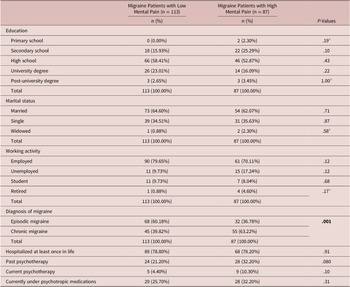
Table 1 shows comparisons between the low and high mental pain groups regarding sociodemographic and clinical variables. There were no significant differences between the two groups, except that the high mental pain group included a significantly higher proportion of subjects with chronic migraine.
Categorical Descriptive Variables. Migraine Patients with Low Mental Pain Versus Migraine Patients with High Mental Pain. The Chi-Square or Fisher test for Categorical Variables

Note: Bold P-value is statistically significant.
a Fisher’s test.
MIDAS total score was significantly higher among subjects with high mental pain compared with those with low mental pain (25.3 ± 26.3 vs 11.8 ± 18.8, P < .001).
At least one DCPR-R diagnosis was present in 57 (66%) of the high mental pain group, compared with 54 (48%) of the low pain group (P = .012). The mean MPQ total score was significantly higher among those who had at least one DCPR-R diagnosis than among those without DCPR-R diagnoses (2.1 ± 2.4 vs 1.3 ± 1.8, P = .007).
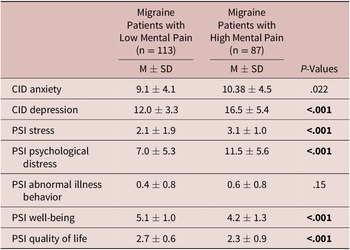
Table 2 shows comparisons between migraine patients with low and high mental pain on psychological variables. Compared with the low mental pain group, the high mental pain group had significantly higher levels of CID depression, PSI stress, PSI psychological distress, and significantly lower levels of PSI well-being and PSI quality of life.
Psychological Variables. Migraine Patients with Low Mental Pain Versus Migraine Patients with High Mental Pain. The Mann–Whitney Test for Independent Samples

Notes: Bonferroni post hoc correction (P ≤ .05/7 that is P ≤ .007 taken as statistically significant). Bold P-values are statistically significant.
Abbreviations: CID, Clinical Interview for Depression; PSI, Psychosocial Index.
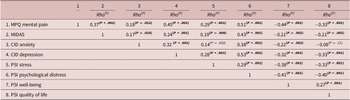
Table 3 lists the study variables that correlated significantly with MPQ total scores. They were calculated for the whole sample. Mental pain showed significant correlations with MIDAS scores, CID depression, CID anxiety, and PSI subscales.
Spearman Correlations Between Continuous Variables Nonnormally Distributed

Note: Bold P-values are statistically significant.
Abbreviations: CID, Clinical Interview for Depression; MIDAS, Migraine Disability Assessment Score; MPQ, Mental Pain Questionnaire; PSI, Psychosocial Index.
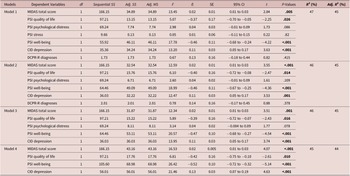
The GLMs are reported in Table 4. The final model accounted for 44% of variance and identified that higher mental pain was associated with greater disability due to migraine, more severe depression scores, and lower scores on PSI well-being and PSI quality of life.
Independent Predictors of Mental Pain Among Migraine Subjects. General Linear Models

Note: Bold P-values are statistically significant.
Abbreviations: CID, Clinical Interview for Depression; DCPR-R, Diagnostic Criteria for Psychosomatic Research-Revised; MIDAS, Migraine Disability Assessment Score; MS, mean squares; PSI, Psychosocial Index; SS, sum of squares.
Discussion
This is the first study to extend previous research into mental pain to test whether it has properties required of a global outcome measure. Strengths of the study include use of standardized and validated measures. The focus on a sample with a discrete diagnosis (migraine) is both a strength and a limitation. It was necessary in this initial study to avoid possible confounding effects of diverse symptoms and diagnoses. However, it also limits the generalizability of our findings. That this was an observational study means that it is not possible to establish a causal relationship between the variables under study and mental pain. A further limitation is that migraine pain was not measured although this might contribute to mental pain.Reference Fava, Tomba and Brakemeier 9 , Reference Sensky 10 , Reference Orbach, Palgi and Stein 31 - Reference Saunders 35 However, MIDAS provides a proxy measure of migraine pain assessing disability related to it.Reference Stewart, Lipton and Dowson 23 Other variables potentially contributing to mental pain were not measured (eg, duration of migraine illness, medical or psychiatric comorbidities, and resilience). However, this study had relatively modest aims—it involved secondary analyses of an existing dataset and was not designed to provide an exhaustive model of mental pain in migraine.
High mental pain was associated with increased CID depression, PSI stress, and PSI psychological distress, as well as lower PSI well-being and PSI quality of life. These findings are consistent with those previously reported.Reference Guidi, Piolanti and Gostoli 14 , Reference Mills, Green and Reddon 36 - Reference Patterson and Holden 38 Compared with the low mental pain group, those with high mental pain were more likely to have a DCPR-R diagnosis, as reported by some authors.Reference Guidi, Piolanti and Gostoli 14 It is well recognized that a significant minority of patients who do not warrant an ICD or DSM diagnosis nevertheless have DCPR-R diagnoses. The high mental pain group was also more likely to have chronic rather than episodic migraine. Supporting our first hypothesis, significant correlations were found between mental pain and disability related to migraine, CID depression, PSI psychological distress, PSI well-being, and PSI quality of life. These correlations, though significant, were modest, as expected if mental pain incorporates the other measures assessed but is at the same time different from each.Reference Sensky 10
The key original aspect of this study, expressed in our second hypothesis, was that some of the psychological measures assessed would make unique contributions to mental pain. Our results showed this to apply for CID depression, migraine-related disability, PSI well-being, and PSI quality of life. This indicates that mental pain encapsulates these disparate variables, and provides evidence that mental pain might indeed serve as a global outcome measure. The final model accounted for 44% of the variance of mental pain. This is particularly encouraging given that this study was not intended to provide an exhaustive model of mental pain. Including further pertinent variables in the model is likely to account for more of this variance. However, even if mental pain incorporates the variables identified in this study as well as other variables, it is unclear whether even the most exhaustive model can account for the full range of the variance in mental pain, because mental pain possibly has unique features which are not shared with other psychological variables.
Conclusion
This study has provided preliminary evidence from a single patient sample that mental pain, measured by the MPQ, shows properties expected of a valid global person-centered outcome measure. These results should encourage further validation studies. If our findings generalize to conditions other than migraine, they have two main implications. First, mental pain warrants further investigation as a measure of a person’s global state of health and well-being, substituting for multiple individual measures (disability, quality of life, depression, etc.). Such a holistic outcome measure should be particularly useful in studies of complex interventions, for example, those with complex benefit–adverse effect relationships, such as different treatments for end-stage renal failure in the elderly. Given that the MPQ is a brief and self-administered instrument, this could be very useful in clinical practice as well as in research. Particularly in the clinical management of people with complex problems, interventions might be guided by discussion between patient and clinician of changes in mental pain and the patient’s attributions about these.Reference Fava, Tomba and Brakemeier 9 Second, our findings support the potentially wide benefit of interventions aimed to reduce mental pain, such as well-being therapy,Reference Fava, Tomba and Brakemeier 9 in addition to strategies which have been already widely encouraged in chronic pain patients, such as a strong therapeutic alliance and shared decision-making. 39
Disclosure
The authors have no conflicts of interest to disclose.
Funding
This research received no specific grant from any funding agency, commercial, or not-for-profit sectors.