Recent research in first language acquisition has shown increasing interest in how children acquire complex morphological systems. A number of such systems are characterized by the existence of grammatical categories such as gender. Gender determines the morphosyntactic properties distinguishing classes of nominal lexemes, and affects inflectional changes, such as in adjective–noun or pronominal agreement or declension (Stump, Reference Stump, Spencer and Zwicky1998). The difficulty in acquiring gender is related to the fact that languages are not completely regular in mapping phonological or semantic features onto the different genders (Corbett, Reference Corbett1991). For example, in Spanish, most feminine nouns end in -a, and most masculine nouns end in -o, but a small subgroup of nouns like lapiz ‘pencil’ or nariz ‘nose’ have no transparent phonological gender marker on the noun itself. In German, female animated entities like die Frau ‘woman’ or die Mutter ‘mother’ are feminine while das Mädchen ‘girl’ is neuter, thus rendering even a straightforward semantic feature like sex unreliable as a cue to grammatical gender. Consequently, learning noun gender can be a challenging task for first and second language learners.
A number of studies (Kempe, Brooks, Mironova & Fedorova, Reference Kempe, Brooks, Mironova and Fedorova2003; Ševa, Kempe, Brooks, Mironova, Pershukova & Fedorova, Reference Ševa, Kempe, Brooks, Mironova, Pershukova and Fedorova2007) have demonstrated, for the Slavic languages of Russian and Serbian, that children commit fewer gender-agreement errors with diminutive nouns than with their simplex counterparts. Specifically, Kempe et al. (Reference Kempe, Brooks, Mironova and Fedorova2003) asked Russian two- to four-year-old children to describe pictures of familiar and unfamiliar animals, with half of the animal names introduced in diminutive form, and half in simplex form. They coded the first occurrence of gender agreement (adjectival or pronominal) and found that children produced significantly fewer gender-agreement errors with familiar and novel diminutive nouns compared to familiar and novel simplex nouns. This finding was later replicated with another group of Russian two- to four-year-olds, and extended to Serbian children of the same age (Ševa et al., Reference Ševa, Kempe, Brooks, Mironova, Pershukova and Fedorova2007).
Diminutives are morphological derivations that denote smallness. However, very often (but not always) diminutivization of nouns is associated with more salience and regularity of phonological gender marking. For example, the Spanish masculine diminutive ending -ito provides a salient morphological marker that transforms the opaque lapiz into the transparently gender marked masculine noun lapicito. Similarly, in Russian, the opaque feminine noun mysh' ‘mouse’, when diminutivized, becomes the transparently marked feminine noun myshka. Thus, in many languages, diminutives constitute a homogeneous cluster of nouns with salient and reliable gender marking. Consequently, children make fewer gender-agreement errors with diminutives.
Cross-linguistically, diminutives are associated with a range of additional semantic and pragmatic features like endearment, attachment and sympathy (Jurafsky, Reference Jurafsky1996), which make them exquisitely suitable for use in child-directed speech (CDS). Indeed, the frequency of diminutives Lithuanian children receive in their input can be considered very high (Wójcik, Reference Wójcik1994; Savickienė, Reference Savickienė and Gillis1998, Reference Savickienė2001, Reference Savickienė2003), as is the frequency of diminutives in the speech of the children themselves. For example, in one Lithuanian longitudinal corpus of mother–child speech (Savickienė, Reference Savickienė2003), across sessions, the mother produced from 40% to 65% of all noun tokens in diminutive form when addressing her daughter at ages 1 ; 7–2 ; 6, and her child produced from 21% to 70% of all noun tokens as diminutives during the same period.
In the present paper, we explore whether a diminutive advantage, similar to the one observed in Russian and Serbian, can be found in the richly inflected Baltic language of Lithuanian. In fact, of all living Indo-European languages, Lithuanian has the richest inflectional morphology, more complex than Latvian, the only other living Baltic language, or the closely related Slavic languages. Studying languages like Lithuanian is of considerable theoretical importance as the morphological complexity in such languages casts doubt on the notion of a default in language acquisition. The co-existence of a multitude of patterns of inflectional change calls into question the appropriateness of rule-based approaches to language learning which view acquisition of morphosyntax as the learning of default rules and memorizing of irregular exceptions (e.g. Pinker, Reference Pinker1999; Pinker & Ullman, Reference Pinker and Ullman2002; Ullman, Reference Ullman2001). We briefly sketch the structure of the Lithuanian system of noun morphology to give the reader an appreciation of its complexity: Lithuanian noun morphology comprises two genders, masculine and feminine, two numbers, singular and plural, and seven cases. As described above, semantics and phonology map onto gender categories in quasi-regular ways. Thus, most masculine nouns end in -(i)as, -is or -ys, and take the so-called first declension. Most feminine nouns end in -(i)a or -ė, and take the so-called second declension. The first and the second declensions are the most productive of the declension types. In addition, some feminine nouns end in -is and take the third declension, and some masculine nouns end in -us and take the fourth declension. Finally, there are some masculine and feminine nouns ending in -uo and -ė which take the fifth declension. To complicate matters further, there are some masculine nouns like tėtė ‘father’ which refer to males, require masculine agreement but resemble the form of most feminine nouns and take the second declension commonly used with feminine nouns. This is similar to the Slavic languages where there are nouns that refer to males, e.g. the Russian djadja ‘uncle’, which resemble feminine nouns and take the main declension used with feminine nouns, while requiring masculine adjectival and pronominal agreement.
Lithuanian diminutive morphology is also fairly complex. One very prominent feature of the Lithuanian language is the highly productive formation of diminutives from any noun via one or more suffixes. The most frequent and productive suffixes are the masculine -elis/-ėlis, -(i)ukas, -utis, -ytis, -aitis and their feminine counterparts -elė/ėlė, -(i)ukė, -utė, -ytė, -aitė. A variety of suffixes can be found in the formation of diminutives for different lexical semantic groups, and for the majority of nouns at least three or four different suffixes can be attached interchangeably to the same lemma, e.g. kepur-ė ‘cap:FEM’ has diminutive forms kepur-yt-ė, kepur-ait-ė, kepur-ėl-ė, kepur-iuk-ė. The diminutive suffixes are interchangeable with no differences in meaning associated with different suffixes. Note that while the word endings of Lithuanian diminutives are fairly homogeneous (-is and -as for masculine and -ė for feminine), there is considerable variety in the phonetic structure of the penultimate syllable and, thus, more overall variety in the structure of diminutives than in Russian or Serbian, where most masculine diminutives end in -(č)ik (Russian) or -(č)ić (Serbian) and most feminine nouns end in -(č)ka (Russian) or -ica (Serbian). Moreover, double suffixation, which reinforces the pragmatic effectiveness or the meaning of smallness associated with the diminutive, is common in all these languages, but tends to be much more frequent and complex in modern Lithuanian, as evidenced by examples such as dal-el-yt-ė ‘particle:DIM:DIM’, žmog-el-iuk-as ‘man:DIM:DIM’ or saul-ut-ėl-ė ‘sun:DIM:DIM’.
The present study is the first experimental study to explore Lithuanian children's acquisition of grammatical gender using an elicited production task (Karmiloff-Smith, Reference Karmiloff-Smith1979) to examine children's ability to produce adjective–noun gender agreement for a variety of familiar and novel nouns. The only other existing studies of Lithuanian children's acquisition of gender are based on a longitudinal corpus of two girls (Savickienė, Reference Savickienė2002; Savickienė & Kalėdaitė, Reference Savickienė and Kalėdaitė2007). Interestingly, for one of the girls for whom all analyses have been completed, only twenty-eight gender errors were recorded during the entire period of observation (1 ; 7–2 ; 5), most of which occurred with singular masculine nouns for which a feminine genitive ending was used instead of the correct masculine genitive ending. The incorrect forms occurred predominantly when a new word was introduced into the girls' vocabulary, e.g. sostas ‘throne’ or laikraštis ‘newspaper’. Thus, despite some overgeneralization of feminine endings, the course of acquiring grammatical gender appeared to be fast and easy. Both girls seemed to have acquired the category of gender rather early, i.e. by age 2 ; 3.
Given this fairly rapid acquisition of gender despite the complexity of the system, we were interested to see whether Lithuanian children would still show a diminutive advantage in gender agreement. In this study, we examine how the derivational status of a noun (i.e. whether or not it is a diminutive derivation) affects children's ability to produce correct gender agreement using the same gender-agreement elicitation procedures as Kempe et al. (Reference Kempe, Brooks, Mironova and Fedorova2003) for Russian, and Ševa et al. (Reference Ševa, Kempe, Brooks, Mironova, Pershukova and Fedorova2007) for Serbian and Russian. As there are no existing experimental studies of Lithuanian children's mastery of gender, we tested children in two age groups, two- to three-year-olds and five- to six-year-olds, to obtain information about the developmental progression in the acquisition of gender agreement. While the high frequency of diminutives in the input suggests that they are a facilitating factor, the somewhat greater complexity of Lithuanian diminutive derivations compared to Russian and Serbian may render diminutive suffixes less reliable as cues to gender categories and thus work against the diminutive advantage. Thus, if a diminutive advantage for gender agreement exists, this would greatly broaden the cross-linguistic evidence that diminutive suffixes provide children with especially salient cues to gender categories in languages with complex inflectional paradigms, and support the view that diminutives can provide an entry point for the child's acquisition of morphosyntax.
It needs to be pointed out that observing a diminutive advantage in children's gender-agreement production does not necessarily tell us whether the associated benefits from diminutives are confined just to the diminutives themselves, or whether they extend to the simplex forms, and the rest of morphosyntax, as well. In other words, it is unclear whether it is the morphological features of just the diminutives that are learned faster, or whether the existence of diminutives in the input ‘bootstraps’ the children into learning important morphological features like gender agreement in their language in general. Unfortunately, studying first language acquisition in children does not allow us to answer this question, as it is impossible to manipulate the children's input, and to compare morphology acquisition of simplex nouns between learners who did or did not encounter diminutives in their input. The study of second language learners, however, provides such an opportunity. Kempe & Brooks (Reference Kempe and Brooks2001) tested precisely this question. That study tested English-speaking adults, and compared learning of Russian gender agreement between a group that encountered diminutives and a group that encountered only simplex nouns in the input. Participants in the diminutive-exposure group heard diminutive nouns in short phrases consisting of a colour adjective plus a noun (e.g. krasnji domik ‘red house:DIM’, krasnaja kozochka ‘red goat:DIM’), whereas participants in the non-diminutive-exposure group heard simplex forms of the same nouns (e.g. krasnji dom ‘red house’, krasnaja koza ‘red goat’) throughout the experiment. After four sessions of exposure, both groups were administered an identical generalization test that required them to produce colour adjective–noun phrases for a variety of familiar as well as novel Russian nouns. The most important finding of this study was that the adults in the diminutive-exposure group produced significantly fewer adjective–noun gender-agreement errors than adults exposed to simplex nouns, despite the fact that the diminutive nouns contained an additional syllable and were more challenging for native speakers of English to process. Crucially, the diminutive-exposure group also outperformed the non-diminutive-exposure group when presented with novel simplex nouns as long as these nouns were transparently marked for gender. These findings strongly suggest that diminutives in the input can facilitate the acquisition of morphology in general, perhaps by highlighting the existence of relevant morphosyntactic features like gender or case (Protassova & Voeikova, Reference Protassova, Voeikova, Savickienė and Dressler2007). Clearly, findings obtained with second language learners do not generalize easily to first language acquisition. Still, they do demonstrate in principle that a salient and homogeneous cluster of words that functions like a low-level schema can facilitate morphology acquisition in the entire system. According to Dabrowska (Reference Dabrowska2006), children form generalizations about inflectional patterns at various levels of abstraction, with low-level schemas co-existing with more general rules even in adults (Albright & Hayes, Reference Albright and Hayes2003; Dabrowska, Reference Dabrowska2004). That is, the representations that enable children to generalize inflectional patterns to novel words range from highly specific (i.e. individual items) to low-level (e.g. diminutives) to more fully general (e.g. all feminine nouns, or all nouns). Dabrowska (Reference Dabrowska2006), following Tomasello (Reference Tomasello2003), has argued that children initially form schemata comprising small sets of highly similar items, and gradually, through a process of assimilation and accommodation, form generalizations encompassing increasingly diverse items or entire grammatical classes (see also Braine, Reference Braine and MacWhinney1987). If we can demonstrate a diminutive advantage for Lithuanian, we can conclude that Lithuanian diminutives constitute such a low-level schema, and thus have the potential to facilitate morphology acquisition. Thus, not only may Lithuanian children perceive diminutive suffixes as salient markers of the underlying gender categories, which may lead to more reliable gender agreement, but when encountering a novel noun in diminutive form, they may infer the gender of the noun from the familiar diminutive suffix, and subsequently generalize this knowledge to the simplex form as well.
METHOD
Participants
Twenty-four younger children (13 girls, 11 boys, mean age 3 ; 1, range 2 ; 5–3 ; 8) and 24 older children (12 girls, 12 boys, mean age 6 ; 3, range 5 ; 6–6 ; 9) were recruited and tested at their homes, or at several daycare centres and schools in Kaunas, Lithuania. All children were monolingual native speakers of Lithuanian.
Materials
Thirty-two coloured photographs of familiar animals and 32 coloured photographs of unfamiliar animals were selected from a set of animal photographs, Faszination Tier & Natur, published continuously for collectors by Meister Verlag GmbH, München, IMP B.V. The novel animals were selected for their unusual appearance, making sure that their real habitat was distant from Lithuania. Sixteen of the nouns denoting the familiar animals were masculine, and 16 were feminine. We also created 32 Lithuanian pseudo-word labels for the unfamiliar animals. All 64 nouns were transparently marked for gender. Half of the masculine nouns, familiar and novel, ended in -as, and the other half in -is in the nominative singular. Half of the feminine nouns, familiar and novel, ended in -a, and the other half ended in -ė in the nominative singular. In addition to these 64 test items, we used four other familiar nouns bitė ‘bee’, drugelis ‘butterfly’, vabalas ‘bug’, povas ‘peacock’ as practice items to introduce a template for eliciting adjective–noun gender agreement.
All nouns were diminutivized for presentation in the diminutive condition. The use of the four main masculine diminutive suffixes -ukas, -elis/-ėlis, -ytis and -utis was counterbalanced across the masculine declension types in the unfamiliar nouns so that each diminutive suffix appeared two times in each of the two transparent declension types, with one exception due to experimenter error. The four main feminine diminutive suffixes -ytė, -elė/-ėlė, -utė and -ukė were counterbalanced across feminine nouns in a similar manner. All the nouns and their diminutive derivations as presented in the experiment are listed in the Appendix.
To elicit adjective–noun gender agreement, we used the antonymous adjective pair didelis-mažas (masculine) vs. didelė-maža (feminine) ‘big–small’ to prompt the children to talk about the animals. Adjective endings were used as indicators of correct or erroneous gender agreement because our previous research on Russian suggested that children produce fewer agreement errors with pronouns or verbs (Kempe et al., Reference Kempe, Brooks, Mironova and Fedorova2003). In the present study, some children occasionally used pronouns as indicators of gender agreement.
The nouns and their diminutive derivations were distributed across two lists in such a way that each noun appeared as simplex in one list, and as diminutive in the other. Each list contained an equal number of simplex and diminutive, familiar and unfamiliar nouns. Half of the children were presented with list 1, and the other half with list 2. The lists were split up into four sets of eight items. Order of presentation of the four sets was counterbalanced, resulting in a total of eight presentation orders. Children in each age group were quasi-randomly assigned to the two lists, matching for sex.
Procedure
Children were tested individually by a female native speaker of Lithuanian in a room adjacent to the main activity room of the daycare centre, or at home. Each child was randomly assigned to one of the two lists, and introduced to the four pictures of familiar animals that constituted the practice set. For each test item, the child was first given the name of the animal in nominative case, e.g. Tai balandis ‘This is a pigeon’, and was asked to repeat it, if necessary more than once in order to ensure correct repetition. Then the child was asked to talk about the animal. To prompt the production of adjectives, one of the four practice items was shown, and the child was asked Bitė yra maža, o balandis? ‘The bee is small, and the pigeon?’ If the children did not follow this template, production was encouraged through an elicitation question Ar tau patinka balandis? Kodėl? ‘Do you like the pigeon? Why?’ If the children still did not produce any utterances, the experimenter tried to elicit children's responses by asking further probing questions like Ką balandis valgo? ‘What does the pigeon eat?’, Kas balandžiui patinka? ‘What does the pigeon like?’ In doing so, the experimenter carefully avoided the use of gender agreement with personal pronouns, relative pronouns and modifiers so as not to provide any clues to the gender of the noun besides its name, as given in the nominative case at the beginning of the trial.
Given the large number of stimuli, i.e. sixty-four per child, elicitation questions were presented until the child provided a single agreement form (i.e. usually an adjective, but sometimes a pronoun), or else lost interest in talking about the animal. For each list, the four sets of eight items were presented in two or three short sessions within the same day or on two consecutive days, with short breaks between the two parts presented on one day. Each set of eight pictures was presented in quasi-randomized order by reshuffling the picture cards before presentation. Most of the younger children required about ninety minutes to complete the procedure, whereas the older children required about sixty minutes. Children's responses were audiotaped.
RESULTS
Responses were transcribed by a native speaker of Lithuanian, and coded with respect to whether the child had provided correct gender agreement or not, or whether the response was unintelligible. Fifty-six items (1·8%) were coded as missing values due to experimenter error in presenting the target nouns. Since we were interested in ensuring the reliability of coding, a second coder (also a native speaker of Lithuanian) transcribed and coded the responses of forty-five out of forty-eight children (93·8% of the data) without access to the initial coding. For the responses that were classified into the three categories ‘error’, ‘correct’ and ‘unintelligible’, we obtained a measure of agreement between the first and second coders using Cohen's kappa of 0·91 (extremely high). We therefore used the results of the first coding for all subsequent analyses. Unintelligible answers (1·4%) were treated as correct in order to obtain the most conservative error estimates and to not inflate the error rates. The pattern of results does not change if these answers are treated as missing.
Children produced the targeted adjectives didelis-mažas (masculine) vs. didelė-maža (feminine) in 77% of responses. In 19% of responses, children used other adjectives, and only in 1·7% of responses did the children use pronominal agreement. Thus, since the overwhelming majority of responses used adjective agreement, variability in gender-agreement errors is not due to differences in response format.
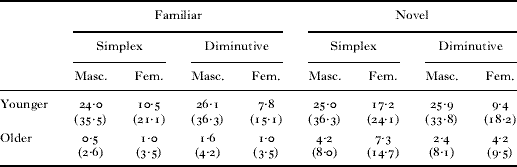
Error percentages as a function of noun familiarity, derivational status and gender in the younger and the older age groups, corrected for missing values, are presented in Table 1. We conducted a 2×2×2×2×2 mixed-type ANOVA with age group (younger vs. older) and sex (boys vs. girls) as between-subjects variables and with noun familiarity (familiar vs. novel), derivational status (simplex vs. diminutive) and noun gender (masculine vs. feminine) as within-subjects variables, with error proportions as the dependent variable. This analysis revealed a highly significant main effect of age group (F(1, 44)=21·58, p<0·001, η2=0·121), with younger children averaging 18·2% errors and older children averaging 2·8% errors. There were significant main effects of noun familiarity (F(1, 44)=5·52, p<0·05, η2=0·004) and derivational status (F(1, 44)=4·98, p<0·05, η2=0·001), which were qualified by a significant two-way interaction of noun familiarity and derivation (F(1, 44)=5·60, p<0·05, η2=0·002). Children produced fewer errors with familiar nouns than with novel ones (9·1% vs. 11·9% errors), and they produced fewer errors with diminutive nouns than their simplex counterparts (9·8% vs. 11·2% errors). The beneficial effect of noun familiarity, however, was statistically reliable only for simplex nouns: children produced fewer errors for familiar simplex nouns than for novel simplex nouns (9·0% vs. 13·4% errors) (F(1, 44)=22·97, p<0·001, η2=0·005), but statistically equivalent numbers of errors for familiar and novel diminutive nouns (9·1% and 10·5% errors) (F(1, 44)=2·09, n.s.). The advantage for diminutive nouns over their simplex counterparts was similarly restricted to novel nouns (10·5% vs. 13·4% errors) (F(1, 44)=9·75, p<0·01, η2=0·002), with children producing statistically equivalent error rates for familiar diminutive and simplex nouns (9·1% vs. 9·0% errors) (F(1, 44) <1·0). Derivational status also interacted significantly with noun gender (F(1, 44)=5·08, p<0·05, η2=0·002). Children produced fewer errors with diminutive feminine nouns than with simplex feminine nouns (5·6% vs. 9·0% errors) (F(1, 44)=7·01, p<0·05, η2=0·003), but statistically equivalent numbers of errors for diminutive and simplex masculine nouns (14·0% vs. 13·4% errors) (F(1, 44)<1·0).
Percentages of gender-agreement error, with standard deviations in parentheses, in the younger and the older groups of children, corrected for missing values, as a function of noun familiarity, derivational status and noun gender (N=24 at each age)

Although the main effect of noun gender was not significant, and nor was the main effect of sex, there was a significant two-way interaction of noun gender and sex (F(1, 44)=7·33, p<0·01, η2=0·053), as well as a two-way interaction of noun gender and age group (F(1, 44)=4·70, p<0·05, η2=0·034), further qualified by a significant three-way interaction of noun gender, sex and age group (F(1, 44)=7·33, p<0·01, η2=0·054). No other two-way interactions, nor any of the remaining higher-order interactions, were statistically significant.
To explore the interactions involving noun gender, age group and sex, additional analyses were conducted for each age group separately. For the older group of children, the main effect of noun gender was not significant (F(1, 22)<1·0), nor were any interactions involving noun gender. In contrast, for the younger children there was a marginal main effect of noun gender (F(1, 22)=4·17, p=0·053, η2=0·072), qualified by a significant interaction of noun gender and sex (F(1, 22)=7·55, p<0·05, η2=0·131). Younger boys produced many more errors with masculine nouns than with feminine ones (43·4% vs. 6·2% errors) (F(1, 10)=10·40, p<0·01, η2=0·334), whereas younger girls showed a non-significant trend in the opposite direction with slightly fewer errors for masculine than for feminine nouns (9·9% vs. 15·4% errors) (F(1, 12)<1·0). Although we did not anticipate such a striking pattern of worse performance for animal names of the same gender as the child, in the case of the younger boys, this is an interesting finding worthy of future study.
DISCUSSION
This study explored Lithuanian children's ability to produce adjective–noun gender agreement in an elicited production task. Younger children (mean 3 ; 1, 2 ; 5–3 ; 8) were observed to produce considerable numbers of gender-agreement errors, averaging over 18%. In contrast to the younger group, the older group of children (mean 6 ; 3, range 5 ; 6–6 ; 9) produced few errors, indicating task mastery. It should be noted in this context that the younger children clearly understood the task instructions, as they readily used adjectives in their descriptions of the pictured animals, and varied the forms of the adjectives across trials. What differed between age groups was the children's success in adjusting the form of the adjective in accordance with the noun's gender. The younger children seemed less able to use the morphophonological features of the noun in the nominative case to determine the correct form of the agreeing adjective. This suggests that they may not have fully mastered the morphophonological cues to gender.
Children's gender-agreement errors were unevenly distributed across conditions, with more errors produced with novel nouns than familiar ones, and more errors with simplex nouns than diminutive ones. As in virtually all other studies using similar tasks with learners of Russian, Serbian and Polish, Lithuanian children demonstrated superior performance with familiar nouns compared to novel ones, an effect that can be taken as an indicator for item-based learning processes (Bybee & Hopper, Reference Bybee and Hopper2001; Tomasello, Reference Tomasello2003), and the pervasive effect of input frequency in language processing (Ellis, Reference Ellis2002). In experiments testing adult language learning (e.g. Braine et al., Reference Braine, Brody, Brooks, Sudhalter, Ross, Catalano and Fisch1990; Brooks, Braine, Catalano, Brody & Sudhalter, Reference Brooks, Braine, Catalano, Brody and Sudhalter1993; Brooks, Kempe & Sionov, Reference Brooks, Kempe and Sionov2006; Kempe & Brooks, Reference Kempe and Brooks2001), learners are less accurate in inflecting words that are unfamiliar to them. Likewise, children produce the majority of their grammatical errors with words that are least well established in their vocabularies (e.g. Brooks, Tomasello, Dodson & Lewis, Reference Brooks, Tomasello, Dodson and Lewis1999; Kempe et al., Reference Kempe, Brooks, Mironova and Fedorova2003; Savickienė, Reference Savickienė2003; Ševa et al., Reference Ševa, Kempe, Brooks, Mironova, Pershukova and Fedorova2007). The observation that children seldom produce gender-agreement errors in their spontaneous speech (e.g. Savickienė, Reference Savickienė2002) might thus be attributed to children's general avoidance of newly introduced vocabulary.
The facilitative effect of introducing nouns as diminutives, as opposed to their simplex forms, complements the experimental results obtained for gender agreement in the Slavic languages Russian and Serbian. It should be noted, however, that the diminutive advantage observed here was a somewhat smaller effect, and was restricted to children's performance with novel nouns, and with feminine nouns. We suspect that the considerably greater variety of diminutive endings in Lithuanian in comparison to Russian or Serbian might have led to the attenuated diminutive advantage observed for Lithuanian. While the Kempe et al. (Reference Kempe, Brooks, Mironova and Fedorova2003) and Ševa et al. (Reference Ševa, Kempe, Brooks, Mironova, Pershukova and Fedorova2007) experiments used only the most common Russian and Serbian diminutive suffixes (i.e. -(č)ik for Russian masculine and -(č)ka for Russian feminine nouns, and -(č)ić for Serbian masculine and -ica for Serbian feminine nouns), in this study, to do justice to the variety of different diminutive suffixes available for Lithuanian, we selected four distinct diminutive suffixes for each gender. This variety, which manifests itself in differences in the penultimate syllable of diminutive nouns, might impede the emergence of a coherent, homogeneous cluster of nouns to serve as a low-level schema for generalizing inflectional patterns (Dabrowska, Reference Dabrowska2006).
The fact that a diminutive advantage was still observed despite the different forms and the larger complexity of diminutive suffixation in Lithuanian compared to Russian and Serbian, suggests that low-level schema formation based on morphophonological homogeneity within a cluster of words may be a universal mechanism in the acquisition of inflectional morphology. Thus, to the extent that diminutives form clusters of nouns that exhibit a sufficient degree of similarity amongst members, and sufficient dissimilarity to the rest of the lexicon, children will find it easier to generalize their knowledge about noun morphology to members of these clusters. Of course, what exactly constitutes sufficient similarity and dissimilarity is a matter of empirical exploration. The fact that the diminutive advantage in Lithuanian was attenuated in terms of effect size suggests that the lower degree of homogeneity, i.e. of within-cluster similarity, due to a larger variety of diminutive suffixes in Lithuanian, makes it harder to form such a low-level schema compared to Russian and Serbian. This underscores the fact that it is not the frequency of diminutives in the input per se, but their degree of morphophonological homogeneity that is the crucial factor in low-level schema formation (Ševa, Kempe & Brooks, Reference Ševa, Kempe and Brooks2006; Ševa et al., Reference Ševa, Kempe, Brooks, Mironova, Pershukova and Fedorova2007). In other words, despite their high frequency in Lithuanian child-directed speech, diminutives tend to facilitate gender acquisition to a somewhat lesser degree than in Serbian or Russian, where diminutive derivations are considerably simpler and morphophonologically more transparent as cues to gender categories. This finding is an interesting addition to the growing body of cross-linguistic studies which highlights the importance of studying the effects of CDS on language acquisition in different languages, as it suggests that statistical properties of the input, such as the distribution of morphophonological features across words, affect the way in which children acquire the morphosyntactic properties of their language.
It seems then that a beneficial effect of diminutives may depend on their presence versus absence in the input rather than their actual frequency in child-directed speech, which can vary considerably across languages (Dressler, Reference Dressler1997; Gillis, Reference Gillis1998; Savickienė & Dressler, Reference Savickienė and Dressler2007). In other words, morphology acquisition may be facilitated as long as there are some diminutives in the input, but their frequency does not necessarily have to be high. For example, for Lithuanian, estimates point to a frequency of diminutives in child-directed speech of about 40–64% of nouns (Savickienė, Reference Savickienė2003), for Russian of about 45% (Kempe, Brooks & Pirott, Reference Kempe, Brooks, Pirott, Almgren, Barrena, Ezeizabarrena, Idiazabal and MacWhinney2001; Protassova & Voeikova, Reference Protassova, Voeikova, Savickienė and Dressler2007) and for Polish of about 37–57% (estimates based on Haman, Reference Haman2003). For Serbian, on the other hand, the frequency is markedly lower; only about 5% of nouns are diminutives in Serbian CDS (Ševa et al., Reference Ševa, Kempe, Brooks, Mironova, Pershukova and Fedorova2007). Results from a recent training study of Serbian gender agreement (Ševa et al., Reference Ševa, Kempe and Brooks2006) suggest that it does not take a high frequency of diminutives in the input to facilitate generalization of adjective–noun agreement patterns, as long as the diminutives are phonologically salient and homogeneous. Over four sessions, Serbian three- and four-year-olds were exposed to unfamiliar nouns, half of which were inflected with artificial pseudo-diminutive derivations (i.e. -upa for feminine, -uf for masculine), and with the other half introduced in simplex form. By the second session, the children committed fewer gender-agreement errors with the pseudo-diminutives in comparison to their simplex counterparts, which suggests that low-level schema extraction is a relatively fast process.
On the other hand, German presents an interesting example in which diminutives might actually hinder morphology acquisition: even though German diminutives, formed by adding -chen or -lein (-l/-le in some Southern German dialects) constitute a homogeneous cluster of nouns, they are likely to delay the acquisition of gender as they change the gender of nouns to neuter, thus obscuring the fundamental distinction between masculine and feminine gender (Kempe et al., Reference Kempe, Brooks, Pirott, Almgren, Barrena, Ezeizabarrena, Idiazabal and MacWhinney2001).
In Lithuanian, the diminutive advantage was observed to be stronger for feminine nouns than for masculine ones. This was due to a relatively large number of errors in masculine novel diminutives in the younger children. Moreover, while we did not observe an overall effect of noun gender on children's accuracy in producing gender agreement, the boys in the younger group unexpectedly exhibited poorer performance on masculine nouns, regardless of whether the nouns were presented in simplex or diminutive form. This pattern needs to be replicated in future studies as it fails to conform to the predictions of either one of the two major proposals regarding gender category acquisition. First, it has been argued that a child's biological gender can help him/her to acquire a certain grammatical category or form. This hypothesis has been supported by research data from Latvian (Rūķe-Draviņa, Reference Rūķe-Draviņa, Ferguson and Slobin1973), English (Mills, Reference Mills1986) and Greek (Christofidou & Stephany, Reference Christofidou, Stephany and Dziubalska-Kolaczyk1997), showing that the gender of a child's name can have an effect on the acquisition of inflectional changes applying to this gender. Moreover, the data on two Lithuanian girls' acquisition of gender (Savickienė & Kalėdaitė, Reference Savickienė and Kalėdaitė2007) mentioned above also corroborate this hypothesis: nouns of feminine gender were acquired first and produced in a grammatically correct form from the very beginning of the recordings. It was assumed that the girls' names, which provided a clear marking of natural gender, helped them to acquire the forms of nouns that belong to the same class as their name, i.e. the class of feminine nouns.
We suspect that an additional factor contributing to task difficulty in gender agreement is the complexity of the agreeing adjectives. In two studies (Kempe et al., Reference Kempe, Brooks, Mironova and Fedorova2003; Ševa et al., Reference Ševa, Kempe, Brooks, Mironova, Pershukova and Fedorova2007), Russian children were observed to make fewer gender-agreement errors with masculine nouns. In Russian, masculine adjectives (e.g. bol'shoj ‘big:MAS’) are always shorter than feminine adjectives (e.g. bol'shaja ‘big:FEM’), both in terms of syllables and in terms of phonemes. It is possible that the increased complexity of the Russian feminine adjectives induced greater difficulty when applying inflectional changes, such that children preferred the simpler masculine form. In Serbian, most adjectives can follow two patterns, one in which feminine and masculine adjectives are of equal length and complexity (e.g. veliki ‘big:MAS’ vs. velika ‘big:FEM’) and one in which the masculine adjectives are shorter and less complex (e.g. velik ‘big:MAS’ vs. velika ‘big:FEM’). To be comparable with Russian, Ševa et al. (Reference Ševa, Kempe, Brooks, Mironova, Pershukova and Fedorova2007) used the latter pattern, and, as in Russian, fewer agreement errors with masculine nouns were observed in Serbian. In Lithuanian, masculine and feminine adjectives are comparable in terms of number of syllables, although masculine adjectives contain an additional phoneme (e.g. didelis ‘big:MAS’ vs. didelė ‘big:FEM’. If increased phonological complexity of the adjectives makes inflectional changes more difficult, it is not surprising that in Lithuanian, unlike Russian and Serbian, performance for masculine gender agreement was not superior, and with the exception of the younger boys, described above, children found masculine and feminine nouns of comparable difficulty with respect to gender agreement. While at this point an explanation of effects of noun gender in terms of adjective complexity remains speculative, the different forms of masculine adjectives in Serbian provide an excellent opportunity to test this hypothesis, which should be an aim of future research.
Taken together, our results lead us to ask to what extent the diminutive advantage in gender agreement generalizes to other morphological domains such as case marking, or even beyond morphology acquisition. This question clearly requires further empirical research examining other morphological domains and cannot be answered from the data presented here. However, below we will provide some considerations that suggest that diminutives might help not just in the acquisition of gender categories but in other domains as well. There are at least two factors that could be responsible for why Lithuanian diminutives may simplify the acquisition of inflectional noun morphology, and may therefore be preferred to their base, simplex forms (Savickienė & Dressler, Reference Savickienė and Dressler2007; Savickienė, Reference Savickienė2001, Reference Savickienė2003). The first and most important factor is that diminutives reduce the complexity of the system of noun declensions, by reducing the number of declension types. This is because Lithuanian diminutives are inflected using the two most productive declension classes. All masculine nouns, regardless of their endings in simplex form, are assigned to the first declension when diminutivized. Similarly, feminine diminutive nouns are assigned to the second declension. Encountering a simpler declension system with the diminutives may help children to acquire the morphosyntactic features of case marking. Second, the use of diminutives helps children to avoid confusing stem alternations. Lexical stress in Lithuanian is not fixed, with different inflected forms of the same word often carrying stress on different syllables. However, in the case of diminutives, the first syllable of the suffix is always stressed across all inflected forms, thus eliminating potentially confusing variability in lexical stress.
In addition to these theoretical considerations, we know from empirical studies in other languages that the diminutive advantage observed for gender acquisition extends to other aspects of noun morphology such as case marking. For example, in a case-marking elicitation experiment, two- to four-year-old Russian and Serbian children exhibited fewer case-marking errors when a novel noun was introduced as a diminutive (Kempe, Ševa, Brooks, Mironova, Pershukova & Fedorova, Reference Kempe, Ševa, Brooks, Mironova, Pershukova and Fedorovain press), or when the experimenter alternated between the simplex and diminutive forms of the noun (Kempe, Brooks, Mironova, Pershukova & Fedorova, Reference Kempe, Brooks, Mironova, Pershukova and Fedorova2007), suggesting that even an occasional presentation of a novel noun in diminutive form facilitates correct case marking. The diminutive advantage for case marking has also been demonstrated for Polish, another Slavic language. Dabrowska (Reference Dabrowska2006) showed that two- to four-year-old Polish children committed fewer case-marking errors with novel diminutive masculine and feminine nouns compared with novel simplex ones. Again, as with gender agreement, these findings only demonstrate that case-marking error rates are reduced for diminutives, and do not directly address the issue as to whether diminutives in the input facilitate the acquisition of case marking in general, a question that would require systematic manipulation of diminutives in the input as in the above-mentioned study on adult second language learners (Kempe & Brooks, Reference Kempe and Brooks2001).
More generally, experimental studies of learners acquiring richly inflected languages, such as Lithuanian and Latvian, are crucial for informing debates regarding the format of learners' linguistic representations. Usage-based approaches to language acquisition (e.g. Bybee & Hopper, Reference Bybee and Hopper2001; Dabrowska, Reference Dabrowska2004; Ellis, Reference Ellis2002; Tomasello, Reference Tomasello2003) assume that learners store representations of actual expressions, and form generalizations at various levels of abstraction. These approaches contrast with the ‘words and rules’ approach (e.g. Pinker, Reference Pinker1999; Ullman, Reference Ullman2001; Ullman, Pancheva, Love, Yee, Swinney & Hickok, Reference Ullman, Pancheva, Love, Yee, Swinney and Hickok2005), which assumes that learners utilize default rules that apply uniformly to members of syntactic classes. According to this approach, gender agreement, once learned, should be applied reliably to all transparently gender-marked nouns, whether they are simplex or diminutive, familiar or novel. Usage-based approaches, on the other hand, make the testable prediction that error rates in elicited production tasks, such as ours, will be strongly affected by item frequency (i.e. familiarity) and the morphophonological characteristics of words, which vary in accordance with phonological neighbourhood density. Our findings are consistent with both of these predictions: children committed fewer errors with familiar nouns and with nouns belonging to a cluster that, while exhibiting a certain degree of morphological variability, was still homogeneous enough to form a low-level schema. Thus, Lithuanian noun morphology, with its multiple gender cues, and its complex diminutive derivations, provides an ideal testing ground for refining our understanding of the principles of language acquisition.
APPENDIX: NOUNS USED IN THE GENDER ELICITATION EXPERIMENT