Introduction
Out of hospital cardiac arrest (OHCA) is a leading cause of death in developed nations, but it is so common, approximately 300,000 to 450,000/year in the United States, that even with low survival rates, the prevalence of survivors is surprisingly high: >50/100,000 (Callans, Reference Callans2004; Young, Reference Young2009). Neurological and cognitive recovery is the most crucial factor for overall quality of survival (Neumar et al., Reference Neumar, Nolan, Adrie, Aibiki, Berg, Böttiger and Vanden Hoek2008). Patients with prompt resuscitation who are responsive immediately after return of spontaneous circulation (ROSC) or follow commands within 6–12 hr have a high probability of full recovery (Longstreth, Inui, Cobb, & Copass, Reference Longstreth, Inui, Cobb and Copass1983) or only minor cognitive impairment (Rewers, Tilgreen, Crawford, & Hjortsø, 2000; Yonelinas et al., Reference Yonelinas, Kroll, Quamme, Lazzara, Sauve, Widaman and Knight2002). Patients with coma more than 7 days after ROSC have bad neurologic prognoses (Levy et al., Reference Levy, Caronna, Singer, Lapinski, Frydman and Plum1985; Wijdicks, Hijdra, & Young, 2006; Young, Reference Young2009). For patients with coma between 1 and 7 days (Booth, Boone, Tomlinson, & Detsky, Reference Booth, Boone, Tomlinson and Detsky2004; Levy et al., Reference Levy, Caronna, Singer, Lapinski, Frydman and Plum1985; Wijdicks et al., Reference Wijdicks, Hijdra, Young, Bassetti and Wiebe2006; Young, Reference Young2009), the prevalence, severity, nature, and outcome of cognitive deficits are uncertain. We previously reported the neuropsychological findings in a small sample of patients, some in this middle range of coma, after OHCA and observed that patients fell into two groups: (1) deficits in memory and psychomotor function; and (2) significant impairments in all cognitive domains (Lim, Alexander, Lafleche, Schnyer, & Verfaellie, 2004). These patients were not, however, an unselected sample. All had been referred to a research center for evaluation late in recovery (eight actually more than 1-year post-OHCA). There have been other reports on cognitive outcome of OHCA, but only four with comprehensive neuropsychological tests and none with a control group matched for cardiac disease and vascular risk factors. As most of the variability in outcome after OHCA appears to lie in this middle segment of the population, it seems the most clinically relevant group to characterize more precisely in comparison to an appropriate control group. Based on our earlier study, we hypothesized that OHCA subjects in this study would also fall into mild and severe subgroups, that subjects in the mild subgroup would have deficits limited to memory and psychomotor capacity, and that even in this selected subgroup there would be a correlation with duration of coma.
Method
Participants
All admissions to Beth Israel Deaconess Medical Center (BIDMC) from June 2005 to December 2008 were screened for a diagnosis of OHCA and followed for recovery. We excluded patients over 70, non-English speaking, with any prior OHCA, with heart surgery within the previous year, or with any history of significant other medical disease (such as cirrhosis or renal failure), brain trauma, stroke, dementia, alcoholism, or active depression, or patients with absent pupillary responses after 24 hr, myoclonic epilepsy within first 48 hr or burst suppression on any EEG. If patients remained (1) comatose for at least 12 hr and (2) confused and amnestic for at least 7 days, we approached families for permission to contact them in 2 months to recruit for study. No family declined eventual participation. There were 28 potential subjects. All were discharged to in-patient rehabilitation programs. Two were not included in the final sample because of additional cardiac complication after the OHCA. Four additional referrals from the same rehabilitation hospitals met inclusion criteria, for a total sample of 30 subjects. The cause of arrest was ventricular fibrillation in 26. ROSC was less than 15 min in 19. Duration of coma was 1–3 days in 22, and 4–7 days in the other 8. Ten received hypothermic management.
We also screened admissions to the Coronary Care Unit at BIDMC from June 2005 to December 2008 for patients with a diagnosis of any acute coronary syndrome. Demographic and clinical exclusion criteria for the cardiac control (CC) patients were identical to those for the arrest patients. Recruitment strategy was identical, but the CC patients themselves were approached. The CC group consisted of 30 participants.
Informed consent was obtained from each patient and spouse or guardian in OHCA subjects at the time of testing as approved by the hospital institutional review board.
Cognitive Measures
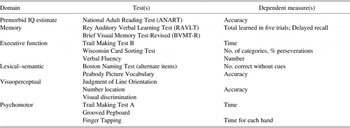
We used the most sensitive tests from the extensive neuropsychological battery used in our previous study (Lim et al., Reference Lim, Alexander, LaFleche, Schnyer and Verfaellie2004). Each test was characterized as tapping one dominant cognitive domain (see Table 1), although some of these category assignments are ambiguous: Memory: Rey Auditory Verbal Learning Test, Brief Visual Memory Test-Revised; Executive: Trail Making Test B, Wisconsin Card Sorting Test, Verbal Fluency; Lexical–semantic: Boston Naming Test (alternate items), Peabody Picture Vocabulary Test; Visuoperceptual: Judgment of Line Orientation, Number Location, Visual Discrimination; Psychomotor: Trail Making Test A, Grooved Pegboard, Finger Tapping.
Cognitive test battery

All tests have published normative data (Lezak, Howieson, Loring, Hannay, & Fischer, Reference Lezak, Howieson, Loring, Hannay and Fischer2004). Raw scores for dependent variables from each test (see Table 1) were converted to Z-scores based on age-based (and, when available, education- and gender-based) norms. A composite Z-score was computed for each domain.
Functional Measures
Depression was assessed with the Beck Depression Inventory. Return to work was probed for all patients employed before admission.
Results
There were no differences between the OHCA and CC groups in any demographic factor: gender (OHCA male, 75%; CC, 77%), age (OHCA, 56.5; CC, 58.7, t(1,58) = 1.22; p > .2), education (OHCA, 14.1; CC, 15.2, t[58] = 1.33; p > .18), American National Adult Reading Test (ANART) (OHCA, 114; CC, 115). Time to testing was equivalent: OHCA 113 days (SD = 26.5); CC 109 days (SD = 17.5); t < 1. There were more OHCA patients with diabetes (OHCA, 10; CC, 4), but no differences in other risk factors, prior cardiac problems (11 patients in each group) or percentages taking psychoactive medication.
Cognitive Measures
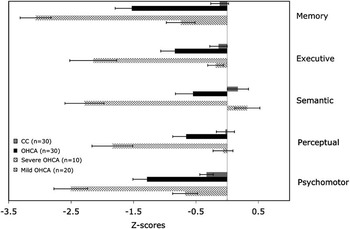
Composite scores for each domain were entered into multivariate analysis of variance (MANOVA) with group as the between subjects variable. All analyses are summarized in the figure 1. There was a main effect of group, F(1,58) = 14.89; p < .001, and a cognitive domain × group interaction, F(4,232) = 2.81; p = .026, reflecting a disproportionate impairment in the OHCA group in memory, and to a lesser extent in psychomotor scores. Follow-up univariate analyses for each cognitive domain indicated that all composite scores were significantly lower in the OHCA group than the CC group (p values between .001 and .033).
Composite Z-scores – mean and standard deviation – for controls, all out of hospital cardiac arrest (OHCA), and mild and severe OHCA separately. CC = cardiac control group.

Given high variability in the OHCA group, a two-step Bayesian cluster analysis was performed using the composite Z-scores as the five input features. Two discrete clusters emerged. Ten subjects comprised a severe group and 20 comprised a mild group. These groups did not differ from each other (or from the CC group) on demographic variables, except that the severe group had lower ANART scores (mean = 106) than the mild (mean = 118) and CC (mean = 115) groups.Footnote 1 MANOVA and follow-up univariate analyses indicated that the two OHCA groups differed significantly in every cognitive domain (all ps < .001).
Comparison of the severe OHCA and CC groups revealed impairments in all domains, F(4,152) = 4.654; p < .001, all univariate follow-ups p < .001, but a disproportionate impairment in memory and psychomotor function, F(4,152) = 3.31. Comparison of the mild OCHA group with CC revealed a significant main effect of domain, F(4,192) = 9.35; p < .001, and a marginal domain × group interaction, F(4,192) = 2.35; p = .06, reflecting a disproportionate impairment in memory. Univariate analyses indicated that only memory, F(1,48) = 5.85; p < .05, was significantly lower in the mild group than in CC. Impairment in psychomotor function was marginal, F(1,48) = 2.68, p = .10.
In all of the CC subjects, only 1.3% of domain scores (2 out of 30 × 5 possible) were unequivocally abnormal (z ⩽ −2.0). In the mild impairment group, there were 4% (4 out of 20 × 5); but in the severe group, there were 58% (29 out of 10 × 5). In total, among the OHCA subjects 37% had memory Z-scores, 27% psychomotor Z-scores, 21% semantic Z-scores, and 13% executive Z-scores in the impaired range. With one exception for each of the first three domains, these individuals all were in the severe group – a few even had poor perceptual scores. At the other end of the scores, two of the mild OHCA subjects had essentially normal scores (all Z-score composites > −0.5), and seven had all scores > −1.0.
Medical predictors
More patients in the mild group than in the severe group were treated with hypothermia (8/20 vs. 2/10; χ2 = 1.2). Although not significant, this difference is compatible with demonstrated effectiveness of hypothermia. Duration of coma of 1–3 days was associated with higher probability of only mild deficits than duration of coma of 3–7 days (mild 17/20, severe 5/10; χ2 = 4.18; p < .05).
Functional Measures
Mean BDI scores were not significantly different between CC (7.0), mild (6.5), and severe (6.1) OHCA groups, and the prevalence of clinically significant depression (BDI > 10) did not differ across groups. Seven CC patients scored in the mild depression range (10–19) and one in the severe range (>20). In the OHCA group, seven patients (four mild, three severe) scored in the mild depression range, and one severe patient scored in the severe depression range.
Of the 20 controls who were working before the index cardiac event, 18 (90%) had returned to work, 1 at lower capacity. All of the OHCA patients were employed before the arrest. Only eight (27%, all mild) had returned to work (χ2 = 39.3; p < .001).
Discussion
The goal of this study was to characterize the pattern of deficits in survivors of OHCA without rapid recovery (Earnest, Yarnell, Merrill, & Knapp, Reference Earnest, Yarnell, Merrill and Knapp1980) and without any of the known markers for survival with very poor prognosis (Wijdicks et al., Reference Wijdicks, Hijdra, Young, Bassetti and Wiebe2006). Three months after OHCA, outcome was mixed: 2/3 had modest impairments in memory and borderline impairments in psychomotor functioning compared to CC; 40% of this mild injury group had returned to work. There was no increase in clinically significant depression compared to CC. The remaining 1/3 were very impaired.
Since 1991, most OHCA outcome reports have used the Utstein reporting criteria. The overall results of the 18 centers have been well summarized (Rewers et al., Reference Rewers, Tilgreen, Crawford and Hjortsø2000). Outcome is reported as Cognitive Performance Category (CPC), a coarse qualitative scale (Cummins et al., Reference Cummins, Chamberlain, Abramson, Allen, Baskett, Becket and Theis1991) ranging from 1 (no or subtle deficits) to 5 (death). Only four centers reported full CPC categories: of 185 discharged patients 50% were CPC1 and 26% CPC2 (moderate deficits). Similar proportions were reported in a 14 year retrospective report on 324 discharged survivors from Goteberg: 53% CPC1 and 21% CPC2 (Graves et al., Reference Graves, Herlitz, Bang, Axelsson, Ekstrom, Holmberg and Holmberg1997) and in a recent report from Prague: 73% (47/64) of 1-month survivors were CPC1 or CPC2 (Pleskota, Hazukovaa, Striteckab, Cermakovac, & Pudila, Reference Pleskota, Hazukovaa, Striteckab, Cermakovac and Pudila2009). The CPC, however, requires no detailed testing of cognition. Even CPC1 is compatible with some impairment, so the precise nature of residual deficits cannot be extracted from these reports.
Residual deficits have been investigated with standard cognitive measures in only a few prospective series. An extensive review of this literature identified only 3 of 28 publications up to 2006 as generally informative of outcome (Moulaert, Verbunt, van Heugten, & Wade, Reference Moulaert, Verbunt, van Heugten and Wade2009), and none included an appropriate control group. Roine, Kajaste, and Kaste (Reference Roine, Kajaste and Kaste1993) reported the results of limited standardized tests in 68 OHCA patients. Thirty four percent of the group had moderate to severe abnormalities on 1–2 (out of at least 11) neuropsychological or clinical measures and 26% on >2 measures. Delayed recall was the most impaired domain, consistent with our finding. Distinctive profiles or subgroups could not be isolated from the tabulations of percentages impaired on the non-standard clinical tests.
Sauve, Doolittle, Walker, Paul, and Scheinman (Reference Sauve, Doolittle, Walker, Paul and Scheinman1996) reported 45 patients tested up to four times over 6 months after OHCA. This population had milder injury than in our study or other similar studies: 32 were unresponsive for ⩽1 day. At approximately 3 months, the group as a whole had no impairments other than memory. Of 40 patients tested, 21 had either no impairments (N = 13) or very mild memory impairments (N = 8). Only six subjects appeared to have deficits other than memory and psychomotor.
The third prospective neuropsychological study (N = 57, 6 months post-OHCA), used the same conservative cutoff for impairment as this study (z ⩽ −2.0) (van Alem, de Vos, Schmand, & Koster, 2004). Only 42% of patients were impaired. Of the 24 impaired patients, executive function (28%), psychomotor function (21%), and memory (12%) were most frequently affected but profiles again hard to determine.
One additional study published since 2006 is directly comparable to our study in methodology but not patient severity (Tiainen et al., Reference Tiainen, Poutiainen, Kovala, Takkunen, Häppölä and Roine2007). At 3 months post-OHCA, 26/45 patients were “cognitively intact or had only subtle deficits.” For the 19 impaired patients, severity was stratified by the number of neuropsychological tests with Z-score ⩽ −1.5 (out of a maximum of 8): 10 moderate (3–4) and 9 severe (5–8), proportions generally similar to our findings. Impairment (composite z ⩽ −1.5) was most common in executive function (33%), followed by memory (24%) and psychomotor (19%). No clinical profiles can be distilled from this summary.
There is one other study of OHCA subjects that focused specifically on the nature of memory impairments (Yonelinas et al., Reference Yonelinas, Kroll, Quamme, Lazzara, Sauve, Widaman and Knight2002). This highly selected cohort of 56 survivors all regained consciousness within 3 days (median 16 hr). Visual inspection of the primary memory data in a figure suggests that no more than 25% of the patients would have been considered impaired at 6 months after arrest in any of the outcome studies cited above. Compared with a matched sample of healthy (not cardiovascular) controls, there was a disproportionate impairment in recall compared with recognition. The group is said to have no other cognitive deficits, but the data are too skimpy to determine any general relevance to OHCA impairment profiles and too speculative to illuminate pathology. This group probably overlaps our mild group, the Sauve et al group, and the fully recovered patients in the other studies.
Our study is the first to use controls matched for cardiac, vascular, and medical risks. Use of only age-matched healthy controls could exaggerate impairments, and as previously suggested (van Alem et al., Reference van Alem, de Vos, Schmand and Koster2004) “the ideal control group would have a history of atherosclerosis similar to the study group (page 421).” The current study is the first to contrast arrest patients to an “ideal” control group; results remained consistent with prior reports. Even so, this report does not speak to outcome of all OHCA patients: age greater than 70, complex medical co-morbidities or prior neurologic disorder were all exclusions for this study.
The use of “cutoffs” creates a simple, dichotomous result that may not accurately characterize impairments. A patient who is consistently in the impaired range but above the cutoff could be counted as unimpaired. Tabulating the number of impaired tests in a domain suggests that each contributes some unique measure of impairment, but performance across tests is likely highly correlated. The quantitative analysis approach used here provides a finer grained sense of the variability of outcome. Only as the severity of memory and psychomotor impairment increased, did impairment appear in new domains such as perception or semantics. The underlying pathology of the mild cases is unknown – perhaps predominantly in hippocampus, but in the more severe cases, it surely is diffuse cortical neuronal injury.
Conclusions
This is the first study of outcome from OHCA to use patients with comparable cardiac and risk factor profiles as controls. It confirms prior reports that patients under the age of 70 who have had OHCA but survive to intensive care unit admission, who recover alertness within 1–3 days but remain confused until discharge to rehabilitation, will have deficits at 3 months, but functional recovery may be encouraging. In 2/3, there may be only mild impairments in memory and perhaps psychomotor function; 1/3 will have more severe impairments in memory and psychomotor function plus impairments in all other cognitive domains.
Acknowledgments
This research was supported by NIH R01 HD046442 (to MPA) and the Office of Research and Development, Medical Research Service, Department of Veterans Affairs (to MV). We are grateful to Kate McNamara, Lily Wong, and Elana Anastasia for research assistance. The authors have no conflicts of interest to disclose.