Introduction
One of the most important components of a country's language policy is its planning on foreign languages and its decisions regarding which foreign language(s) to choose and teach to its people in the nation's school system (Cenoz & Gorter, Reference Cenoz, Gorter and Spolsky2012). The government generally makes a selection among the candidate languages on the basis of the languages' perceived economic and socio-political value inside and outside the country. However, the socio-economic power and prestige of languages are variable and bound to change over time (Wright, Reference Wright2004). For this reason, changes are almost always observed in any country's foreign language policy.
North Korea (N.K., hereafter) is no exception in this respect. Since the country was established in 1948, there have been noteworthy changes in its foreign language policy. These changes have been influenced by socio-political or economic changes within the nation or in its surrounding countries. Russian was the sole jeil oegugeo (first foreign language)Footnote 1 during the early period (1948~1963) of Kim Il–sung's rule, but English was soon adopted as another jeil oegugeo as Kim Il–sung (Kim I–S, hereafter) and his regime recognized its significance as an international language. Following the collapse of the Soviet Union in 1991, which occurred during the reign of Kim Jong–il (Kim J–I, hereafter), English became the only jeil oegugeo (first foreign language) in N.K. and has since gained in status and popularity among the country's citizens. After Kim Jong–un (Kim J–U, hereafter), the current leader of N.K., rose to power in 2011, more changes in education policy were made to bolster English education and to help increase the English proficiency of North Korean students and citizens. The primary goal of this article is to describe these changes in English language policy introduced by Kim J–U and his regime.
This paper will first describe English education policies that were enacted during the rule of Kim I–S and Kim J–I, the two previous leaders of N.K. Then, it will discuss the new policy changes made in English education under Kim J–U's regime, while also introducing recent social phenomena that demonstrate North Koreans' substantially increased interest in English. Ideological education and the idolization of the Kim family, which remain incorporated into English education and connected to its purpose are then discussed. The final portion of this article discusses the future prospects of English education and English language policy in N.K.
English education under the two previous leaders
Immediately following Korea's liberation from Japan in 1945 and until just before the official establishment of the North Korean government, it was possible for secondary schools in N.K. to teach both Russian and English to their students, even though the North Korean educational system was already heavily influenced by both the Soviet Union and Soviet-backed politicians headed by Kim I–S. However, after the official government of North Korea was established in 1948, Russian was designated as the sole jeil oegugeo (first foreign language) and the teaching of English in secondary schools was prohibited as a result of the Cold War, which had just recently begun around the world.
Kim I–S officially ruled N.K. from 1948 to 1994. Because his reign spanned several decades, his policy (and that of his regime) toward foreign languages naturally changed due to factors inside and outside of the country. At the beginning of his rule, Russian was a target language that every North Korean was expected to learn; it was the language of the powerful ‘big brother’ communist country whose ideology, culture, science and technology were to be imitated and researched. Only Russian, accordingly, was allowed to be taught in secondary schools.
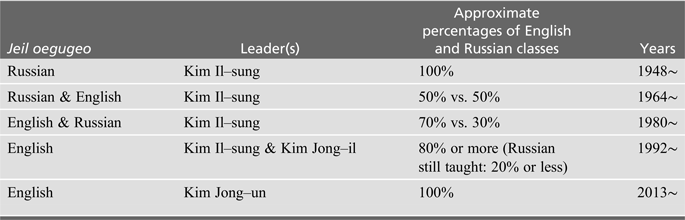
Kim I–S and his government, however, abandoned the Russian-only foreign language policy in 1964 (see Table 1). Previous research (Bae, Reference Bae2015; Lee, Yang & Kwon, Reference Lee, Yang and Kwon2005; Song, Reference Song2002) suggests that there were three chief motivations for the designation of English as another jeil oegugeo.
Jeil oegugeo (first foreign language[s]) of North Korea and the ratio of English and Russian classes in secondary schools

The first motivation was Kim I–S's belief that North Koreans should possess some knowledge of English in order to wage an effective war against the ‘American imperialists’, their chief enemy. He is quoted as saying that North Korean youths should be able to say, for instance, ‘Raise your hand’ or ‘We won't shoot if you throw your gun away and surrender’ in the ‘enemy's language’ (North Korea Research Institute, 1983: 1337).
The second motivation is the regime's growing awareness of the need to teach its citizens English, a rapidly rising global language, so that N.K. could engage in more effective dialogue as well as diplomatic and trade relationships with foreign countries. Kim I–S also made political and diplomatic efforts to propagate his Juche Ideology (i.e., Kim I–S-initiated N.K.’s own style of communist ideology) to nations overseas, especially to those that were non-aligned (Song, Reference Song2002), and he found that English was essential for this purpose.
The third motivation was Kim I–S's realization (Kaplan & Baldauf, Reference Kaplan, Baldauf and Hinkel2005; Song, Reference Song2002) that the country should advance its science and technology in order to develop its national economy and military power; to achieve these goals, North Koreans needed to learn English, a lingua franca in science and technology and the language in which most literature was (and is) written.
After English was designated as an additional jeil oegugeo, its popularity among North Korean students grew gradually through the 1960s and 1970s, as the international prestige of English rose and the relative status of Russian was downgraded. The latter is attributable to the Soviet Union's loss of its status as the sole communist power, which resulted from China's gradual rise and the Soviet Union's domestic economic difficulties that began in the 1970s. In the 1980s, English finally became the most popular and sought-after foreign language in N.K. (Kim, Reference Kim and Kim1990). After the dissolution of the Soviet Union at the end of 1991, Russian was downgraded to a second foreign language and was taught in secondary schools to a small percentage of students (Cho et al., Reference Cho, Lee, Kang and Jung2015: 30).
Kim J–I became the supreme leader of N.K. after the death of his father in 1994. Around this time, most of the former communist countries became decommunized and the U.S was the only superpower in the world. In this political environment, Kim J–I was more pragmatic and utilitarian than his predecessor. He stressed that to build a strong socialist country, N.K.’s secondary education should be focused on science and foreign language/English language education (Kim & Kim, Reference Kim and Kim2001). Kim J–I believed that the primary purpose of formal education was to develop competent scientists and technologists with excellent international communication skills. To achieve this goal, English education was bolstered at schools and the following policies were adopted.
First, the regime began to seek international assistance in order to improve N.K.’s overall English education. In 2000, the government made an agreement with the Foreign and Commonwealth Office of the United Kingdom to work with an English Language Teacher Training Program to improve the English competence and teaching ability of the nation's English teachers (Fitzek, Reference Fitzek2017). Kim J–I's government also sought help from UNESCO and was able to obtain substantial financial and educational support. UNESCO participated in the revision of English textbooks used in schools, and financially supported English teachers and professors' participation in international conferences and workshops on new teaching methods (Bae, Reference Bae2015: 99–100). Second, English was reintroduced as a subject in primary schools in 2008Footnote 2 with the financial help of UNESCO, and the instructional time devoted to English in secondary schools was also extended by 37 hours (Bae, Reference Bae2015: 53).
New changes from the new leader
After Kim J–I's sudden death at the end of 2011, Kim J–U was announced as the ‘Great Successor’ by the Workers' Party (nodongdang) (Yan & Schubert, Reference Yan and Schubert2011); he assumed absolute power in N.K. as the ‘supreme leader of the party, the army, and the people’. Unlike his father, who took the ‘military first’ approach, Kim J–U emphasized that N.K. needed to strengthen both its national defense and its economic power, proclaiming a ‘dual track’ policy (Wee, Reference Wee2018). One of the first things his government undertook for this purpose was a reformation of N.K.’s education system. Kim J–U had two goals in this endeavor: 1) economic development by advancing science and technology; and 2) strengthening socialist values by suppressing growing capitalistic individualism among his people. In his writing released on April 6 of 2012, Kim J–U said:
We need to allocate more of the national budget to education and modernize our educational system. The quality of secondary education has to be greatly improved and college education also needs to be strengthened so that our country could produce more world-class scientists and technologists who can help build a strong socialist country. (from Kim J–U's writing ‘Let's have, with respect, the great leader Kim J–I as our eternal general secretary of our party and complete our self-reliant revolution brilliantly’, quoted secondhand from Cho et al., Reference Cho, Lee, Kang and Jung2015: 12).
Just like his predecessors, Kim J–U believed that advancement in science and technology was essential to the development of the nation's economy and military strength, and that world-class scientists or technologists must possess good English skills to keep up with ever-changing scientific knowledge and engage in efficient international communication. He also wanted to bolster ideological education to inhibit North Koreans' increasingly individualistic attitude and pursuit of private interests, both of which were caused primarily by the formation and spread of capitalistic markets during and after the ‘March of Suffering’, N.K.’s period of famine (1994–1998) (Bae, Reference Bae2015: 82–83; Kim, Reference Kim2017).
For these purposes, Kim J–U introduced a 12-year obligatory education system as an educational reform, thereby adding one more year to elementary school education and dividing secondary school into middle school and high school (the only exceptions are the top 14 secondary schools, called jeil kodeung juanghakkyo, which continue to be six-year schools). The 11-year obligatory educational system that existed at the time, which was instituted in 1972, was replaced by this new system in an effort to improve the quality of overall education and to build a powerful socialist nation. Kim J–U's government also made a strong effort to increase the education budget. In 2016, for instance, the education budget was enlarged by 8.1%, an increase that was second only to the government budget for the construction sector (Jang, Reference Jang2016).
In N.K.’s new system of education, English classes were significantly strengthened and bolstered. Chung (Reference Chung2017: 117) goes so far as to say that Kim J–U's rise to power was a milestone in the history of N.K.’s foreign language/English language education, rendering the periods before and after his seizure of power fundamentally different. His regime made important policy changes regarding English education, which can be summarized as follows.
First, according to the new kyoyuk kanglyeong (curricula of school education and teaching guidelines) released in 2013 (Education Committee of North Korea, 2013a, 2013b, 2013c), English is the only foreign language taught in primary school and secondary school. Russian is completely removed from the school curricula.
Second, English education was extended from ‘urban’ secondary schools to ‘rural’ secondary schools, where English classes were not available at all before 2013. This move made English education obligatory for every secondary school student in the nation.
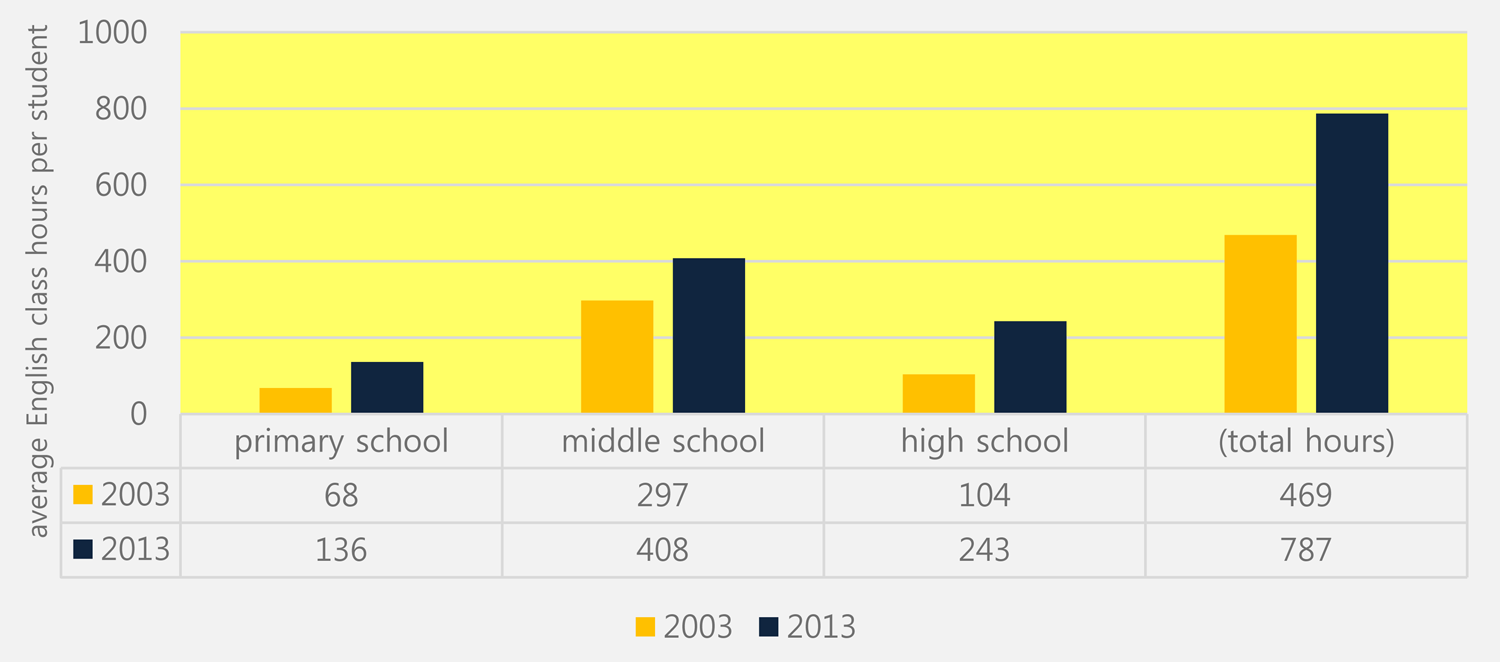
Third, the amount of school time devoted to English increased significantly (see Figure 1). In primary school the class hours were doubled from one hour per week to two hours; thus, the total hours devoted to English instruction reached 136. In urban high schools, 173 hours were devoted to foreign language (English or Russian)Footnote 3 education in 2003, but this increased to 243 hours for English alone (cf: Table 11-10 of Cho et al., Reference Cho, Lee, Kang and Jung2015).Footnote 4 The same number of hours of English are now taught at rural high schools as well, which educate approximately 40 percent of high school students (KBS News, 31 Oct., 2017).
Average English class hours per student in primary and secondary schools of N.K. ‘before’ and ‘after’ Kim Jong–Un's education system reform

For urban middle schools, 495 hours were devoted to foreign language instruction (English or Russian) in 2003, but now students take 408 hours of English class, a change that began in 2013 (cf: Table 11-9 of Cho et al., Reference Cho, Lee, Kang and Jung2015). When only urban middle schools are considered, the total number of hours of ‘foreign language’ class is reduced, but the average number of hours of English education per middle school student has actually increased, because, first, English education is conducted in rural middle schools as well as urban and, second, all students take English classes now that Russian is not taught at all in urban middle schools. Accordingly, as Figure 1 shows, English class hours in primary and secondary schools have increased by approximately 318 hours on average per student, an increase rate of 67.8% from 2003 to 2013.
English education changed not only with regard to class hours but also with regard to quality. The curricula of English education and the textbooks used in primary and secondary schools were significantly revised and improved with active participation and advice from English education experts affiliated with UNICEF and the British Council (Chung, Reference Chung2012; Bae, Reference Bae2015: 147). A focus on listening and speaking skills modeled on communicative language teaching (CLT), whose elements have been gradually introduced since 2008, is now firmly established. Bae (Reference Bae2015: 101) claims that the English textbooks currently used at North Korean schools are quite similar to the CLT-approach textbooks published by Cambridge University Press or Oxford University Press.
It is not just Kim J–U and his government who have endeavored to increase the English proficiency of North Koreans. Students and citizens have developed a stronger interest in English and have intensified their efforts to develop their English skills. First, there are now stronger motivations to gain proficiency in English. Primary and secondary school students are highly motivated to study hard in English because English is one of the main subjects at school that is regularly tested. Further, students need good English skills and proficiency to enter good secondary schools and colleges. Only the graduates of the top 14 secondary schools (jeil kodeung junghakkyo), which are still six-year schools, can be admitted to college right after graduation without having to first fulfill the 10-year compulsory military duty. Furthermore, college graduates need good proficiency in English to obtain popular jobs such as diplomat, foreign trade manager and partner, and scientist and technologist, among others (Bae, Reference Bae2015: 91–92).
Following the changes in foreign language/English language policy made by Kim J–U's government, more North Korean students and adult learners have been working hard to attain higher proficiency in English. One telling piece of evidence is testimonies by North Korean defectors (e.g., Chung, Reference Chung2013b) and news reports (e.g., Lee, Reference Lee2012) that illegal and expensive private English tutoring is prevalent among students in large cities, arranged and funded by financially able parents who want their children to enter good secondary schools and colleges and obtain desirable jobs. Another notable news report (Kim, Reference Kim2014) states that since 2014, all intelligence agents of the Ministry of State Security are required to complete compulsory English training in Pyongyang for six months. These two reports suggest that English education, which has been largely confined to formal school education, is gradually spreading to spheres of private education and continuing education. English has never been as popular or important as it is in Kim J–U's era. N.K. may be beginning to catch ‘English fever,’ as some news reporters (e.g., Kim, Reference Kim2014; Eum, Reference Eum2015) describe.
Goals of English Education Still Unchanged
Despite radical improvements in English language education in terms of instruction hours and the quality of English textbooks and instructional methods, one thing has not changed: the ultimate purpose of English education in schools in N.K. According to kyoyuk kanglyeong (curricula of school education and teaching guidelines) published in 2013 (Education Committee of North Korea, 2013a, 2013b, 2013c), the primary purpose of English education in schools is to give students a useful tool that can help them build a strong socialist nation and help them become revolutionaries who can fight for the people. This purpose has not changed since the 1970s, when A Thesis on Socialist Education was written and presented by Kim I-S (Central Committee of the Workers' Party of North Korea, 1977).
Under this purpose, there are three concrete goals of teaching English in middle school (Education Committee of North Korea, 2013b) and high school (Education Committee of North Korea, 2013c). The first two goals are shared by both school levels: 1) to inculcate Kim I–S's Juche Ideology in students and 2) to develop students' loyalty to the Kim family. The third goal of teaching English in middle school is to develop students' listening, speaking, reading, and writing skills so that they can easily learn more advanced English in high school. The third goal for high school English classes is to increase students' confidence in English skills by helping them to improve their English on their own initiative, thus building a firm foundation for life-long English learning. Accordingly, two of the three concrete goals of English teaching in secondary schools are ideology-driven and related to the idolatry of the Kim family rather than linguistic skills or proficiency.Footnote 5
Kim J–U's regime is actually strengthening North Korean students' education in political ideology more than ever before. As Cho et al. (Reference Cho, Lee, Kang and Jung2015: 25) points out, strengthening education in English, computers, and political ideology was a key goal of the School Curricula Revision made in 2013. A subject focusing on the idolatry of Kim J–U, the new leader, was added at primary and secondary school levels, a course about Kim Jong–suk, Kim I–S's wife and Kim J–I's mother, was added in middle school, and Current Party Policies was added in high school, resulting in a noticeable increase in the total instructional hours of political ideology subjects for primary and secondary schools. Kim J–U's regime is clearly trying to strengthen the teaching of Juche Ideology and the Kim family's idolization to maintain a tighter ideological grip upon its people while, for economic and pragmatic reasons, also promoting English learning among its people and allowing more contact with foreign people and culture than before. This trend is expected to continue for the foreseeable future, as the regime is well aware that the latter can be risky to its stability and maintenance.
A Look into the Future
After Kim J–U took power, the economy of N.K. remained in relatively good shape until 2017, when the U.S.- and U.N.-led economic sanctions against N.K. intensified, causing it to record −3.5% economic growth. In his new year's address on January 1, 2018, Kim J–U suddenly proposed inter-Korea dialogue and governmental and civilian level exchanges, which eventually led to three successive inter-Korea summits and two historic summit meetings between US President Trump and Kim J–U.
Even though the first U.S.–N.K. summit in Singapore produced an agreement (Rosenfeld, Reference Rosenfeld2018) that N.K. will commit to denuclearization, the two heads of state did not reach a further agreement at the Hanoi summit on the concrete procedure of North Korea's denuclearization and the United States' lifting of economic sanctions against N.K. Though a third summit between the two is being mentioned as a possibility (e.g., Mohammed & Brunnstrom Reference Mohammed and Brunnstrom2019), the eventual outcome of the US–N.K. talks and negotiations are difficult to conjecture. Kim J–U's regime may really want to reform its present economic system and open the market, as China and Vietnam did, or the regime's goal may be just to establish a peace treaty with the U.S. and obtain, without systemic reformation, economic benefits that the treaty could bring from foreign countries.
Whichever direction the nation goes, Kim J–U's policy on English and English education is not expected to substantially change in the future. The changes made under the current regime were motivated by its awareness of the importance of English as an international language with regard to N.K.’s advancement in science and technology, the growth of its national economy, and efficient dialogue and exchanges with foreign countries. Since 2013, the regime has designated two Special Economic Zones and 22 Economic Development Zones (in addition to the three existing Special Economic Zones) in an effort to lure foreign investments (Lee & Shim, Reference Lee and Shim2018; Lim, Reference Lim2015). Successful developments of these economic zones could provide more impetus for Kim J–U's current English policy, as more business and cultural contacts with foreigners in these special areas would lead to a significant increase of interest in English and greater motivation to learn the language among the nation's students and citizens. Even if the negotiations between the U.S. and N.K. break down and the U.S. once again becomes an ‘enemy’, it is unlikely that the English language policy of Kim J–U will fundamentally change.
Acknowledgements
The present research was supported by a 2019 research fund grant from Dankook University, South Korea.
 HYEON-SEOK KANG is a professor in the English department at Dankook University in South Korea. He received a Ph.D. in linguistics from Ohio State University. His research interests include sociolinguistic variations in Korean English and Korean dialects, genderlects, and language policies on the Korean Peninsula. He served as the president of the Sociolinguistic Society of Korea in 2013 and 2014. He has publications in English Today, Language and Speech, BLS, CLS, and others. Email: hskang1@dankook.ac.kr