Introduction
Opioid use has increased substantially in recent years. Currently, nearly two million Americans suffer from opioid use disorders. Furthermore, approximately 47,000 Americans die annually of opioid overdose.Reference Coffa and Snyder1 Along with the increasing awareness of opioid-related deaths, there has been a push to increase naloxone availability to lay persons. In 2018, California (USA) passed AB 2760 which mandated clinicians to offer naloxone prescriptions to individuals when certain conditions are met, including any concurrent prescriptions of benzodiazepines and opioids, use of 90mg or more of morphine equivalents daily, or any person who has an increased risk for an overdose, such as a history of overdose or substance use disorder.2 With the desire to make naloxone more readily accessible, this study sought to determine if emergency medical providers are indiscriminately administering naloxone or if naloxone is being reserved for those patients likely to benefit from its administration.
Methods
This study is a retrospective study of adult (age 13 years and older) patients who received naloxone by emergency medical technicians (EMTs) or paramedics working for two Emergency Medical Service (EMS) agencies in California (either the Los Angeles City Fire Department [LAFD] or the Los Angeles County Fire Department [LACoFD]) from January 1, 2017 through December 31, 2018.
The primary objective of this study was to determine the frequency in which naloxone was administered to individuals without respiratory depression (respiratory rate less than 12 breaths per minute). The secondary objective was to describe the general characteristics of patients receiving naloxone by EMS during the current opioid epidemic. An EMS unit was defined as a designated EMS field resource such as an engine company or ambulance. The University of Southern California (Los Angeles, California USA) Institutional Review Board approved this study (IRB HS-18-00632).
Setting
The LAFD and LACoFD are the two largest EMS provider agencies in Los Angeles County, providing 9-1-1 response to more than 80% of its 10 million residents. The LAFD serves the City of Los Angeles, whereas the LACoFD provides care in select cities and unincorporated areas of Los Angeles County, excluding the City of Los Angeles. The LAFD and LACoFD respond to nearly 500,000 and 400,000 annual incidents, respectively. In both jurisdictions, EMS incidents account for approximately 85% of the calls.
Study Eligibility
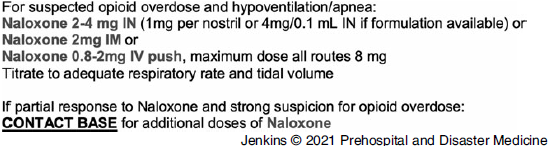
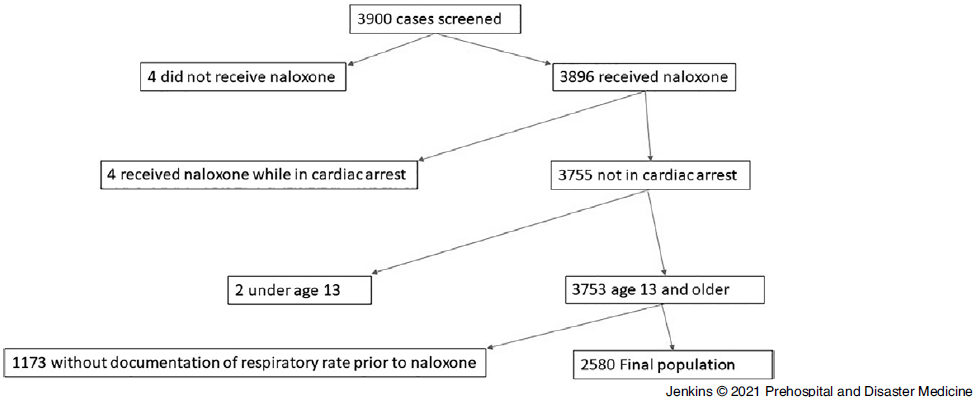
Patients who were at least 13 years of age and who received naloxone by fire department personnel responding to a 9-1-1 call in two agencies (LAFD or LACoFD) from January 1, 2017 through December 31, 2018 were included. Patients who received naloxone by police or lay person before EMS arrival were excluded (Figure 1). Naloxone was administered by intranasal, intramuscular, and/or intravenous routes according to standard treatment protocols from the Los Angeles County EMS Agency (Figure 2).
Treatment Protocol for Naloxone Administration by EMS Providers in Los Angeles County.
Abbreviations: EMS, Emergency Medical Services; IM, intramuscular; IN, intranasal; IV, intravenous.

Flow Diagram of Included and Excluded Patients.

Data Abstraction and Analysis
A computerized report was made of all encounters by the LAFD or LACoFD in which naloxone was administered during the study period by abstracting the prehospital electronic health records (Health EMS; Stryker Corporation; Kalamazoo, Michigan USA). The health records were searched for all patients who had naloxone administered as a medication, and the records were then obtained and reviewed by a second member of the study team.
Prior to data analysis, there were several patients who were excluded because of either missing data or because the respiratory rate prior to naloxone was not documented. Furthermore, patients were excluded in circumstances where two investigators independently felt the data were mis-entered (eg, appearing as though a respiratory rate was reversed for a heart rate). Additionally, cases where it appears naloxone was not administered (eg, listed as a treatment, yet a dose of 0mg was administered) were excluded.
The data were reported as medians with interquartile ranges (IQR). Comparisons involving associations between two continuous (or ordinal) variables were excluded using a non-parametric Wilcoxon rank-sum test (for comparisons between two groups). Categorical variables were evaluated by a chi-square test.
Results
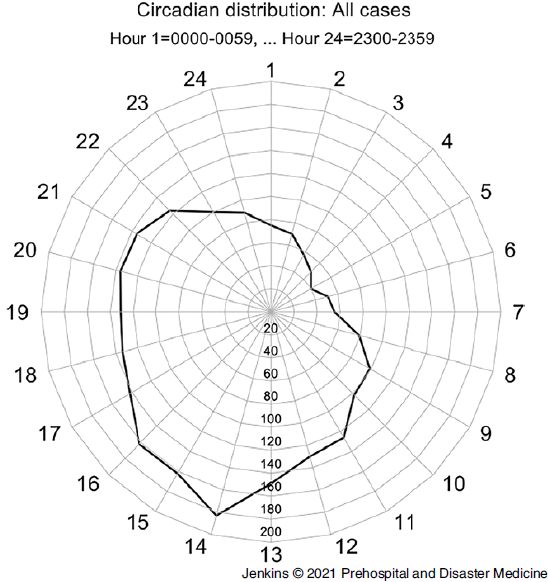
During the two-year study period, a total of 2,580 patient encounters were identified who met study inclusion criteria, including 1,400 (54.3%) from LAFD and 1,180 (45.7%) from LACoFD. A total of 185 different EMS units administered naloxone with a median (IQR) of 18 (13-25) administrations per unit. These 185 units included both EMT and paramedic providers. The number of cases were relatively evenly distributed between 2017 (1,235; 47.9%) and 2018 (1,345; 52.1%). Most cases occurred in the afternoon and early evening (Figure 3).
Circadian Distribution of Naloxone Administrations (All Cases).

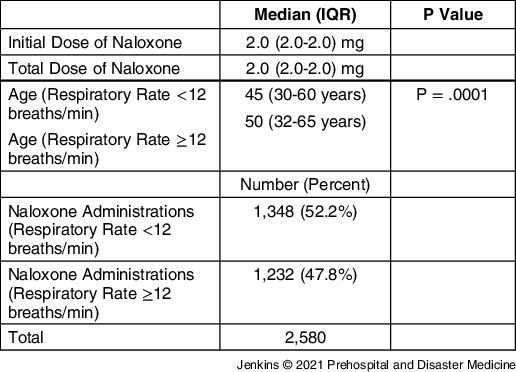
The initial dose of naloxone ranged from 0.2-8.0mg with a median (IQR) dose of 2.0 (2.0-2.0) mg. The total amount of naloxone administered prehospitally ranged from 0.4-12.0mg with a median (IQR) dose of 2.0 (2.0-2.0) mg. Naloxone was administered intravenously in 1,561 (60.5%) cases, intranasally in 563 (21.8%) cases, and intramuscularly in 439 (17.0%) cases. Other routes including endotracheal or intraosseous routes were administered in 17 (0.7%) cases. Multiple routes (eg, intramuscular followed by intravenous) were employed in 278 subjects. Among both the intramuscular and intranasal routes, the median (IQR) dose range was 2.0 (2.0-2.0) mg with an overall range of 0.4-12.0mg.
Among individuals who had an initial respiratory rate of at least 12 breaths per minute, the median (IQR) age was 50 (32-65) years, compared with those with an initial respiratory rate of less than 12 (45 [30-60] years). Based upon the finding of statistically significant differences and given the age distributions were not normal, a “cendif” procedure for calculating the median difference between the two groups was executed; the median (IQR) age of cases with a pre-naloxone respiratory rate under 12 breaths per minute was four years lower than those with a respiratory rate of at least 12 breaths per minute (P = .0001; 95% CI, 2-5 years).
The median (IQR) respiratory rate prior to administration of naloxone was 12 (6-16) breaths per minute. A total of 1,232 subjects had a pre-naloxone respiratory rate of at least 12 breaths per minute. Therefore, naloxone was administered to patients without respiratory depression (defined as an a priori respiratory rate of under 12 breaths per minute) in 1,232 (47.8%) cases (95% CI, 45.8-49.7; Table 1). The administration of naloxone to individuals without respiratory depression was not associated with the month or year of administration, nor was it associated with the sex of the patient. However, there was a small association between agency and administration of naloxone to those without respiratory depression. One agency administered naloxone to those without respiratory depression in 526 (44.6%) cases, versus 706 (50.4%) with the second agency (P = .003).
Median Initial and Total Doses of Naloxone

Note: Also included are the median ages of cases with and without respiratory depression, respectively, and the total number of cases from each group in which naloxone was administered.
Discussion
In this study, a respiratory rate of under 12 breaths per minute was established as a marker of respiratory depression and the primary indication for naloxone administration. Naloxone is an opioid antagonist designed to reverse life-threatening effects of opioids. While it is possible an individual may experience some toxicity of opioids with a respiratory rate of at least 12 breaths per minute, the authors felt that such individuals were unlikely to be exhibiting life-threatening toxicity.
Previous studies determined a respiratory rate of 12 breaths per minute or less, or clinical scenario consistent with opioid use (eg, miosis or presence of drug paraphernalia), is highly predictive for determining which patients respond to naloxone.Reference Hoffman, Schriger and Luo3 These criteria were re-examined more than 20 years later; those authors found a respiratory rate of under 12 to be associated with a 67% response to naloxone.Reference Friedman and Manini4 While criteria such as miosis or presence of drug paraphernalia may be useful indicators for naloxone use, it was felt these were too inconsistently documented to permit meaningful analysis. This study found that naloxone was administered to individuals without respiratory depression in nearly one-half of all cases.
Naloxone is a relatively safe medication with few complications in those without opioid dependence. However, the administration of naloxone to those with opioid dependence may precipitate withdrawal. Opioid withdrawal symptoms classically include nausea, vomiting, diarrhea, and agitation, among others.Reference Naloxone5,Reference Buchwald6 While opioid withdrawal is classically not thought to be life threatening in adults, precipitated withdrawal following naloxone administration has been rarely associated with pulmonary edema and hemodynamic instability.Reference Lynn and Galinkin7 Additionally, there are real but difficult to quantify risks to the provider created by administering naloxone in the prehospital setting. The EMS provider may experience a needle stick or the patient may become agitated and combative, creating a safety risk for first responders.
Furthermore, naloxone would not reverse central nervous system (CNS) depression caused by a non-opioid etiology. Thus, administering naloxone to a patient who is addicted to opioids but exhibiting CNS depression from a non-opioid etiology may result in the patient remaining unresponsive, but now starting to vomit, thereby creating a scenario for aspiration or airway obstruction.
Most studies of naloxone safety have been conducted in the context of presumed opioid overdose.Reference Lynn and Galinkin7,Reference Wermeling8 To the authors’ knowledge, studies on precipitated withdrawal in individuals with baseline opioid dependence but who are unresponsive from non-opioid etiologies (eg, neurologic, infectious, metabolic) are not readily available. Nonetheless, given the myriad of causes for impaired mental status in the prehospital setting and prevalence of chronic opioid use, whether naloxone should be administered more cautiously by EMS personnel is reasonable to consider. This is achievable by following strict indications for naloxone administration and titrating initial doses to avoid withdrawal symptoms.Reference Wermeling8,Reference Boyer9
A review by Sanello and colleagues of altered mental status protocols from the 33 EMS agencies in California showed that less than one-half of EMS agencies required a specific respiratory rate for naloxone administration.Reference Sanello, Gausche-Hill and Mulkerin10 This included the County of Los Angeles EMS Agency, which implemented the protocols followed by EMTs and paramedics in the current study.
This study focused on naloxone administration by EMTs and paramedics. It is nearly impossible to retrospectively determine if a drug was administered by an EMT but under the direction of a paramedic (eg, the paramedic was attempting to start intravenous access while the EMT administered intranasal naloxone). Thus, separating EMT from paramedic providers in this study retrospectively would be inaccurate and may lead to incorrect assumptions. Nonetheless, both EMTs and paramedics have specific training to obtain and interpret vital signs as well as to perform patient assessments. Such personnel would be more likely to be accurate on their administration of naloxone compared with less-trained first responders (eg, police officers) or the lay public. The opportunity to more widely implement simple and sensitive parameters for naloxone administration (eg, a respiratory rate under 12 breaths per minute), especially given its expanded use, should be emphasized.
Given the potential complications of naloxone administration, it is suggestible that naloxone should not be administered indiscriminately in the prehospital setting. While opioid overdose has clear potential to be life threatening, if one is not exhibiting respiratory depression, emergency reversal is unlikely to be necessary. Therefore, it is reasonable to assume that enhanced training about indications and contraindications would be beneficial.
Limitations
This study is limited by its retrospective nature. Like all retrospective studies, the study is limited by the potential for recording bias. There were multiple subjects with incomplete data, which also has the possibility to introduce a selection bas. It is quite possible that many cases that were excluded because of a lack of pre-naloxone respiratory rate was a function of the EMS providers not documenting initial vital signs, as they were preoccupied by providing life-sustaining care. Consequently, if that is the case, these results may over-estimate the degree of naloxone administration in individuals without respiratory depression. The large numbers of cases excluded may reduce the accuracy or generalizability of the study. Furthermore, the study is limited by the accuracy and validity of the original database. While a prospective observational study could prevent that issue, this study nature would be virtually impossible to do prospectively. Even if the retrospective nature and incomplete records did somewhat bias the results, it was felt that the magnitude of such a skew is small, and given a substantial number of subjects who received naloxone were not bradypnic, the conclusions would still stand.
This study was designed to measure how frequently EMS personnel administer naloxone without respiratory depression and not the frequency of complications. However, complications of naloxone use have a clear potential to exist in the prehospital setting. Any intervention in which the anticipated benefit is nil (eg, naloxone administration to a patient who is tachypnic) is likely to be outweighed by the risks. If EMS personnel, who have had proper training, are administering this drug to individuals without respiratory depression, it is likely that lay personnel will be at least as likely to administer it similarly.
Additionally, no meaningful difference between individual EMS units with regards to naloxone administration was found. While this can be extrapolated to EMT and paramedic providers behaving similarly, it was felt that such conclusions are likely inaccurate for reasons previously discussed.
Conclusions
Naloxone is commonly administered by EMTs and paramedics in Los Angeles County, California to patients without respiratory depression. Further study is required to determine if respiratory depression alone is a proper indication for naloxone administration and to determine if there are any adverse effects for administration of naloxone without respiratory depression.
Conflicts of interest/funding
none