I. Introduction
Distinctions between ideal and nonideal theory are employed in a number of ways in contemporary moral and political philosophy. My interest here is primarily in one dimension of this contrast: a conception according to which normative theory can be (justifiably and fruitfully) divided into two parts — a part having to do with ideal theory which assumes full compliance and abstracts away from issues having to do with implementation and, contrasting with this, a nonideal part having to do with implementation and with rules and institutions appropriate for conditions of partial compliance. Footnote 1 On this conception, empirical facts about human behavior and motivation, connected to issues surrounding compliance and implementation, are irrelevant to ideal theory, although such facts can be relevant to the nonideal part of normative theory. Footnote 2 In particular, on this conception, it is assumed that whatever information may be relevant to (or acquired from) attempts at implementation, including information to the effect that implementation would have, by everyone’s estimation, very bad consequences, should not influence the content of ideal theory — the impact of this information is confined to the nonideal part of normative theory. Footnote 3
I want to use this ideal/nonideal contrast, to explore, more generally, some issues having to do with how, if at all, empirical facts about “human nature” and social structures governing human interaction might be relevant to normative theorizing, against the background of arguments, motivated in part by the ideal/nonideal distinction, which contend that such facts are irrelevant to central parts of normative theorizing — the ideal parts. For ease of reference, I will sometimes describe the conception of ideal theory under discussion as “fact-independent,” by which I mean that it is independent of various facts about human beings.
I explore these issues by making use of some empirical literature on reciprocity and trust and their role in sustaining cooperative behavior — I will call these reciprocity-based considerations in what follows. I focus on these for several reasons. First, they are the subject of a rich literature that has developed over the past several decades, reflecting work in economics, psychology, neurobiology, evolutionary biology, and other disciplines. Many social and behavioral scientists regard reciprocity-related motives as among the strongest and deep-seated other-regarding motives that human beings possess and, while not denying the existence of additional other-regarding motives of a nonreciprocal sort, tend to think of these as playing a less central role in human behavior than they are assigned in some normative theories. Of course reciprocity-based considerations also play an important role in a number of normative theories, particularly treatments of distributive justice. Footnote 4 In addition, unlike the considerations to which some normative theories appeal (e.g., the version of luck egalitarianism defended by G. A. Cohen Footnote 5 ) appeals to reciprocity are, as an empirical matter, common in ordinary discourse and argument as standards for the assessment of social programs and economic arrangements (as I will discuss in Section VI below).
It is a natural thought (at least for those of us whose primary professional self-identification is not political philosophy) that these apparent empirical facts about reciprocal behavior might have some bearing on the role of reciprocity in normative theories. If, for example, human beings care a great deal about reciprocity and regard it as normatively important, one might ask what implications, if any, this has for normative theories that neglect this notion or that recommend policies that are inconsistent with it. Second, issues surrounding the nature and role of reciprocity are a natural forum for exploring descriptive and normative issues having to do with noncompliance (and other issues that arise in connection with nonideal theory) since one of the distinctive features of reciprocity as a normative concept is that it makes reasons to aid and cooperate conditional on whether others are also complying or behaving cooperatively. If, as appears to be case, much cooperative human behavior is motivated by reciprocity-based considerations and because of this, people withdraw from cooperative ventures when others behave nonreciprocally, what, implications, if any, does this have for normative theorizing? Is this a consideration that should play no role in ideal theory (because ideal theory assumes full compliance — hence no failure to reciprocate)? I will suggest below that taking the normative significance of reciprocity seriously puts considerable pressure on some current conceptions of ideal theory.
A closely related issue concerns the nature of the other-regarding motives present in human beings. A widespread view includes, among the “circumstances of justice,” the presence of “limited altruism.” Indeed, it is hard to conceive how an account of justice — even an ideal theory — could completely abstract away from this feature of human motivation. Given that this is so, it also seems natural to inquire about the more detailed character of this limited altruism. For example, do people exhibit limited altruism in the sense that they tend to approximate some weighted average of self-interested and utilitarian motives? Or is their altruism limited (or also limited) in other ways — for example, in virtue of being conditional to some significant extent on other’s willingness to reciprocate? If the fact of limited altruism is somehow relevant to theorizing about justice, even in its ideal theory incarnation, why should we exclude the possibility that the more detailed structure of this motive also matters?
Finally, the empirical literature on reciprocity and cooperation highlights various features that are sometimes ignored in ideal theory, including the importance of relational considerations in thinking about justice, the heterogeneity of human motivation and valuation, the necessary role of institutions in sustaining cooperation, and the importance of thinking strategically rather than parametrically about the impact of rules and institutions on human behavior.
My focus, as I said above, will be on versions of ideal theorizing that abstract away from issues raised by noncompliance and other empirically-based implementation issues, perhaps even while acknowledging that, as an empirical matter, compliance will not occur. This conception of ideal theory should be distinguished from conceptions that claim that, given certain normative principles, there are empirically based reasons for expecting fairly widespread compliance and the absence of other implementation problems and which then go on to investigate the performance of these principles under these circumstances, using these results in turn to serve as a baseline to address what to do when there is noncompliance. Arguably Rawls’s discussion of ideal theory and strict compliance is of this latter sort — he does not claim that it is irrelevant to the assessment of his principles of justice whether or not people will comply with them, but instead claims that people will (as an empirical matter) largely comply and that this is an important point in favor of his theory. Of course, Rawls may be wrong about these empirical claims, but this is different from adopting a conception of ideal theory according to which issues of compliance are irrelevant. Footnote 6
Another possible function of ideal theory has to do with its role in describing a goal or standard (an “ideal”) for assessing existing policies. Although this role is often entangled in contemporary discussion with a conception of ideal theorizing as a fact-independent project, the two should be distinguished. In principle, one might think that an ideal theory could play the role of goal or standard without assuming a fact-free conception — again, I take something like this to be Rawls’s position. Although I will argue for the attractions of a kind of normative theorizing that is not fact-independent and is nonideal in this sense, nothing that I say is meant to impugn the value of some suitable “ideal” theory as a (fact-sensitive) standard.
The organization of this essay is as follows: Section II provides a kind of overview of what is at stake in discussions of ideal theory. Section III sketches the underlying normative idea of reciprocity and some of its implications. Sections IV and V explore various arguments, pro and con, bearing on the relevance of empirical facts to normative theory and the connection of these to the ideal/nonideal distinction. Sections VI and VII describe some empirical results bearing on reciprocal behavior and argue that these support various normative claims concerning reciprocity, thus illustrating the more abstract claims about the relevance of the empirical to the normative defended earlier. Relatedly, these sections also show how normative concerns surrounding reciprocity land us squarely in the realm of nonideal theory — it is hard to see how there could be an ideal theory that captures the normative significance of reciprocity.
II. Some Assumptions and Distinctions
It is not always easy to understand what is at stake in discussions of ideal theory. This section thus contains a sort of road map or overview of what I take to be some of the main issues and the assumptions I will be making about them, as well as a brief reminder of some of the claims made by defenders of ideal theory.
First, how should we understand the claim that facts about human behavior (hereafter actual claims) are or might be “relevant” to normative claims (whether or not such claims are thought of as part of ideal theory)? A common contention is that one cannot derive an “ought” from an “is.” Strictly speaking, this is arguably not true, but I believe that it is close enough to correct in connection with many or all of the descriptive and evaluative claims I will be discussing. I will accordingly accept it in what follows. Of course it does not follow that all factual claims are, in any ordinary sense of the word, “irrelevant” to normative claims. One obvious possibility is that some factual claim F might, in conjunction with a connecting normative claim N1 imply some different normative claim N2, where N2 is not implied by N1 alone (and where N1 is thought to be acceptable independently of N2). Here F is relevant to N2 in virtue of the “connection” established by N1 although F is not by itself sufficient for N2. For example, F might be a factual claim about the great difficulty (for humans) of performing a certain kind of action, N1 a normative claim to the effect that normative theories that require people to perform actions of that level of difficulty should be rejected, and N2 the conclusion that some particular normative theory X which requires actions of this difficulty should be rejected. I emphasize that my interest at this point is not in defending this particular connecting claim (in fact I am skeptical about its applicability in many cases — see Section V), but rather merely in illustrating a certain kind of formal structure relating the descriptive and the normative, other examples of which I will invoke below.
Second, as already intimated, my major focus will be on trying to illustrate, positively, how empirical considerations involving reciprocity can be relevant to all of normative theory (rather than just some proper subpart — the nonideal part), with the implicit suggestion that important issues are missed if we ignore such considerations. In my view, the main argument against focusing on ideal theory is the opportunity costs this involves — what it leaves out. Nonetheless I will also discuss and criticize some arguments, due to Estlund and Cohen, in defense of ideal theory. Some brief remarks about their views will help to clarify my own position.
As remarked above, G. A. Cohen advocates a sharp distinction between fundamental moral principles, including principles of justice, and rules of social regulation. The former are held to be independent of “facts about human nature” and indeed any facts at all of a nonnormative sort. Footnote 7 Cohen is particularly vigorous in criticizing Rawls for allowing presumed facts about human nature to influence the content of his theory of justice, targeting, among other things, the role played by the need for incentives in the difference principle. Of course such empirical facts are, in Cohen’s view, relevant to rules of social regulation, but Cohen’s idea that there is a domain of normative theory to which such empirical facts are irrelevant is what I want to target.
Estlund’s position is perhaps somewhat more nuanced. He focuses particularly Footnote 8 on arguments that criticize normative proposals on the basis of considerations having to do with facts about motivational failure or incapacity — that is, arguments that some normative proposal should be rejected because people lack the capacity to be motivated to act in accord with its recommendations. Estlund accepts that “ought implies can” —and thus that if a normative theory implies that people ought to do what they cannot do, that “ought” requirement is not binding. He holds, however, that failure to perform some action because of motivational incapacity — because (as he puts it) one cannot bring oneself to “will” to do it — does not show that one is unable to perform it. He concludes from this that a normative theory can coherently require people to do things that they may be motivationally incapable of and that it need not be a defect in the theory that it imposes such requirements. There is thus at least in this respect space for a form of normative theory (ideal theory or as Estlund calls it “aspirational theory) that ignores or abstracts away from empirical facts about human motivation.
Estlund also makes some much more sweeping claims, that go beyond contentions about the irrelevance of motivational incapacity to portions of normative theory:
Here is the common position that I will argue against: The human nature constraint: A normative political theory is defective and thus false if it imposes standards or requirements that ignore human nature — that is, requirements that will not, owing to human nature and the motivational incapacities it entails, ever be satisfied. Footnote 9
The content of justice, however, might — for all that is implied by the points about circumstances of justice — precede any facts about what humans or any beings happen to be like, including whether limited altruism is part of their nature. Footnote 10
By eschewing any foundation of justice or morality in human nature, my approach shares something significant with Kant’s moral philosophy. Footnote 11
These sound like general claims in support of the value or legitimacy of a form of normative theorizing that abstracts from or ignores facts about human nature in general (or at least a large range of such facts thought by others to be relevant) and I will treat them as such in what follows. Footnote 12
Let me add, finally, that in thinking about these defenses of ideal theory it is important to be clear about what is at stake. Of course one can always stipulatively define ideal theory as that portion or variety of normative theory whose principles are independent of factual claims in some particular class (such as facts about human motivation). Cohen and Estlund seem to be doing (at least) this. This move neither ensures that (i) the set of these principles is non-empty or non-trivial, nor that (ii) one can reliably recognize which principles are members of this class (that is, fact-independent in the required way). Of course, Estlund and Cohen assume both (i) and (ii). Footnote 13 But even putting this aside, it is a further, independent claim that the principles of ideal theory, characterized in this way, coincide with the “content of justice” or capture “our concept” of justice. This is also a claim that both Estlund and Cohen make.
We should also distinguish the definitional possibility described above from the further and much more substantive claim that it is desirable (or valuable or worthwhile) to organize normative inquiry and theorizing in accord with a sharp division into ideal and nonideal theory, with the former conceived along the lines described above. Obviously it does not follow from the fact (if it is a fact) that it is possible to divide normative theorizing in this way, that it would be a good thing to do so. Both Estlund and Cohen clearly think that such a division is desirable. Some may be tempted to suppose that this is uncontroversial — why not a “division of labor” in which both ideal and nonideal theory are done, either by the same or different people? This allows arguments for the relevance of empirical considerations to normative theory to be met with the all-purpose response, “I’m happy to agree with everything you say, but those empirical considerations belong to nonideal theory. They are irrelevant to what I am interested in, which is ideal theory.”
I think this response is more problematic than it may initially appear. Not all (apparently) conceptually possible divisions of labor are a good idea (or sensible or likely to lead to intellectual progress.) I will suggest below that this proposed division of normative inquiry into ideal and nonideal parts, with the former conceived along the lines advocated by Cohen and Estlund, is likely to get in the way of successful normative inquiry rather than facilitating it. One way in which it might do this is by insulating central portions of normative theory (the ideal part) from the possibility of learning from experience — from, for example, experiences having to do with what happens when one tries to implement normative proposals. A related point is that such insulation may make it harder to resolve disagreements about the principles of ideal theory since many or all empirical constraints on its content have been removed.
III. Reciprocity as a Normative Notion
A useful point of entry into a discussion of the normative significance of reciprocity, particularly in connection with justice, is provided by an exchange between Brian Barry and Alan Gibbard. Barry maintained that theories of justice tended to collapse, under dialectical pressure, into one of two alternatives. The first alternative (Justice as Mutual Advantage — JMA) takes justice to amount to whatever rules would result from bargaining among purely self-interested parties of roughly equal ability and threat advantage — with people complying with these rules to the extent and only to the extent that it is in their self-interest to do so. The other alternative, which Barry called Justice as Impartiality (JI), instead took justice to involve a desire or motive to justify oneself to others in an impartial way. As Barry understood JI, it mandates (when possible) aiding others whenever they are worse-off, at least when they are not in this condition as a result of their own choices, so that it has much in common with what is currently called luck egalitarianism. This requirement was understood as not conditional in anyway on the existence of any prior relationship or interaction between the parties involved or the anticipation of such a relationship in the future. Barry claimed that Rawls’s theory was an unstable combination of both conceptions, that JI was clearly the normatively superior view, since JMA fails to protect the weak and helpless, and that Rawls’s theory should be reformulated accordingly.
In response, Gibbard claimed the existence of a third alternative (and an associated motive), embodying a conception of justice distinct from both JMA and JI, which he called “justice as fair reciprocity” (JR ). Footnote 14 Gibbard claimed this was the animating idea behind Rawls’s theory, a claim subsequently explicitly endorsed by Rawls. Footnote 15,Footnote 16 Gibbard characterized this conception as follows:
If I return favor for favor, I may be doing so in pursuit of my own advantage, as a means to keep the favors rolling. My motivation might, though, be more intrinsically reciprocal: I might be decent to him because he has been decent to me. I might prefer treating another well who has treated me well, even if he has no further power to affect me. We tip for good service in strange restaurants. Footnote 17
This nicely captures the motivation that, as an empirical matter, underlies reciprocation (see Section VI) and along with this, the core normative commitment of (positive) reciprocity: there is a prima-facie requirement to respond to those who provide one with benefits by providing benefits in response, and that, furthermore, one should so respond because or for the reason that one has been so benefitted; one’s motive in responding to a benefit by providing a benefit in return is and should be (at least in part) to reciprocate. (Notice how the existence, as an empirical matter, of a motive with a certain structure and an associated normative claim are, in this case, closely linked — the motive reflects what, empirically, is valued and this in turn has some connection with what we ought to value, so that a fact about human nature is taken to have implications, presumably in conjunction with other background assumptions, for how we ought to think about justice.) In the absence of the provision of a prior benefit (or perhaps the anticipation of one — see below), one has no reciprocity-based reason to aid. This is not to say that one may not also have other reasons for providing benefits to people that are distinct from considerations of reciprocity — for example, it is consistent with a normative role for reciprocity that the fact that X is in need may provide Y with a reason to aid X, even if X has not previously benefitted Y and there is no prospect of their ever standing in a reciprocal relationship. Footnote 18 However, this will not be a reciprocity-based reason. This motive and the associated principle are not based on self-interest since, for example, JMA would prescribe defection for a second mover in a one-shot sequential prisoner’s dilemma in which the first mover has cooperated (see below), while JR would prescribe cooperation, as in Gibbard’s example of tipping for an already consumed meal. JR is also distinct from JI because, among other considerations, the latter prescribes helping behavior even in the absence of any prior history of interaction or reciprocation or the anticipation of these or, for that matter, even in the presence of prior noncooperative behavior. For example JI, as well as many forms of utilitarianism, would prescribe cooperation on the part of a second mover 2 in a one shot sequential prisoner’s dilemma in which the first mover 1 has defected if 2 is sufficiently badly off in comparison with 1 and the distribution that results from this combination of choices is utility-maximizing or moves both parties closer to some favored distributional pattern. Another important respect, discussed in more detail below, in which JR differs from nonreciprocal notions of justice such as utilitarianism or luck egalitarianism has to do with their very different recommendations about what one ought to do in circumstances in which others are not complying.
The notion of trust, which is complementary to that of reciprocity, involves a willingness to take some risks (by providing benefits or behaving cooperatively) in one’s interactions with others in the expectation or hope that those others will reciprocate. A trusting person is thus willing to provide benefits to another not (just) in response to past cooperative acts by that other person, but also in the anticipation that such aid will be reciprocated in the future; in other words, the trusting person is willing to act prospectively in an attempt to establish a reciprocal relationship that would not otherwise exist. A disposition to trust and a disposition to reciprocate are of course logically distinct; someone might scrupulously reciprocate benefits but be highly untrusting; the opposite profile, although presumably less likely to occur as an empirical matter, is also not impossible. Nonetheless, again as an empirical matter, the two dispositions seem to be highly correlated. People who tend to behave reciprocally also tend to trust, and those who behave nonreciprocally also tend not to trust others. Footnote 19 People also view the choice of trusting actions as a way of inducing others to act reciprocally, as is illustrated by some of the experimental work described below (see, for example, the extensive form trust game on p. 24).
Reciprocal behavior can of course occur in contexts involving more than two people. One such context involves public goods: a number of people are in a position to contribute to a common good which will benefit all, but because of the non-exclusionary nature of the good, each individual will be better off if she does not contribute while others do. Someone guided by considerations of reciprocity will contribute in such cases as long as enough others are doing so, but will think she has no reciprocity-based reason to contribute if enough others are not.
The cases of reciprocity discussed so far have all been cases of direct reciprocity. In indirect reciprocity, A confers a benefit or cost on B and reciprocation occurs, prompted by this interaction, but at least one of A or B is not party to this reciprocation. For example, in response to the receipt of a benefit from A, B may engage in indirect reciprocation by conferring a benefit on a third party, C (“paying forward”). Or in response to A’s providing a benefit to (or imposing a cost on) B, some third party D, may provide a benefit to (or impose a cost on) A. Although this may seem puzzling to those who think of motives to reciprocate as based directly on self-interest, there is a considerable amount of evidence from both experiments and field studies (as well as casual observation) that indirect reciprocity can be an important motivation in human behavior and that people incorporate values connected to indirect reciprocity in their normative thinking. For example, Dufwenberg et al. find, in an “indirect” version of a trust experiment in which third parties are given an opportunity to reward a trustor who has given money to a second party, that third parties send almost as much money to the original trustor as is sent by second parties in the original version of the game. Footnote 20 Other results show that those who are recipients of benefits but do not have the opportunity to reciprocate to their benefactors are more likely to confer benefits on third parties than those who have not received benefits. Anthropological evidence also supports the claim that indirect reciprocity plays an important role in sustaining many food-sharing practices in small-scale societies. Footnote 21
IV. Empirical Results and Normative Theory I: Arguments for Relevance
Before turning to a more detailed look at some empirical results concerning reciprocity and their possible normative significance, it will be useful to explore some arguments, pro and con, bearing on the question of whether (and how) such results (or any results of a similar nature) can ever be relevant to normative theory. I begin with some considerations in favor of relevance and then look at some arguments that exploit the ideal/nonideal distinction to argue for irrelevance.
A. Underdetermination
One “pro” consideration invokes concerns about underdetermination. Even if we confine ourselves to normative theories that (claim to) embody liberal democratic values (equal respect for persons and so on), there are a wide variety of different alternatives on offer, including varieties of libertarianism, utilitarianism, and egalitarianism. In my assessment, the largely non-empirical arguments advanced by proponents of each alternative (typically based on supposed a priori insights into what equality, justice, and so on, “really” require) have not been successful in convincing adherents of alternative approaches, suggesting that common commitments shared by the various approaches do not by themselves have sufficiently specific content to single out any particular normative theory as the uniquely correct one. In these circumstances it is worth exploring the possibility that there may be additional constraints that can narrow down the choice among alternative normative theories. Empirical facts about human beings — about human motivation and behavior, about what human beings can know and what they value, about how social and institutional structures influence these interactions — are one possible source of such additional constraints. For example, we may discover that a normative theory that appears attractive in the abstract can only be implemented by means of institutions that have normatively undesirable features or that creates incentives that, given empirical facts of human psychology undermine the values the theory attempts to embody, thereby providing reasons for preferring some alternative theory. From this perspective it is worrisome that current proposals about ideal theory look like attempts to insulate an important part of normative theory from this sort of information. Of course, the persuasiveness of such a project will depend on the details of how it is executed, but to the extent it can be carried out, one would think that normative theorists should welcome it. As discussed below, such a project does not aspire to put normative theorizing out of business — it does not attempt to replace normative theorizing with purely descriptive theorizing about human behavior, or to derive normative conclusions from purely descriptive premises. Instead, in its most plausible version (and as suggested in Section II), it attempts to use descriptive claims, in conjunction with other assumptions, at least some of which will be normative, to constrain the possibilities among (other) normative claims.
One way in which empirical information can be relevant to the assessment of normative theorizing is by using such information to predict likely or possible consequences of implementation. However, another, perhaps more important way in which it can be relevant is the following: often, prior to implementation, we do not know how a normative proposal will work in practice — this will depend on many complex considerations which policy makers will be unable to completely anticipate. (Our theories of human behavior and interaction are too weak for such complete anticipation.) In such cases, there may be no alternative to implementing the proposal in some form and seeing, empirically, what happens — one lets the world provide empirical feedback about the normative proposal. By contrast if we refuse to regard what happens when a normative proposal is implemented as relevant to the assessment of that proposal (on the grounds that the proposal is an exercise in ideal theory and that implementation considerations are irrelevant to ideal theory) we cut ourselves off from this sort of opportunity to learn from experience.
An illustration is provided by Cohen’s response Footnote 22 to Anderson’s charge Footnote 23 that implementation of luck egalitarianism would require “shameful revelation.” Cohen dismisses this as merely an implementation difficulty irrelevant to the correct “conception” of justice — thus ensuring that nothing will be learned about this conception from this and other empirical considerations having to do with implementation. For this to be a reasonable strategy, one would need to be very confident that the correct conception of justice can be identified independently of such considerations, presumably on the basis of non-empirical, a priori considerations of some kind. The track record of a priori theorizing points to the opposite conclusion.
B. The track record of a priori theorizing
Putting aside areas like logic in which precise formal argumentation is possible, philosophical theorizing that aspires to be completely independent of empirical facts —either having to do with human beings or the rest of nature — has, to put it gently, not had a terribly successful track record. (Think of philosophical claims about space and time that ignore physical theorizing about this subject, or philosophical theories of perception that ignore relevant psychology and neurobiology.) Some may respond that while fact-independent strategies may be deficient in the above cases, normative theory (or at least portions of it) is a different matter since it concerns claims about how things ought to be, rather than how they are. However, at least in many areas of inquiry, we don’t think that normative proposals should be pursed completely independently of empirical information. Few nowadays would advocate normative proposals about scientific method that are entirely independent of empirical facts about the behavior of the systems being investigated and the capabilities of those doing the investigating. Theorizing about ideal machines, such as Carnot’s heat engine, which is then used as a normative standard for assessing the performance of actual, physically realizable machines rests in part on empirical assumptions about how nature behaves — Carnot does not, for example, think it worthwhile to consider an ideal machine that violates the conservation of energy. It is not obvious why one should expect matters to be fundamentally different in the moral and political realm. Indeed, as many have observed, a number of the most important contributors to moral and political philosophy (Plato, Aristotle, Hobbes, Hume, Rawls) have made extensive appeals to supposed empirical facts about human beings; so despite current skepticism about (or lack of interest in) such projects, there is plenty of historical precedent for this sort of enterprise.
C. Theoretical versus practical
On one conception of the nature and point of normative thinking — call it theoretical — the goal is to discover what is true or what one ought to believe or judge in the normative realm. In this respect, normative theories are thought to be similar in aspiration to scientific theories — just as different theories of gravitation compete with one another, and individuals try to discover the correct theory, so also for different theories of justice, even if a somewhat different methodology is employed. Assuming this conception, it may be hard to see how, for example, facts about human motivation or what people can know could be relevant to fundamental normative theories. After all, no one thinks that whether people are willing to believe or make use of a theory of gravitation is relevant to whether it is true. This view of normative theory thus leads naturally to the thought that the question of whether a normative theory is “true” should be sharply separated from, for example, whether we can get people to believe it or use it, or what the consequences of their using it might be, and thus to some version of the ideal/nonideal distinction.
I will not try to argue against this “theoretical” conception, but it is important to recognize that there is an alternative according to which the goal or point of normative theorizing is more practical — it involves deciding what to do (where this includes choice of individual actions, but also choices of systems of rules and institutions) and not, completely independently of this, merely deciding what to think or believe. On this conception, normative theorizing in ethics and political philosophy has important features in common with engineering, with choosing a technology or a design, or with solving a prudential problem. Just as it is uncontroversial that in order to design a good automobile one needs to take account of the nature of the materials that go into the car as well as the characteristics of the people who will drive them, so also for the design of moral rules and political institutions — here people and social structures are the relevant material.
One attraction of this more practical conception is that fits well with a naturalistic, non-mysterious understanding of the role that normative thinking about social and political matters plays in the lives of people in general. Why do we have conceptions of justice and related notions at all? What is the point or function of these notions? An extremely natural suggestion is that these (or at least those conceptions that have any claim to normative attractiveness) have developed as a means of structuring and regulating our interactions with one another, so that we can obtain some of the advantages that result from cooperative living while controlling the adverse impact that our behavior can have on others. Sometimes such conceptions and the rules and institutions associated with them reflect explicit and deliberate choices (legislation, constitutions) but more often they are the result of slow trial-and-error processes of social evolution. In either case, they involve patterns of thinking and rules that we human beings construct or create to solve problems in social living. As many have noted, on this constructivist, practical conception, it is completely unsurprising that our thinking about justice and related matters should reflect the influence of “nonideal” practical concerns about implementation, finding schemes that encourage compliance and so on. Footnote 24
D. Parametric versus strategic thinking
I turn now to another contrast relevant to the ideal/nonideal distinction: the contrast between thinking parametrically and thinking strategically. Any normative theory offering advice about what to do in a situation affecting others will need to take some account of how people behave in that situation. But there are two different ways of attempting to do this. Suppose that one uses some normative theory to attempt to determine (by the lights of that theory) whether to adopt course of action B or B’, which will in turn affect those in group P. A parametric approach recognizes that whether one adopts B or B’ may influence whether those in P adopt action A or A’ in response and includes this fact in the analysis but stops at that point, probing no further. In particular, the decision rule or strategy R1 underlying the choice of A or A’ adopted by those in P is taken to be causally independent of whatever rule, strategy, or principle R2 underlies the choice of B or B’. Similarly the behavior of those outside of P is taken to be independent of R2. In other words, we don’t think about how people (both in A and outside of it) may alter their choices and calculations and the decision rule underlying these (including the range of options considered and how these are weighted) in response to R2, and how this will affect outcomes. Taking such considerations into account involves thinking strategically (and dynamically) — thinking not just about how adoption of some principle may directly affect others, treating their likely behavior as fixed, but how they are likely to modify their behavior in response to the principle adopted, the likely consequences of this, and so on. One thinks in terms of the entire extensive form game, rather than just stopping at the first node. Thinking strategically is an important aspect of nonideal theory and involves considerations that will be missed entirely if one focuses only on ideal theory.
Here are two illustrations. A number of examples in the philosophical literature have the following abstract form: X threatens, credibly, to do something (B1) having very bad consequences unless Y does something (B2) having consequences that are also bad but less so than B1. Focusing only on X’s choice between doing and not doing B1, and the way in which this depends on Y’s choice (and in this respect reasoning parametrically), many writers conclude that “consequentialist” theories recommend Y’s doing B2. One problem with this reasoning is that it is insufficiently strategic and does not take account of various dynamic effects — for example, it does not take account of the likely effects on the behavior of X and others of Y’s adopting this decision rule. Once this adoption becomes known, it follows that X and others can put Y under an obligation to do almost anything, however terrible, by credibly threatening to do something worse. In Singer’s example, the Nazi government could morally obligate people to assist in executions as concentration camp guards by credibly threatening to replace them with more murderous and sadistic guards. Footnote 25 If we take this and other considerations (for example, the desensitizing effect of serving as a guard on Y’s behavior) into account, it is not obvious that (as Singer assumes) consequentialist theories recommend B2 or that they differ from the recommendations of deontological theories in this respect. To the extent that we want to argue for or against consequentialism by considering what it implies about what to do in situations like that described above, excursions into the nonideal (and thinking strategically) will be unavoidable. Footnote 26
A similar point holds for theories of justice, whether or not they are officially consequentialist — when we attempt to implement these in the nonideal real world, they inevitably create incentives for people to be or to present themselves as being in certain conditions rather than others and to alter their behavior accordingly. For example, attempts to implement a luck egalitarian theory will create incentives for people who want aid to present themselves as (or to be, to the extent they can conceal the role of their choices in this) in conditions over which they have no control — the more they can plausibly deny the role of their own agency, the more aid-worthy they become. Luck egalitarians should consider whether these are incentives they wish to create (particularly given their emphasis on the moral significance of autonomous choice) and this requires thinking strategically. One of the advantages of reciprocity-based considerations is that they are less manipulable in this way. Footnote 27
V. Empirical Results and Normative Theory II: Arguments Against Relevance and Responses
If the arguments of the preceding section are correct, there are reasons to regard some empirical claims about human behavior and motivation as relevant to normative theory, under some conceptions of that enterprise. Although few philosophers, if any, would deny this in principle, there have been, as noted in Section I, a number of recent attempts to invoke the ideal/nonideal distinction to limit the scope of any such claims of relevance. This section examines several of these.
A. Definitional moves
It seems uncontroversial that in considering whether to implement a particular set of rules or institutions associated with a normative theory one should take account of how people will behave in the context of those institutions and how this will affect the consequences of implementation. Some theorists respond to this observation by accepting it and (in effect) defining (or redefining) the subject matter of the associated normative theory (or some portion of the normative theory — the “ideal” or “aspirational” part) in such a way as to exclude the relevance of this observation — roughly, by taking the normative theory not to be about implementation at all. For example, Estlund Footnote 28 considers what he calls a Carens market Footnote 29 in which there is a “behavioral requirement” that individuals devote themselves to maximizing their pre-tax income which is then redistributed equally among everyone. Estlund agrees that attempts to actually implement this arrangement would lead to very unsatisfactory outcomes because people will not behave in accord with this requirement. However, Estlund distinguishes the proposal to implement this arrangement, which he calls an “institutional proposal,” and the requirement to implement and comply with it, which he calls an “institutional principle.” He further distinguishes both of these from “fundamental political principles” which he describes as abstract claims without institutional content such as a claim that a certain distributive pattern is just.
Estlund contends that it is no objection to the institutional principle that people should implement and comply with the Carens market that they will not comply with its requirements, since that principle does not say the market should be implemented in the absence of compliance. Estlund associates both sorts of principles — institutional and fundamental political — with the subject matter of ideal theory or “aspirational” theory, to this extent making it true by stipulation or definition (or something close to these) that compliance and implementation issues are irrelevant to such principles and to ideal theory. As noted earlier, a broadly similar strategy is followed by Cohen, who distinguishes between what belongs to the notion of justice, strictly speaking — what he calls the “content of justice” — and to which considerations having to do with implementation and compliance are irrelevant and what he calls “rules of regulation,” which legitimately incorporate such considerations. Footnote 30
Suppose that we grant, for the sake of argument, that it is possible to introduce the kinds of distinctions described above. As noted in Section II, it is a further and much more controversial claim that these distinctions capture, as an empirical matter, how people think about justice or other moral principles they regard as fundamental — that their thinking is such that they regard all compliance (and other such) issues as irrelevant or “external” to justice. This claim requires empirical evidence, which, as nearly as I can see, Estlund and Cohen do not provide. Moreover, this empirical claim seems dubious, for a number of reasons. Footnote 31 In addition, it would be puzzling (and ironic) indeed if Estlund and Cohen were to be interpreted as arguing for the irrelevance of various empirical considerations about human behavior to normative theorizing in the form of ideal theory on the basis of empirical considerations about humans think.
For this reason, it seems more plausible to interpret Estlund and Cohen as introducing definitional stipulations with no claim that these track actual usage and thinking in any very close way — that is, they should be understood as stipulating that part of what is meant by “institutional principle” or “fundamental principle of justice” or “ideal theory” is that certain empirical facts about human behavior are to be regarded as irrelevant to these. As noted earlier, this raises the question of whether these stipulations are likely to be intellectually fruitful — an issue I explore below.
Let me add that even if the distinctions that Estlund and Cohen introduce are accepted, they have provided no reason to doubt (in fact both seem to agree) that “institutional proposals,” “regulation,” and “nonideal theory” are legitimate parts of normative political theory and, by their own accounts, facts about human motivation and behavior are highly relevant to this enterprise. So one possibility is that the political philosopher interested in bringing empirical facts about human behavior to bear on normative theorizing can meet this portion of Estlund’s and Cohen’s arguments simply by relabeling her recommendations as proposals about institutional principles or regulation. This is one way of understanding my use of empirical evidence about reciprocal behavior in normative theorizing in Section V below, although, as should be obvious from my discussion, I think this concedes far too much to the defenders of ideal theory.
B. The argument from “taint”
There is, however, a more substantive argument that can be extracted from Estlund’s and Cohen’s discussions. Put very roughly, this involves a worry (hereafter, “the argument from taint”) about morally illegitimate compromises intruding into or “tainting” notions of justice or other fundamental moral principles. Imagine a proposed cooperative scheme (for example, the U.S. constitution of 1787) that will succeed in providing crucially important public benefits but only if it incorporates racist elements — the interests and psychology of many of those subject to the scheme is such that if these elements were removed, they would withdraw their support and the scheme would collapse. Others subject to the scheme find these elements deeply morally offensive but acquiesce because they judge correctly that the collapse of cooperation would be worse than its highly flawed continuation. As we ordinarily think about these matters these racist elements should not be regarded as in any way requirements of justice or fundamental moral principles — instead they are compromises with those requirements, acquiesced in because the alternatives are even worse. This shows that not every concession to human motivation that may be required for an institution to deliver some desired result is for that reason alone properly viewed as “required by justice or morality, ” even if on balance the concession is itself justified. Estlund takes considerations of this sort to show that, “it is never a feature’s status as characteristic of humans by nature that constrains the concept of justice, since a judgment is also required in every case about whether the feature’s moral value or significance suits it to have this kind of weight.” Footnote 32
I accept this claim — indeed, it accords with the schema in Section II for establishing the relevance of factual information to normative conclusions that some connecting normative premise is always required to accomplish this. But what follows from this claim, in my view, is not that empirical facts about “human nature” are always irrelevant to considerations of justice, but rather that if we want to show that such facts are relevant we need to subject them to a certain kind of moral assessment. It is true, of course, that one can always block inferences from factual premises about human motivation and behavior to normative conclusions by assuming the correctness of some favored normative theory N2* and then using this as a basis for excluding as “tainted” all motives and behaviors not conforming to N2* — e.g., we argue that anyone who is not motivated to comply with the requirements of the Carens market is for that reason alone acting from tainted motives which are thus not relevant to what justice requires. I take it, however, that arguments of this sort are plainly question-begging — if one is going to appeal to taint to argue for the irrelevance of various empirical facts about human motivation, some independent argument that such motivations are tainted (or “unreasonable”) needs to be provided. Footnote 33
C. The positive relationship between empirical information and normative theorizing
How, more positively, might empirical information be relevant to normative theorizing? Let’s distinguish two possibilities. The first focuses on supposed difficulties created by the absence of certain motivational possibilities and behaviors; the second focuses instead on the significance of the presence of certain motivations and behaviors. Arguments of the first sort typically involve claims about either the impossibility of people (or enough people) acting in certain ways or, alternatively, claims about the extreme difficulty or unlikeliness of their doing so. For example, it might be claimed that most people will find it impossible or very difficult to act in accord with the unselfish requirements of the Carens market and that this in itself undercuts such requirements. I agree with critics that such arguments are problematic when taken just by themselves, although, for the reasons described above, I do not find Estlund’s complete dismissal of them persuasive. Even though (let us assume for purposes of discussion) one cannot be morally required to do what is impossible, it is dubious that the behavior and motivation of the sort contemplated in the Carens market (and similar examples) is “impossible” in any relevant sense, at least for many people. Moreover, although the required behavior may be difficult for most people, it can be argued, on the other side, that there are obvious public policy reasons of an incentive-based sort not to allow people to evade otherwise justified requirements by arguing that it is “difficult” or burdensome for them to comply, particularly when the source of the difficulty is “psychological.” Footnote 34
Consistently with this, it seems to me that, as an empirical matter, in many situations compliance problems arise not so much because those affected are unable to behave in the mandated ways or would find this extremely difficult, but rather because that they think that they are justified in not complying, and regard demands that they do so as illegitimate, particularly in cases in which others are not complying. In other words, people often fail to comply because they think they have morally legitimate reasons for noncompliance. This suggests that rather than resting the case for the relevance of motivational considerations on claims about the difficulty or impossibility of compliance (or of willingness to comply) alone, we should (also) think of empirical considerations as playing a different, more positive role – as providing support for claims about the relevance and importance of certain identifiably moral values and concerns in normative theorizing.
What I have in mind is the following: Suppose one could show that certain motivations and behaviors toward others are very widespread and that these are valued and endorsed by most who exhibit them — that they connect with, embody, of further ends or goals that human beings as an empirical matter care about. Furthermore, suppose one could also show there are no non-question-begging reasons to think that there is a moral requirement not to act on the motives in question. Then one might think that these considerations count as defeasible or prima facie reasons for assigning moral value to the motivations and the action patterns with which the considerations are associated (and the concerns and valuations that underlie these) and to think that it is reasonable and justifiable for them to be incorporated into normative theory in some form. This fits the abstract schema described in Section II, with empirical premises D1 describing human motives and valuations of these, normative premises N1 holding that these are not illegitimate or tainted, and normative conclusions N2 following from these premises. Again, such an argument will not be question-begging or circular as long as the premises N1 are appropriately independent of the conclusions N2. An argumentative strategy of this sort also fits well with the constructivist picture of normative theory described in Section III: at the end of the day, normative requirements can only reflect what we care about or value, suitably filtered by other values we hold — there isn’t some additional, independent source of normativity Footnote 35 .
As an illustration, as a matter of descriptive psychology, most people are strongly motivated to love their children and value their welfare and to act accordingly. Moreover, although there is of course plenty of room for moral argument about just what parents are entitled to do on behalf of their children and how this relates to and trades off against other obligations they have, there are no generally accepted reasons for thinking that some substantial level of concern for one’s children is itself morally illegitimate — on the contrary. The inference pattern I am considering takes these considerations to provide prima facie support for normative theories incorporating these values. The claim that (i) concern for one’s children is not morally illegitimate and has beneficial consequences is not itself tantamount to (and seems acceptable independently of) the claim that (ii) this concern should be reflected or incorporated in any particular way in some normative theory.
The arguments in the following section about the moral significance of reciprocity are intended in roughly the same way. First, empirical evidence shows (unsurprisingly) that people are in fact motivated to reciprocate and value reciprocity in their relationships. Reciprocity sustains patterns of cooperation that provides goods that would not be obtained in the absence of such motives and, in combination with the right rules and institutional structures, protects cooperative schemes against free-riding in a way that other, more unconditional other-regarding motives do not. Reciprocity-based motivations and principles may, as observed above, conflict with other sorts of principles in some situations, but assuming that reciprocity-based considerations should not be dismissed for this reason alone, one might think that there are no obvious independent reasons for treating such considerations as automatically tainted. In particular we need not think of them, for example, as reflecting selfishness or weakness of will.
To enlarge on this last point: the tendency in philosophical discussion of compliance problems, particularly among those who are skeptical about the relevance of compliance issues to normative theorizing, is to focus on cases in which the noncompliance occurs for reasons or motives (selfishness, laziness, stupidity, and so forth) that can be readily portrayed as discreditable. But the existence of reciprocity-based concerns among many people shows that this is a great oversimplification. Suppose our favored theory mandates unconditional aid to others when they meet appropriate conditions, independently of whether one is in relationships involving reciprocity with those others and independently of whether other potential aiders are willing to provide aid. A great deal of empirical evidence, some of it reviewed below, suggests that many people, motivated by reciprocity-based considerations are unwilling to provide aid in such circumstances. But these reciprocators are not selfish in any ordinary sense; they are, after all, willing to contribute or cooperate even when it would be in their self-interest not to do so — they just don’t think that they are required to cooperate if others are not doing so. Someone motivated in this way acts (and thinks of herself as acting in accord with) a distinctive moral set of concerns or values, organized around reciprocity. Note that this is not (or need not be) a matter of the reciprocator finding it psychologically “impossible” or very difficult to comply with requirements of unconditional cooperation. It is rather a matter of the reciprocator having an alternative set of moral beliefs that are at variance with the theory that mandates unconditional cooperation.
As cases of this sort show, compliance issues are not just issues about whether one should comply even if one does not want to or finds it difficult or is too selfish to comply. Compliance also raises assurance issues — normative issues about whether one is morally required to comply when others are not and issues about what to do when the noncompliance of some encourages noncompliance in others. These issues become particularly salient when we recognize that large numbers of people are influenced by reciprocal motives. When a theory of justice produces noncompliance and unwanted results because many people fail to comply for reciprocity-based reasons, we have a problem that is very different from problems that arise when noncompliance results from straightforwardly morally objectionable motives. In cases of the former sort, it is much less easy to dismiss compliance worries as based on considerations that are “external” or “irrelevant “ to core elements of our notion of justice or on “I never said people would be perfect” grounds. Footnote 36
Once the possible normative significance of the existence of motives to reciprocate is recognized, it is also natural to suppose that more detailed empirical facts about the structure of those motives can also have normative significance. I also develop this idea in the following section.
VI. Reciprocity: Some Empirical Results
I turn now to a more detailed exploration of some empirical results bearing on the existence and character of reciprocity as a motive in cooperation, and the normative significance of these. I focus mainly on experimental results from prisoner’s dilemmas, public goods games, and trust games.
A. Prisoner’s dilemmas
If an ordinary prisoner’s dilemma (PD) is played only once, and both players are self-interested in the sense of caring only about their own material payoffs, their dominant strategy is of course to defect. If the game is played repeatedly with the same partner and a fixed probability of the game ending in each round, then, if this probability is sufficiently low, cooperative strategies like tit-for-tat (that is, beginning with cooperation and then responding to cooperation with cooperation, and defection with defection) are among the Nash equilibria of the repeated game. This may encourage the thought that self-interest is enough by itself to explain whatever cooperative behavior occurs empirically in repeated games. However, this is dubious. For one thing, there are many other Nash equilibria in the repeated game with self-interested players, including many that are far less cooperative (such as always defect). Appeals to Nash and self-interest do not explain why cooperative equilibria rather than these alternatives so often occur. As an empirical matter, even in one-shot PDs somewhere between 30 and 60 percent of subjects cooperate in typical experiments, with somewhat higher levels of cooperation in repeated PDs. Footnote 37 However, even if a player’s choice to cooperate in a one-shot PD is taken to indicate that she is not purely self-interested, this choice does not distinguish between the hypothesis that the player is a reciprocator and the hypothesis that she is an unconditional altruist of some sort, since versions of both hypotheses predict cooperation. As noted above, a somewhat more sensitive test for the presence of reciprocators is provided by the behavior of second movers in a sequential prisoner’s dilemma. If the second mover (player two) is an unconditional altruist, then, depending on the payoffs and the weight she assigns to player one’s welfare, she may cooperate even if player one has defected. By contrast, if the second mover is a reciprocator, then one would expect whether she cooperates will vary depending on whether player one has cooperated on the first move; player two will reciprocate a cooperative move by player one by cooperating herself, but will be considerably less likely to cooperate if player one has defected.
In a series of experimental tests relevant to the existence of reciprocators, Ahn, Ostrom, and Walker Footnote 38 asked subjects to state their preferences regarding outcomes in one-shot double-blind prisoner’s dilemmas, both involving simultaneous and sequential moves. In both versions, substantial numbers of players ranked (C, C) as more or equally preferred to (D, C) despite the higher material payoff to self in the latter condition, with the preference for (C, C) being stronger in the sequential game. Ahn, Ostram, and Walker also report results from behavioral experiments that are broadly consistent with these expressed preferences: 36 percent of subjects cooperated in the simultaneous move game, and in the sequential game, 56 percent of first movers cooperated and 61percent of second movers cooperated when first movers cooperated. By contrast, virtually no second movers cooperated when first movers defected. The authors also note, however, that these preferences for reciprocation can be strongly influenced by experience: for example, subjects who experience nonreciprocal behavior from others, alter their expressed preferences for reciprocation (even with new partners) and act accordingly.
An important feature of the experimental results described by Ahn, Ostram, and Walker. (which also appear in virtually all other studies of reciprocity and trust) and to which I will return below is the apparent heterogeneity of motivation across different subjects. In Ahn, Ostram, and Walker’s study, although roughly 60 percent of second movers cooperate when first movers cooperated in the experiment, this leaves approximately 40 percent who behaved in a self-interested way in this condition. Other experimental results support a similar picture, according to which most populations consist of a mix of different types or varieties of subjects, some of whom seem to be strongly motivated by reciprocal considerations (when these are relevant), and others of whom seem to be motivated mainly by self-interest. A third, smaller group seems more strongly motivated by nonreciprocal, nonconditional other-regarding motives even in circumstances in which considerations bearing on reciprocation seem relevant — for example, they will continue to cooperate even in the face of defection by their partners. As we shall see, this heterogeneity has important implications for issues having to do with the circumstances under which cooperative schemes will be undermined by noncompliance. Reciprocal strategies are particularly attractive under such circumstances, but again to recognize this we need to think nonideally.
B. Public goods games
In a linear public goods game, each player i from a group of N players chooses an amount c i (from an initial endowment w i which is the same for each player) to contribute to a public good. The sum ∑c i of these individual contributions is multiplied by some factor m (1/N <m <1) and this total is then divided equally among all of the players, regardless of how much they contributed. This game may be either played once or repeated, with total contributions announced after each round. In both cases, the dominant strategy for a purely self-interested player is to “free-ride,” receiving his share of the contributions of others, but contributing nothing. Thus, in this case whatever cooperative behavior occurs cannot be understood as a repeated game effect involving selfish players.
Experimental studies of behavior in repeated public goods show that average contributions across all subjects begin at a relatively high level (around 50 percent of total endowment), but that there is considerable variation in individual contributions, with some subjects contributing nothing from the first round onward. When the game is repeated, average contributions typically decline sharply over time.
The most plausible explanation for this decline is that the subjects are a mix of self-interested players and reciprocators. Reciprocators begin by cooperating in the early rounds of the game, expecting or hoping that others will as well. By contrast, self-interested types contribute nothing from the start. The decline in contributions occurs because reciprocators gradually stop contributing in response to the noncontributing behavior of self-interested players — reciprocators are not willing to continue to contribute while others free-ride. This interpretation is supported by subject’s verbal explanations of their own behavior as well as a number of other pieces of evidence including “restart” and “grouping” effects.
In the restart version, a public goods game is repeated for, say, ten rounds, stopped, and then “restarted” in the sense that subjects are told that a new ten-round repeated game will begin with the same players. Footnote 39 Contributions exhibit the standard pattern of decline over the first ten rounds, but the restart temporarily boosts contributions. This behavior makes sense if many of the subjects are reciprocators who are willing to contribute when the restart begins as part of an attempt to signal anew their willingness to cooperate if others are willing to do so as well. By contrast, this behavior makes little sense if the subjects are purely self-interested and just contribute in early rounds out of confusion, as some have claimed. We would also not expect to see this pattern of decline in contributions over time if the subjects who are not self-interested are unconditional altruists or if the motivations are some weighted average of self-interest and unconditional altruism — the contributions of such subjects would remain stable over time or even increase, as contributions from others decline.
Experiments involving grouping effects also support this interpretation of public goods games as involving interactions between reciprocators and more self–interested players with declines in contribution, when they occur, deriving from the adverse impact of the latter on the former. A representative example is an experiment conducted by Page, Putterman, and Unel Footnote 40 in which subjects were given information every three rounds about the contributions of other subjects in previous rounds and were also given an opportunity to express preferences about future partners. Subjects whose mutual rankings were the lowest (with a low ranking meaning that a partner is most preferred for cooperation) were then organized into a first group; those whose rankings were intermediate were organized into a second group, and so on, for a total of four groups. The result of this “endogenous grouping treatment” was that the average level of contribution across all groups (70 percent) was much higher than the average level of contribution in a baseline treatment in which there is no regrouping (38 percent). Moreover, average levels of contribution varied greatly across the groups, with this following the order of group formation — that is, contributions were highest and continued to be so in the first group, formed of the highest cooperators, and were lowest in the fourth group: in the first group, 50 percent contributed their entire endowment in the final period (with the corresponding numbers from the second, third, and fourth groups being 43, 18, and 0).
Another relevant piece of evidence is this: if a significant portion of subjects are reciprocators, one would expect their contributions to be positively correlated with their beliefs about the extent to which others are contributing, since reciprocators contribute more to the extent that they believe others are contributing more. This prediction contrasts with the prediction that follows from other hypotheses about the motivations of subjects who contribute. For example, a simple “utilitarian” model according to which subjects are unconditional altruists who care, in addition to their own self-interest, only about whether some optimal aggregate amount is contributed in toto, predicts that individual subjects will contribute less if they believe that others will contribute more, and will contribute more if they believe others will contribute less. In an experimental study employing a repeated public goods game, Croson found, in accordance with the hypothesis that a large portion of subjects are reciprocators, a strong positive correlation between a subject’s beliefs about how much others would contribute and that subject’s actual contributions, as well as a correlation between individual contributions and the actual level of other’s contribution across different periods of the game. Footnote 41 Many field studies show a similar pattern—for example, people’s willingness to fully pay taxes is highly correlated with their beliefs about whether others are similarly complying. Footnote 42
C. Punishment
A number of recent experiments have explored the effects of introducing a costly punishment option into a repeated public goods game. Footnote 43 This allows subjects, at cost c to themselves, to punish noncontributors by imposing a fine that reduces their earnings by amount r where r>c. Under this condition, a number of subjects punish noncontributors, even in the final round of the game, in which punishment cannot influence future behavior, so that punishment is clearly not a strategy that increases the punisher’s expected payoff. Introduction of this option prevents the decline in contributions with repeated play that is otherwise observed. Again, an obvious interpretation is that punishers are reciprocators who are willing to engage in negative reciprocation, even when it is not in their self-interest to do so. In the absence of an explicit punishment option, reciprocators have no way of responding negatively to free-riding except by withdrawing their contributions; when a punishment option is provided, they make use of this instead and do not reduce their contributions.
D. Trust games
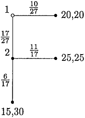
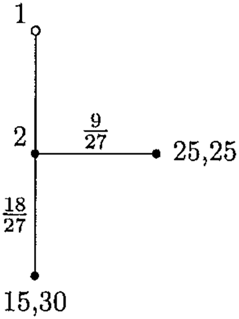
McCabe, Rigdon, and Smith Footnote 44 compared behavior in following two extensive form games (both variants on “trust games”). Footnote 45
In Figure 1, player 1 moves first, at choice node 1. Player 1 can choose to move across, ending the game and ensuring a payoff of (20, 20) (first number is player one’s payoff) for herself and player two. Alternatively, player one can move down, in which case player two has a choice of moving across, with payoffs (25, 25) or moving down with payoffs (15, 30). Player 1’s choice to move down is thus a “trusting” move in the sense that she foregoes a certain payoff of 20 in order to give player two an opportunity to choose an alternative that is better (25, 25) for both, but also trusting that player two will not choose down, producing an outcome that is still better for player 2 (30 versus 25), but worse for player 1. Put slightly differently, in choosing down, player 1 confers a benefit on player 2 which she expects or hopes will be reciprocated by player 2’s choosing in a way that benefits player 1. To the extent that player 1 chooses in this way, this is an example of the use of the conferral of benefit to induce reciprocation. A natural hypothesis about interactions of this type, described by Philip Pettit Footnote 46 is to suppose that under the right conditions the trust communicated by Player 1’s choice of down can help to induce player 2 to behave reciprocally and that when Player 1 moves down, she acts with this intention or expectation.
Trust Game With Outside Option

Now compare this with the game in Figure 2, which is just like the game in Figure 1, except that the outside option has been removed — now player 1’s only choice is to move down. Because of this, player 1’s move down cannot communicate to player 2 an intention to trust or help player 2. Supposing that something like Pettit’s analysis is correct, this removes one of player 2’s motives to move across: the motive of reciprocating the trust shown by player 1. As a result, one would expect that to the extent that player 2 is the sort of reciprocator who responds to the intentions with which player 1 acts, player 2 would be more likely to choose down in the second version of the game than in the first version. As the numbers attached to the game trees (which give the proportions of players choosing each alternative at each node) this is indeed what is found — the difference in choices of down versus across by player 2 between the two versions of the game is significant at the 0.01 level. Although, as we see from Figure 2, a significant number (33 percent) of second movers are influenced by a nonreciprocity-based or unconditionally altruistic desire to benefit player one (at a cost to themselves), even when there is no prior provision of benefit by player one, the increased proportion of second movers who move across in the first version of the game (65 percent) strongly suggests that a powerful additional, independent motive to reciprocate is operative when a prior benefit has been provided. Moreover, first movers in the first version of the game (accurately) anticipate this response, and this expectation plays a role in motivating their choices.
Trust Game Without Outside Option

E. Normative significance
If we were to incorporate these observations into a normative account of the role of reciprocity (justice as reciprocity) proceeding along the argumentative lines sketched in Section V, we are led to the following picture. First, there are a distinctive set of motives and associated normative concerns that are distinct both from self-interest and from unconditionally altruistic motives (whether these are utilitarian or linked to the achievement of some favored distribution pattern that is not conditional on people’s willingness to reciprocate), just as Gibbard claimed. Although this is not the place for extended discussion, this suggests a number of points concerning the design of distributive schemes. For those of us favoring generous social welfare programs, it is important to design such programs so that they are supported by reciprocal motives rather than conflicting with them: Social Security in the United States is an example of the successful recruitment of such motives, while, as argued by Fong, Bowles, and Gintis, many programs that provide aid to the disadvantaged would probably attract stronger support if they more clearly conformed to moral values built around reciprocity, and avoided, when doing so is possible and consistent with other values, forms of aid that are unconditional in the sense of requiring no form of reciprocity. Footnote 47 On the other (“advantaged”) side, a concern with reciprocity furnishes a powerful argument — one, unlike most philosophical theories of justice, that appeals to considerations actually invoked in political discourse Footnote 48 — that those whose economic success depends upon infrastructure and cooperation provided by others have obligations grounded in reciprocity to “give something back” to others.
Second, results described above (for example, the extensive form version of the trust game) suggest that people treat situations in which others are worse off and can be aided but in which no history of reciprocation exists very differently from otherwise similar situations in which reciprocal relationships exist. They are more willing to provide — and more likely to think that they ought to provide — aid in the latter case. At the same time, however, motives to reciprocate are not the only other-regarding motives people possess — motives of a more unconditional sort are also present. This suggests a normative theory in which the requirements of distributive justice and the provision of aid are at least somewhat different for those with whom we are involved in ongoing relations of reciprocity (for instance, inhabitants of our neighborhood, city, country) than those (if any) with whom we are not so involved — a feature with obvious implications for theorizing about justice in international contexts. Third, as the trust game example and numerous others illustrate, reciprocators care about the intentions with which others act when reciprocation is possible and not just the magnitude of the material benefits involved. This suggests that an adequate normative theory that incorporates notions of reciprocity should not just focus on the material benefits obtained through the reciprocal relationships but also on what reciprocators express about their attitudes toward each other through their interactions, since this is reflected in the intentions with which they act. To the extent that reciprocity matters in justice and elsewhere in normative theorizing, this points us toward a relational conception in the sense of Anderson Footnote 49 according to which these have to do with the establishment and regulation of relationships among people and not just the realization of particular patterns of distribution of material goods. In particular, reciprocity is characterized by relationships among people that involve the absence of exploitation of other’s contributive behavior, free-riding, “taking without giving back,” and so on. Although I will not argue for this claim here, I see this is a potent source of criticism of many of our present social and political arrangements.
VII. Additional Implications: Heterogeneity, Institutions, and Sustaining Cooperation
The picture of motivation and behavior described in the previous section is one according to which human motivation is heterogeneous, with preferences for reciprocation playing an important role in many subjects but not in many others, and with the latter group tending not to comply with reciprocity-based requirements in the absence of incentives to do so. Because many other-regarding subjects are reciprocators rather than unconditional cooperators, whether cooperation is sustained depends on the nature of the interactions between these two groups, reciprocators and nonreciprocators. This in turn depends on the rules and institutions governing such interactions. Rules or institutions can encourage cooperation by allowing reciprocators and unconditional cooperators to identify one another and to interact preferentially with those of a similar type and to limit interaction with those self-interested types who act exploitively. Or they can undermine cooperation by allowing interaction between different types to occur indiscriminately. Similarly, appropriate rules and institutions can encourage cooperation by making it possible to sanction exploitive behavior by self-interested types. More generally, one consequence of the existence of a substantial group of people who are reciprocators and another who are self-interested is that finding the right rules and institutions to govern their interaction matters crucially to successful cooperation. The idea that “institutions matter” is now widely accepted across many different areas of social science — my point is that the behavior of reciprocators will be particularly sensitive to which institutions are present. To the extent that reciprocal behavior is empirically and normatively important, a concern with “institutional proposals” and hence nonideal theory is unavoidable. Put differently, reciprocity is a moral notion that seems particularly badly suited to a treatment that remains within the confines of ideal theory.
Finally, an additional point about the normative consequences of reciprocal motives: it can encourage cooperative behavior on the part of people who are otherwise not inclined to cooperate, as when selfish types discover they can do better for themselves by cooperating (at least until late rounds) rather than defecting in repeated prisoner’s dilemmas with partners who are reciprocators. By contrast, a requirement that individuals contribute even when others are not (or that they contribute more as others contribute less, as is apparently implied by some normative theories) does not discourage and may in some circumstances encourage free-riding, leading to the unraveling of cooperation among those who are not unconditional cooperators. Put more bluntly, those who contribute independently of what others are doing or who contribute more as others contribute less (and normative theories that mandate this) can actually be dangerous to the maintenance of cooperation, in real-world circumstances in which some will behave exploitively and others will withdraw cooperation in the face of such behavior. This is one of several respects in which cooperative schemes incorporating reciprocity are more robust under a range of conditions involving heterogeneous motivations than are the alternatives. More generally, many of the attractive features of normative theories assigning a central role to reciprocity and, correspondingly, some of the less attractive features of normative theories that ignore considerations of reciprocity only become apparent when one considers nonideal circumstances of less than full compliance. These insights are missed if one remains just within the realm of ideal theory. Footnote 50