I
It is nearly forty years since Filippo Coarelli's brilliant Guida archeologica di Roma (FC Reference Coarelli1974) announced the arrival of a new era in Roman topographical studies. A series of seminal monographs soon followed, on the Roman Forum (FC Reference Coarelli1983, Reference Coarelli1985),Footnote 1 the Forum Boarium (FC Reference Coarelli1988), and the Campus Martius (FC Reference Coarelli1997). A volume on the Palatine was advertised as forthcoming,Footnote 2 but unforeseen circumstances put that project on hold.
In 1985 Andrea Carandini began his archaeological exploration of the north slope of the Palatine, from the Arch of Titus to the Temple of Vesta. The first results were impressive enough, a series of substantial houses dating back to the sixth century b.c. (AC Reference Carandini1986), but in 1988 came a discovery that made news around the world. This was nothing less than the wall of Romulus' Palatine city, proof that the foundation legend was based on historical fact.Footnote 3 Opinion was immediately divided. Some historians accepted the new findings with enthusiasm (‘Fait totalement nouveau: aujourd'hui, la fondation de Rome est perceptible archéologiquement’),Footnote 4 while Carandini kept the doubters at bay with an extraordinary sequence of monographs, public presentations and books for the general reader, in which he set out his ever more elaborate vision of the origins of Rome.Footnote 5
There was no serious debate. Carandini sometimes complained about that (AC Reference Carandini and Greco2005, 28), but he had only himself to blame. His very particular style of argument made rational discussion difficult,Footnote 6 as did his way of dealing with criticism of his own position (AC Reference Carandini1997, 492):
Il confronto tra il monumento da noi rinvenuto e quello descritto dalle fonti è per un uomo di cultura occidentale del tutto spontaneo, direi inevitabile. Solo un masochista, un perverso o un ipocrita potrebbe imporsi di non vederlo.
In particular, he was not going to listen to ‘classicisti tradizionalisti, chiusi in un insopportabile scetticismo snobistico’ (AC Reference Carandini2008, 7).Footnote 7
It would have been useful for people outside Rome to know what Coarelli thought of it all, but for a long time he kept silent. As he says in his new book, it was clear from the start that no useful discussion was possible ‘in presenza di un sistema chiuso in se stesso e nutrito di affermazioni apodittiche, quasi mai sostenute da argomenti verificabili’ (Pal., xii). Besides, he was busy with other things. Coarelli contributed a huge number of items to the indispensable Lexicon Topographicum Urbis Romae;Footnote 8 he was in charge of the spectacular bimillenary exhibition on Vespasian (FC Reference Coarelli2009); and he produced, as the first volume of a new history of Roman art, a definitive account of the art and material culture of early Rome (FC Reference Coarelli2011).
What brought him back to the Palatine was the media storm about the supposed discovery of the Lupercal in 2007,Footnote 9 followed by the appearance of a book by Carandini and one of his pupils about the house of Augustus (Pal., xii–xiii).Footnote 10 Coarelli disagrees profoundly with their reconstruction (Pal., 347–55), but his book is deliberately not a polemic.Footnote 11 On the contrary, it is exemplary in its insistence on rational argument and attention to the evidence. Appropriately, the publisher has given it a cover in the same dignified format as the original monograph series of 1983–97.
Meanwhile, Carandini himself has moved on. In 2009, now retired from his chair at La Sapienza, he was appointed president of the Consiglio superiore dei Beni culturali, the official advisory body to the Minister of Culture. In a sense, it is the job he was born for. In an interview published last year (AC Reference Carandini2012a),Footnote 12 he combined an absorbing account of his own family background and intellectual development with an eloquent manifesto on the value of beni culturali to Italian society in the age of Berlusconi. Conscious of an ancestral duty to the lost world of rigorous education and public responsibility in which he grew up, he sees it as a moral imperative to put the general public in touch with their own heritage by disseminating the results of research as widely as possible. In pursuit of that ideal, he has now brought into being the magnificent Atlante di Roma antica.
Appearing under the joint auspices of the Ministry, the Rome archaeological Superintendency and La Sapienza, ARA is, first and foremost, a marvel of book design. It is a boxed set of two thick volumes (with a ribbon to help extract them), produced to a very high standard and superbly illustrated. The plans and diagrams in Volume 2 succeed in presenting a vast amount of information with remarkable clarity, once the reader has grasped the order of presentation (the Augustan regiones VIII, X, IV, III, V, II, I, XII, XIII, XI, VI, VII, IX, XIV) and put a bookmark at tav. II, the key map.Footnote 13 It is an object lesson in how to present very complex material intelligibly.
After Carandini's lengthy introduction, the main chapters in the text volume cover the history of each of the regiones in turn: they are the work of Chiara Bariviera, Daniela Bruno, Maria Cristina Capanna, Paolo Carafa, Fabio Cavallero, Maria Teresa D'Alessio, Francesco De Stefano, Giada Fatucci, Dunia Filippi, Fabiola Fraioli, Sarah Gozzini, and Paola Pacchiarotti.Footnote 14 Each chapter is based on a standard chronological framework, which usefully creates a sense of coherence, and also (as we shall see) reveals something of what the project presupposes about early Rome.
Volume 1 also contains the illustrations, including, in a separately numbered sequence, the imaginative reconstructions that Carandini has always regarded as a necessary part of archaeological publication (AC Reference Carandini2000a, 152–5). These work best when they are indeed imaginative, attempts to picture the site before the city existed, or when it was in decay. Ill. 2, for instance, rightly described as a ‘ricostruzione fantastica ispirata alla leggenda romulea’, imagines the eighth-century b.c. Capitol in a scene worthy of the Brothers Grimm, while ill. 1 (by Roberto Meneghini) and ill. 33 (by Daniele Manacorda) offer a brilliantly evocative picture of medieval life among the towering ruins. Much less persuasive are the reconstructions of grandiose buildings for which next to no archaeological evidence survives;Footnote 15 and in one regrettable case we are offered a reconstruction for which the supposed evidence has already been refuted.Footnote 16 But perhaps that degree of tendentiousness is a small price to pay for such an impressive monument of historical outreach.
Since the simultaneous appearance of Palatium and the Atlante di Roma antica (with Daniela Bruno's substantial chapter on regio X)Footnote 17 comes at a time when several long-running Palatine excavation programmes have reached the final publication stage,Footnote 18 it may be worth looking again at some of the problems of interpretation which make the topography of this most historic part of Rome so difficult. The discussion follows Coarelli's order of treatment: the boundaries of the Palatine (Pal., ch. 1, Section II below); the ‘city of Romulus’ (Pal., ch. 2, Section III below), cult-sites and republican houses (Pal., chs 3–4, Section IV below), and the development of the imperial palaces (Pal., ch. 5, Sections V and VI below).
II
Varro believed that the Palatine was originally bounded by water:Footnote 19
No-one doubts that the Palatine has the Arcadians as its originators, by whom their town was first called Pallanteum; for some time the Aborigines had inhabited it, but later, because of the inconvenience of the neighbouring marsh (palus) which the Tiber had made as it flowed by, they abandoned it and set out to Reate.
As a consequence, Varro also believed that the Aventine was named from the verb aduehere, ‘to carry or convey to (a place)’, and that ferries were needed to carry goods there:Footnote 20
I myself am strongly of the opinion that [Auentinus] is from ‘conveying’, for in the past the hill was cut off by marshes (paludes). And so they were conveyed there from the city by rafts; the evidence for it is that the <…> by which at that time <…> is called Velabrum, and the place from which they alighted at the bottom of the noua uia is the sacellum uelabrum.
He goes on to argue that the toponym Velabrum, evidently imagined as a landing-stage, was also derived from ‘conveying’.Footnote 21 The poets repeat Varro's idea, picturing boats and sailors on the waters of what became the city.Footnote 22
Velabrum is listed in the Constantinian Regionary catalogues in regio XI, the Circus Maximus; it was the name of a market-place on the uicus Tuscus, the street leading from the Roman Forum to the Circus via the Forum Boarium.Footnote 23 The landing-stage Varro imagined there was evidently at the foot of the Palatine at its western corner, convenient for ferrying passengers and goods to the Aventine across the valley of the Circus Maximus.Footnote 24
After the Aborigines had left, Evander's Arcadians arrived.Footnote 25 But the place they called ‘Pallantion’ was not surrounded by water; on the contrary, it was surrounded by grass, the rich pasture to which Hercules brought the cattle of Geryon.Footnote 26 According to Dionysius, Evander's little town was not even on the hill, but below it and around it,Footnote 27 and certainly most of the cult sites the Arcadians are supposed to have founded would have been submerged in Varro's landscape.Footnote 28 In this story there is no lake or marsh, and the Tiber keeps within his banks. Even in the story of Romulus and Remus, where the Tiber does not keep within his banks, there is no lake or marsh: the twins were cast adrift on an unusual river overflow, which then receded.Footnote 29
The ARA authors seem to me rather evasive about the historicity of such legends. Under the heading ‘età mitistorica’ (ARA, 217–18), Daniela Bruno reports the arrival of Evander as a fact (‘sappiamo’), and although that of Hercules is only ‘secondo la leggenda’, it is still narrated in the indicative mood; the events are confidently dated to 1253 and 1235 b.c. respectively.Footnote 30 In Chiara Bariviera's regio XI chapter (ARA, 423–4) the same events, and the same dates, are reported in the subjunctive as part of a ‘passato mitico’; but they are still described as ‘memorie mitiche’.Footnote 31
Varro's watery landscape is assumed to be authentic. Bruno emphasizes the ‘Velabrum marsh’ as a permanent natural feature of the site,Footnote 32 and Dunia Filippi in her chapter on regio IV treats Varro's landing-stage and sacellum <ue>labrum as topographical data for the eighth century b.c. (ARA, 150 and tavv. 1–2). Filippi gives the name Velabrum to the entire valley between the Palatine and the Capitol (ARA, 143), a common modern usage but one with absolutely no ancient authority.
Coarelli ignores Evander, but like Bruno (ARA, 221) he believes that Varro preserves a memory of the situation before the Tarquins constructed the cloaca maxima and drained the valley between the Palatine and the Capitol (Pal., 72–3). He is of course aware of Albert Ammerman's geological demonstration that that valley was never a permanent marsh.Footnote 33 Nevertheless, he believes in Varro's paludes as a genuinely early feature of the terrain (Pal., 10–15 and 69–73).Footnote 34 Like Filippi (ARA, 150), he appeals to the abundant evidence for seasonal overflows of the river;Footnote 35 but that, as we saw with the Romulus and Remus story, is a quite different phenomenon, one familiar to the city's inhabitants in every age up to the completion of the lungotevere embankments in the early twentieth century.
The result of Coarelli's belief is an uneasy treatment of Velabrum, which he has to regard as an unstable toponym (Pal., 103–5). He distinguishes between a ‘historic’ Velabrum, as referred to in the literary sources, and a supposed ‘original’ Velabrum extending from the Aventine to the edge of the Forum (Pal., 70, 79–80).Footnote 36 Like Filippi (ARA, 150 and tavv. 1–2), he places Varro's imagined landing-stage very close to the Forum, at a point just behind the temple of Castor (Pal., 82–3). The reason is Varro's reference to ‘the bottom of the noua uia’, and the unsolved question of the route of that elusive thoroughfare.Footnote 37 But even without entering into that controversy, I think one is entitled to ask how Varro could possibly have imagined the north-west corner of the Palatine as the embarkation point for his ferry to the Aventine.
We are not, of course, dealing with ‘memories’ in any meaningful sense of the term.Footnote 38 If we combine a late seventh-century date for the draining of the valley and creation of the Forum (so for instance FC Reference Coarelli2011, 13–14) with the late third-century date of the first Roman historical texts, it is obvious that Varro could have had no authentic understanding of the conditions of the pre-urban site. But he wanted to understand, so like a good historian — indeed, like Thucydides in the archaiologia — he made inferences from whatever information he had, and that included the etymology of place-names. I do not suppose it mattered to him that what he inferred was inconsistent with ‘historical’ narratives about Evander's Arcadians or the exposure of the twins; no doubt he was confident that he knew better. But when we have geological evidence to the contrary, we are not obliged to share his confidence.
The ARA authors do not draw attention to the fact that ancient accounts of the origins of Rome are frequently inconsistent with each other. They prefer to speak of ‘la leggenda’ or ‘la tradizione letteraria’, as if all the various versions formed a unitary story which might or might not be true. Their position is evidently the one Carandini himself has often stated, that the literary sources preserve authentic information transmitted from the distant past by ‘oral tradition’ (AC Reference Carandini1997, 37) or ‘cultural memory’ (AC Reference Carandini, Carandini and Cappelli2000b, 11).
One source in particular is treated with great respect, Tacitus' account of Romulus' pomerium (Annals 12.24, on a.d. 49), which validates the 1988 discovery of ‘Romulus’ wall'. Here is A. J. Woodman's translation:
I deem it not inappropriate to recognise the beginnings of its foundation and what perimeter was laid down by Romulus. So, from the Forum Boarium — where we see the bronze representation of a bull, because that is the species of animal which is harnessed to a plough — it started as a furrow for marking out the town, taking in the great altar of Hercules. From there, at regular distances, stones were interspersed across the base of the Palatine hill to Consus' altar; next, to the old curiae; then, to the shrine of the Lares.Footnote 39 The Roman Forum and Capitol were believed to have been additions to the city not by Romulus but by Titus Tatius. Later the perimeter was augmented in step with our good fortune; and the boundaries which Claudius laid down at that time are easy to recognise and are written down in the public records.
If we take the Forum Boarium and the nearby ara maxima of Hercules as representing essentially the same place, the four points mentioned form a quadrilateral. The north-eastern side of it does indeed coincide approximately with the line of the wall found in 1988; but the south-western side is defined by sites in the valley that would have been submerged in the marsh if ‘the tradition’ were self-consistent.
Carandini insists on the authenticity of Tacitus' report, even suggesting that the historian had himself seen the Romulean boundary-stones (AC Reference Carandini2006, 195), but at the same time he assumes that Romulus' pomerium ran along the slope of the hill,Footnote 40 and that Tacitus' reference to the Forum Boarium, ara maxima and altar of Consus must reflect a later ‘restructuring’ (AC Reference Carandini2006, 236); the text is therefore to be understood not literally but ‘stratigraphically’ (AC Reference Carandini2006, 427).
Daniela Bruno avoids the problem (ARA, 220). Having reported that ‘according to the tradition’ Romulus ploughed the furrow for his walls and set up stones to mark his pomerium, she simply adds that Tacitus ‘remembered’ the details of its course nine centuries later, and that the points he mentions corresponded to cult sites that were outside the pomerium and the walls but so well known as to mark the four angles ‘unequivocally’. But that contradicts Tacitus' clear statement that the ploughed furrow began in the Forum Boarium and included the ara maxima. The one source for Romulus' ritual boundary must be true and false at the same time.
It is refreshing to turn to Coarelli's analysis of the Tacitus passage (Pal., 15–29), placed early in his account of the boundaries of the Palatine as if to show at the outset how it should be done. Of course Tacitus offers no authentic evidence for archaic Rome; his information came from the acta publica explaining Claudius' extension of the pomerium in a.d. 49,Footnote 41 and though Claudius was himself a learned historian, what he knew about archaic Rome was no doubt only what he had read in Varro. And yet Coarelli too believes that authentic information could be found.
On the principle that religious rituals remained essentially unchanged (Pal., 140),Footnote 42 Coarelli cites the route of the naked runners at the Lupercalia as evidence that the archaic Palatine did have a ritual boundary (Pal., 28). The key text is Varro's explanation of the name February, which refers to the lustratio by the Luperci of ‘the old Palatine oppidum’ (the same word used by Tacitus);Footnote 43 moreover, Dionysius and Plutarch both describe the original Luperci as running round Evander's settlement.Footnote 44
But here too, it seems to me, not enough notice has been taken of the sheer variety of the ancient sources. The verb most often used for the running of the Luperci was discurrere, ‘to scurry this way and that’, implying that there was no fixed route, though the events of 44 b.c. suggest that they ended up in the Forum.Footnote 45 Ovid's aetiology of the rite explained it by a story of Romulus and Remus running off in different directions; more startlingly, one of the explanations quoted by Plutarch has the twins running all the way from Alba to the Palatine.Footnote 46 It is hard to imagine how such versions could have come about if a fixed route round the Palatine was guaranteed by ancient ritual.
Varro is just one source among many — and he is not even consistent with himself. In De gente populi Romani he interpreted the Lupercalia as a memorial of the great flood, because the Luperci ran up the Sacra Via and then down again, as if escaping the rising waters and returning when they receded.Footnote 47 That is hardly compatible with a lustration route round the Palatine, which is in any case inconsistent with Varro's own picture of marshes surrounding the hill. Why should one version be ‘authentic’ and another not? And since we know that the Lupercalia ritual developed over time,Footnote 48 why should it be self-evident that the Luperci of Varro's day were still doing exactly what their forerunners had done seven centuries before?
Of course it is possible that once in the distant past the Palatine had been a separate oppidum with its own ritual boundary. But that hypothesis can be neither confirmed nor refuted from what historians and scholars, however learned, wrote in the first century b.c. or after. To say that one text or another transmits historically accurate information can be no more than an act of faith.
III
In the narrative chapters of ARA, the standard chronological scheme for pre-republican Rome is as follows:
Età pre-urbana, c. 1000–c. 850 b.c.: cultura laziale Phases I, IIA1Footnote 49
Età proto-urbana, c. 850–c. 750 b.c.: cultura laziale Phases IIA2, IIB, IIIA
Prima età regia, c. 750–616 b.c.
Seconda età regia, 616–509 b.c.
The closing point of the first stage is the start of the Esquiline necropolis, marking the ‘synoecism’ of previously separate villages that had had their own burial grounds (ARA, 149–50).Footnote 50 The second stage goes down to the archaeological context of the wall discovered in 1988, so temptingly close to the date of Romulus' foundation of the city according to ‘the tradition’ (i.e. Varro).Footnote 51 It is clear that ‘c. 750 b.c.’ is not just an archaeological definition.
From now on the chronological stages are defined by the supposed regnal dates of the canonical seven kings (ARA, 361, 392, 551): Romulus 753–716 b.c., Numa 716–672, Tullus Hostilius 672–641, Ancus Marcius 640–616, Tarquinius Priscus 616–578, Servius Tullius 578–535, Tarquinius Superbus 534–509. There is, of course, no good reason to believe in the historicity of any regnal date before 508/7 b.c., or indeed of any reign before the sixth century.Footnote 52 Nevertheless, the third stage is subdivided by Dunia Filippi at 675 b.c., as the end of the ‘periodo di fondazione’ (ARA, 150), and by Fabiola Fraioli at 672 b.c., as the end of the reign of Numa (ARA, 285); and the fourth stage begins when Ancus Marcius is succeeded by Tarquinius Priscus, supposedly in 616 b.c.
The significance of the division between the third and fourth stages is not at all clear; certainly there seems to be no suggestion that the ‘first regal period’ is any less historical than the second. On the contrary, the whole sequence from 1000 b.c. is treated as epistemologically unproblematic, as archaeological data and legendary stories are seamlessly deployed together. Paolo Carafa's heading for what ought to be called the prehistory of regio XIV — ‘dal tempo mitico del dio Giano al 775–750 circa a.C.’ (ARA, 551), where the closing date signifies cultura laziale IIIA — is unusual only in being explicit about the confusion of categories.
The ‘proto-urban’ phase has always been a problem for those who think that the wall discovered in 1988 proves that the foundation story is based on fact. Given that there was already a substantial integrated settlement at the site of Rome from about 850 b.c.,Footnote 53 what exactly would have been ‘founded’ in 753 b.c.? The ARA authors are notably vague on the subject,Footnote 54 but they do take it for granted that the founder was Romulus and that he did whatever he did in or about 753 b.c.
They assume there was a single legendary tradition, but in fact there were dozens.Footnote 55 Servius knew eight different foundation legends, Festus knew ten, Plutarch thirteen, Dionysius fourteen.Footnote 56 Even if we think only of stories concerning Romulus, it is still absurd to ignore the early and authoritative view of Naevius and Ennius, that Romulus was the grandson of Aeneas.Footnote 57 Why not use that ‘tradition’ as evidence for a foundation in the late Bronze Age? The date offered by Varro, like all the others reported by our sources,Footnote 58 could only be a learned conjecture, impossible even to conceive before Timaeus and Eratosthenes in the third century b.c. had constructed a continuous chronology that incorporated the Trojan War and all the other events that we call Greek myth.Footnote 59
As for the wall, it is indeed consistent with the story that Romulus fortified the Palatine,Footnote 60 but not with the story that Romulus' city wall included the Palatine, the Forum and the Capitol,Footnote 61 or the one that identified his city gate as the ‘temple of Janus’ in the Forum.Footnote 62 Some episodes in the ‘history’ of Romulus' Rome — the asylum, the treachery of Tarpeia — presuppose a settlement that included the Capitol, as does the casa Romuli frequently mentioned as a feature of the Capitol in the early Empire.Footnote 63
Coarelli is incomparably more nuanced than the ARA authors in his treatment of the ancient sources, but even he regards ‘the city of Romulus’ as a meaningful historical concept.Footnote 64 Believing that its topography, at least, is recoverable from what the Romans of Varro's time collectively imagined,Footnote 65 he interprets as a single historical phenomenon three items mentioned separately by our sources: (a) Roma quadrata, (b) the pomerium (and implied walls) defined by Tacitus, and (c) the antiquum oppidum Palatinum mentioned several times by Varro. We had occasion to consider (b) in Section II above; now we must look at (a) and (c).
For Roma quadrata our earliest evidence is a corrupt line of Ennius: ‘et †quis est erat† Romae regnare quadratae’.Footnote 66 The verb regnare makes it clear that Ennius was referring to the city itself, as founded by Romulus (the grandson of Aeneas). Next is Varro, who asserts that when Romulus founded Rome ‘it was first called “square Rome” because it was placed at the balancing-point’.Footnote 67 What he meant is disputed, but at least it is clear that like Ennius he understood Roma quadrata to mean the city itself. Third in chronological sequence is Dionysius on Romulus:Footnote 68
When he thought everything had been done that was reckoned to be acceptable to the gods, he called everyone to the appointed place and drew a four-cornered figure round the hill by yoking a bull and a cow together and ploughing a continuous furrow, which was designed to accommodate the wall.
Since Varro explicitly identifies the bull-and-cow ploughing ritual as creating the pomerium,Footnote 69 it is not surprising that Coarelli takes it as self-evident that Roma quadrata was the Romulean pomerium described by Tacitus (Pal., 15, 23, 97–8).Footnote 70 But it is not as simple as that.
First, it is noticeable that neither Varro nor Tacitus refers to Roma quadrata in the context of the pomerium. Second, Appian attributes the foundation of ‘square Rome’ to both the twins together, and Plutarch puts it before the augury contest, quite separate from the walls marked out by Romulus' ploughing ritual.Footnote 71 Third, Appian specifies that it was indeed square, four stadia to each side, and therefore not compatible with the irregular quadrilateral implied by Tacitus.Footnote 72 Fourth, and most damning of all, Varro's definition of the pomerium assumes a circular layout, to account for the derivation of urbs from orbis.Footnote 73
Pace Dionysius, you cannot make a ploughed furrow turn a right angle without taking the ploughshare out of the ground. But one can see what may have happened: since Dionysius had consulted many mutually contradictory authorities on the origins of Rome,Footnote 74 it looks as if at this point he conflated into a single episode what his sources may have described separately as ‘square Rome’ and Romulus' ploughing ritual. Each item individually could have come from Varro,Footnote 75 but probably not the combination of them.
Coarelli is well aware of the circular-wall version, as reported in Plutarch (Pal., 185–9). He interprets it as a tradition of ‘two foundations of Rome’ — first square, then circular — representing a historical development from an archaic ‘Rome of Romulus’ on the Palatine to a more spacious sixth-century city enclosed by the ‘Servian’ walls.Footnote 76 That seems to me to be just a modern version of what the ancient authors do, merging inconsistent variants into an artificially unified narrative. There is no reason to suppose that Plutarch's account reflects any sort of historical reality.
Now let us turn to Varro's ‘ancient Palatine oppidum’. It is mentioned in three passages of De lingua Latina, of which the first is unfortunately corrupt:
Besides, I see that there are said [to be] gates inside the walls — on the Palatine the Mucionis, from ‘lowing’ (mugitus) because by it they drove the herds out into the cowpastures that were then in front of the antiquum oppidum [?],Footnote 77 and a second, the Romanula, named from Rome, which has steps on the noua uia at the shrine of Volupia. (5.164)
This sacrifice [the Larentalia] is carried out in the Velabrum, at the exit into the noua uia. Some say it is at the tomb of Acca, on the grounds that near there the priests sacrifice to the departed spirits of slaves; both sites were outside the urbs antiqua, not far from the porta Romanula, which I discussed in the previous book. (6.24)
I prefer to believe that February [is called] after the dies februatus, because then the People is purified [februatur] — that is, a lustratio is performed of the antiquum oppidum Palatinum, girded with human flocks.Footnote 78 (6.34)
There is no reference to Romulus, or to Roma quadrata, or to the pomerium. The walls referred to in the first passage (‘intra muros uideo portas dici’) are the city walls of Varro's own time; as a third example of a ‘gate inside the walls’ he offers the porta Ianualis in the Forum, the ‘temple of Janus’ which could only be closed when there was no war anywhere. So these passages are not obviously evidence for a ‘city of Romulus’ — and in fact there is reason to believe that Varro thought of the ancient Palatine oppidum as pre-dating the foundation.
The Collectanea rerum memorabilium of C. Iulius Solinus, compiled probably in the fourth century a.d.,Footnote 79 begins with a lengthy passage on the origins of the city of Rome and its chronology down to the principate of Augustus (1.1–33). Varro is cited once (1.17), many of the details look Varronian,Footnote 80 and the chronological framework, down to the consulship of Hirtius and Pansa, is that of Varro in De gente populi Romani.Footnote 81 There are also some demonstrably post-Varronian items,Footnote 82 but the simplest hypothesis is that Solinus used Varro for his main theme and inserted other material from other sources as he went along.
The question is important for our purposes because of Solinus' opening sentence, in which he explains the name of Rome (1.1):
There are some who would like it to appear that Rome was first given her name by Evander, when he found there the town (oppidum) which the young men of Latium had previously built and called Valentia; he kept the meaning of the original name, and Valentia was called ‘Roma’ in Greek.
A Varronian version of the event is referred to at 1.14, quoted at the beginning of Section II above: there the oppidum is attributed to Aborigines rather than iuuentus Latina, and the Arcadians name it ‘Pallanteum’. A third version appears in Servius' commentary on Aeneid 8.51:
Evander … came to Italy, and having driven out the Aborigines occupied the area where Rome now is and founded a small town (modicum oppidum) on the mons Palatinus.
The extended text of Servius adds at this point ‘Just as Varro says, didn't the Arcadian exiles take refuge on the Palatium under the leadership of Evander?’. That was the story Virgil used: his Evander is both an exile and a founder.Footnote 83
It seems clear that Varro knew several variants of these legendary events, and all of them took for granted a Palatine oppidum, whether built originally by the Aborigines, the iuuentus Latina, or the incoming Arcadians. Whatever the details, I think we can be sure that the antiquum oppidum he refers to in De lingua Latina had nothing to do with Romulus.
Two of the three passages where the phrase appears refer also to gates — the porta Mucionis, or better Mugionis,Footnote 84 and the porta Romanula, of which the first certainly did have something to do with Romulus. It was the scene of a famous action in the war against Titus Tatius' Sabines, where Romulus' men were finally inspired by Jupiter Stator to stand their ground, and it is described in Livy's narrative of the event as ‘the old gate of the Palatine’.Footnote 85 That could mean ‘old from the reader's perspective’, since Livy frequently places historical events in the Rome of his own time;Footnote 86 but equally it could mean ‘old when the events took place’, implying a gate from some previous era rather than one in the walls Romulus had just constructed.
What matters for the topography is that Romulus vowed a temple to Jupiter Stator at the very place where the god's divine power had been made manifest.Footnote 87 The real Jupiter Stator temple was vowed by M. Atilius Regulus in 294 b.c.,Footnote 88 and it is likely that the whole story of Romulus and the Sabines dates from about that time.Footnote 89 Surprisingly, the Constantinian Regionary catalogues place the temple not in regio X (Palatium) but in regio IV (Templum Pacis), and therefore north of the Sacra Via, which formed the boundary. Accordingly, thirty years ago Coarelli identified the temple, in its late antique form, as the so-called Temple of Divus Romulus, the fourth-century rotunda with two side halls which was later converted into the vestibule of the church of SS. Cosma e Damiano (FC Reference Coarelli1983, 26–33). That hypothesis is accepted by Fabio Cavallero (ARA, 209) and Fabiola Fraioli (ARA, 290, 298).Footnote 90
But now there is new information, a fragment of a set of calendar fasti which marked 27 June as [Ioui] Statori in Palatio.Footnote 91 That has caused Coarelli to rethink his position; he now wonders whether the temple may have been in the vicinity of the Arch of Titus (Pal., 34, 108). The question had already been complicated by Carandini's claim to have found the gate itself, both in its eighth-century form and in a sixth-century reconstruction at a different site 33 m away.Footnote 92 Moreover, Livy's narrative of the death of Tarquinius Priscus puts the Jupiter Stator temple on or close to the noua uia, the course of which is itself desperately controversial.Footnote 93 As a result, in recent years the historic gate-and-temple complex has been conjecturally placed at a bewildering variety of sites.Footnote 94 However, I think the ancient sources enable us to place it with some confidence.
The temple was destroyed in the great fire of a.d. 64, and since Plutarch refers to it in the present tense, it was evidently rebuilt.Footnote 95 But it may not have been rebuilt in the same place. After the fire, Nero's architects redeveloped the whole area from the Forum up to the ridge where the Arch of Titus now stands, turning the old Sacra Via into a grand rectilinear avenue flanked with porticos, leading up to the uestibulum of the new imperial palace (ARA, tavv. 97, 104). It is likely that the rebuilt Jupiter Stator temple was part of that scheme, and Plutarch describes its position as ‘at the beginning of the Sacra Via as you go up to the Palatium’.Footnote 96 No pre-Neronian source describes the Sacra Via as leading to the Palatine;Footnote 97 but now Palatium also meant ‘palace’, and that was where the new Sacra Via took you.Footnote 98 So if the Jupiter Stator temple had been rebuilt on the left side of the Sacra Via as you went up from the Forum, that would account for its listing under regio IV.
Its original position, now known to be in Palatio, can be identified from a series of texts. First, in a speech falsely attributed to Cicero, which may well be late republican or Augustan, the temple is described as in Palati radice, a phrase used elsewhere to describe the Regia.Footnote 99 Second, Ovid in exile imagines his book being guided round an unfamiliar Rome:
‘This place belongs to Vesta, who guards Pallas and the fire; this was the small palace of ancient Numa.’ Heading to the right from there, he said ‘That is the gate of the Palatine, here is Stator, in this place Rome was first founded.’
Third, Appian, who had good contemporary sources for the late Republic, describes a violent episode in 59 b.c.:
Bibulus burst into the Forum while Caesar was still speaking. There was a riot, … and his friends got him out, against his will, into the nearby temple of Jupiter Stator.
Fourth, Dionysius' account of Romulus' vow sets the scene ‘near the so-called Mugonian gate, which leads to the Palatine from the Sacra Via’.Footnote 100 These passages are not only consistent with each other; they also indicate a site just across the Sacra Via from the fourth-century ‘temple of Divus Romulus’.
So I prefer Coarelli's 1983 view to the one he now espouses. If the temple of Jupiter Stator at the site of ‘the old Palatine gate’ was where our sources suggest — i.e., close to the Forum (Appian), just above the Vesta temple and the Regia (Ovid) — then Nero's architects might well have rebuilt it directly across the street, at the beginning of the new Sacra Via as you went up to the Palatium (Plutarch), leaving the original site to be redeveloped as the extended and realigned ‘house of the Vestals’ (ARA, tavv. 44–46). A site further up the street has now been identified as Jupiter Stator by Carafa, Carandini and Arvanitis; but since their hypothesis depends on Carandini's identification of the site(s) of the porta Mugionis, it cannot also be used as evidence for it.Footnote 101
If our reading of the sources is right, then we have a rough idea of where one of the gates associated with Varro's ‘ancient Palatine oppidum’ was situated (see p. 11 above). The other one was the porta Romanula, not far from the Velabrum, the market-place on the uicus Tuscus which was listed in regio XI.Footnote 102 It may or may not be identical with what Festus called the porta Romana, ‘set up by Romulus at the bottom of the cliuus Victoriae’;Footnote 103 that street presumably led down from the temple of Victoria, which is now securely identified at the western corner of the Palatine (Pal., 226–8). The conclusion should surely be that the porta Roman(ul)a was below the western corner of the hill, closest to the river.Footnote 104
In 1964, however, Castagnoli argued that the porta Romanula was at the northern corner of the hill, closest to the Forum,Footnote 105 and that idea, endorsed by Coarelli in his detailed analysis of ‘the cults of the Velabrum’ (FC Reference Coarelli1983, 230–3), has been the accepted position ever since.Footnote 106 So when Henry Hurst in 2003 was excavating at the top of the ramp or stepped street that leads up from the Vesta temple to the Palatine slope, and found an anomalous deep cut in the bedrock, implying a robbed-out rectangular structure measuring about 4.5 m by 3.5 m, he had a good idea of what it might be:Footnote 107
Among the shifting sands of Roman topography in recent years, the Porta Romanula has remained surprisingly consistently attached to the northwest corner of the Palatine in the vicinity of the present site. What has seemed so far to be a relatively unproblematic ancient textual location is the passage of Varro (De lingua Latina 6.23–4) where he talks of a sacrifice ‘in the Velabrum, where there is a way out into the Nova Via … outside the ancient city … not far from the Porta Romanula’. There seems to be a consensus that there was a route from the Forum to the Palatine Hill from earliest times and that this gate was at the point of entry to the fortified Palatine enclosure.
However, as we saw in Section II, the idea that the Velabrum was at this corner of the Palatine is anything but unproblematic. What if the consensus is in error?
It is important to understand what the new archaeological evidence consists of. Hurst explains very clearly:Footnote 108
[A]lthough no more than a rectangular cut into the cappellaccio bedrock survives, there is a series of indications that it represented a solid structure that may have stood until Hadrianic times, possibly serving to house a mill-wheel in the later stages of its life … [I]t could be any sort of deeply-founded structure; while presumed to be early, because of its non-correspondence in alignment to other structures, it is undated. That it could have been part of a gate in the Palatine defensive circuit is arguable from its position and apparent character.
On the strength of that, Daniela Bruno now states confidently that the Porta Romanula, perhaps in a rebuilt version of republican date, survived till the age of Hadrian (ARA, 80, 221).Footnote 109 The archaeologist relies on the consensus, the consensus finds confirmation in the archaeology — and all to place one gate of the supposed Romulean circuit less than 200 m away from where the sources place another.
There was no ‘city of Romulus’. The foundation is a legend, created at a time when the Romans were founding cities of their own and naturally imagined that someone had founded Rome in the same way.Footnote 110 Some said the founder was Evander, some said Aeneas, some said Romulus.Footnote 111 And of course these were stories, not ‘memories’.
What the 1988 excavation showed is that there were fortifications on the Palatine in the eighth century b.c., as there no doubt were at other points as well;Footnote 112 but no-one seven centuries later remembered who built them or why. Some archaic features evidently survived in the later city, like the ‘earth wall of the Carinae’ mentioned by Varro.Footnote 113 Obviously Varro believed that the ‘gates within the walls’ were also genuinely ancient, evidence for an ‘old Palatine oppidum’. But it is striking that he does not attribute the oppidum to Romulus, or any other founder. If pressed on the subject, he might have given his opinion that the Aborigines built it,Footnote 114 but he would surely have gone on with sunt qui dicunt … and a list of other learned explanations.
IV
If we ask what the Palatine was like in Varro's own time, it is not easy to find an answer. The entire hill was devastated in the great fire of a.d. 64,Footnote 115 and after that much of it was taken over by the grandiose palace complexes of Nero, Domitian and Septimius Severus. Archaeological plans of the pre-Neronian Palatine are largely blank.Footnote 116 It is striking that Coarelli's chapters on cult sites and republican houses are predominantly concerned with the edges and slopes of the hill rather than the summit plateau. He thinks the summit was all residential,Footnote 117 but that seems an arbitrary assumption: why should the lost republican Palatine have had any less varied a mix of public and private property than the rest of the city?
One great step forward in our understanding comes with Coarelli's discussion of the ‘Capitoline base’, on which are recorded the names of the uicorum magistri urbis regionum XIIII who made a dedication to Hadrian in a.d. 136.Footnote 118 At that time there were only five uici in regio X, clearly a direct result of the huge expansion of the palace complex. However, the Constantinian Regionary catalogues attribute twenty uici to regio X, and Coarelli infers that this figure represents the original count from 8 b.c., when the system of regiones and uici was set up.Footnote 119 As he rightly says (Pal., 115), it is hard to imagine any other explanation. But in that case, the lists as a whole must be considered as redactions not of an original Constantinian document, but of an Augustan document imperfectly updated; and that in turn means that they could contain usable information about the pre-Neronian Palatine.
The two catalogues are the Notitia, evidently written in a.d. 354, and the Curiosum, which postdates a.d. 357.Footnote 120 They describe regio X as follows:Footnote 121
Regio X Palatium continet: casam Romuli; aedem Matris deum et Apollinis Ramnusii; pentapylum; domum Augustianam et Tiberianam; auguratorium; [aream Palatinam]; aedem Iouis [Victoris; domum Dionis]; curiam ueterem; Fortunam Respicientem; Septizonium diui Seueri; Victoriam German[ic]ianam; Lupercam.
Thanks to Coarelli's liberating hypothesis, some of the puzzles in this list may turn out to be explicable.
For instance, why is Victoria given the epithet Germaniciana? Coarelli suggests a rebuilding by Caligula (Pal., 228, 234, 443); but the first and most significant use of the name ‘Germanicus’ was precisely at the time when the regiones were created. By 9 b.c. Augustus' stepson Nero Drusus had conquered Germany, and as far as anyone knew at the time it was an expansion of empire as permanent and glorious as Caesar's conquest of Gaul.Footnote 122 Drusus himself died at the moment of victory, but the Senate decreed to him and his offspring the honorific agnomen ‘Germanicus’.Footnote 123 We know Augustus rebuilt the temple of Victoria,Footnote 124 and this was an obvious time for him to do it.
We may note in passing that the horrea Germaniciana et Agrippiana listed in regio VIII may also belong in this historical context, at a time when Augustus was taking particular care of the grain supply.Footnote 125 After the deaths of Agrippa in 12 b.c. and Nero Drusus ‘Germanicus’ in 9 b.c., building granaries in their name would be a suitable honour for two particular heroes of the Roman People.Footnote 126
If the temple of Victoria was indeed rebuilt as a monumentum to Nero Drusus and the conquest of Germany, its misplacement in the Regionary lists may have a meaning. It appears not where it belongs topographically, between the temple of the Great Mother of the Gods and the temple of Apollo, but in the penultimate position, immediately before the misspelled Lupercal. The topographical nexus between the Victoria temple at the top of the hill and the Lupercal at the bottom is made clear by Dionysius, in a work completed in 7 b.c.,Footnote 127 and the Lupercal too was rebuilt by Augustus.Footnote 128
We happen to know that in a.d. 23, on the untimely death of Drusus Caesar, son of Tiberius and nephew of Nero Drusus, the Senate decreed that a statue to the deceased should be set up at the Lupercal;Footnote 129 moreover, the honours for Drusus Caesar were the same as those for Germanicus Caesar, who had died in a.d. 19,Footnote 130 and the honours for Germanicus Caesar had included statues in triumphal dress ‘in those public places where Divus Augustus and […] had erected statues for his father Drusus Germanicus’.Footnote 131 I think it is reasonable to infer that the Lupercal, a hero-shrine below a victory-temple,Footnote 132 was developed by Augustus as a memorial to Nero Drusus ‘Germanicus’, whose son and nephew were later honoured there too.Footnote 133
The same historical context — the death of Nero Drusus ‘Germanicus’ and the creation of the regiones — may also explain Apollo's appearance in the regionary list as Rhamnusius. That was the regular epithet of the avenging goddess Nemesis, who punishes boastful arrogance.Footnote 134 Apollo shared his Palatine temple with his sister Diana;Footnote 135 famously, on behalf of their mother Latona, the two of them punished the boastful arrogance of Niobe, and the story of their vengeance was carved in ivory on the temple doors.Footnote 136
It was easy to associate Nemesis with Diana, another pitiless virgin,Footnote 137 but in Ovid's telling of the Niobe story the avenging archer is conspicuously Apollo.Footnote 138 So when in 9 b.c. the poet of the Consolatio ad Liuiam suddenly delivered a fierce threat of vengeance against Germany for boasting of the death of Nero Drusus,Footnote 139 contemporaries could imagine a ‘Rhamnusian’ Apollo exacting revenge. That particular moment seems to justify the epithet, invoking a darker, angrier god than the shining Phoebus of the Carmen saeculare just eight years earlier.
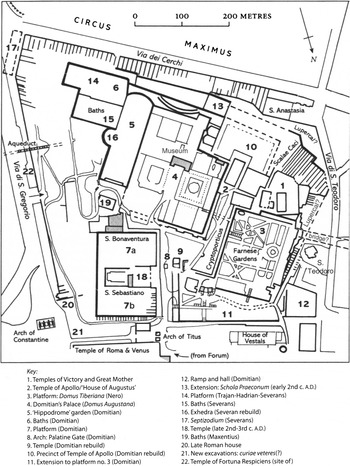
Let us assume therefore, as a working hypothesis, that the fourth-century lists do indeed incorporate material from the very beginning of the regionary system. Obvious later additions are domus Augustiana et Tiberiana (see Section V below), Septizonium diui Seueri, and no doubt the mysterious domus Dionis. The casa Romuli, on the other hand, was already a well-known feature of the Palatine in the first century b.c., located at the top of the steps that led down from the western corner of the hill to the Circus Maximus;Footnote 140 and the temple of Fortuna Respiciens, from which part of the terracotta frontal decoration survives (Pal., 202–19), had evidently been on the eastern side of the hill, above the present-day Via di S. Gregorio (Fig. 1, no. 22), from at least the second century b.c.Footnote 141
The imperial Palatine, from Amanda Claridge, Rome: An Oxford Archaeological Guide (2nd edn, 2010), 124, fig. 50.

Jupiter Victor is a problem. The temple vowed to Jupiter Victor by Q. Fabius Rullianus in 295 b.c. was evidently on the Quirinal (Pal., 234–41),Footnote 142 and the temple of Jupiter Victor referred to by Josephus in his narrative of a.d. 41 is now firmly sited on the Capitol by a new fragment of calendar fasti (Pal., 241–6).Footnote 143 There is no confirmation anywhere for a Palatine temple of Jupiter Victor; Ovid refers to a temple dedicated inuicto Ioui on 13 June, but that can only be the one referred to in the Regionary list if the poet was being imprecise about the epithet, which is certainly possible, or if the name had been changed by the fourth century a.d. (Pal., 239).Footnote 144
Coarelli suggests that Iouis Victoris in the Regionary list is a corruption of Iouis Vltoris, referring to Alexander Severus' rededication of the great temple of Elagabalus on the Vigna Barberini site (Pal., 247, cf. ARA, 260 and tav. 87). That is certainly a possibility; but I think an Augustan explanation is still available if we look carefully at the sequence of names in the list: auguratorium, area Palatina, aedes Iouis Victoris.Footnote 145
The auguratorium is otherwise known only from an inscription recording its rebuilding by Hadrian in a.d. 134.Footnote 146 It should certainly have been of significance for Augustus, whose honorific name alluded to the foundation of Rome augusto augurio.Footnote 147 In the second half of the first century b.c. — i.e., after Varro — what evidently mattered about Romulus' foundation of the city was that it was done auspicato.Footnote 148 That adverbial ablative absolute referred to the founder's inaugural auspices, taken at dawn from a hut ‘in a clear space’, facing east.Footnote 149 The hut cannot have been the one at the top of the steps above the Circus Maximus, from which the view was only south and west; it must have been on the summit of the hill, and therefore identical with the ‘hut of Mars’ in which Romulus' augural lituus was discovered in the ashes after the sack of Rome by the Gauls.Footnote 150 The Regionary catalogues list casa Romuli separately from auguratorium, and that distinction of two separate sites is essential to bear in mind if we are to understand the conceptual landscape of the pre-Neronian Palatine.
Late sources inform us that Romulus founded his new city ‘around the hut of Faustulus’.Footnote 151 That makes sense: the hut where the twins had been brought up must have been thought of as the only one available before the creation of the new settlement.Footnote 152 According to Conon, a Greek mythographer of the age of Augustus, Faustulus' hut was still preserved in his time ‘in the precinct of Jupiter’.Footnote 153 If that ‘hut of Faustulus’ was Romulus' auguratorium, then the otherwise unattested precinct may be that of Jupiter Victor, as in the Regionary list. And if so, the Jupiter Victor temple was on the summit of the hill.
In this context Coarelli rightly draws attention to two further passages in Josephus' narrative of a.d. 41 (Pal., 248). The assassination of Gaius took place at the time of the ludi Palatini, for which a temporary theatre was put up ‘a little in front of the imperial residence’ — and the stage-building incorporated a wooden hut.Footnote 154 Unfortunately, Coarelli assumes that there was only one ‘Romulean’ hut preserved on the Palatine, the one on the slope above the Circus, and therefore that the temporary theatre was situated where the ludi Megalenses took place, in front of the temple of the Great Mother at the western corner of the hill (Fig. 1, no. 1).Footnote 155 But it is hard to imagine how that site could be described as ‘in front of the imperial residence’.
Another detail in Josephus should point us in a different direction. After the killing of Gaius, a group of Praetorians found Claudius hiding, and took him off with them as a possible replacement emperor. They joined the main body of troops ‘in the open space on the Palatine, where the story goes that the city of Rome was first settled’.Footnote 156 Josephus' phrase represents what his source no doubt called area Palatina, a feature also named in the Regionary lists. It would not be surprising if the ‘imperial residence’ opened on to the area Palatina, as it certainly did in the post-Neronian topography.Footnote 157
There is no sign of any area Palatina in the ARA maps of the pre-Neronian Palatine (tavv. 62, 64, 70), which offer instead two main streets on a south-west–north-east orientation, labelled ‘cosidetto clivo Palatino’ A and B; they are said to date back to the seventh century b.c., but it is not clear what the evidence for them is supposed to be.Footnote 158 Similarly, Coarelli's idea that the summit of the hill was given over to aristocratic houses does not help us to make sense of this public piazza with a famous historic story attached to it. But the sequence in the Regionary lists could imply an interestingly coherent Augustan complex.
In the previous section we saw Ovid's book being led through Rome, taking a right turn from the Sacra Via just above the Vesta temple and the Regia: ‘That is the gate of the Palatine; here is [Jupiter] Stator.’ The poet omits the ramp or steps that brought you up to the top of the hill (long lost in the post-Neronian topography), and the next item on the book's route is ‘the place where Rome was first founded’. As the book looks around, it sees what the reader knows is the uestibulum of the house of Augustus.Footnote 159 It is reasonable to infer that Augustus' forecourt looked out on the area Palatina, as described by Josephus.
‘Just in front of the residence’ was the wooden hut (Josephus) used by Romulus for his foundation augury (Dionysius), the dwelling of Faustulus in the precinct of Jupiter (Conon); so the sequence auguratorium – area Palatina – aedes Iouis Victoris in the Regionary list would indeed make sense as Augustan topography. Perhaps Jupiter Victor (or Invictus) looked out on the area Palatina in much the same way as Jupiter Optimus Maximus on the area Capitolina.Footnote 160 Certainly his cognomen (whichever it was) would be helpful for Augustus, since Jupiter's wars were all civil wars, against insurgents such as Titans, Giants or Hundred-handers, a topical theme of which the poets of his time were well aware.Footnote 161
Since the auguratorium was necessarily on the summit,Footnote 162 it seems that we must place this lost topography somewhere north-east of the temple of Victoria, on the high ground later used for the imperial palace called domus Tiberiana, where the Farnese Gardens are now (Fig. 1, no. 3). However, that is precisely the area for which Coarelli believes he can demonstrate that the high Palatine was entirely given over to aristocratic houses (Pal., 303–36). His view is shared by Carandini (AC Reference Carandini2010, 91–4, 128–38) and Bruno (ARA, 229–31 and tav. 64), but I believe it is based on unreliable evidence.
In 2001, Clemens Krause excavated an area cut deep into the side of the hill below the northern corner of the domus Tiberiana platform (Fig. 1, no. 3), and found a concrete base and travertine blocks, the remains of a short-lived building that was soon replaced by a bath complex.Footnote 163 Since the site overlooks the Forum, Krause believed it was part of the house of Cicero, and that the remains were those of a ‘temple of Libertas’ erected by Clodius in 58 b.c. and demolished the following year. Since a number of Cicero's neighbours can be identified from the literary evidence, it was possible for Krause, followed by Carandini and Bruno, to reconstruct a whole ‘residential quarter’ on this part of the hill.
However, it is clear from the Ciceronian evidence that there never was a temple of Libertas.Footnote 164 The textual argument is complex, and need not be repeated here;Footnote 165 it is enough to register the salient facts, that what Clodius built was a portico (replacing the porticus Catuli) that extended on to the site of Cicero's house, and that what he dedicated in it was a statue and an altar.Footnote 166 So there is no reason to suppose that Cicero's house was on the side of the hill that faced north-west, and in fact there is good evidence to suggest that it faced north-east, towards the Sacra Via.Footnote 167
Of course there were aristocratic houses all over the Palatine, but we do not know who lived where, and we have no reason to suppose that they monopolized the entire space. The piazza, the hut and the Jupiter temple may not be easy to place on a plan, but the evidence for their existence is undeniable. As with Jupiter Stator below the northern corner of the hill, so with Jupiter Victor (or Invictus) on the summit, we have to imagine a building destroyed in the fire of a.d. 64 and presumably reconstructed on a different site, in a thoroughly redeveloped urban landscape where no fewer than fifteen uici had disappeared by Hadrian's time under the ever-expanding imperial gardens and palaces.
Before leaving the republican Palatine, it is worth drawing attention to Coarelli's excellent treatment of the cult of the Great Mother (Pal., 249–82). We know from Valerius Maximus that her temple burned down in 111 b.c. and a.d. 3, and from Ovid that the rebuilders were ‘first Metellus, now Augustus’;Footnote 168 in a detailed prosopographical argument, Coarelli makes a good case for C. Metellus Caprarius, who was consul in 113 b.c., triumphed in 111, and was censor in 102 (Pal., 251–8). In his more familiar capacity as art-historian, he brilliantly identifies the surviving cult-statue, complete with the socket for the insertion of the black stone, just as Arnobius says (Pal., 271–6).Footnote 169
V
It was probably in late 43 or 42 b.c. that the young Caesar, now triumuir rei publicae constituendae, acquired the house on the Palatine that had belonged to Q. Hortensius.Footnote 170 Its approximate position ought to be obvious, since the Flavian palace (Fig. 1, no. 4) was called domus August(i)ana,Footnote 171 and an Augustan house on that site is precisely consistent with what we inferred above about the hut on the summit ‘in front of the basileion’. But that fundamental item of evidence has been systematically ignored for over half a century.
In 1954 Gianfilippo Carettoni began excavating the site of a late republican house immediately north-west of the Apollo temple podium.Footnote 172 He soon came to believe that the house was architecturally connected with the temple, and must therefore be the house of Augustus itself;Footnote 173 and that idea in turn was exploited in Paul Zanker's enormously influential book The Power of Images, as evidence that the young Caesar ‘took his cue from the Hellenistic kings’ in creating a palace-sanctuary complex like those of Pergamum and Alexandria.Footnote 174
Further exploration seems now to have revealed that Carettoni was wrong about the relationship between house and temple: not only was the house much more extensive than he had thought, with two separate peristyles, but it was largely destroyed while still in the course of construction, in order to create the Apollo temple and its portico.Footnote 175 Nevertheless, it seems that the young Caesar's ‘Hellenistic palace’ is just too seductive a concept to be abandoned: the new consensus, shared equally by Coarelli (Pal., 371–95) and by Carandini and Bruno (ARA, 228, tavv. 64E and 69),Footnote 176 is that the newly-revealed two-peristyle house was the original ‘house of Octavian’, hugely expanded from its Hortensian nucleus but then destroyed before completion by ‘Octavian’ himself for the construction of the Apollo temple complex after 36 b.c.Footnote 177 It is a paradoxical idea.
The young Caesar was not an emperor. On the contrary, as triumuir he was an agent of the Roman People, elected to avenge the murder of his adoptive father, who had been the People's champion against a powerful oligarchy.Footnote 178 The Roman People loved public magnificence but hated private luxury.Footnote 179 When not fighting his necessary wars, Imperator Caesar certainly delivered magnificence — the Apollo temple itself, hugely expensive with its famous portico,Footnote 180 and the great Mausoleum in the Campus Martius, surrounded by a public parkFootnote 181 — but there is neither evidence nor likelihood that he made a private palace for himself.Footnote 182 As his biographer makes clear, Augustus was a great public builder, but his own quarters, both in Rome and in the country, were modest and unpretentious.Footnote 183
Neither the original ‘Carettoni house’ nor its two-peristyle extension (Fig. 1, no. 10) coincides with the site of the later palace called domus August(i)ana (Fig. 1, no. 4). Special pleading is required to explain the name. For Carandini and Bruno it is because the palace was somehow ‘grafted on’ to the house of Augustus (‘innestato’, ARA, 238);Footnote 184 for Coarelli it is because the ‘settore pubblico’ of the house of Augustus, supposedly separate from his private dwelling, more or less coincided with the site of the Flavian palace (Pal., 395–9).
This idea that Augustus had a domus priuata and a separate domus publica is shared by Carandini and Bruno, who place the latter immediately east of the Apollo temple, symmetrically matching the ‘Carettoni house’; but their reasons seem quite inadequate, given the total lack of archaeological evidence.Footnote 185 The notion is based on two passages in Dio, which report that in 12 b.c. Augustus ‘made part of his own house public property’, and in a.d. 3 ‘made it all public property, because he was pontifex maximus, so that he might live in premises that were simultaneously private and public’.Footnote 186 But only the one house is mentioned.
Carandini and Bruno also believe that the Apollo temple complex begun in 36 b.c. included both the portico of the Danaids,Footnote 187 usually placed immediately to the south-west of the temple (Fig. 1, no. 10), and a much larger (and unattested) second colonnaded piazza at a lower level, supported on an enormous brick building over 20 m high projecting out from the side of the hill as far as S. Anastasia (ARA, 233 and ill. 10–11); in this lower portico there was supposedly a second altar, a sacred grove,Footnote 188 a tribunal for the Secular Games,Footnote 189 and a balcony for watching the ludi circenses; below it, the brick building housed apartments and offices for the imperial bureaucracy, cells for political prisoners, and in the basement, four storeys below,Footnote 190 the Lupercal, where the goat was slaughtered and sacrificed each February (ARA, 234 and tavv. 70A, 71, 72).
Coarelli is incredulous (Pal., xv), and rightly so.Footnote 191 But his own version of the Augustan property, consisting both of the extended ‘Carettoni house’ and of the Flavian palace site, is also inconsistent with the evidence if it attributes to the first princeps an architecturally integrated palace on Neronian lines. It is important to take seriously what the sources tell us about the early emperors' differing reputations in the matter of private building.
Augustus, as we have seen, did not own or build extravagant houses or villas. Tiberius, who was unpopular for not taking on public projects (only two, neither finished), was at least ‘moderate in private building’.Footnote 192 Gaius, on the other hand, was notorious for spectacular extravagance on his own pleasures, especially in building villas and country houses at enormous expense;Footnote 193 in Rome, he extended the imperial property to the Forum, ‘making the temple of Castor and Pollux into his forecourt’, built a bridge from the Palatine to the Capitol, and began the construction of a new house in the area Capitolina.Footnote 194 Claudius, no doubt in deliberate contrast, was economical and unassuming, and built nothing in Rome that his biographer saw fit to mention.Footnote 195
Outrageous extravagance came back with Nero, both before the fire of a.d. 64 and even more after it.Footnote 196 The great estate of the domus aurea, with its lake and parklands in the heart of the city,Footnote 197 became an example both to those who wished to cancel it out, like Vespasian and Titus, and those who wished to emulate it, like Domitian.Footnote 198 For the early development of the imperial property, however, it is that sequence of contrasting Julio-Claudian reputations that we should keep in mind. To whom should we attribute the architectural features revealed by excavation?
It is important to distinguish between (a) the expansion of one's property by acquiring neighbouring houses and (b) the creation of a large purpose-built palace on a unitary design. The latter could only be achieved where a substantial area of land was available at one time; it is not easy to imagine circumstances that would deliver that before the fire of a.d. 64. As we should expect, the Augustan complex developed on model (a): the princeps himself lived in the aedes Hortensianae, his grandsons were taught in the domus Catulina, one of his freedmen gave his name to the domus Gelotiana overlooking the Circus, and no doubt there were various other properties similarly identified.Footnote 199
The matter is complicated by the way our sources on the imperial Palatine sometimes use the word domus to mean not a single building but a complex of contiguous buildings. Suetonius, for instance, reports that the young Caesar built the temple of Apollo ‘in that part of his Palatine domus which had been struck by lightning’, when in fact it was constructed on one of the neighbouring sites that he had bought up in order to use for building;Footnote 200 Tacitus and Suetonius both refer to the domus (singular) created by Nero to connect the Palatine property with Maecenas' gardens on the Esquiline;Footnote 201 and when Pliny, in a famous passage, referred to the city having been twice surrounded by the domus Gai and the domus Neronis,Footnote 202 he was obviously not referring to single buildings.
The well-informed source of Josephus' narrative of a.d. 41 evidently used the same convention. The interchangeable use of οἶκος or οἰκία and βασίλειον in Josephus' text presumably represents domus and Palatium in his source,Footnote 203 but it is very clear that the imperial complex the source described was one of separate houses with streets and alleys between them.Footnote 204 And at one point he takes the trouble to explain to his readers how there could be several houses in the one domus:Footnote 205
[The assassins] went by other streets, and reached the house of Germanicus, father of Gaius whom they had just killed, which was adjacent. This was because the basileion, though a unity, was made up severally of the buildings belonging to each one of those who had been born in the imperial power, named after those who had built them or even begun building any of the parts.
So too Suetonius refers to ‘the house in which Gaius was killed’, implying that there were several, and the commentaries of the Arval Brethren report that on 27 May a.d. 38 Gaius hosted the college ‘in domo su[a, q]uae fuit Ti. [Ca]esaris aui’ (as opposed to one of his other houses).Footnote 206
The acquisition of a neighbouring house offered the opportunity to create something bigger and more impressive than before. That was the motive attributed by Cicero to Clodius, when the latter tried to exploit the site of Cicero's demolished house in 58 b.c.: ‘he wanted to live with more space and more grandeur, to join two large and noble houses together’.Footnote 207 In particular,Footnote 208
he had set his heart on a 300-foot paved portico with rooms attached, a grand peristyle and everything else in character, on the Palatine with a superb view, so that he could easily outdo everyone else's houses in spaciousness and splendour.
According to Carandini (AC Reference Carandini2010, 130, fig. 55, whence ARA, tav. 64G),Footnote 209 Clodius actually built the grand peristyle he wanted, and its footprint is still detectable in the archaeology of the Palatine. That cannot be true (Cicero got his house back, and it was not on that site anyway), but the new archaeological data do provide good evidence for the phenomenon in general.
The cryptoporticus below the central part of the Farnese Gardens (Fig. 1, no. 3) was previously thought to be Neronian. However, the latest excavations have revealed a substantial portico, about 34 m by 20 m, surrounding a large rectangular pool, with a water-pipe stamped Ti. Claudi Caes. Aug. in a context subsequent to the original layout.Footnote 210 That Claudian second stage necessarily implies that the original layout was Tiberian or earlier. Since the cryptoporticus formed the nucleus (and dictated the orientation) of the domus Tiberiana palace,Footnote 211 the conclusion is obvious: what we have here is the original house of Tiberius,Footnote 212 as expanded to a dignity worthy of Augustus' son-in-law (11 b.c.) and adopted son and heir (a.d. 4). No doubt the cryptoporticus itself had once been a uicus between separate houses.
It does not follow, however, that the entire Farnese Gardens platform, built out over the side of the hill on huge substructions, also dates back to the late Augustan period. That is the inference made by Maria Antonietta Tomei;Footnote 213 but the wholesale expropriations that would have been necessary are quite inconsistent with the reputations of Augustus and Tiberius for modesty in private building.Footnote 214 What the new results illustrate is the familiar late republican phenomenon of laxe habitare and continuatio domorum.Footnote 215 Conditions changed radically only with the fire of a.d. 64.
Since the later domus Tiberiana (Fig. 1, no. 3) expanded Tiberius' house on a palatial scale, we must assume that the later domus August(i)ana, the Flavian palace (Fig. 1, no. 4),Footnote 216 did the same with that of Augustus. As we saw in the previous section, Augustus' original (and modest) house probably looked out on to an area Palatina at the summit of the hill, and that is certainly compatible with a site within the confines of the Flavian palace.
The following sequence seems to be compatible with all the evidence. Let us assume, first, that Augustus' extension of his Palatine property, no doubt begun at the proscriptions,Footnote 217 proceeded more decorously during the years of peace, by gradual purchase and inheritance; second, that the process accelerated under his more aggressively acquisitive successors, so that Gaius was able to extend the sequence of properties as far as the Forum and the Capitol, and Nero as far as the Esquiline;Footnote 218 and third, that when the disaster of a.d. 64 made a clean sweep of the properties on the Palatine, it was then possible for the emperor to indulge his architectural ambitions and create large unitary palaces without any obstacles in his way.Footnote 219
Neither Coarelli nor Bruno is content with that economical hypothesis. Instinctively resisting the idea of a random collection of imperial properties,Footnote 220 Coarelli too attributes the ‘monumental’ domus Tiberiana to Tiberius himself (Pal., 454–67), and as we have seen, his belief that the ‘settore pubblico’ of the house of Augustus was equivalent to the Flavian palace, with a formal entrance on the north side (Pal., 395–9), seems to imply a unitary Augustan palace as well. Although his view of the Augustan origin of the imperial Palatine is less implausible than that of Carandini and Bruno, it still seems to me to be unsatisfactory.
As a test case for both the Pal. and ARA versions, we can take one of the most historically significant sites in Rome, the uestibulum of Augustus' house. That was where in 27 b.c. the laurels were set up beside the door, and the oak-leaf crown above it;Footnote 221 it was where in 12 b.c. Vesta received her shrine from the new pontifex maximus;Footnote 222 it was where in a.d. 14 Augustus' body lay in state before his funeral, and probably also where the wooden theatre was set up each year for the games in his memory.Footnote 223 Where do our authors imagine it?
Ovid's book, on its vainly hopeful way from the Sacra Via to the Palatine library in a.d. 13, gives us a rough idea of where the uestibulum was.Footnote 224 As we have seen above, the itinerary fits in with the idea of a piazza at the summit of the hill, with Augustus' symbolic forecourt looking out on the site of Romulus' founding augury. From there, ‘in the same direction’, the book comes to the lofty steps of Apollo's marble temple, which seems to imply, as Amanda Claridge has pointed out, that the temple faced north-east (to the Palatine), rather than south-west (to the Aventine) as has been assumed for the last 150 years.Footnote 225 Without going into that problem here,Footnote 226 we can at least infer from Ovid that a site immediately north of the temple (Fig. 1, no. 2) seems appropriate for Augustus' uestibulum. But that is not where it features in either ARA or Pal.
At first, Carandini and Bruno interpreted uestibulum as if it meant the corridor from the front door to the atrium, and therefore made Augustus' supposed domus priuata and domus publica open straight out on to the street.Footnote 227 That was quickly changed,Footnote 228 but the revised version is not much of an improvement. What we are offered now is a porch of four columns attached to the west wall of the ‘House of Livia’; that house, together with the ‘Carettoni house’ to the south, is assumed to be Augustus' domus priuata. Less than 3 m out from the wall of the house, the imagined columns stand on a platform about 5 m above the level of the street, facing the side wall of the temple of Victoria; a flight of steps leads down at an improbably steep angle, but even so the bottom step is only 3–4 m away from the temple wall opposite.Footnote 229 There is, of course, no room for the Vesta shrine, much less for a temporary theatre. To pick out the supposed uestibulum in its cramped position at the top left corner of Bruno's reconstruction of the ‘house of Augustus’ (ARA, ill.10) is to realize how fundamentally implausible the whole concept is.
A uestibulum was not a porch. It was a forecourt, a partially enclosed area in front of the door, often with a portico round it, where people stood waiting for admission to the morning salutatio.Footnote 230 Augustus' uestibulum, as shown on the ‘Sorrento base’ (Pal., 404–5, figs 127–8), featured an Ionic colonnade.Footnote 231 Coarelli locates it on the north-east side of the Flavian palace site, which he believes was more or less coterminous with the ‘settore pubblico’ of Augustus' property (Pal., 486–91).Footnote 232
In everything but the date, Coarelli's identification is brilliantly persuasive. He interprets the little-known area immediately south-west of the church of S. Bonaventura as a monumental uestibulum about 60 m wide, with columns down the two short sides; foundations surviving in the western half of the area are taken to be the base of Vesta's temple as rebuilt by Domitian; there were wide steps on the south side rising to a formal entrance — the pentapylum of the Regionary catalogues? — which led into the grand eastern court of the Flavian palace.Footnote 233 It was from those steps, he suggests (Pal., 398), that Nero was acclaimed in a.d. 54, Piso addressed the Praetorians in January 69, Vitellius offered a premature abdication and witnessed the execution of Flavius Sabinus later in that year, and Plotina reassured the citizens in early a.d. 99 that as empress she would still be the same woman.Footnote 234
In Bruno's ARA chapter the gradus Palati are conspicuous by their absence. Indeed, the north–south cross-sections of the domus August(i)ana at ARA, tavv. 82 and 83 offer the illusion of a palace built wholly on the level, ignoring the sloping ground beneath the north-east side. Bruno's version of the uestibulum of the Flavian palace — again, no more than a portico in front of the door — is to the west of Coarelli's, leading straight in to the aula regia audience-chamber above an implausibly short flight of steps (ARA, tavv. 81 and 82). Since that seems incompatible with the lie of the land, Coarelli's version is clearly to be preferred.
But why should we think of it as Augustan? There is no hint of steps in front of Augustus' door on the ‘Sorrento base’, or in Ovid's description; on the contrary, the first steps Ovid's book notices are those of the Apollo temple.Footnote 235 And even that a.d. 54 terminus ante quem may not be secure: since Tacitus reports Nero's acclamation without any mention of steps (the Praetorian cohort was simply on guard in front of the door),Footnote 236 it is quite possible that Suetonius' reference was anachronistic.
The steps were needed because the grand uestibulum of the Flavian palace was on the north-east slope of the hill. However, that of Augustus' house was evidently on the summit. Coarelli rightly notes that the other entrance to the Flavian palace, on the west side opposite the ‘House of Livia’, seems to have been marked by a monumental arch (Pal., 491). I think that was probably the site of Augustus' uestibulum, and what Coarelli has detected near S. Bonaventura was part of the wholesale reconstruction after the fire of a.d. 64.
VI
The palatial Palatine consisted mainly of three great rectangular building blocks, one on the summit, the domus August(i)ana (Fig. 1, no. 4), and two partially built out as artificial platforms over the north-west and north-east slopes, the domus Tiberiana (Fig. 1, no. 3) and the area of the Vigna Barberini (Fig. 1, no. 7a–b).Footnote 237 Attempts to read the first two back into the early Principate are, I believe, misguided, neither required by the archaeology nor consistent with what the sources say about Augustus and Tiberius.
By the time of the great fire, however, things had changed. The Iulii Caesares and Claudii Nerones were no longer primi inter pares among Roman aristocratic families in a constitutional res publica which Cicero would still have recognized. On the contrary, they were now rulers of a dynastic monarchy, where law was what the princeps willed,Footnote 238 in a city garrisoned by his own regiment of guards.Footnote 239 The catastrophe of a.d. 64 offered the opportunity to redesign Rome as a true Neropolis,Footnote 240 perhaps with security in mind as well as grandeur.
If we are right to infer that Josephus' εὐρυχωρία was a piazza on the summit, the original area Palatina, it can hardly have survived the creation of the extended domus Tiberiana platform. The Neronian design produced a broad straight avenue, about 25 m wide,Footnote 241 running between the domus Tiberiana and the domus August(i)ana to the temple of Apollo; and incidentally, if Coarelli is right to identify it as the uicus Apollinis named on the Hadrianic list (Pal., 123), that is another good reason to suppose the Apollo temple faced north-east.Footnote 242
It is easy to see the outlines of the Neronian master-plan. The newly rectilinear Sacra Via led up from the Forum to the forecourt of the domus aurea with its colossal statue (the platform of the Hadrianic temple of Rome and Venus);Footnote 243 from a right turn at that point (by the Arch of Titus) another broad straight avenue, conventionally called the ‘Clivus Palatinus’, though there is no ancient evidence for its name,Footnote 244 led up to a sloping quadrilateral piazza, to which a Domitianic arch soon formed the entrance (Fig. 1, no. 8); to the right was a substantial temple (Fig. 1, no. 9), of which the concrete core of the podium survives. From the upper left corner of the piazza one reached what Coarelli convincingly identifies as the uestibulum of the Flavian palace; from the upper right corner one proceeded by the broad street already mentioned towards the Apollo temple, with the domus August(i)ana to the left and the domus Tiberiana to the right.
In designing their domus August(i)ana, Nero's architects had at their disposal not only the site where Augustus' house had been but also those of the neighbouring properties, such as the ‘Casa dei Grifi’ (ARA, tavv. 64, 67), the basements of which could be incorporated into their foundations. They organized this extended space on a north–south axis, thus effectively turning the ‘Augustan’ property through ninety degrees and moving its formal entrance from the west side (on the summit) to the north side (on the slope). So the new piazza — familiar to modern tourists as a green space with shady trees — was surely the area Palatina, displaced from its original position but leading to the uestibulum of the domus August(i)ana,Footnote 245 just as the original piazza on the summit had led to that of the house of Augustus.
That may explain the position of the pentapylum in the Regionary lists (above p. 16). On the assumption that the lists are based on the original version of 8 b.c., and adopting Coarelli's hypothesis that the new pentapylum was part of the new uestibulum (Pal., 488–91), we may tentatively infer that the uestibulum in front of Augustus' house had had a columnar entrance with five spaces,Footnote 246 and that in Augustan times the sequence ‘aedes Apollinis – auguratorium – pentapylum – area Palatina – aedes Iouis Victoris’ represented a coherent, and symbolic, topographical reality. The Neronian rearrangement may have reproduced the individual elements, but the coherence would inevitably be compromised.
Bruno identifies the unidentified temple podium in the new area Palatina as the auguratorium (ARA, 247, 254), a good idea as far as the position is concerned, but unconvincing architecturally: Romulus' rebuilt augural hut would hardly need such monumental support. Coarelli, on the other hand (Pal., 282–3), identifies it as the temple of Jupiter Propugnator, which is attested in the records of an unidentified priestly college in the late second and early third centuries a.d.Footnote 247 Much preferable, to my mind, though equally unprovable, is the suggestion of Mario Torelli that it might be the temple of Jupiter Victor.Footnote 248 Conon in the Augustan age put the hut of Faustulus ‘in the precinct of Jupiter’, and if that hut is rightly identified as the auguratorium, ‘just in front of the residence’ (above p. 20), then perhaps this temple was a further example of Nero's planners reproducing an Augustan feature in the context of a re-sited imperial uestibulum.
We can be sure that the construction work on these new projects was urgently carried out in the period from summer a.d. 66 to winter 67–8, while Nero was bestowing his presence on the artistic and athletic festivals of Greece. The great spectacle for Tiridates in a.d. 66 had taken place in the Forum, at the Theatre of Pompey and on the Capitol,Footnote 249 but when Nero made his quasi-triumphal entry to the city eighteen months later, he processed to a palatial Palatine that was now evidently ready to welcome its master.Footnote 250
Within a few more months the creator of Neropolis was dead by his own hand, and the new palace was successively occupied by the rival claimants to his position.Footnote 251 It was not, however, appreciated by Vespasian, whose rule followed the Augustan model of generous public building coupled with modest private expenses. He chose to live mostly in the horti Sallustiani rather than on the Palatine, and he redeveloped the park of the domus aurea site for the benefit of the Roman People.Footnote 252 This new ethos may be what lies behind a striking change in the myth-historical significance of the Palatine.
Daniela Bruno rightly notes Martial's repeated description of Domitian's palace as the aula Parrhasia (ARA, 242).Footnote 253 Parrhasia was a district of western Arcadia; of Bruno's two explanations, the anachronistic notion of Arcadia as a terrestrial paradise (in fact it was a hard, rugged, primitive land) is surely less significant than the clear allusion to Arcadian Evander, first founder of the Palatine. Two other Flavian poets, Statius and Silius Italicus, make the connection explicitly.Footnote 254 When Virgil's Aeneas visited Evander at ‘Pallanteum’, the pauper king's humble dwelling was an object lesson in how to live without luxury.Footnote 255 The Flavians prided themselves on their frugal Sabine origin,Footnote 256 and may well have chosen to advertise a legendary affinity with a founder from a similar background.Footnote 257 And of course it would be in contrast with what had gone before.
Nero, as the Sibyl herself announced, was the last of the Aeneadae.Footnote 258 Stage-performer, charioteer, spendthrift, matricide, dead and infamous at thirty-one, in one short lifetime he had nullified the example of his dutiful Virgilian ancestor. The parts of the Aeneid that had resonance now were those that expressed Italian contempt for ‘Phrygian’ luxury and effeminacy.Footnote 259 So when Valerius Flaccus opened his Argonautica with a loyal address to Vespasian, he made a point of Oceanus' previous resentment of the ‘Phrygian Julii’, as if they had been unworthy to sail on him.Footnote 260
Vespasian's parsimonious and unassuming style did not outlast him. Domitian, dominus et deus, soon reverted to Neronian despotism and Neronian magnificence; his ‘Parrhasian court’ was greater than the pyramids, equal to heaven itself.Footnote 261 The difference can be seen in Silius Italicus, where Juno warns Hannibal at the gates of Rome in these words:Footnote 262
‘Your business is not with some Phrygian or Laurentine colonist … See, where the hilltop rises high to the breezes, the Palatine, named by the Parrhasian king, is held by Apollo; his rattling quiver is full, he bends his bow and plans for war.’
What Evander's hill now represented was not frugality but power.
Three Domitianic aulae are known by name. It seems clear that the aula Parrhasia was the domus August(i)ana, perhaps renamed to avoid damaging comparisons, and the aula Tibereia mentioned by Statius was obviously the domus Tiberiana, named after a predecessor Domitian respected.Footnote 263 The third one was the ‘court of Adonis’ (αὐλή Ἀδωνιδος), in which Apollonius of Tyana supposedly told Domitian more than the emperor wanted to hear.Footnote 264 It was represented on the Severan marble plan as DIA[eta A]DON[aea], and Coarelli brilliantly associates it with the diaeta of the imperial concubines mentioned by Plutarch as an example of Domitian's building mania (Pal., 522–3).Footnote 265 But where was it?
According to Bruno (ARA, 243–4), it was at the site near S. Bonaventura identified above as the uestibulum and gradus Palati. However, Bruno also draws attention to an alternative proposal, once shared but now rejected, that the αὐλή Ἀδωνιδος was the Vigna Barberini platform (Fig. 1, no. 7a–b). That is the view for which Coarelli now makes a powerful and convincing case (Pal., 497–532), based on a thorough history of the site and the various attempts to interpret it, from Gian Pietro Bellori in 1673 to the latest report of the École française excavation team.Footnote 266
In a nice piece of lateral thinking (Pal., 528–9), he adduces Theocritus' Adoniazousai, the dramatized story of two Syracusan ladies in Alexandria who go to see the festival of Adonis in the royal aula.Footnote 267 (Only now, for a post-Neronian Rome, and not for the time of Imperator Caesar 120 years earlier,Footnote 268 is it sensible to apply parallels from the royal courts of the Hellenistic world.) Coarelli goes on to suggest that the great garden on the Vigna Barberini platform could have been the site of the tomb of Antinous, described in the hieroglyphic inscription on the Pincio obelisk as ‘in the gardens of the emperor at Rome’ (Pal., 530–2).Footnote 269 The obelisk inscription names the deified Antinous as Osiris, a god with whom Adonis too was sometimes identified.Footnote 270 The idea is certainly consistent with what the archaeology suggests about the development of the site in the Hadrianic and Antonine periods, before the great fire of a.d. 192 laid the whole area waste (Pal., 503–5).Footnote 271
Bruno, however, rejecting this view of the diaeta Adonaea, explains the Vigna Barberini platform as the setting for a grand new temple of Jupiter Victor (ARA, 247–8, 259), on the less than compelling argument that since there was a well-attested third-century temple there, it is possible that there had been an unattested Domitianic one there too, on a quite different orientation. This suggestion was made on a priori grounds by Françoise Villedieu (in FC Reference Coarelli2009, 247), who very properly admitted that the arguments for it were ‘very weak’; Coarelli is surely right to insist that the complete lack of any archaeological evidence must rule it out (Pal., 509). Nevertheless, the phantom temple features prominently in ARA (tav. 80).
The fire of a.d. 192 destroyed the Templum Pacis, the whole of the Sacra Via area, and the Palatine (with its libraries) including the domus Tiberiana.Footnote 272 It came close to destroying the imperial archives,Footnote 273 which seem to have been in the complex of rooms below the north corner of the Vigna Barberini platform (Pal., 533–8).Footnote 274 The devastated area was evidently not redeveloped for several years (Pal., 507–9), no doubt because of the civil wars of a.d. 193–7 and the Parthian war of 197–9; only after Septimius Severus' triumphal return to Rome in a.d. 202 could the main rebuilding programme begin.Footnote 275
Daniela Bruno's account of the Severan ludi saeculares in a.d. 204 (ARA, 256), which begins by wrongly attributing them to the fratres Aruales, goes on with this confident description of the ritual of 31 May:
In area Apollinis et in porticu eius tornavano l'imperatore e i sacerdoti per il culmine delle celebrazioni, che stavolta possiamo probabilmente ambientare nel terrazzamento superiore, il portico delle Danaidi.
This presupposes the over-imaginative ‘Augustan’ layout proposed by Carandini and Bruno (above), supposedly still in being even after the devastation of a.d. 64 and that of a.d. 192 (ARA, ill. 23). In fact, we can be sure that the portico of the Danaids no longer existed (no source ever mentions it after the Neronian fire), and the phrase Bruno quotes here is a blatant confusion of the Severan acta ludorum with those of 17 b.c.Footnote 276
It may be that after Severus' death Caracalla planned a temple on the Vigna Barberini platform for his deified father (Pal., 510–12); if so, the project was soon overtaken by something much more portentous. His sixteen-year-old cousin and successor, hereditary priest of the Syrian solar deity Elagabalus, arrived in Rome in September 219 and immediately began the construction of an enormous temple to the god whose name he bore (ARA, tav. 87, Pal., 500).Footnote 277 The site is described by his biographer as ‘in the place where the aedes Orci previously was’, a clearly corrupt phrase which Coarelli ingeniously emends as Adon(id)is horti (Pal., 527–8);Footnote 278 certainly the god of Emesa (Homs) would be well housed in a place previously dedicated to the Assyrian Adonis and the Bithynian Antinous.
Where Severus' ludi saeculares had advertised continuity, the Elagabalus temple announced ruthless totalizing change, as the young priest-emperor and orgiast collected into the cult of his own god all the traditional symbols of the city's past.Footnote 279 That could not last, and after only three years' rule Elagabalus was murdered. But though the temple seems to have been rededicated to Jupiter Ultor (FC Reference Coarelli and Steinby1996), it continued to earn its place in the myth-history of the city.
Eighty years later, the senior centurion of the Praetorian Guard was discovered to be a Christian, and sentenced to be used as a target for archery practice in the Campus Martius.Footnote 280 Having survived that, and been secretly nursed back to health by a Christian lady who lived near the Palatine, he waited for Diocletian and Maximian to appear from the palace. When they came out, he called out from the top of the Elagabalium steps, reproaching them for listening to the slanders of the ‘temple priests’ against the Christians. Diocletian was unimpressed, and ordered him to be beaten to death in the Palatine ‘hippodrome’ (Fig. 1, no. 5) and his body disposed of down the cloaca maxima.Footnote 281
The scene of Sebastianus' harangue was remembered in pious legend, and it was on the ruins of Elagabalus' temple that the church of the martyr-saint was later built (Fig. 1, no. 18).
I hope this long disquisition has managed to convey something of the interest and stimulus generated by these very important new publications in Roman topography. Of course there are areas of disagreement, some of them substantial; that is inevitable, given the complexity of the problems and the difficulty of making coherent sense of all the various types of evidence. Even with the Palatine's unusual richness of archaeological documentation, it remains true, as Andrea Carandini rightly reminds us (ARA, 32–3), that all hypotheses are necessarily provisional.