Introduction
In the last few decades, there has been growing interest in the understanding of different trajectories to problematic behaviors (Achenbach et al., Reference Achenbach, Ivanova, Rescorla, Turner and Althoff2016). In fact, research on developmental psychopathology has mainly focused on two different trajectories leading to risky behaviors (i.e. substance use, violence and suicidal behaviors): the internalizing and externalizing paths (Achenbach et al., Reference Achenbach, Ivanova, Rescorla, Turner and Althoff2016). While internalizing and externalizing paths are defined by factor analyses as higher-order factors, they both comprise several different constructs (lower-order factors). In fact, internalizing problems generally comprise social withdrawal, somatic complaints and anxiety-depressive trait (ADT); externalizing problems comprise delinquent behaviors and trait-aggression (TA) (Achenbach, Reference Achenbach1991). Thus, while some individuals with internalizing problems (i.e. social withdrawal, ADT) would be at risk of suicidal behaviors and substance use problems, others with externalizing problems (i.e. delinquency and TA) would also be at risk of these problematic behaviors (Achenbach et al., Reference Achenbach, Ivanova, Rescorla, Turner and Althoff2016). Although these constructs are commonly studied separately, some have found that both seem to co-occur (Colder et al., Reference Colder, Scalco, Trucco, Read, Lengua, Wieczorek and Hawk2013), as illustrated by the moderate correlation between them (r = 0.45–0.54) (Achenbach et al., Reference Achenbach, Ivanova, Rescorla, Turner and Althoff2016).
The co-occurrence of both trajectories is mainly detected in literature on conduct disorder (CD) and antisocial personality disorder (ASPD) (Wolff and Ollendick, Reference Wolff and Ollendick2006; Cunningham and Ollendick, Reference Cunningham and Ollendick2010). In fact, some results suggest that approximately 30% of children with major depressive disorder also meet the criteria for CD and conversely, 50–76% of children with CD meet the criteria for a diagnosis of mood disorder (Arredondo and Butler, Reference Arredondo and Butler1994; Greene et al., Reference Greene, Biederman, Zerwas, Monuteaux, Goring and Faraone2002). Interestingly, in a recent review, Fanti (Reference Fanti2018) found that this comorbid subgroup is characterized by over-arousal of the autonomic nervous system and severe emotional dysregulation. Despite some authors suggesting that ADT attenuates the severity and course of CD (Mason et al., Reference Mason, Kosterman, Hawkins, Herrenkohl, Lengua and Mccauley2004), others have observed opposite results (e.g. additive effect) (Capaldi, Reference Capaldi1992; Miller-Johnson et al., Reference Miller-Johnson, Lochman, Coie, Terry and Hyman1998; Ezpeleta et al., Reference Ezpeleta, Domènech and Angold2006; Ingoldsby et al., Reference Ingoldsby, Kohl, Mcmahon, Lengua and Group2006; Cunningham and Ollendick, Reference Cunningham and Ollendick2010; Hodgins et al., Reference Hodgins, De Brito, Chhabra and Cote2010). Thus, the relationship between these constructs remains unclear. Fergusson et al. (Reference Fergusson, Lynskey and Horwood1996) have found that the shared variance between CD and affective disorders was mainly accounted by common risk factors (i.e. two-thirds). As observed in several psychopathologies and maladaptive behaviors, one promising explanation for such overlap is a shared underlying risk factor: negative affect dysregulation (Wolff and Ollendick, Reference Wolff and Ollendick2006; Hussong et al., Reference Hussong, Jones, Stein, Baucom and Boeding2011; Wills et al., Reference Wills, Simons, Sussman and Knight2016). There is therefore a need to better understand this overlap developmentally (Fergusson et al., Reference Fergusson, Lynskey and Horwood1996; Wolff and Ollendick, Reference Wolff and Ollendick2006; Cunningham and Ollendick, Reference Cunningham and Ollendick2010).
Developmental psychopathological research has focused on identifying the antecedents and consequences of negative emotion dysregulation. Several authors have found strong relationships between childhood abuse, social problems (e.g. victimization), attention deficit/hyperactivity disorder (ADHD) and an increased vulnerability to display negative affect problems in adolescence (Chronis-Tuscano et al., Reference Chronis-Tuscano, Molina, Pelham, Applegate, Dahlke, Overmyer and Lahey2010; De Pauw and Mervielde, Reference De Pauw and Mervielde2010; Shaw et al., Reference Shaw, Stringaris, Nigg and Leibenluft2014). First, substantial evidence from meta-analyses and literature reviews indicates that childhood abuse and neglect increased significantly the risk of developing (in general) negative emotion dysregulation (Dvir et al., Reference Dvir, Ford, Hill and Frazier2014; Infurna et al., Reference Infurna, Reichl, Parzer, Schimmenti, Bifulco and Kaess2016). Although this seems to be particularly the case for anxiety/depressive mood dysregulation (Dvir et al., Reference Dvir, Ford, Hill and Frazier2014; Infurna et al., Reference Infurna, Reichl, Parzer, Schimmenti, Bifulco and Kaess2016), childhood abuse also appears to impact significantly the course of anger dysregulation (Kolla et al., Reference Kolla, Malcolm, Attard, Arenovich, Blackwood and Hodgins2013; Liu et al., Reference Liu, Lewis and Evans2013; Gardner et al., Reference Gardner, Moore and Dettore2014; Iverson et al., Reference Iverson, Mclaughlin, Adair and Monson2014; Ramirez et al., Reference Ramirez, Jeglic and Calkins2015). Second, several findings suggest that impulsivity is a core feature of negative emotion psychopathologies (Links et al., Reference Links, Heslegrave and Van Reekum1999; Sebastian et al., Reference Sebastian, Jacob, Lieb and Tuscher2013; Berg et al., Reference Berg, Latzman, Bliwise and Lilienfeld2015). In fact, meta-analyses and literature reviews suggest a significant trajectory between ADHD and negative emotion psychopathologies (e.g. BPD, ASPD) (Sebastian et al., Reference Sebastian, Jacob, Lieb and Tuscher2013; Graziano and Garcia, Reference Graziano and Garcia2016). Although the directionality between the two constructs is not well understood (Sebastian et al., Reference Sebastian, Jacob, Lieb and Tuscher2013), findings support that higher impulsivity increases the severity of negative emotion dysregulation (Factor et al., Reference Factor, Reyes and Rosen2014; Shaw et al., Reference Shaw, Stringaris, Nigg and Leibenluft2014; Stepp et al., Reference Stepp, Lazarus and Byrd2016; Moukhtarian et al., Reference Moukhtarian, Mintah, Moran and Asherson2018).
Moreover, problems with regulating intense negative emotions in youth is known to increase the likelihood of suicidality (Zlotnick et al., Reference Zlotnick, Donaldson, Spirito and Pearlstein1997; Weinberg and Klonsky, Reference Weinberg and Klonsky2009), physical aggression (Beauchaine et al., Reference Beauchaine, Klein, Crowell, Derbidge and Gatzke-Kopp2009; De Pauw and Mervielde, Reference De Pauw and Mervielde2010) and substance use (i.e. alcohol, cannabis and cigarette) (Weinberg and Klonsky, Reference Weinberg and Klonsky2009; Cheetham et al., Reference Cheetham, Allen, Yucel and Lubman2010) in young adulthood. Whereas externalizing symptoms are known to be consistently associated with substance use (Hussong et al., Reference Hussong, Jones, Stein, Baucom and Boeding2011), the unique association between internalizing problems and substance use is less clear (Hussong et al., Reference Hussong, Jones, Stein, Baucom and Boeding2011). Nevertheless, recent studies have shown that a subgroup of youth at risk for substance use problems is characterized by co-occurring internalizing-externalizing problems (Colder et al., Reference Colder, Scalco, Trucco, Read, Lengua, Wieczorek and Hawk2013). Moreover, the co-occurrence of TA and ADT in adolescence was found to be associated with more ASPD traits, lifetime alcohol and/or substance use disorders and lifetime suicide attempts in adult prisoners compared with TA without ADT (Hodgins et al., Reference Hodgins, De Brito, Chhabra and Cote2010). A few studies on this subject highlight the necessity to better understand this co-occurrence in the development of psychopathologies and at-risk behaviors.
Yet, there are a limited number of longitudinal studies on internalizing-externalizing pathways associated with problematic behaviors. Moreover, very little attention has been paid to the within-subject variability between both constructs (Hussong et al., Reference Hussong, Jones, Stein, Baucom and Boeding2011). Therefore, the heterogeneity of co-occurrent internalizing–externalizing traits linked to subsequent problematic behaviors remains unclear. A method to overcome this issue is joint trajectories analysis, which allows identifying developmental distinctive clusters based on within-person joint trajectories of two constructs (Nagin and Tremblay, Reference Nagin and Tremblay2005). For example, a recent study using this approach showed that children with high irritability and high depressive/anxious mood, and to a lesser extent moderate irritability and low depressive/anxious mood (at ages 6–12) were significantly more likely to report higher rates of suicidality at ages 13–17 (Orri et al., Reference Orri, Galera, Turecki, Forte, Renaud, Boivin, Tremblay, Cote and Geoffroy2018). Although negative emotion difficulties are also related to cannabis, alcohol and cigarette use (Hussong et al., Reference Hussong, Jones, Stein, Baucom and Boeding2011) as well as physical aggression (Fanti, Reference Fanti2018), only suicidality was assessed as an outcome in this study.
We aim to (1) examine the developmental patterns of TA and ADT during youth from ages 10 to 16, and (2) investigate both childhood predictors and problematic outcomes (suicidality, physical aggression and substance use) at 16 and 18 years old in the identified joint trajectories.
Method
Study design and sample
Data were based on pooled data from the Longitudinal Studies of Child Abuse and Neglect (LONGSCAN) Consortium. Briefly, the LONGSCAN consortium was formed in 1990 and is composed of one central coordinating center (University of North Carolina) and five independent study sites (Southwestern, n = 330; Northwestern, n = 254; Eastern, n = 282; Southern, n = 243 and Midwestern, n = 245) in the United States designed to investigate the antecedents and consequences of child maltreatment (total sample = 1354 children). All sites were coordinated for uniform measurement, data collection and entry to improve the ability to compare and pool data. Each site secured human subjects' approval from each site's institutional ethics review boards. All caregivers provided written informed consent and assented for child participants at each interview. Confidentiality of the data was protected by a Federal Certificate of Confidentiality [please see Runyan et al. (Reference Runyan, Curtis, Hunter, Black, Kotch, Bangdiwala, Dubowitz, English, Everson and Landsverk1998)].
The analyses reported in our study focus on data collected every 2 years at ages 10 through 18 (10, 12, 14, 16 and 18 years old). All 1354 participants were included. The total sample comprised 51.5% girls. Also, the total sample was represented by 53.2% African Americans and 26.1% Caucasians. The study was conducted in accordance with the Transparent Reporting of a multivariable prediction model for Individual Prognosis or Diagnosis (TRIPOD) recommendations (Collins et al., Reference Collins, Reitsma, Altman and Moons2015).
Measures
Trajectory analyses
Anxiety-depression trait
Caregivers assessed the level of ADT at ages 10, 12, 14 and 16 by using the Anxious/Depressed subscale of the Child Behavior Checklist (CBCL) (Achenbach, Reference Achenbach1991). This widely used subscale consists of 14 items rated on a three-point scale (0 = not true; 1 = somewhat or sometimes true; 2 = very true or often true). The internal consistency (Cronbach's αs) for interviews at ages 10–16 ranged from 0.84 to 0.86.
Trait-aggression
Caregivers assessed TA using the Aggressive Behavior subscale of the CBCL (Achenbach, Reference Achenbach1991). This subscale consists of 14 items (e.g. destroy things, irritable and temper tantrum) rated on a three-point scale (idem). Cronbach's αs for assessments at ages 10–16 ranged from 0.91 to 0.92.
Predictors
Child behavior checklist subscales (CBCL)
An ADHD symptom composite measure was created from nine items derived from the CBCL (Achenbach, Reference Achenbach1991), following DSM-5 criteria (American Psychiatric Association, 2013) (online Supplementary Material 1). Internal consistency for the ADHD scale was 0.80. Delinquency (eight items) and social problems (eight items) subscales from the CBCL were used in the current study (Achenbach, Reference Achenbach1991). Cronbach's αs were 0.70 and 0.68, respectively. Measures of ADHD symptoms, delinquency and social problems were all assessed at 8 years old.
Childhood abuse
Self-reports of childhood (up to 12 years old) psychological, physical and sexual abuse were assessed retrospectively at 18 years old using an Audio-Computer Assisted Self Interview (A-CASI) delivery system. Self-reports of psychological, physical and sexual abuse were assessed using 18, 15 and 11 questions, respectively. These scales showed acceptable to good internal consistency (i.e. 0.79, 0.62 and 0.88, respectively). Severity of abuse was computed on an ordinal three-point scale (0 = no psychological abuse; 1 = mild to moderate; 2 = moderate to severe). Self-reports for the frequency of each type of abuse (psychological and physical–sexual abuse) was rated on a three-point scale (0 = no self-reports; 1 = 1–2 times; 2 = 3–10 times; 3 = over 10 times) (online Supplementary Material 1).
Control variables
Sociodemographic characteristics
Sociodemographic variables (sex, ethnicity, sites of the assessment, years of education of the caregiver and family income) were assessed at 8 years old. Family income was assessed as the original study, with one item: ‘What is the total estimated from all sources after all taxes and deductions are taken out’ with responses ranging from 1 to 11 (1 = less than $5000 per year; 11 = more than $50 000 per year, with a $4999 segment for each point on the scale).
Negative outcomes
Violent behaviors
Physical aggression was derived from a 26-item scale measuring the level of delinquency [adapted from Elliott and Huizinga (Reference Elliott and Huizinga1983) and Huizinga et al. (Reference Huizinga, Esbensen and Weiher1991)]. Six items related to physical aggression in the past 12 months were chosen (i.e. hit to hurt, use of a weapon for money to attack people, used weapon for money, involvement in gang fights or physically hurt someone). Cronbach's αs were 0.81 and 0.60 for physical aggression at 16 and 18 years old, respectively. The presence or absence of any of these physically aggressive behaviors in the last 12 months was used in the current study. Suicidality items were derived from the Adolescent Health Status & Service Utilization. Participants were asked if they had seriously considered making suicidal plans or had attempted suicide during the last year (i.e. presence/absence of any of these suicidal behaviors). Dichotomization (i.e. presence or absence of any of these items in the last year) was used in the current study since the base rate of each different behavior was too small to be analyzed separately in subsequent analyses.
Substance use
Substance use was assessed using a LONGSCAN self-report measure on tobacco, alcohol, drugs and involvement in drug-related activities (TADA). This measure is based on items found in the Youth Risk Behavior Survey, Monitoring the Future Study and the CHAMPS Study (Knight et al., Reference Knight, Smith, Martin and Lewis2008). It assesses the presence or absence of substance use during the last year for alcohol, tobacco and cannabis separately.
Analyses
Group-based trajectory modeling
The analyses were achieved in five steps. First, individual trajectory models of ADT and TA were identified by group-based trajectory modeling (GBTM) (step 1). More precisely, we used the PROC TRAJ SAS procedure to fit GBTM for each variable independently (i.e. ADT and TA), in order to assess the optimal number of trajectory groups per variable (Jones et al., Reference Jones, Nagin and Roeder2001). The GBTM allows identifying data-driven longitudinal clusters of individuals following distinct developmental trajectories on a certain variable. Since the GBTM is a data-driven approach, individuals are estimated to follow their respective trajectory group (i.e. cluster) and therefore, cannot switch between trajectory groups within the same construct. Briefly, the model defines the shape of each distinct trajectory (e.g. polynomial order) and extracts the proportion of participants belonging to each trajectory group. To ensure an optimal trajectory analysis, it is recommended that the sample has a baseline and a minimum of one follow-up measurement (Nagin and Tremblay, Reference Nagin and Tremblay2005). Moreover, trajectories were evaluated and chosen, probabilistically, based on several model fit indices such as the Bayesian information criterion, logged Bayes factor, average posterior probabilities (AvePP) and odds of correct classification (OCC) (Jones et al., Reference Jones, Nagin and Roeder2001; Arrandale et al., Reference Arrandale, Koehoorn, Macnab and Kennedy2006; Niyonkuru et al., Reference Niyonkuru, Wagner, Ozawa, Amin, Goyal and Fabio2013). Finally, it is recommended to use a censored normal (CNORM) model for continuous data that are approximately normally distributed. Furthermore, this distribution model is often used since the data derived from psychometric scale can be clustered at the minimum or at the maximum of a measurement scale. In the current project, considering that data from ADT and TA for 10, 12, 14 and 16 years old were normally distributed (based on Shapiro–Wilk test), we chose the recommendation to use uncensored CNORM model (Jones et al., Reference Jones, Nagin and Roeder2001). See online Supplementary Material 1 for a summary of the trajectory selection process. Refer to the online source (http://www.andrew.cmu.edu/user/bjones/) for more details.
Second, a joint model was estimated using the parameters of trajectory groups identified in step 1. The joint trajectory analysis uses the first trajectory model (ADT) and calculates the probabilities for each trajectory of ADT to be in each trajectory of the second model (TA). This allows calculating the proportion of children estimated to belong simultaneously to ADT and TA trajectories found in the first step (step 2). Third, χ2 tests and analyses of variance were used to assess differences between trajectory groups regarding sociodemographic characteristics (step 3). Statistically significant sociodemographic variables between each trajectory were used as control variables in further analyses. Last, logistic regression analyses were done to predict the group (joint trajectory group) membership (step 4), and to assess the adjustments of each trajectory group at ages 16 and 18 (step 5). An α of 0.005 was chosen to control type-I error rate in statistical analyses performed in steps 4 and 5.
Results
Step 1: identification of ADT and TA trajectories
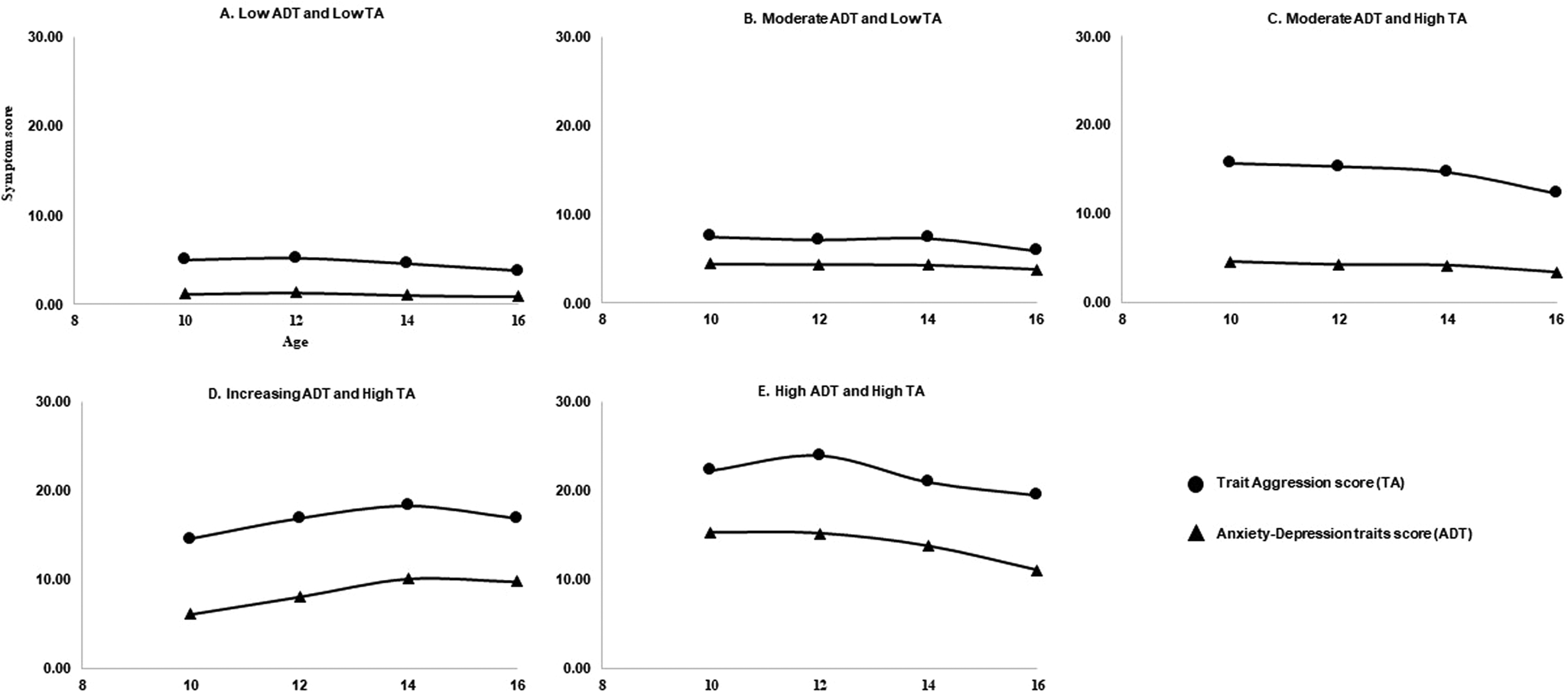
Only children who completed at least two assessments for ADT and TA were included in the trajectory's analyses (n = 1079). Excluded youth did not differ significantly from those who completed two assessments relatively to sex and ethnicity (online Supplementary Table S3). Four trajectories for ADT and two trajectories for TA were considered as the most parsimonious models based on indicators of goodness of fit (online Supplementary Material 1 for a summary of the trajectory selection process). Briefly, the trajectory analyses of ADT (independently of TA) revealed four trajectories: low-ADT (42.2%); moderate ADT (42.8%); increasing ADT (11.9%) and high ADT (3.1%), while the analyses on TA (independently of ADT) identified two trajectories: low-TA (69.9%) and high TA (30.1%) (see online Supplementary Figs S1–S2).
Step 2: joint developmental trajectories of ADT and TA
Children were estimated to belong in a joint trajectory group based on ADT and TA trajectories simultaneously based on parameters of ADT and TA trajectories (step 1). Moreover, trajectory groups of the joint model showed good to excellent AvePP (i.e. ranging from 0.85 to 0.96) and OCC (from 9.41 to 347.9) (see online Supplementary Table S2). Percentages that follow are mixed proportions of joint trajectory groups: 51.8% of the total sample were characterized with low ADT and low TA (LADT-LTA, Fig. 1a); 13.3% with moderate ADT and low TA (MADT-LTA, Fig. 1b); 21.2% with moderate ADT and high TA (MADT-HTA, Fig. 1c); 10.5% with increasing ADT and high TA (IADT-HTA, Fig. 1d) and 3.2% with high ADT and high TA (HADT-HTA, Fig. 1e). Interestingly, none of the children had increasing levels of ADT and low TA or low ADT and high TA. Only one girl had high ADT and low TA; this individual was excluded from analyses.
Developmental groups based on joint trajectories of ADT and TA scores between 10 and 16 years old as assessed by the CBCL: (a) LADT-LTA; (b) MADT-LTA; (c) MADT-HTA and (d) IADT-HTA; (e) in front of HADT-HTA.

To support the validity of these trajectories, we extracted the probabilities for each TA trajectory conditional on a given ADT trajectory and vice versa (online Supplementary Material 1). Briefly, the probability of children with high levels of ADT to display high levels of TA was 0.97, while the probabilities of children with high levels of TA to display moderate, increasing and high levels of ADT were 0.58, 0.31 and 0.58, respectively. Therefore, high TA displays more heterogeneous levels of ADT suggesting that high TA may or may not be associated with high ADT.
Step 3: sociodemographic differences between trajectory groups
Bivariate analyses examining differences between ADT and TA trajectory groups on sociodemographic variables showed that sex, ethnicity and sites statistically differed between trajectory groups (χ2 = 11.62, p = 0.020; χ2 = 53.73, p < 0.001; χ2 = 78.14, p < 0.001, respectively). See online Supplementary Material 2 for complete sociodemographic characteristics of the trajectory groups and pairwise comparisons.
Step 4: childhood predictors of joint ADT and TA trajectory groups
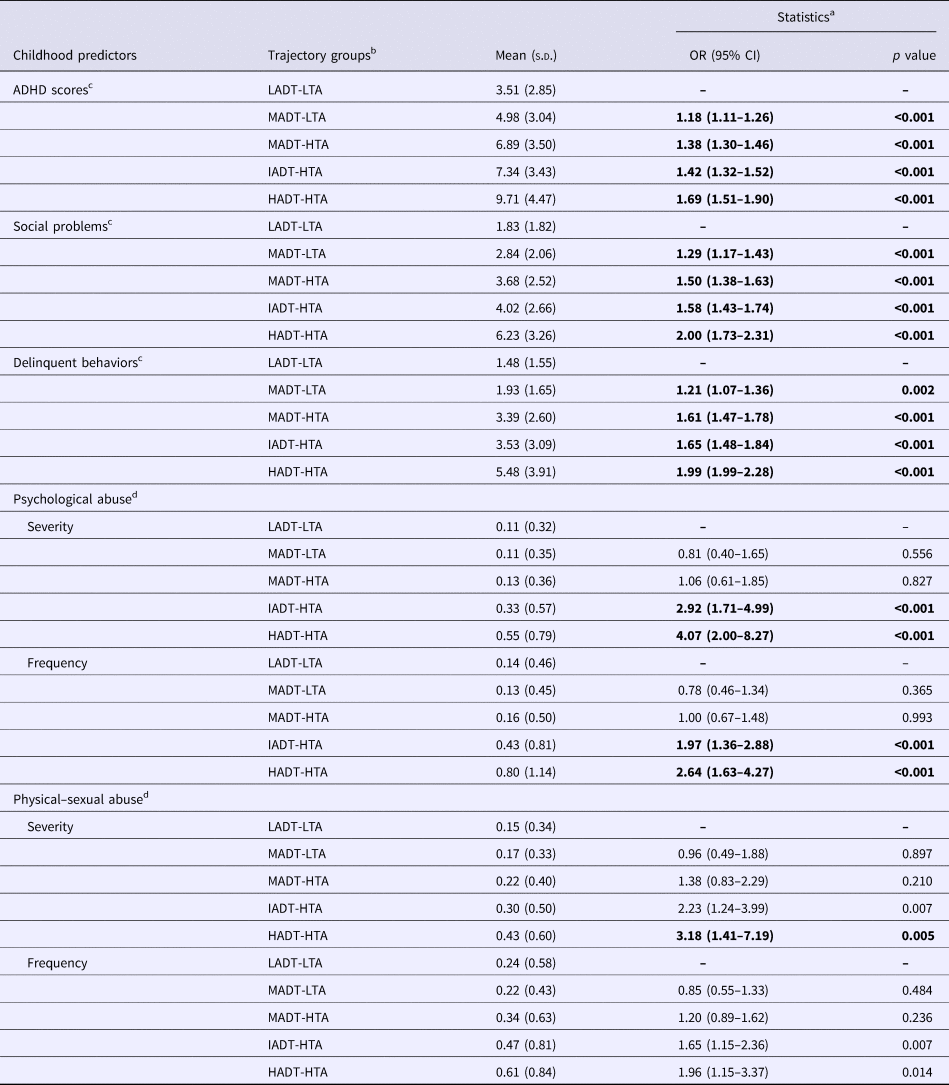
Table 1 presents the multinomial logistic regression results on childhood predictors. All groups (HADT-HTA, IADT-HTA, MADT-HTA and MADT-LTA) were significantly more likely to display higher levels of childhood delinquency, social problems and ADHD symptoms than the LADT-LTA group. Additionally, the IADT-HTA and the HADT-HTA trajectory groups were significantly more likely to have reported more severe and frequent childhood abuse (both psychological and physical–sexual abuse) than their counterpart in the LADT-LTA group. Pairwise comparisons were also performed (online Supplementary Material 3); severity and frequency of childhood psychological abuse significantly predicted a higher risk of following the IADT-HTA trajectory over MADT-HTA [odds ratio (OR) 2.61, 95% confidence interval (CI) 1.41–4.81, p = 0.002; OR 1.88, 95% CI 1.21–2.91, p = 0.005].
Multinomial logistic regression of childhood predictors by trajectory groups (n = 1078)

ADT, anxiety-depression trait; TA, trait-aggression; LADT-LTA, low ADT-low TA; MADT-LTA, moderate ADT-low TA; MADT-HTA, moderate ADT-high TA; IADT-HTA, increasing ADT-high TA; HADT-HTA, high ADT-high TA; OR, odds ratio.
Bolded values represent statistically significant result (p < 0.005). No formal correction was made for multiple comparisons.
a Adjusted for sex, sites and ethnicity.
b LADT-LTA as the reference group.
c Assessed at 8 yrs old.
d Abuse occurring Before 12 years old.
Step 5: negative outcomes of joint trajectory groups
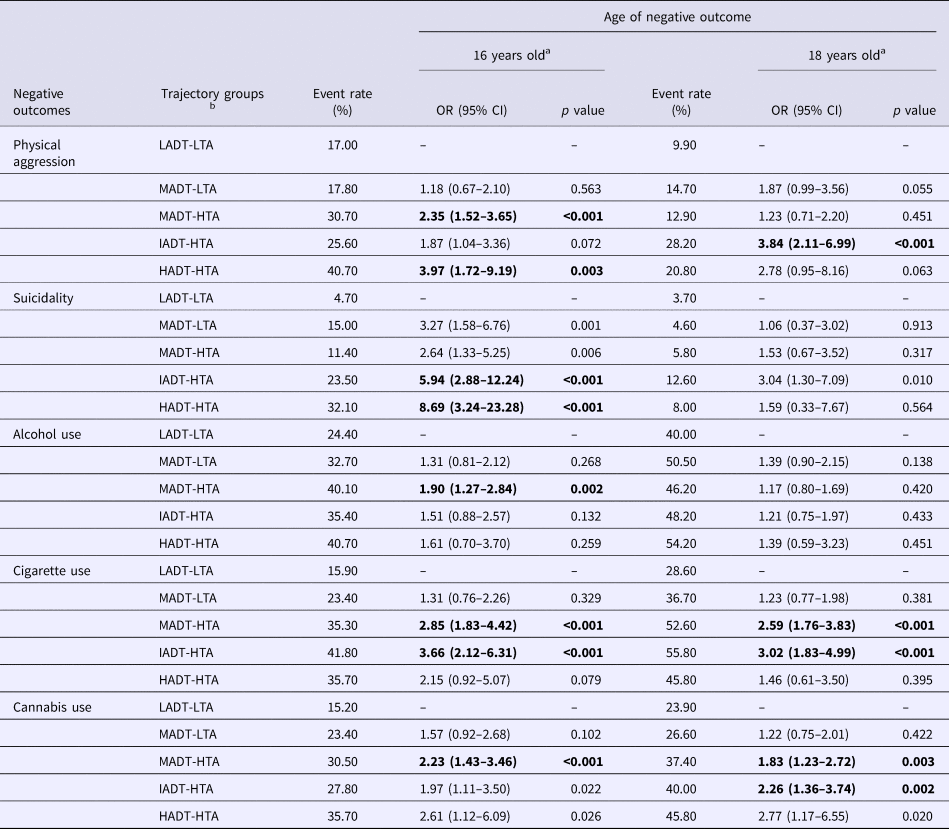
Table 2 presents the results of logistic regressions on negative outcomes at ages 16 and 18 with LADT-LTA as the reference group. The MADT-HTA, IADT-HTA and HADT-HTA trajectory groups, but not the MADT-LTA group, were more likely to display physical aggression at 16 years old. Moreover, adolescents in all trajectories were more likely to show suicidality than adolescents in the LADT-LTA group at 16 years old. Nevertheless, these effects tended to lose statistical significance at 18 years old except for the IADT-HTA trajectory group.
Multinomial logistic regression of negative outcomes by trajectory groups at 16 and 18 years old (n = 1078)

ADT, anxiety-depression trait; TA, trait-aggression; LADT-LTA, low ADT-low TA; MADT-LTA, moderate ADT-low TA; MADT-HTA, moderate ADT-high TA; IADT-HTA, increasing ADT-high TA; HADT-HTA, high ADT-high TA; OR, odds ratio.
Bolded values represent statistically significant result (p < 0.005). No formal correction was made for multiple comparisons.
a Adjusted for sex, sites and ethnicity.
b LADT-LTA as the reference group.
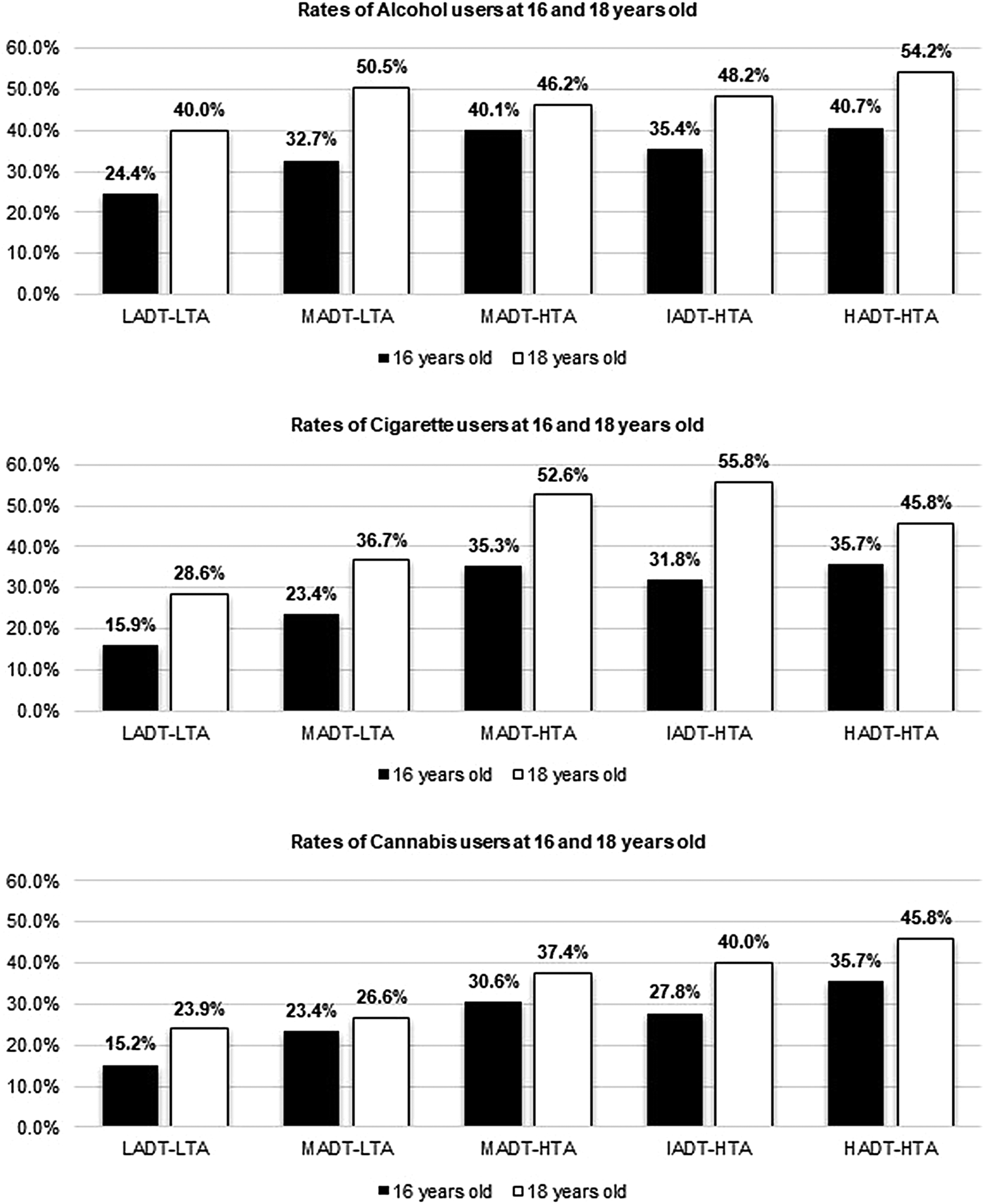
Regarding alcohol use, only adolescents in the MADT-HTA were more likely to use alcohol than in the LADT-LTA group (OR 1.90, 95% CI 1.27–2.84, p = 0.002). No statistical differences between trajectory groups were observed at 18 years old regarding alcohol use. Adolescents following the MADT-HTA and IADT-HTA trajectory groups were significantly more likely to use cigarettes at 16 and 18 years old than the adolescent in the LADT-LTA group. Finally, adolescents from all trajectory groups with high TA (HADT-HTA, IADT-HTA and HADT-HTA) were significantly more likely to use cannabis at 16 and 18 years old than adolescents in the LADT-LTA group. Increases in prevalence of substance users, between trajectory groups at 16 and 18 years old are presented in Fig. 2 (see online Supplementary Material 4 for pairwise comparisons).
Changes in prevalence of users of substances between 16 and 18 years old by trajectory groups. ADT, anxiety-depression trait; TA, trait-aggression; LADT-LTA, low ADT-low TA; MADT-LTA, moderate ADT-low TA; MADT-HTA, moderate ADT-high TA; IADT-HTA, increasing ADT-high TA; HADT-HTA, high ADT-high TA.

Discussion
To our knowledge, this is the first study to examine the joint developmental patterns of ADT and TA during adolescence (from ages 10 to 16). In the last decade, researchers have largely studied separately internalizing and externalizing trajectories of psychopathologies (Achenbach et al., Reference Achenbach, Ivanova, Rescorla, Turner and Althoff2016). Although this view is accepted in the literature on developmental pathways to problematic behaviors (i.e. substance use, suicidality and violence), it is worth noting that these trajectories are not always mutually exclusive as they can co-occur and predict the development of maladaptive behaviors in adolescence. By using an innovative, data-driven approach (joint trajectory analysis), we found five distinct trajectory groups based on negative affect problems with three of them displaying an overlap between internalizing and externalizing problems (MADT-HTA; IADT-HTA and HADT-HTA). We found that approximately one in three adolescents (34.5%) followed one of these three trajectory groups, which is similar to other findings (Ingoldsby et al., Reference Ingoldsby, Kohl, Mcmahon, Lengua and Group2006). In adolescents with moderate to high ADT, there was a probability of 0.67–0.99 to display high TA. These results suggest that the overlap between ADT and TA is significant and emphasize the clinical importance of assessing TA in anxious-depressive individuals for a holistic understanding of the psychopathology.
Furthermore, we observed that children having reported higher levels of problems in childhood (ADHD symptoms, social problems and delinquency) and more severe/frequent childhood abuse (psychological and physical–sexual abuse) were significantly more likely to follow trajectories with moderate to high ADT and high TA than trajectory groups with low levels of ADT and TA. Evidence suggests that TA and ADT may arise from shared genetic vulnerabilities, and that environmental risk factors may exacerbate the development of these traits (Azeredo et al., Reference Azeredo, Moreira and Barbosa2018). In fact, extensive literature suggests that shared environmental risk factors such as victimization may lead to autonomic hyper-arousal and negative emotion dysregulation (i.e. negative urgency) (McLaughlin et al., Reference Mclaughlin, Hatzenbuehler and Hilt2009; Dvir et al., Reference Dvir, Ford, Hill and Frazier2014; Wardell et al., Reference Wardell, Strang and Hendershot2016). Concerning ADHD symptoms, it may represent an important developmental indicator of impulsivity, which is frequently observed in adolescents with externalizing problems and co-occurrent internalizing–externalizing problems (Wolff and Ollendick, Reference Wolff and Ollendick2006; Cunningham and Ollendick, Reference Cunningham and Ollendick2010; Nordström et al., Reference Nordström, Ebeling, Hurtig, Rodriguez, Savolainen, Moilanen and Taanila2013; Wardell et al., Reference Wardell, Strang and Hendershot2016; Azeredo et al., Reference Azeredo, Moreira and Barbosa2018). Thus, the co-occurrence of impulsivity and negative affect dysregulation [generally referred to as negative urgency (Smith and Cyders, Reference Smith and Cyders2016)] may exacerbate the severity and the course of negative-emotion psychopathologies (i.e. ADT and TA) (Nordström et al., Reference Nordström, Ebeling, Hurtig, Rodriguez, Savolainen, Moilanen and Taanila2013).
Another central contribution of this study is the explicit identification of the negative outcomes related to trajectory groups with co-occurring ADT and TA. Children following trajectory groups with high TA and higher ADT were significantly more likely to display violence (suicidality and physical violence) and substance use (cigarette and cannabis) at ages 16 and 18 than those with low levels of ADT and TA. Interestingly, this follows other findings suggesting that the latter co-occurrence may act as an additive effect and may increase significantly the risk of developing substance use problems, physical aggression and suicide attempts in adulthood (Capaldi, Reference Capaldi1992; Miller-Johnson et al., Reference Miller-Johnson, Lochman, Coie, Terry and Hyman1998; Ezpeleta et al., Reference Ezpeleta, Domènech and Angold2006; Hodgins et al., Reference Hodgins, De Brito, Chhabra and Cote2010; McCarty et al., Reference Mccarty, Wymbs, Mason, King, Mccauley, Baer and Vander Stoep2013; Orri et al., Reference Orri, Galera, Turecki, Forte, Renaud, Boivin, Tremblay, Cote and Geoffroy2018). It is well known that these three outcomes share several bio-psycho-social predictors, including negative urgency (Mann, Reference Mann2003; Dumais et al., Reference Dumais, Lesage, Lalovic, Séguin, Tousignant, Chawky and Turecki2005; Siever, Reference Siever2008; Dawes et al., Reference Dawes, Mathias, Richard, Hill-Kapturczak and Dougherty2008). Recent models of urgency have proposed that when experiencing strong negative feelings (e.g. ADT and TA), rash actions may result (substance misuse, physical aggression, suicidal attempts), providing a positive or negative reinforcement of relief (Carver et al., Reference Carver, Johnson and Joormann2008; Smith and Cyders, Reference Smith and Cyders2016). Hence, the ADT–TA overlap is likely to be heterogeneous, and more severe forms may increase the severity and the plurality of problematic outcomes associated with intense negative mood (Ezpeleta et al., Reference Ezpeleta, Domènech and Angold2006; Hodgins et al., Reference Hodgins, De Brito, Chhabra and Cote2010; McCarty et al., Reference Mccarty, Wymbs, Mason, King, Mccauley, Baer and Vander Stoep2013; Orri et al., Reference Orri, Galera, Turecki, Forte, Renaud, Boivin, Tremblay, Cote and Geoffroy2018). Nonetheless, future studies should aim to examine the shared genetic and environmental factors between ADT and TA and the phenotypic outcomes resulting from the co-occurrence within a negative-urgency framework.
Strengths and limitations
The study was derived from a large longitudinal sample of children assessed every 2 years since the age of 4–18. We used an innovative joint trajectory modeling analysis to explore the developmental overlaps between ADT and TA. Nevertheless, there are limitations that should be acknowledged. First, we used dichotomous negative outcomes to assess the overall adjustments of the trajectory groups. Dichotomization of negative outcomes (i.e. presence or absence of behaviors) was used in the current study to reduce the overfitting bias in multinomial regression analyses since: (1) since the base rates of each different behaviors, separately, were too small and (2) because of the relatively small sizes of subsamples (i.e. trajectory groups). Severity and frequency of violence/suicidal behaviors and substance use should be examined in future studies to support our findings. More details about these outcomes could have increased our ability to detect stronger differences between trajectory groups but also increased our understanding of the implications of joint trajectories of ADT and TA on the development of several disorders in adulthood such as Substance Use Disorders (SUDs) and personality disorders. Second, data on childhood abuse was acquired retrospectively during the interview at the age of 18. However, it has been shown, by using the same sample, that retrospective reports of childhood abuse were concordant with Child Protective Service (CPS) and were also more strongly associated with psychological adjustments than with CPS determinations (Everson et al., Reference Everson, Smith, Hussey, English, Litrownik, Dubowitz, Thompson, Knight and Runyan2008). Third, the measure used in the current study assessed severity and frequency of childhood abuses before age of 12. Since trajectory groups were defined on the age range of 10–16 years old, the overlap could have introduced bias in the prediction analysis. However, it is noteworthy to mention that a large majority of childhood abuses generally occurs before the age of 10 (Cammack and Hogue, Reference Cammack and Hogue2017). Fourth, to reduce common method-variance bias, future studies should seek to use independent measures of ADT and TA, as well as parental and/or teacher reports, in order to replicate findings of this study. Finally, subsequent analyses (i.e. predictors and outcomes) were carried out with the assumption that children were assigned to a single joint trajectory group (e.g. groups 1, 2, 3, 4 or 5). However, since the joint trajectory group assignment was probabilistic, the assumption used in the current study may have affected statistical inference of subsequent analyses regarding trajectory groups with lower AvePP and OCC. Notwithstanding, our study provided clinically relevant findings about the developmental patterns of affective instability.
Conclusion
By using an innovative approach to understand the co-occurrence of internalizing and externalizing problems, we observed relevant findings for research and clinical practice. While past research on CD has largely focused on callous-unemotional subtypes (First, Reference First2013; Frick, Reference Frick2016), some promising results suggest that a second variant of CD, predominantly characterized by autonomic over-arousal and emotion dysregulation, is also important (Fanti, Reference Fanti2018). Researchers working on personality disorders in adulthood should be aware of these promising findings (Beauchaine et al., Reference Beauchaine, Klein, Crowell, Derbidge and Gatzke-Kopp2009). Finally, future studies with a larger sample size should aim to replicate the current study and investigate the presence of more precise joint trajectories.
Supplementary material
The supplementary material for this article can be found at https://doi.org/10.1017/S0033291719001272.
Author ORCIDs
Jules R. Dugré, 0000-0003-4946-0350;Stéphane Potvin, 0000-0003-1624-378X.
Acknowledgements
SP is holder of the Eli Lilly Canada Chair on schizophrenia research. AD is holder of a Junior 1 salary award from the Fonds de Recherche du Québec en Santé. LD is holder of a scholarship from the Fonds de Recherche du Québec en Santé. SP and AD are holders of grants from Otsuka Pharmaceuticals an HLS Therapeutics unrelated to the current study. The data used in this publication were made available from the National Data Archive on Child Abuse and Neglect, Cornell University, Ithaca, NY, and have been used with permission. Data from Longitudinal Studies of Child Abuse and Neglect (LONGSCAN) Assessments 0–12 were originally collected by Desmond K. Runyan, Howard Dubowitz, Diana J. English, Jonathan Kotch, Alan Litrownik, Richard Thompson and Terri Lewis and The LONGSCAN Investigator Group. Funding for the project was provided by the Office on Child Abuse and Neglect (OCAN), Children's Bureau, Administration for Children and Families, Department of Health and Human Services [The National Center on Child Abuse and Neglect (NCCAN), under the Office of Human Services funded this consortium of studies during the early years of data collection from 04/01/1991 until NCCAN became part of OCAN in 1998] (Award numbers: 90CA1467, 90CA1481, 90CA1466, 90CA1458, 90CA1572, 90CA1569, 90CA1568, 90CA1566, 90CA1678, 90CA1681, 90CA1680, 90CA1676, 90CA1677, 90CA1679, 90CA1744, 90CA1745, 90CA1746, 90CA1747, 90CA1748, 90CA1749). The collector of the original data, the funder, NDACAN, Cornell University and their agents or employees bear no responsibility for the analyses or interpretations presented here.
Conflict of interest
The authors declare no potential conflicts of interest.